Biblical Womanhood Bible Study

Imperishable Beauty: Lesson 15- A Beautiful Portrayal of Biblical Womanhood in the Church

Previous Lessons: 1, 2, 3, 4, 5, 6, 7, 8, 9, 10, 11, 12, 13, 14

Read These Selected Scriptures
In lesson 14 we looked at the beauty of women’s position in the church. Today, we’ll examine how our character can beautifully portray biblical womanhood in the church.

Questions to Consider

1. Briefly review lesson 14 (link above). What did you learn about the position women occupy in the church? As you study today’s lesson think about some of the ways you can portray biblical womanhood to others from that position.

2. Carefully examine the 1 Corinthians 11 passage. (As you study this passage, it may help to keep in mind that, unless widowed, virtually every adult woman in the church would have been married. That was the cultural norm. So Paul is able to use the terms “women” and “wives” nearly interchangeably. Click on the “Read These Selected Scriptures” link above and read the footnote (c) for verse 5.)

Compare the format of this introduction (2-3) to the format of the introduction of the letters to three of the seven churches in Revelation. Describe this format noting how the word “but” acts as a pivot point for all four passages.ย For what does Paul commend the Corinthian church? (2) “But” in what area of church life does Paul imply the Corinthians are not “getting it”? (3) Explain what verse 3 means as it applies to the day-to-day functioning of the church both in Corinth and today. What is the authority “flow chart” for the church?

Verse 3 serves as the main idea or theme of this passage. What is the main theological point God is trying to drive home to the church?

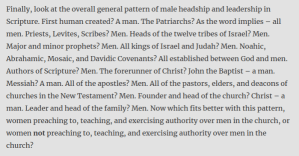
To what event in biblical history is Paul referring in 7b-9? Compare these verses with 1 Timothy 2:12-14. Explain how the creative order (man created first, woman second / man as head, woman as helper) is the cornerstone of the authority structure (3) in the family and the church.

In 4-5 and 14-15, Paul uses two separate examples from Corinthian culture that demonstrate the differences between men and women in order to illustrate the concept of the hierarchy of authority in the church. What are those two examples? Is God commanding that Christian women today must have long hair and must cover their heads when praying? Is God commanding that Christian men today must have short hair and must never cover their heads while praying?

In Corinthian culture, one of the ways women could portray biblical womanhood in the church was to signify by wearing their veils that they embraced submitting to their husbands and to the authority structure of the church. Can you think of any similar ways women can portray biblical womanhood today?

3. Examine the 1 Timothy 2 and 1 Peter 3 passages. What is the venue or setting for the instructions in each? (You may need to look at more of each chapter.) Locate the word “but” in each of these passages (2:10, 3:4), noting the concept that comes before the word “but” and after it. Describe how women areย notย to adorn themselves. “But” describe how womenย are to adorn themselves.ย Are things like braids, jewelry, and clothes intrinsically sinful, or is Paul again giving cultural examples to illustrate a theological point he’s making? What is that point? What is it about the bent of women’s hearts that would cause God to give this instruction to women in the context of the home and the church, but not to give this instruction to men at all? As godly women, where is our focus to be? How does it benefit the church for us to “wear”, or portray, biblical womanhood by adorning ourselves modestly and with good works?

What similar themes do you see in these two passages and the 1 Corinthians 11 passage? How do these three passages work together to demonstrate to us how we may live out biblical womanhood in the church?

4. Locate, in the 1 Timothy 2 (10), 1 Peter 3 (6), and 1 Timothy 5 (10) passages the phrases about doing good works. How are good works a major responsibility of women in the church, and a main way we display biblical womanhood?

Explain the context of the 1 Timothy 5 passage. The passage is talking about women who are _______. But a large part of this passage talks about how these women lived and served the church prior to becoming widows. Make a two column list. On one side, list the good works of all the women (widowed, married, young widows, any believing woman, etc.) mentioned in this passage. On the other side, list some specific ways you and other women in the church can carry out these good works today.

What are the “bad works” to be avoided in this passage? How can focusing on doing good works help us to avoid the bad works?

5. Study the remaining passages (Luke, Acts, Romans, 1 Corinthians) in today’s lesson. How did the women who followed Jesus, Dorcas, Lydia, and Priscilla (Prisca) each portray biblical womanhood in the church by their character and good works? To whom did they minister? How did the church benefit from each of them robustly living out God’s plan for women in the church?


Homework

If you’d like to read more about some of the passages from today’s lesson, you might enjoy the following articles:

Rock Your Role: A Head of the Times- Head Coverings for Christian Women?

The Mailbag: Potpourri (Calvinism, Baptism, Modestyโ€ฆ)

Rock Your Role: Oh No She Di-int! Priscilla Didnโ€™t Preach, Deborah Didnโ€™t Dominate, and Esther Wasnโ€™t an Egalitarian


Suggested Memory Verse

Nevertheless,ย in the Lord woman is not independent of man nor man of woman;ย for as woman was made from man, so man is now born of woman. Andย all things are from God.
1 Corinthians 11:11-12

Complementarianism, Mailbag

The Mailbag: “What’s a Woman to Do?” Potpourri

Welcome to another โ€œpotpourriโ€ edition of The Mailbag, where I give short(er) answers to several questions rather than a long answer to one question. I also like to take the opportunity in these potpourri editions to let new readers know about my comments/e-mail/messages policy. Iโ€™m not able to respond individually to most e-mails and messages, so here are some helpful hints for getting your questions answered more quickly. Remember, the search bar can be a helpful tool!

In these potpourri editions of The Mailbag, I’d also like to address the three questions I’m most commonly asked:

“Do you know anything about [Christian pastor/teacher/author] or his/her materials? Is he/she doctrinally sound?”

Try these links: 
Popular False Teachers /
 Recommended Bible Teachers / search bar
Is She a False Teacher? 7 Steps to Figuring It Out on Your Own
(Do keep bringing me names, though. If I get enough questions about a particular teacher, I’ll probably write an article on her.)

“Can you recommend a good women’s Bible study?”

No. Here’s why:
The Mailbag: Can you recommend a good Bible study for women/teens/kids?
The Mailbag: โ€œWe need to stop relying on canned studies,โ€ doesnโ€™t mean, โ€œWe need to rely on doctrinally sound canned studies.โ€.

“You shouldn’t be warning against [popular false teacher] for [X,Y,Z] reason!”

Answering the Opposition- Responses to the Most Frequently Raised Discernment Objections


It’s ladies night!…er…day…or whatever. I’ve accumulated several questions that have to do with women’s roles in the church and home, so that’s the theme of today’s Mailbag. If you have similar questions, you might find my article Rock Your Role FAQs to be helpful.


Is it biblical for women to serve as children’s ministry leaders or directors in the church?

It could be, depending on the situation. (You should not bear the title Children’s “Pastor,” though. Biblically, women are not pastors so carrying that title would be dishonest and misleading.)

It is perfectly biblical for women to teach and lead children in the church setting. (And when I say “children”, I mean birth to about age 12. I’ve addressed women teaching youth/teens here, #13.) The biblical prohibition is against teaching and holding authority over men in the church. Male children are not men.

The potential 1 Timothy 2:12 issue is not with teaching and leading children or supervising other women who teach children. The issue at play is whether or not you’ll be holding unbiblical authority over any men who work or volunteer in the children’s department as Sunday school teachers, Awana leaders, nursery workers, etc. And that’s something that’s got to be examined on a case by case basis. It could be completely biblical for you to serve as a children’s director in one church but not in another simply due to circumstances of the environment.

Does your church only have women working in the children’s department? Is there an associate pastor or elder over you that handles any issues of authority? Would you have to train, evaluate, or correct male volunteers? What kinds of things would male volunteers need to come to you about? These and other questions all need to be carefully considered by your pastor, elders, your husband, and you.

Generally speaking, it is biblically OK for a woman to serve as children’s ministry leaders as long as that position, in that particular church, does not require her to instruct men in the Scriptures or hold unbiblical authority over men.


My husband is a new Christian (Praise the Lord!). I was raised in church and have a firm foundation in the Word, but unfortunately he was not blessed with such an upbringing. When we study the Bible together at home, how can I handle his lack of knowledge in a Godly way? I know what the Bible says about women not teaching men, and I strongly desire to be obedient to God’s Word. I’m just a little confused about what that looks like in this situation.

I rejoice with you over your husband’s salvation! This is a great question that’s probably on the minds of many godly women.

First, I think we might need to review a little bit of “what the Bible says about women not teaching men.” When Scripture prohibits women from teaching or holding authority over men, it does so in a specific setting: the gathered body of Believers (the church – You may want to go back over my article Jill in the Pulpit.). You are talking about helping your newly saved husband privately, at home. That’s different, and it is not included in the 1 Timothy 2:12 prohibition.

At home, between the two of you, the only issue is whether you’re submitting to him and respecting him. If your husband wants you to explain things to him from Scripture and you do that in a loving, kind, and submissive way, there’s absolutely no biblical problem with that. (It’s also important that you know the correct answers to his questions and can handle Scripture rightly. If not, study it together or ask your Sunday School teacher, pastor, etc., for help.)

In Scripture, we see Priscilla and her husband Aquila taking Apollos aside privately (likely in their home) and helping him understand “the way of God more accurately.” And Paul commends Priscilla in “the great thank you list” of Romans 16. She would not have been mentioned in a positive light in Acts nor commended by Paul in Romans if she had been sinning by helping Apollos. And if she wasn’t sinning by helping Apollos, who wasn’t even her husband (again, recalling that this was a private conversation, not teaching in the church), it would not make sense that it would have been wrong for her, or any other woman to help her own husband.

In 1 Peter 3 and 1 Corinthians 7 we see that a woman can be instrumental in bringing her unsaved husband to Christ. Why, then, would she not – privately, at his own request – continue to answer his questions, explain things, or suggest passages of Scripture for him to read after he got saved?

It would be beneficial to your husband for him to begin learning from godly men, not because it’s wrong for you to help him learn, but because other men can help him learn his role as a Christian man and how to handle things men go through better than a woman – even his wife – can. It might be helpful to your husband for you to suggest good books by doctrinally sound men for him to read and good preaching and podcasts to listen to (see some of my favorites in the sidebar to your left). He would probably also benefit tremendously from getting involved with a men’s group or Bible study at church, or having a godly older man disciple him.

What a blessing that God has given your husband a knowledgeable, godly wife who can help him!


I teach the Bible to women and young people in the home of a Christian sister. Frequently, her husband brings his Bible and sits in on the group. I usually just ignore the fact that heโ€™s in there and focus on the youth, because, technically, that’s who I’m there to teach. I feel uncomfortable with him there because I agree with the Bible that I’m not supposed to be teaching men, but I also feel uncomfortable asking him to leave his own den. What do you recommend in this case?

It’s a bit of a sticky situation, but more because of etiquette and logistics than because of Scripture. Let’s explore a few different aspects of this situation.

โœข Is the husband saved? If he’s unsaved, the dilemma stops here. He’s not part of the church (the universal body of Believers), he’s an outsider observing Christians, and the things of God are folly to him. He’s not even capable of understanding Christian teaching on a spiritual level, so you’re not teaching him. At best, he’s absorbing enough of the gospel to eventually lead him to Christ. That would fall under the category of evangelism, and Scripture doesn’t prohibit women from sharing the gospel with men. (See #11 here)

โœข Take into consideration that different people sometimes have different ideas about etiquette and social interactions. Whether or not he’s saved, it’s possible the husband is sitting in on the group because he feels, as the host, it would be rude of him not to. By talking with him about your discomfort with his presence, you might actually be letting him off the hook when there are other things he’d rather be doing.

But from here on out, we’ll assume the husband is saved and doesn’t fully understand that women aren’t to teach men in the gathered body of Believers.

โœข You mentioned that you are teaching “women and young people”/”youth”. I’m inferring from that phraseology that this group of “young people/youth” is a co-ed group in their teens. If I’m correct about that (and maybe I’m not), this could be part of the issue depending on the age of the kids in the group. First, of all, if the males in this group are in their late teens to early 20s or older, you really don’t have a leg to stand on. You’re teaching men (even if they are young men), so that needs to stop. But this could also be a contributing factor to why the husband is coming to the study, especially if he is a younger man. If he sees you teaching 18 year old young men and he’s 25, he probably doesn’t see much difference between those young men and himself and assumes he’s welcome to attend. There’s no hard and fast biblical command about it, but I usually recommend women stop teaching boys around the time they start middle school (12ish). I’ve explained more here, #13.

โœข It’s possible the husband only has a partial understanding of the applicable Scriptures here. Perhaps he thinks Scripture only says women can’t be pastors or that as long as you’re outside the four walls of the church building you can teach men. Maybe you and his wife can pull him aside privately after the meeting or at another time and explain a little bit more about what Scripture says, your desire to obey it, your discomfort with him there, and your discomfort with asking him to leave.

โœข You know the husband and his wife better than I do. Would it work better to explain things to the wife and ask her to talk to him? Or possibly for you and your husband to talk to him and his wife together? It might also be beneficial for you to set up a meeting with your pastor and get some wise counsel from him on how to proceed.

โœข Enlist the aid of your husband and/or some other godly men at church. They could invite this fellow to join them during your class time for a men’s Bible study, bowling, a movie, dinner, watching the game on TV, or whatever. Maybe the husband just needs some friends or a better offer! :0)

โœข If you’ve talked to the husband and he understands what Scripture says, and your dilemma, and he refuses to refrain from attending the class, it’s time to move the class meeting to another location – perhaps your house, the church, or the home of someone else in the group. If it gets to this point, things have moved beyond whether or not you’re teaching a man. Now he’s intentionally being a stumbling block to a sister in Christ (which, if you belong to the same church, actually requires church discipline). He is sinning and he causing you to sin against your conscience. Scripture says if something causes you to sin, remove it. Since you can’t remove him from his house, you’ll have to remove yourself from his house.

โœข Finally, along the lines of removing things from your life that cause you to sin, if you’ve tried every possible way of working things out and you’re still going to be in a situation where you’re sinning against your conscience, step down from teaching. As much as you might want to, you do not have to teach that class. And it’s far better to  give up a “want” and not sin than to keep doing a “want” and sin. God takes sin very seriously, and we should, too.

I’ve tried to cover a range of possibilities and solutions, and some of them may sound extreme, but most of the time situations like this among friends, and especially among church family, can be resolved with a simple, loving conversation. Try talking to him about it, and you’ll most likely be able to work it out.


If you have a question about: a Bible passage, an aspect of theology, a current issue in Christianity, or how to biblically handle a family, life, or church situation, comment below (Iโ€™ll hold all questions in queue {unpublished} for a future edition of The Mailbag) or send me an e-mail or private message. If your question is chosen for publication, your anonymity will be protected.

Bible Study

You Have What it Takes to Lead a BIBLE Study?

I am so sick of women’s ministry/discipleship/”Bible” study that centers around narcissistic navel-gazing, I could vomit. My hurts, myย feelings, my opinions, my self image.

Newsflash- You’re not the only person on the planet who’s ever been hurt or had problems.

And wallowingย in the hurt and your emotions has never been the way to heal and feel better. Healing from the hurt comes from taking your focusย off yourself and placing itย on Christ: studying the actual Bible, obeying His commands, walking in holiness, praying, worshiping, serving others.

Theseย canned “Bible” studies that masquerade as teaching the Bible – maybe even have the name of a book of the Bible in the title – yet all the “study” questions are about you, your preferences, and how you feel, are doing you no favors, ladies. They are keeping you enslaved to your hurts and self idolatry so you’ll continue to buy more and more of these books. Don’t be naive. LifeWay, CBDยน, and all the major “Christian” publishers know that there’s no money to be made in telling you to study your Bible. If you study your Bible you might actually grow inย Christ, learn to glorify Him instead of your own opinions, heal from your hurts, and learn to handle your problems in a biblical way. And then all these divangelistas – whose main function in life seems to be exegeting stories from their own lives and telling you all aboutย theirย pain- will be out of a job because you won’t need them, their books, their DVDs, their conferences, their simulcasts, or their merch, any more.

The Christian retail machine doesn’t make money when you follow what the Bible says to do: sit under good preaching and teachingย at your own church, disciple women in your own church, be discipled by godly older women in your church, serve your church, attend your church like your life depends on it (because your spiritual life does), study your Bible every day, live in obedience to Christ.ย 

You’re being played and you’re being used by Big Christian Retail, ladies. Stop clinging to the pretty little gilded shackles they have locked around your wrists. Break free and experience the freedom in Christ that can only come from walking faithfully with Him in His Word.

I’m no prophet, nor a son of a prophet, but sometimes I think I might have a tiny inkling of how Jeremiah felt when he said:

If I say, โ€œI will not mention him,
or speak any more in his name,โ€
there is in my heart as it were a burning fire
shut up in my bones,
and I am weary with holding it in,
and I cannot.
Jeremiah 20:9

When I see the way so many professing Christian pastors, leaders, and teachers in the public eye damage the spiritual lives of their followers by adulterating God’s Word, biblical anger wells up inside me. And sometimes, the pressure gets to be too much and it finds a way to escape, like it did the other day when I tweeted the remarks above.

Iย hateย with a holy, biblical hatred what the Christian retail machine, overall, has done to Christians, particularly Christian women, by feeding them fluff and false doctrine.

Go back and read the robust theological thoughts and writings of some of the women who helped usher in the Reformation. And then go stick your head in the door of the average women’s “Bible” study at the church down the street and listen to the teaching and comments. We didn’t get to where we are today without somebody poisoning the water hole.

So it was with no small sense of irony that two days after I had let the fire loose on Twitter, I found myself clicking – with much trepidation – on an article from LifeWay Women that popped up in my feed:ย You Have What It Takes to Lead a Bible Study.

It was written by a darling young lady named Mickey who made several very good points and was charming and encouraging. I’m certain she wanted the article to be helpful and edifying, and I have no points of contention with her personally. This article was a work product. It expresses LifeWay’s position, not necessarily Mickey’s personal thoughts and opinions. (I wrote for a LifeWay publication once. Believe me, if what you’ve written doesn’t match what they’re trying to convey, they edit it until it does. Which, as a business, they certainly have a right to do.)

“What might LifeWay Women think qualifies someone to leadยฒ a Bible study?” I wondered, as I waited for the page to load. “I have what it takes? What does it take in their eyes?”

The first point of the article was to address women’s feelings of inadequacy about leading a Bible study and reassure them. Feelings. Not what the Bible says about teaching God’s Word, or the qualifications for doing so, or even the need other women have to be taught Scripture. Feelings. For LifeWay, the major obstacle to overcome for a woman who’s on the fence about teaching a Bible study is her feelings of inadequacy.

And how did LifeWay address those feelings of inadequacy and offer reassurance? Again, not with Scripture (indeed, no Scriptures are quoted or even referenced in the article), but by exegeting a personal anecdote from the author’s life. “I felt inadequate too, but then I gave it a try and I was successful. So if you’re feeling inadequate to lead, just give it a try. You’ll be successful, too.” It may be an oversimplification, but that’s the take away.

If this methodology sounds familiar to you, maybe it’s because you’ve worked through one of LifeWay’s most popular women’s “Bible” studies. Generally speaking, this is the core of the majority of LifeWay’s women’s “Bible” study products: your feelings and the exegesis of personal stories from the author’s life to relate to and address those feelings.

The article went on to quote a recent LifeWay Women survey which asked women,

“What is the biggest obstacle keeping you from leading a Bible study?โ€

Know what the number one answer was? “I donโ€™t feel like I know enough to lead.” (Again with the feelz.)

Is it any wonder, when, for decades now, evangelical women have been fed a steady diet of nothing but girlfriend stories that they feel inadequate to teach the Bible? Of course they feel inadequate! They don’tย know their Bibles because the materials they’ve been getting from LifeWay all this time haven’tย taughtย them the Bible. They likely know more about their favorite author than they do about Jesus. Most of them probably correctly feel inadequate because theyย don’t know enough to lead.

Feelings of inadequacy aren’t wrong simply because they make you feel bad. Sometimes your feelings of inadequacy are wrong because you’re neurotic or unrealistically anxious, and sometimes they’re right because you don’t have the skills to handle the task you’re attempting.ย We’ve all watched enoughย American Idol auditions to know that.

Our feelings need to be informed, molded, and submitted to the facts of God’s written Word. And what does God’s written Word have to say about whether or not you have what it takes to lead a Bible study?

Not many of you should become teachers, my brothers, for you know that we who teach will be judged with greater strictness.
James 3:1

Where LifeWay issues a blanket “anybody can do it” encouragement to the hundreds of women (whom LifeWay has never laid eyes on and has no idea whether or not they’re biblically qualified to teach God’s Word) reading this article – “…trust me, friend, you have what it takes, too” –ย the Bible saysย that teaching Scripture is a solemn, weighty ministry fraught with the burden of responsibility of imparting God’s Wordย correctly. And precisely because of that, “not many” should become teachers.

Do your best to present yourself to God as one approved, a worker who has no need to be ashamed, rightly handling the word of truth.
2 Timothy 2:15

What does LifeWay think qualifies someone to lead a Bible study? “…a willing spirit, an open heart for new friendships, and thirst for more of God.” Is that what the Bible says about qualifying for the lofty responsibility of teaching God’s Word? No.ย The Bible says we need to work hard at studying, understanding, and rightly handling God’s Word so that we don’t end up twisting it or teaching something that conflicts with it. We need to be able to stand before God unashamed to say, “I worked hard, and studied long, and did my very best to teach your Word accurately.”

And the Lord’s servant must not be quarrelsome but kind to everyone, able to teach, patiently enduring evil, correcting his opponents with gentleness.
2 Timothy 2:24-25a

LifeWay seems to think getting over your feelings of inadequacy means you have what it takes to lead a Bible study.ย The Bible saysย there’s a much higher standard. Are you evenย able to teach – to accurately explain what God’s Word says, in a way women can understand, and help them correctly apply it to their lives? Are you quarrelsome? Kind? Able to endure evil patiently? Do you know and can you handle Scripture well enough to correct someone who makes an unbiblical argument, and can you do it gently?

Older women likewise are to be reverent in behavior, not slanderers or slaves to much wine. They are to teach what is good, and so train the young women to love their husbands and children, to be self-controlled, pure, working at home, kind, and submissive to their own husbands, that the word of God may not be reviled.
Titus 2:3-5

LifeWay doesn’t address the character needed to teach the Bible.ย The Bible says you’re to be mature and behave reverently, you’re not to gossip and slander others, and you’re not be controlled by alcohol.

While one of LifeWay’s tips for leading a small group is to choose a study that fits the “interests, preferences, and characteristics” of the women in your group, the Bible doesn’t really care what they’re interested in or prefer to learn. It prescribes what theyย needย to learn. Do you know “what is good” according to Scripture? You have to know that if you’re going to teach it. And you also have to know what the Bible says about wives loving and submitting to their husbands, loving their children, being self-controlled, kind, and pure, and working at home, if you’re going to teach those things.


The Bible says you have to know your Bible to teach a women’s Bible study. You have to have certain skills, abilities, and character traits. Not just anybody can do it. Not just anybody should do it.

Do you have what it takes to lead a Bible study? If you want to know, don’t check with LifeWay. Check your Bible.


ยนChristianbook.com – It used to be called Christian Book Distributors. Old habits die hard. :0)

Additional Resources:

Bible Studies

Basic Training: Bible Studies and Sermons

McBible Study and the Famine of God’s Wordยฒ
After I finished writing today’s article, I noticed that the LifeWay article exclusively used the phrase “leadย a Bible study” rather than “teachย a Bible study.” This is likely due to the fact that many LifeWay studies do not require the leader to teach so much as to play a DVD of a popular LifeWay author teaching. It is probably also intentional – to encourage women to lead without that pesky little need to be biblically qualified to teach. However, most people still rightly understand “leading a Bible study” to mean teaching the Bible, thus the survey response of “I don’t feel like I know enough to lead,” and Mickey’s own fear that “I donโ€™t know enough about the Bible to lead…”. You don’t need to know much about the Bible to push a button on a DVD player.ย McBible Study and the Famine of God’s Word addresses this harmful practice and the need for the church to have trained teachers teaching the Bible.

4 Ways Weโ€™re Getting Womenโ€™s Discipleship Wrong, and How We Can Get it Right!

The Mailbag: โ€œWe need to stop relying on canned studies,โ€ doesnโ€™t mean, โ€œWe need to rely on doctrinally sound canned studies.โ€.

Biblical Womanhood Bible Study

Imperishable Beauty: Lesson 14- A Beautiful Position in the Church

Previous Lessons: 1, 2, 3, 4, 5, 6, 7, 8, 9, 10, 11, 12, 13

Read These Selected Scriptures
For the past few lessons, we’ve looked at biblical womanhood in the family. Today, we’ll begin looking at biblical womanhood in the church setting, examining the beautiful position God has given women in the gathering of the Body.

Questions to Consider

1. Read Galatians 3:28 (if you have a moment, read all of chapter 3 for a fuller view of the context). What does this verse, especially in light of the remainder of chapter 3, mean? What does it mean to be “one in Christ Jesus”? How does this verse speak to the concept of unity in the church? How does this verse speak to the equal value of every person in the eyes of God? When it comes to a soul being saved, is there any difference between a woman or man, slave or freeman, Jew or Greek? Do Greeks have to repent more than Jews? Does Jesus have to work harder to save women than men?

2.ย Briefly review the topics of lessons 4-9 (links above). Are any of these concepts (identity in Christ, being created by God, etc.) specific to one sex, or do they apply to all people? Make two lists: “Things Christians Are” and “Things Christians Do”. List about 5-10 things Christians are (ex: forgiven, ambassadors for Christ) and things Christians do (ex: pray, show mercy). Are any of the things you listed specific to men only or women only? Considering all the things the Bible says Christians are and Christians do, what would you estimate is the percentage of thingsย all Christians are to be and do versus the percentage of things that are only for men or only for women?

3. Examine the 1 Corinthians passage. Verse 33 is kind of the “theme verse” of 1 Corinthians 14. What is the main subject of this chapter? (Hint: See section heading here). What is the venue (home, church, marketplace, etc.) in which the instructions of chapter 14 apply? (33b) Briefly skim over the rest of chapter 14. What was the overall, “for the greater good,”ย reason for the instruction to women in v. 34-35? What were some other activities and people the Holy Spirit, via Paul, placed restrictions on in chapter 14? Why? What is the main priority of chapter 14? Does the instruction in 34-35 mean that women may never utter a word once they step through the doors of the church? How do you know that? Whatย do these instructions mean, and how do they apply to women in the church today? What do these instructions teach us about our responsibility to pay attention to the preaching and teaching of the Word and learn from it? How can this passage help us to see the value and edification in discussing the Scriptures at home with our husbands?

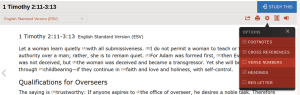
4. Go to the 1 Timothy and Titus passages by clicking on the “Read These Selected Scriptures” link at the top of today’s lesson. Recall that when the Bible was written, there were no chapter and verse numbers. (Those were added much later.) First Timothy and Titus would have read like one long, continuous letter or e-mail. Click on the “options” icon and uncheck the box next to “verse numbers”.

Now read the 1 Timothy passage, noting the flow of thought and how the end of chapter 2 is interconnected with chapter 3. What is the main idea of this passage? (OK, now click the verse numbers back on. :0)

What is the first word of verse 11? Think about women’s social status and value in Paul and Timothy’s culture, and in many cultures since that time, even today. Why does the Holy Spirit instruct pastors to “let” women learn? What does this teach us about the responsibility God places on us as women to learn His Word? Would you categorize verse 11 as a “do this” or “don’t do this” verse?

Examine verse 12. Is this mainly a “do this” or “don’t do this” verse? What two things does the Holy Spirit say women are not to do in the gathering of the church body? What does He say womenย are to do? Think about God’s nature and character. Does He ever give instructions arbitrarily or just to spoil our fun?ย Whyย does God give us commands and instructions, generally speaking? Are the instructions in verse 12 good for women and for the church?

Does God haveย to give us the reasons behind His instructions, or is “because I said so” sufficient reason for us to obey Him? Take a look at 13-14. God kindly gives not one, but two reasons for His instructions in verses 11-12. What are those two reasons? How do they fall in line with God’s design for male headship and leadership across biblical history in the hierarchical structures He has set up?

The 11-15 passage starts with a “do this” verse (11), followed by a “don’t do this” (12) “and here’s why” (13-14) section, then finishes up with another “do this” verse (15).

Verse 15 can be a little cryptic to us today because we equate the word “saved” with salvation. Does verse 15 mean that women gain salvation by having children? How do we know it doesn’t? The NASB helpfully, and more accurately, renders this word as “preserved“. We don’t feel it much today, but think about the stigma women (particularly Jewish women) carried at the time this was written simply because they were daughters of Eve. Paradise was lost and the curse of sin entered the world because of aย woman, many men thought, and they viewed and treated women accordingly. Yet who was chosen to bring the Messiah into the world? And following in her footsteps, a major way godly women can “save” or “preserve” the reputation, esteem, and value of womankind is to “continue in” what 3 godly character traits? (15) Because if they continue in those three godly character traits, they will be raising up a godly seedย to the Lord (even if the children they bear aren’t perfect like Mary’s child was :0)

So we’ve seen the position womenย are to occupy in the church, followed by the positions womenย aren’t to occupy, and that’s followed, in the 1 Timothy 3 and Titus 1 passages by the p_____s m__ are to o____.

According to the 1 Timothy 3 and Titus 1 passages, which positions are men to occupy in the church? What is an overseer? (Use your cross-references if necessary.) Go through these two passages circling any words or phrases that indicate that pastors, elders, and deacons are to be men. Are these positions open to all men in the church?

Examine each of the three sections (1 Timothy 3:1-7, 3:8-13, and Titus 1:5-9) individually. How could the wife of a pastor, elder, or deacon help him, or make things easier for him, to meet the biblical requirements for his office? (Ex: How could a pastor’s wife make it easier for him to be hospitable?)


Homework

If you’d like to dig deeper on some of these passages, you may enjoy reading the following articles from myย Rock Your Role series:

All Things Being Equal (Galatians 3:28)

Order in His Courts: Silencing Women? (1 Corinthians 14:33b-35)

Jill in the Pulpit (1 Timothy 2:11-12)


Suggested Memory Verse

There is neither Jew nor Greek, there is neither slave nor free, there is no male and female, for you are all one in Christ Jesus.
Galatians 3:28

Basic Training, Bible Study, Sermons

Basic Training: Bible Studies and Sermons

For more in the Basic Training series, click here.

When I started theย Basic Training series, I thought I’d be writing about foundational theological concepts and practices in Christianity. You know, likeย baptism orย the sufficiency of Scripture. It never occurred to me that I might someday need to explain something so basic that most lost people could define it as well as (sometimes better than) many professed Christian leaders.

But the more “Bible” studies and sermons I take in, the more I think a remedial course in exactly what those things are supposed to consist of might be very beneficial to the church at large, and an unfortunate necessity for many pastors, teachers, and Christian celebrities.

I could be way off base here, but I’d almost bet that if you went up to ten random people on the street and asked them what a Bible study class is supposed to do, at least nine out of ten of them would answer, “Study the Bible.” If you asked those same people what a sermon is, you might get more varied answers, “It’s when the preacher explains what the Bible says,” or “It’s a pastor telling you how to be a good person,” (remember these are random, probably unsaved, people) or “A sermon tells you about God.” But I’m guessing none of them would answer, “It’s when a preacher gives a stand up comedy routine,” or “A sermon is mostly stories about the preacher, his family, and other people,” or “A sermon is when you watch a movie and then the preacher adds a few remarks at the end about what you can learn about God or life from the movie.”

Yet, that’s pretty much where way too many churches are these days.

So let’s take a look at what Bible studies and sermons are and aren’t supposed to be.

It’s All About The Bible

This is supposed to be a “duh” moment for Christians, pastors, teachers, and churches. If someone is teaching a Bible study or a pastor is preaching a sermon, the first thing he should reach for is his Bible. He is to be preaching or teaching God’s written Word. It’s right there in black and white in 2 Timothy 4:1-2:

I charge you in the presence of God and of Christ Jesus, who is to judge the living and the dead, and by his appearing and his kingdom: preach the word; be ready in season and out of season; reprove, rebuke, and exhort, with complete patience and teaching.

That’s a very solemn and weighty charge to pastors. In today’s vernacular, it’s almost like placing your right hand on the Bible, raising your right hand, and saying, “As God is my witness, I swear to God I will ______.” (and actually understanding the gravity of that and meaning it). God is witnessing this charge to you pastor – you’d better take seriously your duty to preach His Word.

And notice, there are only two times when a pastor is supposed to preach the Word: in season and out of season. When his people want to hear it and when they don’t. When he feels like it and when he doesn’t. When he’ll be persecuted and when he won’t. When it’s easy and when it’s hard. When it’s a pleasant, encouraging passage, and when it’s a passage that offends people. Pastors, and, by extension teachers, are to preach and teach the written Word of God in every sermon and teaching opportunity. Always.

It’s Not About the Preacher/Teacher/Author

There are a lot of awesome pastors, teachers, and authors out there who labor faithfully to rightly teach God’s Word to His people. I am unspeakably grateful to them and for them.

But let’s face it, there are also a lot of narcissistic gas bags out there who use the pulpit and the pages to pump up their already over-inflated egos by endlessly blathering on and on about themselves, their families, their friends, and their experiences. You can tell by the ratio of personal stories to Scripture who they love best and are most interested in.

I’ve read books and heard sermons that I walked away from thinking, “I know more about that pastor or author, his family, his trips, the charity work he does, and who his important friends are than I do about God and His Word.” (I’ll tell you this, he’s received his reward.)

Pastors, teachers, authors aren’t to preach themselves, they’re to preach the Word.

It’s Not About Gimmicks and Entertainment

A sermon series based on movies. A pastor riding a motorcycle into church. Ziplining during the sermon. Rock concerts and light shows. Raffles and giveaways of cars and other big ticket items. The pastor and his wife promoting a sermon series on sex. On the news. From a bed. On the roof of the church.

Pastors and teachers aren’t charged to entertain people or get them in the doors of the church and keep them there by any means necessary. Pastors and teachers are charged – with God as their witness – to faithfully preach and teach His written Word. Jesus said shepherds who love Him will feed His sheep, not entertain them.

Newsflash – the world isn’t going to find that interesting enough to get out of bed for on Sunday morning. Newsflash – That’s fine. The gathering of the church isn’t for the world. The gathering of the church is for the church – the people who have been saved out of the world and into the body of Christ – to give them an opportunity to worship the Savior they love with their brothers and sisters, to disciple them in God’s Word, and to equip them with God’s Word to go out and share the gospel with the world.

It’s Not About You, Either

The flip side of “it’s all about the Bible” is, it’s not about you. What does that mean? The sermon or the Bible study lesson should not teach us to look down in narcissistic navel-gazing, it should teach us to look up at God, who He is, what He has done, and what He says in His written Word.

Over the years, I’ve had the discouraging duty of reviewing various women’s “Bible” studies. Though some have been better than others, the theme running through the majority of them is “it’s all about you” – your feelings, your hurts, your ego, your opinions, your personal experiences. It’s evident in the way authors insert long stories about their own lives and base their ideas, agendas, and assertions on those personal experiences rather than on Scripture. It’s evident in the questions the reader is supposed to answer at the end of each lesson: “Have you ever experienced _____?” “How does ____ make you feel?” “If you could ____, how would you do it?” “What do you think others’ opinion of you is?”

Good Bible studies give you rightly handled, in context Scripture until it’s coming out of your ears, and then they ask questions like, “What are the attributes of God listed in this passage?” “Verse 3 talks about lying. What are some other verses that talk about lying, and how can we tell from these verses how God views lying and why?” “How does this passage point us to Christ?”

Is there a need for introspection during Bible studies and sermons? Sometimes. But the focus is not you and your feelings and experiences. The focus is on reflecting on the glory of God in the passage you’ve just heard, repenting of the sin the passage you’ve just read has convicted you about, obeying the command in the passage you’ve just heard, and things like that. It’s Bible-focused, driven, and governed, not me-focused, driven, and governed.

Context, Context, Context

It’s not just important to preach and teach the Bible, it’s important to handle the text of the Bible correctly and in context.

You’ve probably heard the old joke about the guy who wants God to tell him what he should do with his life. So he opens up the Bible to a random spot, closes his eyes, puts his finger down on the page, and looks at the verse he’s pointing at. It’s a New Testament verse: “Judas went and hanged himself.” “Hmm,” he thinks, “that doesn’t make much sense.” He shuts his Bible and tries the process again. This time, it’s an Old Testament verse, “Go and do thou likewise.”

We laugh at the silliness of this little story, but it hits frighteningly close to home for far too many pastors and teachers.

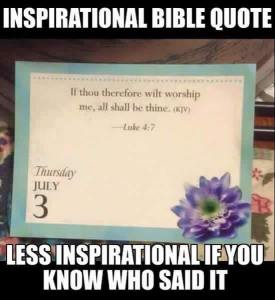
Perhaps you’ve read a devotional that quotes a Bible verse (or maybe even just part of a verse) at the top of the page. The author then goes on to teach on that verse or tell a personal story. When you look up the verse and read a little more of the chapter it’s in, you discover it has nothing to do with the author’s story or doesn’t mean what the author was teaching.

Or maybe you’ve sat in a church service where the pastor reads a verse or two at the beginning of the sermon and then basically closes his Bible and shares personal thoughts and stories for the rest of the sermon time that have nothing to do with the verses he read at the beginning. Or a sermon in which the pastor hopscotches all over the Bible (often using a myriad of translations) reading a verse here, half a verse there, in an effort to prove his homespun thesis or support the agenda he’s crafted.

Yes, technically, there’s Bible in all of those teachings, but none of those methods handle Scripture properly or in context. That’s called eisegesis, and it basically means reading your own ideas into the text of Scripture, or twisting Scripture to get it to say what you want it to mean.

The proper method of teaching Scripture is exegesis. Exegesis is taking a passage of Scripture in context, and โ€œleading outโ€ of it- teaching what the passage means. That’s nearly always going to require reading several verses from the passage to catch the reader or listener up on what’s going on in the story she’s just parachuted into.

Good pastors and teachers read and teach the biblical text in an organized way. When you sit down to study, say, a history book, you start at the beginning of the book and you work your way through to the end. You donโ€™t start by reading two paragraphs out of the middle of chapter 7, then move on to the last three sentences of chapter 49, then the first half of chapter 1. Thatโ€™s how people preach, teach, and โ€œstudyโ€ the Bible sometimes, and itโ€™s just as crazy to read the Bible that way as it would be to study a history book, or math book, or science book that way, or even to read a novel or a magazine using that helter-skelter method.

Expository vs. Topical

This section is a brief, modified excerpt from my article The Mailbag: Expository or Topical Preaching: Which is better?.

For readers who might not be familiar with the terms, expository preaching and teaching is basically when a pastor preaches (or a teacher teaches) through books of the Bible from beginning to end carefully explaining what each passage means. (Ezra is an example of an expository Bible study.)

Topical preaching can have a couple of different meanings depending on who youโ€™re talking to and what she understands the term to mean. Some people understand โ€œtopical preachingโ€ to mean a sermon series, usually in a seeker driven church, that centers around something in pop culture. (For example, popular movies or the Olympics.) Normally, these sermons are very shallow, biblically โ€“ sometimes nothing more than a pep talk or self-help tips. This type of preaching and teaching is unbiblical, and if it makes up the bulk of the teaching at your church, Iโ€™d recommend finding a new church.

There is, however, a biblical form of topical preaching and teaching that can be very helpful, occasionally. If a doctrinally sound pastor sees an issue in the church that needs to be addressed, or a biblical topic to explore, there is nothing wrong with his taking a break from preaching through a certain book (or when heโ€™s between books) to teach on this issue from the pulpit. (Imperishable Beauty: A Study of Biblical Womanhood is an example of a biblical, topical Bible study.)

In my opinion, the majority of a pastorโ€™s preaching and a Bible study’s teaching should be expository with occasional breaks for (biblical) topical preaching and teaching as needed. There are a variety of reasons for this (more in the linked article):

โ€ข Expository preaching models for the congregation the proper, systematic way they should study the Bible at home.

โ€ข Expository preaching helps a pastor better preach the whole counsel of God.

โ€ข Expository preaching pushes pastors to tackle hard and unfamiliar passages as they come up in the text.

โ€ข Expository preaching should keep the Old Testament and certain books of the Bible from being neglected as much as they usually are.

โ€ข Expository preaching gives the congregation a better grip on the overall story arc of the Bible and the culture of the period being studied.

Expository and topical preaching are both helpful in their own ways, but the most important thing is that the pastor is โ€œrightly handling the word of truth.โ€


There’s a lot of lousy preaching and teaching out there these days, but if you’ll look for good, solid biblical preaching and teaching (check the Recommended Bible Teachers and Bible Studies tabs above for ideas) God can use it mightily in your spiritual life to grow you to greater Christlikeness.