Faith, Sin

Repeating Wrongs Renders Right?

Originally published September 17, 2013

“Four hundred thirty seven.”

“Sorry, that’s not right. Try again, Buddy.”

scribble scribble scribble

“Oh, ok. Four hundred thirty seven.

“No, Honey. You just said that, and I just told you it was wrong. Give it another try.”

“But it’s 437!”

“Son, I have the answer book right here in front of me. The answer is not 437. Repeating the wrong answer over and over again doesn’t magically make it right.”

I can’t tell you how many times I’ve had this conversation -nearly verbatim- with each of my four children in the fourteen years I’ve been home schooling.

But I can tell you that this morning was the first time I realized that this is the same way many people relate to God and the Bible.

When this dialogue takes place between my child and me, it is because the child has done something wrong. He has forgotten to carry the one. Confused a peninsula with an isthmus. Mistaken an adverb for an adjective.

But he can’t see what he’s done wrong, or indeed, that he’s done anything wrong. And because he’s blind to his wrongness, his default position is to assume that he is right and I am wrong. Forget that he’s in fifth grade and I have a bachelor’s degree, half a master’s degree, and nearly two decades of teaching experience. Never mind that this is the fourth time I’ve taught fifth grade from this very same book. Completely disregarded is the fact that I have the teacher key right in front of me that shows exactly what he did wrong and what the right answer is.

No. He’s right. I’m wrong. The book is wrong. Math is stupid.

Foolishness is indeed bound up in the heart of a child.

But foolishness is bound up in all of our hearts when it comes to sin:

“My husband doesn’t treat me right.
God wouldn’t want me to be miserable
for the rest of my life, so my relationship
with the guy at work is just fine.”

“What the Bible says about
homosexuality only had to do
with male cult prostitutes, so my
monogamous homosexual relationship
with my partner isn’t a sin.”

“I’ve gone to church all my life.
Once, I even repeated a ‘sinner’s
prayer’ and was baptized. It doesn’t
matter what my life looks like now,
I’m sure I’m saved because of that.”

“The Bible says women aren’t
to instruct men in the church?
But I feel that God has called me
to be a pastor, so that verse must
not mean what it clearly says.”

Over and over we say it, hoping to convince ourselves, to drown out God’s law that’s written on our hearts, and to shout down anyone who would call us to repentance. Because we’re blind to our wrongness, our default position is to assume that we’re right and God, and His Word, are wrong. Never mind the fact that He’s God -Creator of the entire universe, knows everything, sees everything, has power over everything, and is perfect in holiness- and we’re, well… not.

No. We’re right. He’s wrong. The Bible is wrong. People who agree with God’s Word are just haters.

But, just like I tell my children: repeating the wrong answer over and over again doesn’t magically make it right.  When each of us stands before God on the day of judgment, it’s not going to matter how many times we’ve tried to convince ourselves, others, and God that our way is right. It’s only going to matter what God says is right.

There is a way that seems right to a man,
but its end is the way to death.
Proverbs 14:12

Abuse, Homosexuality, Mailbag, Sin

The Mailbag: Perversion-palooza Potpourri

Welcome to another โ€œpotpourriโ€ edition of The Mailbag, where I give short(er) answers to several questions rather than a long answer to one question.

I like to take the opportunity in these potpourri editions to let new readers know about my comments/e-mail/messages policy. Iโ€™m not able to respond individually to most e-mails and messages, so here are some helpful hints for getting your questions answered more quickly. Remember, the search bar (at the very bottom of each page) can be a helpful tool!

Or maybe I answered your question already? Check out my article The Mailbag: Top 10 FAQs to see if your question has been answered and to get some helpful resources.


It’s June, and you know what that means: perversion-palooza [aka “Pride”] month. What does the Bible say about these and other issues of sexual immorality? How should your church be addressing them? What can you say if a loved one lives in this kind of sin or has been victimized by it? Here’s a roundup of Mailbag articles and other resources that may help.


Can you give me a basic overview of what the Bible says about sexuality and sexual immorality?

Basic Training: Homosexuality, Gender Identity, and Other Sexualย Immorality

Christmas Dinner with the Sexual Sinnerย atย A Word Fitly Spoken


Any resources for offering a biblical apologetic against homosexuality?

Movie Tuesday: Audacity


Is it possible to be a “gay Christian”?

The Hole in World Visionโ€™s Gospel

An Apology, A Request for Forgiveness, and Someย Clarifications

Pride, Pronouns & Prodigals at A Word Fitly Spoken


Does God love homosexuals?

God Loves Gays


How can Christians best show homosexuals the love of Christ?

Cancer: A Love Story


Can you give me some general principles and Scriptures for relating to friends and loved ones who live a lifestyle of sexual immorality?

Christmas Dinner with the Sexual Sinnerย atย A Word Fitly Spoken

Pride, Pronouns & Prodigals at A Word Fitly Spoken


How does the legalization of same sex “marriage” impact homosexuals and Christians?

SCOTUS to Rule on Same Sex โ€œMarriageโ€: A Call to Prayer and Godly Response


Should Christians attend a homosexual (or “trans”) “wedding” as a guest?

The Mailbag: Should Christians Attend A Homosexual Wedding?

Pride, Pronouns & Prodigals at A Word Fitly Spoken

Talk Back: Alistair Begg at A Word Fitly Spoken


Should a Christian employee work at a homosexual โ€œweddingโ€?

The Mailbag: Potpourri (Spanking, Women teaching men, Working a homosexual โ€œweddingโ€โ€ฆ) (section 4)


How can Christians navigate Gay Pride Month?

Glad you Asked: Pride, Parenting, Evangelism and Denying Self at A Word Fitly Spoken


A friend or relative wants me to use an opposite sex name and pronouns for him (or her). Is that biblical?

The Mailbag: Whatโ€™s In aย Name?

Pride, Pronouns & Prodigals at A Word Fitly Spoken


I suspect someone has surgically altered her body to appear to be the opposite sex.

The Mailbag: Lady looks like a dude?


Should a man who presents himself as a woman be allowed to attend women’s events at church?

The Mailbag: Guess whoโ€™s coming to (the womenโ€™s ministry)ย dinner?


How should we handle church roles when it comes to medically intersex people?

The Mailbag: Church Roles and Ambiguousย Anatomy


Can you point me to some biblical resources on pornography?

Biblical Resources on Pornography


My husband wants me to watch porn with him to spice up our sex life. Should I?

The Mailbag: Should Christian Couples Watch Pornographyย Together?


I’m including these resources on sexual abuse in this article because the abuse itself is a perversion of biblical sexuality and because the sexual sins addressed above can lead to abuse. If you were victimized by an abuser, you are not guilty of perversion, an act of perversion was committed against you.

What are some practical ways to prevent sexual abuse at my church?

Preventative Measures: 6 Steps SBC Churches Can Take to Prevent Sexual Abuse (Most of this applies to any church)


I know a woman who is a victim of sexual abuse. How can I help her biblically? (If the victim is a man, much of this still applies, but refer him to your pastor so a godly man can help and disciple him.)

From Victimhood to Victory: Biblically Helping Abused Womenย Heal

Band-Aids vs. Chemotherapy: Why Suffering Women are Drawn to False Doctrine and 7 Things We Can do to Help.

4 Ways Christian Advocates for Victims of Abuse Need to Get Biblically Back onย Track


My husband and I are having sexual problems that stem from the fact that I was molested as a child. What should I do?

The Mailbag: Potpourri (Sexual abuse, Feminism, Serpent seed doctrineโ€ฆ) 3rd section


If you have a question about: a Bible passage, an aspect of theology, a current issue in Christianity, or how to biblically handle a family, life, or church situation, comment below (Iโ€™ll hold all questions in queue {unpublished} for a future edition of The Mailbag) or send me an e-mail or private message. If your question is chosen for publication, your anonymity will be protected.

Sanctification, Sin

Throwback Thursday ~ 6 Reasons to Recapture Righteous Anger

Originally published November 3, 2017

Do you ever get the sense that anger is a problem in the church these days? It’s more apparent if you’re on social media, but even if you’re not you’ve probably seen Christians acting in anger in your church and Christian groups you belong to. Maybe even among your Christian family and friends.

In the evangelical social construct today’s Christian women have built and immersed themselves in where “being nice” is the highest attribute we can attain to, anger – any anger whatsoever – is usually seen as sin. The antipode of the sweet, effervescent, always-positive, don’t-rock-the-boat church ladies we’re “supposed” to be.

In the evangelical social construct today’s Christian women have built and immersed themselves in where “being nice” is the highest attribute we can attain to, anger – any anger whatsoever – is usually seen as sin.

Time to pick up the biggest rocks we can find and smash that pretty pink stained glass window, ladies.

The problem with anger in the church is not anger itself, but that Christians get angry about the wrong things instead of the right things, and act on that anger – sometimes even anger over the right things – in the wrong way. There are many things Christians should be angry about. Indeed, if Christians got angry about the things we’re supposed to get angry about and acted on that anger in a biblical way, the church would be better – and more Christlike – for it. But what are the right and godly reasons for getting angry and acting on that anger?

If Christians got angry about the things we’re supposed to get angry about and acted on that anger in a biblical way, the church would be better – and more Christlike – for it.

1.
Anger Is an Attribute of God

No character trait God exhibits can ever be considered intrinsically sinful because God is holy and perfect. God displays anger numerous times in the Bible, yet we know God is without sin. Therefore, we know that the emotion of anger itself is not a sin. It can’t be, or that would make God a sinner, and, by definition, not God. God’s anger demonstrates for us that there are times and situations in which anger is holy and good, and that there are godly ways to act on that anger.

God’s anger demonstrates for us that there are times and situations in which anger is holy and good, and that there are godly ways to act on that anger.

2.
Imago Dei

People are made in the image of God. The creation reflects – albeit dimly and sinfully – the Creator. No one has to teach us how to feel anger or love or justice or desire. Those things are just there, hard wired into us from the womb simply because we’re image bearers. Our sin nature is where the train jumps the tracks with those attributes, because sin causes us to apply those attributes to the wrong objects (loving an idol, desiring someone else’s spouse) and to express those attributes in wrong ways (vengeance, abuse).

3.
Multi-Tasking Attributes

God is simultaneously perfect in love, power, wrath, kindness, compassion, anger, justice, mercy, grace, patience, and all His other attributes. When we see Him pouring out His wrath, that doesn’t mean His attributes of love and compassion have disappeared. When God executes judgment, that doesn’t mean He has ceased to be a merciful and patient God. All of God’s attributes are 100% present and potent all of the time. And – though filtered through our sinful flesh – the same is true for Christians. Expressing anger over the right things in a godly way does not cancel out the fact that you’re also loving, kind, patient, peaceful, or joyful. God created us to reflect His nature by simultaneously exhibiting His attributes in a godly way.

God created us to reflect His nature by simultaneously exhibiting His attributes in a godly way.

4.
Symbiotic Anger

How can we know whether we’re getting angry over the right things or the wrong things? It is right and good to be angry over the things that anger God – idolatry, the defaming of His name, false doctrine, sin in the church, people who harm or take advantage of the innocent and vulnerable, dishonesty, cruelty, deception, the failure to do what is right – first and foremost when we see these sins in our own hearts and lives, but also against others who perpetrate these sins. But we may not be angry for sinful reasons such as pride, selfishness, impatience, self-righteousness, inflexibility, greed, hate, bigotry, lust, and personal preferences. What the Bible shows God getting angry about we should be angry about, too.

What the Bible shows God getting angry about we should be angry about, too.

5.
Anger Versus Sadness

A few months ago on social media, I mentioned an incident in which a male member of a certain church sinfully took advantage of several female members of that church. Without exception, every Christian woman (and many of the men) who commented on the incident made the statement (or some variation of it), “That’s so sad.” There are many aspects of a sinful situation over which it’s appropriate to feel sad. It was right to feel sad for this man’s completely innocent wife and children, as well as his victims and the church, who all suffered as a result of his sin. Jesus wept over the effect sin had on His beloved Jerusalem and the rift that sin created between God’s people and Himself. But, interestingly, both Matthew and Luke show us an instance of Jesus’ sorrow over sin immediately preceding or followed by an instance of Jesus’ anger over sin. It’s fine to feel sad for the people who innocently suffer as a result of someone else’s sin. It’s godly to grieve over the general effects and ultimate consequences of sin. But don’t stop there. We should also be angry at sin and at those who blaspheme the name of God and harm others by committing sin. The biblical instances of God being angry over sin and those who perpetrate it far outnumber the instances of God grieving over the effects of sin. Sadness is good, but it shouldn’t replace godly anger toward sin.

Sadness over sin is good, but it shouldn’t replace godly anger toward sin.

6.
Harness the Wild Stallion

Up until now, we’ve mostly been looking at the emotion of anger, but the emotion of anger usually leads to action. The fact that the emotion usually leads to action doesn’t mean the emotion always should lead to action. Sometimes it shouldn’t lead to action at all. Sometimes it shouldn’t lead to action right away. Sometimes it shouldn’t lead to action from you, but from a more appropriate person.

But most of the time, if you’re experiencing righteous anger over the right things, that godly anger should motivate you to take godly action using godly methods. And one of those godly methods is understanding the difference between letting the wild stallion of anger tear madly around the corral and putting a bit and bridle in its mouth to harness and guide all of that energy into plowing a field or pulling a wagon. Venting your anger to a friend might make you feel better temporarily, but it does nothing to fix the problems created by the sin you’re angry about. Harness your anger with the fruit of the Spirit and use that anger as a tool to energize and motivate you to help the victims of sin, call the sinner to repentance, set up a plan to prevent this sin from happening again, and repair the damage done by sin.

How often do you become righteously angry over sin? When you hear a false teacher twist God’s Word, do you blow it off as no big deal? Does it faze you at all when church members refuse to submit to your pastor’s biblical leadership? Do you lend an ear when your best friend verbally eviscerates her godly husband to you?

Ladies, there are things WORTH getting angry about. Righteous anger is not a bad, unloving, or unladylike thing.

Ladies, there are things worth getting angry about. Righteous anger is not a bad, unloving, or unladylike thing. If someone intentionally hurt your child, you would come unglued because you love him so much. What does it say about our love for the Lord when we defend people who mock Him, give the benefit of the doubt to those who defame Him, or yawn apathetically when people rebel against Christ and His Word? When someone blasphemes the name of the holy God of the universe, the Savior who willingly endured the cross for your sin, why wouldn’t you get angry about that? When someone attacks, betrays, or perpetrates evil upon a fellow image bearer – especially if that person is a brother or sister in Christ – you are right to be angry at both the sin and the sinner.

Anger over sin and evil is good and holy. God exhibits anger over sin and evil, and we, as His image bearers, should share His indignation. When Christians are angry over the right things and use that anger to fuel a godly response to sin it makes the church more biblically healthy and grows it to greater Christlikeness.

When Christians are angry over the right things and use that anger to fuel a godly response to sin it makes the church more biblically healthy and grows it to greater Christlikeness.

Evangelism, Gospel, Salvation, Sin, Throwback Thursday

Wayback Wednesday ~ The Gospel According to Lot

Originally published February 26, 2013

Then the men said to Lot, โ€œHave you anyone else here? Sons-in-law, sons, daughters, or anyone you have in the city, bring them out of the place. For we are about to destroy this place, because the outcry against its people has become great before the Lord, and the Lord has sent us to destroy it.โ€ So Lot went out and said to his sons-in-law, who were to marry his daughters, โ€œUp! Get out of this place, for the Lord is about to destroy the city.โ€ But he seemed to his sons-in-law to be jesting.
Genesis 19:12-14

The story of the destruction of Sodom and Gomorrah would make an epic movie. Youโ€™ve got your good guys: Abraham, Lot, and the angels. Your bad guys: everybody else in town. Violence, dramatic tension, a narrow escape, major pyrotechnics, and the good guys take the day. Epic, I tell you.

But thatโ€™s just whatโ€™s happening on the surface.

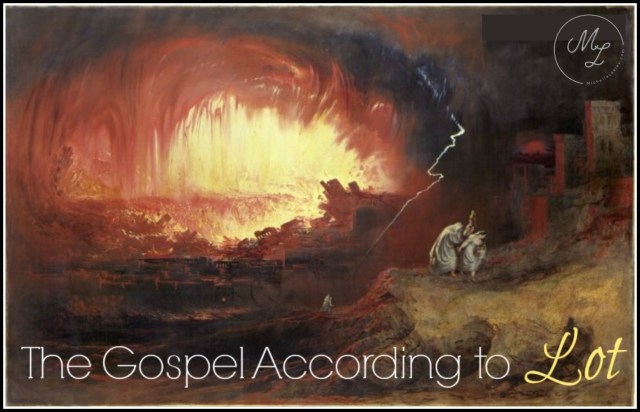
If you look closely, you can see the light of the gospel casting a shadow over Sodom. A shadow thatโ€™s the size and shape of a cross.

If you look closely, you can see the light of the gospel casting a shadow over Sodom. A shadow thatโ€™s the size and shape of a cross.

The city of Sodom was so wicked that God personally came down to deal with it. Judgment was coming. There was hell to payโ€”quite literally.

God revealed His plan of destruction to Lot, His only follower in Sodom. But God didnโ€™t stop there. Did Lot have anyone in town that needed to be rescued from the coming devastation? Hurry! Go get them and urge them to flee!

โ€œMy sons-in-law!โ€ thought Lot. Perhaps he raced out the back door, slipped carefully past any of the blinded mob left on his front porch, and scurried surreptitiously through town to avoid other hostile neighbors. Arriving at the respective homes of the two men betrothed to his daughters, he must have pleaded with them to drop everything and come with him. It was the only way they could be saved.

But they wouldnโ€™t go with him. They didnโ€™t believe him.

hp-crossshadow

The next morning, judgment came. And that handful of peopleโ€”righteous Lot, and those who believed with him that God would save them if they left everything behind and followed Himโ€”were the only ones spared.

Is that shadow becoming clearer?

This world is a frightfully wicked place. And, one day, God is going to come down personally to deal with it. Judgment is coming. It will be swift, it will be terrible, and it will be final. God has revealed this to us in His word. He has also revealed to us, His followers, the plan of escape: Jesus.

But God doesnโ€™t stop there. Do we have friends and loved ones who need to be rescued from the very real and eternal hellfire and brimstone that await them if they stay in the Sodom of their sin?

Jesus tells us to โ€œgo out andโ€ฆcompel them to come inโ€ (Luke 14:23), and that they โ€œmust be born againโ€ (John 3:7).

This isnโ€™t some kind of โ€œGod loves you and has a wonderful plan for your lifeโ€ game weโ€™re playing here. Itโ€™s urgent, a matter of life and death.

This isnโ€™t some kind of โ€œGod loves you and has a wonderful plan for your lifeโ€ game weโ€™re playing here. Itโ€™s urgent, a matter of life and death.

Eternal life. Eternal death.

And Godโ€™s way is the only way out.

God didnโ€™t offer Lotโ€™s sons-in-law the option of having their cake and eating it, too, by remaining in Sodom and being saved from His wrath. And it doesnโ€™t work that way for us either. We donโ€™t get to have Jesus and continue to rebel against Him by remaining in our sin.

Just as Lotโ€™s sons-in-law could not survive Godโ€™s judgment any other way than fleeing the sin of Sodom and following Godโ€™s escape route, there is only one way we may escape. We must flee from our sin and into the forgiving arms of our crucified and risen Savior.

This is the gospel with which we must compel them. It is the only gospel that saves.

“If sinners will be damned, at least let them leap to hell over our bodies. And if they will perish, let them perish with our arms around their knees, imploring them to stay. If hell must be filled, at least let it be filled in the teeth of our exertions, and let not one go there unwarned and unprayed for. – C.H. Spurgeon.

Do you know Jesus as your Savior? Are you certain?

Abuse, Church, Sin, Southern Baptist/SBC

Preventative Measures: 6 Steps SBC Churches Can Take to Prevent Sexual Abuse

Originally published February 22, 2019

The state I live in is heavily Catholic and Southern Baptist. For many years, journalists and others have been delving into the gobsmacking number – thousands – of pedophile and sexually abusive Catholic clergy across the globe, and, in recent months, my own local paper has been tackling the issue as it pertains to priests and other Catholic leaders in our area who have been revealed as abusers. So I was kind of prepared for the Southern Baptist Convention to be the next entity to be investigated. My guess is that either Presbyterians or Mormons will be next.

It’s absolutely appropriate that the news media conducted this kind of investigation into the SBC. What’s not appropriate is that SBC leadership appeared not to be ready for it because – at least from my perspective as the average person in the pew – it’s not something the Convention has a history of policing itself on in any appreciable way. SBC leadership should have been ready and eager to fling the doors wide open and transparently welcome any sort of investigation by the media, demonstrating whatever progress has been made in dealing with perverts in our pulpits. Instead, they seemed to be caught virtually unprepared despite the fact that the signs of the times should have indicated to them that this was coming.

In my opinion, the Houston Chronicle did an excellent job of exposing the problems with abuse in the SBC in its three-part series of articles, even taking the time to explain the crucial point of church autonomy, which sets SBC churches apart from the governing structure of Catholicism and other organizations, and which has, in many cases enabled abusers to move from church to church undetected. SBC leaders who have explained that they have no authority to force churches to participate in any sort of registry of abusers and the credibly accused are correct (but couldn’t it be voluntary?). SBC leadership, unfortunately, has no such authority over individual churches. Each church has to set its own standards and methods for preventing abuse. So what can individual, autonomous churches do to prevent abuse?

1.
Preach the Gospel

That might sound pretty basic, but it’s one of the basics we desperately need to get back to. We need to be churches who hammer on the gospel – the wretchedness of sin, the supreme holiness of God, the cross, the tomb, the resurrection, grace, mercy, repentance, forgiveness – week in and week out. Not only is that…well…it’s just what any biblical church is supposed to do, but my guess is that the vast majority of the perpetrators in these abuse cases are not actually Christians – despite what they may claim or what office they might hold – they are false converts because a lot of churches they’ve been part of have neglected their duty to preach the gospel.

Too many SBC churches teach an easy – “Just repeat this quick little prayer, and boom, you’re in!” – believism that unrepentant sinners hang their eternal hats on as a “Get out of Hell, Free!” card. They’ve never found themselves filthy and undone before an unfathomably holy God because they’ve never been confronted by that God or that characterization of their sin in the preaching and teaching of their churches. Could some of these perpetrators be genuinely regenerated Christians? It’s possible, but not likely. By and large, true Christians are not out there abusing others – it’s the false converts.

2.
Meaningful Membership

Some churches have done away with formal membership altogether. Everybody’s welcome, come and go whenever you want, if you want, no requirements, no accountability. That’s not biblical, nor is it how the church has handled membership over the course of church history.

Traditionally there have been three main ways to join a SBC church: a newly saved person makes a public profession of his faith to the church body and is baptized into membership, or membership can be transferred from one church to another. You can transfer your membership by promise of letter (your previous church sends a letter to your current church recommending or not recommending that you be accepted for membership) or by statement (when obtaining a letter from a previous church isn’t possible, this is an “honor system” personal testimony that you are a baptized Believer).

Promise of letter in particular is a decent and biblical system that needs to be upheld, adhered to, and taken gravely seriously rather than just waving every Tom, Dick, and Harry through the wide open doors of the church. And in the case of new church members and new staff members (new staff members have to transfer their membership, too), it could help curb abuse if both the sending and receiving churches would look upon it as far more than a mere formality.

One of the very valid problems the Chronicle articles cite is that sending churches (the churches the abusers came from) did not inform subsequent churches of the problems with the abuser. They silently foisted people they knew were dangerous onto unsuspecting congregations. If sending churches would respond honestly to inquiries from receiving churches (the churches the abusers are going to) about their former staff and members, and if receiving churches would ask probing, personal questions rather than sending out perfunctory form letters, that would be a good start to making more headway on preventing abuse.

Furthermore…

Meaningful membership makes it harder for people to anonymously breeze in to the church, abuse, and slip out before anybody realizes what’s going on.

There are sexual abusers out there who find and attend churches with loosey-goosey membership policies for the express purpose of cultivating a pool of victims. They know these churches are blindly and ignorantly trusting, so they show up for a couple of weeks, talk a good game, and promptly volunteer to work in the nursery or with the youth. If your church has a firm membership policy, required membership class, requires members to sign a church covenant, only allows church members (not just anybody who wants to or seems talented) to serve in any office, task, role, or capacity – and only after they have been members for a specified amount of time (ex: must have been a faithful member for at least six months to teach, serve on a committee, etc.), that sort of abuser isn’t going to waste his time or chance being caught by attending your church.

3.
Church Discipline

One of the failings of far too many SBC (and other) churches is sweeping sin under the rug and refusing to biblically exercise church discipline before it’s too late and calamity strikes. Church discipline isn’t just for the “big” sins like a pastor who commits adultery. Church discipline is for all observable, unrepentant, biblically defined sin. If we have verifiable knowledge that a brother or sister in our church is sinning, we have the obligation not to please ourselves by turning a blind eye and avoiding a confrontation, but to lovingly go to that person and plead with her, for her own restoration and reconciliation to Christ, to repent and walk blamelessly. Often (hopefully), that first step in the church discipline process precludes the need for the remaining two.

Churches that consistently, lovingly, and biblically practice church discipline help prevent abuse in four ways…

First of all, nobody wakes up one morning and decides to start sexually abusing others. There are always “smaller” sins leading up to abuse – obscene comments, dirty jokes, leering, pornography, inappropriate touching in public. If we would address those “smaller” sins when we see them happening, we might just prevent the potential abuser from continually hardening his heart by getting away with sin, bring the gospel to bear on his life, and keep him from becoming an abuser in the first place. He might actually get saved, which is one of the goals of church discipline.

Second, if a church cultivates an atmosphere of practicing church discipline, unrepentant abusers aren’t going to hang around long. They don’t want to be caught.

Third, if a church ends up having to go through all the steps of church discipline with an unrepentant potential abuser, the last step – bringing this person before the church to remove him from membership – is public. Church members are made aware of the problems with this person so they can avoid being victimized by him and the procedure of removing the potential abuser from church membership goes into the church records. When he then goes to a new church, that receiving church should inquire of the sending church about him (see “Meaningful Membership” above). The sending church can then provide the record of his removal so the receiving church will be aware of the problems with this person.

Fourth, if we practice church discipline on the “smaller” sins with an unrepentant abuser, he is likely to be removed from membership in the church before he gets to the point of abusing someone.

Another aspect of church discipline is tightening up the rolls and removing members who are dead (no, I’m not kidding), have moved away, have stopped attending, or are no longer members in good standing for other reasons. This may not prevent someone from abusing, but at least if he does abuse, the media won’t be able to report that he’s (still) a member of your church, thus tarnishing your church’s, and possibly God’s, good name.

4.
Take Biblical Requirements for Leadership Seriously

It’s not like the Bible doesn’t tell us what kind of man should be a pastor, elder, or deacon. It’s right there, in black and white, twice, in 1 Timothy 3 and Titus 1. And yet there are churches who barely give those requirements a glance in favor of “more important” qualities they want in a pastor: Does he have at least a master’s degree from seminary? Is he a certain age? Does he rub elbows with Christian celebrities? Does he have a track record of successful building programs, fundraising, and attracting lots of new members? Is he charismatic and a dynamic speaker? None of those things are inherently bad unless they take precedence over the biblical qualifications.

But when churches are hiring men as pastors, youth directors, etc., whom they knowย have been in prison for abuse, as theย Chronicle articles cited, we have to think some other factor is more important to those churches than the biblical requirements. Because someone who has been accused, tried, convicted, and imprisoned by worldly courts for sexual abuse is no longer “above reproach” – the very first requirement in both passages (and Titus mentions itย twice for emphasis) – he is not “respectable”, and he is notย “well thought of by outsiders”. The very existence of theย Chronicle’s articles proves that. It boggles the mind that something like this has to be said to professing Christians who are supposedly spiritually mature and biblically knowledgeable enough to be on the pastor search committees for their churches, but…

People who have criminal records as sex abusers are permanently disqualified from professional ministry because they no longer meet these biblical requirements.

(And just as an aside, if your church has a “no hire” policy for men who have ever been divorced for any reason but yet you’ll hire a convicted sexual abuser…well…I’m just at a loss for words at that level of hypocrisy. OK, maybe one word: repent.)

But, “forgiveness for repentant sinners!” I can hear compassionate Christians cry out. Absolutely. Absolutely. I have a loved one who was radically and genuinely saved while he was in prison for child molestation. God can and does save sexual abusers, and those forgiven Christians need a church home just like everybody else does. We lovingly welcome into membership repentant sinners who are transparent with the church about their previous sin and who volunteer to be kept accountable. But we do not put them back into the position of pastor, elder, deacon, etc., first because they are biblically disqualified, and second, because it is not loving to that person nor to the rest of the church to allow him access to facets of church life that would tempt him back into sin. And it is putting God to the test to intentionally put such a person into a tempting situation as some sort of way of “proving” that God has really saved this person. We would not make a convicted embezzler the church treasurer and we should not be putting sexual abusers in positions that would tempt or allow them to abuse again – even volunteer positions. That doesn’t mean we doubt their salvation or the work God has done in their hearts, that means we recognize that Satan is cruel and crafty and we humbly admit that we still succumb to temptations to sin. It’s not holding a grudge or unforgiveness, it’s exercising biblical wisdom.

5.
Stop Being Afraid

When we allow the fear of man to determine our actions instead of the fear of God, we are in grave spiritual error.

Peter and the apostles stood up to the authorities who threatened and imprisoned them, insisted on obeying God’s Word, boldly declared, “We must obey God rather than men,” took their licks like men, went away rejoicingย that they had been counted worthy to suffer dishonor for the Name, and kept right on trucking in obedience to God. How far have we fallen when we won’t even address a brother’s sin with him because we’re afraid of confrontation? When we cover up a predator’s behavior and unleash him on others because we’re afraid of a defamation lawsuit? When we must obey men rather than God because we’re more afraid of the earthly consequences than spiritual consequences – because we don’t trust God to take care of us or His church?

Brothers and sisters, this must not be.

How far have we fallen when we cover up a predator’s behavior and unleash him on others because we’re afraid of a lawsuit?

Should we act wisely? Of course. Make sure we’re obeying the law and not hurting anyone as far as we’re able? Certainly. Get some legal advice? Absolutely. But when the rubber meets the road of choosing what’s right in God’s eyes versus what’s safe or comfortable in our own eyes, we choose what’s right in God’s eyes every time and we trust Him with the outcome. The God who parts seas, cools furnaces, and raises the dead is powerful enough to handle court cases and the ire of sinful men. Let us say with the Psalms and the Proverbs:

The fear of man lays a snare, but whoever trusts in the Lord is safe.
Proverbs 29:25

…in God I trust; I shall not be afraid. What can man do to me?
Psalm 56:11

The Lord is on my side; I will not fear. What can man do to me?
Psalm 118:6

Trust in the Lord with all your heart, and do not lean on your own understanding. In all your ways acknowledge him, and he will make straight your paths. Be not wise in your own eyes; fear the Lord, and turn away from evil.
Proverbs 3:5-7

6.
Practical Wisdom

Do the practical stuff. God has given us brains, experience, resources, and promises us wisdom. We would be failing to honor Him if we did not make use of all of those blessings in order to protect our churches from predators.

Perform criminal background checks on all staff members and on anyone who works with children, the disabled, or vulnerable adults regardless of how well you know them or how trustworthy you think they are.

Check references on every employee from the pastor to the janitor. Do it thoroughly and diligently, not flippantly.

Put accountability measures in place such as requiring at least two adults to be present in children’s and youth activities and classes at all times. No teen or adult – including the pastor, youth pastor or any other staff member – should ever be alone with a child on church property or at church functions.

Hold training sessions for the whole church on your church’s security measures, and how to report suspicious behavior and suspected abuse. Specifically address parents on the issue of trusting other adults in the church. Time after time, we hear that children are victimized because parents have left their child alone with a pastor or other Christian adult assuming that person was trustworthy. Teach them instead to assume that any adult – regardless of his title or position – who seeks to be alone with a child is untrustworthy.

Explore the services of organizations like Ministry Safe and others who can help you make your church a safer place. Pick the brains of sister churches who have put precautions in place for helpful suggestions and resources.

In the aftermath of bombshell news of abuse, the most common line of reasoning is, “How can we fix this? What can we do?”. Thoughts turn to practical solutions. That’s not wrong. In fact, it’s very, very right. We should make every effort to put pragmatic safeguards in place. But we can’t focus on the practical and tangible and leave out the spiritual. Because abuse is a spiritual issue way before it’s a safety issue.

We can’t focus on the practical and tangible and leave out the spiritual. Because abuse is a spiritual issue way before it’s a safety issue.

And if we get the spiritual part of it right from the get go, we drastically reduce the chances that we’ll have to fall back on practical safety measures. An ounce of prevention is worth a pound of cure, and a church striving to uphold the highest Scriptural standards of holiness will find itself fortified with tons of both.