Mailbag, Parenting

The Mailbag: Should single women foster or adopt children?

Should single women foster or foster to adopt?

It’s a great question, and a decision that shouldn’t be entered into lightly.

I know that there’s an urgent need for foster parents, so I hate to exclude anyone who’s willing, but at the same time, Christians must be governed by Scripture first, and practical considerations afterward. And in this case, God’s design for the family demonstrates that single women should not adopt and should not foster (except, perhaps, in cases of temporary emergency).

God has numerous reasons for confining sex to marriage, and one of those reasons is that sex results in children. When a married woman gets pregnant, the baby already has a built in set of parents – a father and a mother. That’s the way God designed things because God knows children need both a father and a mother.

But that’s not all – mothers need husbands/fathers, and fathers need wives/mothers. Until you have children, you cannot fully grasp how challenging, physically exhausting, frustrating, and emotionally draining motherhood can be, even under the best of circumstances with a husband. You also have no idea what a joy motherhood can be, and how your loneliness will exponentially increase without a husband to share that joy with.

Compounding the stress on a single foster mother is the fact that children who need foster care have usually spent quite some time in a horrific home situation. They’ve been abused, neglected, abandoned, exposed to drugs, violence, and other unspeakable atrocities. Those things do great damage to children, and, as a result, they often arrive at their foster homes with severe emotional and behavioral problems. And you won’t have a husband to help you. All of that will fall on you to handle, alone.

Consider also, that, unless you’re independently wealthy, if you’re a single woman, you’re going to be working full time. You’re going to take a child who needs extra attention, who’s likely to have been neglected or abandoned and turn around and abandon him again to a daycare or babysitter every day while you’re working. Even if you work from home, your attention won’t be fully focused on him. He doesn’t need that. He needs to be someone’s first priority for a change.

A foster child needs to be someone’s first priority for a change.

Perhaps the most important thing to ponder is this: What’s your motive for wanting to foster or adopt? Is it because you want children, and, without a husband, this seems like the best way to get them? Or, is it because God has given you a desire to help and minister to hurting children? In other words, is your motive “me-focused” or “ministry-focused”?

Is your motive “me-focused” or “ministry-focused”?

Forgive me for being overly direct, but if your motive is me-focused, single or married, you are the last person who should be fostering children. Me-focused people are what lands children in foster care in the first place.

God didn’t create children to make you feel fulfilled. We all want things in life that God has said no to, and God’s prescription for that is not to try to circumvent His “no” with loopholes like foster care, but to learn to be content in the circumstances in which He has placed us.

…I learned to be content in whatever circumstances I am. I know how to get along with humble means, and I also know how to live in abundance; in any and all things I have learned the secret of being filled and going hungry, both of having abundance and suffering need. I can do all things through Him who strengthens me.

Philippians 4:11-13

God didn’t create children to make you feel fulfilled.

If you think your motive might be me-focused, may I make a suggestion? Take your eyes off your desire for children and refocus them on studying, meditating on, and memorizing Philippians 4. (Yes, the whole chapter. It’s only 23 verses long. You can do it!)

If your motive is truly ministry-focused, there are a number of ways you can minister to children besides becoming a single foster mother. Scripture tells us…

So then, while we have opportunity, let us do good to all people, and especially to those who are of the household of the faith.

Galatians 6:10

…so start with your church. Set up an appointment with your pastor or the appropriate elder and explain your desire to minister to children with your church’s support.

  • Ask about ways to get involved with the children’s ministry at your church.
  • Volunteer to teach or help in children’s Sunday School, Vacation Bible School, Bible Drill, parents’ night out, or other children’s ministries.
  • Are there single parents in your church who need a hand with the kids from time to time?
  • Are there married couples -especially those who live far from family- who would welcome an “adopted” aunt or grandma (or at least occasional free babysitting) for their children?
  • Are there disadvantaged children who attend children’s outreach activities at your church whose parents aren’t members? Perhaps you could befriend the parent(s) and help out with their children.

If you already minister to children connected to your church and still have time to do more, look into ways you could minister to children in your community without parenting them.

  • Perhaps emergency foster care or respite foster care would be an option.
  • Maybe there’s a parachurch or community organization (for example: Big Brothers / Big Sisters or something similar) that needs volunteers.
  • Does your denomination have a children’s home or orphanage? (Mine does.) Contact them to find out how to minister to the resident children.

Though, generally speaking, single women should not foster or adopt, exceptional or emergency situations involving family or close loved ones may arise that make it necessary: Your unmarried sister is sent to jail for 18 months, and you’re the only relative who can take her children in. You’re 22 and somewhat established in a good job and a decent place to live, and your parents die in a car accident, leaving behind your 16 year old brother who will be grown and out on his own in a few years.

In exceptional or emergency situations, I would urge you to first consider if you are truly the only option. Children in these situations still need a mother and a father, and the mother and father need each other.

If you are, indeed, the only option for these children, set up an appointment with your pastor for counsel, ask about any resources he’s aware of, and ask your church for prayer, help, and support. You’re going to need it, and the children in your care will too.


If you have a question about: a Bible passage, an aspect of theology, a current issue in Christianity, or how to biblically handle a family, life, or church situation, comment below (Iโ€™ll hold all questions in queue {unpublished} for a future edition of The Mailbag) or send me an e-mail or private message. If your question is chosen for publication, your anonymity will be protected.

Holidays (Other), Parenting

Beautiful Motherhood: A Mother’s Day Bible Study

As we look ahead to Mother’s Day,
let’s check out what the Bible has to say about mothering.
This is lesson 12 of my topical Bible study:

Imperishable Beauty- A Study of Biblical Womanhood.

Read These Selected Scriptures

Questions to Consider

1. What are some attributes or character traits of a godly mother from Proverbs 31 that we can emulate? In todayโ€™s lesson, rather than attributes to emulate, weโ€™ll be focusing on Godโ€™s instructions to obey for mothers. We’ll examine how we’re to regard motherhood and our children, how we’re to train our children in godliness, how we’re to discipline our children out of ungodliness, and the example we’re to set for our children. Some of these instructions can also apply to childless women in their relationships with their spiritual children (i.e. younger women or children they disciple) and others. As you read over todayโ€™s passages, explain how childless women might apply some of these Scriptures.

2. Examine the first three passages (Psalm 127-Titus 2) together. What do these passages say about how we are to regard motherhood and our children? What should the attitude of our hearts be? In what sense are children a reward? How do we know that Psalm 127:3 does not mean that if you act in a way that pleases the Lord He will reward your good behavior with children? What does this verse mean? Is loving your children (Titus 2:4) simply a feeling of affection toward them? If so, why would young women need to be trained to love their children? When you finish today’s lesson, come back to Titus 2:4 and give a fully-orbed biblical definition of what it means to love your children.

3. Examine the next five passages (Proverbs 22-Ephesians 6) together. Why does God want us to train our children in godliness? Explain the phrase “in the way he should go” (Proverbs 22:6). How does the gospel figure in to training your child? Look carefully at the three Old Testament passages. At what age should we begin training our children in godliness and the Scriptures and how long should this training continue? Is Proverbs 22:6 an iron-clad guarantee or promise from God that if we raise our children in a godly home they will definitely get saved and turn out to be godly adults? Why not? (Scroll down to the Deuteronomy 21 passage if you need help.)

To whom are the Colossians and Ephesians verses addressed? Does this mean they don’t apply to mothers or that it’s OK for mothers to provoke their children, but not fathers? If they apply to both parents, why are they addressed to fathers? How are we not to deal with our children according to these verses? What does it mean to provoke your children? Why are we not to provoke them (Colossians), and how are we to deal with them instead (Ephesians)? Compare Ephesians 6:4b to the Old Testament verses in this section. How are they similar?

3. Examine the next three passages (Proverbs 29-Deuteronomy 21) together. What is the purpose of godly discipline? What are the biblical definitions of the words “discipline” and “reproof”? Are discipline, reproof, and training the same as punishment? Why or why not? What are some of the consequences of disciplining your child? The consequences of refusing to discipline your child? According to Proverbs 13:24, what motivates someone to discipline her child? What motivates someone to refuse to discipline her child? Are “love” and “hate” simply emotional feelings in this verse or an attitude, posture, or orientation of mindset toward the child? Look closely at Deuteronomy 21:20. Is this passage most likely talking about a very young child or an older child/teenager? According to the Deuteronomy 21 passage, does godly discipline always result in an obedient son or daughter, or can there be exceptions to the rule?

Why is it important to both train your child in godly ways and discipline him out of ungodly ways? Explain how this fits into the “put off the ungodly, put on the godlymodel of biblical sanctification.

4. Examine the last five passages (Deuteronomy 21-Matthew 10) together. What do these passages teach us about the godly example we need to set for our children?

Sometimes we see implicit instructions to parents in passages that explicitly teach children how to treat and regard their parents. For example, if there were a verse that said, “Children, love your parents,” we could learn from that verse that we need to act in a way (lovable) that makes it easier for our children to obey that Scripture. Considering this concept, look at the Exodus 20 and Proverbs 1 passages. If your children are to honor you, in what manner should you behave? What should your teaching be like if your children are not to forsake it and to consider it a “graceful garland” and a “pendant”?

What is the context of Ezekiel 16? To whom is the parent/child metaphor in this  passage addressed? Explain the phrase “like mother, like daughter”. Why is it important to set a good example for our children with our own behavior, and why was this a good metaphor for God to use in addressing Israel’s unfaithfulness to Him?

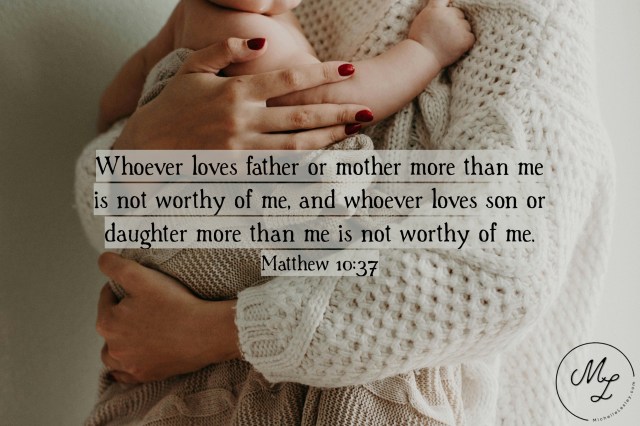
Examine the Deuteronomy 21 and Matthew 10 passages together. What is to be a mother’s highest priority – her relationship with her child, even the life of her child, or her love for, obedience to, and loyalty to Christ? Do you love Christ more than your child? If you had to choose between your child and Christ, who would you choose? What message does it send to our children when we show and tell them that we love Christ more than we love them? How can you demonstrate to your child that your highest love and loyalty is reserved for Christ?


Homework

Examine each of the instructions in Deuteronomy 6:6-9. Make a list of practical ways your family could put each of these instructions into practice and discuss it with your husband. Together, pick one of these practices and implement it with your children this week.


Suggested Memory Verse

Holidays (Other), Mailbag, Parenting

The Mailbag: Mother’s Day Potpourri

Originally published May 3, 2021

Welcome to another โ€œpotpourriโ€ edition of The Mailbag, where I give short(er) answers to several questions rather than a long answer to one question.

I like to take the opportunity in these potpourri editions to let new readers know about my comments/e-mail/messages policy. Iโ€™m not able to respond individually to most e-mails and messages, so here are some helpful hints for getting your questions answered more quickly. Remember, the search bar (at the very bottom of each page) can be a helpful tool!

Or maybe I answered your question already? Check out my article The Mailbag: Top 10 FAQs to see if your question has been answered and to get some helpful resources.


This week on the blog, in anticipation of Mother’s Day, it’s all about the mamas. Here’s a roundup of Mailbag articles and other resources on motherhood and parenting…


How can I raise my daughters to be godly women?

Avoiding the Creepers: Six Ways to Raise a Biblically Strong Woman


How can I raise my sons to be godly men?

Six Ways to Raise a Godly Man


Am I violating Scripture’s prohibition on women teaching men by teaching my sons the Bible at home?

Rock Your Role FAQs (#12)


Can you recommend a good Bible study for teen girls?
Can you recommend a devotional I can do with my kids?
How can I teach my kids the Bible?

The Mailbag: Potpourri (Kidsโ€™ devotionals, The Chosen- Season 2, Methodist apostasy) (section 1)

The Mailbag: Can you recommend a good Bible study for women/teens/kids?

The Mailbag: Potpourri (NBCS, Homeschool resources, Piperโ€ฆ) (section 3)

12 Techniques for Raising Bible-Saturated Kids

Homemade Catechism: 11 Scriptures for Real Life Parenting Situations


Which children’s Bible do you recommend?

The Mailbag: Childrenโ€™s Bible Recommendations


How can I know if my disabled (or very young) child is saved?

The Mailbag: Salvation and the Mentally Challenged


My young child says she is saved and wants to be baptized. How can I know if she’s really saved and ready for baptism?

A Review of Justin Petersโ€™ โ€œDo Not Hinder Themโ€


I’m thinking about homeschooling, but I don’t know where to start. Help!

Homeschool Resources


As a stay-at-home / homeschooling mom of boys, how can I make sure they’re getting the male leadership and influence they need during the day while my husband is at work?

The Mailbag: Potpourri (Christian romance novelist, home schooling sons, Spanish resourcesโ€ฆ) (section 2)


What is your position on birth control or having a planned family size? 

The Mailbag: Christian Women Working, Using Birth Control, and Limiting Family Size

The Mailbag: Should I Risk Another Pregnancy?


Should I cover myself and my baby while breastfeeding for the sake of modesty?

The Mailbag: Should Christian women cover up while breastfeeding?


How can I teach my children about modesty?

Modesty- Part 3 at A Word Fitly Spoken (We suggest you listen to all three parts in order as they build on one another)


Is spanking biblical or abusive?

The Mailbag: Potpourri (Spanking, Women teaching men, Working a homosexual โ€œweddingโ€โ€ฆ) (section 1)


Can I get some guidance on training my children to behave in church?

Thatโ€™s (Church) Life! โ€“ How to โ€œDo Churchโ€ โ€“ Part 1 at A Word Fitly Spoken

Churchmanship 101: Training Your Child to Behave in Church 

The Mailbag: Potpourri (Joniโ€™s testimony, โ€œMessyโ€, Female seminary profsโ€ฆ) (section 4)

Yes Sir! Thatโ€™s My Baby!


How do I deal with my unsaved parents who are an ungodly influence on my children?

The Mailbag: Grandparents an Ungodly Influence on My Kids


Biblical advice / information on parenting in general?

Do You Trust God with Your Kids?: 8 Ways to Parent Your Children Like God โ€œParentsโ€ You

Parenting: What a Child Wants, What a Child Needs

Parenting Without Shame

The 10 Commandments of Parenting


If you have a question about: a Bible passage, an aspect of theology, a current issue in Christianity, or how to biblically handle a family, life, or church situation, comment below (Iโ€™ll hold all questions in queue {unpublished} for a future edition of The Mailbag) or send me an e-mail or private message. If your question is chosen for publication, your anonymity will be protected.

Faith, Parenting

Wayback Wednesday ~ Follow On

Originally published July 29, 2010

Again the next day John was standing with two of his disciples, and he looked at Jesus as He walked, and said, “Behold, the Lamb of God!” The two disciples heard him speak, and they followed Jesus. And Jesus turned and saw them following, and said to them, “What do you seek?” They said to Him, “Rabbi (which translated means Teacher), where are You staying?” He said to them, “Come, and you will see.” So they came and saw where He was staying; and they stayed with Him that day, for it was about the tenth hour. John 1:35-39

When we speak of “following Jesus” today, we mean that we follow in His footsteps figuratively. We keep His teachings. We obey Him. We submit to His leadership.

But when Jesus was physically present on earth, people were literally able to follow Him. Around. As in, walking right behind Him. Maybe even stepping on the backs of His sandals like my children do to me sometimes.

Which got me to thinking. Why do people follow other people around? And who are these people who follow other people around? And why are my children and my dog always following me around? And why does it annoy me when my children and my dog follow me around? (Ok, I haven’t figured that one out yet, but there’s some kind of a sin issue in there somewhere, I’m sure.)

Who?
First of all, you don’t usually see an adult following another adult around unless one of them is a stalker. But there are a some occasions in which it might be appropriate and legal, for example, if the person being followed is a tour guide, or if the person being followed is a seasoned employee training a new hire. Much of the time, literal followers are children. And at my house, the dog.

Why?
Why do people follow people around? Think about it– have you ever followed somebody around? Why did you do it? Do people follow you around? Why do they do it?

People generally follow another person around because:

a.) they are interested in what that person is doing,
or
b.) they want to learn from that person,
or
c.) they have no idea where they’re going and the person they’re following does. 

That’s why people followed Jesus around. They had heard that he spoke and taught as no one ever had before. They had heard about the miracles and healings. They were curious. Were the rumors true? What might they see? Would Jesus do something for them?

For some, that initial interest blossomed into a desire to sit under the tutelage of Jesus. They couldn’t get enough of His teaching, so these first century groupies followed him from speaking engagement to speaking engagement.

Certainly, none of the people who followed Jesus around had a clue as to where they were going, spiritually speaking. Jesus did. He not only knew the way to the kingdom of God, He was the Way. Who better to follow?

So why do my children and my dog follow me around?

Well, my dog follows me around because hope springs eternal in her that I will drop food on the floor, or that one miraculous day, the meal I’m cooking in the kitchen will actually be for her. She’s not interested in learning anything from me and she knows her way around the house just fine.

My children follow me around for the same basic reasons people followed Jesus around. They’re curious. They want to know what I’m doing, and they hope it will be something fun that will involve them. When they’re young, even cooking, sweeping, and folding the laundry seem interesting to them (yeah, my kids don’t get out much) and they want to learn how to do it just like Mom. When we’re in an unfamiliar place, they follow me because they don’t know how to get where we’re going, and I do.

Which makes me think.

How am I walking? Am I walking the way Jesus walked? Do I walk uprightly? Do I walk in integrity?  Do I walk blamelessly?

Do I follow Jesus so closely that by following me around, my children can learn to follow Him too?

Mailbag, Parenting

The Mailbag: Potpourri (Rescinding a recommendation… Women at the Last Supper… Consistent discipline)

Welcome to another โ€œpotpourriโ€ edition of The Mailbag, where I give short(er) answers to several questions rather than a long answer to one question.

I like to take the opportunity in these potpourri editions to let new readers know about my comments/e-mail/messages policy. Iโ€™m not able to respond individually to most e-mails and messages, so here are some helpful hints for getting your questions answered more quickly. Remember, the search bar (at the very bottom of each page) can be a helpful tool!

Or maybe I answered your question already? Check out my article The Mailbag: Top 10 FAQs to see if your question has been answered and to get some helpful resources.


Our women’s ministry team recently asked all of us Bible study teachers to promote the study they have chosen, and I personally recommended it to the women in my class. I told them โ€œI donโ€™t know anything about the author and havenโ€™t read the study, but I trust the women’s ministry team and recommend you participate.โ€ That afternoon I began researching her and discovered she was a woman pastor. I immediately contacted the womenโ€™s coordinator and shared my concerns.

I feel TERRIBLE that I have recommended a woman whose life choices make her a stumbling block to the gals I dearly love and have taught for years. My first instinct is to send my students only an email rescinding my recommendation and warning them that the author routinely preaches in her local church. I am torn between protecting them from a very beguiling threat and the implications a warning has for exposing the women’s ministry team. LESSON LEARNED for future recommendations, but for now, what is my Biblical obligation/priority?

That’s a difficult spot to be in. I’ve been there myself, having passed along a recommendation from someone I thought was discerning and trustworthy, only to find out later that she was not.

Here’s what I would suggest:

  • If you haven’t already, get alone with the Lord in prayer and repent of your carelessness. There is grace, mercy, and forgiveness awaiting you.

  • Write out a carefully, kindly, and wisely worded email to your class apologizing for your carelessness and explaining why you need to rescind your recommendation. Support everything you say with Scripture. (If you think it would be helpful, you may wish to include a link to this article of mine.) Don’t hit “send” yet.

  • Talk to your pastor before you do anything else. Explain the situation, plead with him to cancel the study, tell him (don’t ask him) your conscience demands that you send an email to your class rescinding your recommendation of the study, and offer to show it to him if he’d like to see it.

  • I pray your pastor will cancel the study. I really do. That will take the pressure off of you. You will still need to apologize to your class and explain why you agree with the pastor’s decision to cancel the study. Unfortunately, in situations like this, the pastor almost always backs up the study and the women’s director, not the discerning Christian who comes to him with concerns.

  • If your pastor affirms the study and the women’s ministry leader, express your disappointment calmly and politely, and reiterate that you must still send the email. Go to the women’s ministry leader, and as a gesture of courtesy, explain that you’ll be sending an email to your class rescinding your recommendation. Then, send the email.

  • Immediately begin looking for a new, doctrinally sound church. Women who are “pastors” and/or preach to men are false teachers. They preach with their behavior, “I don’t like this command of Scripture, so I’m not going to obey it. If there’s a command of Scripture you don’t like, you don’t have to obey it either.”. If your pastor is so doctrinally ignorant or unsound that he affirms this sin and false teaching, you don’t need to be sitting under his teaching and leadership.

What are the Scripture verses that back up the teachings that women were at the last supper? I know that this is something Iโ€™ve heard before, yet now my grandson is asking me about it because thatโ€™s what he learned in school.

There aren’t any. In fact, I’ve never heard anyone claim that any person – man or woman – other than Jesus and the twelve disciples were in attendance at the Last Supper.

  • The Matthew account says Jesus “reclined at table with the twelve.”
  • The Mark account says Jesus “came with the twelve. And as they were reclining at table and eating…”
  • The Luke account says Jesus “reclined at table, and the apostles with him.”
  • The John account focuses more on Jesus’ teaching at and after the supper than the actual supper itself, but even John says, “During supper” (v.2) Jesus “began to wash the disciples’ feet…” (v.5)

When you consider all four of the gospel accounts together, there is absolutely no argument to be made that anyone was present at the Last Supper besides Jesus and the twelve. There were no women among the twelve. There were no women apostles. Therefore, no women were at the Last Supper.

I’m guessing what happened is that somebody – perhaps Catholicism, in order to elevate Mary, or perhaps feminists, in order to make Jesus seem like an egalitarian – took a mention of “disciples” (without “the twelve” in front of it) from one of these passages and decided that could mean any follower of Jesus he or she wanted it to mean (most likely Mary, the mother of Jesus, or Mary Magdalene).

If your grandson is asking questions like this, take him to Scripture and teach him how to be a good Berean. Show him how to look up the passages in question and compare what he’s being taught to what the Bible actually says.

And if you have a relationship with his parents that allows you to express your concerns about what he’s being taught at school, express them (kindly, yet seriously, taking care not to be overbearing). I shudder to think about all the unbiblical things that school is indoctrinating your grandson with that he’s not asking you about.


I am a Christian mom, and I rarely accept back talk from my son. I always call it out, and usually give him some kind of discipline, but it doesn’t seem to improve things. Is there a secret formula?๐Ÿ˜ƒ

That’s something a lot of moms deal with, and I know it’s got to be frustrating. Good for you for looking for ways to make your discipline more effective!

If what you’re doing isn’t working, your discipline either isn’t severe enough or isn’t consistent enough, or both. Discipline has to hurt in order to be effective.

A good example of the importance of consistency is an experiment I learned about when I was a psychology major back in the Stone Age. We were studying conditioning (training a subject in a behavior), and a lot of the studies we looked at had to do with training rats to push a lever for a pellet of food. Some rats got a pellet every time they pushed the lever. Some never got a pellet. Some got a pellet sometimes. Those were the rats who pushed the lever the most because they never knew when they would be rewarded with food or “punished” with none.

It’s the same with inconsistent discipline. You’re actually increasing the undesired behavior by being inconsistent because your child never knows whether that bad behavior is going to be rewarded, ignored, or punished. This is also part of what Ephesians 6:4 is talking about when it says not to exasperate your children.

Especially with boys, Dad needs to be involved. Your son needs to know that if he doesn’t respond to your discipline, Dad is going to step in and take over. The two of you should sit down, talk this through, and put a plan in place for how to work this out in various situations.

Also helpful would be to find a couple in your church whose children are well behaved and respectful and ask them to disciple you and your husband in this area.

Get those things going, and you’ll see improvement.


If you have a question about: a Bible passage, an aspect of theology, a current issue in Christianity, or how to biblically handle a family, life, or church situation, comment below (Iโ€™ll hold all questions in queue {unpublished} for a future edition of The Mailbag) or send me an e-mail or private message. If your question is chosen for publication, your anonymity will be protected.