I love to read Christian fiction but find that it can be a bit of a minefield. It can get off course theologically and may reflect the world more than biblical Christianity. Have you ever given recommendations on Christian fiction writers?
Great question! We all need a little mind candy now and then, but we don’t want it to be a vehicle for delivering bad theology to our brains.
First, let me sort of set the stage for what’s in my mind when I think of “Christian fiction.” Other people might have other definitions of this book genre, and that’s absolutely no problem, but, to me, Christian fiction has an overtly biblical message or theme and maybe even a blatant presentation of the gospel. When I think of “Christian fiction” I’m not thinking merely “family friendly” (a good clean story with nothing biblical in it), or a novel with a character in it who happens to attend church or be a Christian but there’s nothing else biblical in the book, or a fiction book on a non-biblical topic that’s written by someone who’s a Christian. So the books I’ll be recommending below will fit this definition of “Christian fiction.”
Next, I know the bulk of Christian fiction marketed to women is romance and Amish romance. And, in keeping with the “stick out like a sore thumb” weirdness that is Michelle Lesley, it’s not a genre (Christian or secular) I personally enjoy. There’s nothing wrong with it if you can find a good one and you like romances, but the books below aren’t romances simply because that’s not what I read. I tend toward biblical history novels and – I don’t know if there’s a particular name for this type – “real life scenario” contemporary Christian lit.
A few final points:
•I don’t hold Christian fiction to quite as high a theological standard as I do Christian non-fiction (theology, Bible studies, “Christian living” books, etc.). Some of the books below may have a few theological “cow pies” you’ll have to step around and ignore, but, for the most part they’re in line with biblical theology.
•My personal standard for recommending a biblical historical fiction book (a fictionalized account of a true Bible story, such as Lynn Austin’s and Chris Skates’ books below) is that the book has to stay true to what the Bible actually says took place including the dialogue, details, and chronology, and any of the fictionalized parts have to comply with biblical principles, theme, history, and culture of the time period.
•I haven’t checked any of these authors (as I would non-fiction Christian authors) to see where they stand on the role of women in the church, and I haven’t researched any of them to discover whether they associate with false teachers.
That said, here are a few recommendations:
Karen Kingsbury– Although her older works of fiction may not be too problematic, she is not someone I’d encourage you to read because of her recent theological trajectory.
Lynn Austin– Here’s a “book report” I wrote on Lynn Austin’s Chronicles of the Kings series. I read that entire series and loved it. It was VERY good and theologically strong.
Chris Skates– Chris’ biblical historical fiction rendition of the story of Noah and his family in The Rain was a fun read.
Those are the only ones I’ve actually written about. Here are some others I’ve read and enjoyed over the years. (Quoted excerpts courtesy of Amazon.com)
The Last Disciple– “As the early church begins to experience the turbulence Christ prophesied as the beginning of the last days, an enemy seeks to find John’s letter, Revelation, and destroy it. Meanwhile the early Christians must decipher it and cling to the hope it provides as they face the greatest of all persecutions.”
(Update: A few months after the original publication of this article, Hank Hannegraaff decided to join the Greek Orthodox church. Though I read and enjoyed this fictional book of his, I would no longer recommend his non-fiction work or ministry as biblically trustworthy.)
Paul Maier:
A Skeleton in God’s Closet– “Dr. Jonathan Weber, Harvard professor and biblical scholar, is looking forward to his sabbatical year on an archaeological dig in Israel. But a spectacular find that seems to be an archaeologist’s dream-come-true becomes a nightmare that many fear will be the death rattle of Christianity.”
The Constantine Codex– “While touring monasteries in Greece, Jon and his wife Shannon—a seasoned archaeologist—uncover an ancient biblical manuscript containing the lost ending of Mark and an additional book of the Bible. If proven authentic, the codex could forever change the way the world views the holy Word of God.”
Kathi Macias:
People of the Book– “Farah lives in Riyadh, Saudi Arabia, with her family, and wants nothing more than to develop a deeper devotion to her Muslim faith. She sees the month of Ramadan as her chance to draw nearer to Allah, and pursues that goal. All goes well until the prophet Isa—Jesus—appears to her in a dream and calls her to Himself.”
Joy DeKok:
Rain Dance– “What happens when a Christian woman facing a childless future and a woman seeking an abortion are waiting to see the same doctor? What if after that “chance” encounter they are unable to forget each other?”
Randy Alcorn: I’ve read and enjoyed most of Randy’s fiction books. Off the top of my head, I don’t recall any I wouldn’t recommend. Two of my favorites were:
Safely Home– “Is this the day I die? Li Quan asks himself this question daily, knowing that he might be killed for practicing his faith. American businessman Ben Fielding has no idea what his brilliant former college roommate is facing…But when they are reunited in China after twenty years, both men are shocked at what they discover about each other.”
Edge of Eternity– I would call this book a modern day Pilgrim’s Progress. “Imagine Being Pulled Into the Hereafter. While You’re Still Alive. A disillusioned business executive whose life has hit a dead-end, Nick Seagrave has lost loved ones to tragedy and his family to neglect. Now, at a point of great crisis, he unbelievably and inexplicably finds himself transported to what appears to be another world.”
Frank Peretti: Years ago, I was a big Frank Peretti fan and read most of his novels. I don’t remember any overt heresy in his work, but it’s been well over a decade since I’ve read anything by him, so that could just be my faulty memory. Most of his novels deal with spiritual warfare, so there’s the potential for some errant theology there. Read discerningly. Two of my Peretti favorites are:
This Present Darkness and Piercing the Darkness (a two book series)- “The small town of Ashton is the unexpected setting for an epic clash between good and evil as a Christian preacher and a news reporter unearth a plot to take over their small community, and eventually the world.”
There are also some books that would fall under the category of Christian fiction which I would strongly recommend against:
The Shack (or any other book) by William Paul Young: While I mentioned that I don’t hold Christian fiction to as high a theological standard as Christian non-fiction, I definitely don’t recommend any Christian fiction fraught with blatant heresy or whose main goal is to teach heresy, and that’s what Young himself has stated is one of the objectives of this book (although he doesn’t consider his views heresy). The movie based on this book releases next month (March 2017). Here are some resources that will explain the theological problems in The Shack in more detail.
Redeeming Love(the book or the movie) by Francine Rivers
The Chosen (any books or materials): Yes, it’s fiction. If you want the non-fiction version, read your Bible.
Inappropriate/Unbiblical Content: In an effort, I guess, to be cutting edge, cool, or gritty, there are novels marketed under the Christian fiction genre which contain profanity, graphic sex scenes, and glorification of other sinful behavior. I would not recommend those books regardless of the reason these types of things are included in the book.
Girl “Porn”: This is really more about what’s going on in the reader’s heart than the book itself. It’s been said that romance novels can be a form of literary “pornography” for women. I mentioned graphic sex scenes above, but I would also caution women away from non-graphic Christian romances if they cause you to create an idol in your heart of the “ideal” man that no real life man can measure up to. If you’re married, read a lot of romances, and find yourself increasingly dissatisfied (in any way) with your husband because he can’t hold a candle to the leading men in the books you’re reading, you need to put those books down and walk away from them. That’s coveting.
False Teacher Fiction: There are a few false teachers who have branched out into the fiction genre. Beth Moore and Priscilla Shirer have both recently released novels, T.D. Jakes has written some fiction, and I believe there are a few others. Even though these books may be fiction and might not even contain any false doctrine, I could not, in good conscience recommend a fiction book that could serve as a “gateway drug” to their non-fiction books.
If you have a question about: a Bible passage, an aspect of theology, a current issue in Christianity, or how to biblically handle a family, life, or church situation, comment below (I’ll hold all questions in queue {unpublished} for a future edition of The Mailbag) or send me an e-mail or private message. If your question is chosen for publication, your anonymity will be protected.
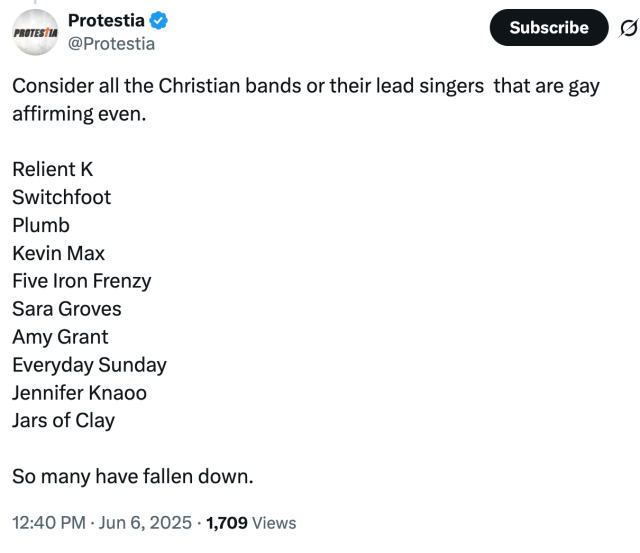
I’ve noticed that false doctrine is not just restricted to sermons, conferences, and Bible studies, but that I have to watch out for it in the contemporary Christian music (CCM) I listen to as well. Are there any CCM groups, artists, or songs I should avoid? Can you recommend any specific doctrinally sound artists or groups?
You’re absolutely right that we need to be careful about what we listen to that wears the label “Christian.” There is a lot of beautiful, doctrinally sound, theologically rich music of all genres out there, and there’s a lot of junk as well.
I’d like to offer a couple of caveats before diving into the answer for this question:
1. I plead extreme ignorance when it comes to CCM. With rare exception, it’s not a genre I enjoy, I don’t listen to it, and the worship service I attend uses “traditional” (mostly hymns) music, so I’m not often exposed to it. I’m all in favor of doctrinally sound CCM for those who like that genre, it’s just not my personal cup of tea or an area I research.
So, in this article I’m going to tell you what little I know, point you to people and resources better equipped to answer this question, and lean heavily on you discerning CCM listeners for help (more on that in a bit).
2. There is lousy theology in every genre of music. There are lousy hymns, lousy Christian rap, lousy CCM, lousy gospel, lousy Southern gospel, etc. This question was asked specifically about CCM, so that’s what the answer is going to focus on. It’s not a debate about hymns or exclusive psalmody versus CCM.
3. Depending on music from currently popular musicians is a lot like depending on Bible studies from currently popular evangelical authors. The majority of them aren’t doctrinally sound, and even the few that are seem to be apostatizing at an alarming rate. My recommendation to churches? Either go back to using tried and true doctrinally sound hymns, sing the Psalms, or find some talented musicians and lyricists in your own (doctrinally sound) church and put them to work writing songs for your worship service.
Why is it important to be discerning about Christian music? Because the music we use in church and listen to at home teaches us theology, and it sticks in our memories (which is why a lot of Scripture memory programs set Bible verses to music to help with memorization). You probably couldn’t recite verbatim a quote from last Sunday’s sermon, but I’ll bet you know the lyrics of a lot of songs by heart. It’s important that those lyrics contain good theology.
It’s imperative for churches to be discerning about the CCM they use in worship. If Jane Churchmember hears a CCM song in church and likes it, she’s likely to Google the song (probably right there in church- I’ve done it!), find out who sings it, and begin following that artist. Worship pastors who use CCM have a responsibility to vet the artists who perform the songs they select for the worship service to make sure they’re not sending Jane into the arms of a heretic. Additionally, music costs money, and you don’t want your church’s offerings supporting false doctrine.
Now, every time I address the subject of being discerning about worship music and that churches should not use worship music from heretical sources (such as Bethel, Hillsong, and Elevation, see below) someone who’s defending using music from these heretical sources will invariably pipe up with this well worn canard1:
Well, [insert name of hymn writer here] wrote lots of perfectly biblical hymns, but he had some theological problems too, and you’re not recommending we get rid of all of his hymns.
Well, first of all, maybe we should more closely examine the theology of some of our most prolific hymnists and stop using their music because of what they believed. Quick – off the top of your head, name the three we should start with…
…And that’s what separates the errant hymnist from Bethel, et al. Most Christians, even those who prefer hymns over CCM, could probably not name three people who wrote hymns, let alone tell you anything about their theology. But if you ask the average Christian to name three top Christian artists, she could rattle them off in a second.
Most hymn writers have been dead for up to hundreds of years. They don’t have Facebook pages you can follow, nobody’s playing their stuff on KLOVE, they’re not on tour to promote their latest album, they don’t have thousands of followers worldwide, and their music is in the public domain, so your church isn’t financially supporting them or their work. If you wanted to follow their errant theology, you’d have to hit the books to research and study it. Contemporary musicians’ theology is only a click away on YouTube, social media, live streamed concerts and conferences, and on their web sites. Nobody is following dead hymnists’ false doctrine, but hordes are following contemporary musicians’ heresy.
And anyone else who closely associates with any of the above (performing together, co-writing songs, Bethel Music produces their albums, etc.)
🟡Artists I Don’t Proactively Recommend (i.e. Use Caution or Avoid)
Casting Crowns has toured with Hillsong. Hillsong – not CC – pulled out of their 2022 tour due to the scandals with Brian Houston.
CityAlight is the music ministry of St. Paul’s Anglican Church, which occasionally allows women to preach and has a few ties to Hillsong (covering Hillsong songs, also this video was recorded at Hillsong studios, see info. section).
Selah member, Todd Smith, is the husband of Angie Smith.
There are probably many others that belong on all three of these lists, but those are the only names I personally know to give you.
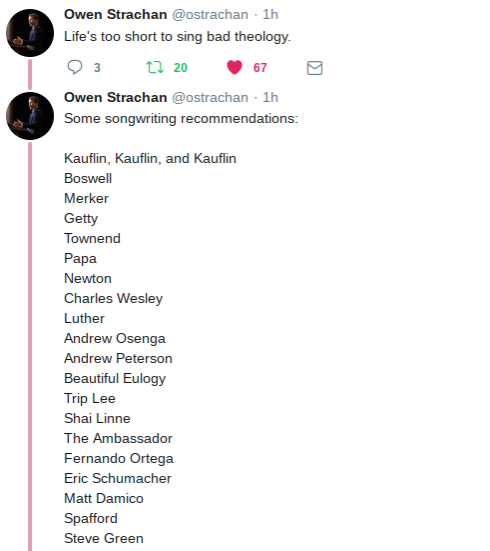
Owen Strachan recently made some recommendations of songwriters, though they’re not all contemporary, on Twitter: (others also responded with suggestions, click here to see):
(I’m not familiar with all of these, but in case you need their first names to look them up: Bob Kauflin, Stuart Townend, Matt Papa, John Newton, Martin Luther, Horatio Spafford.)
You will, of course, need to vet for yourself the theology and associations of any musician or group you decide to follow. It’s not quite the same as vetting a teacher or pastor, but several of the principles in my article Is She a False Teacher? 7 Steps to Figuring it Out on Your Own can be adapted for vetting musicians. Additionally, I would recommend three things when deciding whether or not to listen to someone:
1. Look up the lyrics of about half a dozen of her latest songs and examine the lyrics against Scripture. It’s helpful to look at the words in front of you without hearing the music so you can really think about them without being emotionally influenced by the music. Are they biblical?
2. Look to see who the artist associates with and admires. The easiest way to do this is to check their Facebook and Twitter feeds. Do you see scads of re-tweets and shares of posts from false teachers? Is she on tour with, co-writing songs with, or having her albums produced by a musician you know should be avoided?
3. Go to the artist’s web site, and examine her statement of faith (if she has one) and the venues she’ll be playing. Does she frequently play at places like Bethel? Lakewood? The Potter’s House? Is she the worship leader at a lot of conferences featuring false teachers? You might also want to look at her bio to see if she mentions her home church. If she’s a member of a church headed up by a false teacher, that’s definitely a red flag.
Below you’ll find some helpful additional resources relating to specific songs, artists, and the CCM industry. I’d also like to solicit the help of you discerning listeners of CCM:
Are there CCM songs or artists you would recommend avoiding due to biblically demonstrable sin or false doctrine? Please comment below with the exact name of the artist/song, the reason to avoid said artist/song, and a link(s) providing lyrics and/or objective support for your reason. Unsubstantiated accusations will not be published. Are there doctrinally sound artists you would recommend? Please comment with the name of the artist (and preferably a link to his/her web site) below.
If you have a question about: a Bible passage, an aspect of theology, a current issue in Christianity, or how to biblically handle a family, life, or church situation, comment below (I’ll hold all questions in queue {unpublished} for a future edition of The Mailbag) or send me an e-mail or private message. If your question is chosen for publication, your anonymity will be protected.
If you’re listening or watching (or even if you’re reading, I guess!), here’s the accompanying handout if you’d like to take notes.
Have you ever heard the term “New Apostolic Reformation” or “NAR” and have some idea of what it is?
If not, I’m so glad the Lord led you here, because, over the last 20 years or so, the New Apostolic Reformation has become the predominant form of false doctrine in Protestant American evangelicalism, and you’ve probably encountered it in some way, even if you’re just now learning what it’s called.
In my opinion, the NAR is the most dangerous form of false doctrine in the United States today because so many people think it is biblical Christianity and unknowingly import it into reasonably doctrinally sound churches. I mean, I’ve never heard of Anytown Baptist Church teaching (as Christianity) that Mohammed was a prophet or that God lives next door to the planet Kolob, but you’ll certainly see NAR beliefs and practices like dominionism, unbiblical manifestations of the “Holy Spirit” and NAR prayer practices gradually creeping into many average evangelical churches.
And, to our shame, America has so diligently exported this false doctrine to other countries under the banner of “missions,” that in many areas of the world – particularly Africa – the New Apostolic Reformation is the primary representation of so-called “Christianity”.
It is pervasive, it is heretical, it is blasphemous, and it is sending people to hell at an alarming rate.
Because this is an article (albeit a long one) rather than a book, I want to give you an overview of a few of the major points of New Apostolic Reformation doctrine, and then I want to focus in on unbiblical NAR practices and experiences so you’ll be able to more easily spot an NAR church*, recognize when a loved one is straying into NAR false doctrine, and keep NAR false doctrine from creeping into your own church.
*New Apostolic Reformation organizations are heretical, which means their organizations are not “churches” and their adherents are not “Christians”. Typically, when I write about the NAR, I use “scare quotes” when referring to NAR “churches” and other Christian terminology the NAR has co-opted. However, because of the volume of this terminology in an article of this length, I felt that attempting to do so would be distracting to the reader and burdensome to the writing process. I have, therefore, left most of them out. But please understand, NAR “churches” are no more real churches than a Mormon “church” or a Jehovah’s Witness “church”.
Because that’s the immediate danger here. You’re not going to go to an NAR “church’s” website, go read their statement of faith page, and see – clearly spelled out for you – the doctrines explained below. But you probably will notice the outward signs and practices. So I do want to give those unbiblical practices and experiences some emphasis.
So let’s start by taking a look at…
Major NAR Doctrines
The first thing you need to understand is that one thing the NAR has in common with the rest of the evangelical world is that there are variations in beliefs and practices from church to church and individual to individual. I mean, I’m Baptist. You ask ten random Baptists what they believe, and you’re going to get ten different answers, even though there will be a lot of similarities.
It’s the same with the NAR. And on top of that, because this is a doctrine of demons, and its leaders disguise themselves as angels of light, some of them will flat out deny right to your face that they believe, teach, and practice some of these things, when you’ve read in their books, and heard in their sermons, and watched in videos of their worship services that they do.
Another thing that leads to variations in beliefs is that the NAR is not an organized denomination like the PCA or the ELCA. There’s no defined structure of leadership or governance. There’s no headquarters building, no national president, no official creed, confession, or statement of beliefs that all its churches hold to, no membership criteria for admitting or dismissing churches, or, indeed, even the concept of “membership” itself, because there’s no denomination for churches to be a member of.
So just keep that in mind. If you walk up to your friend NAR Nancy and say, “I heard your church believes X, Y, and Z,” she’s very likely to say either, “No, it doesn’t,” or “I never heard of that,” because NAR “churches” really minimize teaching and doctrine and maximize feelings and experiences.
But let’s look at some of those doctrines that most NAR churches and those in leadership in the NAR hold in common:
False Doctrine 1: Restoration of the offices of Apostle and Prophet
Probably the most definitive, stake your claim doctrine of the NAR that separates them from typical, Bible believing Protestant churches, is that they believe God has restored the offices of Apostle and Prophet. “Capital A” Apostle, as in Peter and Paul. “Capital P” Prophet, as in Isaiah and Jeremiah.
NAR doctrine holds that the offices of Apostle and Prophet have been restored to the church, and that God places people in those offices today to rule and run the church. The prophets (supposedly) receive new revelations from God and the apostles take that revelation and apply it to govern the church.
Here’s why that’s unbiblical: Acts 1:21-26 clearly spells out the normative requirements for the office of Apostle:
1. He had to have followed Jesus during His entire earthly ministry, from his baptism by John the Baptist to His ascension. And/or (in the case of Paul)…
2. He had to have been an eyewitness to the resurrected Christ.
3. He had to have been personally appointed to the office by Christ Himself.
Now, NAR apostles will skirt around numbers 2 and 3 by telling you that Jesus appeared to them and personally appointed them in a dream or a vision. But even if you give them that, not a single one of them followed Jesus during His earthly ministry, the very first requirement of an Apostle.
Furthermore, if God wanted Apostles and Prophets running the church today, why doesn’t He say in the New Testament that He wants Apostles and Prophets running the church? There is no mention whatsoever of the office of Prophet in the New Testament, or any qualifications a man must meet if he wants to hold the office of Prophet in the church. And none of the original Apostles in Acts were replaced when they died.
We have the pastoral epistles – 1&2 Timothy and Titus. These are the policy and procedure manuals for the church. You’ve read them (and if you haven’t you can stop right now and read all three of them in 30-40 minutes). Do they say anything about Apostles and Prophets running the church? No, they don’t.
The Apostle Paul, an actual Apostle – under the divine, theopneustos inspiration of the Holy Spirit, writes these words to Titus, who’s getting a bunch of new churches up and running…
For this reason I left you in Crete, that you would set in order what remains and appoint elders in every city as I directed you.
Titus 1:5
Not Apostles. Not Prophets. Elders. And then he goes on in verses 6-9 (and in 1 Timothy 3:1-7) to list the qualifications of elders, or overseers, or pastors, not Prophets and Apostles. If God wanted Prophets and Apostles running the church He would have said so right here. And He doesn’t.
False Doctrine 2: Dominionism and the 7 Mountain Mandate
The NAR believes that the biblical gospel isn’t good enough. You know the gospel, right? If not, or if you’re not sure, click here. That’s the gospel. That is the complete gospel. We don’t add to it or take away from it.
But the NAR says that’s not the complete gospel. They have what they call the Kingdom Gospel, which is the gospel plus the idea that Christ’s death, burial, and resurrection made it possible for NAR “Christians” to take dominion of the earth, and gave them a mandate to do so.
Now, this is not your Genesis 1:28 dominion where God tells Adam to take dominion over the fish and the birds and every living creature. This is also not the idea of sharing the gospel and being salt and light – being a godly influence on the world – like Scripture tells us to.
This is the idea of the NAR taking over every institution and government of every nation, and eventually, literally ruling the world in order to usher in the second coming of Christ. That’s dominionism.
They even have a plan for doing this called the 7 Mountain Mandate, which basically breaks society down into seven different categories or “mountains” to move – government, media, family, business & finance, education, church & religion, and arts & entertainment.
The NAR twists two main Scriptures to teach this.
The Great Commission- Matthew 28:19 says, “Go therefore and make disciples of all the nations…”. What does that mean? It means “as you go,” as you walk through life each day, share the gospel with people and disciple them if they become Believers. Send out missionaries. That’s what the Great Commission means.
The NAR teaches that “make disciples of all the nations,” means make every nation disciples. Infiltrate every corner of every nation and make that nation NAR.
The other Scripture they twist is in the Lord’s Prayer. Matthew 6:10: “Your kingdom come. Your will be done on earth as it is in heaven.” Does that mean we’re supposed to literally take over the world and establish God’s kingdom on earth by force or by stealth? Of course not. But that’s what the NAR believes and teaches.
“Your kingdom come. Your will be done on earth as it is in heaven.” What does that mean? It’s similar to “Maranatha: come Lord Jesus”. It is our prayer that Christ will come soon to rule and reign over all the earth.
This is not the biblical spiritual warfare we find in Ephesians 6 with the full armor of God – standing firm in Christ with prayer, study of the Word, righteousness, truth, and so on.
This is more like something out of a scary Hollywood movie. The NAR believes that there are powerful, high ranking demons and evil spirits that control various geographical regions or territories as well as those 7 mountains in the 7 Mountain Mandate. These evil spirits have to be driven out before the NAR can take dominion of all of the seven mountains, and, thus, each nation.
You’ve read your New Testament. Does the Bible teach this? Of course not. Say it loud. Say it convictionally. Say it fearlessly and without shame:
THE BIBLE DOESN’T TEACH THAT.
That is spiritual warfare. Stand firm against the schemes of the devil -like the false teaching of the New Apostolic Reformation- by girding your loins with truth and taking up the sword of the Spirit which is the Word of God. That is spiritual warfare.
False Doctrine 4: Signs and Wonders
This is probably the best known doctrine of the NAR because it’s the most visible and publicized. The NAR teaches that you can do all the same miracles you saw Jesus do during his earthly ministry.
For many, the reason they believe this is that they believe a twisted version of Philippians 2:6-7. They think when that passage says Jesus “emptied Himself,” that He gave up His deity. That when He came to earth, He was not God. This is called Kenoticism, or the Kenotic heresy.
Bethel Church in Redding, California, is basically ground zero for the NAR in the United States- and that’s what they believe. That’s why you’ll hear discerning Christians say that Bethel and the NAR are heretical. Because they are. They literally deny the deity of Christ. You can’t get more heretical than that.
Both Bethel and most of the NAR believe Jesus was just a regular human being like you and me who was so faithful to God and so filled with the Spirit that He was able to work miracles. So, of course, if you’re able to be that faithful to God and filled with the Spirit, you can do those miracles, too.
They’ll also take you to John 14:12, where Jesus said: “…he who believes in Me, the works that I do, he will do also; and greater works than these he will do…”
Now, if you’re a good student of your Bible, you will read this verse in context and you will quickly see that it is not promising or commanding Christians today to go out and work miracles.
But the NAR twists this verse to mean that they are to do all the same miracles Jesus did. Mostly healing the sick and raising the dead. And then you’ve also got speaking in tongues, and prophecy, and extra-biblical revelation.
But they don’t even get their own Bible twisting right, because Jesus didn’t just say they would do the same works He did. Jesus said those of us who believe on Him would do greater works than He did. What’s greater than healing the sick, or raising the dead?
There’s only one thing greater than that- it’s the miracle that takes place when God raises the spiritually dead to newness of life in Christ. We have the privilege and the honor of being entrusted by Christ to take the gospel – the true gospel – to those who are dead in their sins so that Jesus can give them life.
That’s the greater work. Jesus could not do that work during His earthly ministry the way we can, because He had not yet died and risen from the grave. And another thing – Jesus’ entire earthly ministry was spent in that little tiny area of Israel. It wasn’t God’s plan for Him to take the gospel to the uttermost parts of the earth like we’ve been able to do. So it’s a greater work in that sense, too.
But the NAR not only gets it wrong in that they don’t understand what the greater work is, they don’t even do the same works Jesus did. They have never genuinely healed one person. They have never genuinely raised one person from the dead. They’ve never multiplied food for thousands or calmed a storm or caused a fig tree to wither instantaneously. Never. If they had, there would be evidence of it.
Now, as I said, your average NAR churchgoer who just shows up for the worship experience on Sunday morning is likely not to even be aware of these doctrines or that her church subscribes to them, because, while some of these things might be hinted at, implied, or assumed on Sunday morning, generally speaking, NAR churches don’t usually sit their members down and formally teach and explain these doctrines to them.
They don’t have a church covenant you sign, or a creed you recite, or a statement of faith, confession, or catechism that says these things. In fact it’s often the opposite – they try to hide these things because they know it’s weird and unbiblical and it’s going to turn people away. And they don’t want to do that, they want to draw people in so they can deceive them.
So, if NAR false doctrine starts creeping into your church, it’s not going to look like your pastor standing up in the pulpit and saying, “Please turn to Philippians 2 and let us learn the Kenotic heresy.” And if your brother and sister-in-law start going to an NAR church, she’s not going to tell you over coffee that they learned all about strategic level spiritual warfare in Sunday School last week.
What you will see and hear is the NAR’s unbiblical practices, experiences, and street level Bible twisting.
Unbiblical NAR Practices and Experiences
I opened this article by asking if you were familiar with the NAR. If not, you might be familiar with the Word of Faith or prosperity gospel:
Name it and claim it / blab it and grab it
It’s never God’s will for you to suffer, be poor, or be sick.
It’s always God’s will for you to be healthy, wealthy, and successful.
To live your best life now, as Joel Osteen would have us believe.
Because the NAR and the Word of Faith movement both have their roots in charismatic Pentecostalism, there is a great deal of overlap between the two as far as what they look like to most people. In fact, the way I usually explain it is that the NAR takes the Word of Faith and kicks it up a notch with outlandish “supernatural” manifestations and signs and wonders, and blasphemously attributes these to the Holy Spirit.
So let’s take a look at some of the NAR’s unbiblical practices and experiences. Some of these will be common to Word of Faith/prosperity gospel churches as well.
Street Level Bible Twisting
Health, Wealth, and Prosperity
Like the Word of Faith, the NAR teaches followers that it is never God’s will for Christians to be poor, unsuccessful, or sick. It’s always God’s will for you to be healthy, wealthy, and successful. The Word of Faith tends to place a little more emphasis on the “wealthy and successful” part. The NAR tends to place a little more emphasis on the “healthy” part.
There are a couple of Scriptures they twist for this. One is John 10:34, where Jesus, in order to demonstrate to the Pharisees that they were being hypocritical and inconsistent, quoted Psalm 82:6: “Jesus answered them, “Has it not been written in your Law, ‘I said, you are gods’?”.
Now, obviously, Jesus was not saying that you and I possess any level of deity whatsoever, because the entirety of the Bible clearly teaches against that. Take the time to read those verses in context and you’ll plainly see that. But both the NAR and the Word of Faith rip these verses out of context so they can say that we are “little gods” – we are divine.
Now, think about it: God can’t get sick. God can’t be poor. So if we’re little gods, we can’t be sick or poor either.
They will also take you to Isaiah 53:5, which, speaking of Jesus’ crucifixion, says, in part, “by His [stripes or] wounds we are healed.” Now, we understand, just by reading the rest of that verse, that what’s being said there is that Jesus’ death on the cross paid for our sins. We are “healed” from our sinful state of spiritual unwellness by the physical unwellness -the wounds- Jesus suffered on the cross that led to His death for us.
And we can even go so far as to say that Jesus’ wounds did ultimately pay for our physical healing, because those of us who are in Christ will all be completely, totally healed the moment we step into eternal life with Jesus.
But the NAR and Word of Faith will tell you that Isaiah 53:5 means that Jesus’ death on the cross purchased your healing in this life on earth. And that’s demonstrably not true. Any pagan can look around and see that even the most godly person he can think of gets sick, gets injured, and eventually dies.
I mean, just take a look at the Johnson family. They have plenty of health issues. Bill Johnson, the leader of Bethel, wears glasses. He had a serious intestinal blockage several years ago that required surgery. I would guess that, at 73 years old, he takes just as many medications for high blood pressure, or diabetes, or cholesterol, or whatever, as most 73 year olds take. Bill’s wife, Beni, who literally wrote the book on health, called Healthy and Free, tragically died of cancer in 2022.
Their own theology doesn’t even work for them.
Love Bombing, Ego Boosting, and Environmental Manipulation
Just the general air and experience of attending an NAR worship service is also Bible twisting. Everything is centered around and focused on you rather than on Christ, even though the whole time they’re saying the focus is on Christ.
But their view of Jesus is that He’s a life enhancement accessory. Jesus is there to serve me, to make my life better, to give me all the stuff my greedy little heart desires. Remember John 6:26? After He fed the 5000, Jesus said to the crowd of people following Him, “you seek Me, because you ate of the loaves and were filled”.
In other words, they weren’t following Jesus because they wanted Jesus. They were following Him to get something out of Him: food, healing, miracles. Something to make their earthly lives easier and better. That’s what the NAR is. They don’t want Jesus, they want a genie.
So even when an NAR church is supposedly focusing on Jesus – singing about Jesus, preaching and teaching about Jesus, praying to Jesus – they’re really still focused on you, because their false Jesus is just a means to an end to get you what you want.
So you walk in the front door, and you’re immediately love bombed – especially if you’re new. You get a million hugs, and everyone’s so thrilled to see you: “Can I help you with that?” “Here’s a coffee and a swag bag for first time visitors.” “Why don’t you come out to lunch with us after?”. You’re made to feel like a queen. Like you’re the most important person in the building.
This is not biblical hospitality – because this place isn’t biblical – this is Satanic manipulation and deception. It’s the same kind of thing cults do to draw people in.
You go in and find your seat, and the house lights go down, and the band comes out, and you get an hour long concert that you can sing along with if you want. It’s music that’s written specifically to get a hold of your emotions. It stirs you and makes you feel good.
The music is often very repetitive and literally mind numbing, because that puts you in a suggestive state, very much like hypnosis. Sometimes they will even tell you something like, “Just empty your mind and sing with your heart and let the spirit move.”
Then someone they call a pastor will come out on the stage, and he or she will give you a word salad with a few Bible verses for croutons, some general truisms and tips you could get from Dr. Phil or Oprah, and tell you a bunch of emotionally manipulative stories.
It’s all about how much God loves you, how great He thinks you are, and how wonderful He wants your life to be. And so quickly that you can’t even catch it, they’re weaving in unbiblical ideas here and nuggets of false doctrine there.
And you’ll get out of there high as a kite, feeling like you can conquer the world and God just thinks you’re awesome… until about 6 a.m. on Monday when the alarm goes off and real life sets in. And you still have all the same problems. And you still have all the same bills you’re struggling to pay. And you’re still taking all the same medications you were taking yesterday.
It’s cotton candy Christianity. It’s fake. They’re not teaching you what the Bible really teaches, and they’re teaching you to worship yourself instead of Christ.
Unbiblical Signs and Wonders
This is what really has marked the NAR in recent years because it’s so obvious and attention grabbing, and in most cases, so clearly fake and unbiblical.
Some of these things are rooted in the NAR’s misunderstanding and twisting of the events surrounding Pentecost. For example…
Speaking in Tongues, etc.
If you will sit down with your Bible and carefully read Acts 2, you will see two things about the phrase “speaking in other tongues”.
The first thing you will see is that “tongues,” in this passage, means known, legitimate, foreign languages. Verse 5 says, “there were Jews living in Jerusalem, devout men from every nation under heaven.”
In verse 8, those devout men from every nation under heaven said of the apostles, “We each hear them in our own language in which we were born.”
And verse 11 bookends the whole thing by saying, “We hear them in our own tongues [languages] speaking of the mighty deeds of God.”
Why were the apostles speaking in all these different languages? To preach the gospel to all these people who spoke different languages. They didn’t have Google Translate. And this purpose is borne out by the rest of the chapter where you can read Peter’s sermon on the gospel.
That’s not how speaking in tongues is practiced in NAR churches. It’s not a legitimate tool for explaining the gospel to someone who doesn’t speak your language. Again, it’s all about you, and how you can have this supposedly supernatural experience of speaking meaningless syllables that makes you feel good and supposedly brings you closer to God as you worship Him. That’s not what the Bible teaches about speaking in tongues.
Furthermore, 1 Corinthians 14:27-28 says that in the church setting, a maximum of three people can speak in a tongue and someone must interpret it from the foreign language being spoken into the common language spoken by the church. And you will rarely, if ever, see those two commands being obeyed in NAR churches.
Did any true prophet in the Bible ever say, “Thus says the Lord…” and then get it wrong? Of course not. One reason for this was that the punishment for false prophets was execution.
If a prophet’s prophecy comes true, but he leads you astray to false gods (like the false god of the NAR) or
If a prophet speaks something God has not commanded him to speak (like the “prophets” of the NAR do) or
If a prophet speaks in the name of a false god (like the false god of the NAR)
…that prophet is to be put to death.
Am I advocating for the death penalty for false prophets today? No, I am not. All I’m saying is, in the Old Testament, all of the NAR prophets would be dead three times over.
The God these people teach isn’t the God of the Bible. The things these people tell you aren’t prophecies. They’re much more like the false prophets Jeremiah and Isaiah warned about who just tell you what you want to hear to make you feel good.
And from the prophet even to the priest everyone practices lying. They have healed the brokenness of My people superficially, saying, ‘Peace, peace,’ but there is no peace.
Jeremiah 6: 13-14
And listen to what God says about His people who prefer the message of false prophets over true prophets:
For this is a rebellious people, false sons, Sons who are not willing to listen to the law of Yahweh, Who say to the seers [the true prophets of God], “You must not see,” And to those who have visions [the true prophets of God], “You must not behold visions for us of what is right, Speak to us pleasant words, behold visions of illusions. Get out of the way, turn aside from the path, Cease speaking before us about the Holy One of Israel.”
Isaiah 30:9-11
In other words, God’s people are telling the true prophets, like Isaiah, “Stop telling us the hard truths of God’s Word. Be nice! Tell us nice things that make us feel good! Scratch our itching ears!”.
NAR prophecies, extra-biblical revelation, words of knowledge – these supposed revelations from God that are found nowhere in the Bible – are the vain imaginings of their own minds. Case in point, the 2020 Presidential election.
Anybody on the planet had a 50-50 chance of correctly guessing who would be the next President, Trump or Biden. Every single NAR prophet who gave a public prophecy got it wrong. Every single one of them. They all said Trump would win the election and occupy the White House, serving as president.
There’s no New Testament special dispensation for prophets to get things wrong. They don’t have the gift of prophecy. They aren’t prophets.
You’ve probably seen videos of Benny Hinn and other fake faith healers calling people up on stage and pretending to heal them.
Maybe you’ve even seen the man on the street videos of Todd White going up to random people and pretending to lengthen their one leg that’s shorter than the other.
You might have even heard of Todd Bentley who has been known to try to heal people by kicking or punching them, such as the man with stomach cancer whom he kicked in the gut.
None of these so-called miracle healings are real. Benny Hinn only allows people into his healing lines who have invisible or fake illnesses, so you can’t tell whether they’re really healed or not. Todd White’s leg lengthening has been demonstrated to be a parlor trick. Todd Bentley has injured more people than he’s healed.
If you still think these things are real, ask yourself, “Where are the doctors and hospitals publicly coming forward and saying, ‘Yes, this person was genuinely, medically healed,’ and why wasn’t it splashed all over the news?”.
Why don’t these fake healers ever heal someone medically documented to be paralyzed, or brain injured, or with cerebral palsy?
Why don’t they walk into hospitals and heal everyone there?
How come there’s not one video of a fake healer instantly growing back an amputee’s arm or leg, or healing someone’s badly disfigured face, or making the skin of a burn victim like new?
God still heals people all the time. He heals people in answer to our prayers, usually through modern medicine and the body’s own healing properties, but sometimes miraculously and inexplicably by His own hand. He is not giving people the sign gift of healing today, and even if He were, it certainly wouldn’t be to these rank heretics.
Resurrections
I’m not really sure why, but these people think they can raise the dead. They’ve never done it. There’s never been any medical documentation of it. And in this age of everyone having smart phones, there’s never been photographic or video evidence of it.
And, I mean, if somebody who was certifiably dead was resurrected, where is he? He ought to be up walking around among us and telling his story on every news channel and talk show.
No one raised Bill Johnson’s wife from the dead when she died of cancer a few years ago. Why not?
In December of 2019, a precious 2 year old little girl named Olive tragically died in her sleep. As a mother and grandmother, I can only imagine the excruciating heartbreak and agony her family went through.
Olive’s parents were members of Bethel Redding where her mother was also a worship leader. Instead of making funeral arrangements for Olive, they contacted Bethel’s dead raising team.
No, I’m not kidding. Your church has a hospitality committee, Bethel has a dead raising team.
And for – not one, not two, – but five days, they cried out to their god, they sang, they jumped around, they chanted “Wake up Olive! Wake up Olive! Wake up Olive!”. And “there was no voice, no one answered, and no one paid attention.” The false god of Bethel did not answer them.
And this story went viral – all over the world. And I remember following this story, and how all I could think about when I saw the pictures and videos of all of this was the 1 Kings 18 story of the prophets of Baal crying out to their false god to answer them with fire and consume their sacrifice. But, verse 29 tells us, “there was no voice, no one answered, and no one paid attention.”
On the sixth day the parents announced that they were planning Olive’s funeral. And how do you think that momma and daddy felt, when, at the worst moment of their lives, their false god failed them and didn’t give them back that precious baby?
Bill Johnson, their pastor whom they trusted, failed them. Their church that so believed they could resurrect the dead, that they had a dead raising team, failed them because Bethel believed and taught lies.
Second only to the fact that NAR heresy sends people to Hell, the cruelest of their false teachings is that they can resurrect the dead.
These are just a few of the more notable unbiblical signs and wonders of the NAR. There are so many more.
NAR People and Organizations to Be Aware Of
I’ve covered some of what the NAR believes, teaches, and practices, but I think it might help you to know some of the movers and shakers in this movement, so if your friend comes to you and says, “I’m reading a book by this lady,” or “I started listening to a podcast by that guy,” you’ll immediately be on the alert.
But please understand, the NAR has been the fastest growing version of so-called Christianity over the last 20+ years, so this is by no means anywhere near a comprehensive list.
If you want to avoid false teachers and heretical organizations in the New Apostolic Reformation, mark and avoid:
Anyone who calls him or herself an apostle, prophet, or prophetess
Bill Johnson (Bethel’s pastor), Brian and Jenn Johnson (Bethel’s worship leaders and founders of Bethel Music). Pretty much anybody with the last name of Johnson who’s associated with Bethel.
If you hear one of these names, you’re dealing with someone in the New Apostolic Reformation. (And if you’d like more information on any of those listed above, try the ministries listed here.)
Now you may have just read a name that surprised and offended you because you like that person. I want you to think about something. If I told you that person was a Mormon, or a Muslim, or a Jehovah’s Witness, or a Hindu, and because of that, you shouldn’t listen to him, you wouldn’t have any problem with me saying that.
The New Apostolic Reformation is just as false, and heretical, and blasphemous as any of those other false religions, but because it calls itself “Christian,” and because your church might use music or materials from some of those people, it’s not as obvious.
The NAR in Music and Women’s Ministry
If you listen to contemporary Christian music, you probably recognized the names of some musicians in the list above: Bethel Music, Jesus Culture, Brandon Lake, Cory Asbury, and Phil Wickham. And there are many more.
Two of the main ways NAR false doctrine usually begins infiltrating otherwise healthy churches is through the music ministry and the women’s ministry.
Bethel Music and its production and publication companies practically have a monopoly on the contemporary worship music industry. If your church sings contemporary worship music in the worship service, you’re probably using music from Bethel, Phil Wickham, Hillsong, and/or Elevation. In order, those are the top four most widely used sources for worship music.
When you bring music like that into your church – even the songs with seemingly biblical lyrics – people like it, they start listening to the music outside the church, and that acts like a gateway drug to draw them in to the NAR and its false doctrine.
Bill Johnson has proudly and publicly boasted about doing this – on purpose. That’s why they’ve built up this music empire. It’s by design, to draw people in.
I, and many others who teach against the NAR, have heard the testimonies of hundreds of people who have told us that’s exactly how they got drawn away into a New Apostolic Reformation church.
Don’t think it can’t happen to you.
Let him who thinks he stands take heed lest he fall.
1 Corinthians 10:12
Can a man take fire in his bosom And his clothes not be burned? Or can a man walk on hot coals And his feet not be scorched?
Proverbs 6:27-28
You don’t know when you’re being deceived. That’s why it’s deception.
I explain things like this when I teach, and I explain all the blasphemies and cruelties the NAR commits against vulnerable people, and I still have Christians come up to me and argue with me that it’s perfectly fine to for them to listen to NAR artists like the ones I just mentioned.
Also, examine the materials your women’s ministry is using and the conferences they’re attending. It’s extremely likely that the authors and teachers your women’s ministry follows are in the NAR themselves, or they’re partnering with and embracing NAR teachers, or they are in some way being influenced by NAR teachers.
Research the authors and teachers your church uses and that you follow. See who they surround themselves with. First Corinthians 15:33 says, “Do not be deceived. Bad company corrupts good morals.” Or if you want the country version: If you lie down with dogs, you get up with fleas. Birds of a feather flock together.
This is one of the reasons why Romans 16:17-18, and 2 John 9-11, and 2 Corinthians 6:14-18, and Titus 1:9 and so many other passages of Scripture command us to have nothing to do with false teachers.
If you find NAR false doctrine infiltrating your church, kindly, lovingly, gently, take what you’ve learned today, go to your pastor, and express your concerns.
Why is any of this important?
A lot of well meaning Christians look at NAR “churches” and think, “Well, they may worship a little differently, but it’s no big deal. We all love Jesus!”
No, we do not.
Regardless of what they say, people who believe and teach damnable heresy, by biblical definition, do not love Jesus. And it is harmful to those people and the vulnerable people they’re deceiving, to say – or treat them like – they do.
I told you about baby Olive and her parents. I didn’t mention the thousands of direly ill and disabled people, the parents of children with terminal cancer, or who are horribly disfigured, who give their life savings to these fake healers because that is their last hope. And they’re either turned away, or they’re not healed, and they’re told it’s their fault because they just didn’t have enough faith.
Or how about the young woman who was almost murdered because she believed a false prophecy that it was God’s will for her to marry this certain guy who turned out to be unspeakably abusive.
The NAR is evangelically-sanctioned spiritual abuse. It has destroyed countless lives, ruins everything it touches, and has sent untold millions to Hell for all eternity.
And as unfathomably awful as that is – exponentiallyworse than all of that – New Apostolic Reformation heresy is a slap in the face to our precious Jesus who hung on a cruel Roman cross in agony for your sins and for mine.
It is blasphemy of the highest order against God, our Father. It is lying about, slandering, and maligning the Holy Spirit.
The New Apostolic Reformation is heresy and has no place in a Christian church in any way, shape, or form. Stay far away from it. Protect yourself. Protect your loved ones. Protect your church.
My husband (he says he’s a Christian) wants me to watch pornographic videos with him to improve our sex life. Is this something God would be OK with? The Bible says I’m to submit to my husband. Should I submit to him and watch the videos?
No. Nononononono. Just all the way around- no. Could I be any clearer? NO
But perhaps I should expand on that just a bit. Let’s start with some Scriptures, shall we?
Let marriage be held in honor among all, and let the marriage bed be undefiled, for God will judge the sexually immoral and adulterous. Hebrews 13:4
“sexually immoral”: πόρνους (pornous)
“You have heard that it was said, ‘You shall not commit adultery.’But I say to you that everyone who looks at a woman with lustful intent has already committed adultery with her in his heart. Matthew 5:27-28
For out of the heart come evil thoughts, murder, adultery, sexual immorality, theft, false witness, slander. Matthew 15:19“sexual immorality”: πορνεῖαι (porneiai)
Let us walk properly as in the daytime, not in orgies and drunkenness, not in sexual immorality and sensuality, not in quarreling and jealousy. Romans 13:13
But now I am writing to you not to associate with anyone who bears the name of brother if he is guilty of sexual immorality or greed, or is an idolater, reviler, drunkard, or swindler—not even to eat with such a one. 1 Corinthians 5:11
Or do you not know that the unrighteous will not inherit the kingdom of God? Do not be deceived: neither the sexually immoral, nor idolaters, nor adulterers, nor men who practice homosexuality, 1 Corinthians 6:9
But sexual immorality and all impurity or covetousness must not even be named among you, as is proper among saints. Ephesians 5:3
For this is the will of God, your sanctification: that you abstain from sexual immorality; that each one of you know how to control his own body in holiness and honor, not in the passion of lust like the Gentiles who do not know God; that no one transgress and wrong his brother in this matter, because the Lord is an avenger in all these things, as we told you beforehand and solemnly warned you. For God has not called us for impurity, but in holiness. Therefore whoever disregards this, disregards not man but God, who gives his Holy Spirit to you. 1 Thessalonians 4:3-8
Viewing pornography is a sin. Period. There are no circumstances whatsoever under which it could be construed as biblically acceptable, and no Scriptures that even hint that it might be OK. (Notice above that our English word “pornography” comes from the same Greek root that is translated in these verses as “sexual immorality”.) When Scripture addresses sexual relations it always teaches, both explicitly and implicitly, that all sexual activity – what you do, what you think about, what you touch, what you look at, what you listen to – whatever you experience sexually is to be within the confines of the husband-wife relationship. The people you’re watching perform sex acts in pornography are not your spouse, so pornography is outside the Bible’s parameters for sex.
Additionally, when you view pornography, you are not loving the people in that video the way Christ commands us to love others. Christ laid His life down to save us out of our sin, and we are to follow Him in that kind of self-denying, Great Commission love for others that calls them out of sin regardless of the cost to us. Christ would never have watched someone committing sexual sin for the gratification of His own flesh. It’s unthinkable that we who bear His name could do such a thing and see nothing wrong with it.
No, you should absolutely NOT submit to your husband’s sinful request to view pornography. (If you are concerned he may become violent over your refusal, get somewhere safe.) There is a hierarchy of submission, and in that hierarchy, God and His word always come first. We obey Him before anyone else. As Peter and the apostles said, “We must obey God rather than men.” If you’ll notice in the 1 Corinthians 5:11 passage above, Paul instructs the church not to have anything to do with someone who claims to be a Christian, yet is guilty of sexual immorality. If God said the church shouldn’t even break bread with someone like that, how could He want you to join your husband in his sexual immorality? You are not sinning by refusing to submit to your husband in this, he is sinning against you by asking you to submit to this.
The best way to handle this situation is outlined in 1 Peter 3:1-2:
Likewise, wives, be subject to your own husbands, so that even if some do not obey the word, they may be won without a word by the conduct of their wives,when they see your respectful and pure conduct.
and Matthew 5:16:
In the same way, let your light shine before others, so that they may see your good works and give glory to your Father who is in heaven.
Walk uprightly before your husband, graciously submitting to him whenever possible, and living in obedience to Christ. Be a godly witness to him in both word and deed. “How do you know, wife, whether you will save your husband?”
In addition to being a godly example to your husband, this is a situation that calls for pastoral counsel if your husband persists in this behavior without repenting. Ideally, the two of you should go in for counseling from your pastor together, but if your husband refuses, you still need to go without him.
Since your husband claims to be a Christian (and I’m assuming if you both claim to be Christians you are active members of a local church), your pastor should also determine whether any formal church discipline should be imposed on your husband, and, if so, what that should entail (resigning leadership positions, meeting weekly with an elder for discipleship and counseling, etc.). This is not a punishment, but a restoration and reconciliation process, because your husband has not merely sinned against you as his wife, but also as his sister in Christ, and, therefore, against the church.
Any husband who pressures his wife to watch pornography with him is not only revealing the sinful lust of his own heart, but is also sinning against his wife by urging her to commit sexual immorality, by dishonoring her, by failing to live with her in an understanding way, by putting her in the excruciating position of having to choose between submitting to and pleasing him and submitting to and pleasing the Lord, by failing to love her sacrificially as Christ loved the church, and by caring more about gratifying his own flesh than encouraging his wife’s holiness.
Likewise, husbands, live with your wives in an understanding way, showing honor to the woman as the weaker vessel, since they are heirs with you of the grace of life, so that your prayers may not be hindered. 1 Peter 3:7
Husbands, love your wives, as Christ loved the church and gave himself up for her,that he might sanctify her, having cleansed her by the washing of water with the word,so that he might present the church to himself in splendor, without spot or wrinkle or any such thing, that she might be holy and without blemish.In the same way husbands should love their wives as their own bodies. He who loves his wife loves himself. Ephesians 5:25-28
I would caution any husband who can unrepentantly and unremorsefully sin against his wife in these ways to seriously examine his heart against Scripture to discover whether or not he is, in fact, saved. The Bible is quite clear that habitual, unrepentant sexual immorality is an indication that a person is not saved.
For any husbands who have committed the sin of indulging in pornography or even pressuring your wife to watch it with you, I would encourage you to get alone with God and feel the weight of your sin against Him and against your wife. Think about the cross and how Christ suffered God’s wrath for your sin of sexual perversion.
Feel guilty. Because you are guilty.
And let that weight of guilt drive you to your knees in repentance, knowing that there is no sin so great – even this one – that God will not forgive it. Christ loves you. He wants to make you clean and set you free from slavery to pornography.
My husband and I have been discussing this question, and he wanted to add the following thoughts, man to man, for husbands.
Scott says:
I am appalled that any man who calls himself a Christian could treat his wife in such a way. This is disgusting behavior that has no place in any man’s life, especially one who claims the name of Christ. This man is pressuring his wife to sin! I call on any husband sinning this way to be a real man, repent, and be the godly husband his wife needs.
Men, we are called to lead our wives toward holiness, so we have to strive toward holiness in our own hearts, words, and actions. If we lead our wives toward sin, we are not leading them, or loving them, the way God wants us to.
Think back to Ananias and Sapphira. Although it’s not the main point of their story, we can still learn from their marital example. We don’t know whose idea it was, originally, to hold back part of the money and lie about it, we just know that they were in agreement about it. If it was Ananias’ idea, he was setting a sinful example and leading his wife to sin (like the husband of the reader who wrote in). If it was Sapphira’s idea, Ananias still had the responsibility to love his wife enough and care enough about her holiness to put his foot down and say, “Absolutely not. We are not going to do this.”
And what about Adam and Eve? If Adam had stepped in and biblically led his wife by saying, “No, we’re not eating that fruit,” and chasing that serpent away with his garden hoe, we wouldn’t be in the mess of sin we’re in today.
God places an enormous responsibility on us as husbands to lead our families to be godly. I fail at this all the time, and I know the other Christian husbands reading this do, too. But God promises to give us the strength and the wisdom we need to lovingly lead our wives and children. And when we fail and turn to Him in repentance, He promises to forgive us.
Therefore, if anyone cleanses himself from what is dishonorable, he will be a vessel for honorable use, set apart as holy, useful to the master of the house, ready for every good work. So flee youthful passions and pursue righteousness, faith, love, and peace, along with those who call on the Lord from a pure heart.
2 Timothy 2:21-22
If you have a question about: a Bible passage, an aspect of theology, a current issue in Christianity, or how to biblically handle a family, life, or church situation, comment below (I’ll hold all questions in queue {unpublished} for a future edition of The Mailbag) or send me an e-mail or private message. If your question is chosen for publication, your anonymity will be protected.
I was wondering what your opinion is about using Facebook to correct false doctrine. Mostly what I do is post Scriptures, but every once in a while I may comment on something that is blatantly contrary to the Bible and I try to point to the appropriate Scriptures to show the truth. This mostly happens when a popular preacher or teacher that does not hold to sound doctrine posts something, or when a friend posts something that is clearly unbiblical.
This is such a great question that so many of us (including me!) struggle with. We love our friends and don’t want to see them believing something unbiblical (and spreading it around on social media) and it’s hard to just scroll past the blasphemy false teachers so often post without taking a stand for God’s word.
I readily admit I don’t have a perfect answer for this question. On the one hand, you want to protect your friends from error. On the other hand, there aren’t enough hours in the day to correct every single false teaching out there. And, if you try, people stop listening and you become ignorable background noise. Here are some of the principles I personally try to operate from on my personal (personal friends and family) social media pages. (I try to be consistent, but it doesn’t always work out that way):
Do keep in mind that – if it’s a matter of someone simply following a false teacher/ministry, not re-posting – people don’t always follow these accounts because they agree with them. Sometimes it’s to keep an eye on what the false teacher is teaching, to find out more about her doctrine because her materials are being introduced at church, etc. I follow two or three accounts on Twitter for reasons like that.
By and large, I don’t follow false teachers/ministries on social media. It just raises my blood pressure too much. So, for the most part, I don’t comment directly on false teachers’ posts because I don’t see them in my feed. If you do decide to comment, be sure you provide ample, in context Scripture passages to support what you’re saying, and comment in a patient, kind tone, not with histrionics, keeping in mind that most of the people who follow that false teacher are baby Christians, Christians who simply aren’t aware they’re being fed false doctrine, or false converts. Be aware that you’re almost certainly not going to change anyone’s mind, that people will verbally eviscerate you, and that the admin of the page will probably block and/or report you.
My main way of sharing biblical truth and discernment is to post about it on my own timeline. That way, the information is out there, yet direct confrontation is avoided.
When it comes to posting things on your own news feed, make sure you’re posting about good resources and teachers as well as warning about the bad. It’s not enough to get people away from bad teaching. They need somewhere to go for good teaching.
I have something of a “Golden Rule” policy about commenting on other people’s posts. I’ve had people comment on my discernment-type posts rebuking me and arguing with me for posting such things, as though they have some sort of right to dictate what I can and can’t post on my own page. That’s not right. People have the right to post what they want to post on their own page, and, while I’m not always perfect at it, I try to remember to respect that fact with others as I would want them to respect it with me. If what the person has posted concerns me for her soul, I will send her a private message. I operate on the assumption that people who claim to be Christians would want to know they’re posting something that’s in conflict with God’s word.
If someone’s post or comment makes me biblically angry, I try to remember to wait 24 hours before responding. I’ve found that helps me to calm down and respond more patiently and kindly. I’ve also found that sometimes my anger clouds my understanding of what the person actually meant. I have greater clarity the next day and can respond (or even refrain from responding) more appropriately.
There are two passages of Scripture I try to keep in mind when responding to people on social media about false teaching. The first is 2 Timothy 2:24-26. It reminds me of where that person might be coming from and how I am to comport myself:
And the Lord’s servant must not be quarrelsome but kind to everyone, able to teach, patiently enduring evil, correcting his opponents with gentleness. God may perhaps grant them repentance leading to a knowledge of the truth, and they may come to their senses and escape from the snare of the devil, after being captured by him to do his will.
The second is Matthew 7:6:
Do not give dogs what is holy, and do not throw your pearls before pigs, lest they trample them underfoot and turn to attack you.
The Bible is the final word of the holy God of the universe. What He says, goes, whether people believe it or not. It is stake in the ground, unalterable truth that needs no defense from us to pigs and dogs (not that everyone who posts false doctrine is a pig or dog- sometimes they’re just unaware). Sometimes the best response you can give on social media is to patiently lay down simple biblical truth in one comment and walk away, refusing to engage in debate, and trusting God to work on people’s hearts through His word.
Above all, pray. Pray for the false teacher/ministry you’re concerned about. Pray for the friend or loved one who’s re-posting false doctrine, that God will open her eyes to the truth. Pray about whether you should approach someone on social media, in which venue (comment, private message, etc.), and for wisdom to use the right words, tone, and Scriptures.
If you have a question about: a well known Christian author/leader, a Bible passage, an aspect of theology, a current issue in Christianity, or how to biblically handle a family, life, or church situation, comment below (I’ll hold all questions in queue {unpublished} for a future edition of The Mailbag) or send me an e-mail or private message. If your question is chosen for publication, your anonymity will be protected.




 My husband (he says he’s a Christian) wants me to watch pornographic videos with him to improve our sex life. Is this something God would be OK with? The Bible says I’m to submit to my husband. Should I submit to him and watch the videos?
No. Nononononono. Just all the way around- no. Could I be any clearer? NO
But perhaps I should expand on that just a bit. Let’s start with some Scriptures, shall we?
My husband (he says he’s a Christian) wants me to watch pornographic videos with him to improve our sex life. Is this something God would be OK with? The Bible says I’m to submit to my husband. Should I submit to him and watch the videos?
No. Nononononono. Just all the way around- no. Could I be any clearer? NO
But perhaps I should expand on that just a bit. Let’s start with some Scriptures, shall we?
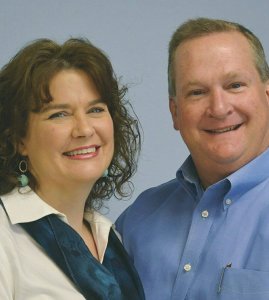 My husband and I have been discussing this question, and he wanted to add the following thoughts, man to man, for husbands.
