Bible, Mailbag

The Mailbag: Which Bible Do You Recommend?

I was saved out of Mormonism but, as a new Christian, spent some time in the Word of Faith movement. I want a Bible that hasn’t been tampered with by a false religion, but I’m not sure which one I can trust. Which Bible do you recommend?

What a blessing it is to even be able to ask this question! You would not ask this question if God had not graciously saved you, and you could not ask this question if there weren’t a ton of different Bibles available in English, nor if you lived in a country where it is illegal to own a copy of God’s word. It’s a dilemma, but it’s a good dilemma to have.

The good news is that there are many fantastic Bibles out there- far more good ones than bad, and far more than I could recommend in this brief article. So, please don’t take this as an exhaustive list or think that because I’ve left a certain Bible out that it isn’t any good.

The first thing you want to look for is a good translation, not a paraphrase. You want to know what God said through Paul, not what somebody 2000 years later thinks about what God said through Paul. You’re looking to get as close to the original wording as is possible.

There are several great English translations on the market. I started using the English Standard Version (ESV) about four years ago, and I love it. Prior to that I used the New American Standard Bible (NASB) for about 20 years. It is also an excellent translation. If you’re familiar with various Bible translations, ESV is, in my opinion, like a more accurate, more linguistically sophisticated 1984 New International Version (NIV). NASB is like a cross between the King James Version (KJV) and the 1984 NIV, but more accurate. The Legacy Standard Bible (LSB), is excellent and is basically a recent precision update of the NASB. In my opinion, ESV, NASB, and LSB are the best translations out there today.

There are, however, several other solid translations such as the New King James Version (NKJV), the Lexham English Bible (LEB), the Christian Standard Bible (CSB– This is a newly revised version of the Holman Christian Standard Bible {HCSB}, and they’re dropping the “Holman”. So HCSB and CSB – whichever one you happen to see – are the same thing.), and the “old” or “1984”ย NIV (You want to stay away from the TNIV {Today’s New International Version}, now out of print, and any 2011 or later NIV, as those both contain gender neutral/inclusive language. The 1984 edition is also out of print, but you may be able to acquire one from a second hand store.)

The KJV is a good translation and the language is beautiful, but if you have trouble with 1611 English, itโ€™s not the only game in town anymore. Some of our modern translations are actually more accurate than the KJV because thousands more biblical manuscripts have been discovered since it was first published, allowing translators to be more precise.

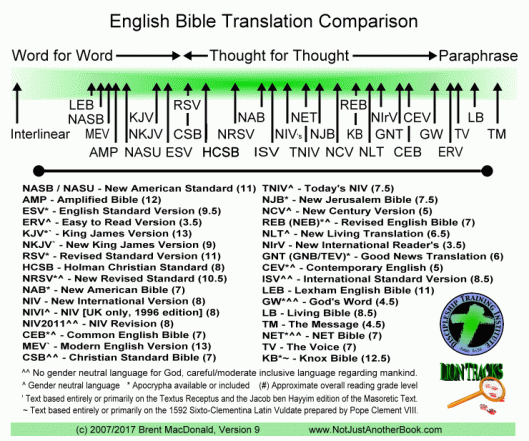
Below is a helpful chart from Brent MacDonald of Not Just Another Book comparing a number of different translations and paraphrases. (On this chart, it’s good to be a “leftist”).

bibletranslationcomparisonsmall

You can try most of these translations out for free at Bible Gateway. There’s even a great feature that allows you to compare several versions side by side:

Just as there are a number of good Bible versions I would recommend, there are a few I’m familiar with which I would strongly recommend against: The Message, The Voice, The Passion Translation, The Amplified Bible, and any “translation” that uses gender neutral language.

More than a few articles have voiced concerns over The Message’s – a paraphrase – often misleading texts. (I would add that Eugene Peterson {author of The Message} frequently shows poor discernment. One recent example is his front cover endorsement of the heresy-laden book – and movie – The Shack.)

The Voice is not only a paraphrase, its contributors include female “pastors” and false teachers such as Brian McLaren, Phyllis Tickle, Chris Seay, and Leonard Sweet.

The Passion Translation is a New Apostolic Reformation version of the Bible which actually changes the wording of many verses in order to fit the NAR agenda. Click here for a Bible translation scholar’s review of Passion’s version of Psalms.

The Amplified Bible falls prey to an improper translation technique called illegitimate totality transfer, which, in its attempt to clarify a particular word or phrase, may actually end up causing you to misunderstand the correct meaning of the verse.

I’ve already mentioned the post-1984 versions of the NIV, but be sure to avoid any “translation” of the Bible that uses gender neutral language extensively or exclusively. And you certainly don’t want a “Bible” that uses neutral or feminine pronouns or references to God – those should always be male.

There are some perfectly reliable and accurate newer Bible translations that will, for example, occasionally render (or add a footnote) “brothers” as “brothers and sisters” when it’s clear from the context that Paul is talking to or about the entire church. That’s not what we’re talking about here. We’re talking about changing passages clearly referring only to men to include women. Thus, these “translations” are actually changing God’s words. Let me give you an example from the Common English Bible (CEB). This is 1 Timothy 3:1-7:

This saying is reliable: if anyone has a goal to be a supervisor in the church, they want a good thing. 2 So the churchโ€™s supervisor must be without fault. They should be faithful to their spouse, sober, modest, and honest. They should show hospitality and be skilled at teaching. 3 They shouldnโ€™t be addicted to alcohol or be a bully. Instead, they should be gentle, peaceable, and not greedy. 4 They should manage their own household wellโ€”they should see that their children are obedient with complete respect, 5 because if they donโ€™t know how to manage their own household, how can they take care of Godโ€™s church? 6 They shouldnโ€™t be new believers so that they wonโ€™t become proud and fall under the devilโ€™s spell. 7 They should also have a good reputation with those outside the church so that they wonโ€™t be embarrassed and fall into the devilโ€™s trap.

Compare this to any reliable translation, and you’ll see the problem (and not just with the gender neutral language). I recently saw a woman “pastor” defend her right to serve in that office from this passage in the CEB “translation,” which, I imagine, is precisely the reason it was rendered this way. (It appears that there are likely a number of other problems with the CEB, as well. I looked only at the passage above and 1 Timothy 2:11-15, and the translation of that passage is completely botched as well, erroneously rendering “woman” and “man” as “wife” and “husband,” removing the “for/because” at the beginning of 13, and completely mangling the meanings of verses 14 and 15. This passage could also be used to support the sins of women preaching, pastoring, and holding authority over men in the church. Again, compare this to any reliable translation.)

If you’re looking for a good study Bible (or want to avoid a bad one), I’ve discussed that a bit here (#4). I frequently use and highly recommend both the ESV MacArthur Study Bible and the Faithlife Study Bible (which is FREE!). When shopping for a study Bible, do you homework and vet the contributors. Avoid any study Bibles whose contributors are false teachers, theologians from apostate churches, female “pastors,” etc. Some in particular I would recommend you avoid are the CSB LifeWay Women’s Bible, ESV Women’s Study Bible and the YouVersion app (all feature false teachers). And check out this article from Tim Challies: What Makes a Really Good Study Bible?.

Looking for a great Bible app? Check these out.


If you have a question about: a Bible passage, an aspect of theology, a current issue in Christianity, or how to biblically handle a family, life, or church situation, comment below (Iโ€™ll hold all questions in queue {unpublished} for a future edition of The Mailbag) or send me an e-mail or private message. If your question is chosen for publication, your anonymity will be protected.
Mailbag

The Mailbag: Is It OK for Christian Women to Wear Bikinis?

It’s that time of year again, ladies. :0)

Foreword: I re-run this article every year in late winter / early spring. And every year, there are a handful of my followers who get mad that I don’t simply say, “No. It is not OK for Christian women to wear bikinis.”

If you’re one of those people, you’re missing the point of this article.

It’s easy to throw out a hard and fast law. It’s not so easy – especially for new Christians and those who come from a background of legalism – to practice biblical decision-making, a skill all Christians need to hone and implement in every area of our lives.

This article is a teaching moment. It’s an opportunity for women to take a fairly easy question that they pretty much already know the answer to and learn how to go through the steps to arriving at a biblical answer.

Remember back in school when your math teacher would make you show your work? She did that because getting the right answer is only a part of problem solving. Understanding and correctly doing all the steps – in order – to arrive at the right answer is the bulk of what she was trying to teach you. This is a “show your work” kind of article.


Summer is just around the corner, so a lot of women will soon be shopping for swimwear. With regard to modesty- do you think it’s OK for Christian women to wear bikinis?

I’m trying to remember back to the days when I might have actually considered – without doubling over in laughter – wearing a bikini. It was a really long time ago. Young, svelte sisters, if I may bring you a bit of comfort- you won’t have to grapple with this question for the rest of your life. As your other older sisters and I can attest, one day, age-appropriateness, your figure, sun exposure, and the desire not to frighten people will make this decision for you long before you have to consider modesty as part of the equation. It’s one of the blessings of getting older.

Just to make sure we’re all on the same page here, let’s quickly define our terms. When I say “bikini,” I’m talking about the fabric equivalent of a bra and panties, not swimwear that covers a lot more yet comes in two pieces.

bikini

not bikinis

Generally speaking, I don’t think bikinis are wise in public unless you’re wearing a shirt or some kind of cover up over it. I’m reluctant to make a hard and fast law about it, though, because, as I’m sure you’re aware, the Bible doesn’t say “Thou shalt not wear a bikini.” (My husband would like to chime in here and says, “However, if you and your husband have a private place for just the two of you to swim or sunbathe, go for it!” You’re welcome, guys.)

A law is a fast and easy “yes” or “no” answer to our question- which is often what our flesh wants, because our flesh is lazy.

As with various other issues, the Bible gives us a general principle (in this case about dressing modestly) and we work out our own salvation in our own cultural context according to all pertinent biblical principles and our own consciences. A law is a fast and easy “yes” or “no” answer to our question- which is often what our flesh wants, because our flesh is lazy. But what God wants Christians to do is study His Word about the issue, pray, and ask Him for wisdom to make a godly decision. When we work through this process, it helps us to develop a greater desire to be conformed to the image of Christ and to be obedient to Him.

What God wants Christians to do is study His Word about the issue, pray, and ask Him for wisdom to make a godly decision.

Let’s take a look at just one passage of Scripture that could be helpful in this regard:

3Do nothing from selfish ambition or conceit, but in humility count others more significant than yourselves. 4Let each of you look not only to his own interests, but also to the interests of others. 5Have this mind among yourselves, which is yours in Christ Jesus, 6who, though he was in the form of God, did not count equality with God a thing to be grasped, 7but emptied himself, by taking the form of a servant, being born in the likeness of men. 8And being found in human form, he humbled himself by becoming obedient to the point of death, even death on a cross.
Philippians 2:3-8 

So, at first glance, you might wonder, “What in the world does this passage have to do with wearing a bikini?” It doesn’t have anything to do with the bikini itself, it zeros in on your heart (Why do you want to wear a bikini?) and your sanctification (Will wearing a bikini make me more Christlike?).

Verse 3a:
Examine your heart- could your motive for wearing a bikini be classified as selfish ambition or vain conceit? Is it possible you want to show your body off to men to appear desirable, or to women to make them jealous?

Verse 3b-4:
Is this a situation in which you should humble yourself and put the interests of those men who might be tempted to lust or those women who might be tempted to covet ahead of your own desire to appear attractive?

Verse 5:
Do you truly desire to have the same mindset as Christ- about this issue and all others?

Verse 6-8:
How did Jesus approach life, according to these verses? He set aside His own rights and privileges (6), He took on the role of a servant (7), He humbled Himself and was obedient to the point of death (8).

When it comes to wearing a bikini, are you willing to have the same mindset as Christ? To set aside your own rights and privileges, be a servant to others, humble yourself, and obey Christ even to the point of death?

These are not questions God wants me to answer for you. These are questions He wants you to come to Him and answer, because He wants your heart. And He wants you to examine your heart and see if it belongs to Him in this area.

Additional Resources:

Is it Okay for Christian Women to Wear Bikinis? at When We Understand the Text

Modesty, parts 1, 2, & 3 at A Word Fitly Spoken

If you’re looking for modest swimwear – even swim dresses – there are several online companies, such as Calypsa, that may have what you’re looking for. Try searching “modest swimwear”. Have you already found a great company you love? Suggest it in the comments below!


If you have a question about: a Bible passage, an aspect of theology, a current issue in Christianity, or how to biblically handle a family, life, or church situation, comment below (Iโ€™ll hold all questions in queue {unpublished} for a future edition of The Mailbag) or send me an e-mail or private message. If your question is chosen for publication, your anonymity will be protected.

Mailbag

The Mailbag: How Can I Find a Good Church?

mailbag


I had to leave my old church (due to unbiblical teaching, because I moved, etc.). How can I find a new, doctrinally sound church?

I get this question a lot, and it’s one of my favorites, because it means the person is thinking about what constitutes a healthy, doctrinally sound church and seeking one out instead of going somewhere she can get her ears tickled. There are a lot of churches out there that have gone off the rails, but there are still a lot of good churches out there as well.

First, you need to know what makes a church doctrinally sound or unsound, which means you have to know what the Bible says about salvation, the Trinity, creation, sin, etc., all the major doctrines, well enough to know whether the church you’re considering believes and practices what the Bible says. I’m a little partial, but I think my denomination’s statement of faith does a decent job of succinctly outlining and giving an overview of the biblical position on the major doctrines, in case you need to study up a little (of course there are some finer points of doctrine you’ll want to take a look at, too).

In addition to what we would think of as the church’s main doctrines, there are some other vital things you’ll want to take into consideration when considering whether a church is healthy, such as whether the church is complementarian or egalitarian, what, if any, connection the church has with false teachers or their materials, whether the church is cessationist or continuationist, how the church handles the music portion of the worship service, and so on.

You can find information on all of these doctrinal issues and more by studying the resources under “What to look for in a church” at the “Searching for a new church?” tab in the blue menu bar at the top of this page.

Ready to start hunting for a new church home? Here are a few guidelines:

1.ย Pray. Ask God to give you wisdom as you search and to guide you to the right church for your family.

2.ย Ask around in person or on social media. Do you have friends or family in the area who could point you to a good church? If your current church is doctrinally sound (i.e. you’re only leaving it because you’re moving), ask your pastor for recommendations. Be sure the people you ask are trustworthy, doctrinally sound Christians.

3.ย Use the church “search engines” at theย “Searching for a new church?” tab in the blue menu bar at the top of this page. Keep in mind that no church is perfect, and you may have to try a church that’s a different denomination than you’re used to, doesn’t meet all your preferences, or that is a bit farther away than you prefer.

4. If you have thoroughly exhausted all of the church search engines at the link above (#3) and none of your friends/family have any good suggestions, contact me, and I’ll be glad to ask around on my social media pages. I’ll keep your name confidential, but I’ll need to know the city and state/country where you’re looking for a church. (Please understand that if you aren’t able to find a church through the search engines or someone you know, it is unlikely that one of my social media followers will be able to come up with anything. This is a “last ditch effort” sort of thing. The search engines are your best bet.)

5. Found a church you think might be a good one? Examine its web site well. Does it have a solid statement of faith? Any female “pastors” on staff? Is the small group Bible study using a book by a false teacher? Are there pictures of members attending the latest gay pride rally? Are there sermons on the site you could listen to? Look for what the church is doing right and any areas that are red flags you should ask about (Be careful not to jump to conclusions, you could be mistaken about something. Ask.)

6. Did the church pass the web site test? Try it on for size. Visit a few times and see if it seems like a good fit.

7. If you’ve been visiting and think this church might be “the one,” schedule an appointment with the pastor (preferably during his office hours, if possible). Ask any questions you still have and ask how you and your family can get plugged in and serve.

Don’t forget- you’re not going to find the perfect church. Any church you join is going to have some problems. Our goal is not to find a place where we’ll be completely comfortable with never a ruffled feather and all of our preferences catered to. Our goal is to find the most doctrinally sound church we can, roll up our sleeves, and get to work serving, loving, and worshiping.


If you have a question about: a Bible passage, an aspect of theology, a current issue in Christianity, or how to biblically handle a family, life, or church situation, comment below (Iโ€™ll hold all questions in queue {unpublished} for a future edition of The Mailbag) or send me an e-mail or private message. If your question is chosen for publication, your anonymity will be protected.

Mailbag

The Mailbag: Christian Fiction Recommendations

This article is kept updated as needed.

I love to read Christian fiction but find that it can be a bit of a minefield. It can get off course theologically and may reflect the world more than biblical Christianity. Have you ever given recommendations on Christian fiction writers?

Great question! We all need a little mind candy now and then, but we don’t want it to be a vehicle for delivering bad theology to our brains.

First, let me sort of set the stage for what’s in my mind when I think of “Christian fiction.” Other people might have other definitions of this book genre, and that’s absolutely no problem, but, to me, Christian fiction has an overtly biblical message or theme and maybe even a blatant presentation of the gospel. When I think of “Christian fiction” I’m not thinking merely “family friendly” (a good clean story with nothing biblical in it), or a novel with a character in it who happens to attend church or be a Christian but there’s nothing else biblical in the book, or a fiction book on a non-biblical topic that’s written by someone who’s a Christian. So the books I’ll be recommending below will fit this definition of “Christian fiction.”

Next, I know the bulk of Christian fiction marketed to women is romance and Amish romance. And, in keeping with the “stick out like a sore thumb” weirdness that is Michelle Lesley, it’s not a genre (Christian or secular) I personally enjoy. There’s nothing wrong with it if you can find a good one and you like romances, but the books below aren’t romances simply because that’s not what I read. I tend toward biblical history novels and – I don’t know if there’s a particular name for this type – “real life scenario” contemporary Christian lit.

A few final points:

โ€ขI don’t hold Christian fiction to quite as high a theological standard as I do Christian non-fiction (theology, Bible studies, “Christian living” books, etc.). Some of the books below may have a few theological “cow pies” you’ll have to step around and ignore, but, for the most part they’re in line with biblical theology.

โ€ขMy personal standard for recommending a biblical historical fiction book (a fictionalized account of a true Bible story, such as Lynn Austin’s and Chris Skates’ books below) is that the book has to stay true to what the Bible actually says took place including the dialogue, details, and chronology, and any of the fictionalized parts have to comply with biblical principles, theme, history, and culture of the time period.

โ€ขI haven’t checked any of these authors (as I would non-fiction Christian authors) to see where they stand on the role of women in the church, and I haven’t researched any of them to discover whether they associate with false teachers.

That said, here are a few recommendations:

Karen Kingsbury– Although her older works of fiction may not be too problematic, she is not someone I’d encourage you to read because of her recent theological trajectory.

Lynn Austin– Here’s a “book report” I wrote on Lynn Austin’s Chronicles of the Kings series. I read that entire series and loved it. It was VERY good and theologically strong.

Chris Skates– Chris’ biblical historical fiction rendition of the story of Noah and his family in The Rain was a fun read.

Those are the only ones I’ve actually written about. Here are some others I’ve read and enjoyed over the years. (Quoted excerpts courtesy of Amazon.com)

Hank “The Bible Answer Man” Hannegraaff:

The Last Disciple– “As the early church begins to experience the turbulence Christ prophesied as the beginning of the last days, an enemy seeks to find Johnโ€™s letter, Revelation, and destroy it. Meanwhile the early Christians must decipher it and cling to the hope it provides as they face the greatest of all persecutions.”

(Update: A few months after the original publication of this article, Hank Hannegraaff decided to join the Greek Orthodox church. Though I read and enjoyed this fictional book of his, I would no longer recommend his non-fiction work or ministry as biblically trustworthy.)

Paul Maier:

A Skeleton in God’s Closet– “Dr. Jonathan Weber, Harvard professor and biblical scholar, is looking forward to his sabbatical year on an archaeological dig in Israel. But a spectacular find that seems to be an archaeologistโ€™s dream-come-true becomes a nightmare that many fear will be the death rattle of Christianity.”

The Constantine Codex– “While touring monasteries in Greece, Jon and his wife Shannonโ€”a seasoned archaeologistโ€”uncover an ancient biblical manuscript containing the lost ending of Mark and an additional book of the Bible. If proven authentic, the codex could forever change the way the world views the holy Word of God.”

Kathi Macias:

People of the Book– “Farah lives in Riyadh, Saudi Arabia, with her family, and wants nothing more than to develop a deeper devotion to her Muslim faith. She sees the month of Ramadan as her chance to draw nearer to Allah, and pursues that goal. All goes well until the prophet Isaโ€”Jesusโ€”appears to her in a dream and calls her to Himself.”

Joy DeKok:

Rain Dance– “What happens when a Christian woman facing a childless future and a woman seeking an abortion are waiting to see the same doctor? What if after that “chance” encounter they are unable to forget each other?”

Randy Alcorn: I’ve read and enjoyed most of Randy’s fiction books. Off the top of my head, I don’t recall any I wouldn’t recommend. Two of my favorites were:

Safely Home– “Is this the day I die? Li Quan asks himself this question daily, knowing that he might be killed for practicing his faith. American businessman Ben Fielding has no idea what his brilliant former college roommate is facing…But when they are reunited in China after twenty years, both men are shocked at what they discover about each other.”

Edge of Eternity– I would call this book a modern day Pilgrim’s Progress. “Imagine Being Pulled Into the Hereafter. While Youโ€™re Still Alive. A disillusioned business executive whose life has hit a dead-end, Nick Seagrave has lost loved ones to tragedy and his family to neglect. Now, at a point of great crisis, he unbelievably and inexplicably finds himself transported to what appears to be another world.”

Frank Peretti: Years ago, I was a big Frank Peretti fan and read most of his novels. I don’t remember any overt heresy in his work, but it’s been well over a decade since I’ve read anything by him, so that could just be my faulty memory. Most of his novels deal with spiritual warfare, so there’s the potential for some errant theology there. Read discerningly. Two of my Peretti favorites are:

This Present Darkness and Piercing the Darkness (a two book series)- “The small town of Ashton is the unexpected setting for an epic clash between good and evil as a Christian preacher and a news reporter unearth a plot to take over their small community, and eventually the world.”

There are also some books that would fall under the category of Christian fiction which I would strongly recommend against:

The Shack (or any other book) by William Paul Young: While I mentioned that I don’t hold Christian fiction to as high a theological standard as Christian non-fiction, I definitely don’t recommend any Christian fiction fraught with blatant heresy or whose main goal is to teach heresy, and that’s what Young himself has stated is one of the objectives of this book (although he doesn’t consider his views heresy). The movie based on this book releases next month (March 2017). Here are some resources that will explain the theological problems in The Shack in more detail.

Redeeming Love (the book or the movie) by Francine Rivers

The Chosen (any books or materials): Yes, it’s fiction. If you want the non-fiction version, read your Bible.

Inappropriate/Unbiblical Content: In an effort, I guess, to be cutting edge, cool, or gritty, there are novels marketed under the Christian fiction genre which contain profanity, graphic sex scenes, and glorification of other sinful behavior. I would not recommend those books regardless of the reason these types of things are included in the book.

Girl “Porn”: This is really more about what’s going on in the reader’s heart than the book itself. It’s been said that romance novels can be a form of literary “pornography” for women. I mentioned graphic sex scenes above, but I would also caution women away from non-graphic Christian romances if they cause you to create an idol in your heart of the “ideal” man that no real life man can measure up to. If you’re married, read a lot of romances, and find yourself increasingly dissatisfied (in any way) with your husband because he can’t hold a candle to the leading men in the books you’re reading, you need to put those books down and walk away from them. That’s coveting.

False Teacher Fiction: There are a few false teachers who have branched out into the fiction genre. Beth Moore and Priscilla Shirer have both recently released novels, T.D. Jakes has written some fiction, and I believe there are a few others. Even though these books may be fiction and might not even contain any false doctrine, I could not, in good conscience recommend a fiction book that could serve as a “gateway drug” to their non-fiction books.


If you have a question about: a Bible passage, an aspect of theology, a current issue in Christianity, or how to biblically handle a family, life, or church situation, comment below (Iโ€™ll hold all questions in queue {unpublished} for a future edition of The Mailbag) or send me an e-mail or private message. If your question is chosen for publication, your anonymity will be protected.

Mailbag

The Mailbag: False Doctrine in Contemporary Christian Music

This article is kept updated as needed.

I’ve noticed that false doctrine is not just restricted to sermons, conferences, and Bible studies, but that I have to watch out for it in the contemporary Christian music (CCM) I listen to as well. Are there any CCM groups, artists, or songs I should avoid? Can you recommend any specific doctrinally sound artists or groups?

You’re absolutely right that we need to be careful about what we listen to that wears the label “Christian.” There is a lot of beautiful, doctrinally sound, theologically rich music of all genres out there, and there’s a lot of junk as well.

I’d like to offer a couple of caveats before diving into the answer for this question:

1. I plead extreme ignorance when it comes to CCM. With rare exception, it’s not a genre I enjoy, I don’t listen to it, and the worship service I attend uses “traditional” (mostly hymns) music, so I’m not often exposed to it. I’m all in favor of doctrinally sound CCM for those who like that genre, it’s just not my personal cup of tea or an area I research.

So, in this article I’m going to tell you what little I know, point you to people and resources better equipped to answer this question, and lean heavily on you discerning CCM listeners for help (more on that in a bit).

2. There is lousy theology in every genre of music. There are lousy hymns, lousy Christian rap, lousy CCM, lousy gospel, lousy Southern gospel, etc. This question was asked specifically about CCM, so that’s what the answer is going to focus on. It’s not a debate about hymns or exclusive psalmody versus CCM.

3. Depending on music from currently popular musicians is a lot like depending on Bible studies from currently popular evangelical authors. The majority of them aren’t doctrinally sound, and even the few that are seem to be apostatizing at an alarming rate. My recommendation to churches? Either go back to using tried and true doctrinally sound hymns, sing the Psalms, or find some talented musicians and lyricists in your own (doctrinally sound) church and put them to work writing songs for your worship service.


Why is it important to be discerning about Christian music? Because the music we use in church and listen to at home teaches us theology, and it sticks in our memories (which is why a lot of Scripture memory programs set Bible verses to music to help with memorization). You probably couldnโ€™t recite verbatim a quote from last Sundayโ€™s sermon, but Iโ€™ll bet you know the lyrics of a lot of songs by heart. Itโ€™s important that those lyrics contain good theology.

It’s imperative for churches to be discerning about the CCM they use in worship. If Jane Churchmember hears a CCM song in church and likes it, she’s likely to Google the song (probably right there in church- I’ve done it!), find out who sings it, and begin following that artist. Worship pastors who use CCM have a responsibility to vet the artists who perform the songs they select for the worship service to make sure they’re not sending Jane into the arms of a heretic. Additionally, music costs money, and you don’t want your church’s offerings supporting false doctrine.

Now, every time I address the subject of being discerning about worship music and that churches should not use worship music from heretical sources (such as Bethel, Hillsong, and Elevation, see below) someone who’s defending using music from these heretical sources will invariably pipe up with this well worn canard1:

Well, [insert name of hymn writer here] wrote lots of perfectly biblical hymns, but he had some theological problems too, and youโ€™re not recommending we get rid of all of his hymns.

Well, first of all, maybe we should more closely examine the theology of some of our most prolific hymnists and stop using their music because of what they believed. Quick โ€“ off the top of your head, name the three we should start withโ€ฆ

โ€ฆAnd thatโ€™s what separates the errant hymnist from Bethel, et al. Most Christians, even those who prefer hymns over CCM, could probably not name three people who wrote hymns, let alone tell you anything about their theology. But if you ask the average Christian to name three top Christian artists, she could rattle them off in a second.

Most hymn writers have been dead for up to hundreds of years. They donโ€™t have Facebook pages you can follow, nobodyโ€™s playing their stuff on KLOVE, theyโ€™re not on tour to promote their latest album, they donโ€™t have thousands of followers worldwide, and their music is in the public domain, so your church isn’t financially supporting them or their work. If you wanted to follow their errant theology, youโ€™d have to hit the books to research and study it. Contemporary musiciansโ€™ theology is only a click away on YouTube, social media, live streamed concerts and conferences, and on their web sites. Nobody is following dead hymnistsโ€™ false doctrine, but hordes are following contemporary musiciansโ€™ heresy.

๐Ÿ”ดArtists to Avoid
Tiffany Arbuckle (Plumb) (homosexuality affirming)
Cory Asbury
Susan Ashton (homosexuality affirming)
Audrey Assad (Catholic)
Avalon (homosexuality affirming)
Ray Bolz (homosexual)
Bethel Music
Jada Cato (homosexuality affirming)
Lauren Daigle
Scott Dente (Out of the Grey) (homosexuality affirming)
Melinda Doolittle (homosexuality affirming)
Elevation Music
Five Iron Frenzy (homosexuality affirming, pro-abortion)
Charity Gayle
Amy Grant (homosexuality affirming)
Sara Groves (homosexuality affirming)
Kim Hill (homosexuality affirming)
Hillsong
Jars of Clay (homosexuality, transsexuality affirming, pro-abortion)
Jesus Culture
Kari Jobe
Jennifer Knapp (homosexual)
Brandon Lake (NAR, close ties with Bethel, Maverick City Music {see below})
Rachel Lampa (homosexuality affirming)
Crystal Lewis (homosexuality affirming)
Matt Maher (Catholic)
Maverick City Music (woke, homosexuality affirming, partners with Elevation)
Kevin Max (DC Talk) (homosexuality affirming)
Andrew Mitch (homosexuality affirming)
Nichole Nordemanย (Nichole has extensive ties to a plethora of false teachers and supported Jen Hatmaker’s embrace of homosexuality in the church, and Michael Passon’s homosexuality.)
Point of Grace (homosexuality affirming)
Rachel Potter (homosexuality affirming)
Relient K (homosexuality affirming)
Rend Collective (homosexuality, transsexuality affirming, numerous issues of false doctrine)
Jessica Rose (homosexuality affirming)
Bryan Rub (homosexuality affirming)
Switchfoot (homosexuality affirming)
Michael Tait
Phil Wickham (in the NAR camp, close ties to Bethel)
CeCe Winans (Love) (Female “pastor”)

These from Protestia.

How “Testify to Love” Became a Song about Something Else with Gabriel Hughes (Avalon -and many of the other bands / artists listed above- affirm homosexuality.)

Let’s Talk About the Worship Music at the [Charlie Kirk] Memorial Service… with Dawn Hill

And anyone else who closely associates with any of the above (performing together, co-writing songs, Bethel Music produces their albums, etc.)

๐ŸŸกArtists I Don’t Proactively Recommend (i.e. Use Caution or Avoid)

Casting Crowns has toured with Hillsong. Hillsong – not CC – pulled out of their 2022 tour due to the scandals with Brian Houston.

CityAlight is the music ministry of St. Paul’s Anglican Church, which occasionally allows women to preach and has a few ties to Hillsong (covering Hillsong songs, also this video was recorded at Hillsong studios, see info. section).

Selah member, Todd Smith, is the husband of Angie Smith.

Shane and Shane uses mostly Bethel, Hillsong, and Elevation music (along with music by other problematic artists) in their Worship Initiative ministry. They have also performed with Bethel.

Doctrinally Sound Artists:
The Corner Room
Keith and Kristyn Getty* 
Hymnology
Indelible Grace Music
Sovereign Grace Music

*(January 2021- Keep an eye on the Gettys. They’re still doctrinally sound as far as I know, but over the past couple of years, they have been platforming some biblically problematic personalities at their events. Jon Harris discusses this on the Russell Fuller reveals more, The Getty’s invited who?, & SEBTS prof. takes on The Gospel Coalition episode of Conversations that Matter, ~28:04)

There are probably many others that belong on all three of these lists, but those are the only names I personally know to give you.

Owen Strachan recently made some recommendations of songwriters, though they’re not all contemporary, on Twitter: (others also responded with suggestions, click here to see):

(I’m not familiar with all of these, but in case you need their first names to look them up: Bob Kauflin, Stuart Townend, Matt Papa, John Newton, Martin Luther, Horatio Spafford.)

My Facebook followers have recommended a number of radio stations, apps, and other ways to listen to doctrinally sound music from doctrinally sound sources.

You will, of course, need to vet for yourself the theology and associations of any musician or group you decide to follow. It’s not quite the same as vetting a teacher or pastor, but several of the principles in my article Is She a False Teacher? 7 Steps to Figuring it Out on Your Own can be adapted for vetting musicians. Additionally, I would recommend three things when deciding whether or not to listen to someone:

1. Look up the lyrics of about half a dozen of her latest songs and examine the lyrics against Scripture. It’s helpful to look at the words in front of you without hearing the music so you can really think about them without being emotionally influenced by the music. Are they biblical?

2. Look to see who the artist associates with and admires. The easiest way to do this is to check their Facebook and Twitter feeds. Do you see scads of re-tweets and shares of posts from false teachers? Is she on tour with, co-writing songs with, or having her albums produced by a musician you know should be avoided?

3. Go to the artist’s web site, and examine her statement of faith (if she has one) and the venues she’ll be playing. Does she frequently play at places like Bethel? Lakewood? The Potter’s House? Is she the worship leader at a lot of conferences featuring false teachers? You might also want to look at her bio to see if she mentions her home church. If she’s a member of a church headed up by a false teacher, that’s definitely a red flag.

Below you’ll find some helpful additional resources relating to specific songs, artists, and the CCM industry. I’d also like to solicit the help of you discerning listeners of CCM:

Are there CCM songs or artists you would recommend avoiding due to biblically demonstrable sin or false doctrine? Please comment below with the exact name of the artist/song, the reason to avoid said artist/song, and a link(s) providing lyrics and/or objective support for your reason.
Unsubstantiated accusations will not be published.
Are there doctrinally sound artists you would recommend? Please comment with the name of the artist (and preferably a link to his/her web site) below.


1From my article The Mailbag: Should Christians Listen to Reckless Love?


Additional Resources

Why Your Church Should Stop Playing Bethel, Hillsong, Elevation, and Jesus Culture

The Mailbag: โ€œI Speak Jesus,โ€ Charity Gayle, and How to Vet Christian Music

Let’s talk about the worship music at the memorial service… at The Lovesick Scribe

The Discernment in Music Archive at Faithful Stewardship

Sound in Worship by Justin Rea

Christian Music Review from Reformed Fellowship Church

Worship Song Ratings by Sandy Simpson

What’s So Bad About Christian Radio by Gabe Hughes

Psalms, Hymns, and Spiritual Songs: Putting Popular Church Music to the Test by Gabe Hughes

In Response to Putting Popular Church Music to the Test by Gabe Hughes

Psalms, Hymns, and Spiritual Songs (vol. 2) by Gabe Hughes

Once Again, Critiquing the Most Popular Praise and Worship Songs by Gabe Hughes

Let’s Talk About the Worship Music at the [Charlie Kirk] Memorial Service… with Dawn Hill


If you have a question about: a Bible passage, an aspect of theology, a current issue in Christianity, or how to biblically handle a family, life, or church situation, comment below (Iโ€™ll hold all questions in queue {unpublished} for a future edition of The Mailbag) or send me an e-mail or private message. If your question is chosen for publication, your anonymity will be protected.