
Mailbag

The Mailbag: What’s your take on White-Howse/Charlottesville/Trump?


What’s your take on the James White/Brannon Howse IFD controversy? The Charlottesville tragedy and other issues of racism? Anything and everything Donald Trump says and does?

There are a lot of divisive situations going on in the world these days. It’s no longer simply, “Did you hear the news?” but, “Which side of the news are you on?” And it seems like, more and more, the evangelical public requires – demands even- that every Christian who has any sort of an audience must declare to the world whose side we’re on or what our position on the issue is. I mean, come on; if people are asking some nobody like me where I stand on various news stories, you know things have gotten out of hand. It’s not that I mind people asking my opinion, it’s just that I’m baffled as to why anyone would care what I think.

But for those of you who really want to know what I think on these issues, here ya go:

1. It doesn’t matter what I think, it matters what God’s Word says.

I’ve said this, like, at least a thousand times on this blog in relation to homosexuality, female preachers, church attendance, and any number of other biblical concepts, and it applies to current events as well. I could give you my opinion, but if it differs from what Scripture says, you’d better not listen to it. And if it’s in line with what Scripture says, well, the Bible says it far better than I ever could, so my opinion is superfluous.

2. It doesn’t matter what I think, it matters what YOU think.

When it comes to what or how to think about a certain situation, the primary source that should shape your thoughts is God’s Word. Not me, not Christian celebrities, not your family and friends: the Bible. You need to be able to think biblically for yourself, not just blindly believe the thoughts and opinions of someone you look up to. When you stand before God one day, I don’t know what all He might ask you, but I feel pretty safe in guessing that He’s not going to ask you what Michelle Lesley thought about a dewdrop on a blade of grass. If you want to know what to think about something, get your Bible out and study what it has to say on the subject.

3. It doesn’t matter what I think because voicing my opinion isn’t going to help or change the situation.

Take the White-Howse controversy for example (and if you don’t know what that is, Google it – I don’t have the energy to get into that whole can of worms). I don’t know, have access to, or closely follow either James White or Brannon Howse, so not only do I not have a dog in this hunt, but no public declaration from me is going to patch things up between them, bring about repentance wherever it might be needed, or solve the problems involved. I do, however, have friends on both sides of the issue. So the only thing a public opinion from me would do would be to alienate people on one side or the other, and, personally, I don’t think this particular controversy is worth that.

4. It’s an unnecessary distraction from the focus of my ministry.

Maybe the focus of your ministry is on racial issues within Christianity. Or rightly applying Scripture to politics. Or the proper way to evangelize Muslims. If so, it would only make sense that you’d speak out about the issues enumerated in today’s Mailbag question. The focus of my ministry is women’s discipleship: teaching Christian women how to rightly handle and apply God’s Word to your life so you can grow in Christ and better serve Him, your family, your church, and others. I’m willing to get controversial when I have to and when it furthers that ministry focus (such as my discernment articles). But to get off into the weeds of, say, the border wall, health care, and taxes (and all the questions, comments, and controversies that go with those issues), would be a distraction from what I’m trying to accomplish here.

5. Not every hill is a hill to die on.

There are a lot of hills I’m willing to die on, and virtually all of them have a chapter and verse reference. I do not like to see Scripture mishandled and false doctrine preached because people’s eternities are at stake, the health of the church is at stake, and Christian women’s sanctification is at stake. I am willing to fight those fights to the death and take the flak the Enemy and his servants hurl at me. But if I fight every fight that comes along, I’m not going to have the time or the strength to fight the battles that God has uniquely gifted and equipped me to fight. Other Christians, have a much better grasp of, and experience with, for example, the racial issues plaguing our country today. I would prefer to remain silent and learn from them. Sometimes the best contribution I can make to a discourse is to keep my mouth shut and listen.

6. It’s just annoying noise.

It makes me crazy when something happens in the news and that’s all anybody can talk about – in person or on social media. (It’s not wrong for people to talk abut these things, mind you, it just gets on my nerves hearing the same remarks and conversations over and over again.) When a scrillion people have already given their opinion on a particular issue – especially when a lot of them are saying the same thing I’d say – what is the everlovin’ point of adding my voice to the cacophony? All that does is put one more annoying opinion in your social media feed when you’d rather be seeing pictures of your friend’s new baby, reading someone’s quote of a Bible verse, or drooling over the latest recipe video.

Sometimes I comment on current events. Sometimes I don’t. When I don’t it’s usually for one of these six reasons, or because I don’t have time, or I’m not interested in the subject, or I’m not knowledgeable enough about the subject to make an intelligent comment, or because I’m not in the mood.

Or maybe I just found a really good recipe video to drool over instead :0)


If you have a question about: a Bible passage, an aspect of theology, a current issue in Christianity, or how to biblically handle a family, life, or church situation, comment below (I’ll hold all questions in queue {unpublished} for a future edition of The Mailbag) or send me an e-mail or private message. If your question is chosen for publication, your anonymity will be protected.


Discernment, Mailbag

The Mailbag: Should I attend the “Bible” study to correct false doctrine?

I’ve been invited to join a ladies’ Bible study class that’s using a book by a well-known author and speaker. The woman who wrote the book is a false teacher. Should I accept the invitation and join the class in hopes of correcting the false doctrine that will be taught?

To join or not to join. I’ve been in the same situation myself, and I know many of my readers have as well. It can be a difficult decision to make. The Bible does say to avoid false teachers, but it also says they should be rebuked, and that older women are to “teach what is good, and so train the young women…that the word of God may not be reviled.”

My counsel to those who have expressed concern to me over studies by Beth Moore, Priscilla Shirer, Lysa TerKeurst, etc. taking place in their churches is to pray that God would give them wisdom as to whether they should attend the study and biblically refute all the false doctrine that comes up (the rebuking/training perspective) or whether they should decline to attend the study (the avoiding perspective), giving anyone who asks a biblical explanation as to why you won’t be participating (also, kind of rebuking/training). There are a lot of things to take into consideration as you begin working through Scripture and prayer to reach a decision.

First, where is your pastor in all of this? Why is he allowing a study to take place that uses materials authored by a false teacher? Maybe he is familiar with the author’s materials and approves of them (in which case you have a bigger issue than whether or not to attend this particular class). But maybe he’s a discerning-leaning guy who’s just not aware that this author teaches false doctrine.

Most pastors are extremely busy. They either don’t have the time or don’t know they need to make the time to vet the authors of the studies their church is using (I’m not excusing this state of affairs, I’m just saying- this is the reality we’re dealing with). And many of them simply assume that if the book comes from LifeWay (or another trusted Christian retailer), it must be OK. So, before making a decision about whether or not to attend the class, go to where the buck stops and humbly, patiently, and kindly find out where your pastor is about the issue. He might just pleasantly surprise you and cancel the class or insist that a doctrinally sound study be used instead, and your problem will be solved.

Next, if you’re married, what does your husband have to say about it? There may be a logistical conflict – he prefers you not to be out that late at night alone for safety reasons, your child has to be picked up from soccer at the time the class meets, etc. – that will immediately solve your dilemma, or there may be some other reason he doesn’t want you to attend the class. Since it’s not sinful to decline attending the class, if your husband says no, you need to respect his decision and decline to join. (You also need to discuss with your husband the issue of approaching the pastor about the study. He might prefer to be the one to talk to him, or he might prefer the two of you talk to the pastor together, rather than you approaching the pastor on your own.)

But even if your husband leaves the decision up to you, ask for his counsel and perspective. Simply by virtue of being a man, a person with his own unique thought processes, and someone who knows you well, he can add invaluable insight that can help you reach a wise decision. This was certainly the case for me when I was faced with this situation. I was leaning toward declining to attend the study, but my husband gave me a whole new perspective and encouraged me to get involved in order to be a corrective influence and godly example to the other ladies. And he was right!

If you’ve talked to your pastor and your husband and the dilemma is still before you, there are several things you need to think, pray, and study through as you’re working toward a decision:

☙Are you biblically knowledgeable enough to recognize and properly refute false doctrine? (It might help to get the perspective of your pastor, your husband, or a mature believer who knows you well and who will be honest with you.)

☙Do you have the extra time to study and make notes ahead of time so you’ll be prepared to refute, with Scripture, during class?

☙Is the study so replete with false doctrine that you’ll have to constantly be speaking up and people will just be annoyed and tune you out?

☙Does your conscience prevent you from financially supporting the false teacher by buying her book for the study?

☙Would it make a bigger impact on this particular group of ladies for you to attend and refute or to decline to attend with explanation? (Consider your influence on them, your reputation for sound doctrine among them, the dynamics of the group, etc.)

☙What will be the repercussions of your actions (whether you decide to attend or decline) on the church at large? How might your family and/or your pastor be affected?

☙Are you spiritually and emotionally prepared for the harsh backlash you will probably receive for refuting? Can you stand firm in the face of that, or will you cave?

☙Are you in the “cage stage” of discernment with a “mow ‘em down!” disposition to match, or do you have the self-control required to follow the instruction of 2 Timothy 2:24-26: to be patient, kind, and not quarrelsome? Do you understand that the goal of discernment is to humbly rescue captives, not to prove how right and knowledgeable you are?

☙Think outside the box. Is there another way to handle this situation besides attending/refuting and declining to attend? What about you (or a spiritually mature woman in your church- someone who is able to teach) offering to teach an alternative class that studies a book of the Bible?

There’s no one size fits all answer to this question. Either of these options (or another) could be biblically wise depending on the people and situations involved. Talk to your husband and your pastor. Examine what God’s word says about false teachers. Pray for wisdom. Follow your biblically-informed conscience.


If you have a question about: a Bible passage, an aspect of theology, a current issue in Christianity, or how to biblically handle a family, life, or church situation, comment below (I’ll hold all questions in queue {unpublished} for a future edition of The Mailbag) or send me an e-mail or private message. If your question is chosen for publication, your anonymity will be protected.

Mailbag

The Mailbag: Potpourri (Nabeel, Spiritual Leadership, Essential Oils…)

Today’s edition of The Mailbag is a tad different in format. Usually, I answer one reader’s question in a long form article. Today, I’m addressing various questions from several readers in a “short answer” format.

Just a reminder- I changed my comments/e-mail/messages policy a few months ago, so I’m not responding individually to most e-mails and messages. Here are some helpful hints for getting your questions answered more quickly. Remember, the search bar can be a helpful tool!


Have you heard of Nabeel Qureshi? What do you think of his teaching and ministry?

I know little about Nabeel except that he was saved out of Islam and now has a ministry that centers on evangelizing Muslims. I’ve never listened to him speak or read any of his books, so I can’t comment one way or the other on the doctrinal specifics he teaches.

However, he is not someone I’d recommend anyone follow. Tragically, Nabeel was diagnosed with cancer about a year ago, and shortly thereafter decided that the thing to do would be to head to Bethel “Church” in Redding, California to have them pray over him for supernatural healing. If you’re not familiar with Bethel, or its leader, Bill Johnson, you may wonder why that’s problematic.

It’s problematic because Bethel is basically ground zero for the New Apostolic Reformation heresy- the most dangerous and destructive heresy attacking the church at large today. Dozens of Christians familiar with NAR false doctrine urged Nabeel on social media not to go to Bethel, and Nabeel blew them off, went anyway, and came back downplaying Bethel’s false teaching as minor, inconsequential differences in theology.

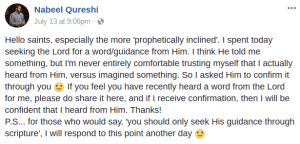
Nabeel also apparently believes in extra-biblical revelation as evidenced by this July 2017 Facebook post:

Cancer is a horrid, painful ordeal. I sympathize with Nabeel’s suffering and have prayed for him. But as our Lord so beautifully demonstrated at His temptation in the wilderness and on the cross, even the worst kind of suffering is not an excuse to compromise Scripture or disobey God.

Popular False Teachers (Bethel/Bill Johnson)
What is the New Apostolic Reformation?


Do you have any resources you’d recommend for women who are married to men who aren’t leading spiritually?

I know it can be really frustrating and painful when you desperately want your husband to be the spiritual leader of your home and he either can’t (because he’s not saved) or he won’t (due to spiritual immaturity, fear, disobedience, etc.)

I’m sure there are books and resources out there that at least touch on this topic, but I don’t read a lot of materials about marriage, so I’m not familiar enough with any to recommend them. (Perhaps someone reading this might like to make a suggestion in the comments? Doctrinally sound authors only, please.) Grace to You’s resources and store and Ligonier’s learn and store are always a good place to look for solid books and resources.

There are a few things I would recommend aside from marriage books, however:

♦ Pray for your husband, and be prepared that you may be in it for the long haul. If he’s not saved, pray for his salvation. If he’s saved but disobedient in this area, pray for his obedience, and ask God to show you how to encourage and help (not nag) him along the way. Ask God to increase your love, understanding, and compassion for your husband.

♦ If your husband is saved and willing to lead but feels inadequate, see if you can find him some help – a Christian men’s group, an older gentleman in your church who’d be willing to disciple him, some counseling sessions with the pastor – if he’s open to the idea of you helping or suggesting in this way. Be careful not to be pushy or bossy about these things or harp on him about attending.

♦ Be faithful to your personal Bible study time. First of all, you need it. Second of all, it sets a good example for your husband.

♦ Any time your husband makes the slightest step toward godly spiritual leadership, encourage him and affirm his leading. That sounds easy right now, but, at least early on, part of that is going to include you submitting to some decisions he makes that you don’t agree with. As long as those decisions aren’t unbiblical, grit your teeth and submit, because…

♦ The Bible says your behavior can have a tremendous impact on your husband. Take some time to study 1 Peter 3:1-6 and 1 Corinthians 7 (especially verses 12-16). These passages both deal with wives who have unbelieving or disobedient husbands, and how our behavior can either encourage them toward godliness or become a stumbling block to them.


Is it dangerous to be involved in yoga even though I don’t practice the meditation part of it? I just like the stretches and exercise I get from it. What are your thoughts?

“Dangerous” isn’t the word I’d choose. “Disobedient” is a better fit. Here are my thoughts (remember, the search bar is your friend):

Should Christians do yoga?


What’s your take on this essential oils craze so many Christian women seem to be into?

There are a lot of different facets to this question:

♦ Some companies who make and sell essential oils and some people who use them do so in conjunction with beliefs in chakras, energies, auras, and all that New Age movement jazz. (Christian Answers for the New Age has more in depth information on those issues.) No Christian should be dabbling around in occultic beliefs and practices.

♦ The oils themselves are spiritually “inert,” so picking up a bottle at the store is not a sin (though you might want to do a little research on the store and/or company that makes the oil to make sure you’re not financing beliefs you don’t want to support).

♦ There are multi-level marketing (MLM) businesses that sell essential oils in the same way people sell Tupperware or Pampered Chef. If that is the business you have chosen, make sure you’re not selling for a company that subscribes to the New Age stuff I mentioned above, don’t annoy your friends, and don’t make a practice of doing business at church. If you have a friend who MLM’s non-New Agey essential oils and you want to buy some, that’s absolutely fine, biblically speaking.

♦ If essential oils work on your minor ailments and that’s what you want to use instead of over the counter medications, there’s no Scriptural problem with that. Just be a good steward of the body and health God gave you and make sure you get proper medical attention for symptoms and illnesses that require it.


I read your article, Should Christians Attend Homosexual “Weddings”? and wanted to know, should Christians attend the wedding of a Christian and an unsaved person? What about the wedding of two unsaved (heterosexual) people?

I would advise Christians not to attend the wedding of a professing believer to an unbeliever due to Scripture’s admonition against this in 2 Corinthians 6:14-18. As with a homosexual “wedding,” Christians should not be supporting, participating in, or giving the appearance of supporting, sin, and a believer marrying someone he or she knows is an unbeliever is sin.

There is no biblical prohibition against an unsaved man and an unsaved woman getting married, so unless there are other grounds on which you cannot support the union (for example- you know he abuses her or you know she’s been cheating on him during the engagement), you would not be supporting, participating in, or appearing to support sin by attending the wedding of two unsaved heterosexual people. (May I suggest a couple’s Bible or Bible study book as a wedding gift?)


If you have a question about: a Bible passage, an aspect of theology, a current issue in Christianity, or how to biblically handle a family, life, or church situation, comment below (I’ll hold all questions in queue {unpublished} for a future edition of The Mailbag) or send me an e-mail or private message. If your question is chosen for publication, your anonymity will be protected.
Mailbag

The Mailbag: Leaving an Unbiblical Ministry Position


How do I gracefully step down from a parachurch ministry where I, as a female, have been preaching to men and teaching Bible Studies to men? I know this is unbiblical, so my mind is saying, “GET OUT!” But, emotionally, I feel guilty for leaving and that I would be letting down the participants and my friend, who’s a co-leader.

Do you know anyone who has had to part ministry ways with a friend, and/or a woman who stepped down from preaching and teaching men, who would be willing to connect with me or just pray for me?

I’ve never been in that particular position myself, so I can only imagine the difficulty of stepping down from such a ministry. I will certainly pray for you, and ask my readers to stop here and take a moment to pray for this sweet sister in Christ, as well.

I have previously addressed the idea of women preaching to men or teaching them the Bible in parachurch or evangelistic outreach types of situations in my article Rock Your Role FAQs:

…So, when a body of believers comes together for these purposes [worship, prayer, the sacraments, and/or the study of God’s word], regardless of the building in which they meet, or whether you call it “church” or not, they are the church, and the biblical parameters about women teaching and holding authority over men applies…

…When it comes to outreach ministries (for example, a meal for the homeless, followed by a group gospel presentation or Bible lesson), it’s best for a man to lead co-ed (or male only) adult groups in anything that could be construed as preaching or teaching the Bible… 

(Click the link above and see #7 & 11 for the complete answers.)

How to gracefully step down? I think you should do so the same way you would if you had to leave because you were moving away or took a new job whose hours conflicted with the ministry’s. You kindly inform the leadership of the ministry that you will no longer be able to participate, and briefly explain why. And in this case, you should also prayerfully consider how you might repent toward your co-leader friend and the participants, in whatever way seems biblically wisest.

Because you do have to leave, and for a reason far more important than an upcoming move or a new job: obedience to Scripture. Leaving due to a move or a job would probably not induce such intense feelings of guilt because you would look at those situations as unavoidable, or out of your hands. But as a slave of Christ who must do her Master’s bidding, if the Word of God requires something of you, it is out of your hands and unavoidable. Obedience to Scripture is not optional for Christians, nor contingent on our convenience, comfort, or circumstances, nor does God accept excuses for our disobedience.

As you’re experiencing, obedience to Scripture can often be difficult. But “Atta girl!” for hunkering down and doing it anyway through the strengthening of the Holy Spirit. I think you will find that the Lord will grow you in holiness and dependence on Him through this situation. May He use you in the future as an example and help to other Christian women facing like circumstances.


If you’ve had a similar experience to this reader and would like to connect with her to encourage her or pray for her, please comment below or e-mail (MichelleLesley1@yahoo.com) me with your name and contact information (e-mail, social media, or phone number- I will read, but not publish, comments containing this private information), and I will pass it along to her. Or feel free to share your own experience in the comments section below.


If you have a question about: a Bible passage, an aspect of theology, a current issue in Christianity, or how to biblically handle a family, life, or church situation, comment below (I’ll hold all questions in queue {unpublished} for a future edition of The Mailbag) or send me an e-mail or private message. If your question is chosen for publication, your anonymity will be protected.

Mailbag

The Mailbag Guest Post: What is the biblical understanding of spiritual warfare?

If your theology pretty much matches up with mine (as outlined in the “Welcome” and “Statement of Faith” tabs) and you’d like to contribute a guest post, drop me an e-mail at MichelleLesley1@yahoo.com,
and let’s chat about it.


Due to teaching Vacation Bible School at church this week, I’m turning today’s Mailbag over to guest poster, Nikki Campbell. This article was originally published at her blog.

What is the biblical way of understanding exactly what spiritual warfare is? How do we “do” spiritual warfare in a way that lines up with Scripture?

Biblical Spiritual Warfare
by Nikki Campbell

Have you ever prayed for a hedge of protection around someone? Have you ever rebuked Satan in Jesus’ Name? Have you ever walked around your house and prayed in ‘Jesus’ Name’ for the cleansing of each room?

If so, then you may be as surprised as I was a couple of years ago when I found out that none of these are Biblical. I was taken by surprise because these are terms and phrases that are widely taught by many popular teachers in the “Christian” world.
And, so I assumed that they were Biblical.

“Few areas of the Christian life are more misunderstood than that of spiritual warfare”, writes Justin Peters in the forword for the book Truth or Territory.  He goes on to say, “Books and conferences on the subject provide instructions on how to wage this warfare by breaking generational curses, praying hedges of protection, exorcisms, mapping the spiritual realm, rebuking and binding the demonic hierarchy all the way up to Satan himself……Would it surprise you to learn that none of these techniques is necessary or even biblical?”

In fact, some of these superstitious techniques can lead to much fear and bondage. When we believe that we have the power and responsibility to rebuke and bind Satan and his demons, we can often feel trapped in a cycle of feeling the need to do it day after day in order to be safe.

“It is critical to accurately understand and apply what the Bible has to say about overcoming temptation and withstanding the wiles of the devil. If the evil one could convince a large enough percentage of Christians to substitute a superstitious approach to doing battle with him in place of the Biblical model, he would largely neutralize the witness of the church.” (Spiritual warfare- God’s way, Elliot Miller)

So, what is true, Biblical spiritual warfare?

Here are some suggestions of how to dig deeper in the Word regarding this subject.

1) Read Ephesians 6:10-20 several times. Notice that the word “stand” is mentioned four times. Why do you think it is emphasized? What are we standing against? Do a word study on the word “schemes”. Where else is it used in the Bible?

(Blue letter Bible is a great tool where you can find root word definitions, cross references and commentaries)

2) The Bible clearly teaches that our flesh, not the devil is our most influential enemy. Look up how many times the NT refers to the “flesh”, and how many times it refers to “demons”.

(Bible Gateway is a great tool for this)

“We have three enemies-the world, the flesh and the devil. These three work in concert with each other against the believer.  If our focus is only one of these enemies, we will quickly find that we are losing the battle on the other two fronts. Too often attention is focused on the devil and defeating him, while the battle against the world and flesh is neglected. As a result of being so preoccupied with only one phase of the battle, many Christians have suffered great infiltration on the fronts of the world and the flesh” (Jim Osman, Truth or Territory).

Here is an amazing sermon by Voddie Baucham, that addresses how the world the flesh and the devil work together.

Did you see “War Room”, where the main character walked around the house in one scene screaming at the devil to leave and go back to hell where he belongs? This movie, along with many famous preachers and teachers today, falsely teach that Christians have some kind of power and authority to boss Satan around. I encourage you to be wary of women’s Bible studies on spiritual warfare that teach women to ‘speak out loud so that that Satan can hear’, and that ‘we are to put Satan back in his place in Jesus’ Name’.

Ladies, we can’t just add “in Jesus’ Name” to the end of sentences and think that gives us the power and authority to do whatever we want. Other than Jesus Himself and His Apostles who were given Apostleship power, no where else in the New Testament are we told that we have the power to do this kind of thing.

In fact, let’s see what the Bible says about people who boldly and willfully yell at and command demons.

3) Look up 2 Peter 2:10-12 and Jude 8-13. What do these passages say about those who blaspheme the glorious ones (angels and demons)?

Did you notice that even the archangel Micheal would not not pronounce a blasphemous judgement against the devil, but said, “The Lord rebuke you.”

4) In 2 Corinthians 12:7 Paul referred to being given a thorn in the flesh, a messenger of Satan to harass him. Although the Bible doesn’t specify what this messenger of Satan was, some people believe that it was some kind of demonic harassment.

(Other views are that it could be (1) an inner psychological struggle, or (2) continued persecution from an opponent, or (3) some kind of a physical affliction. I tend to lean toward the physical affliction.)

For the sake of those who take the view point that it was demonic harassment, let’s look further into how Paul handled it. Look at verse 7 to see why it was given him. Did Paul command this messenger of Satan to leave in ‘Jesus’ Name’?  No!  What did he do/who did he turn to about this? (Verse 8).

Paul pleaded with God to remove this thorn, but when God responded with, “My grace is sufficient for you, for my power is made perfect in weakness” (2 Cor 12:9), Paul not only accepted God’s will, but boasted about his weakness so that the power of Christ would rest on him.

5) 2 Corinthians 10:3-6  is one of my favorite passages addressing spiritual warfare.

According to this passage, what do the weapons of our warfare have the divine power to destroy (Verses 4 and 5)?

“The weapons of our warfare are not physical, but spiritual, such as prayer, the Word of God, faith, and the power of the Holy Spirit. By the Spirit we tear down the strongholds of wrong thinking and behavior.” (ESV study Bible notes, pg 2235)

This is a truth war. A battle for the mind. Not a territorial, physical battle against Satan and his demons.

I highly recommend the book Truth or Territory, by Jim Osman. It really gave me great insight in understanding this subject from a Biblical perspective. So good!

I also recommend the 4 part sermon series called, Angels, Demons and Spiritual Warfare, by David Platt. HereHere, and Here are the other three parts.


Nikki Campbell is a Christ-follower, a wife, and a mom of two. She loves spending time in God’s Word, being with her family, and discipling women. She has a passion for learning and encouraging others to walk in truth. Her prayer is that God would be glorified, His kingdom would advance, and women would grow in knowledge, discernment and unity through her blog Unified in Truth.


ALTHOUGH I DO MY BEST TO THOROUGHLY VET THE THEOLOGY OF THE BLOGGERS WHO SUBMIT GUEST POSTS, IT IS ALWAYS POSSIBLE FOR THINGS TO SLIP THROUGH THE CRACKS. PLEASE MAKE SURE ANY BLOGGER YOU FOLLOW, INCLUDING ME, RIGHTLY AND FAITHFULLY HANDLES GOD’S WORD AND HOLDS TO SOUND BIBLICAL DOCTRINE.