I just wanted to say, I appreciate all that you do! I love visiting your page regularly because I have found it to be a trustworthy, biblical source.
My heart is aching to be with my church family and worship together. I’ve been BEGGING God to give pastors and elders the courage to open the doors again. I completely understand that there are several interpretations of Romans 13 and what that looks like in our current situation. I do know that the virus is a real threat and many are fearful. I do.
The areas I’m struggling with are:
Would/when would civil disobedience be OK?
All the things that go along with isolation/lockdown: depression, suicide, domestic abuse, child abuse and neglect, economic crash resulting in more death and poverty, etc.
I see an inconsistency with believers inviting families and friends over to their homes (breaking the mandate) and yet saying that in order to uphold Romans 13 we ought to keep the church closed.
I look around at my fellow believers that seem to be totally content with “watching church” every week and are in no hurry to get back.
I’m in distress that my [young] children are growing up thinking this is normal.
I’m just trying to figure it all out and wondered if you had any light to shed on the situation. My spirit has been SO unsettled. I’m not sure if you’ve already seen this [podcast episode by a doctrinally sound theologian], but this is probably the most biblical piece that I’ve come across. I’d love to hear your thoughts.
Thank you so much for your kind words. I appreciate your passion on this issue. Some of your concerns were answered in my article The Mailbag: Why no COVID weigh-in?. Here are my thoughts on your questions and comments above;
• I totally understand your feelings about wanting to get back to church. I feel the same way, and I think most genuinely regenerated Believers would agree.
• Have you and your husband sat down and discussed all of your feelings about the issues? I know it always helps me to process my thoughts and unburden myself by talking things out with my husband.
• Have you talked to your husband about the possibility of discussing all of these things with your pastor? He can probably help alleviate some of your concerns or at least provide you with information about your own church and situation.
• I’m sensing that you’re experiencing a bit of anxiety over this issue, and it sounds like a lot of your concerns have to do with the way other people are acting and thinking. Can I make a few suggestions that may help you to be more at peace?
· Stop worrying about what other people are thinking, saying, and doing about all of these issues. That’s not a burden God has called you to carry. I don’t want to be so blunt as to say, “Mind your own business,” but keeping your focus on managing your own household and family will go a long way to reducing your anxiety about this.
· Get off social media and stop watching the news. You won’t be able to worry about how other people are responding or not responding to the issue if it’s not constantly in front of you.
· Keep busy. If you have free time, read a (non-COVID-related) book, learn how to knit, bake, garden, do a project with the kids. Ask your pastor if there’s anything you can do to help get things ready for meeting together again at your church (phone calls, e-mails, cleaning, etc.).
· Here are some Scriptures that may help:
Therefore I tell you, do not be anxious about your life, what you will eat or what you will drink, nor about your body, what you will put on. Is not life more than food, and the body more than clothing? Look at the birds of the air: they neither sow nor reap nor gather into barns, and yet your heavenly Father feeds them. Are you not of more value than they? And which of you by being anxious can add a single hour to his span of life? And why are you anxious about clothing? Consider the lilies of the field, how they grow: they neither toil nor spin, yet I tell you, even Solomon in all his glory was not arrayed like one of these. But if God so clothes the grass of the field, which today is alive and tomorrow is thrown into the oven, will he not much more clothe you, O you of little faith? Therefore do not be anxious, saying, ‘What shall we eat?’ or ‘What shall we drink?’ or ‘What shall we wear?’ For the Gentiles seek after all these things, and your heavenly Father knows that you need them all. But seek first the kingdom of God and his righteousness, and all these things will be added to you. Therefore do not be anxious about tomorrow, for tomorrow will be anxious for itself. Sufficient for the day is its own trouble. Matthew 6:25-34
and to aspire to live quietly, and to mind your own affairs, and to work with your hands, as we instructed you, 1 Thessalonians 4:11
Fret not yourself because of evildoers; be not envious of wrongdoers! For they will soon fade like the grass and wither like the green herb.
Trust in the Lord, and do good; dwell in the land and befriend faithfulness. Delight yourself in the Lord, and he will give you the desires of your heart.
Commit your way to the Lord; trust in him, and he will act. He will bring forth your righteousness as the light, and your justice as the noonday.
Be still before the Lord and wait patiently for him; fret not yourself over the one who prospers in his way, over the man who carries out evil devices!
Refrain from anger, and forsake wrath! Fret not yourself; it tends only to evil. Psalm 37:1-8
• Ask God to help you stay in the mindset of trusting your pastor, praying for him, and joyfully submitting to his leadership. Remind yourself it’s not your job to set policy for your church, that’s your pastor’s/elders’ job. Also, you don’t need to concern yourself with how other pastors are handling their churches. Focus on your own church and how you can pray for and help it.
• Stop worrying about hypotheticals and what ifs (civil disobedience in the future, abuse, suicide, reasons for shutting the doors of the church, etc.). God does not require you to have the answers to those questions, and if/when they do happen, He will carry you through it then. Focus on glorifying God in what He has given you to do today.
• I have six kids ranging in age from 32 to 17, so as an older mom to a younger mom, relax. Your children are not as fragile as you think and they are not “growing up” thinking this is normal. A) It’s only been a couple of months. B) If your kids are young, I can practically guarantee you that, even if this goes on for a few more months, they’ll never remember it. Ask them when they’re in their 20s and see if I’m right. :0)
• I love the theologian you mentioned and I listen to his podcast regularly, but I know my own tendency to be fearful of the future, and I’ve noticed that when he starts “doomsaying” about how terrible things are going to get, my anxiety shoots up. He may be 100% right about everything that’s going to happen, but that doesn’t mean you have to listen to him say it if that makes you anxious. (That may be an “eye” you need to gouge out if it causes you to sin by worrying.)
You don’t have to have all the answers. It really is OK to loosen your grip, put all these unknowns in God’s hands, and trust Him to work everything out His way and in His timing – not yours – as you practice “waiting upon the Lord.”
Wait for the Lord; be strong, and let your heart take courage; wait for the Lord! Psalm 27:14
Trust in the Lord with all your heart, and do not lean on your own understanding. In all your ways acknowledge him, and he will make straight your paths. Be not wise in your own eyes; fear the Lord, and turn away from evil. It will be healing to your flesh and refreshment to your bones. Proverbs 3:5-8
If you have a question about: a Bible passage, an aspect of theology, a current issue in Christianity, or how to biblically handle a family, life, or church situation, comment below (I’ll hold all questions in queue {unpublished} for a future edition of The Mailbag) or send me an e-mail or private message. If your question is chosen for publication, your anonymity will be protected.
Just out of curiosity, is there a reason you (like many other leaders/public figures) are choosing not to take a stand [on churches not gathering during this time, when the “right time” to open the doors again would be, etc.] one way or another, publicly? I feel as though now more than ever, we are looking to our leaders, pastors, etc for guidance on navigating this current situation and there is hardly any to be had. Why are so many choosing not to discuss it? I know that you have a large following, which is why I was wondering why you weren’t being more vocal.
This question was posed by one of my dear Facebook followers last week, and I thought it would be a good question to answer in The Mailbag.
She is quite right. Other than this episode (Church Was Never Meant to be Remote: Reuniting After COVID-19) of A Word Fitly Spoken, I haven’t really addressed any of the specific issues surrounding COVID-19 nor taken sides on things like wearing masks, opening up the economy, when is the “right time” for churches to start meeting in person again, etc.
I cannot speak to why other people with platforms have or haven’t addressed any or all of these issues. I can only speak for myself. Others may have some of the same reasons I’m about to share, or they may have different reasons. If you want to know what someone else’s reasons are, you’ll have to ask him or her. Here are the reasons I haven’t publicly addressed these issues:
😷¹ I am not your leader. (I know the lady who asked the question knows that, but I think it’s important to clarify this point in case it might be fuzzy to others.) I am a content creator. My job is to provide you with doctrinally sound leisure time reading and listening material to bolster what you should already be receiving at church². Think of this ministry as an optional, nutritious, between-meals snack, and your local church as your essential three square meals a day. You should not be looking to me or any other online personality for leadership or shepherding. That’s your pastor’s and elders’ job at the church level, your parents’ job if you’re a minor living in their home, or your husband’s job if you’re married. As I often say, it is my joy to serve you in Christ. That’s what I am to you – a servant, not a leader.
😷 I’m global. For reasons He hasn’t disclosed to me, God has chosen to make my content available on every continent on this planet except Antarctica (although I actually have one follower who has been to Antarctica – does that count? :0) That means, if I “took a stand” on various issues surrounding COVID, it would go out to all kinds of different countries and areas with all kinds of different cultures, laws, and governmental leaders. All I know is America, Louisiana, Baton Rouge. That’s what molds the way I think and form opinions about these issues, and that’s not only not necessarily applicable to someone in Pakistan, or Venezuela, or Eritrea, it could be discouraging to people in those countries, or even dangerous for them to act on my America-centric pronouncements. I mean, my goodness, my Louisiana viewpoint and advice on these issues probably aren’t even applicable to people in New York or Nebraska or Oregon.
😷 It’s political. COVID-related issues are saturated with politics. You can’t divorce one from the other. And if you’ve followed me for any length of time, you may have noticed that I don’t get involved in political or legal issues unless they intersect directly with Scripture. I’m a “stay in my lane” kind of gal, and politics and policies are not my lane. For me, personally, for this particular ministry and what I’m trying to accomplish here, politics is an unnecessary distraction. My focus (and I realize it’s a narrow focus, and I’m OK with that) is helping to build spiritually strong, biblically literate Christian women who can strengthen their local churches and evangelize and disciple other women and children at the local church level. We’re all different body parts here, ladies. I’m going to focus on being an ear and let somebody else focus on being an eye.
😷 It’s a local church issue. When to start meeting again, whether or not to go to multiple services to spread everybody out, whether or not masks and hand sanitizer will be required, even whether or not to accept a loan from the government…these are all things (and more) that the pastor and elders of each local church will have to decide for that particular church. Every church is different. Every pastor is different. Different decisions will need to be made for different churches because these types of things are not mentioned in Scripture, they’re issues of adiaphora (Christian liberty). What difference does it make what I think if that’s not what your pastor has decided for your church? All that does is set me up in opposition to your pastor forcing you to choose between him and me. You don’t need that kind of tension in your life, and your pastor certainly doesn’t need it in his church. I’d rather say this: Whatever your pastor decides for your church, as long as it’s in keeping with Scripture, I support him, and I encourage you to joyfully submit to his leadership. That’s way more constructive and biblical than offering you my personal opinion.
Obey your leaders and submit to them, for they are keeping watch over your souls, as those who will have to give an account. Let them do this with joy and not with groaning, for that would be of no advantage to you.
Pray for us, for we are sure that we have a clear conscience, desiring to act honorably in all things. I urge you the more earnestly to do this in order that I may be restored to you the sooner. Hebrews 13:17-19
😷 I’m not the bandwagon type. Usually. Every once in a while, I’ll weigh in on whatever the hot topic du jour is, but when I do, I normally try to address an aspect of it that hasn’t been addressed by others. If I have nothing to say except the same thing everybody else is saying, I figure, “What’s the point?”. At that point, I’m just adding noise to the clamor and it’s boring. And that’s the case here- I have nothing new to add to the conversation about masks, when to go back to church, etc.
Also, I figure if I’m sick of hearing about a particular topic, you’re probably sick of hearing about it too. Several weeks ago, I posted a question on Facebook asking whether y’all wanted me to write something about COVID or write about something else. I didn’t do the math, but I got dozens of responses and it looked to me like about 98% of y’all were begging me to, “please write about something else, anything else!”. So I figured y’all are just as sick of hearing about COVID-related issues as I am.
😷 I hate dumpster fires. There aren’t words in the English language to express to you how deeply I detest social media fights (especially over non-scriptural issues) between professing Christians. Honestly, some of y’all are worse than my kids when it comes to arguing. You can’t just politely state your position, let others state theirs, and move on. No, you’ve got to argue the issue to death even when it was clear 20 comments ago that the other person wasn’t going to change her mind. If you want to do that on your social media page, have at it. But remember, when you do it on my social media page, I’m the one who has to read through all the ugly comments, feel all the angst and anger, and end up blocking people who can’t behave like godly adults. And I know that if I took sides on some of these COVID issues that’s exactly what my social media, blog comments, and e-mail would turn into- one great big dumpster fire of arguing. I know this because I’ve posted far more innocuous things and people have started arguments over those issues and even issues completely unrelated to the original topic. By refraining from offering my opinion on COVID-related issues, I prevent the distraction from and derailing of my ministry, and I keep strife, arguing, and unnecessary division off my platforms.
😷 Because…the Bible. As I was writing this article, a few passages of Scripture came to mind:
A fool takes no pleasure in understanding, but only in expressing his opinion. Proverbs 18:2
Have nothing to do with foolish, ignorant controversies; you know that they breed quarrels. And the Lord’s servant must not be quarrelsome… 2 Timothy 2:23-24a
…and charge them before God not to quarrel about words, which does no good, but only ruins the hearers. 2 Timothy 2:14b
When words are many, transgression is not lacking, but whoever restrains his lips is prudent. Proverbs 10:19
Now, not all of these verses apply directly to the issue at hand. But I think they do enlighten us to some general biblical principles:
God don’t like ugly.
God doesn’t want us arguing. Yes, sometimes we have to contend for the faith, but that’s completely different from quarreling over opinions and issues the Bible doesn’t address.
Sometimes the wisest thing a Believer can do is keep her mouth shut.
These are the reasons I have chosen not to share my position on the various controversial issues surrounding COVID-19 (as well as several other issues over the years). If you want to know what to do about a particular issue, read up on it from a reliable source, compare what you read to rightly handled Scripture and reject anything that contradicts it, ask your pastor, and follow his leadership.
¹The masked emojis are not my way of subtly “taking a stand” one way or the other on masks. I just find basic bullet points boring, and that was the most relevant emoji I could find for this subject.😆
²I am assuming, for the purposes of this article, that you are in a doctrinally sound church, with a solid, trustworthy pastor. If you’re not, you have bigger problems than not hearing my opinions on COVID issues. Please see the “Searching for a new church?” tab in the blue menu bar at the top of this page.
If you have a question about: a Bible passage, an aspect of theology, a current issue in Christianity, or how to biblically handle a family, life, or church situation, comment below (I’ll hold all questions in queue {unpublished} for a future edition of The Mailbag) or send me an e-mail or private message. If your question is chosen for publication, your anonymity will be protected.
Welcome to another “potpourri” edition of The Mailbag, where I give short(er) answers to several questions rather than a long answer to one question. I also like to take the opportunity in these potpourri editions to let new readers know about my comments/e-mail/messages policy. I’m not able to respond individually to most e-mails and messages, so here are some helpful hints for getting your questions answered more quickly. Remember, the search bar (at the very bottom of each page) can be a helpful tool!
In these potpourri editions of The Mailbag, I’d also like to address the three questions I’m most commonly asked:
“Do you know anything about [Christian pastor/teacher/author] or his/her materials? Is he/she doctrinally sound?”
I know this is going to sound silly or troll-like, but I’m serious! I have a habit of praying a quick prayer when thoughts cross my mind, like “God, please help Aunt Pam to feel better from her cold today,” or “Lord, thank You for providing that salary bonus I needed.” Sometimes those same kinds of thoughts and prayers cross my mind when I’m using the bathroom. Is that wrong? Should I wait until I get out of the bathroom to think that little prayer? What about what Deuteronomy 23:14 says about using the bathroom, “that God may not see anything indecent among you and turn away from you”?
I don’t think that’s a silly or troll-like question at all, and I’ll bet there are bunches of Christians out there who do the exact same thing and now, after reading this question, are wondering the exact same thing.
First Thessalonians 5:17 instructs us to “pray without ceasing,” which means our hearts are to be constantly oriented toward prayer even though we’re not consciously praying every moment of the day. (Kind of like your compass’ needle always points north even if it’s just sitting in a drawer not being used.) For most Christians, that means we’re intermittently speaking to God, just like you described, throughout the day as things happen, as random thoughts cross our minds, as we see various things. And this becomes such a habit (a good one!) that it doesn’t occur to us to think about where we are or what we’re doing as we utter those prayers in our hearts. Honestly, I think that mindset of reflexive prayer is pleasing to God, because it embodies what it means to pray without ceasing.
Deuteronomy 23:12-14 is part of the Old Testament ceremonial law regarding, in this particular case, the way Israel was to set up camp. When you give the law a good, thorough reading, you’ll notice that the underlying principle of most of the laws is that Israel is to be set apart and holy – different – from the pagan nations surrounding them. And He gives them laws to this effect that touch every aspect of their lives so that, at every turn, throughout the course of their day, there are little reminders, through the law, to “Be holy for I am holy.” This law is just one more of those little reminders: Don’t act like animals like the pagan nations around you, Israel, and just potty willy nilly in the street or the front yard or wherever you take a notion to. Step it up and keep your camp to a higher standard, because God is with you and you are His people.
The Deuteronomy passage is not about offending God by relieving yourself. God has seen every single time every person on the planet has ever relieved himself/herself, because God is omnipresent. If that were offensive to Him, He would not have designed your body to work that way.
Although I don’t think “bathroom time” should be the only time you pray, I don’t see anything in Scripture indicating that God considers it offensive for you to reflexively pray even though you happen to be in the bathroom at that moment. However, if it offends your sensibilities, wait until you get out of the bathroom and then pray.
Would you read 1 Tim 3 1-7 to read women can’t be “overseers/leaders/official” as in they can’t be “Children pastors” or “Women Pastors” in the church with those actual titles or even as directors? The verses only say men and state guidelines on how to choose. I’ve noticed some red flags in my church with a woman Worship Leader, which I don’t agree with since she sometimes teaches in between songs, but they are also giving women the pastor title, but only for children and women.
If I’m understanding correctly, you’re asking:
Is it biblical for women to hold a position of leadership over the women’s ministry or children’s ministry of a church?
Is it biblical for a woman to be the worship leader of a church?
If so, is it biblical to give those women leaders the title of, for example: “Pastor of Women’s Ministry” or “Children’s Pastor”?
Here are the fast and dirty answers. Below are a couple of links where I’ve discussed these issues in more detail.
Assuming the woman is doctrinally sound, has a godly character, her husband (if she’s married) is on board, and she’s otherwise qualified for the job, it’s fine for a woman to lead women or children in the church as long as the position she holds (which will vary from church to church) doesn’t require her to preach to or teach Scripture to men, or hold unbiblical authority over men.
No, it is not biblical for a woman to be the worship leader of a church. This is supposed to be a pastoral position.
No, churches should not give any woman on staff the title of “Pastor,” even if she isn’t violating Scripture in her position. Because Scripture doesn’t permit women to be pastors it is misleading and confusing, and will probably give people the impression that she is violating Scripture and that that’s OK. Neither should the converse be true – churches should not have women on staff in any capacity that violates Scripture (preaching to/teaching men, holding authority over men) and try to conceal that fact by giving her a title (instead of “pastor”) like “minister,” “facilitator,” “coach,” “associate,” “director,” etc.
We have been searching for a doctrinally sound church in the area we moved to, and unfortunately it has not been easy! The few that we have found still use a Hillsong, Bethel or Elevation music. I usually cross a church off the list quickly if they sing from those artists. But like I said, now I am finding even doctrinally sound churches are throwing some of those songs in. Do you have any insight to this dilemma?
It can be really difficult to find a doctrinally sound church these days. Unfortunately even some churches that are fairly solid use music from these groups. The first thing I would recommend is that you check out the Searching for a new church? tab in the blue menu bar at the top of this page, just to make sure you haven’t overlooked any doctrinally sound churches in your area. There are lots of church search engines there and other resources that might help.
My counsel would be to find the most doctrinally sound church you possibly can (following your husband’s leadership, of course, if you’re married, {and assuming, in this particular case, that he’s saved}), attend for a while to get a feel for whether or not it’s a fit for your family, and set up an appointment with the pastor to ask any questions you might have (check out the articles under “What to look for in a church” at the “Searching…” tab for suggestions of questions you may want to ask). (I would recommend the appointment with the pastor regardless of how perfect the church seems.)
If the church uses Bethel, etc. music, this would be the time to gently and lovingly address it with the pastor, but let him know that this is a reason you’re a bit reticent about joining the church so he’ll understand the seriousness of the problem. I would approach the subject giving him the benefit of the doubt that he simply doesn’t know the problems with these groups (the vast majority of pastors are ignorant of things like this – they shouldn’t be, but it is what it is).
If he seems open, you might want to ask if you can send him some information. (You can find links on all three groups at the “Popular False Teachers & Unbiblical Trends” tab. Pick the 2 or 3 most convincing links for each group and send those rather than sending him the link to that tab. For someone who’s ignorant in the area of discernment, opening up that tab would be information overload, and he’ll tune it out.) If he says yes, send the links and then touch base with him again in a couple of weeks to get his reaction.
The only other counsel I would offer you is to remember that no church is perfect, and God may put you into a particular church to help it with those imperfections.
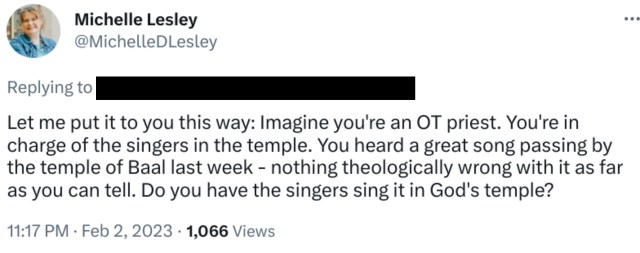
I would now like to take a moment to highlight this reader’s question for pastors and ministers of music. This is yet one more reason it is detrimental to your church to use music from Bethel, Jesus Culture, Hillsong, Elevation, any musician connected these groups (such as Phil Wickham who’s very prolific and has strong ties to Bethel), or any other musician who isn’t doctrinally sound (after you have thoroughly vetted him/her/them.) regardless of how biblical the lyrics of any particular song of theirs that you’re using might be. You could potentially be turning away solid, mature, discerning Believers who might otherwise be interested in joining your church. The woman who sent in this question is not the first to ask me something like this – not by a long shot. This issue is increasingly of concern to Christians looking for a solid church. (For that reason, I do not list churches – even Reformed or seemingly otherwise doctrinally sound churches – on my Reader Recommended Churches list, who use music from heretical sources like these.)
When a visitor walks into your sanctuary for the first time, your worship service is the “face” of your church to her. What kind of a first impression are you making? When you use music by doctrinally unsound musicians, it does not say, “We’re really a doctrinally sound church – honest! We only use songs from these groups whose lyrics are biblical.”. It says, “This church has leaders who aren’t discerning,” or “If this church uses music by these heretical groups, what other doctrinal problems does it have?”. Why put that stumbling block out there when there is plenty of music available with biblical lyrics written/performed by doctrinally sound musicians?
And there’s another stumbling block that using this type of music puts in front of weaker brothers and sisters that you may not have realized. I have heard from a number of Christians whom God graciously saved and rescued out of the pit of “churches” similar to Bethel, Hillsong, and Elevation. They tell me that when they walk into what they think is a doctrinally sound church and hear music from these and other heretical sources, it triggers a form of spiritual PTSD. It’s traumatizing to them. They immediately become fearful that your church is mere steps from turning into one of these types of “churches.” Will they grow out of that reflexive reaction? Yes, someday, as God continues to sanctify them. In the meantime, do you want the music at your church to cause them unnecessary anxiety? I hope not.
Even for Christians who have not come out of “churches” like these but are knowledgeable about their heretical theology, using these songs in your worship service is putting a stumbling block in front of them, too. Take me, for example. I’ve studied these groups. I’ve seen their heresy and the damage they do to both the Kingdom and to the individuals who follow them. And because of that, I’ve zealously spoken out against them. If I visit your church and an Elevation song suddenly flashes up on the screen, my ability to worship is completely derailed in grief that your church would use a song from that source – especially if you know about their theology and are well acquainted with music from doctrinally sound sources that you could have used instead. I cannot sin against my conscience by singing those songs. Consider me a “weaker brother” if you like, but do you care more about me as your sister in Christ, or your “right” to use music from these sources? What about Paul’s posture in 1 Corinthians 8:9-13?
But take care that this right of yours does not somehow become a stumbling block to the weak. For if anyone sees you who have knowledge eating in an idol’s temple, will he not be encouraged, if his conscience is weak, to eat food offered to idols? And so by your knowledge this weak person is destroyed, the brother for whom Christ died. Thus, sinning against your brothers and wounding their conscience when it is weak, you sin against Christ. Therefore, if food makes my brother stumble, I will never eat meat, lest I make my brother stumble.
If this was true in Paul’s personal life, shouldn’t it surely be true of our worship services? If you wouldn’t put a Christmas tree or portrayals of Jesus in your sanctuary because it might offend a brother in Christ, why would you use worship music that causes offense to your brothers and sisters?
Finally, what is the proactively good reason for intentionally choosing music from a heretical source? In other words, when you’re selecting music for the worship service, why would you choose, say, a Hillsong song about God’s glory, or Psalm 23, or the crucifixion, when you could just as easily choose a song from a doctrinally sound source about any of those things – a source that isn’t a stumbling block to anyone, won’t give anyone the wrong impression about your church, won’t lead anyone to follow a heretical “church,” and won’t use your church’s offerings to support a heretical “church”? What makes the Hillsong song you’re choosing better than the song from the doctrinally sound source? It doesn’t seem to me that there’s a good enough reason to use songs from these sources that outweighs all the good, biblical reasons not to use them.
There is simply no good reason for a doctrinally sound church to use music from heretical sources like these.
Hello there. I read your blog about Priscilla Shirer being a false teacher. Read some parts of your blog. Found your recommended preachers with sound doctrine. I don’t know what denomination you’re in. But I just wanted to ask if you believe if we can lose our salvation?
Hi there! I’m a Reformed Southern Baptist. You can read more about my denomination and my beliefs at the Statement of Faith tab and the Welcome tab (both in the blue menu bar at the top of this page.
If you have a question about: a Bible passage, an aspect of theology, a current issue in Christianity, or how to biblically handle a family, life, or church situation, comment below (I’ll hold all questions in queue {unpublished} for a future edition of The Mailbag) or send me an e-mail or private message. If your question is chosen for publication, your anonymity will be protected.
Answer a fool according to his folly, lest he be wise in his own eyes. Proverbs 26:5
There’s a lot of foolishness masquerading as Christianity these days. Occasionally, I get e-mails and messages showcasing this type of foolishness. It needs to be biblically corrected so these folks can stop “being wise in their own eyes,” repent, and believe and practice the truth of Scripture. From time to time, I share those e-mails in The Mailbag with a biblical corrective, not only so the e-mail writer can be admonished by Scripture, but to provide you with Scriptures and reasoning you can use if you’re ever confronted with this kind of foolishness.
To answer a fool according to his folly (or in the case of most of the foolishness addressed to me – a professing Christian acting the fool by spouting unbiblical folly) is to stand toe to toe with him and firmly and biblically address his unbiblical foolishness without backing down or letting him run roughshod over you – sometimes even mirroring his own words back to him to help him see his hypocrisy. Some Christians think holding your ground, refusing to compromise on biblical truth, and offering correction in this way is unkind or unloving. It is not. Not if you’re going by the Bible’s definition of love rather than the world’s definition (“be nice” “accept everything” “don’t confront”), and not when you’re dealing with a pridefully stubborn person. One of the most unloving things a Christian can do is to see a professing brother or sister in biblical error and ignore it rather than trying to help that person see the truth of God’s Word. Jesus, Paul, Peter, Jude, John, Jeremiah, Isaiah, and many others, did this plenty of times in Scripture, and, often, much more stringently that I and other 21st century Christians do. Sometimes love – real, biblical love – has to be tough in order to reach someone’s heart.
(This reader’s blog comment {in blue},
responding to this article, is reprinted in full.)
Kay Arthur is a servant of the Lord and those of us who are Christians and love God and do her Bible studies can discern for ourselves. Who are you to bring up such things? Go study the Word of God yourself and take the log out of your own eye. Maybe you can go find somewhere to serve and stop trying to bring dissension among believers. I’m sure you can find better things to do then [sic] pick apart a woman who has devoted her entire life to teaching the Word of God. The woman is 86 yrs old, let’s all try to leave a legacy as she is doing.
All right, let’s break this down, shall we?
Kay Arthur is a servant of the Lord…
I never said she wasn’t. I’ve clearly stated on many occasions, including twice in the article you commented on (which I’m assuming you read) that I do not regard her as a false teacher, and I have never questioned her salvation, nor (unless she apostatizes) do I plan to.
By the way, did it ever cross your mind that I might be a servant of the Lord? Just because someone is serving in a way you don’t personally like, doesn’t mean she’s not serving the Lord. A lot of people didn’t care for…say…John the Baptist’s methods, or Jeremiah’s messages, or Paul’s teaching, but that doesn’t mean they weren’t servants of the Lord. When determining whether or not someone is a servant of the Lord, the question is not, “Do I like what this person has to say and the way in which she says it?” the question is, “Does this person’s teaching and behavior line up with Scripture? Is she bearing fruit in keeping with repentance? Is she teaching what is good? Is she following the principle of teaching sound doctrine and rebuking those who contradict it?”.
…and those of us who are Christians and love God and do her Bible studies can discern for ourselves.
So why haven’t you discerned for yourself the things I’ve mentioned in the article? Why are you arguing against the issues I’ve brought up instead of agreeing with them? And why are you accusing and slandering me for exercising biblical discernment? It doesn’t appear from your comment that you are “discerning for yourself” or you would have already noticed these issues and you’d agree with the biblical passages I’ve cited that these things conflict with Scripture.
But you’re right, some Christians who love God and do her Bible studies can discern for themselves. Which, in several cases, is what has led them to write to me and ask about the issues with Kay that I’ve cited in the article. They’ve been discerning. They’ve noticed that some of the things Kay teaches and does conflict with Scripture.
Who are you to bring up such things?
I am a Christian being obedient to the clear teaching of Scripture to contend for the faith.
What’s the problem with bringing up such things? You want to hide the fact that a Christian teacher is deviating from Scripture in certain areas? Can you cite any rightly handled, in context Scripture which supports that idea? Because the Bible never suggests we should hide sin or unbiblical teaching:
Take no part in the unfruitful works of darkness, but instead expose them. Ephesians 5:11
This is the message we have heard from him and proclaim to you, that God is light, and in him is no darkness at all. 1 John 1:5
Brothers, if anyone is caught in any transgression, you who are spiritual should restore him in a spirit of gentleness. Keep watch on yourself, lest you too be tempted. Galatians 6:1
Not many of you should become teachers, my brothers, for you know that we who teach will be judged with greater strictness. James 3:1
(I’m not suggesting, via these verses, that Kay is demonic or a false teacher or anything like that. But anything that you or I or Kay or anyone does that is sinful and/or contradicts Scripture is a work of darkness, and the Bible does not even hint that these things should be covered over, swept under the rug, or hidden. In fact, it says the opposite. God’s desire is always that sin and unbiblical teaching be dealt with and corrected in a biblical manner for His glory and our good.)
And what’s the problem with me or anyone else bringing up such things? In fact, why aren’t you bringing up such things? You’re a discerning Christian who loves God, and does Kay’s Bible studies – why haven’t you brought up the issues with Kay? The Bible clearly instructs us to hold to rightly handled Scripture and reject whatever contradicts it. Why aren’t you doing that? And why are you attacking me for following the Bible’s instructions? That’s not the fruit of a discerning Christian who loves God.
Either Kay is actually being obedient to Scripture in the issues I’ve cited in the article and you can prove that with evidence and Scripture (in which case, it’s actually to your advantage that I’ve brought these things up so you can publicly disprove what I’ve said and exonerate Kay), or she is being disobedient to Scripture in these issues (in which case, it’s also to your advantage, spiritually, that I’ve brought these things up so you can be aware and take Scripture’s side on these things rather than taking Kay’s side).
Go study the Word of God yourself and take the log out of your own eye.
What log? You’re wielding Scripture like a weapon and an insult against a sister in Christ who is obeying God’s Word, and you don’t even seem to understand what it means in context. (And neither of those things, if you’re a student of Kay’s, speaks very well of her teaching). And the reason I know that is because I’ve studied Scripture, as you’ve probably surmised from the copious amounts of it which I’ve cited in that article and this one.
If you’ll read the entirety of Matthew 7, you’ll notice that, in context, verses 1-5 (from which you’ve drawn your remark above) warn against judging others hypocritically. In other words, we’re not to judge a brother or sister for a slight fault (speck) when we’re guilty of that same fault to a much greater degree (log). Can you please explain precisely how I have done that in the article about Kay? Where have I taught unbiblically about spiritual warfare or endorsed someone else who does? When have I ever shared a stage with the likes of Beth Moore or Priscilla Shirer, much less co-authored books with them? When have Iever invited men to a conference I’m speaking at? How am I judging Kay hypocritically rather than judging her with right, biblical judgment?
Further along in Matthew 7, Jesus Himself not only judges false teachers (and, again, I’m not saying Kay is a false teacher) and false doctrine, but tells us to recognize them by their fruits (i.e. make judgments about what is and isn’t biblical). Obviously Jesus is not guilty of hypocritical judgment by warning against false teachers and telling us to do the same, and neither are those of us who obey His instructions.
What is hypocritical judgment is you casting aspersions at me – like: I haven’t studied the Word, and I’m hypocritically judging someone – with no evidence or biblical support. You have no evidence or grounds for saying that I don’t study the Word. In fact, I think that the twelve years’ worth of material on this blog is sufficient evidence to refute that claim. You have also provided no evidence or biblical support to your claim that I have a “log in my eye.”
But the biggest hypocritical judgment you’re committing? You’re accusing me of being unbiblical based solely on your own personal opinions, not based on Scripture. You have cited no rightly handled Scripture whatsoever. You’re accusing me of judging while you’re judging me. Who’s got the log in her eye?
Maybe you can go find somewhere to serve…
Another unsubstantiated, unbiblically judgmental accusation. You know nothing about me. You have no idea whether I’m “serving” somewhere or not. I am a faithful, active as I’m able to be member of a local church and I serve it in any way I’m permitted to. Furthermore, I am serving the Lord with this ministry. At the moment, I’m doing so by rebuking your unbiblical judgments and ideas.
…and stop trying to bring dissension among believers.
And another Scripture you seem not to understand, which you’re wielding against a sister in Christ like a weapon and an insult. (And, again, your lack of understanding of the Scriptures does not speak well for Kay’s teaching. Jesus said we will know whether teachers are good or bad by the fruit of their ministry. You’re part of the fruit of Kay’s ministry. How do you think your misunderstanding and misusing Scripture reflects on her?)
I’m guessing (since you didn’t quote or reference it) the verse you’re alluding to is Romans 16:17. Let’s look at what it actually says:
I appeal to you, brothers, to watch out for those who cause divisions and create obstaclescontrary to the doctrine that you have been taught; avoid them.
Where have I said anything contrary to sound biblical doctrine as taught in Scripture? This verse teaches that the people who cause divisions and create obstacles (“bring dissension”) among Believers are the people who teach things and act in ways that are contrary to the doctrine that you have been taught by Scripture. For example, the things Kay has taught and done (ex: teaching men, yoking with false teachers, etc.) that are contrary to Scripture. Had she not taught and done these things, there would be no “dissension” because I would have been able to happily and wholeheartedly recommend her and you wouldn’t have had anything to complain about. When there is dissension among Believers it is the fault of those who are contradicting Scripture, not those who are standing for Scripture.
I’m sure you can find better things to do then [sic] pick apart a woman who has devoted her entire life to teaching the Word of God.
Log, meet speck. Pot, meet kettle. Do you not see the hypocrisy of you saying this to me? My life is devoted to teaching the Word of God as well, even the parts you don’t personally like. And yet here you are picking me apart. I’m sure you can find better things to do.
And, again, twelve years’ worth of material on this blog. One article about Kay that was written four years ago. Over 1600 on other topics including Bible study, discipleship, encouragement, evangelism, apologetics, recommended Bible teachers, Biblical Counseling resources, and resources for helping people find solid churches all over the world, among a plethora of other topics. Although there’s nothing wrong with the article I wrote on Kay – so I don’t need to “find better things to do” – I’m sure any objective person would see a 1600+:1 ratio as evidence that I’ve certainly found other things to do.
Furthermore, writing a carefully annotated discernment article addressing and explaining multiple issues with a teacher is not “picking someone apart”. It’s called being ethical, biblical, and thorough. (And by the way, one of the reasons I have to be so thorough is because if I only briefly cited one or two issues, I would get critics like you saying, “That’s all you’ve got? That’s nothing!”. It’s a lot harder to dismiss multiple and well-documented incidents.) While some people may choose to write a paragraph casting unfounded aspersions and making unsubstantiated accusations against sisters in Christ (log), I prefer to be as fair, biblical, and extending of grace to the person I’m critiquing as I possibly (speck) can.
The woman is 86 yrs old, let’s all try to leave a legacy as she is doing.
I’m sorry, is there some sort of age limit beyond which we’re allowed to sin and teach unbiblical doctrine with impunity? I don’t recall seeing that in the Bible anywhere. Solomon was elderly when he started worshiping false gods, and yet God doesn’t shy away from pointing this out publicly. In writing. Unconcerned about how doing so might impact Solomon’s legacy. Age is no excuse for sin or unbiblical teaching. In fact, God specifically says quite the opposite:
Older women likewise are to be reverent in behavior, not slanderers or slaves to much wine. They are to teach what is good, and so train the young women to love their husbands and children, to be self-controlled, pure, working at home, kind, and submissive to their own husbands, that the word of God may not be reviled. Titus 2:3-5
The truth is, we’re each responsible for our own legacy. If Kay wants to leave a more godly legacy, the areas I addressed need to be biblically corrected. I am doing my best to leave a legacy of pointing women to Christ and His Word, teaching them to be discerning, and encouraging them to be faithful to their local churches. There are many areas in my life in which I need to be more obedient to God’s Word so that I can leave a more godly legacy.
Misunderstanding and misusing Scripture. Falsely accusing, slandering, and hypocritically judging a sister in Christ. How’s your legacy looking? It’s something to think about, because, as you rightly pointed out, we should all look to the legacy we’re leaving. And we should strive to make it a godly one.
If you have a question about: a Bible passage, an aspect of theology, a current issue in Christianity, or how to biblically handle a family, life, or church situation, comment below (I’ll hold all questions in queue {unpublished} for a future edition of The Mailbag) or send me an e-mail or private message. If your question is chosen for publication, your anonymity will be protected.
In the summer of 2021, Amy and I recorded a three part series of our podcast, A Word Fitly Spoken, reviewing The Chosen, which included both seasons 1 & 2. Some, but not all, of the information in this article is discussed in those episodes, and the episodes contain much more information than this article. Click here to listen, or scroll down to the Additional Resources section at the end of this article.
The overview and review below were written in April of 2020, immediately after the premier of season 1 of The Chosen. At that time, very little about Dallas Jenkins’ problematic theology and other unbiblical issues with The Chosen were publicly known. This article is honest and faithful to what I knew at the time (and demonstrates how quickly “Christian” things can turn unbiblical). Additionally, it covers only season 1. The biblical issues in season 2 of the show grew progressively worse and worse (listen to our 3-part podcast series that includes season 2), and more information came to light about off-screen biblical issues with Dallas Jenkins, actors, producers, etc. Because of the many unbiblical things that have transpired concerning The Chosen since its initial release,
I now strongly recommend against watching The Chosen.
The “Review” section of this article contains SPOILERS.
From their website: The Chosen is the first multi-season television series about the life of Christ, as witnessed through the eyes of those He impacted. Directed by Dallas Jenkins (The Resurrection of Gavin Stone) and distributed by VidAngel Studios, The Chosen has grown to become the largest crowdfunded TV series of all time. (VidAngel is a Netflix and Amazon-based streaming service that allows you to skip distasteful content regarding profanity, nudity, sexual situations, and violence.)
In other words, if you’re familiar with the original content “TV series” Netflix creates and streams, it’s kind of like that, but it’s on VidAngel. You can also watch all eight episodes of the first season for free on The Chosen’s website, The Chosen app on Google Play or Apple (which you can also stream to your smart TV), and on YouTube. (I’ve posted the YouTube version of each of the eight episodes below in the “Review” section of this article, so you can watch them all right here if you like.)
From the extremely limited amount of information about his theology* available online, The Chosen’s writer/director Dallas Jenkins (son of Jerry B. Jenkins) seems to be fairly doctrinally sound in his beliefs. He is a Christian/inspirational filmmaker, and former Director of Visual Media and member of the Executive Leadership Team at Harvest Bible Chapel (James MacDonald’s former church), which has long had a reputation for adhering to a biblical statement of faith. Dallas was one of the leaders of HBC who attempted to bring about a biblical solution to the MacDonald debacle several years ago (read Dallas’ statement here). I spot-checked for connections between Dallas and several major false teachers and found none.
Update (7/12/20):Thank you to a kind reader who brought to my attention a recent interview of Dallas on a Mormon YouTube channel. Dallas seems to believe that Mormonism and Catholicism are both Christianity. You can listen to the short version (with Todd Friel’s commentary) here (starting at 45:00) or the entire interview here, as well as Gabriel Hughes’ 2021 thoughts on Dallas’ theology here (starting at 18:08). You may also wish to compare (fairly, objectively, and discerningly) Dallas’ comments in the interview with his comments (below) at the end of this article. It is one thing to use the products and services of a non-Christian company. It is another matter to personally believe, as a Christian, that false religions are Christianity and that adherents of those religions are brothers and sisters in Christ. If these revelations of Dallas’ beliefs prevent you from watching The Chosen, that is certainly understandable, and I would encourage you not to sin against your conscience by watching it. But just to clarify, these revelations do not somehow magically change the actual content of the episodes, nor my evaluation of said content. In other words, I biblically evaluated what I saw in the episodes, so the remainder of this review stands.
There is an accompanying devotional to the movie entitled The Chosen: 40 Days with Jesus. I’ve read the sample available at Amazon (the endorsements {Liz Curtis Higgs isn’t someone I’d recommend, I’m not familiar with any of the others}, the foreword, and the first three devotions). It’s not Bible study, so don’t expect it to be. Bible study is reading and studying the text of the Bible. It’s a devotional. It’s like having a Hershey’s Kiss for a mid-afternoon snack. It’s quick and sweet and enjoyable, but it’s not sitting down at the table and eating a substantive, well-balanced meal of Bible study. For a “Hershey’s Kiss” it’s not bad. It uses Scripture and the Bible characters in the show to point the reader to Christ. The first three entries lean heavily on Mary Magdalene, which, I would guess, is because she is one of the first characters introduced in The Chosen.
I watched all eight of the episodes in season 1 of The Chosen, and several of Dallas’ commentaries, interviews with actors, and behind the scenes videos. For the most part, I thought The Chosen was very good, biblically and cinematically. The costumes, sets, scenery, visual effects, sound editing, and acting were all top notch from my perspective. I even like the theme song. It is, overall, true to Scripture when portraying something recorded in Scripture (Although, as in nearly every Bible movie, there are minor details that are changed when it seems like it would be just as easy not to change them. For example- an episode portrays Jesus standing in Peter’s boat to preach when the biblical account clearly says He sat. When it’s right there in black and white, why not follow it?). When “filling in the blanks” (fictionalized character development and events not recorded in Scripture) it was mostly (except for a few notable issues which I’ll describe in the “Review” section below) consistent with biblical principles and practices as well as first century Middle Eastern culture.
Some things I really appreciated about The Chosen:
🎉 The common vernacular. You’ll hear characters using very 21st century American words and phrases like, “I’ve got this,” “lucky guess,” “OK,” “guys,” “No kidding,” etc. It might interrupt your suspension of disbelief for a second, but it’s a good reminder that Jesus and the disciples didn’t walk around speaking stilted King James English. They spoke whatever was the first century Aramaic/Hebrew equivalent to today’s common man’s vocabulary.
🎉 The characters in The Chosen look and sound Middle Eastern, as they should, rather than looking European and sounding British.
🎉 I know this is hard for some Christians to accept, but Jesus, being fully human (in addition to fully God) and being made like us in every respect, probably cracked a smile and kidded around with his friends (in a totally holy and biblical way) every now and then. The disciples most likely did, too. I appreciated the moments of appropriate humor in The Chosen that serve to remind us that Jesus, Peter, James, John, and all the rest were real, normal human beings.
🎉 I’ve watched a lot of Jesus movies, and I really believe that The Chosen is the best overall portrayal of Jesus – His looks, mannerisms, personality, spiritual life, teaching, relating to others, the whole ball of wax – that I’ve ever seen. “Reverently realistic” is the way I’d put it.
Overall, I would give the first season of The Chosen a B or B+.
Caveats:
🎥 I can only comment on what I’ve watched. As of the writing of this article, I have only seen season 1 of The Chosen, because that’s all that has been released.
🎥 *Dallas Jenkins is a filmmaker, not a pastor or Bible teacher. As such, I regard him, his theology, and his work more along the lines of a Christian fiction author than a pastor or teacher.
🎥 As with any Bible movie, you must hold The Chosen at arm’s length with the thought constantly in your mind: this is not the Bible, this is a TV show. Whatever you see in this series might be a reasonable imagining of how a biblical event happened, or how a biblical character acted, or it might have happened in a totally different way. Don’t take what you see in The Chosen as “gospel” (if you’ll pardon the pun).
Something I’ve been very concerned about as I’ve read and heard viewers’ responses to The Chosen is repeated remarks like, “I came to know Jesus better through this show.” Unless the person saying this means that the show inspired her to pick up her Bible and study it, and that’s how she came to know Jesus better, this is a very dangerous statement. The Bible is clear that we come to the knowledge of Christ and His Word through Scripture.The Chosen (as I’m sure Dallas Jenkins would agree) is not Scripture. It is not breathed out by the Holy Spirit, it is neither infallible nor inerrant, and the actor portraying Jesus in the show is not Jesus. You cannot get to know Jesus better through The Chosen because the person you’re seeing on the show isn’t Jesus. We must never derive our doctrine or practices from any source except the Bible.
🎥 The Chosen isn’t for you if you…
…hold to the belief that depictions of Jesus are a Second Commandment violation. (Although, in episodes 1&2, “Jesus” does not make an appearance until the last five minutes or so of the episode, if your conscience allows you to watch up until that point.)
…are offended by anything that is not straight, word for word Scripture.
…are offended by the thought of Jesus kidding around with His friends and doing other normal, non-sinful, things humans do.
…have a difficult time separating fact (the Bible) from fiction (much of The Chosen).
If you fall into any of these categories, please do not watch The Chosen.
Review (Spoilers start here):
As I said, I thought The Chosen was pretty good overall. I’ve made a few brief remarks on each episode below. Some of my remarks showcase a problematic issue in that particular episode, but that doesn’t mean I disliked the entire episode. Generally speaking, if there’s something in an episode I didn’t comment on, I either liked it, could take it or leave it, or it somehow escaped my attention. I thought the content of each episode was biblically consistent or plausible unless otherwise noted.
Every night last week, Dallas Jenkins hosted a livestream of each episode, with his commentary (and interviews and extra video features- all of which you can skip if you like) prior to and following the episode. The videos below are the YouTube videos of those livestreamed episodes. (Update, April 2021: The original 2020 livestream videos were removed from YouTube. Below are the versions re-released in 2021 January 2023: The 2021 videos were removed from YouTube. Below are the versions re-released in 2022.)
Episode 1:
This series focuses on Jesus’ ministry years, rather than being a chronological biography of His whole life. Jesus doesn’t appear until the last five minutes of episode 1 (as an adult) when He drives the demons out of Mary Magdalene (who has been living under the assumed name “Lilith”). We meet Simon and his wife Eden, Andrew, Nicodemus and his wife Zohara, Matthew, and assorted Roman soldiers and townspeople. It was nice to see the wives brought into the story, and I enjoyed the interactions between the husbands and their wives. All of the action and dialogue takes place before Jesus arrives on the scene, and no one but Mary interacts with Him in this episode, so nearly everything we see is fictionalized.
Prior to Jesus healing Mary, Nicodemus is called upon to exorcise Mary’s demons. I strenuously doubt that actually happened, but it wasn’t overtly unbiblical.
In a couple of interviews with Dallas Jenkins, he mentioned that they decided to play Matthew as having Asperger’s Syndrome – a choice which doesn’t conflict with Scripture outright, but one I find very strange as there’s no indication anywhere in the Bible that Matthew had any sort of disability. Dallas attributes this creative decision to the fact that Matthew is depicted in Scripture as a “numbers guy,” “meticulous,” and because he chose a job that made him a social outcast. Well…OK, but those things don’t automatically point to the autism spectrum. The majority of people with those traits are not autistic.
If you’re familiar with Asperger’s, you’ll recognize the characteristics. If you’re not, the actor underplays it enough that Matthew just comes off as a high strung, socially awkward germophobe. I could be way off base here, but it feels like the Asperger’s aspect was added to Matthew’s character either for the purpose of manufacturing diversity to appease audience members whose worldly worldview centers around such things, or to be an inspiration to people on the autism spectrum (Dallas mentions in one interview that one of his own children is autistic). Either way, if either of those reasons are actually the case, they are spiritually inappropriate motives when it comes to portraying anything biblical, or even just a historical character. We don’t bend the Bible to make it more appealing to a particular audience.
And finally, is it just me, or does the actor who plays Matthew look exactly like actor David Krumholtz (Bernard in The Santa Clause)? Sorry if you can’t unsee that.
Episode 2:
James (Zebedee), John, James, and Thaddeus make their first appearances in this episode.
When Nicodemus questions Mary Magdalene about the identity of the man who healed her, she tells Nicodemus, “His time for men to know Him has not yet come,” implying that her healing, which was portrayed as private (only Mary and Jesus present) took place before Jesus’ first public miracle at the wedding at Cana. (This is discussed further in episode 5.) This is biblically plausible. The Bible does not indicate when Mary’s healing took place nor whether or not it was done in public. The Bible also does not preclude Jesus having performed (unrecorded) private miracles or healings prior to his first public miracle.
Jesus again shows up in the last few minutes of the episode, inviting Himself to the Shabbat (Sabbath) dinner Mary Magdalene – a single woman – is hosting in her home. Also present – James (not Zebedee) and Thaddeus – already disciples (“students”) of Jesus, and Barnaby and Shula, a man and woman who are friends of Mary’s. When they all get to the table, Jesus invites Mary to lead the ceremony prior to the meal. Mary demurs and says, “No, now that you are here, you must do it.” Jesus replies, “Thank you, but this is your home, and I would love for you to do it.” Mary reads Scripture, leads prayer, and offers the blessing. While we need to keep in mind that this is not a portrayal of a Christian woman violating the principles of 1 Timothy 2:12, I find it extraordinarily difficult to believe that this would have been consistent with first century Jewish culture and practice. Rabbis (as Jesus is referred to in this scene) were held in high regard, and the household would have considered it an honor and a blessing for a visiting Rabbi to lead the Shabbat ceremony. Furthermore, it would not have been a woman’s place, culturally, to lead men in Scripture reading, prayer, and blessing.
Episode 3:
Jesus camps out alone in the countryside prior to calling His disciples. That’s not really indicated in the Bible, nor is having a band of children coming to visit every day, but…OK. His interactions with the children are charming and realistic.
Jesus as a craftsman/carpenter is completely plausible and consistent with biblical archaeological and anthropological evidence. In fact, it is probably more accurate than the Bible’s rendering of “carpenter” due to the narrow way we define that term. Jesus likely also engaged in stone masonry as lumber wasn’t plentiful in that region, and buildings and homes were usually mudbrick or stone.
Jesus teaches the children the Lord’s Prayer, which does not conflict with Scripture, nor is it implausible. We know that as Jesus traveled around and encountered various people He repeated His teachings. We may only have a certain teaching of His recorded once in Scripture, but that doesn’t mean He only taught it once.
Episode 4:
John the Baptist is brought into the conversation, but doesn’t appear until the last few minutes (Early on, The Chosen seems to have a habit of introducing major characters in the last few minutes of an episode.). He has already been arrested and Nicodemus goes to visit him in prison. I doubt that really happened, but it’s not outside the realm of possibility/plausibility.
Jesus calls (consistent with the Luke 5 account) His next disciples: Simon, Andrew, James and John, and we see the miraculous haul of fish (you’ll probably want to watch the behind the scenes footage near the end of the video about how they accomplished this special effect – it’s fascinating). Simon’s plaintive statement, “We’ve been waiting so long for You,” brought me to tears. We’ve been waiting so long for Him too.
Matthew – perpetually recording everything in his journal – witnesses this scene at the seashore, which is not indicated in Scripture but, again, isn’t outside the realm of possibility/plausibility, either.
Episode 5:
I love how Eden, Peter’s wife, is portrayed when he tells her he’s going to quit fishing and follow Jesus full time. This is a godly woman who loves and supports her husband and wants nothing more than for him to follow the Messiah.
Mary Magdalene – a single woman unaccompanied by a close male relative – traveling with a bunch of men to the wedding at Cana is unlikely in the extreme. It would have been completely culturally, if not morally, inappropriate and her virtue – and Jesus’ intentions – would have been impugned by others.
One of the objections I had to The Bible miniseries several years ago was that the writers felt the need to appease a feminist American (and, sadly, evangelical) culture by elevating Mary Magdalene to the same position and level of personal and ministerial intimacy with Jesus as the twelve disciples – in essence making her the “13th disciple”. I am concerned that as The Chosen progresses, it may attempt to do the same thing, and this is the major reason I rated this series as low as I did.
See what I mean? This is the banner pic for The Chosen’s social media pages.
Having Mary constantly hovering around with the Twelve is not the way either she or the disciples are presented in the gospels (if she had been as close to Jesus as she is portrayed in The Chosen, we would likely hear more about her in the text of Scripture). There was the “inner circle” of intimacy with Jesus: Peter, James, and John. Then came the next closest circle, the remainder of the Twelve. Finally, there was a larger crowd of men and some women who followed Jesus regularly. This last group is the group Mary and the other women who followed Jesus would have fallen into, not in the circle with the twelve disciples.
Certainly Jesus elevated the general prestige and worth of women, but He did not elevate them to the position of social and cultural equality with men as American culture does. That would have been a stumbling block to nearly anyone observing or interacting with Jesus and would have been a major distraction from His ministry.
All of that being said, The Chosen does depict Mary Magdalene as being soft-spoken, humble, and meek, befitting a woman of her time and culture, not as a brash, raging femi-nazi.
Toward the end of the episode, Simon and Jesus kid around about Andrew’s lack of grace when it comes to dancing. (There’s certainly nothing wrong with that. It was brotherly and endearing.) Simon then asks Jesus if He would change Andrew into a better dancer, and the words the writers put into Jesus’ mouth were, “Some things even I cannot do.” Now, in that context, the writers may have meant to convey that Jesus was just making a witty remark and that, in fact, it was not part of His mission to transform Andrew from klutz into Fred Astair. But I think that was a poor choice of wording. It’s contextually untrue (because Jesus was certainly capable of making Andrew graceful), and it’s understandably going to offend Christians to hear “Jesus” say He’s unable to do something.
The wedding at Cana is beautifully, and as far as I can tell, authentically portrayed, and the depiction of Jesus changing the water into wine is consistent with Scripture.
Episode 6:
Again, Mary Magdalene is traveling on an overnight trip with what appears to be about six or eight of the Twelve. As I mentioned in my remarks on episode 5, this would have been completely culturally inappropriate and is not consistent with the way Mary and the disciples are presented in Scripture.
In the portrayal of story of the men who bring the paralytic to Jesus, while men are the ones actually carrying the paralytic on a litter, Tamar, a woman (a self-described friend of the paralytic), leads the way, and it’s made clear this is all her idea. When Simon attempts to stop the entourage from pushing their way through the crowd to Jesus, Tamar is the one who pleads with him, and Mary Magdalene reproves him (which would not have been her place in that culture). Moments later, Tamar is the one who comes up with the idea of going up to the roof, and Mary Magdalene assists her. Once the hole is made in the roof, Tamar calls down to Jesus and asks Him to heal her friend, and Jesus says to her, “Your faith is beautiful.”
As with the insertion of Asperger’s into Matthew’s character, this clunky insertion of women into the biblical narrative where there are none feels like a blatant attempt to play to a 21st century feminist audience. And in this instance it does conflict with Scripture. The Luke 5 account is clear that men (v.18) brought the paralytic to the place where Jesus was. Those men (v.18) were the ones “seeking to bring him in and lay him before Jesus.” When it was impossible to get through the crowd, those same men (v.19) were the ones who decided to go up to the roof and let their friend down through the hole. And when they did, Jesus looked at those men (v.20) and affirmed their faith. The writers have erased a faithful group of men from this story in order to exalt women. That’s not being faithful to Scripture, that’s pushing an agenda- whether their own, or that of the segment of their audience they hope to placate.
Let’s be clear- there’s more than one way to be ashamed of the gospel, and “modernizing” it to fit the world’s sensibilities about diversity and feminism is one of those ways. I dearly hope The Chosen’s writers will recognize that, whether they meant to or not, this is what they’re doing and that they will correct their course in future episodes.
Episode 7:
This episode starts off with a scene you might not recognize if you’re not thoroughly familiar with the Old Testament. It’s Moses crafting the bronze serpent, which Jesus later tells Nicodemus was a type and shadow of His redemptive death on the cross. The depiction of Jesus’ meeting with Nicodemus is beautifully played with utmost clarity and fidelity to Scripture – much of the dialog drawn verbatim from John 3. I was again brought to tears imagining a faithful servant of God waiting so many years for the Consolation of Israel and finally getting to meet Him face to face. For me, this was the best scene of the entire season.
When Jesus calls Matthew from the tax booth, Gaius reminds Matthew of all he’ll be leaving behind – wealth, position, protection – if he follows Jesus. It was a striking reminder that the disciples gave up everything to follow Jesus, and that we should be willing to do the same.
Episode 8:
Love, love, LOVE the opening scene in which Jacob – digging the famous “woman at the well” well – tells his new Canaanite friend about God, “We didn’t choose Him. He chose us.”. This is exactly right. Dead in our trespasses and sins, we don’t choose God. We can’t choose God. He chooses us and rescues us out of our sin. It’s great that the writers are bringing the Old Testament into this “New Testament” period of time, because, even though we encounter Him on the right side of The Book, Jesus lived His whole life and performed His entire ministry in the Old Testament mindset and milieu. Everybody was basically still living in the Old Testament – their Bible, their history, their culture, their practices, everything was still very much Old Testament.
In the scene between the woman at the well and her husband, and the scene in which the Pharisees arrived at Matthew’s house during dinner, it was helpful that The Chosen fleshed out the Jewish/cultural attitudes toward sin and sinners. I think sometimes when we read the biblical account, we don’t get how horrified and disgusted the Jews were by sin – particularly the sins of others.
Nicodemus bringing in the story about Hagar’s experience with God in the wilderness – “You are a God who sees me” – lays the foundation for Jesus to be that God who sees women (and, indeed everyone) in this episode. Jesus’ interaction with the women in this episode – Peter’s wife Eden, her mother, and the woman at the well – were lovely, consistent with Scripture, and exactly what we would imagine to be characteristic of Jesus. This type of interaction between the Jesus character and women is completely sufficient to demonstrate Jesus’ love for and value of women. There is no need to present Mary Magdalene in a culturally inappropriate, stick-out-like-a-sore-thumb way in order to prove that point.
Overall, I think The Chosen, season 1, is an enjoyable historical dramatization of Jesus’ early years of ministry. If you choose to watch it, I would encourage you to do so with an open Bible, to make sure that everything you believe comes from the text of Scripture rather than from The Chosen. Happy viewing!
If you have a question about: a Bible passage, an aspect of theology, a current issue in Christianity, or how to biblically handle a family, life, or church situation, comment below (I’ll hold all questions in queue {unpublished} for a future edition of The Mailbag) or send me an e-mail or private message. If your question is chosen for publication, your anonymity will be protected.