Church, Discernment

Build the Wall and Station a Guard: A Plea for Pastors to Protect 6 Areas of the Church Vulnerable to False Doctrine

Pastors, your church is vulnerable to false doctrine in these 6 areas. Here's how you can protect it.

The Great Wall of China

The Wailing Wall

The walls of Jericho

Walls. Sometimes they go up, and sometimes they come a tumblin’ down. When I was a kid it was, “Mr. Gorbachev, tear down this wall!” Now it’s, “Elect me and I’ll build a wall between the United States and Mexico.”

There was a time in history when it was common practice for a city to have a wall built around its perimeter. Walls have historically been built for protection, to keep inhabitants safe from attacking marauders. When Israel returned to Jerusalem after Babylonian captivity, their first priority was to rebuild the altar – their focal point of worship. Next came the temple – to consecrate, or set apart, their worship. And, finally, the city wall – which protected everything, including their worship.

Today, when Christians plant a church, we start off with our focal point of worship, the author and finisher of our faith, Jesus Christ. He is the foundation of the church, the center of our worship, our rallying point.

As the church grows, we consecrate it, setting it apart from other organizations and gatherings by buying or constructing its own special building. It’s not a store or an office or a restaurant. It’s a church. It’s where believers gather to worship, fellowship, and be trained in God’s word.

But somehow we never get around to protecting our churches from enemy attack. Indeed, it hardly ever occurs to most pastors and church members that there’s a need for a wall.

But there is. A huge need. And for some churches, it’s already too late.

Pastor, I plead with you- it’s time to build a wall around your church. A “walls of Jericho”-high wall. A chariot races on top- thick wall. And an armed guard posted at the gate. Not to keep out visitors or people who might look or act differently from your congregation- God forbid! It’s to keep out the false doctrine that’s infiltrating and attacking the Body in so many ways. And some areas of your wall are going to need extra fortification because they’re protecting these six vulnerable areas.

1. The Preaching of the Word

Pastor, the buck starts and stops with you. Are you preaching the Word? In season and out of season? Are you rightly handling God’s word? Preaching sound doctrine and rebuking those who contradict it? Declaring the whole counsel of God? Or is your focus on preaching to entertain, to keep people happy, to encourage giving, or to keep from rocking the boat? Only you can answer these questions. Strong preaching is the first step in building a strong wall to protect your church.

2. The Teaching of the Word

How much do you know about how, and what, your Sunday School, Bible study, or other small group leaders teach? Have you ever observed, evaluated, or interviewed any of your teachers? Does your church have any formal qualifications for teachers? Are they required to go through any sort of training? Who are their spiritual influencers? Which celebrity pastors and authors are they recommending to their classes?

A teacher who is listening to or reading materials by false teachers during the week is going to have her theology shaped by those false teachers, and she’s going to bring that warped theology into the classroom where it will infect the students. A teacher whose main discussion questions are, “How do you feel about this verse?” or “What does this verse mean to you?” is not handling God’s word properly and, thus, not properly training her students. Find out what’s going on in your Sunday School classrooms, and strengthen your wall by strengthening your teachers.

3. Sunday School/Small Group Curricula

Because so few teachers are properly trained, churches tend to rely heavily on the Sunday School curricula to do the actual teaching. Have you examined your curricula lately? Are the lessons anchored in copious amounts of rightly exposited Scripture or are they mainly comprised of inspirational stories and illustrations? Are the discussion questions watered down pablum or do they challenge people to think and search the Scriptures for understanding? Does the curriculum recommend supplementary materials or music from doctrinally sound, or questionable, sources? Does the curriculum recommend “homework assignments” that include unbiblical practices such as contemplative prayer or yoga? Build a solid wall with solid curricula.

4. Women’s Bible Study

This is an area of your wall which needs major fortification. In many churches, it is the primary avenue through which false teaching infiltrates the Body. Is your women’s ministry using studies or materials by a best selling author like Beth Moore, Priscilla Shirer, Christine Caine, Joyce Meyer, Lysa TerKeurst (Proverbs 31), Jen Hatmaker, Lisa Harper, Lisa Bevere, Victoria Osteen, Jennie Allen, Rachel Held Evans, Ann Voskamp, Sheila Walsh, or anyone with “Jakes” in her name? Are they attending conferences, retreats, or simulcasts headlined by any of these people? Then the women of your church are being taught false doctrine. Your men’s Bible study curriculum also needs to be examined, but women’s Bible study is a major foothold of false doctrine.

5. Music

If your church uses KLOVE’s playlist to formulate its worship set, you’re probably importing false doctrine right into your worship service. You’ve got to vet both the lyrics (hymns don’t get a pass on this, by the way) and the artists for sound theology. When it comes to contemporary worship music, the most popular and common sources of false doctrine are Hillsong, Elevation, and Bethel/Jesus Culture. Here’s another good resource.

6. Ecumenism

Is your church partnering or fellowshipping with other local churches outside your own denomination? Are you thoroughly familiar with their beliefs and practices? Are those beliefs and practices biblical? Where do they stand on female pastors, elders, and teachers? Homosexuals as church members or leaders? Abortion? The inerrancy, infallibility, and supremacy of Scripture? Extra-biblical revelation? Signs and wonders? Works righteousness? Do they have a biblical statement of faith “on paper” but stray from it in practice? Not every organization that calls itself a Christian church actually is one by biblical standards, and we are not to partner or fellowship with those whose beliefs and practices do not line up with Scripture.

That’s a lot of vetting to do for a pastor who’s probably already overwhelmed and stretched thin. May I make a suggestion? Don’t try to do it alone. After all, those cities with protective walls hired soldiers to guard the gates. Is there an associate pastor who could take on vetting curricula and fellow churches and conference speakers? Is there a mature, discerning layman or woman you trust who would be willing to lend a hand with researching your music or women’s Bible study books? Do you have a “master teacher” capable of training your Sunday School and small group teachers? Ask your people for help. Use the able. Train the willing. Get that wall built to shut out false doctrine, and station your armed guards at the gates to check out everything that comes in.

The enemy is out there, dear pastor. Let’s make sure that’s where he stays.

Discernment, False Teachers

Is She a False Teacher? 7 Steps to Figuring it Out on Your Own

Oops, you’ve reached an old link. Sorry about that.
Please click here for the correct one.

Discernment

Still Be Discerning about Discerners Discerning Discernment Ministries

discerners discerning discernment

Recently, one of my favorite blogs, ParkingSpace23ย (a fantastic, doctrinally sound blog I’d encourage everyone to subscribe to), published an excellent article by John Chester called Still Be Discerning about Discernment Ministries. It’s all about John’s thoughts on discernment blogs and podcasts and why he has chosen to swear off of them.

John seems like a thoughtful guy and he handled what can be a touchy subject evenly, calmly, scripturally, and with grace. As someone who frequently writes on discernment topics, it gave me some good food for thought and an opportunity to biblically examine both my writing and reading/listening habits. It’s a great article, I was thankful for it, and I agree with a lot of his points.

But while John has decided not to partake of discernment blogs and podcasts, I still find discernment ministry to be an important aspect of this blog as well as my personal spiritual “diet”. Does that mean I think John, or any other Christian, is wrong for not wanting to regularly read or listen to discernment material? Absolutely not! But I’d like to present a bit of a different perspective regarding the value of discernment ministry.

In the first few paragraphs of his article, John draws a distinction between two different types of discernment ministries- a disctinction which I think is both astute and important. John differentiates between what I would call “propositional” discernment sites like CARM, and, if I’m understanding him correctly, mine – which generally post single, position paper-type articles on a given false teacher or false doctrine – and what I would call “daily news” discernment ministries such as Berean Research and Fighting for the Faith – which report on the shenanigans du jour of false teachers and apostate churches.

John’s position is that the propositional discernment ministries [PDM] can be helpful when needed, but he is not fond of the daily news discernment ministries [DNDM]. I think both can be beneficial, assuming they’re done biblically. Take a look at John’s points and my counterpoints, and then you can prayerfully decide whether or not it would be profitable for your sanctification to include discernment media as part of your spiritual fare.

John’s point: “[DNDMs] often spend much time dissecting sermons or blog posts that someone with even a rudimentary sense of discernment would have stopped listening to or reading within the first few phrases.”

Michelle’s counterpoint: “Someone with even a rudimentary sense of discernment” is the crucial phrase here. Perhaps John is blessed to pastor a body of believers who are good bereans and most of the Christians he knows are discerning. I hope that’s the case. It shouldย be the case that every believer has “a rudimentary sense of discernment” and immediately rejects false doctrine when she hears it. Nothing would bring me more joy.

But, sadly, that’s not the case. In fact, in my experience, the exact opposite is true, especially among Christian women. The vast majority of Christians are very undiscerning when it comes to false teachers and false doctrine. Often, people lack discernment because they’re false converts. But because most churches don’t proactively teach discernment, there are also plenty of genuninely born again believers who take at face value that anything which wears the label of “Christian,” is sold at a Christian retailer, or is proclaimed by a Christian celebrity is biblical and trustworthy.

I know, because I used to be one of those undiscerning Christians who hadn’t been taught any better by my church. Sure, I could pick out charlatans like Benny Hinn or Todd Bentley, and I probably would have described people like Kenneth Copeland and Jesse Duplantis as “wrong” or “that’s not what Baptists believe” without really knowing why. But the Beth Moore Bible studies that every church I’ve ever been a member of has pushed on its female membership? I had no idea she was teaching false doctrine, especially since my own church was endorsing her books.

It wasn’t until I Providentially “stumbled across” Todd Friel’s TV program,ย Wretched, one night several years ago that I began to understand what false doctrine was, why it was wrong, biblically, and how it could hurt me and the church. And it wasn’t until I discovered Chris Rosebrough’s Fighting for the Faith that I learned how to compare everything to Scripture – to listen to sermons with a discerning ear and read Christian books with a discerning mind. Todd and Chris taught me the discernment no church ever bothered to mention to me. And from the myriad of discerning Christians I’ve known, heard from, and read about, people like me are the rule, not the exception.

It’s not right that the church isn’t teaching Christians how to be discerning. I think every biblically responsible discernment ministry would agree that it is the church’s job, not a discernment ministry’s, to teach Christians to be bereans. But that’s not happening. And I thank God for those ministries who are standing in the gap- who have helped thousands of Christians like me.

John’s point: “[DNDMs] are unbiblical. What I mean is that there seems to me to be no biblical model or mandate for this kind of ‘ministry’.โ€

Michelle’s counterpoint: John may hold more closely to the regulative principle than I do, which would, understandably, account for my difference in perspective from this point. We do a lotย of things, both in church and in parachurch ministry, that there’s no specific biblical model or mandate for. There’s no biblical model or mandate for vacation Bible school or crisis pregnancy ministry or handing out gospel tracts or even writing for a Christian blog. Yet these, and many other ministries, can carry the gospel to the lost (I’ve heard of many people who have read/listened to DNDMs, realized they were false converts, and have become believers.) and edify the saved – just like discernment ministries can. And there’s certainly a biblical mandate for that.

John’s point:ย “Did Jesus ever engage in a point by point take down of a particular Phariseeโ€™s teaching that is recorded in Scripture? How much do we know about the Nicolaitans…in Revelation 2:15?… Or… the Colossian heresy…in Colossians 2:8?”

Michelle’s counterpoint: Jesus didn’t do sermon reviews (that we know of) the same way Chris Rosebrough does. But He did publicly enumerate and correct many of the Pharisees’ false teachings in Matthew 23. He publicly clarified Scripture and corrected unbiblical beliefs and false teachings – “You have heard it said…but I say to you…” – in the Sermon on the Mount. He publicly warned people against the false teaching of the scribes, Pharisees, and Sadducees. And every time those scribes, Pharisees, and Sadducees confronted Him with questions or after a miracle, He set them straight for the whole crowd to hear.

As to the Nicolaitan and Colossian heresies, Colossians and Revelation 2 were addressed to particular churches. Just because weย may not know much about these heresies doesn’t mean the Ephesian and Colossian churches weren’t thoroughly familiar with them. Perhaps that’s why John and Paul didn’t elaborate- because their intended audiences were already knowledgeable about those heresies. And perhaps the reason they might have been familiar with those heresies is that they were constantly being warned about them. Every book in the New Testament (except Philemon) warns against false teaching or false teachers.

Not so with the church today. Christians are not only notย being warned about the heresies and false teachers running rampant in evangelicalism, undiscerning pastors are actually embracing false teachers, inviting them to speak at their churches, simulcasting their conferences, sharing their social media posts, and ordering their materials for the church’s small groups. And the church at large is so biblically illiterate that Christians have no idea they’re being fed false doctrine.

John’s point: “Curiously many discernment mavens will quote 1 Peter 3:15 as a text that supports what they do. But to be blunt, it doesnโ€™t, not by a long shot…. This is about being ready to proclaim Christ to those who would persecute you.”

Michelle’s agreement: I could not agree with this point more. This verse isn’t about discernment. (I usually hear this verse more frequently in support of apologetics ministries, and it isn’t about apologetics, either.) It’s about evangelism.

One of the main features of today’s false doctrine is the twisting of Scripture and ripping it out of context. How can we who do discernment work rebuke false teachers for taking Scripture out of context and then turn right around and do the same to justify our own ministries? We knowย better. Specks and logs, anyone?

There are plenty of other passages of Scripture (such as the ones I’ve cited above and others) that speak of the importance of warning against false teachers and removing false doctrine from the church. We should not be using a verse that has nothing to do with discernment to justify discernment ministry.

John’s point: “Donโ€™t get me started on the lack of gentleness and respect [from 1 Peter 3:15] that permeates many of these blogs and podcasts.”

Michelle’s agreement/counterpoint: John is right, here. Some of the discernment ministries that (incorrectly) claim the first part of 1 Peter 3:15 as justification for their ministry are not following the second part of the verse which says to “do so with gentleness and respect”. There are discernment ministries whose articles I absolutely will not share or link to because their snideness and name calling are so over the top it overshadows the valid point they’re trying to make, sometimes even damaging their own credibility.

At the same time, we do see instances of Jesus using harsh language and calling false teachers names, and Paul, Elijah, and others couldn’t always be characterized as gentle or respectful.

The thing is, their cultural context was a little different from ours, and these are descriptive passages, not prescriptive. Sometimes different cultures call for different approaches. Additionally, one woman’s “gentle and respectful” is another woman’s “harsh and unkind.” I’ve written discernment articles that were characterized as hateful by some Christians and too nice toward the false teacher by others- both about the same article!

Although I fail miserably at it – often – I try to use 2 Timothy 2:24-26 as my guideline when I write:

And the Lord’s servant must not be quarrelsome but kind to everyone, able to teach, patiently enduring evil, correcting his opponents with gentleness. God may perhaps grant them repentance leading to a knowledge of the truth, and they may come to their senses and escape from the snare of the devil, after being captured by him to do his will.

It not only reminds me of howย to contend for the faith (not quarrelsome, kind, patient, gentle), it reminds me whoย I’m contending for (those being held captive by Satan’s snare of false doctrine), and whyย I’m contending (that they might repent, know the truth, come to their senses, and escape captivity).

John’s point: “[DNDMs] are unhealthy…’you are what you eat’…A diet of constant critical speech and reading is naturally going to produce a critical spirit.”

Michelle’s agreement: This is absolutely true. I don’t know whether it makes me over-critical or not, but when I OD on discernment media it certainly makes me feel angry, frustrated, depressed, and that there’s no hope for the church. It takes my eyes off Christ and the very real salvific and sanctifying work He is still doing in churches across across the globe, and causes me to focus on the monster of false doctrine instead.

It’s exceedingly important that we not go overboard on discernment or any other single aspect of theology or or spiritual life. In order to be spiritually healthy, we mustย have a balance of allย the good things: discernment, Bible study, prayer, evangelism, fellowship, worship, service, etc. When I find myself spending too much time in Discernment Land, I know it’s time to step back and readjust my focus.

John’s point: “They are not very helpful…I donโ€™t think very many Christians, especially the kind who read theological blogs, are going to be taken in by [blatantly obvious false teachers].”

Michelle’s agreement/counterpoint: I’ve already shared my thoughts on the helpfulness of discernment ministries for Christians who are not discerning, but, if I’m understanding him correctly, I think what John is saying here is that Christians who are alreadyย discerning aren’t going to be taken in by false teachers, and, therefore, have little need for regular consumption of discernment media. I generally agree with that. I still subscribe to a few DNDMs and peruse their daily headlines, not because I need to learn discernment, but because I like to know what’s going on in the church, just like people skim section A of the newspaper because they like to know what’s going on in the world.

I might add, though, that just because someone is the type of person who reads theological blogs doesn’t mean he’s on top of things, discernment-wise. Thom Rainer writesย a theological blog (and books, and has a seminary Ph.D), yet persists in allowing false doctrine onto the shelves of LifeWay despite the many rebukes he has received from pastors, seminarians, lay people, and, yes, discernment media. Not long ago, I took a class via video from a conservative Southern Baptist seminary president who positively (albeit in passing) cited Beth Moore and Rick Warren in one of the sessions. And these are just two isolated examples. There are many more.

John’s point: “[DNDMs] often have significant blindspots…In their rush to expose the errors of others, often discernment bloggers/podcasters can overlook real problems with themselves or with their theological allies, especially in the areas of tone and conduct.”

Michelle’s agreement: This is so true. There’s no way I could disagree with this, because I have been guilty of it myself far too often. I would only add that this is not a problem specific to discernment ministry. Every ministry has blind spots because every Christian has blind spots. We’re all guilty of hypocrisy, myopia, failure, and sin. And, because we’re believers, when a brother or sister points out our sin, we repent, we receive God’s wonderful, cleansing, restorative grace, mercy, and forgiveness, and we move forward in obedience to Him and His word.

John closes out his insightful article with this thought:

I am not saying that you must swear off โ€œdiscernmentโ€ blogs and podcasts, but I am saying I did, for the reasons above along with others, and I think I am better off for it. I would challenge you to consider what I have written and to think deeply about your spiritual diet.ย I am exhorting you to be discerning about discernment ministries.

I am not saying you mustย partake of discernment blogs and podcasts. But I am saying I do, for the reasons above along with others, and I think I am better off for it. I would challenge you to consider what John and I have written and to think deeply about your spiritual diet. I am exhorting you to think about it, study about it, pray about it, and discern what God would have you do about consuming discernment media.


Discernment

Answering the Opposition- Responses to the Most Frequently Raised Discernment Objections

Discernment- it’s a dirty job, but somebody’s gotta do it. While I’m a women’s discipleship blogger rather than a discernment blogger, discernment is part of discipleship. And it’s sorely lacking among Christian women today, which is why it’s regularly featured in my writing.

I’ve been very encouraged by the hundreds of e-mails, messages, and comments I’ve received from women who have turned away from false teachers or helped their loved ones and churches to forsake false doctrine because of something I have written. (I claim absolutely no credit for that. God and His Word get all the glory. He is the one who changes hearts, not me.) It’s such a blessing to hear from so many women who are actively pursuing Christ and the truth of His Word.

Unfortunately, there are also occasional comments and messages from women who are disciples of the false teachers I warn against, who take me to task for doing so. The same unscriptural accusations are raised again and again against me and against others who take a biblical stand against false teachers and false doctrine.

Here, in no particular order, are the most frequently raised objections to my discernment work and my answers to them. Many readers have told me that these same objections have been raised to them when they warn others of false teachers. Please feel free to use this article as a resource if these objections are raised with you.

Amy Spreeman and I recorded a series of A Word Fitly Spoken podcast episodes dealing with each of the items in this article. I’ve included a link to the appropriate episode in each section in case you’d like to listen.

1. Did you contact Ms. Twisted Sister* in obedience to Matthew 18:15-20 before publishing this article about her?

No, I have not confronted Ms. Twisted Sister about her false teaching. Hereโ€™s why:

a. The Matthew 18 passage does not apply to public false teaching. It is about sin in the local congregation where you actually know the offender personally and have access to him/her. It has to do with correcting sin in the local church and removing the offender from the local church if she refuses to repent. Jesus, Paul, and others refuted public false teaching publicly without following the (again, inapplicable) steps in Matthew 18 many times. D.A. Carson and Randy Alcorn have each written excellent articles further explaining the inapplicability of this passage to public false teaching. The real question is, why hasn’t the teacher’s own pastor placed her under church discipline for teaching men and/or teaching false doctrine?

b. I have no doubt that others have confronted her about these things. Plus, she has a Bible and supposedly knows it well enough to teach it. If so, then she is well aware of what the Bible says about these issues. If not, she does not know the Bible well enough to be teaching (James 3:1).

c. I have attempted plenty of times to contact people like Ms. Twisted Sister. One of two things happens: either Iโ€™m ignored altogether, or one of her underlings gets back in touch with me to defend her. Itโ€™s a complete waste of time.

d. What if I had contacted Ms. Twisted Sister and she flatly refused to repent of the false doctrine she’s teaching? Would you then be in full support of my article which warns against her? No? Then whether or not I attempted to contact her is not the issue you have with this article, so why bring it up?

โ€œBut did you go to him in private?โ€ A look at Matthew 18

2. You say that Ms. Twisted Sister* is in disobedience to Scripture because she preaches to men. You’re just as guilty because you have a blog and social media pages that men can read.

All this accusation does is to demonstrate the accuser’s lack of understanding of Scripture and how to correctly study it in context, which are fruits of sitting under the “instruction” of false teachers who don’t train people in proper hermeneutics.

Having a blog in the public square for women that men “trespass” on is not the same thing as intentionally and unrepentantly preaching to men in the church setting as I’ve explained in further detail in this article.

Furthermore, when “trespassing” takes place, who is at fault- the person trespassed upon or the trespasser himself? If a man is improperly receiving biblical instruction from a blog for women the man is the one at fault, not the woman blogger who has no intention of instructing him.

Addressing Objections to Discernment โ€“ Part 1

3. But look how many people Ms. Twisted Sister* is helping! I’ve grown so much in my relationship with the Lord because of her!

No you haven’t. It is impossible to grow to biblical, Christian maturity by following someone who teaches false doctrine, just like it’s impossible to grow physically healthy by eating a diet of poison. The only kind of growing you can do by following a false teacher is growing away from the Lord, despite what you may think or feel. Second Timothy 3:7 clearly says that those who follow false teachers are “never able to arrive at a knowledge of the truth.” If it’s impossible for a teacher to lead you to know the truth of Scripture, how in the world is she helping you or anybody else?

False teachers are not “helping” anyone but themselves. Just like the false teachers Paul spoke out against, they are “teaching for shameful gain what they ought not to teach.”

The size or apparent success of a false teacher’s ministry also does not prove that she is helping people or teaching God’s Word correctly. Jesus always taught biblical truth, and yet we read in John 6 that after one of His teaching sessions, “many of his disciples turned back and no longer walked with him”. The size of a ministry is not an indicator of whether or not it is biblical.

Finally, the “help” a ministry provides is not an indication that the false teacher is doing what is right in God’s eyes. Did you know that several medical procedures that have helped many people were discovered in World War II concentration camps during torturous experiments on inmates? Does the fact that those medical procedures have helped so many people justify the torture the Nazis inflicted on their victims? The ends do not justify the means, especially in Christianity.

Addressing Objections to Discernment- Part 2

4. You’re creating division and disunity by speaking out against Ms. Twisted Sister*.

No, again, this demonstrates a lack of knowledge about what the Bible actually teaches. Scripture is abundantly clear that it is the false teachers, not those speaking out against them, who are creating division and disunity. See Jude 18-19 and Romans 16:17-18.

The solution to this division and disunity is for false teachers to repent of their false doctrine, learn how to rightly handle and teach God’s word, and begin to teach sound doctrine, not for discerning Christians to keep quiet.

Addressing Objections to Discernment- Part 2

5. You’re slandering Ms. Twisted Sister* by warning against her.

The dictionary definition of slander is: “to make a false spoken statement that causes people to have a bad opinion of someone.” (So, technically the correct word would be libel when we’re talking about writing, because slander has to do with verbal speech.)

The key word in the definition of slander is “false.” When I demonstrate that someone is a false teacher, I do so by providing ample truthful video, audio, or text evidence of what the person says or does and compare it with what the Bible says. This is not slander. This is similar to what a lawyer does in court when examining someone accused of a crime. The lawyer provides evidence of the accused’s words and behavior and compares it to the law so a judge or jury can decide whether or not the accused is guilty of breaking the law. The fact that you don’t like the verdict doesn’t mean the lawyer is slandering the accused by exposing her own words and behavior.

Addressing Objections to Discernment- Part 4

6. You’re being unkind, unloving, ungodly, divisive, hateful, self-righteous, mean, critical, etc. for calling out false teachers.

Every single book of the New Testament except Philemon warns against false teachers or false doctrine. Jesus called out false teachers. So did Peter, Paul, John, Jude, and other New Testament figures. And they usually did so much more harshly than I do. Are you ready to say that Jesus Himself and the apostles writing under the inspiration of God the Holy Spirit were being unloving, ungodly, hateful, etc., for speaking against false teachers? That’s a very serious allegation to make against the Jesus you claim to follow.

Discernment work, done properly (and I’m not denying that sometimes it’s done improperly) is done out of love– love for the victims of false teachers. It’s the same love that sees an oblivious child in the street with a truck bearing down on him and snatches the child out of harm’s way. It is not loving to let people continue to believe false doctrine that may lead them to an eternity in hell without at least trying to rescue them.

Addressing Objections to Discernment- Part 4

7. Ms. Twisted Sister* may not always be right but that doesn’t mean she’s a false teacher. We all get things wrong.

Following that logic, I would be accusing every pastor in the history of the New Testament church of being a false teacher, including Paul and the apostles, because they have all made mistakes in their preaching at some point. And I’m certainly not doing that.

In the same way that a driver, despite taking every precaution, could one day accidentally hit and kill a pedestrian is different from a person who decides to go out and become a serial killer, there is a big difference between a pastor who generally preaches sound doctrine, makes an innocent mistake, repents of it, corrects it, and goes on to continue to preach sound doctrine, and a person who unrepentantly, and despite continued rebuke, wallows in false doctrine and rebelliously keeps teaching it. Let’s not pretend that the two are the same. These are not innocent mistakes these false teachers are making and repenting of. This is the continuous, rebellious, proclamation of false doctrine.

Addressing Objections to Discernment- Part 3

8. Maybe Ms. Twisted Sister* says some things that are wrong, bibically, but she says some good things, too. I just “chew up the meat and spit out the bones”.

Please show me the Scripture, chapter and verse, in context that says that this is the way we are to deal with false teachers. Hint- it doesn’t. It says exactly the opposite. It says we are to have nothing to do with false teachers, and that if we embrace them, we are taking part in their wicked works. See Romans 16:17-18, 2 John 9-11, 2 Corinthians 6:14-18, Ephesians 5:11,and Titus 1:9-16.

Addressing Objections to Discernment- Part 3

9. You’re judging Ms. Twisted Sister*! The Bible says not to judge.

No, the Bible says not to judge improperly or unbiblically. The same Jesus who said not to judge improperly in Mathew 7 also said we are to “judge with right judgment” in John 7.

Matthew 18:15-20 and 1 Corinthians 5:11-13 are clear that it is the duty of Christians to make scriptural judgments about sin in the church and excommunicate so called Christians who unrepentantly persist in sin.

The Bible does not say not to judge at all, it says to do it biblically.

The Mailbag: Judge Not?

Addressing Objections to Discernment- Part 4

10. You shouldn’t be writing against Ms. Twisted Sister*, you should just be praying for her.

First of all, I do pray regularly for false teachers. But to say we should only pray for them and not warn others of them is to say that Jesus and all the other New Testament figures who warned against false teachers and false doctrine – under the inspiration of the Holy Spirit – were wrong to do so and should simply have prayed for them. Are you willing to level that kind of accusation against Jesus and the Holy Spirit?

Addressing Objections to Discernment โ€“ Part 1

It’s disappointing for people who idolize a certain teacher – someone they’re so sure is helping them grow closer to the Lord – to hear hard truths about this person they’ve come to love and admire. I get that. I’ve stood in their shoes. It’s like ripping off a Band-Aid or being doused with a bucket of cold water. But, as I said, it is not loving to see people believing false doctrine without at least making an attempt to rescue them, even if it hurts at first. Let us pull them back from the brink in love and patience. Second Timothy 2:24-26 says it best:

And the Lord’s servant must not be quarrelsome but kind to everyone, able to teach, patiently enduring evil, correcting his opponents with gentleness. God may perhaps grant them repentance leading to a knowledge of the truth, and they may come to their senses and escape from the snare of the devil, after being captured by him to do his will.


*Every now and then someone will read this article and email me in utter confusion about just who this “Ms. Twisted Sister” is. It’s probably because I’m old and one of the few people who grew up in the 1980’s who still remembers the heavy metal band that was named Twisted Sister. (Unbelievably, these geezers are still at it, and I would certainly not recommend that you listen to or follow them.)

Anyway, I apologize for my lack of clarity. “Ms. Twisted Sister” is simply a more colorful way of using a generic or “fill in the blank” name for whichever false teacher is being discussed at the moment than saying “Teacher X” or “Jane Smith” or “the false teacher” or whatever.

I fancied it a clever play on words because the false teachers people most often use the above arguments to defend are usually female (I guess I could use “Mr. Bent Brother” for the male false teachers. That was actually the original name of the band Twisted Sister, but this is way more of the history of Twisted Sister than you ever wanted to know, and I digress.). These female false teachers “twist” Scripture (i.e. take it out of context), and are not Christians, despite their claims to be “sisters” in Christ. So not only do they twist Scripture, their “sisterhood” is also twisted. The “Ms.” is a hat tip to the second wave feminism the mid-20th century tried to drown us in, because feminism nearly always plays a significant part in the why and how of these women becoming false teachers, whether they admit it, or realize it, or not.

That’s who “Ms. Twisted Sister” is.๐Ÿ˜€

Discernment, False Teachers

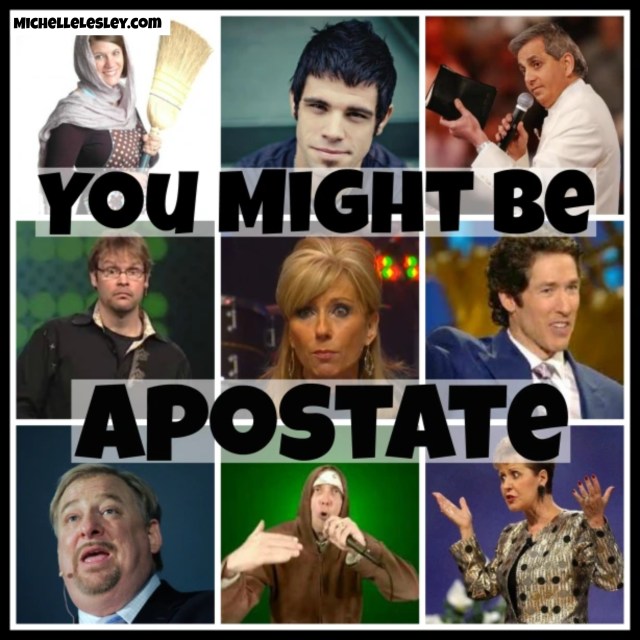
You Might Be Apostate

Comedian Jeff Foxworthy hit the big time several years ago with his “You Might Be a Redneck” one-liners. He frequently introduced the bit by saying, “I’ve found that there are rednecks all over, but sometimes people don’t know they’re rednecks. So, I came up with this little test…” and continued with such gems as:

“If you’ve ever had to carry a bucket of paint to the top of a water tower to defend your sister’s honor, you might be a redneck.”

“If your wife has ever said, ‘Honey, come get this transmission out of the tub so I can take a bath!’ you might be a redneck.”

“If you’ve ever been accused of lying through your tooth, you might be a redneck.”

It was a routine that a lot of us in the South found hilarious because we knew someone (or were someone) who fit nearly every one of Jeff’s jabs.

Like rednecks, there are apostate false teachers all over the place out there, only a lot of them (and their disciples) don’t know they’re false teachers. And the fruit of their lives and ministries is far wackier than anything a redneck has ever dreamed up. That fruit is a sign that we’d better examine the root of doctrine from which the fruit sprang.

So if any of the preachers and teachers you’re following have ever said or done the following things (or something even crazier), watch out, because they Might Be Apostate.

HoNuthaLevel

If you’re a middle aged pastor who makes embarrassing rap videos, who publicly extols the virtues of Spanx for men (even though it gives you gas) and who calls himself a Ferrari you might be apostate.

If you feature a Naked Cowboy impersonater (aka- your youth “pastor”) at your “Christian” women’s conference, you might be apostate.

If you’ve ever purposefully applied the pronoun “herself” to God, you might be apostate.

If you celebrated your 35th birthday by preaching at the “church” of your mentor, T.D. Jakes, and placing a $35,000 check in his offering wheelbarrow, you might be apostate.

If God has ever told you to go up to a stranger in the airport and ask if you can brush his hair, you might be apostate.

If you’ve ever given your congregation a sob story about needing a new $70 million Gulfstream jet, because the old one is worn out, you might be apostate.

If you think of the Holy Spirit as the “sneaky,” “silly,” “funny,” “blue genie from Aladdin,” you might be apostate.

If you’re a woman who thinks God is OK with you preaching to men despite what His word clearly says to the contrary, you might be apostate.

If you’ve ever said, regarding your church’s worship service, “I probably wouldn’t have a stripper on stage…” but leave the door open to the idea because “God told Isaiah to walk around naked for three years,” you might be apostate.

Benny Hinn at Maple Leaf Gardens on Sept. 28, 1992 photos by Tony Bock/Toronto Star and handout photo.

If you think smacking people in the face with your Nehru jacket is a ministry of the Holy Spirit, you might be apostate.

If you’ve ever typed a Facebook status in tongues, you might be apostate.

If you say you’re a trinitarian, but think the Father, Son, and Holy Ghost are three “manifestations” of God rather than three Persons, you ARE apostate.

If you think Proverbs 21:9 means you should camp out on your roof in a quest for biblical womanhood, you might be apostate.

If your senior pastor father sexually abused boys at your church and paid them off to keep them quiet and you, as the subsequent pastor, knew about it but didn’t speak up, you might be apostate.

If you officiated at your homosexual son’s “wedding,” you might be apostate.

If you’re a pastor who thinks expository preaching is “cheating” because it’s “too easy” and that “it’s not the way you grow people” AND that we shouldn’t say “the Bible says…” AND that parents who take their children to a small church instead of a mega church are “stinkin’ selfish,” AND that we shouldn’t use the Bible to convince the lost of their need for Christ, you might be apostate.

If you’re Oprah’s idea of an awesome pastor, you might be apostate.

download

If your preaching, ministry, and theology have ever been publicly rebuked by John MacArthur, Paul Washer and Steve Lawson, you might be apostate.

If you partnered with a Roman Catholic mystic with a degree in spiritual psychology to make a completely unbiblical movie about the Bible featuring ninja angels and Mary Magdalene bossing the disciples around, you might be apostate.

If you and your 80s rock star third husband stand in the pulpit and tell people to watch porn to improve their sex life, you might be apostate.

If a feature of your “worship service” is people laughing uncontrollably or barking like dogs, you might be apostate.

If you’ve ever decided to “p*ss off the religious people” on Easter Sunday by playing AC/DC’s Highway to Hell to open the service, you might be apostate.

If you’ve written a book entitled “I Am” and it’s about positive confession rather than Jehovah, you might be apostate.

If you think you have the power to control the weather by the words you speak, you might be apostate.

Joyce-Meyer-600x450

If you think that between the cross and the resurrection Jesus went to Hell and that Satan and the demons jumped up and down on His back, you might be apostate.

If the top three “pastors” you encourage people to follow on Twitter are T.D. Jakes, Rick Warren, and Joel Osteen, you might be apostate.

If a currently practicing homosexual couple wants to serve in leadership at your church and your only problem with it is that one of them isn’t yet divorced from his wife, you might be apostate.

If you’ve ever been accused of having an affair with Benny Hinn, you might be apostate.

If, a hundred years ago, your worship leaders might have been carted off to the funny farm or treated to an exorcism for conducting themselves like this, you might be apostate.

And, if you’re about to write a comment rebuking me for marking false teachers to avoid and exposing unfruitful works of darkness because Jesus would never do such a thing then you don’t know your Bible.

And you just might be apostate.