Or maybe I answered your question already? Check out my article The Mailbag: Top 10 FAQs to see if your question has been answered and to get some helpful resources.
For any men who might be reading – this question is about breastfeeding. If that’s a sensitive issue for you, please just scroll right on past this section.
I have searching for biblical content about breastfeeding and your post from 3 years ago “The Mailbag: Should Christian women cover up while breastfeeding? really did make think. I’m currently studying to become a pediatric dietitian if God allows it, and I have a debate in myself. I’m starting to create content in social media in order to teach about these topics: breastfeeding, nutrition, etc. But now I don’t know if it’ correct to share real videos that are educative to teach how to properly breastfeed, showing examples and different cases that help mothers to understand. Since it is shameful to show breast according to Bible, am I wrong if I am looking to share or record these types of videos? Just to clarify, these videos only shows the necessary.
I hope my email can reach you and have an advice for this, may the Lord continuing giving you wisdom and excuse me any grammatical error since english is not my first language.
Can I first just say – I have the utmost admiration for anyone who tackles English as a second language. Its intricacies and inconsistencies are often difficult even for us native speakers! When I get English messages from followers whose native language is not English, they almost always apologize for grammar and spelling errors. Please rest assured, when I read your messages, I’m not critiquing them, I’m wishing I were as proficient in a second language as you are!
Instructional videos for mothers about breastfeeding are not the same thing as a mother who is breastfeeding in public. For one thing, your videos are aimed specifically at women (new mothers), and for a legitimate purpose (teaching breastfeeding). If a man (assuming he’s not a health care worker who needs to view your videos for professional purposes) proactively clicks on and watches your videos in order to see women’s bare breasts, he is the one at fault, not you. His actions would be more similar to a man who peeks through the window of a woman’s bedroom to watch her breastfeed, not a man out in public, minding his own business, who’s suddenly confronted with a view of a woman’s breasts because she’s not making any effort to reasonably cover while nursing.
Additionally, aiming your videos at new mothers (women) is more similar to a woman breastfeeding her baby in a group meeting for new moms (all women), than out in public (random men and women present).
Here are a couple of things I would suggest:
Make sure the titles of your videos make it obvious in some way that they are educational, instructional videos on breastfeeding for new mothers and postpartum/neonatal healthcare workers.
Instead of, say, just posting these videos on your personal Facebook, Twitter, Instagram, etc., pages, set up a separate professional social media page or group specifically for your videos and other breastfeeding materials. (I would suggest also setting up a website and YouTube channel specifically for your breastfeeding materials.) Not only will this help build your professional online platform, but your male friends and family members won’t be randomly running across your videos (which might make them uncomfortable) every time they scroll through social media.
I think that’s really as far as your responsibility goes. Men have to take responsibility for what they view at some point, too. It’s not all on you.
I have a question about women who are ordained. My cousin is ordained to perform marriages in the state of South Carolina. Would that be considered the same as an ordained preacher and against I Timothy 2 teaching? As far as I know all she does is perform marriage ceremonies and does not “preach” in the pulpit.
Great question!
I’m thinking there might be a little confusion about the term “ordained” here. “Ordaining” is what a church does when it sets someone apart for ministry. “Licensing” is what the government does that allows a person to legally perform marriages recognized by the state.
For example, pastors, elders, and (usually) deacons are ordained by the church to their respective offices, but they are not automatically licensed to legally perform marriages. For that, they have to go downtown to the courthouse and fill out some paperwork. By the same token, people can go to the courthouse, fill out the paperwork, and become licensed to perform marriages, and never have set foot in a church in their lives.
So, I think maybe you mean your cousin is licensed by the state to perform marriages, not that she is ordained by her church to do so. (I’ve never heard of a church that ordains someone just to perform marriages, but if that’s what’s going on here, the more pressing problem is the church’s ecclesiology, not your cousin officiating at weddings.)
So let’s go with your cousin being licensed by the state, not ordained by the church: No, that’s not technically a violation of 1 Timothy 2:12, assuming she’s not preaching a sermon as part of the marriage ceremony. The biblical prohibition is against women pastoring, preaching to men, instructing men in the Scriptures, and holding unbiblical authority over men in the context of the church gathering.
But there are all kinds of variables that play into whether or not it’s wise or appropriate for her to be officiating weddings. Does your cousin profess to be a Christian? Where do these weddings take place – in a church, park, reception hall, beach, etc.? Is she performing these weddings, or being viewed as performing these weddings as an official representative of her church? (In other words, would those not in the know confuse her performing weddings for her being a pastor of her church?) Do the bride and groom profess to be Christians? If so, why would they not want their pastor (or at least a pastor) to perform the ceremony in their own church?
I’m just saying I would need to know a lot more, probably on a case by case basis, to weigh in on whether or not it’s actually a good idea for her to perform any or all of these wedding ceremonies.
FIRST, I want to say thank you for your recent list of doctrinally sound men. My reason for writing comes from referring to them as “awesome” in your social media post about them:
“Today on the blog: Check out these awesome men to follow and learn from…”
I would just would ask you to consider the use of the word “awesome” when it applies to “mere” men (or women, for that matter.) Never mind the “world,” but Christians use that word so freely when talking about truly “good” things (and we also use it for things like movies and ice cream.)
Is it wrong to want there to be a word that is reserved for God and what he does? When something is clearly a work of God, even working through a person, there are times I can agree that it is something awesome. But largely, the things we call awesome are not.
It’s always good to evaluate our words to make sure we are representing Christ well, and, no, it’s not wrong to want there to be a word that is reserved for God and what He does. But let me challenge us to take this a bit deeper than just the surface level use of a particular word.
I’ve received this same basic question a handful of times over the years, and the question has always been about the word “awesome”. And I just have two questions about that:
First, why “awesome”? I think a much stronger biblical case could be made against using “good” or “holy”.
I’m betting that, like the reader who wrote in, we all use the word “good” in the same ways the word “awesome” is used – “truly good things,” movies, ice cream, saying “Good dog!” etc. – because they both mean the same thing, except that awesome is a little more intense. And yet, while Scripture doesn’t speak to our use of the descriptor “awesome,” Jesus Himself addressed the use of the word “good” in Mark and Luke:
And a ruler asked him, “Good Teacher, what must I do to inherit eternal life?” And Jesus said to him, “Why do you call me good? No one is good except God alone.
Now, when we read this passage in context, we know that Jesus isn’t telling this guy (or us) that he shouldn’t call Him good, that he shouldn’t call anything good, that Jesus isn’t good, or that Jesus isn’t God. Quite the opposite of most of those, in fact.
He’s directing the rich young ruler’s attention to the fact that only God is completely good. That God is the only and perfect standard and embodiment of good. He was basically saying, “You’re calling me good in this context. Does that mean you’re prepared to call me God?”.
But what Jesus doesn’t say (here or anywhere else in Scripture) is, “Since only God is truly, completely, and perfectly good, you can’t use the word “good” to describe anything else.”. In fact God Himself uses the word “good” to describe other, lesser things besides Himself. He has prepared good works for us to do. God pronounced everything He created good. He gives us good gifts. He says good trees bear good fruit. And so on.
Personally, if I got to choose the word we were all going to consecrate to use only for describing God, it would be “holy”. I would be totally OK with us losing expressions like “holy cow,” “holy moly,” etc., forever. (And when my kids were little and would use one of those expressions, I would remind them, “Only God is holy.”.) First of all, there are far fewer people and things that could correctly be called “holy” than “awesome” or “good”.
“Only Thou art holy,” we sing. And it’s true. Though Christians are a holy nation, and we’re to strive for holiness, we are only positionally holy and set apart because Christ’s righteousness has been imputed to us. Even our righteous deeds are as filthy rags. In a common grace sense, we might say someone is a “good” man for the job, or a store is having an “awesome” sale, but there is no common grace sense in which anyone but Christians – and we, only through Christ – could, in any way, properly be called holy.
My second question about reserving “awesome,” or any other adjective, strictly for God is: If you’re going to be consistent with your line of reasoning, how far are you going to take this? If you’re going to stop using “awesome” for anything but God, are you also going to stop using the word “good” for anything but God? What about “perfect”? Powerful? Just? Kind? Compassionate? Merciful? Are you going to stop saying, “I love you” to your family because God is love, and only He loves perfectly and completely?
I hope not. I hope you won’t stop using any of those words, because God doesn’t require you to. It would be self-imposed legalism. Remember when Jesus said to the Pharisees, “The Sabbath was made for man, not man for the Sabbath.”? He was trying to teach them that the Sabbath was meant to be a blessing and a benefit of rest to God’s people, not a slave driver of legalism adding one more day of work (to earn God’s favor) to their week.
It’s kind of the same general idea with language in this case. Language is one of God’s good and awesome gifts to us. It gives us a way to express our reverence for Him, but also our delight in the work of His hands – like ice cream and dogs. Just as with the Sabbath, there’s a godly and appropriate way to use language, but, outside of those parameters, language was never meant to enslave us or hamstring our ability to communicate. When we use language to appreciate God’s good gifts, or to express delight or pleasure, knowing that every good gift and grace redounds to His glory, He is exalted.
When we use language to appreciate God’s good gifts, or to express delight or pleasure, knowing that every good gift and grace redounds to His glory, He is exalted.
If you’re convicted not to use the word “awesome” for anything but God, or you don’t want people calling you awesome as a matter of conscience, that’s totally fine. Don’t violate your conscience. But you must realize that it is a matter of your conscience, not everybody’s. And you can’t bind others to your conscience. Whether or not to use the word “awesome” is an issue of Christian liberty. It is not a biblical command.
If you have a question about: a Bible passage, an aspect of theology, a current issue in Christianity, or how to biblically handle a family, life, or church situation, comment below (I’ll hold all questions in queue {unpublished} for a future edition of The Mailbag) or send me an e-mail or private message. If your question is chosen for publication, your anonymity will be protected.
You can hardly say the sky is blue or water is wet these days without offending somebody. It shouldn’t be surprising to us that when self reigns on the throne of a person’s heart, she will bow down and serve the king of personal feelings. And as a loyal subject, she will fight to the death any perceived threat to that ruling authority. It is normal for unsaved people to live their lives with their feelings leading them around by the nose.
It is normal for unsaved people to live their lives with their feelings leading them around by the nose. It is not normal for Christians to live that way.
It is not normal for Christians to live that way. And it concerns me that I’m seeing more and more Christian women who allow themselves to be controlled by their feelings rather than being controlled by Christ.
(I’m about to step on some toes, here, so if you’re offended {maybe especially if you’re offended} by what follows, hang in there with me until we get past the hurt feelings and arrive at God’s Word, or you’re actually going to be proving my point.)
❤ Last May, the day before Mother’s Day, I was sort of mindlessly flipping through my Facebook and Twitter feeds, when something caught my notice. Tweet after tweet, status after status, article after article about Mother’s Day. But the vast majority of those posts were not honoring and encouraging women who are mothers, which is the whole point of Mother’s Day. They were focused on women for whom Mother’s Day is painful. Women who are infertile. Single women who haven’t had children. Women who have lost children in miscarriage or other tragedies. People whose mothers have died. Mothers whose children are estranged.
❤ As April Fool’s Day approached this year, I began noticing admonishments not to say, “I’m pregnant,” as an April Fool’s joke on social media in order to protect the feelings of women struggling with infertility or have miscarried.
❤ I have heard from dozens of women who refuse to obey God’s command to join with a doctrinally sound local church – even though they’re physically and logistically able to – because they have been hurt by a previous church.
❤ Christian women who follow false teachers commonly lash out in anger – often displaying the opposite of every one of the fruits of the Spirit – when presented with incontrovertible biblical evidence that the teacher is promoting false doctrine.
❤ And have you seen the fracas over racism in evangelicalism lately? Ungodly statements and accusations are flying from both sides of the aisle because, feelings: feelings of being owed something, fear of man feelings of not wanting to appear racist, feelings of retribution, feelings of pride and self-righteousness.
Life circumstances and other people genuinely and validly hurt us sometimes. No sane person would deny that, and certainly no Christian with a modicum of Christlike compassion would deny it. I’ve been on the receiving end of some of the painful situations I mentioned above. Pain – deep, agonizing, and often undeserved pain – goes with the territory of being human. None of us are immune.
And, if you’re a Christian, you worship a Savior who more than understands what it’s like to be hurt – not just the physical torture of flogging and crucifixion, but the emotional pain during his life of being “despised and rejected by men, a man of sorrows and acquainted with grief”. Jesus experienced far more misery than you or I ever will, and yet, He handled it in a way that brought honor and glory to God. As His disciples, we are called to follow His example when it comes to our own pain.
Jesus could have allowed this grief to stay at the forefront of His heart and mind, governing His thoughts and reactions towards others and towards life in general. But He didn’t. He chose to deal with His pain in a godly way, refusing to allow it to control Him, paralyze Him, or deter Him from His mission, but putting it in its proper perspective. Pain is not paramount – holiness is. Jesus didn’t allow His pain to reign – He determined that His heart and mind would be led by holy thoughts and actions.
Jesus didn’t allow His pain to reign – He determined that His heart and mind would be led by holy thoughts and actions.
Jesus didn’t expect people to accommodate His feelings
Can you imagine Jesus demanding a safe space or that people refrain from posting certain things on social media in order to protect His feelings? Neither can I. It must have been monumentally difficult to endure the insults and mockery that constantly came His way, especially when He had the power (and the right) to shut those people up so He wouldn’t have to deal with all of that. Instead, Jesus accepted that hurtful people and circumstances are part of life and He proactively chose to respond to those people and circumstances in a godly way – setting an example for us in the process.
Can you imagine Jesus demanding a safe space or that people refrain from posting certain things on social media in order to protect His feelings? Neither can I.
Not just one person, one time, or one situation. Seventy times seven. Even if the person didn’t ask for forgiveness. Even if the person innocently stuck his foot in his mouth. Not once do we see Jesus harboring bitterness in His heart or holding a grudge against someone who hurt Him personally, whether intentionally or unintentionally. Jesus forgave and moved on with His life and ministry.
Jesus was content
Sometimes, it’s not a person who hurts us, but the circumstances God has sovereignly brought or allowed into our lives. Did you catch that? Anything that’s going on in your life is only going on because God is permitting it or causing it. From infertility to medical conditions to racism to the consequences of sin, God is in charge of what happens to you, and He uses these painful situations to teach you obedience, cause you to depend on and trust in Him, and conform you to the image of Christ.
“Foxes have holes, and birds of the air have nests, but the Son of Man has nowhere to lay his head,” Jesus said. Jesus was homeless, poor, unmarried, and childless, yet never once do we see Him complain about any of these circumstances. He accepted the station in life to which God had assigned Him and was content with His lot, making the most of His situation to the glory of God. We can follow Jesus in that godly mindset, realizing that “godliness with contentment is great gain” and that the Holy Spirit can empower us to find ways to be content no matter our situation.
Jesus didn’t retaliate or sin when His feelings were hurt
If our response to a hurtful person or situation is to take vengeance, lash out in anger, or wallow in self-pity, we aren’t acting the way Jesus did. He never retaliated against those who hurt him, failed to exercise self-control in responding to unkind people, or felt sorry for Himself as a result of his situation. Jesus alwaysperfectly showcased the Fruit of the Spirit: love, joy, peace, patience, kindness, goodness, faithfulness, gentleness, and self-control.
Jesus focused on others, not Himself
Did Jesus stay home from the wedding at Cana because He couldn’t deal with the fact that someone else was getting married and He wasn’t? Was He overcome by hurt and jealousy when people brought their children to Him because He longed to experience the joys unique to fatherhood? No. He made sure the happy couple’s big day was even better by celebrating with them and giving them an awesome gift. He embraced and blessed other people’s children, pouring out His love upon them.
It is absolutely and inarguably incumbent upon us as compassionate, caring, kind, and merciful followers of Christ to weep with those who weep in the midst of suffering. We follow in Jesus’ footsteps by comforting others with the comfort He has shown us. We do our best to be sensitive to the hurts of others and not cause additional or unnecessary pain. We lift up the fallen and strengthen the knees that are weak, just like Jesus did.
It is absolutely incumbent upon us to weep with those who weep in the midst of suffering. But God also requires us to draw upon His strength, look past our own pain, and rejoice with those who rejoice.
But God also requires us to draw upon His strength, look past our own pain, and rejoice with those who rejoice. Just as it is good and right to comfort a friend who’s infertile or grieve with parents who have miscarried, it is also good and right for that friend and those parents to rejoice on Mother’s Day and Father’s Day with those whom God has chosen to bless with children, or to celebrate with loved ones who have just announced a pregnancy. We take the focus off ourselves and put it on others, just like Jesus did.
Life hurts sometimes. And it’s OK to feel that pain. To grieve over loss. To mourn over suffering. But we cannot let those feelings be the boss of how we act and think. If we are to follow Christ, we must ask Him to help us follow His example of dealing with our raw and tender feelings: not expecting people to tiptoe around us, not allowing bitterness or unforgiveness to take over our hearts, not allowing our pain to reign and cause us to sin. We follow Christ’s example by taking up our cross daily, following Him, serving others, and living to the full the lives God has ordained for us. Whether it’s easy or it’s hard. Whether we’re joyful or sorrowful. Whether we feel like it or not.
This article was last updated on April 29. Today’s (May 5) updates include:
May:
The ineptitude or sabotage (it’s unclear which) of Baptist Press’ interview with Tom Ascol
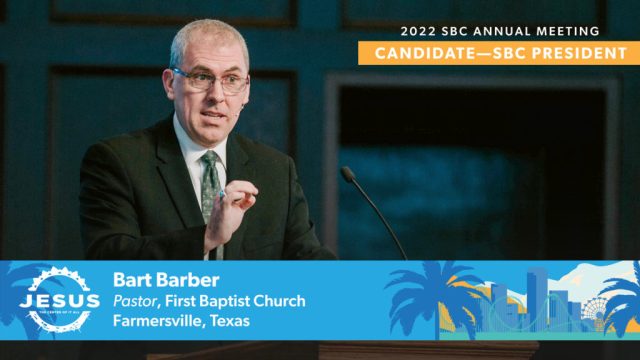
The video of the SBC presidential candidate forum
I’m still collecting proposed resolutions for SBC 2022. I invite anyone submitting a resolution to send it to me for inclusion in this article. (More under “April”)
The 2021 annual meeting of the Southern Baptist Convention opened the eyes of a lot of Southern Baptists to the sin and corruption infecting our cooperative of churches.
The foremost question on the minds of many doctrinally sound and discerning Southern Baptist pastors and church members is whether or not the SBC is too corrupt to be saved. “Should we shake the dust off our feet and leave the SBC, or should we stay in and fight for fidelity to Scripture?”
If you and your church are choosing to stay in and fight, it is crucial that you be well-informed enough on the issues and the candidates to vote biblically when you attend the 2022 annual meeting in Anaheim. And that also means you’re going to need to know your Bible well enough to vote biblically on those issues.
Because what really hurt doctrinally sound Southern Baptists at the 2021 meeting (and previous years’ meetings) was not just those who were consciously pushing an unbiblical, liberal agenda, it was also the messengers who were ignorant of the issues and the candidates, and just voted according to whatever sounded good on the surface, or just blindly trusted whoever was on stage at the moment.
Representing your church (and millions of other Southern Baptists) as a messenger at the annual meeting is a grave responsibility and it should be treated as such. You’ve got to get informed. Your church and pastor have to get informed. The other churches in your association, and your associational leadership have to get informed.
That’s where this article comes in.
I know it’s hard to keep up with the issues when you’ve got a life you’re trying to live and responsibilities you’re trying to take care of. I want to try to make staying informed a little easier for you, your church, and your association, so please share this around.
This article (initially published in the summer of 2021 and subsequently updated) is a timeline of significant events in the SBC at the national level starting with the 2021 annual meeting and moving forward from there. I’ve tried to keep things brief, so you may need to take what you see here and do some more digging on your own if you want an in depth look at a particular issue.
I’ve also posted a few “Points of Order,” things that aren’t really a current event, but more along the lines of SBC polity or information you might need.
If you think I’ve left out something significant (I’m trying not to get bogged down in too much minutiae), please leave a comment and a link, if possible.
For a recap of the major decisions and happenings of the 2021 annual meeting, please read my article: SBC21: Aftermath, Thoughts, and Where Do We Go From Here? There are lots of informative links at the end of the article in the “Additional Resources” section.
June 2021
Point of Order: Financial Contributions
If you’re staying in the SBC, you might be concerned about your offerings being sent to the Cooperative Program to fund SBC entities which are operating unbiblically. This is a dilemma for doctrinally sound churches and individuals, because, until fairly recently, making a financial contribution to the SBC at the national level was a requirement for being “in friendly cooperation with the SBC.”
So how do we stay in the SBC to fight ungodliness by sending messengers to the annual meeting, yet maintain our financial contribution without funding ungodliness? [Now former – see “October” below] Executive Committee member Rod Martin explains:
I have been repeatedly asked how the formula works that determines how many messengers an SBC church may send to the Annual Meeting. Here’s the deal:
Under the recent constitutional amendment, every church now gets two messengers whether they give or not. Previously you had to give a minimum amount to get any messengers at all.
The previous maximum number of messengers was 10. That number is now 12.
You can get one additional messenger (up to the maximum) for every percentage point of additional giving out of undesignated receipts. That’s fair for every church: if you’re giving 5%, you get five more messengers. If you’re giving 10%, you get ten more messengers. The dollar amount doesn’t come into play.
That said, and I very much disagree with this, you can also get one additional messenger (up to the maximum) for each $6,000 in giving. That means megachurches can have 12 messengers by giving next to nothing as a percentage of their budgets. I think that was a big mistake. But the vast majority of SBC churches are small, so they greatly outnumber those churches, and also, the 12 messenger cap greatly limits the power of those giant churches on the floor.
The “giving” I just described can be through the Cooperative Program, but no longer has to be: it can be to any convention entity. So let’s say you wanted to give all of it to Lottie Moon, or give all of it through IMB but designated for certain specific missionaries: you could do that and get all ten additional messengers. There are many other possibilities as well.
I think this change to our system (which was part of GCR)was a giant mistake, as was GCR generally. However, while I know some people disagree, I don’t think it actually disadvantages smaller churches in practice, and it definitely creates a lot of flexibility for churches to give creatively while also maintaining their maximum possible messenger representation.
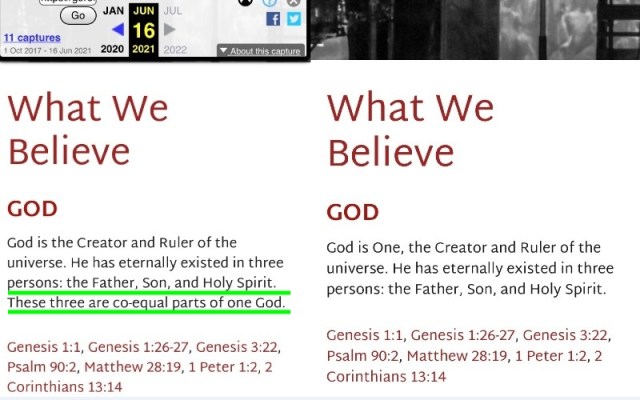
On June 16, the second day of the 2021 annual meeting, a messenger mentioned in a question from the floor that the “What We Believe” page of the church Ed Litton pastors (Redemption Church in Saraland, Alabama) contained a heretical view of the Trinity called partialism.
Photo courtesy of onenewsnow.com
Quietly, and almost immediately, the heretical wording was deleted from the website, as you can see in the “before and after” screenshots above.
It’s not just that the wording was heretical. Redemption Church’s statement of faith – the core of its identity as a church – was changed without a vote by the church body. Indeed, without even notifying or consulting the church body. How would that go over at your church?
To date, neither Litton nor Redemption Church has offered any official explanation regarding why a multi-SBC seminary degreed pastor would lead his church to codify a heretical statement of faith in the first place, nor how that statement of faith was able to be altered without input or permission from the church, nor why it took outside publicity to spur the change.
Unofficially, the explanation some claim Litton has given is that the original heretical wording was some sort of typographical error by the person who typed it into the website. (I want to stress that this is hearsay.)
About a week after the convention ended, starting during the week of June 20:
A side by side video surfaced of Ed Litton (Jan. 2020) and J.D. Greear (Jan. 2019) preaching the same (Greear’s) sermon on Romans 1.
The sermon was Greear’s infamous “The Bible whispers about sexual sin” sermon, so there was not only the plagiarism aspect, but, just as when Greear originally preached it, there was outrage over the bad theology contained in the sermon itself.
Greear and Litton each issued statements explaining, justifying, and excusing the plagiarism.
Litton removed 143 sermons from his church’s website and YouTube, leading most to surmise that these sermons probably also contained plagiarism, due to his explanation of his “sermon by committee” paradigm explained in his statement.
The secular news media began reporting on all of this.
Justin Peters posted a very thorough video biblically explaining and providing documentation for all of this:
Almost immediately, three more side by side sermon comparison videos of Litton and Greear surfaced showing even further plagiarism by Litton. Romans 8 sermonRomans 13 sermon* Romans 14 sermon* (The Justin Peters video above includes the Romans 1 sermon side by side video.)
*I am citing Reformation Charlotte for the purpose of these videos only. It is not a site I endorse.
Somewhat simultaneously, some of Litton’s scrubbed sermon videos begin reappearing on his church’s website and YouTube, and both he (in an interview with the Washington Times) and the leadership of his church (in a statement obtained by Baptist Press) issued statements about why the videos had been removed in the first place. The reasons given by Litton and his church leadership did not match.
For another timeline of these events with additional links, click here.
Further examples of Litton’s sermon plagiarism, some instances going back years, continue to surface.
With all the outcry against current SBC president, Ed Litton, and calls for his resignation, you might be surprised to learn that there is no mechanism in place for removing a sitting SBC president. For the office of president to be vacated, he has to resign, die, or be incapacitated.
The only official governing statement about replacing a sitting SBC president is this sentence from Article V of the SBC Constitution:
“In case of death or disability of the president, the vice presidents shall automatically succeed to the office of president in the order of their election.“
Maybe plagiarism and heresy don’t seem like that big of a deal to you. What’s going to happen when a sitting president commits adultery, steals SBC funds, comes out of the closet as a homosexual or transgender, or is discovered to be a child molester, and refuses to resign?
xxxxx
July 2021
EC SATF Named
Prior to the 2021 convention, allegations were made that the Executive Committee mishandled some charges of sexual abuse by SBC pastors / at SBC churches, which the EC vehemently denied. At the convention, a motion was made that President Ed Litton appoint a task force to investigate these allegations. That task force was named on July 9:
The purpose of the task force is to objectively examine whether the EC handled these charges of sexual abuse fairly and appropriately with regard to recommending whether or not the church should be disfellowshiped from the SBC.
You’ll notice many of the members and advisors work or volunteer in the field of victim advocacy. While it is good to have people with experience on the task force, that has to be balanced with their ability to be objective if this is to truly be an independent review.
For example, Rachael Denhollander has been a polarizing figure in victim advocacy because she has a reputation for never having met an accusation of abuse she didn’t believe, or “having an ax to grind” when it comes to allegations of abuse. If anything, she has a reputation for being biased in favor of alleged victims and unable to objectively assess when false charges have been levied.
When someone (such as some of the members of this task force) has made victim advocacy his career or life’s mission, that person is heavily invested in one side of the issue. It raises the question, “How objective can some of these task force members/advisors be?”.
I’m sorry, but there’s just no polite way to say this, and sometimes you have to call a spade a spade. Ed Litton has been caught in two obvious, public lies about the plagiarism fiasco and his wife co-preaching with him.
Kathy’s Co-Preaching:
This is an issue that came up prior to the 2021 convention so it is not included in this article, but I referred to it in this pre-convention article regarding Ed Litton’s wife Kathy:
This man who wants to be at the helm of your entire denomination, violates Scripture by allowing Kathy to “co-preach” the Sunday sermon at their Southern Baptist church here, and here, and several more sermons can be found at their church’s website.
If you try to click on the links above you’ll notice two of them yield no results. That’s because once Ed Litton was publicly taken to task for allowing his wife to preach, he deleted the sermon videos, which is covering up sin, rather than biblically repenting of it.
When first questioned about allowing his wife to preach, Litton explained that this was because it was a sermon series on marriage and family and he wanted Kathy to provide her perspective. (Scripture doesn’t allow for this, but some accepted this justification.)
It has now been discovered that Litton had Kathy co-preach at least one other sermon series in 2013 which had nothing to do with marriage and family.
(If you’re unclear about why this is a violation of Scripture, please click here, here, and here to read up.)
Plagiarism (see “June” above):
In a news interview with his local CBS affiliate, Litton clearly says the allegations of plagiarism came from “unnamed sources”.
(See 2:40 for the “unnamed sources” segment.)
This is patently untrue. Many SBC pastors and others have publicly sounded the alarm about the plagiarism issue, and all the ones I’m aware of have used their real names.
SWBTS/Greenway Provide Cover for Litton’s Non-Repentance
On September 14, during SWBTS’ chapel service, seminary president Adam Greenway interviewed Ed Litton on a variety of topics, first – and most notably – the plagiarism scandal (3:50). Once again, Litton finessed instead of repenting.
You can tell where Greenway stands as he prefaces his question to Litton by disparagingly referring to the “snark” he received from “anonymous social media accounts” when he announced that Litton had been invited. (“Anonymous”? What I saw when I commented on his Twitter announcement was, I’d estimate, well over 90% non-anonymous, concerned, yet frustrated Southern Baptists wanting the plagiarism issue addressed, and for Litton to resign.)
And, of course, you’ll notice that Litton doesn’t repent over this sin, and even characterizes those who exposed his sin as meaning evil against him in the Genesis 50:20 sense. (More here.)
“In a 44-31 vote Tuesday, Oct. 5, the Southern Baptist Convention Executive Committee (SBC EC) opted to waive attorney-client privilege in connection with a third-party investigation of itself [see “July” above]. Ahead of the special called meeting, six committee members resigned, and Chairman Rolland Slade noted during the meeting an expectation that other resignations may soon follow with the passage of the widely-debated waiver of attorney-client privilege.” – SBC Executive Committee votes to waive attorney-client privilege in sexual abuse investigation at Conservative Baptist Network
Waiving ACP was not necessary in order for Guidepost Solutions (the firm retained by the SATF to investigate allegations of mishandling of abuse cases by the EC) or the SATF to investigate allegations of the EC’s mishandling of abuse cases. It put the SBC in jeopardy of losing its legal representation and insurance coverage, and left individual EC members vulnerable to lawsuits (thus, the aforementioned resignations). And since any compensation paid to abuse victims would have been covered by the insurance policy, it was a very foolish decision indeed.
Multiple EC Resignations
As a result of the EC voting to waive ACP, fourteen committee members resigned effective in late September and October – including President Ronnie Floyd and Rod Martin – due to personal legal vulnerability and frustration.
On October 11, Guenther, Jordan & Price, the Nashville firm which had provided legal representation for the SBC since 1966, terminated its relationship with the Southern Baptist Convention
“The Executive Committee’s board of directors, by a majority vote, has acted to prospectively and preemptively waive the Executive Committee’s attorney-client privilege without knowing the communications affected by the waiver and without knowing the effect it will have on the Executive Committee, the Convention, and those who have served as members or employees of the Executive Committee…For these reasons, we believe our commitment to a certain standard of professional conduct leaves us no choice but to advise you that we are withdrawing from our role as general counsel to the Southern Baptist Convention and the Executive Committee of the Southern Baptist Convention.“
On October 28, the EC trustees met and retained Bradley Legal to provide legal services on an interim basis. (See “February” below for more information on Bradley Legal.)
November 2021
A Discussion of the Issues
On November 19, the Conservative Baptist Network hosted a panel discussion centering on problematic issues in the SBC. Led by SBC First Vice President, Dr. Lee Brand, participants included (L-R: Randy Adams, Tom Ascol, Russell Fuller, Rod Martin, and Allen Nelson)
There was a problem with the audio the night of the recording that caused the first 10-12 minutes of the video’s volume to be extremely low. It clears up after that.
UnMerritted Praise
On November 22, James Merritt – multi-seminary degreed pastor of Cross Point church (SBC) in Duluth, Georgia, former SBC president, chair of the 2021 Resolutions Committee, former chair of the EC, former president of the SBC Pastors’ Conference, visiting professor at SEBTS, etc. – posted this tweet regarding his son Jonathan’s sermon at his (Jonathan’s) “church” the day before. Jonathan is openly homosexual, and his “church” is homosexuality affirming, egalitarian, and universalist, among other anti-biblical beliefs:
Obviously, it should go without saying (especially to someone as biblically knowledgeable as a pastor, former SBC president, and SBC seminary professor should be) that a practicing homosexual is not saved and has, therefore, rejected the gospel. How could any sermon he preached be “faithful to the gospel”?
Naturally, his appalling statement received pushback from biblically faithful Christians, and James Merritt once again showed his baser nature by lashing out at those taking him to task.
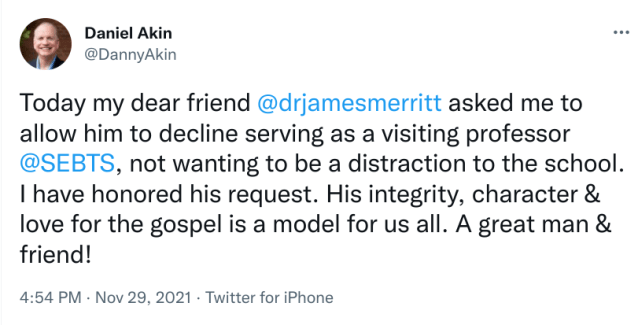
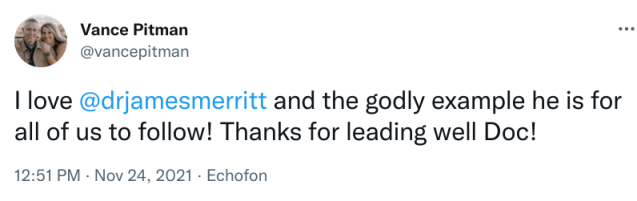
Likely facing pressure behind the scenes, James Merritt resigned his position as visiting professor at SEBTS (but not his pastorate). For this, he was practically lauded as a hero by SEBTS president Danny Akin…
Someone gave reporter Liam Adams of the Tennesseean James Merritt’s binder from his tenure as 2021 Resolutions Committee chair. The binder contained private emails between Tom Ascol and James Merritt as well as other confidential Resolutions Committee communications and information, some of which was used in an article Adams wrote.
In this video, Justin Peters examines four incidents in recent SBC history that seem to demonstrate a gradual progression toward affirming homosexuality. Two of the incidents took place at First Baptist Church Orlando, pastored by David Uth (president of the 2020 Pastors’ Conference who was roundly criticized for inviting false teachers and a female “pastor” as speakers), one incident involved James Merritt, and another involved former SBC President J.D. Greear.
Following a tweet by pastor and EC member Adam Wyatt singing the praises of new interim legal team Bradley Legal, questions began to be raised about the many ties the firm has to the homosexual and woke agendas. From sponsoring Nashville Pride to a glowing report on Bradley’s “inclusivity” from the Human Rights Campaign, Bradley is proud of its “diversity”.
On February 28, in the middle of a self-aggrandizing video noting his past and anticipated accomplishments, and breaking with decades of tradition, Ed Litton briefly announced he would not seek or accept a second term as president of the Southern Baptist Convention.
Point of Order: The SBC President’s Term of Office
“The officers shall be elected annually and shall hold office until their successors are elected and qualified. The term of office for the president is limited to two (2) years, and a president shall not be eligible for re-election until as much as one (1) year has elapsed from the time a successor is named.”The Constitution of the Southern Baptist Convention, Article V, Point 2
In plain English: There is an election for SBC president (and other officers) every year at the SBC annual meeting, which means we could elect a new president every single year. However, the SBC Constitution allows the president to serve two consecutive one-year terms, and, in recent history, most SBC presidents and messengers have taken the Constitution up on that offer. The last single-term president was Adrian Rogers, who (though later elected to two consecutive terms in the mid-1980’s) served from 1979 to 1980, 43 years ago.
xxxxx
March 2022
Willy Run?
March 1, one day after Ed Litton announced he would not seek re-election for a second term as SBC president (see “February” above), Willy Rice, pastor of Calvary Church in Clearwater, Florida, announced that he would be nominated for SBC president at the annual meeting in June. (See “April” below)
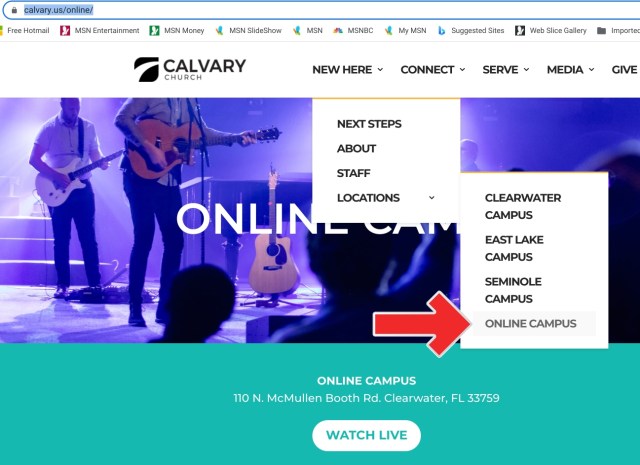
Calvary follows the multi-site model with three locations in Florida. They also have an “online campus” which they seem to equate with the three physical locations. Though there’s nothing wrong with a church live streaming its worship service, leading people to believe that watching a video of a worship service is equal to being a faithful member of a local church and physically gathering with that church body for worship and fellowship is an unbiblical ecclesiology. The Greek word for “church” in the New Testament is ἐκκλησία, or ekklesia. It literally means a gathering or assembly. No gathering, no church. The Bible commands and assumes that we physically gather as the church.
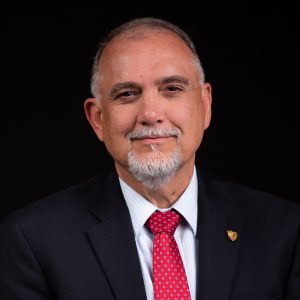
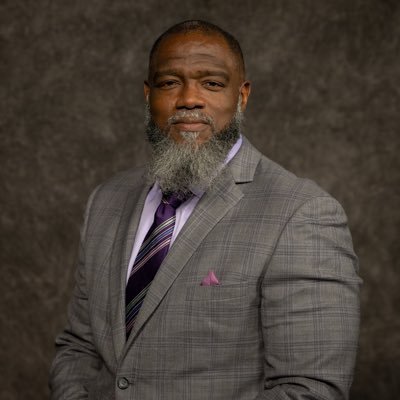
On March 22, it was announced that Tom Ascol – pastor of Grace Baptist Church in Cape Coral, Florida, and president of Founders Ministries – would be nominated for SBC president, and Voddie Baucham – author, sought after conference speaker, and currently dean of theology at African Christian University in Zambia – for president of the Pastors’ Conference.
Both men have an outstanding record of fidelity to Scripture, biblical ecclesiology, Christian ethics, and sound doctrine. Both have spoken unashamedly against sexual sin, false teachers, Critical Race Theory and racialism, egalitarianism, and the social justice movement. Both are dedicated to the bold proclamation of the mercy and grace of God in the biblical gospel rather than the watered down gospel of seeker sensitive easy believism.
There could be no two better men than these to begin the hard task of turning the SBC back to faithfully believing and obeying God’s Word. If at all possible, my Southern Baptist sisters, I urge you to talk to your pastor about representing your church as a messenger at the SBC annual meeting in Anaheim in June (along with as many other messengers as your church qualifies for) and vote for Tom and Voddie.
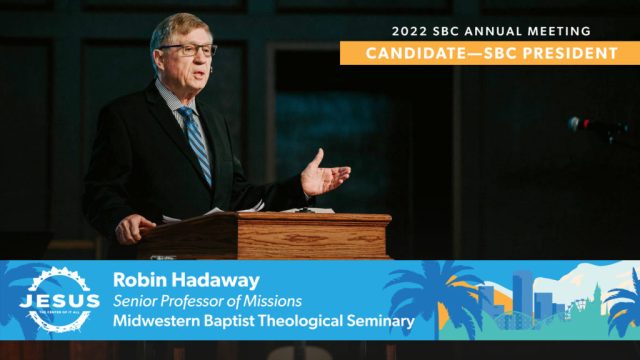
On March 23, a third candidate for the SBC presidency was announced. Former IMB missionary, Robin Hadaway. Hadaway served for many years as a missionary in Africa and South America. Following his time on the mission field he spent twenty years at Midwestern Baptist Theological seminary as a professor of missions and in several different administrative positions. He has also served in various offices and capacities in the Southern Baptist Convention.
In late March (spilling over into April), a situation began to unfold in which Tom Buck (and his wife, Jennifer), pastor of First Baptist Church, Lindale, Texas, who has battled valiantly against corruption in the SBC, was maligned, lied to, and threatened with blackmail. The situation involved not insignificant figures in SBC life, including SEBTS professor Karen Swallow Prior, SEBTS President Danny Akin, former 2022 SBC presidential nominee Willy Rice, and others.
This is the same type of “dirty tricks” move from the liberal contingent of the SBC we’ve come to expect over the last few years in the weeks immediately preceding the annual meeting, as they attempt to sully the reputations of those on the biblical side of the aisle in an attempt to influence, or even derail, the SBC presidential election.
The story is both heart wrenching and enraging, and provides insight into just how evil and corrupt the SBC has become at the highest levels. The story is somewhat lengthy and involved, and the timeline intricate, but I urge you to peruse the following pertinent documentation:
On April 1, potential SBC presidential nominee, Willy Rice (see “March” above) announced that it was about to be made public that a deacon in his church had committed “sexual sin” in his past – prior to his salvation – “that could also be described as abusive” but which did not involve criminal charges. The deacon was removed from his position. (I would like to point out, for clarity, that the 2021 resolution Rice quotes from near the end of the video says that anyone who has committed sexual abuse is permanently disqualified from the office of pastor. The man in question was a deacon, not a pastor.)
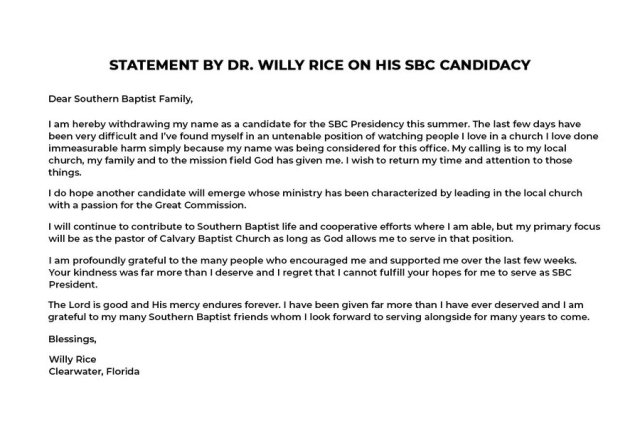
On April 6 – likely under pressure from “progressive” SBC leadership because he was the progressive candidate, and abuse is a major plank in the progressive platform – Rice announced he was withdrawing his name as a candidate for SBC President.
On April 7, it was announced that pastor Bart Barber would be nominated for president of the SBC. Barber was appointed by current SBC president Ed Litton (see above) as chair of the Resolutions Committee, and will serve in that capacity at the 2022 annual meeting.
Though he may not consider himself progressive, Barber is the candidate most progressives will likely end up voting for, simply because a) he has greater name recognition than Robin Hadaway, and b) they want the least conservative candidate possible to win.
You can read about Barber’s positions on various issues at Bart Barber FAQs on his church’s website. You may find the following sections to be informative:
Critical Race Theory– in which Barber says it is problematic there is no agreed upon definition of CRT, yet conducts a Twitter poll (which any marginal statistician could tell you is hardly reliable) about this undefined concept of CRT, and uses those results to conclude that CRT is “far from being an urgent issue to address in your church or in the Southern Baptist Convention.”
(Barber also served on the 2021 resolutions committee which quashed a resolution condemning CRT as incompatible with the BFM signed by 1300+ Southern Baptists. Tom Ascol, on the other hand, at that same meeting, made a motion to rescind 2019’s Resolution 9. Read more here.)
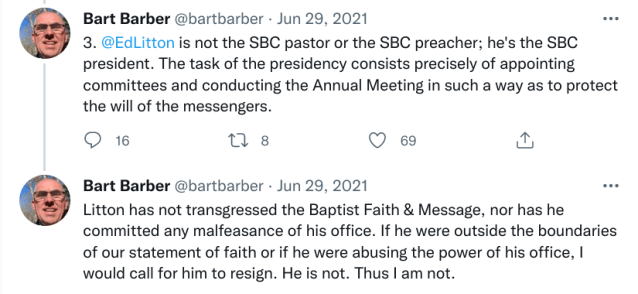
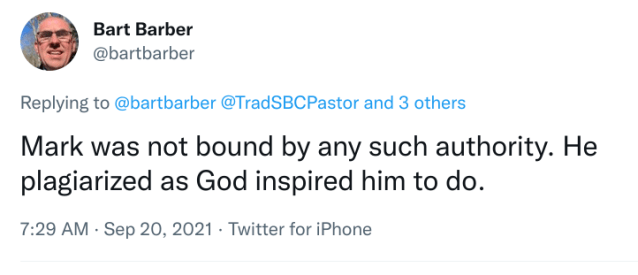
Plagiarism– in which Barber asserts that, since the authors of Scripture, young pastors, and those newly converted on the mission field may not have access to advanced theological training, the internet, commentaries, methods of attribution, etc., and, thus, may repeat things they’ve been told by others with no attribution, this excuses someone like Ed Litton – who does have all of those advantages and should know better – from plagiarism. How does Ed telling JD Greear’s personal life experiences as though they were his own fit into that paradigm? It’s not readily clear.
You can read the rest of Barber’s defense of Litton – as well as his opposition to the CBN (Conservative Baptist Network) here. Tom Ascol was, at that same time, vocally decrying Litton’s sin of plagiarism.
Though the content of his interactions with her are benign, Barber seems to have a friendly Twitter relationship with false teacher Beth Moore (here, here).
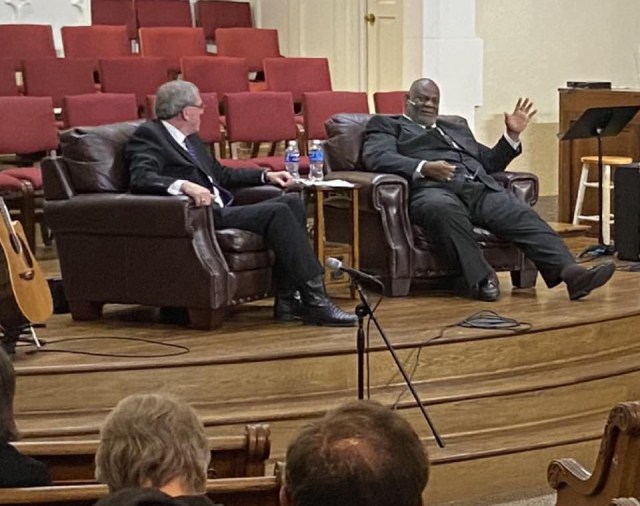
In 2020, Barber invited Dwight McKissic to be a guest on his podcast, and recorded the episode in the sanctuary of his church. McKissic is an SBC “pastor” (he is biblically disqualified) who plays the race card in nearly every conversation, is a rabid egalitarian, and defends false teachers such as Beth Moore (McKissic suggested that she should be nominated as president of the SBC a few years ago) whenever he gets a chance.
On April 15, the resolutions portal opened for submitting a resolution to the 2022 Resolutions Committee. The 2022 resolution submission window closes May 30.
Resolutions are essentially position statements messengers may have the opportunity to vote on at the Convention. (Parliamentary procedure or committee action may preclude a vote.) I would love to publish the text of, or information regarding as many resolutions as possible so messengers can take the time to read, inform themselves, and especially pray about how they should vote that they may not have once at the convention site.
If you know someone who will be submitting a resolution at the Convention and would like to have it published here, please comment below or contact me as soon as possible.
Resolutions
This is the originaltext that will be submitted to the Committee on Resolutions. Please bear in mind, the Committee on Resolutions has the authority to “reword” these resolutions in any way they choose and then present the edited version to the Convention for a vote. (This was a major issue with Resolution 9 on CRT in 2019. The Committee “reworded” the original resolution so much that the edited version ended up saying basically the opposite of the original version.) The Committee also has the authority to decline to present a resolution for a vote. When you arrive at the Convention, please carefully read the versions of the resolutions you are given before voting on them, since they may have been altered.
A resolution has traditionally been defined as an expression of opinion or concern, as compared to a motion, which calls for action. A resolution is not used to direct an entity of the Southern Baptist Convention to specific action other than to communicate the opinion or concern expressed. Resolutions are passed during the annual Convention meeting.Resources in Resolutions at SBC.net
As I mentioned above, a resolution is akin to a position statement on anything from abortion to a war in another country to National Ice Cream Day if you like. Individual Southern Baptist church members write up resolutions and submit them to the Committee on Resolutions within the allotted time frame. The Committee on Resolutions processes each resolution. Most, they will decline to present for a vote. Some, they will tweak, re-word, edit, beef up, or water down, before presenting. Some, they will present as is. Sometimes, when several similar resolutions are submitted, they will write a new resolution, combining the ideas they like from each, and present a resolution from the committee for a vote. Messengers then have the opportunity to vote in agreement or disagreement with each resolution the Committee on Resolutions presents.
Resolutions are non-binding. This means neither you nor your church nor any other Southern Baptist individual or church has to abide by any resolution. Resolutions serve mainly to make a public statement: This is what the majority of Southern Baptists believe about this issue this year.
Each year, no later than 75 days prior to the SBC Annual Meeting, the SBC president, in conference with the vice presidents, appoints a Committee on Resolutions whose task is to consider and recommend appropriate resolutions to the messengers attending the annual meeting….Only members in good standing of churches entitled to send messengers to the next annual meeting of the Southern Baptist Convention may submit resolutions.
For more information on how to submit a resolution to the committee click here: Submit a Resolution
xxxxx
Change of Venue
On April 28, the Executive Committee voted to move the 2023 SBC annual meeting from Charlotte, North Carolina (the site approved by messengers in 2016), to New Orleans, Louisiana. Due to increased attendance over the past few years, it was anticipated that the Charlotte venue would be too small.
SATF Cost
Also on April 28, with regard to the Sexual Abuse Task Force:
EC members were informed that since Oct. 1, a total of $1,661,530 has been paid toward Guidepost Solutions [the independent investigating agency] and $17,478 toward Task Force travel and meetings.
In September, the EC voted to allocate up to $1.6 million toward the work by Guidepost Solutions. In February, they voted to increase the funds allocated to $2 million for the investigation or the “coverage of any other direct expenses without further approval.”
“Baptist Press recently released an interview that Jonathan Howe and Brandon Porter conducted with me…on April 5. Both they and I recorded the interview. They did so indicating that they would edit out the “ums,” “uhs,” and “wells,” etc. from the transcript in order to make the article flow well without losing the contextually understood meaning of my words.
In the interview that they posted, however…my responses were largely left unedited except for the exclusion of certain things I said…There are other misquotes throughout the article…in the interest of openness and transparency, I am making available the full audio below. In it you can hear a more complete and accurate version of the how the questions were phrased as well as my exact answers.”
Tom Ascol, Bart Barber, and Robin Hadaway participated in a panel discussion on issues facing the SBC at First Baptist Church, Keller, Texas, on May 4. The discussion was moderated by Joe Wooddell and Tony Richmond—both of FBC Keller.
SATF Report and Recommendations
Guidestone Solutions, the firm hired by the SATF to investigate the EC for mishandling cases of abuse is to submit its report to the SATF 30 days prior to the SBC annual meeting in Anaheim (June 14-15, 2022). The report is to be made public one week after receipt, along with the SATF’s recommendations on any action the SBC should take as a result of the report.
Recall the things from the introductory lesson that you wanted to keep in mind as you study the text of Psalm 119.
Don’t forget to read in complete sentences instead of stopping at the end of each verse.
Recall the themes you’ve been noticing in Psalm 119. Watch for those themes to be repeated in today’s and future passages. You may wish to make a list of those themes to refer to throughout this study.
Questions to Consider
1. Review your notes from last week’s lesson. Does that passage relate to this week’s passage? How? Do you notice any repeated words, thoughts, or themes?
2. Let’s look at a few themes in today’s passage.
The first is the theme of the psalmist’s imploring. Make a list of all the phrases in this section which indicate imploring (e.g. “Answer me, O Lord”). Who is he imploring, for what, and why? When we implore someone about something, what does our imploring indicate that we believe about that someone? What does the psalmist’s imploring God indicate he believes about God? Is his belief correct? How do we know this? Think of a time when you implored God about something. What did your imploring indicate you believed about God? Regardless of how He answered, was your belief correct? How do you know?
Our next theme is the theme of night. Which two verses in this passage contain this theme? What is “the watches of the night” (148), and what does the psalmist mean in this verse? (It may help to compare a few different translations.) What sort of picture do darkness and night paint in this passage? What is the antidote to darkness and night in this passage?
The third theme is the theme of far and near. Which verses explore this theme? In each instance, list what is far from or near to what. In what ways are far and near contrasted? In each instance of far or near, note whether the psalmist is indicating that far or near is a good thing or a bad thing. Have you experienced any of these instances in your own life? What does this teach us about salvation and the nature and character of God?
The final theme is the theme of hope. Which verse explicitly declares the psalmist’s hope? What does he hope in, and why? Make a list of other phrases in today’s passage which implicitly indicate the psalmist’s hope. Who or what does he hope in? How does this hope ease the tension of, and comfort him in his affliction? Do you have that same hope in Christ? Write out a few statements of your own hope in Christ and His Word modeled after the structure of verse 147 (e.g. “I [negative circumstance], but I hope in [characteristic of God / the Word].)
How do the themes of imploring, night, far and near, and hope relate to and inform one another in this passage?
Did you notice any other themes in today’s passage? Explore them using your cross references. How do they connect to the aforementioned themes?
3. Note the word “promise” in 148. In this context, does “promise” mean Scripture in general, a specific verse or promise, the nature and character of a God who keeps His promises, all of the above? Explain why. (Again, it may help to compare a few different translations.)
4. How many times, and in which verses, does the psalmist use the phrase “give me life according to Your…”? How does the first line of each verse inform or relate to the “give me life” part of the verse? What are the three “according to’s” in these verses?
Whenever God acts in any way, in any circumstance, explain how and why He always acts:
according to His promise:
according to His rules:
according to His steadfast love:
Can you think of some examples from Scripture in which we see God acting according to His promise, according to His rules, and according to His steadfast love? What about some examples from your own life?
5. Make a list of each phrase in today’s passage in which the psalmist is basically saying, “I obey Your Word.”. Do you get the sense that the psalmist is saying to God, “I obey You, therefore, You owe me X,Y, and Z.”? That God should react to his obedience as a quid pro quo? Why or why not?
Remember that, unlike Christians today, the psalmist was living under the Mosaic covenant. Under this covenant, God promised to bless Israel’s families, fields, flocks, finances, and fighting men if they obeyed Him, and to curse them in all of these areas if they disobeyed him. This was the air the psalmist breathed that informed his view of God, his relationship to God, and how he expected or anticipated that God would act in his life. Knowing this background, why do we see this repeated refrain of “I keep Your commandments,” especially when the psalmist is suffering, in today’s passage and throughout Psalm 119? What is the psalmist reminding himself of – about himself and about God – by repeating this again and again? How does “holding God to His Word” demonstrate the psalmist’s trust in God to keep His promises? Explain how the psalmist’s constant cry of “I obey Your Word” calls upon God to be God – to act in accord with His nature and character, to keep the promises He made in the Covenant, and to act within the parameters of the Covenant.
How is the psalmist’s brand of “stake my life on it, total obedience, so much so that I don’t get why God hasn’t acted yet” faith and belief different from the easy, shallow, mental assent, untested “I love Jesus” brand of belief that requires nothing of, and demonstrates nothing about the “believer,” that we see in so many professing Christians today? Which type of belief is Jesus calling us to when He says “Repent and believe the gospel,” and Paul and Silas, when they said to the Philippian jailer, “Believe in the Lord Jesus, and you will be saved.”? How is this type of “stake my life on it” belief different from both the works righteousness, “quid pro quo” type of “belief” in God and the easy / shallow type of “belief” in Jesus? How is the posture of the psalmist’s heart, and the genuinely regenerated Believer’s heart different from the posture of heart of those who subscribe to these other two forms of “belief”?
Praying Psalm 119
Have you ever tried praying the psalms? I want to encourage you to try praying part of Psalm 119 back to God each week of this study. (If you’re familiar with my other studies, this will take the place of the weekly “Homework” section.)
The psalms are uniquely suited for praying back to God, both verbatim and conceptually, because they are often written as prayers – as though the psalmist is talking to God. Did you notice that about today’s passage? In which verses?
What is a concept or thought for your own life that the Holy Spirit impressed on your heart or convicted you about from today’s passage? Is there a particular verse(s), or maybe the whole passage, that you would like to pray back to God verbatim? Whatever your “prayer point” from today’s lesson, pray it at least daily until we get to the next lesson.
With all the insanity going on in the public school system these days, the number of parents – especially Christian parents – choosing to homeschool is skyrocketing. Need somebody to point you in the right direction for suggestions, materials, and help getting started? You’ve come to the right place.
I’m a veteran homeschool mom. That means I homeschooled four of my children and they’ve all graduated and become productive, godly citizens. It also means I’m out of the day to day, “in the trenches” life of a homeschool mom. So I’m not keeping abreast of all the new curricula, methods, and programs, but since I do get questions about homeschooling from time to time, I can at least give you a little nudge in the right direction. Especially for those of you who fall into two particular categories:
I’d love to homeschool, but we can’t afford to live on one income.
Do you know of any good Christian homeschooling blogs?
I homeschool, so I’m asked from time to time about homeschooling resources, but to be honest, it’s just not something I really read about. I recently asked my readers to recommend some good, doctrinally sound online homeschool blogs and resources, and here’s what they suggested (Please note, I have not vetted any of these. You will need to do the research yourself to discover whether or not they’re doctrinally sound.)
Home School Legal Defense Association– With over 100,000 member families, Home School Legal Defense Association (HSLDA) is the nation’s largest, most trusted homeschool advocacy organization. We’re here to advance and protect your freedom to homeschool.
A lot of families think they can’t homeschool, when, in reality, they can, they just need a little help. I hope these resources will point you toward finding the help you need so you can discover the many joys of homeschooling.