Discernment, False Doctrine, False Teachers

Throwback Thursday ~ Clinging to the Golden Calf: 7 Godly Responses When Someone Says You’re Following a False Teacher

Originally published January 16, 2015
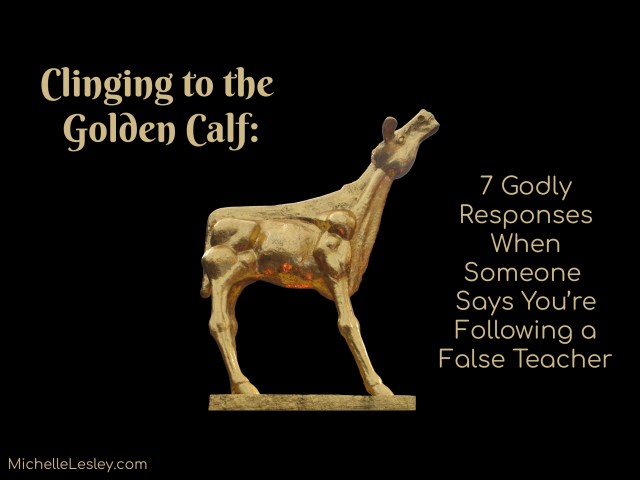
Ever heard of Jeroboam? If you’ve read your Old Testament, the name probably rings a bell, but, let’s face it, it’s hard to keep all those Jeroboams, Rehoboams, Ahinoams, and Abinoams straight, right? Well, let’s read a little bit about Jeroboam:

And Jeroboam said in his heart, โ€œNow the kingdom will turn back to the house of David. 27 If this people go up to offer sacrifices in the temple of the Lord at Jerusalem, then the heart of this people will turn again to their lord, to Rehoboam king of Judah, and they will kill me and return to Rehoboam king of Judah.โ€ 28 So the king took counsel and made two calves of gold. And he said to the people, โ€œYou have gone up to Jerusalem long enough. Behold your gods, O Israel, who brought you up out of the land of Egypt.โ€ 29 And he set one in Bethel, and the other he put in Dan. 30 Then this thing became a sin, for the people went as far as Dan to be before one. 31 He also made temples on high places and appointed priests from among all the people, who were not of the Levites. 32 And Jeroboam appointed a feast on the fifteenth day of the eighth month like the feast that was in Judah, and he offered sacrifices on the altar.

1 Kings 12:26-32a

The Kingdom of Israel had just split into the southern kingdom of Judah and the Northern kingdom of Israel. Jerusalem, where the temple is located, is in Judah. Jeroboam (king of Israel) figures that if his people continue traveling to Jerusalem for feasts and sacrifices, they will eventually turn their loyalty back to the the kingly lineage of David (aka: Judah, 26-27) and heโ€™ll lose both his kingdom and his head. So, in order to keep the people inside the borders of Israel and control them, he makes a couple of golden calves (which somebody should have remembered turned out badly the last time that was tried {Exodus 32}) for them to worship at either of two convenient locations, Bethel, in the southern part of Israel, and Dan in the northern part. Jeroboam, leading the way, had the Israelites simply transfer their feasts and sacrifices that they would have offered to God to these golden calves. It’s a fascinating story that you can read more about here if you’re interested.

So why am I going on and on about Jeroboam?

Because Jeroboam’s story is so similar to something that is happening in the visible church today. He was a well known personality who led God’s people to worship an idol which he told them was God. And God’s people went along with it, transferring their worship from the one true God to the golden calf called “God.”

There are a ton of Jeroboams out there today. Some of you reading this might be following one of them and worshiping the idol their false theology tells you is the God of the Bible. And in the same way that a man of God came along and rebuked Jeroboam for his blasphemy, a man or woman of God might come along and call out the Christian celebrity you’re following, or take you aside -out of love and concern- and let you know that person is a false teacher.

I hope you won’t respond like Jeroboam did. He was so angry, he tried to kill the prophet. But sadly, I have seen this type of response (at least verbally) many times, especially from women, when faced with the fact that their favorite Bible teacher or author is preaching a false gospel.

So, what’s a godly way to respond when someone tells you you’re following a false teacher?

1. Consider the source and listen.

If you know the person who’s telling you this, think about her godliness and character. Is she generally a godly person? Does she know her Bible well? Does she show love and concern for others? Is she trustworthy? A godly person of good character has no reason to toss out wild and unfounded accusations, especially if you’re her friend and it might offend you. In fact, she’s probably scared to tell you.

But even if it’s a stranger on a blog saying Celebrity Bible Woman is a false teacher, hear her out and make sure you understand what the issues are. Remember, what she’s saying might be true, but you’ll never know if you immediately write her off.

2. Listen for content, not tone.

There are some discerning people out there who will bring you flowers and candy and hold your hand as they gently tell you the person you’re following is a false teacher, and then there are discerning people whose tone or manner might rub you the wrong way as they’re delivering the news. Don’t let the way something is said turn you off to the content of what is being said. Don’t sacrifice truth on the altar of tone.

3. Keep your emotions in check.

It’s tempting to let our feelings take charge when we’re receiving bad news, but you aren’t going to be able to evaluate the content of what the person is saying if you’re consumed by rage or hurt. It might help to remind yourself of your relationship to the teacher/author in question. Do you even know her personally? It’s not like someone is leveling accusations against your child, spouse, or best friend. Put your emotions aside and let reason and clear thinking rule the day.

4. Don’t blindly believe the messenger.

You don’t have to -nor should you- believe everything you hear just because it quotes a Bible verse or wraps itself in the label “Christian”. That applies to both the person who tells you you’re following a false teacher and the alleged false teacher herself. Listen carefully to what the person has to say, make sure you understand it, then get out your Bible and get to work. Are the issues the person has raised biblical? What does God’s word have to say about these issues? Is the person you’re following violating Scripture? If so, choose to stop following the false teacher because the Bible -not a person- tells you to do so. People are fallible. God’s word is not.

5. Don’t shoot the messenger.

It’s been my experience that women who are loyal devotees of false teachers can be some of the most vicious people in the world if you dare to question their idol. I have had women verbally rip me to shreds, threaten me, call me names, accuse me of “judging,” and tell me I’m what’s wrong with Christianity for politely pointing out from Scripture that someone is teaching false doctrine. Ladies, we give Christian women as a whole a bad name when we act like that. More importantly, that kind of behavior is a reproach to Christ, and never appropriate for someone who calls herself a Christian.

6. Defend from Scripture, not opinion,
emotion, or personal preferences.

It is downright embarrassing when a person is shown that Celebrity Bible Woman is violating a certain Scripture, and her only argument is, “But I just LOVE her! She’s such a great teacher and helps me understand the Bible so well!” If it were really true that Celebrity Bible Woman is such a great Bible teacher, her followers ought to be able to  prove -from Scripture- that what Celebrity Bible Woman is doing or teaching isn’t unbiblical. The bottom line is that Scripture is our ultimate authority, not our opinions, not our personal preferences, not how much we love a certain teacher. For a Christian, if something comes up against the Bible, the Bible wins. Period. So, if you’re going to defend Celebrity Bible Woman, defend her from Scripture. And if you can’t, why are you still following her?

7. Love Christ more than you
love your favorite teacher.

If someone shows you from Scripture that your favorite teacher, author, or pastor is teaching false doctrine and you ignore that warning because you are so enamored with that teacher, then what you’re saying is that you love that teacher more than you love Christ and His word. Jesus said:

Whoever loves father or mother more than me is not worthy of me, and whoever loves son or daughter more than me is not worthy of me.

Matthew 10:37

Your parents. Your children. They’re the people you love most in the world. If Jesus says you can’t love them more than you love Him, do you think it’s going to be OK with Him if you love your favorite Bible teacher more than you love Him? It’s not. Love Christ above all else, and cut that false teacher out of your life.

It can be difficult to hear that you’re following a false teacher. You like her. She makes you feel good. You think you’re doing great in your walk with the Lord. It’s hard to give all that up. But we must be careful that we never put our feelings for a person above Christ and His word. If someone tells you you’re following a false teacher, don’t brush her off or attack her. She’s most likely coming to you out of love and concern for you and for the body of Christ. Check out what she’s saying against the Bible. And if she turns out to be right, stop following that false teacher and thank her. Because a person who rescues you from an enemy of Christ is truly your friend.

Discernment Bible Study

Choose What Is Right: A Study in Discernment ~ Lesson 1- Introduction

Ladies, be sure you don’t skip this introductory lesson to our study!

Welcome to our new study, Choose What is Right: A Study in Discernment!

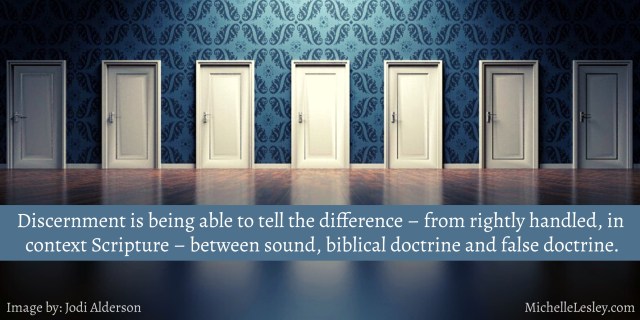
Discernment has various connotations in various contexts, but for the purposes of this study, weโ€™re going to keep the focus narrow and define discernment as being able to tell the difference – from rightly handled, in context Scripture – between sound, biblical doctrine and false doctrine.

What does the Bible say about discerning between true and false doctrine? How does God regard false teachers, and how are we to deal with them in our personal lives and families, and as the church?

Have you ever read the book of Job? When we think about Jobโ€™s story, our minds usually turn to the theme of suffering, and how to suffer well as Christians, but did you realize another major theme of the book of Job is discernment? Jobโ€™s three friends come to him in his suffering and comfort him with โ€ฆ false doctrine. Job is well on his way to believing them when his true friend, Elihu, steps in and, though heโ€™s not perfect, does his level best to correct them.

The theme verse for this topical study in discernment comes from Elihuโ€™s speech in Job 34:

Hear my words, you wise men, and give ear to me, you who know; for the ear tests words as the palate tastes food. Let usย choose what is right; let us know among ourselves what is good.

Job 34:2-4

This 11-15 lesson study will help us to be wise women who pay attention to what God says about discernment and how to avoid false doctrine. It will show us how to test words as the palate tastes food. It will teach us to know what is good, so we can choose what is right.

The striking title image for our study was designed by Jodi Alderson. To me the doors represent the idea that we are often presented with several options of teachers or doctrines that all appear, on the surface, to be equally good and biblical. We must use our discernment skills to find out which ones actually match up with Scripture.

Another aspect of the image I like is the use of light and darkness. We live in a world of darkness. Some of the doors we’re presented with are obviously dark and will only lead to more darkness. But some of the doors appear to shine forth the light of truth. (It reminds me of 2 Corinthians 11:14-15, which is a verse we’ll tackle later in this study.) Which ones really lead to truth? We have to know what is good so we can choose the ones that are right. Great job, Jodi!

Many thanks to all of those who worked so hard on your entries for our title pic contest. You ladies were very creative and did some outstanding work!ย 

There were too many entries to share all of them with you, but here are a few “honorable mentions”:

Laura Ezinga
Brenna Van Cleve
Robin Self
Cheryl Toepfer

(I need to apologize for creating some confusion in the article announcing the title pic contest about whether the title was supposed to be “Choose What is Right” or “Choose What is Good“. I think what happened is that I have a teaching session for my speaking engagements on Titus 2:3-5 entitled “Teach What Is Good” and that title kept getting mixed up in my brain with the title and key verse for this study. Thank you so much to those who brought this error to my attention. I promise my mix up did not affect the contest in any way. I was judging images and design, not wording.)


If you’re new to using my Bible studies, just a few housekeeping items and helpful hints:

The studies Iโ€™ve written (you can find all of them at the Bible Studies tab in the blue menu bar at the top of this page) are like โ€œtraining wheelsโ€. Theyโ€™re designed to teach you how to study the Bible for yourself and what kinds of questions to ask of the text so that, when you get the hang of it, you wonโ€™t have to depend on other peopleโ€™s books and materials โ€“ even mine โ€“ any more. To that end, I do not provide answers for the study questions in the studies Iโ€™ve written.

My studies are meant to be extremely flexible and self-paced so that you can use them in the way that works best for you. You can do an entire lesson in one day or work on the questions over the course of the week (or longer). You do not need to feel obligated to answer all (or any) of the questions. If the Holy Spirit parks you on one question for several days, enjoy digging deep into that one aspect of the lesson. If He shows you something I haven’t written a question about that captures your attention, dive in and study it! Those are ways the Holy Spirit speaks to us through His Word. This is your time to commune with the Lord, not a school assignment or work project you are beholden to complete in a certain way by a certain deadline.

I will post a new lesson on the blog every other Wednesday, so there is nothing to sign up for or commit to. Simply stop by the blog every other week, or subscribe to the blog via e-mail to have the lessons delivered to your inbox.

I use hyperlinks liberallyThe Scripture passage for each lesson will be linked at the beginning of the lesson. As you’re reading the lesson, whenever you see a word in a different color text, click on it, and it will take you to a Scripture, article, or other resource that will help as you study.

All of the studies Iโ€™ve written are suitable for groups or individuals. You are welcome to use them as a Sunday school or Bible study class curriculum (for free) with proper attribution.

You are also welcome to print out any of my Bible studies (or any article Iโ€™ve written) for free and make as many copies as youโ€™d like, again, with proper attribution. Iโ€™ve explained more about that in this article (3rd section).

From time to time I receive inquiries from men about using my studies for their personal quiet time or for teaching a co-ed or men’s Bible study class. It is my personal conviction that it is more in keeping with the spirit (though not the letter) of 1 Timothy 2:12, Titus 2:3-5, and related passages for men to use Bible study materials authored by men rather than by women. Therefore, on the honor system, I would request that men please not use my studies for personal use, or when teaching a class with male members. (Vetting the studies for your wife, daughter, or the women of your church, is, of course, fine. Encouraged, actually.)


Introduction to
Choose What Is Right: A Study in Discernment

Part of my philosophy of Bible study is that our main “diet” should be systematic, expositional study of the text. In other words: pick a book of the Bible, start at the beginning, and study it through to the end. Then, pick another book and start again. This method of studying helps us understand passages in their context and correctly apply them to our lives, and helps us avoid eisegesis, taking passages out of context, and incorrectly applying them.

However, thereย is a place for the study of a biblical topic such as peace, sin, the family, God’s wrath, or biblical womanhood. For example: if you’re struggling to trust God because of a sudden circumstance in your life, you don’t have time to study through every book of the Bible to learn what the Bible says about trusting God. You may need to spend some time in focused study on passages from various books that deal specifically with the topic of trusting God, and that’s OK. My goal with this study is not only that you learn what the Bible has to say about the topic of discernment, but also to demonstrate how to do a topical study properly so you can do topical studies on your own when the need arises.

Normally, in the introductory lesson to my studies, we take a look at the author of the book of the Bible we’re studying, the audience he wrote it to, the historical setting of the book, and other “backstory” issues. But because this is a topical study, and we’ll be examining passages from various books of the Bible, we’ll have to briefly address those issues as needed in each lesson.

So in the introduction to this study, I’d like to address two items in your “backstory.”

Salvation

If you’re not saved, this study isn’t going to be very helpful to you, because, as we’ll soon learn, lost people are naturally drawn to false teachers and false doctrine, and are incapable of truly embracing the things of God.

This week, before we tackle discernment, I’d like everyone – even if you know beyond a shadow of a doubt that you’re saved – to work through the Scriptures and materials at the What Must I Do to Be Saved? tab in the blue menu bar at the top of this page (and while you’re there, let’s do a little social media evangelism – share the link for that page around to your friends and followers!).

Do you understand theย biblicalย gospel? Have you truly repented of your sin and trusted Christ as Savior? Spend some time alone with God examining your heart and life against these Scriptures. If you’re unsure whether or not you’re genuinely saved, I would encourage you to put this study aside and work through my studyย Am I Really Saved?: A First John Check Up first. You cannot be discerning if you don’t belong to God.

Expectations and Presuppositions

What do you expect out of this study? What kinds of ideas or preconceived notions are you carrying into this study? Take some time to answer the following questions.

1. When you hear the word “discernment,” what do you think of?

2.ย Without looking in your Bible, jot down five or ten things youย think the Bible teaches about discernment.

3. What does your church teach about discernment? Is your church careful about its doctrine and the materials it uses? Is there someone in your church that you look up to as a good example of discernment?

4. What Scriptures come to mind when you think about discernment?

5. Why are you interested in a study about discernment, and what do you hope to get out of this study?

6. What are your strengths and weaknesses when it comes to discernment? What are some things you’d like to improve on?

Take some time in prayer between now and our next lesson to begin preparing your heart for this study. If there’s a specific issue you struggle with when it comes to discernment, ask God to teach you the truth of His Word about that issue and strengthen you in that area. Write down your prayer and review it when the study is over to see how God answered you through the study of His Word. I’m excited to have you join me in this journey of discovering what God’s Word has to say about discernment!

Our next lesson will be two weeks from today.

Discernment

Asbury, Revival, and Discernment

Have you been hearing about this “Asbury Revival” thing lately, and wondering what it is? Is it a “real” revival? Is it biblical? Are people getting saved? These are just a few of the questions Christians have been asking as video, eyewitness accounts, and, undoubtedly, a good deal of speculation have made their way out of Kentucky to other parts of the country.

I would encourage you to examine the resources below and compare everything to rightly handled, in context Scripture. This is a way of testing the spirits as Scripture commands us, rather than simply believing every spirit that comes along.

Beloved, do not believe every spirit, but test the spirits to see whether they are from God, for many false prophets have gone out into the world.

1 John 4:1

To help you practice your discernment, here (and throughout this article) are some questions to keep in mind as you read about and watch the “Asbury revival”:

๐Ÿ”ฅWhere does the Bible say that, in context, and rightly handled? Does the Bible really say that?

๐Ÿ”ฅIs what I’m reading objective, rightly handled, in context Scripture, or someone’s subjective personal experiences, opinions, feelings, or preferences? Which am I hearing more of?

๐Ÿ”ฅCould what I’m reading about have been replicated by a non-Christian person, event, or experience?

๐Ÿ”ฅWho, or what, is my attention being drawn to – Jesus and His written Word, or people, opinions, feelings, and experiences?

๐Ÿ”ฅA good, biblical approach to evaluating events like this, initially, is to “wait and see” what will transpire. We don’t want to make snap, uninformed judgments, but when there’s the possibility that spiritual damage could be done, at what point have we waited long enough and seen enough evidence that it is time to stop waiting and start warning?

What’s this all about?

“The 2023 Asbury Revival is an ongoing Christian revival at Asbury University in Wilmore, Kentucky. The event was prompted after students spontaneously stayed in Hughes Auditorium following a regularly scheduled chapel service on 8 Feb. 2023. News of the phenomena was quickly spread on social media and in Christian online publications. The revival has been compared to similar revivals at Asbury, notably one that occurred in 1970, which had far-reaching consequences in Methodism, US culture, and in the growth of the Jesus movement. The revival is noted for its use of social media, as the participants are mainly members of Generation Z.” 2023 Asbury Revival, Wikipedia

(Normally, I would not use Wikipedia as a resource, but after sifting through a dozen or so news stories for one that wasn’t slanted, didn’t drown the reader in tons of superfluous information, and simply presented the basic facts, unbelievably, Wikipedia is what I was left with. There are a few more details and a decent timeline of events at the link above.)

Entering week three, Asbury President Kevin Brown issued an announcement that the event will end on Wednesday, February 22. Asbury revival in Kentucky will end after two weeks of non-stop services, worship, Lexington Herald Leader

Theological Foundation, Background, and Context

๐Ÿ”ฅAre all of Asbury’s doctrines and practices biblical? If not, which ones, and why?

๐Ÿ”ฅConsider the following passage as you learn about Asbury’s doctrine and practices. Which parts of what you will read below are “tree,” and which parts are “fruit”? According to Scripture, does Asbury seem to be a healthy tree that will bear good fruit, or a diseased tree that will bear bad fruit?

You will recognize them by their fruits. Are grapes gathered from thornbushes, or figs from thistles? So, every healthy tree bears good fruit, but the diseased tree bears bad fruit. A healthy tree cannot bear bad fruit, nor can a diseased tree bear good fruit. Every tree that does not bear good fruit is cut down and thrown into the fire. Thus you will recognize them by their fruits.

โ€œNot everyone who says to me, โ€˜Lord, Lord,โ€™ will enter the kingdom of heaven, but the one who does the will of my Father who is in heaven. On that day many will say to me, โ€˜Lord, Lord, did we not prophesy in your name, and cast out demons in your name, and do many mighty works in your name?โ€™ And then will I declare to them, โ€˜I never knew you; depart from me, you workers of lawlessness.โ€™ Matthew 7:16-23

Asbury University has “its roots in the American Methodist and holiness tradition.” Here is their theological foundation as explained by Asbury University: Wesleyan-Holiness Theology

Briefer and more contemporary: Who are the Wesleyans, and what are the beliefs of the Wesleyan Church?

Though Asbury University retains many biblical standards on paper, genearally speaking, Wesleyans are Arminian, egalitarian rather than complementarian, pro-abortion, pro-homosexuality, and social justice oriented. They tend toward theological “progressivism” – the liberal end of the theological spectrum rather than the conservative end.


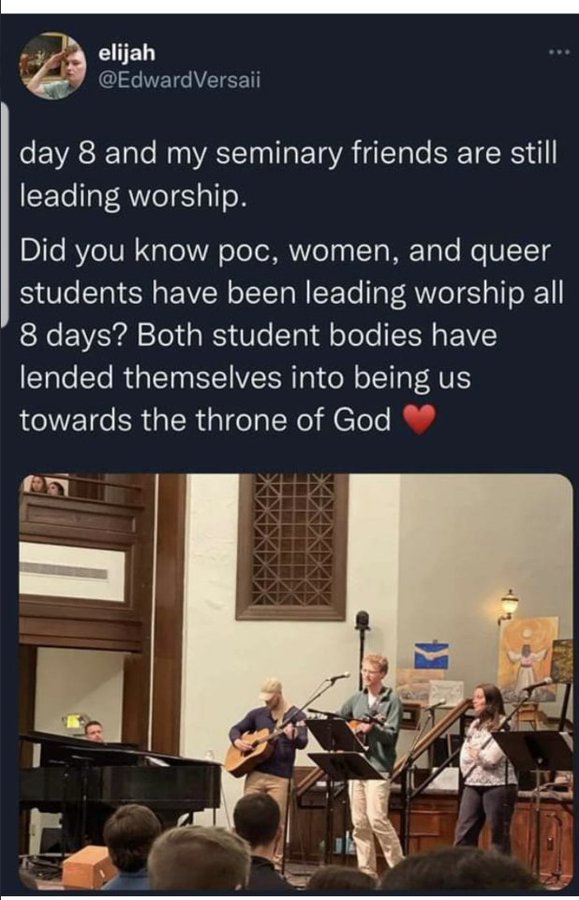
And, indeed, there are openly homosexual students at Asbury, and they have been helping lead this event. From an Asbury student:

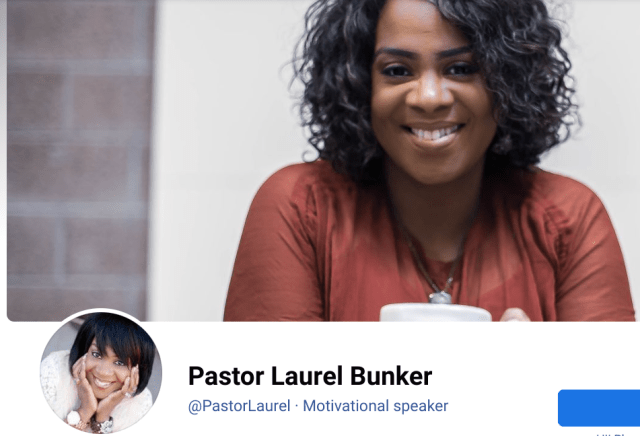
And here is “Pastor” Laurel Bunker, who is scheduled to preach at chapel on March 20, 2023 – just one of the numerous women they regularly have preach.


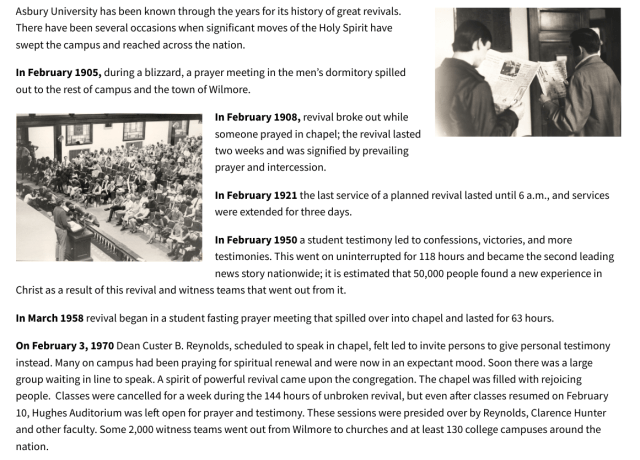
Asbury University also has a history of recurring spiritual events which they have dubbed “revivals” and attribute to the Holy Spirit. From the Asbury University website:

Notice anything about the dates of these events? They all occurred near the time of the Collegiate Day of Prayer, which is always the last Thursday of February. This has raised questions as to whether or not these events may have been at least somewhat contrived or encouraged. Coincidentally or not, Asbury University is hosting the 200th anniversary simulcast for the Collegiate Day of Prayer on Thursday, February 23 – the day after the current “revival” is scheduled to end.

Content of the Meetings

๐Ÿ”ฅWhat does the Bible say about the way we are to worship? How does the content of the Asbury meetings measure up against Scripture’s commands and instructions for biblical worship?

What’s being called the “Asbury revival” started after a regular weekly chapel service. This is the message that was preached during that chapel service that apparently got things going.

Many people have said that the gospel was preached during this sermon. Many others have said the gospel appeared nowhere in this sermon.

This is the gospel:

You are a sinner. You were born in sin and rebellion against the holy God of the universe, and youโ€™ve also willfully chosen to break His law. Youโ€™ve lied. Youโ€™ve wanted and taken things that didnโ€™t belong to you, which is coveting and stealing. Youโ€™ve lusted after someone, which Jesus said is committing adultery in your heart. Youโ€™ve been sinfully angry, which Jesus says is committing murder in your heart. Youโ€™ve dishonored your parents. And thatโ€™s only 6 of the 10 Commandments.

James 2:10 says, โ€œFor whoever keeps the whole law but fails in one point has become guilty of all of it.โ€ So youโ€™re guilty of breaking all of Godโ€™s law.

When you break the law, justice must be meted out. And the just punishment for rebellion against God is an eternity in Hell, which all of us richly deserve. And you can take that eternal death sentence for your sin, and serve it yourself if you want to, but God, who is rich in mercy, has provided another way out. A better way out. He sent His son, Jesus, to earth to live a perfect sinless life so He could take your death penalty for you. And thatโ€™s just what He did on the cross. He died in your place. He took the punishment for your sin. And then he rose bodily from the grave on the third day afterward.

If you want to be right with God, have your sins forgiven, and stand clean before Him now and when you die, confess your sin and rebellion against Him. Sorrowfully turn your heart and life away from sin and toward Him, believing that Jesusโ€™ death, burial, and resurrection paid the penalty for your sin, and you ask Him to save you. And He will.

(For a more extensive version of the gospel with more Scripture references click the What Must I Do to Be Saved? tab in the blue menu bar at the top of this page.)

๐Ÿ”ฅWas the gospel preached during this message? Did you hear about sin, repentance, God’s law, Christ’s life, death, burial, and resurrection for your sin, and God’s grace, mercy, and forgiveness? Can people get genuinely saved without hearing the full biblical gospel?

While many people have stood and spoken in front of those assembled, there have been conflicting reports about whether or not any further sermons have been preached.

Not all public speaking, even in a Christian or church setting, is preaching. To preach is to point the congregation to Christ and His written Word by taking a passage of Scripture and teaching, exegeting, expositing, and proclaiming it. Rightly handled Scripture is the substance around which a sermon revolves. Other forms of Christian speaking – such as personal testimonies, public prayer, words of encouragement, and merely reading or alluding to Scripture – are valid and appropriate at times, but they are not the same thing as preaching a sermon.

Below is the livestream of the Asbury meeting.

๐Ÿ”ฅWhich types of speaking do you see and hear? Preaching? Teaching Scripture? Personal testimonies? Is the speaker teaching and explaining Scripture, speaking about personal thoughts and experiences, speaking about the experience of the “revival” itself? Do you see more singing and prayer or more preaching?

๐Ÿ”ฅConsider this passage as you listen to the speakers in the livestream:

For โ€œeveryone who calls on the name of the Lord will be saved.โ€ How then will they call on him in whom they have not believed? And how are they to believe in him of whom they have never heard? And how are they to hear without someone preaching? And how are they to preach unless they are sent? As it is written, โ€œHow beautiful are the feet of those who preach the good news!โ€ But they have not all obeyed the gospel. For Isaiah says, โ€œLord, who has believed what he has heard from us?โ€ So faith comes from hearing, and hearing through the word of Christ. Romans 10:13-17

๐Ÿ”ฅCould someone hear the full gospel and get saved through what any of the speakers are saying? Why or why not?


There have been a number of reports that the nearly perpetual music during the meetings has largely been songs from Bethel, Hillsong, and Elevation. What do you observe in the livestream?

๐Ÿ”ฅHave all of the songs’ lyrics been doctrinally sound according to Scripture? Is God pleased when we use music from heretical sources to worship Him even if the lyrics of a particular song don’t conflict with Scripture?


One of the concerns early on in the meetings was that rank heretics of the worst order such as Todd Bentley, Rodney Howard Browne, Tasha Cobbs, and Greg Locke were attracted to and enjoyed attending the Asbury meetings. Some speculated that they attended in order to gain some sort of power, take over the meetings, or garner attention for themselves.

๐Ÿ”ฅWould such demonically controlled people have shown up at a “revival” meeting at any doctrinally sound church you can think of where the gospel was being preached and Scripture was being rightly handled? If they had, what impact should that have had on them, spiritually?

False teacher Todd Bentley posts he is โ€˜booked to spend several daysโ€™ at โ€˜Asbury revivalโ€™ โ€” university says he was not invited to speak

OP Continued: “…This happens when people get hungry for more of God. Many will refer to this as a sovereign move of God, however God sovereignly moved 2000 years ago on the day of Pentecost, and he has never stopped. He is still moving today. Canโ€™t wait to hear all the critics, the controllers or better yet the opportunists who would love to co-opt what God does. Let this shut down the whole university! Let the fire continue to fall & spread! #Revival #HolySpirit #Awakening @AsburyUniv

In addition to the worst of the worst evangelical heretics, several in Catholic leadership have attended the meetings and spoken glowingly about them. (Catholicism is not Christianity. Those who hold to Catholic doctrine – and we certainly would expect Catholic leaders to hold to Catholic doctrine – are not Christians because Catholicism anathematizes the biblical gospel.)

‘Jesus was right next to me’: Asbury revival sets Catholics on fire with Holy Spirit

๐Ÿ”ฅIs it possible for an unbeliever who anathematizes the biblical gospel (i.e. believes and teaches that anyone who believes the biblical gospel is condemned to Hell) to be “set on fire with the Holy Spirit”? According to Scripture, what is the function of the Holy Spirit in the life of an unbeliever?


There has been one (that I’m aware of) instance of someone allegedly exorcising a demon during the meetings. If you’re familiar with the trappings of the New Apostolic Reformation, you know that what you see in the video below goes hand in glove with the NAR’s heretical theology of “spiritual warfare”.

๐Ÿ”ฅDoes a “tree” (see Matthew passage above) of sound doctrine produce heretical fruit? Would this type of incident be likely to happen at any doctrinally sound church you know of? If not, why not? If so, how would it have been handled by the pastors and elders?

What Other Biblically Trustworthy Voices Are Saying

๐Ÿ”ฅSome have said it’s sinful or wrong to biblically critique the Asbury meetings without physically going there to experience it personally in real time. Does the Bible require us to be physically present while something is happening in order to experience it personally before making informed, biblical evaluation, observation, or critique?

If yes, have you ever evaluated the Holocaust or slavery as sinful? Have you ever said that Mormonism, Hinduism, Satanism, etc., were unbiblical, having never practiced one of those religions yourself? Consider this passage in which Jesus comments on events at which He was not physically present.

The Mailbag: Applying Twisted Scripture to Pseudo-โ€œChristianโ€ Events, Ideas, and Fads

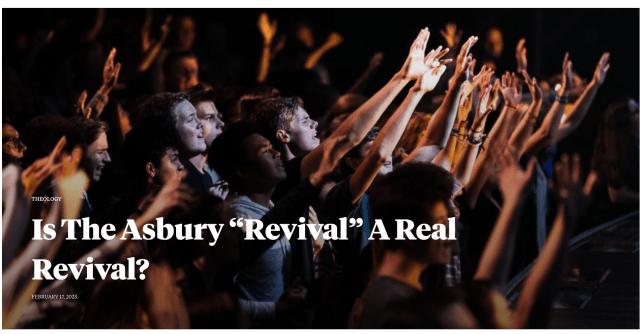
Is The Asbury โ€œRevivalโ€ A Real Revival? by Samuel Sey

Let’s have some real talk about this whole Asbury revival thing. We’ll start with a lesson from the Western Front. at Not the Bee

The Asbury Revival: observations from a local pastor at The Cripplegate

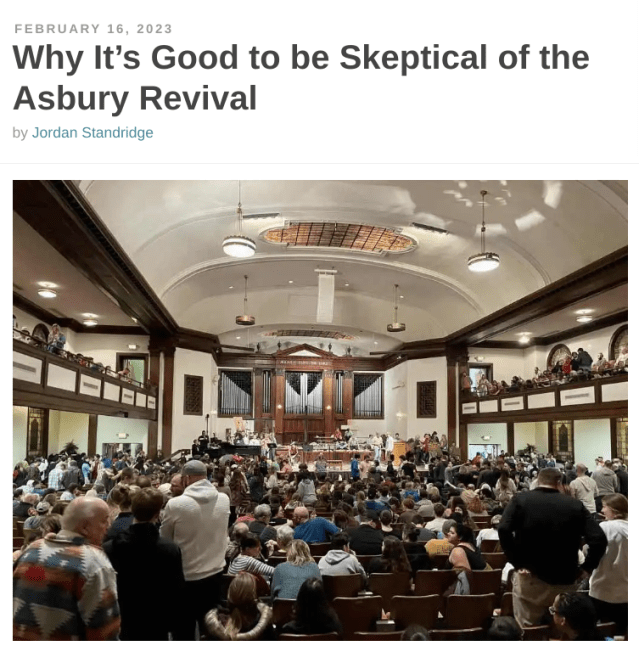
Why Itโ€™s Good to be Skeptical of the Asbury Revival at The Cripplegate

Can Anything Good Come Out of Asbury?

๐Ÿ”ฅConsider these passages. God is able to take any sin, any false doctrine, any bad situation, and use it for His glory and our good. What are some scripturally good, doctrinally sound things that could happen as a result of the meetings at Asbury?

๐Ÿ”ฅWhat are some things doctrinally sound Christians and churches could do to reach out to and help the students at Asbury?

๐Ÿ”ฅWhen someone hears the biblical gospel and gets genuinely saved while still a member of a “bad tree” belief system or a follower of a false teacher, does she stay in that unbiblical environment or does God grow her and bring her out of it? What is something you could do to share the gospel with and disciple someone caught in a false belief system?

Mailbag

The Mailbag: Potpourri (Women giving eulogies… Highlighting my Bible?… Sharing resources with men… Leading a tract ministry)

Welcome to another โ€œpotpourriโ€ edition of The Mailbag, where I give short(er) answers to several questions rather than a long answer to one question.

I like to take the opportunity in these potpourri editions to let new readers know about my comments/e-mail/messages policy. Iโ€™m not able to respond individually to most e-mails and messages, so here are some helpful hints for getting your questions answered more quickly. Remember, the search bar (at the very bottom of each page) can be a helpful tool!

Or maybe I answered your question already? Check out my article The Mailbag: Top 10 FAQs to see if your question has been answered and to get some helpful resources.


My father passed away recently, and I’ve been asked by my family to give one of several eulogies. I am saved, and I’d be very eager to share the gospel, as most of my beloved relatives & extended family are not. However, I will decline, and not go against God’s Word, if this would be an example of “teaching” both men & women. Thank you so much.

My deepest condolences on the loss of your father.

No, giving a eulogy is not a violation of Scripture for women. What God prohibits you from doing is pastoring, preaching, teaching men the Scriptures, and exercising authority over men in the context of the gathering of the church body.

A funeral is not the gathering of the church body (especially when, as you indicated, most of the people attending are lost), and a eulogy doesn’t correlate to a sermon, it correlates more closely to giving a short personal testimony. You’ll be talking about your dad, not instructing or exhorting people from the Scriptures.

Was your dad a Believer? If so, one way to share the gospel during your eulogy that might make you more comfortable would be to word the gospel in terms of your dad’s testimony. (i.e. “In 1973, Dad hit rock bottom and came to realize he was a sinner. He cussed like a sailor, he wasn’t leading his family to know the Lord, he was a liar … but then he picked up the Bible Grandma had given him so many years ago and started reading. As he read, he came across Scriptures like X, Y, and Z [read Scriptures like Romans 3:23, etc. here] ….I’m so glad Dad trusted in the death, burial, and resurrection of Christ to save him, and I know he’d want you to trust Christ, too.”)

If your dad wasn’t a Believer, was there something in his life that lent itself to you becoming a Believer? If so, you could word the gospel in terms of your own testimony. (i.e. “…Dad had messed up. Again. But that led me to think about all the times in my life when I had messed up. I had sinned so many times against a holy God…. [insert the gospel via your testimony here] … and even though Dad wasn’t perfect, I’m so thankful for the way God used his life to help me understand that I needed Christ.)

What you might want to do is meet with your pastor for some counsel on this. He has undoubtedly performed a lot of funerals, both for saved people and unsaved people, and I’m sure he can give you better guidance than I can.

Additional Resources

Rock Your Role: Jill in the Pulpit

Rock Your Role FAQs

Rock Your Role series


Youโ€™re the first person I thought of to ask how to highlight Bible verses using specific colors. Do you have a system for this skill that you can share? Iโ€™m 61 and have never had a church that taught it.

Well, I’m honored that you thought of me! I’m almost 54 and I’ve never been in a church that taught it either. I think it’s really just an individual thing that you develop a method for on your own rather than something the church teaches.

I wish I could help you come up with a system, but I don’t use highlighters in my Bible. I did when I was younger, but I ended up highlighting so many verses it just became pointless.

(I have no idea what @faithcomedy is. I’m not recommending it, just leaving it on the pic for a photo credit.)

My husband gave me a MacArthur Study Bible for Christmas! Itโ€™s a precious gift, so I want to use it wisely.

Your husband is a keeper! I hope you gave him plenty of hugs and kisses. The MacArthur Study Bible is one of the best study Bibles out there.

I also want to learn how to study my Bible without a formal study, so I thought I would start with a few of your studies before going solo. I believe systematically highlighting what I learn will help me focus better and provide order to my efforts. Brain fog and focus are current challenges for me, so keeping things simple works best.

I hope you’ll enjoy whichever of my studies you decide to use. Studying straight from the text of Scripture is the wisest possible use of that new Bible.

My advice would be to ask your friends at church how they highlight. You can also Google something like “how to highlight my Bible”. I’m sure you’ll get lots of results. Just sift through them carefully, use what works for you, and throw out the rest.

My daily structure was shattered last year, but God used it to get my attention. Now, Iโ€™m working on re-establishing self-discipline to restore the structure as God directs me. Thank you for your time in considering my thoughts. Your assistance is greatly respected and appreciated.

You are more than welcome. I’m so encouraged to hear how God is working in your heart and life. It is my pleasure to serve you in Christ.


You write to women. I love the things you write but are they appropriate to share with men? Is it my place to share with men? Iโ€™m not talking about my husband, I have a man who is the right age to be my son, I am 62, and he randomly sends me things from teachers you have helped me learn to veer away fromโ€ฆ but my friend has much more of an attitude of something you wrote somewhere about chewing the meat,spitting out the bonesโ€ฆ I canโ€™t remember exactly how you said it. Anyway he feels like sharing anything is better than sharing nothing. I am wondering if forwarding him your article is a good idea or if there is a strong male pastor who writes about discernment? I hate to send videos of John MacArthur although Iโ€™ve watched him and itโ€™s so good. But Iโ€™m not sure if sending an hour long video is something that would capture his attention enough. He is of course accusing me of being a Pharisee๐Ÿ˜”

Thank you so much for your kind words. Hon, let me start off by saying this- if this disrespectful dude is young enough to be your son and he feels comfortable calling someone he should view as a mother figure a Pharisee, he’s not your friend. You may have some sort of relationship with him, but it’s not a friendship, at least not on his part. A younger man treating an older woman that way ought to be ashamed of himself.

While it’s admirable that you’re trying to help him, it sounds like you’ve already tried to, and he’s thrown it back in your face. Scripturally, you are under no obligation to keep going back indefinitely for what he’s dishing out. Even God the Father, Jesus, and their admonitions in Scripture donโ€™t teach us to keep indefinitely pursuing people who have rejected biblical truth:

  • Think about Old Testament Israel. God pursued them, disciplined them, sent them prophets, performed miracles โ€“ the whole works โ€“ and He bore with them in their idolatry and disobedience for hundreds of years. But not forever. He eventually sent them into exile.
  • Remember the story of Jesus and the rich young ruler? Did Jesus chase him down and keep trying to convince him once he rejected biblical teaching from Jesus Himself? No. He let him go. What about the father of the prodigal son? Dad lets that rebel leave. (You can probably think of many more examples.)
  • Matthew 7:6: Do not give dogs what is holy, and do not throw your pearls before pigs, lest they trample them underfoot and turn to attack you.
  • Mark 6:11: And if any place will not receive you and they will not listen to you, when you leave [this phrase assumes they will leave], shake off the dust that is on your feet as a testimony against them.

Now, all of that being said, you’ll want to spend some time in prayer for wisdom about how much longer you should hang in there with him on this topic. It is perfectly permissible for you to say, at some point, “It seems like we are at an impasse about these teachers and it is causing contention. If you’d ever like to discuss how you can stop following these false teachers and follow some sound teachers instead, my door is always open. But until then, let’s talk about other things instead.”. Keep praying for him. This is a heart issue, not an evidence issue. God has to open his eyes to the truth before he’ll be able to see it.

In the meantime, yes, it is OK to send him my articles, but if you’re looking for a man’s discernment materials instead, you can’t go wrong with Chris Rosebrough. Check out his YouTube channel and the archives of his podcast, Fighting for the Faith.


I donโ€™t want this question to appear on the forum, if thatโ€™s all right. Like the name and details….

This was the preface to a question a reader posed in a comment here on the blog. I certainly understand wanting to remain anonymous, but I can’t answer blog comments that way. I’m not able to. If you leave a blog comment and I publish and respond to it, your name, avatar, and comment are going to be visible to the public in the comments section of the article you commented on. And I can’t respond to your comment without publishing it. I’m sorry, that’s just the way WordPress works.


A church I previously attended is interested in funding a ministry idea I have to mail or email gospel tracts to anyone for free. They are encouraging me to lead the ministry and I donโ€™t see how I qualify biblically being an unmarried woman. I told them I read in the Bible a Christian woman is allowed to share the gospel but a Christian man qualified as bishop or deacon should lead the ministry. They said I shouldnโ€™t worry about being a woman leading the ministry. I could use your guidance and prayers about what I should do.

Should I work on the ministry plan and administrate the ministry? I would still find qualifying Christian men to lead the ministry through a Board of Directors/Advisors. Thanks in advance for your thoughts on this.

What a fantastic ministry! I’m so glad you thought of this, and I hope it will be a blessing to many.

If your conscience prevents you from heading up this ministry, then don’t sin against your conscience by heading up this ministry.

That said, you do want to be sure your conscience is biblically informed before you base a decision on it.

The biblical prohibition is against women pastoring, preaching, teaching the Bible to men, or exercising unbiblical authority over men in the gathering of the church body. I’m guessing your hesitation is based on the “authority” aspect of that passage.

On the surface, with the limited information I have, it doesn’t sound like ordering and mailing tracts, the administrative sorts of tasks that go along with that (i.e. buying stamps, taking the mailers to the post office, etc.) and organizing those who volunteer to help, would be an authority issue. I mean, how much supervision does a man need to stick a tract into an envelope, seal it, stamp it, and address it? Are you truly “exercising authority” by sending him a list of email addresses to send e-tracts to?

However, there may be some other aspects of the situation I’m not aware of that would make authority an issue. Assuming your current church is doctrinally sound, I would suggest you set up an appointment with your pastor, lay everything out for him, and ask for his counsel and advice.


If you have a question about: a Bible passage, an aspect of theology, a current issue in Christianity, or how to biblically handle a family, life, or church situation, comment below (Iโ€™ll hold all questions in queue {unpublished} for a future edition of The Mailbag) or send me an e-mail or private message. If your question is chosen for publication, your anonymity will be protected.

Discernment Bible Study

New Bible Study Kickoff and Title Pic Contest

Happy Wednesday, Ladies! It’s time to kick off our next Bible study:

…..with a fun title pic contest!

What does the Bible say about discerning between true and false doctrine? How does God regard false teachers, and how are we to deal with them in our personal lives and families, and as the church?

Have you ever read the book of Job? When we think about Job’s story, our minds usually turn to the theme of suffering, and how to suffer well as Christians, but did you realize another major theme of the book of Job is discernment? Job’s three friends come to him in his suffering and comfort him with … false doctrine. Job is well on his way to believing them when his true friend, Elihu, steps in and, though he’s not perfect, does his level best to correct them.

The theme verse for this topical study in discernment comes from Elihu’s speech in Job 34:

Hear my words, you wise men, and give ear to me, you who know; for the ear tests words as the palate tastes food. Let us choose what is right; let us know among ourselves what is good.

Job 34:2-4

This 11-15 lesson study will help us to be wise women who pay attention to what God says about discernment and how to avoid false doctrine. It will show us how to test words as the palate tastes food. It will teach us to know what is good, so we can choose what is right.

But before we get started studying, how about a little fun?

You’ve probably noticed that I design a title picture for most of the Bible studies I write. Here are a few past title pics I’ve designed myself:

But sometimes, I like for us all to share in your creativity. Y’all have sent in some beautiful and creative entries in our past title pic contests – indeed, the title pics for The Sermon on the Mount, The Women of Genesis, Living Stones, Imperishable Beauty, and other studies, were all designed by readers – so, once again, I wanted to get some of you involved in the design process for our new study.

You can see the rest of my Bible study title pics as well as those designed by my readers at the Bible Studies tab in the blue menu bar at the top of this page. Take a moment to look them over to get a feel for my style and the general appearance I like my title pics to portray.

If you enjoy and have a knack for photo editing, or you know someone who does, I’m accepting submissions for title pictures for the Choose What Is Good study. If your submission is chosen it will be used each week of the study, and you’ll be credited (name and website, if any) by watermark. I’d love to be able to offer a huge cash prize, but, hey, we’re small potatoes here. This is just for fun and maybe a little publicity for your site, if you have one.

Contest Guidelines

โ˜™ Ladies only. Sorry guys! :0)

โ˜™ You must use images that don’t require attribution. Pictures you’ve taken yourself are fine, as are images from sources such as Pixabay, Pexels, Freely, Unsplash, StockSnap, or other stock photo web sites. Please include the image source web sites you use along with your submission. (You cannot just grab and use any old picture off the internet. Photographers own their images and usually require permission, attribution, and often a fee, for their use.)

โ˜™ Title pics should be landscape (a horizontal rectangle) with a width of 2000-4000 pixels and proportionate height. I prefer JPG images, but PNG is fine, too, if necessary.

โ˜™ Your title pic must contain the full title of the study: Choose What Is Right: A Study in Discernment (Be sure to double check your spelling, capitalization, and punctuation. You can omit the colon after “Right” if “Choose What Is Right” and “A Study in Discernment” are not on the same line. See my image above. Notice that “in” is the only word not capitalized in this title.).

โ˜™ Since I use the title pic background image for each lesson’s suggested memory verse, please send a blank copy (no words on it) of the picture you’re using along with the title pic you design.

โ˜™ If your submission is selected, I’ll be glad to watermark it with your website address (please submit your picture without any watermarks) if you have one, as long as your web site doesn’t conflict with my statement of faith or my beliefs outlined in the Welcome tab.

โ˜™ Deadline for submissions is 11:59 p.m., Monday, February 27, 2023.

โ˜™ E-mail your title pic submission along with a blank copy of your image, your full name, web site address (if any), and the source(s) you used for your image(s) to MichelleLesley1@yahoo.com. You are welcome to submit as many images as you like.

โ˜™ Please don’t be offended if your submission isn’t selected. If I peruse all the submissions and I’m just not “feeling it,” I may still elect to design one of my own.

โ˜™โ˜™โ˜™โ˜™โ˜™

Feel free to share this around with friends who have an interest in photo editing. If you want to take a whack at it for fun but don’t know where to start, play around with Be Funky, PicMonkey, or Canva and see which one works best for you.

Think about how the Bible describes and defines discernment, Scripture’s posture toward false doctrine, and the necessity of sound doctrine, and try to capture one of those themes in your image.

Happy designing!