Mailbag, Worship

The Mailbag: Potpourri (Boundaries… Submit vs. address sin?… Discernment- Who do you think you are?)

Welcome to another โ€œpotpourriโ€ edition of The Mailbag, where I give short(er) answers to several questions rather than a long answer to one question.

I like to take the opportunity in these potpourri editions to let new readers know about my comments/e-mail/messages policy. Iโ€™m not able to respond individually to most e-mails and messages, so here are some helpful hints for getting your questions answered more quickly. Remember, the search bar (at the very bottom of each page) can be a helpful tool!

Or maybe I answered your question already? Check out my article The Mailbag: Top 10 FAQs to see if your question has been answered and to get some helpful resources.


This comment was left on my article, Taking Offense:

Thank you for this biblical truth: โ€œJesusย taught usย toโ€ฆlove our enemies, do good to those who hate us, bless those who curse us, pray for people who abuse us, turn the other cheek, give to those who want to take from us, treat others the way we want to be treatedโ€. Are boundaries biblical then? Do we stick around when someone is pouring out non-stop criticism and verbally abusing us or talking behind our back? Family members can be the worst. People who are not following Jesus and who are consumed with darkness, hate people who are walking in the Light. I understand not taking offense, but in my experience, when I turn the other cheek to abusers, they keep abusing and hate you more. It is not good to allow them to sin against us because when their sin flows freely, it not only harms me but it harms them too. Thoughts?

Great question! It’s one Amy Spreeman and I have received numerous times over the past few years, so we’ve recorded a podcast mini-series on it!

Beautiful Biblical Boundaries- part 1 deals with the Scriptures and biblical precepts addressing boundaries. We discuss how and when to erect boundaries (and how and when not to). This episode is currently scheduled to drop next Wednesday, November 12.

In Beautiful Biblical Boundaries- part 2, we’ll answer listeners’ questions about boundaries in their own lives and relationships. This episode is currently scheduled to drop in about two weeks, on Wednesday, November 19.
Please note that the links above will not work until the dates specified.


This comment was left on my article, Marriage: Itโ€™s My Pity Party and Iโ€™ll Cry if I Want To ~ 7 Ways to Take Your Focus Off Yourself and Put it Back onย Christ (By the way, yes, I realize that the length of the titles of some of my articles rivals those of many of the Puritans’ books and pamphlets. I’m OK with that.๐Ÿ˜€)

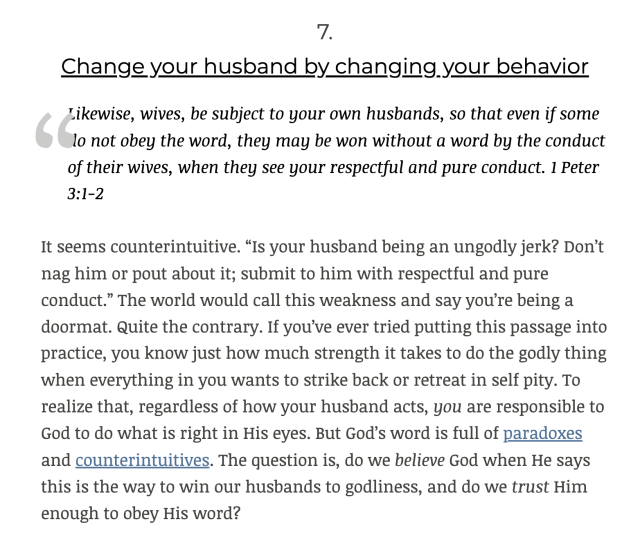
I have a question about number 7…

This article pertains to normal, relatively healthy, Christian marriages. In other words, not abusive marriages. If you are being abused, get yourself and your children to a safe place, and call the police, your pastor, or a loved one for help.

Of course, I agree that we should be subject to our husbands. However, are we not to call them out gently on their sin when they are acting like โ€œan ungodly jerkโ€ according to various verses such as Proverbs 27:5, Luke 17:3, Matthew 18:15, and Galatians 6:1? I guess Iโ€™m just confused because both commands seem to contradict each other.

This is another super question! The short answer is, “Yes,” but as Ecclesiastes 3:1,7 tells us, “there is a time for every matter under heaven…a time to be silent and a time to speak,” and in the moment when your husband is acting like “an ungodly jerk,” he’s apt to respond poorly to his sin being exposed and corrected, which just compounds his sin. (And frankly, we wives usually respond just as poorly in that moment when the shoe is on the other foot.)

In that moment, generally speaking, it’s usually a time to be silent, and, assuming he’s not asking you to sin, do whatever it is he’s gruffly or impatiently asking you to do with a gracious, kind, willing, and loving attitude and demeanor, as opposed to pouting and feeling sorry for yourself – which is the theme of the article (and also why #7 focuses on the “a time to keep silent” aspect of submission rather than the “a time to speak” aspect of addressing your husband’s sin).

Have you ever heard the phrase “killing someone with kindness”? God has an amazing way of taking our example of godly obedience, kindness, and refusing to retaliate, and using that to convict the other person of his sin. He does that Himself with us:

Or do you think lightly of the riches of His kindness and forbearance and patience, not knowing that the kindness of God leads you to repentance?

Romans 2:4

So, yes, there’s a time to speak and – approaching your husband the way you would want to be approached – kindly and humbly address his sin. That time is usually… later. Not in the moment.


What makes you confident in your ability to determine who is a true or false teacher of the Bible? Are you a theologian or do you have background in studying theology and the Bible? Just curious.

(I’ve distilled this question down from a much longer laundry list of complaints from a follower about a Facebook post in which I warned against false teacher Priscilla Shirer. It’s hard to tell from the wording in the brief excerpt above, but this was not a genuine, good faith question from someone desiring to grow in her discernment skills. It was tossed out in a snarky, accusatory, “Who do you think you are?” tone. My tone below, per Proverbs 26:5, is a biblically appropriate response to hers.)

The Bible makes me confident in my ability to determine who is a true or false teacher of the Bible. And if you’re a genuinely regenerated Christian, it should make you confident too.

Our authority as Christians comes from God’s Word, not from a seminary. You don’t have to go to seminary to be a discerning Christian (in fact, many seminaries are so rife with false doctrine that you’d better be discerning before you get there). If you think about it, none of the people who wrote the Bible’s teachings on false teachers and false prophets ever went to seminary, including the Bereans, whom God praised for their discernment.

Scripture tells us:

Beloved, do not believe every spirit, but test the spirits to see whether they are from God, because many false prophets have gone out into the world.

1 John 4:1


Examining teachers and comparing their teaching and behavior with Scripture is a command from God for Christians, not an option, and certainly not something for Christians to criticize and scorn other Christians for doing (as long as they’re doing it biblically, which I am).

So the question here is not why am I obeying God’s Word, testing this spirit against Scripture, and when she’s found to be a false teacher, warning other Christians about her. The question is, if you’re a Christian, why aren’t you? Why aren’t you studying your Bible so that you understand it, and can see how Shirer’s words and actions conflict with it? Why aren’t you warning others against her? I would be very concerned about that for my own spiritual life if I were you.

I hope this resource will answer any other objections to the Bible’s command for discernment that you may have.

I later added these remarks (slightly edited here) to the remainder of the commenters on that post:

I would encourage you younger ladies (especially those who have been commenting in the “Where do you get off?!?!” vein to me) to consider this:

“When one becomes so familiar with His Word you can spot a false teacher a mile away – I told my girls that when you walk close to God and His WORD you become sensitive to the clanging gong of false teachers.”

This quote is from a 70+ year old “Titus 2:3-5 woman” who has been walking with the Lord and a passionate student of God’s Word for over 50 years. And she’s right. And as a younger woman (I’m 56), I’m very thankful for the wisdom she just spoke into my life.

As I said, I’m 56. I have been a faithful member of decent churches since 9 months before I was born. I’ve been saved since I was 12. That means I’ve been walking with the Lord and studying His Word at church, a Christian high school and college, in other Christian organizations, and on my own for 44 years. Longer than many of you have been alive. Furthermore, I’ve been blogging and “doing discernment ministry” for over 17 years.

If you had a doctor with 44 years of training and 17 years of diagnostic experience and he gave you a diagnosis you didn’t like, would you immediately throw it back in his face with a sassy, disrespectful, “What qualifies YOU to say so?” or “What makes you so sure you’re right? MY opinion is…”. I doubt it. You might respectfully ask him some questions or request some resources to help you understand. You might even politely seek a second or third opinion, but you would not be so brash and arrogant to immediately assume he has no idea what he’s talking about and is just being mean to you, and you know better than he does.

I’m not saying this to toot my own horn or “look down on anyone’s youth” (that would be out of context, anyway), and I’m certainly not saying I’m without sin or never make mistakes. I’m saying there’s a reason Titus 2:3-5 specifies that older women are to train younger women. (Which implies that younger women should listen to older women instead of immediately dismissing us out of hand when we say something you don’t like – especially when it’s backed up with rightly handled Scripture and other mature, doctrinally sound Christians corroborate it.) Younger women do not have the same spiritual maturity, life experience, wisdom, and biblical training that older women have who have been walking with the Lord for decades. (I definitely didn’t have it when I was a younger woman!)

By all means, get a second opinion from rightly handled, in context Scripture. Politely ask questions. Do the research on your own. But stop being so reactionary and lashing out every time you hear something biblical that you don’t like. All you’re doing is showcasing your spiritual immaturity and ignorance of Scripture and your lack of self control. Or, worst case scenario, you’re bearing the fruit of someone who isn’t saved.

I’m far from perfect, but I didn’t just fall off the turnip truck and start slinging the label of “false teacher” around willy nilly. By God’s incredible grace, mercy, wisdom, and sanctification, I’ve been doing this a long time, and I know what I’m talking about – all glory to Him.


If you have a question about: a Bible passage, an aspect of theology, a current issue in Christianity, or how to biblically handle a family, life, or church situation, comment below (Iโ€™ll hold all questions in queue {unpublished} for a future edition of The Mailbag) or send me an e-mail or private message. If your question is chosen for publication, your anonymity will be protected.


Holidays (Other), Movies, Reformation Day

Movie Time: Martin Luther Double Feature

Reformation Day is tomorrow, October 31.


Tomorrow is Reformation Day! Here are two great movies to show at your Reformation Day party or church fellowship. Or, just snuggle up on the couch and enjoy!

Get in the spirit with the wonderful Ligonier documentary, Luther: The Life and Legacy of the German Reformer.

Next up, here’s 1953’s Martin Luther.

Holidays (Other), Mailbag

The Mailbag: Halloween vs. Yoga?

Originally published November 1, 2021

I read your article Should Christians Participate in Halloween? and I am hoping to get a point cleared up in my head. I donโ€™t want to be legalistic, and hope not to come across that way. I am just very confused about it. I agree with you on every other theological point. But I donโ€™t see this as [adiaphora] in the same way I donโ€™t see practicing yoga as [adiaphora]. I asked you this same question last year and did not get a reply. Maybe I asked in an offensive way. Honestly want clarity on this issue. How is partaking in any way with a pagan practice any different than practicing yoga? Thanks in advance.

This is a really great question. I appreciate how you’re thinking this through and wanting to be biblically consistent. I want to be biblically consistent, too, so let’s dig into this:

I asked you this same question last year and did not get a reply. Maybe I asked in an offensive way.

Let me quickly address this point of policy first. Although I don’t respond to people who come after me in an angry, argumentative, attacking way, that isn’t the only reason I don’t respond to emails, messages, comments, etc. In fact, it’s not even the main reason, because that’s a very small percentage of the correspondence I receive. So it’s very unlikely that’s the reason I didn’t respond to your question. (I apologize, but I don’t remember receiving the question.)

The main reason I don’t respond to most of the correspondence I receive is that I simply don’t have time. If you’d like a longer explanation about that, click here.

How is partaking in any way with a pagan practice any different than practicing yoga?

It isn’t. “Partaking in a pagan practice” is the reason yoga is unbiblical.

But that’s not what my Halloween article said nor what it was about. I know you actually read the article, and I really appreciate that, but a lot of people either didn’t read the article and only responded (vehemently) to the title of it, or they skipped, missed, or didn’t understand these very clear statements in the opening paragraphs:

…Halloween activities available to you that do not violate scriptural principles or your conscience or cause you to become a stumbling block to someone weaker in the faith…

Please understand that when I say [should Christians participate in?] โ€œHalloween-related activities,โ€ I am including things like handing out candy and tracts to your neighborhood trick-or-treaters, participating in your churchโ€™s trunk or treat {assuming no sin is being committed and the gospel is being shared}, etc.

The article in no way suggests that it’s OK for Christians to take part in paganism or sin. It just doesn’t. In fact, the Scriptures I quote in the article as well as my commentary on them, and all of the additional resources at the end of the article explicitly say that Christians are not to take part in those kinds of things.

But sharing the gospel with the children who come to your door, the acquaintances you talk with in your yard, the neighbors your kids trick-or-treat from, or the families who drop by your church’s candy-fest because it’s safe and non-scary is not, in any conceivable way, sinful, demonic, unChristian, celebrating Satan, or any of the other epithets that come my way every year when I run that article. And it certainly isn’t participating in paganism. How could sharing the gospel in any circumstance be demonic or any of those other things? It’s blasphemous to say such a thing.

Dear sister who sent in the question, I know you didn’t mean it that way, but please indulge me a tangent for a moment: I think some of the others who commented on the article didn’t think things through enough to realize this is what they were inadvertently saying with their broad brush remarks – that sharing the gospel in the midst of evil is itself evil.

Do we not remember that Jesus was a guest in the homes of prostitutes, tax collectors, and sinners – as evil an environment to the “Christians” of His day as Halloween is to Christians today? Do we not remember it was the Pharisees who rebuked Him for doing so and for (supposedly) defiling Himself?

Jesus didn’t defile Himself by going into those homes because He wasn’t participating in, nor approving of, any sin which took place there. He met those people where they were, called them to repentance, and planted the seeds of the gospel. And that’s exactly what many Christians do on Halloween. (And they often receive from their fellow Christians the same Pharisaical judgment Jesus received.)

And this is the crux of the answer to your question, my sister. Participating in dark, evil, pagan, or debaucherous aspects of Halloween is just as wrong as participating in yoga. How is participating in non-sinful aspects of Halloween different from participating in yoga?

Think of it this way: A kid rings your doorbell on Halloween. You hand him a tract and some candy. That tract is the good news that the celebration of death, evil, and darkness all around him is wrong and that Jesus is the light of the world and the Lord of life. You’re leveraging the good news of the gospel against the evil, pagan, and sinful aspects of Halloween. When you do yoga, you’re taking part in paganism, cooperating with it, and tacitly approving of it – not fighting against it.

I donโ€™t see [Halloween] as [adiaphora] in the same way I donโ€™t see practicing yoga as [adiaphora].

That’s good, because while participating in non-sinful aspects of Halloween, such as the aforementioned, is an issue of adiaphora (Christian liberty), participating in the pagan (Hindu) worship ritual of yoga is not, so you shouldn’t see them the same way.

All of this, of course, is not to say that you can’t avoid Halloween altogether if it makes you uncomfortable. You don’t have to take part in your church’s fall fest or hand out tracts at your door. You can go out to dinner, go to a Reformation Day worship service, go to bed early, or whatever you like. But what you can’t do is bind the consciences of your brothers and sisters in Christ who want to do something on Halloween that isn’t sinful and might even be evangelistic. You cannot unbiblically judge them by your personal convictions. And you certainly can’t call them names or question their salvation as I’ve had the misfortune of seeing some professing Christians do. You have to follow your biblically-informed conscience on issues of Christian liberty. Your brothers and sisters have to follow their own consciences. You will answer to God for your decisions. They will answer to God for theirs.

Additional Resources:

Christian Liberty at A Word Fitly Spoken

Christian Liberty with Michelle Lesley at Echo Zoe Radio


If you have a question about: a Bible passage, an aspect of theology, a current issue in Christianity, or how to biblically handle a family, life, or church situation, comment below (Iโ€™ll hold all questions in queue {unpublished} for a future edition of The Mailbag) or send me an e-mail or private message. If your question is chosen for publication, your anonymity will be protected.
Holidays (Other)

Should Christians Participate in Halloween? 7 Scriptures to Consider

Originally published October 24, 2014

I have re-run this article every year for over ten years. And every year, people who call themselves Christians fly into a rage and say all sorts of verbally abusive things to and about me simply because I don’t call down fire from Heaven upon everything about October 31 outside of locking yourself in your home with the lights turned off.

It’s been over ten years. It should be obvious by now that I’m not going to do that. My reasons should also be obvious from even a casual reading of the article. But since reading comprehension skills seem to be on life support these days, let me attempt to spell it out as clearly as possible:

  • There is a difference between the words participate and celebrate. Take a moment to ponder that difference. Then, read the article and notice I’ve used the word “participate” (referring to Christians) throughout.
  • Whether you like it or not, there are non-sinful aspects of, and activities surrounding Halloween. Many of these include evangelism. Evangelism is never sinful. If you condemn Christians for sharing the gospel on Halloween or any other day, you need to follow 2 Corinthians 13:5‘s admonition to examine yourself and see if you are in the faith.
  • As I stated in the article, participating in non-sinful aspects of Halloween (or pretty much anything else) is an issue of Christian liberty. If you don’t know what that is, you need to learn (see the “Additional Resources” section at the end of the article). Scripture does not permit you to bind other Christians’ consciences to yours.
  • Perhaps you, years ago, already studied the relevant Scriptures, prayed through the issue, and arrived at a godly and wise decision about Halloween for your family. That doesn’t mean every other Christian has. There are new Christians, and Christians who have only recently been brought by God to the place in their sanctification where they now realize they need to think this issue through biblically. This article is a teaching and discipleship moment for those Christians. The biblical way to make decisions is not to make a knee-jerk determination based on what I (or anyone else) have decided according to my conscience. The biblical way is to search the Scriptures, pray for wisdom, and then make the most godly decision possible according to your own conscience. That is the purpose of this article. Give people the space and the grace to do that.
  • After more than ten years, I have heard all the legalistic lambasting I can take on this subject, and no one is coming up with any unique arguments. Therefore (per policy), I will not be reading or publishing legalistic (or antinomian, for that matter) rants or verbally abusive comments here or on my social media platforms, and such emails and social media messages will be immediately deleted without response.

For more, listen in to this episode of The Plumb Line radio show, Halloween with Michelle Lesley, which is based on the following article.

Should Christians participate in Halloween? 

Since there is no specific Bible verse that says, “Thou shalt/shalt not participate in Halloween and its related activities,” this is an area of Christian liberty that must be decided by each individual or couple on the basis of scriptural principles and prayer. If there are non-sinful Halloween activities available to you that do not violate scriptural principles or your conscience or cause you to become a stumbling block to someone weaker in the faith (which may even be your spouse or child), you are free to participate in those aspects of Halloween.

(Please understand that when I say “Halloween-related activities,” I am including things like handing out candy and tracts to your neighborhood trick-or-treaters, participating in your church’s trunk or treat {assuming no sin is being committed and the gospel is being shared}, etc.)

Here are some Scriptures and principles that may be of help as you make your decision:

1 Corinthians 10:23:
“All things are lawful,โ€ but not all things are helpful. โ€œAll things are lawful,โ€ but not all things build up.

Is it helpful? Does it build you/your family up?

1 Corinthians 10:24-30:
Let no one seek his own good, but the good of his neighbor. 25 Eat whatever is sold in the meat market without raising any question on the ground of conscience. 26 For โ€œthe earth is the Lord’s, and the fullness thereof.โ€ 27 If one of the unbelievers invites you to dinner and you are disposed to go, eat whatever is set before you without raising any question on the ground of conscience. 28 But if someone says to you, โ€œThis has been offered in sacrifice,โ€ then do not eat it, for the sake of the one who informed you, and for the sake of conscienceโ€” 29 I do not mean your conscience, but his. For why should my liberty be determined by someone else’s conscience? 30 If I partake with thankfulness, why am I denounced because of that for which I give thanks?

Who is watching what your family does? Are you serving your neighbor and drawing him closer to Christ by the activities you participate in?  

1 Corinthians 10:31:
So, whether you eat or drink, or whatever you do, do all to the glory of God.

Are you glorifying God by participating in the activity you’re considering?

Philippians 4:8:
Finally, brothers, whatever is true, whatever is honorable, whatever is just, whatever is pure, whatever is lovely, whatever is commendable, if there is any excellence, if there is anything worthy of praise, think about these things.

Does the activity exemplify and cause you to think about things that are pure, lovely, etc.?

Ephesians 5:11-12-
Take no part in the unfruitful works of darkness, but instead expose them. 12 For it is shameful even to speak of the things that they do in secret.

Is the activity spiritually unfruitful, a work of darkness, shameful? Are you taking part in evil or exposing it?

Isaiah 5:20:
Woe to those who call evil good and good evil, who put darkness for light and light for darkness, who put bitter for sweet and sweet for bitter!

Does the activity celebrate, honor, or make light of sin, evil, and darkness?

1 Corinthians 15:54b-55:
Death is swallowed up in victory.โ€
โ€œO death, where is your victory?
O death, where is your sting?โ€

Christ died to put death to death. Does the activity you’re considering glorify death?


Additional Resources:

Christian Liberty at A Word Fitly Spoken

Christian Liberty with Michelle Lesley at Echo Zoe Radio

Christians: When Halloween Comes Knocking at A Word Fitly Spoken

Halloween Statement for Christians by Marcia Montenegro

Should Christians Celebrate Halloween? from Answers in Genesis

Halloween and the Gospel of Life from Answers in Genesis

Halloween Articles from Answers in Genesis

Should Christians Celebrate Halloween from Got Questions

If your church is planning a trunk or treat, or any outreach event ever, really, or even if your church just ever has visitors, please read this X post from Eric and remember that hospitality isn’t just providing food, a venue, and an event, it’s welcoming others as Christ welcomes us.

Church, Holidays (Other), Reformation Day

The Five Solas of the Protestant Deformation

Reformation Day is Thursday, October 31

Originally published September 15, 2017

October 31, 2017 marked the 500th anniversary of the beginning of the Protestant Reformation and commemorated the date in 1517 when Martin Luther famously nailed his 95 theses – a list of grievances against the Catholic church for unbiblical doctrines and practices – to theย door of Castle Church in Wittenberg, Germany.

Lutherโ€™s calls for reform spread quickly throughout Europe, inspiring the likes of church fathers Ulrich Zwingli (Zurich), John Calvin (Geneva), and John Knox (Scotland) to join the effort in their own locales. As they worked to address the issues raised in Lutherโ€™s document, these men codified what we know today as the โ€œFive Solas of the Reformation,โ€ the basis of Protestant church doctrine. The five solas are:

1. Sola Scripturaโ€“ Scripture alone is the basis for all church doctrine, belief, and practice. (2 Timothy 3:16-17)

2. Sola Gratiaโ€“ Salvation is by grace alone. It is an unmerited gift of God based solely on His goodness, not our own (because we donโ€™t have any). (Ephesians 2:8-9)

3. Sola Fideโ€“ Salvation is through faith alone. Faith is a gift bestowed by God. We are saved only by placing that faith in Christโ€™s finished work on the cross, not by doing good works or by any other attempts to earn salvation. (Ephesians 2:8-9)

4. Solus Christusโ€“ Salvation is found in Christ alone. As Acts 4:12 says, โ€œAnd there is salvation in no one else, for there is no other name under heaven given among men by which we must be saved.โ€

5. Soli Deo Gloriaโ€“ God saves man for Godโ€™s glory alone, and Believers are to live our lives to glorify Him alone. (Romans 11:36)

The five solas should be the foundation of the church’s orthodoxy (beliefs or doctrine) and our orthopraxy (church practices). But over the past five centuries there’s been a declension. A downgrade. The church has become deformed from the beautiful biblical portrait of a bride “without spot or wrinkle or any such thing, that she might be holy and without blemish” because we’ve functionally replaced the Five Solas of the Reformation with pragmatic, and often idolatrous, solas of our own making…

No longer is Christian doctrine and practice governed strictly by sola Scriptura, especially among Christian women. Now it’s all about our own personal feelings, opinions, and life experiences. Won’t go to a church that preaches sin and repentance because it offends your sensibilities? You’ve become accepting of homosexual “marriage” because someone you love dearly has adopted that lifestyle? Believe God is in the habit of talking to people because you’ve “heard His voice”? Then you’re basing your doctrine and practices on your own feelings and experiences rather than on what the Bible says.

The Christian’s instructions for life and godliness are found in only one place: the Bible. We do not squish Christianity into the mold of what makes us happy, what we agree with, our relationships with others, or the things we’ve experienced. We start with the Bible and we bring everything else in our lives – everything we think, feel, believe, say, and do – into submission to it. If a personal feeling, opinion, or experience conflicts with Scripture, it is wrong. We don’t change Scripture to fit our perspective, we change our perspective to fit Scripture.

We don’t change Scripture to fit our perspective, we change our perspective to fit Scripture.

If you want to know what road the modern church is headed down simply pick up your Bible and turn to… the Old Testament. Especially the verses that say “everyone did what was right in his own eyes.” Jesus said the way to greatness was humility, servanthood, and anonymity. We want glory, recognition, and applause. God says, “walk in My ways.” We say, “I’ll consider that if it fits in with my plans, is agreeable to me, and makes me look good to others.” We “welcome” the Holy Spirit into His own church as though we own the place. We are so used to being on the throne of our own lives that we use words like “letting” or “allowing” God to do something without even realizing it. We don’t ask, “Is it pleasing to God?”, we say, “If it’s pleasing to me, it must be pleasing to God.” Goodbye soli Deo gloria. Hello soli ego gloria.

Instead of asking, “Is it pleasing to God?”, we say, “If it’s pleasing to me, it must be pleasing to God.”

More and more, “Christians” are driven by the selfish greed of “What can God do for me?” rather than the pursuit of holiness. So-called Christian teachers who will scratch itching ears are sought out, and an abundance of hucksters are at the ready, eager to “give the people what they want” in order to make a fast buck.

These people who claim the name of Christ care nothing about following in His footsteps – or even knowing what those footsteps are – craving instead the temporal creature comforts of wealth, success, popularity, health, self esteem, and influence. They want to be told what their flesh wants to hear, and they want to believe that’s Christianity. Share in Christ’s sufferings? Never. Away with the Via Dolorosa. Lead us down the primrose path.

Share in Christ’s sufferings? Never. Away with the Via Dolorosa. Lead us down the primrose path.

Spotlights. Merch. Audiences of thousands. Agents. Entourages. Sometimes it’s hard to tell the Christian celebrities from the secular. The star-struck church has created its own caste system in which biblical fidelity is measured by how many books you’ve sold, the number of attendees at your megachurch or conferences, and the size of your audience on social media. That many followers? That number of bestsellers at the Christian retail chain? She must know what she’s talking about. We’ll use her books for our women’s “Bible” study – no vetting necessary! But that 85 year old pastor who’s been faithfully expositing the Word to his rural congregation of twenty for the better part of his life? No kudos. No esteem for honorable servants of the Lord such as he. We want glitz and glam and hype and bling. We want to be cutting edge, relevant, and attractional. Because maybe – just maybe – some of that glory will rub off on us. And so it goes – we follow the latest and greatest Christian authors, bands and personalities, attracted more to their pretty faces, stylish clothes, and charisma than to sound doctrine, while Christ’s sheep, relegated to a dark corner of the sanctuary, bleat to simply be fed the Bread of Life and the Living Water.

The star-struck church has created its own caste system in which biblical fidelity is measured by how many books you’ve sold, the number of attendees at your megachurch or conferences, and the size of your audience on social media.

What’s hot rightthisminute? What’s the current style, the latest trend, the fad du jour? The Church of What’s Happening Now wants to know. Whether it’s today’s Christian bestseller that simply every small group is using now, dahling, or caving to whichever way the wind is blowing today when it comes to the world’s sexual morality, if we can just ride the viral wave of the immediate we can get people in the doors, money in the offering plate, and souls into Heaven. Maybe.

Vox populi, vox Dei? Have we forgotten how uncool it was to be the only one building an ark before rain was invented? That idol worship was the latest thing going in Jeremiah’s day? That it was the crowds who cried “Crucify Him!”?

The God of the Bible is not hip and groovy. He’s seen as hopelessly out of touch with current morals and values. A doddering old fool who just can’t seem to get with the times. His holy ways are antiquated and obsolete. We’re modern and educated and wise to the ways of the world. We know better how His church and our lives should run.

The God of the Bible is not hip and groovy.

Just what is it we’re building our Christian doctrine and practices on these days? ‘Cause it sure isn’t the unadulterated written Word of God and the original five solas. Maybe it’s time we took a good hard look at how far we’ve slidden in the last five hundred years. How far we’ve strayed from the purity of Scripture and doctrine the Reformers worked so hard for, were imprisoned and persecuted for, were martyred for.

Maybe it’s time for another Reformation.


Additional Resources:

Why We’re Protestant: The Five Solas of the Reformation and Why They Matter by Nate Pickowicz

What was the Protestant Reformation? at Got Questions

5 Questions and the 5 Solas at The Cripplegate

Reformation Resources to Feed Your Heart and Mind at G3 Ministries