Mailbag, Politics

The Mailbag: How Should Christians Vote?

Originally published November 5, 2018

Tuesday, November 5, is election day in the United States. How should Christians vote?

Voting is a privilege, and, for U.S. citizens, a right. I encourage you to use your vote as a godly influence by voting according to biblical principles. My answer to today’s Mailbag question is adapted from my 2008 article, How Should Christians Vote?

10730205_864190773621858_7293920273710529598_n

November 5 is election day. How can we steward our vote in a godly way?

First things first. Christians, especially Christian women, should vote, if at all possible and if their consciences allow. Neglecting to vote would not only be an insult to the sacrifice of the dedicated men and women who have given their lives in the cause of freedom and suffrage over the years that we might have the luxury of having a voice in our governance, but voting is a gift from God. Should we treat this gift lightly by failing to exercise it?

If you have never had the opportunity to visit a country, such as those in the Middle East, in which basic freedoms and women’s rights are limited if in existence at all, I urge you to do so if at all possible. After I returned to the U.S. from a visit to the Middle East a few years ago, I realized just how much we take for granted what an enormous blessing it is that God has seen fit to place us in a land of liberty, abundance, and opportunity. When I vote, I see it as a way of returning thanks to God for the gift of freedom, and honoring those who have made the ultimate sacrifice to secure our liberties.

When I vote, I see it as a way of returning thanks to God for the gift of freedom, and honoring those who have made the ultimate sacrifice to secure our liberties.

For whom should Christians vote? The Bible says in 1 Corinthians 10:31 that whatever we do, we should do all things for the glory of God. “Whatever” and “all things” includes voting. Christians should vote for the person they believe will bring the most glory to God. Considering the candidate options with which we’re often presented, this, at times, seems an impossible task.

How do we know which candidate to vote for? Like all other decisions in a Christian’s life, this one should be governed by God’s leading through prayer and Biblical principles. Ask God for wisdom (James 1:5) to make a Godly decision.

Study the candidate’s platform and where he stands on each issue. Is he a proponent of anything that clearly conflicts with Scripture? Would he push to legalize or undergird things God calls sin such as abortion or sexual perversion? Does he support the persecution of Christians – denying us freedom of speech or assembly, and taking away the rights of Christians to run their businesses according to biblical principles?  Can we, as Christians– whose goal in life is supposed to be turning from sin and pursuing holiness – knowingly and intentionally disregard the fact that a candidate would work to further sin, rather than fight against it, and give him our support?

Sometimes we lean towards voting for the candidate who would benefit us the most, personally. Perhaps he has promised a tax cut for our particular bracket, or said he would improve the roads we use for traveling to work. In and of themselves, those are good things, but does his platform also include favoring things which would hurt others or be detrimental to the fabric of our society in general? In other words, should a Christian vote for something or someone who will benefit herself at the expense of harming others?

I don’t believe we can do that and remain true to Biblical principles such as:

Do nothing from selfishness or empty conceit, but with humility of mind regard one another as more important than yourselves; do not merely look out for your own personal interests, but also for the interests of others. Philippians 2:3-4

Now we who are strong ought to bear the weaknesses of those without strength and not just please ourselves. Each of us is to please his neighbor for his good, to his edification. For even Christ did not please Himself; Romans 15:1-3a

The Bible calls us to the mindset and heart attitude of placing others ahead of ourselves, laying down our lives for others, and doing what’s best for others before we consider what’s best for ourselves.

The question of a candidate’s character is another issue for Christians to consider. Some Christians consider sitting out an election or voting for a third party candidate who has little to no chance of being elected because one of the two major candidates stands for ungodly policies while the candidate whose policies more closely align with biblical principles is a person of questionable character.

I completely understand this dilemma, and if you are strongly convicted that you should either not vote, or vote for a third party candidate, then you should certainly not violate your conscience. That being said, your conscience should be molded primarily by Scripture, but also by reasoning. If I might offer a few thoughts for your consideration:

  • Could you possibly cast a ballot for the major candidate of poor character with the perspective that you are not voting for him, but that you are voting against the major candidate with more ungodly policies? Or, could you go into the voting booth with the mindset that you are voting for policies, not a person?
  • Voting for a particular candidate does not mean, even in God’s eyes, that you agree with or endorse any sinful actions he has committed in the past in his personal life. You are hiring him to do a (secular) job. If you were interviewing someone to clean your house and you found out that, in the past, she had had an affair and divorced her husband, would hiring her mean that you approve of her past sin?
  • Consider the fact that the “moral” politicians of yesteryear may have been, in actuality, just as immoral as the “immoral” candidate currently on the ballot, but because the media and historians were more discreet and protective of politicians’ privacy back then, you just don’t know about their moral failings. Statistically speaking, the vast majority of politicians are/have been unsaved (just like the vast majority of people, period, are unsaved), and sinners gonna sin, even if you don’t know about it. You will never have the opportunity to vote for someone who isn’t a sinner. Every candidate has sinned in the past and will sin once in office.

If you’re unsure, could you take the perspective that you are not voting *for* a candidate, but *against* the candidate with the more ungodly policies? Or that you are voting for *policies,* not a *person*?

As is frequently the case these days, the person we vote for, believing he will make the most Christ-like decisions, loses the election. I don’t know about you, but I’m usually pretty disappointed when this happens.

I try to keep it in perspective, though. It’s within the realm of possibility that the person who won the election will get radically saved after taking office and make even more Godly decisions than the other candidate would have made. It’s also possible that he will unintentionally make the decisions God wants him to make for other reasons, such as political expediency or pleasing a particular special interest group. The Bible says in Proverbs 21:1, “The king’s heart is like channels of water in the hand of the LORD; He turns it wherever He wishes.

Not only should we pray before we vote, but we have a Biblical mandate to pray for the winner after the election is over:

First of all, then, I urge that entreaties and prayers, petitions and thanksgivings, be made on behalf of all men, for kings and all who are in authority, so that we may lead a tranquil and quiet life in all godliness and dignity. This is good and acceptable in the sight of God our Savior, who desires all men to be saved and to come to the knowledge of the truth.
I Timothy 2:1-4

Above all, we must remember that, while this election and future elections may determine who will sit in the White House, the Congress, or the State House, they do not, nor will they ever, determine who sits on the throne of the universe as King.

While elections may determine who will sit in the White House, the Congress, or the State House, they do not, nor will they ever, determine who sits on the throne of the universe as King.

Please steward your vote in a godly way. Research the candidates, the issues, and the Scriptures, and vote for the people and proposals that are most aligned with biblical principles.

Please steward your vote in a godly way. Research the candidates, the issues, and the Scriptures, and vote for the people and proposals that are most aligned with biblical principles.

Additional Resources

Election 2020 โ€“ How Can Christians Vote Biblically? at A Word Fitly Spoken

The Mormon Moment: Can Christians Biblically Vote for a Mormon? (Depending on the candidates in your district, you may find the principles in this article from the 2012 Presidential election to be helpful.)

Does God expect Christians to vote? at Got Questions

Since God is totally sovereign over world leaders and events, why should we vote or be involved in politics? by John MacArthur

Christians and Politics: Part 1  Part 2  Part 3  Part 4 by John MacArthur

Principles for Voting by R.C. Sproul

Should Women Vote? at A Word Fitly Spoken


If you have a question about: a Bible passage, an aspect of theology, a current issue in Christianity, or how to biblically handle a family, life, or church situation, comment below (Iโ€™ll hold all questions in queue {unpublished} for a future edition of The Mailbag) or send me an e-mail or private message. If your question is chosen for publication, your anonymity will be protected.

Politics

Throwback Thursday ~ Seven Thoughts on Voting for the Lesser of Two Evils

Originally published May 6, 2016

This article was originally published in 2016. In this re-post, I’ve updated the name of one candidate and made only a few other minor edits. It’s amazing how applicable the details still are.

It’s been said ad nauseam that, in polite company, it’s not wise to discuss religion or politics. They’re hot button issues that people often have strong, differing opinions about, which can lead to arguments, which can ruin a perfectly nice party, picnic, or wedding reception.

This is one of the reasons I’m loath to write about or discuss politics. To me, biblical Christianity and sound doctrine are worth going to the mattresses for. When it comes to politics, though, I’m usually fine with keeping my opinions about the governor, president, or candidate du jour to myself.

But in light of recent events, there are a lot of differing points of view even among Christians who are, theologically, very like-minded. Christians who want God to guide every aspect of their lives, including voting. And I think it’s a political conversation worth having as we near election day with Kamala Harris and Donald Trump as the two major candidates.

Why? Well, laying aside the entire election for just a moment and evaluating Trump only on his personal character and personal opinions on issues such as abortion and homosexuality, biblically literate Christians would be hard pressed to describe him as a virtuous, godly man whom they have zero qualms about enthusiastically supporting. (Come to think of it, I don’t think I’ve ever voted for someone who fit that description. I’ve had at least a couple of qualms about everyone I’ve ever voted for. Haven’t you?) Quite the opposite, in fact. Most of the Christian people I hang with find Trump odious. Arrogant. Dishonest. A blowhard. Unkind. Immoral. And, now that he is the “conservative” candidate, the lesser of two evils (the greater being Harris). But even the lesser of two evils is still evil, and nobody’s crazy about feeling she has no choice but to vote for someone she considers evil.

Even the lesser of two evils is still evil, and nobody’s crazy about feeling she has no choice but to vote for someone she considers evil.

So what’s a Christian voter to do with Trump as the only “conservative” candidate? I’ve heard three predominate stances:

View 1. “I’m voting for Trump as the lesser of two evils. Assuming he adheres to at least some of what he has promised, fewer babies will be murdered under his administration, and the homosexual agenda will be stemmed at least a little more than it would be if Harris wins.”

View 2. “I just can’t, in good conscience, vote for someone whose character and policies are so ‘bottom of the barrel’. I don’t trust Trump to keep his promises, and I don’t see much, if any difference, between voting for him and voting for Harris. I’m sitting out this election.”

View 3. “I think it’s important to vote, but I can’t bring myself to vote for Trump. I’m voting third party/write in. I don’t like that it will probably give the White House to Harris, but at least I’ll be voting and the GOP will hear my voice and change its ways.”

I know good, godly Christian people who fall into all three of these categories. I have fluctuated back and forth among all three myself, and, to be honest, I’m still not sure where I’ll land come November 5. As I’ve begun to think about this issue, here are seven thoughts I’ve had about voting for the lesser of two evils:

As I’ve begun to think about this issue, here are seven thoughts I’ve had about voting for the lesser of two evils…

1.

If there’s a passage in the Bible that addresses voting in a democratic republic in an election for secular governmental officials, I haven’t run across it, and I don’t think anyone else has either. This makes sense if you think about it, because, in the Old Testament, God’s people lived under a theocracy (God was their king), and even during the period of the Old Testament kings, the people didn’t get to vote for the candidate of their choice. The New Testament was generally written to people under Roman rule who didn’t get to pick their leaders either. So, there’s really nothing specific in Scripture we can point to about voting as we know it today.

2.

I’m starting to hear a new (to me, anyway) false teaching floating around: “God commands us to vote.” I don’t know which, if any, passage of Scripture is being mangled (and it would have to be mangled because the Bible doesn’t say this at all) to create this nonsensical notion, but the Bible doesn’t any more say God commands us to vote than it says God commands us to drive electric cars or observe Lent. If you’re following a preacher or teacher who’s pushing this junk theology, run away and don’t look back. God does not command that we vote. If you pray and study the Scriptures about it, and your conscience still prevents you from voting on November 5, you are notย sinning.

3.

Because, in America, we do have the privilege of voting, Christians should take that responsibility soberly and vote in a way that best lines up with biblical principles. That means we do not vote for candidates who actively promote or encourage sin, for example, someone who promises to expand abortion, legislatively encourages and celebrates the sin of homosexuality, or endorses the persecution and prosecution of Christians and biblical values. If you’re on the fence about voting for Trump, you’ll have to do the research to see where he stands on the important issues, compare his stances to Scripture, and decide for yourself whether or not you can vote for him.

4.

This is not something to break fellowship over or be judgmental towards brothers and sisters in Christ about. If you’re such a vehement proponent of view 1 (or 2 or 3 of the three views I discussed near the beginning of this article) that you’re breaking ties with Christians who hold views 2 and 3, politics has become an idol for you and you need to repent. There are many Christians out there praying for wisdom, seeking to do what’s godly, and following their consciences according to biblical principles. They are not necessarily in the wrong because they come to a different conclusion from yours. If one botanist focuses on a daisy’s petals and another focuses on its leaves, that doesn’t make one right and one wrong. They’re just focusing on different aspects of the same flower.

5.

I’ve seen this quote by Spurgeon posted all over social media:

“Of two evils, choose neither.”

I love Spurgeon as much as the next guy, and it’s a fine quote, but let’s be careful that we’re not subconsciously elevating this quote to the level of Scripture. It’s not. Spurgeon may have been the Prince of Preachers, but he wasn’t the King of Kings (and he’d be the first to tell you that).

6.

Anything could happen between now and Election Day. Trump or Harris could keel over and die of a heart attack. A revival could sweep America and thousands of newly saved Christians could demand a godly candidate. Trump could get saved. Harris could get saved. (Let’s just daydream on that a little. Wouldn’t it be great to have the dilemma of trying to decide between two candidates who were both on fire for the Lord? Don’t think it can’t happen. After all, God saved Paul.) Matthew 6:34 says:

Therefore do not be anxious about tomorrow, for tomorrow will be anxious for itself. Sufficient for the day is its own trouble.

Pray, yes. Study, yes. But let’s not invest time in worrying about the election.

7.

God is sovereign, and He is the one responsible for the outcome of every election. Romans 13:1b says:

…there is no authority except from God, and those that exist have been instituted by God.

Ultimately, however you decide to vote, you can’t mess up the results of the election. God has already decided which person He’s going to put in the Oval Office, and He’s not depending on your vote or anyone else’s to accomplish it. We seek to do what’s right and biblical in the voting booth because we love Christ and want to honor Him, and we trust God with the final results.

We seek to do what’s right and biblical in the voting booth because we love Christ and want to honor Him, and we trust God with the final results.

Give it some thought. Do some reasearch. Study your Bible. Ask God for wisdom. Then, make the wisest and most godly choice you can. And stop worrying. God’s in control of all of this, and He will have His way and continue to care for His people. Trust Him.

God’s in control of all of this, and He will have His way and continue to care for His people. Trust Him.


As I mentioned, politics is a hot button issue, so I’m going to be a little more restrictive on the comments on this article. Before commenting, please make sure you’ve read the entire article as well as the “comment parameters” section of the “Welcome” tab at the top of this page. Also, please recognize that the focus of this article is limited to the idea of voting for Trump as the lesser of two evils. There’s a time and place to debate policy, whether or not you think Harris is evil, problems in the Republican party, etc. This ain’t it. Please stick to the topic at hand. Thanks :0)


Podcast Appearances

Guest Appearance – The Plumb Line Radio Show

This summer, I had the pleasure of appearing as a guest on The Plumb Line Radio Show with Jay Rudolph to chat about the New Apostolic Reformation. How can you recognize NAR tendencies in the church and help your friends and loved ones who have fallen prey to this heresy? Listen in to these two brief interviews and find out!

The Plumb Line, episode 444- NAR- Michelle Lesley, part 1

The Plumb Line, episode 445- NAR- Michelle Lesley, part 2

If you’re in the vicinity of Des Moines, Omaha/Lincoln, Phoenix, Pittsburgh, San Diego, New York City, Jacksonville, Chicago, or Kansas City, you can listen to The Plumb Line on your local Christian radio station. Click here to find out which radio stations carry The Plumb Line and when. If you don’t live near one of those markets, you can always follow and listen on Spotify.


Additional Resources:

The Mailbag: What is the New Apostolicย Reformation?

Godโ€™s Not Like โ€œWhatever, Dude,โ€ About The Way Heโ€™s Approached inย Worship

The Mailbag: Should Christians listen to โ€œRecklessย Loveโ€?


Got a podcast of your own or have a podcasting friend who needs a guest? Need a speaker for a womenโ€™s conference or church event? Click the โ€œSpeaking Engagementsโ€ tab in the blue menu bar at the top of this page, drop me an e-mail, and letโ€™s chat!

Mailbag

The Mailbag: Is lust a sin for women, too?

Originally published September 17, 2018

In the past, I’ve had lots of trouble wondering about my desire and tendency to look at, and get excited by, physically attractive men, especially men who reveal a lot of themselves in underwear modeling and soft-core porn. I think this is a sin, but I’m not sure.

I’ve gotten mixed reactions when I’ve mentioned this to people. There are some who say that, yes, this is the sin of lust. Yet there are others who have told me that women cannot possibly struggle with lust, only men do. I once dealt with one particular man who was very dogmatic that God created men and women to be tempted differently, and that lust is not a temptation women deal with, so he dismissed my struggles with this subject.

When I tried to search Scripture, using Matthew 5:28, it would also seem that this is a male-only sin. So is it OK for me to keep looking at male models, including underwear modeling and soft-core porn?

This is an awesome question for three reasons. First, you’re concerned about whether or not you’re sinning with the aim of mortifying this behavior if it is a sin. Second, you’re not relying on your own feelings, opinions, or experiences to determine whether or not this is a sin, you’re turning to Scripture to find out. Those are both very encouraging things. They demonstrate that the Holy Spirit is working in your heart to sanctify you and make you more like Christ. Third, it gives us an opportunity to take a look at the Scriptures in more depth and give an example of handling God’s Word correctly and in context for everyone reading this article. So, thank you for asking!

The short answer to your question is, yes, lust is sinful for the women who experience it just as much as it is for the men who experience it. But I don’t want you to just take my word for it, so let’s look at why.

The Scripture you’ve cited, Matthew 5:28, is definitely one of the passages that addresses this issue. It says:

But I say to you that everyone who looks at a woman with lustful intent has already committed adultery with her in his heart.

I suspect this verse might be the reason the man you spoke with said that lust is a male-only sin, because this particular verse speaks to men lusting after women. However, to make a blanket statement that because God created men and women differently, lust is never a temptation for women is foolhardy and shows a lack of biblical knowledge and understanding as well as a denial of reality.

Let’s address reality first. It is true that God created men in such a way that they are more likely to be sexually stimulated by what they see than women are. However, that does not mean that no woman anywhere has ever experienced lust. God also created men in such a way that men are usually taller and stronger than women and women are usually more emotionally expressive than men. But we can look around us and see that some women are taller or stronger than some men, and some men are more emotionally expressive than some women.

Furthermore, while you really can’t do anything about how tall you are (and, to some extent, how strong you are), lust is something that can be introduced to women and encouraged in women by culture. A hundred years ago, it would have been unthinkable to see advertisements featuring nearly naked men, or strip clubs with male dancers, or pornography aimed at women, so readily available and with so little shame attached. And at that time there were probably far fewer women who struggled with the sin of lust.

These days, it’s right there on your phone or computer or TV or at the bachelorette party for your friend. Lust, lewd behavior, and lurid talk by women are actually encouraged by the feminist movement. (If men are going to objectify women with lust and porn, we’re going to objectify them right back. Really? This is equality? The right to sink to the same depth of degradation as the scuzziest of men? No thanks.) Watch any sitcom or drama on TV. You’ll see it soon enough. And, of course, there’s money to be made by making women into consumers of porn and other sexual material, so the businesses that peddle these things encourage women to lust as well. All of which means that today, just a hundred years later, far more women are struggling with the sin of lust.

So we can see that the reality is that lust is a temptation experienced by some women, even though men are more prone to it.

But is lust a sin for women if Matthew 5:28 is speaking in terms of men lusting? Yes. There are a couple of different reasons for this, one cultural, and one biblical.

Let’s go cultural first to understand more clearly why this particular verse is addressed to men rather than men and women. We start off with the knowledge that men are much more likely to experience lust than women. Then we take the culture of the time into account.

Jesus spoke these words in a patriarchal society. In His culture, there were no women in positions of authority and power. Men ran the political system, the religious system, and men were the heads of their households. (By the way, despite what our culture today would say, this wasn’t a bad thing in and of itself. In fact, most of this was perfectly biblical.) Normally, women were not educated, and they depended on men – first their fathers, then their husbands, and finally, their grown sons – to take care of them their entire lives.

So when Jesus was teaching to the crowds as with the Sermon on the Mount (which Matthew 5 is part of) the cultural understanding was that He was primarily teaching the men, and any women and children they brought with them were basically along for the ride. Indeed, many would have thought the women incapable of understanding teaching (since they were intellectually inferior to men) or unworthy of receiving teaching (because God had created them as “lesser” than men).

The Jewish understanding that Jesus was primarily teaching the men would have been similar. Rabbis didn’t teach women, they taught men. Any intentional biblical instruction women received would have been from their fathers or husbands at home. We can see further evidence of this cultural and Jewish understanding in several different Scriptures. A few examples:

At the feeding of the five thousand, the feeding of the four thousand, and some other New Testament “crowd scenes”, the crowd is numbered by the number of men present.

Both the woman at the well herself and the disciples “marveled” that Jesus was speaking with a woman.

Due to Martha’s cultural and Jewish understanding of women’s roles, Jesus had to explain to her that it was OK – even good – for Mary to sit at His feet and learn.

At Pentecost, Luke refers to the “multitude” as “devout men“, and Peter addresses this crowd as “men of Judea“, “men of Israel“, and “brothers“.

So, in Jesus’ secular and Jewish cultural context, He was understandably speaking to the men present. (And what was He telling these men who lived in a world that taught them that women were inferior to men, and that men could regard and treat women any way they wanted to? Jesus elevates the status of women by telling the men they’ve got to respect women even in their hearts. They’ve got to respect their wives by not committing adultery with other women in their hearts, and they’ve got to respect those other women by not using them as objects of sexual gratification in their hearts.) It would have been an unnecessary distraction from His message to address the women directly, and it would certainly have been viewed as inappropriate, maybe even perverted, for Jesus to have suggested that women lusted after men.

So Jesus’ culture, and the fact that lust is largely a sin committed by men, required Him to address this remark to men. But those two things do not have any bearing on the intrinsic sinfulness of lust itself, and they do not mean that this instruction applies only to men. In the section of Matthew 5 preceding the section on lust, Jesus deals with the sin of being angry with your “brother”. Does this mean anger is only sinful if you’re angry with a man instead of a woman? The section of Matthew 5 immediately following the section on lust says men may not divorce their wives except for unfaithfulness. Does this mean women are free to divorce their husbands for any reason? Of course not.

But it’s important to remember that Matthew 5:28 is not the only passage of Scripture that deals with lust. Let’s look at some others.

These passages describe lust as female attribute:

a wild donkey used to the wilderness, in her heat sniffing the wind! Who can restrain her lust?
Jeremiah 2:24a

Oholah played the whore while she was mine, and she lusted after her lovers…everyone after whom she lusted…the Assyrians, after whom she lusted…Her sister Oholibah saw this, and she became more corrupt than her sister in her lust and in her whoring, which was worse than that of her sister. She lusted after the Assyrians…all of them desirable young men.
Ezekiel 23:5a,7b,11,12a,c,

Ezekiel even describes Oholibah viewing pictures of men lustfully. Doesn’t it sound like a woman viewing pornography?:

But she carried her whoring further. She saw men portrayed on the wall, the images of the Chaldeans portrayed in vermilion, wearing belts on their waists, with flowing turbans on their heads, all of them having the appearance of officers, a likeness of Babylonians whose native land was Chaldea. When she saw them, she lusted after them and sent messengers to them in Chaldea.
Ezekiel 23:14-16

In the Jeremiah passage, the lusting woman represents Israel. In Ezekiel, Oholah represents Samaria, and Oholibah represents Jerusalem. So these are not individual women lusting, rather, God is using the illustration of a woman lusting after her “lovers” to describe the unspeakable abomination of Israel’s idolatry. He was using the severest language He could to disgust His people over their sin and move them to repent and turn back to Him. God could have chosen any sin – male lust, robbery, murder, etc. – to represent how horrific their idolatry was to Him, but what did He choose? Female lust. Let that sink in.

Romans 1:18-32 clearly refers to the sins of both men and women, with verse 24 stating:

Therefore God gave them up in the lusts of their hearts to impurity, to the dishonoring of their bodies among themselves,

These passages speak of lust in neutral, rather than male or female, terms:

and especially those who indulge in the lust of defiling passion
2 Peter 2:10a

For all that is in the world, the lust of the flesh and the lust of the eyes and the boastful pride of life, is not from the Father, but is from the world.
1 John 2:16

Lust is a form of coveting – the greedy yearning to have something that God has not given to you or has given to someone else, and that is certainly not limited to men. Also notice in these passages that you can covet a person, and that coveting is often linked to sensuality or sexual immorality.

You shall not covet your neighbor’s house; you shall not covet your neighbor’s wife, or his male servant, or his female servant, or his ox, or his donkey, or anything that is your neighbor’s.
Exodus 20:17

coveting, wickedness, deceit, sensuality, envy, slander, pride, foolishness. All these evil things come from within, and they defile a person.
Mark 7:22-23

But sexual immorality and all impurity or covetousness must not even be named among you, as is proper among saints…For you may be sure of this, that everyone who is sexually immoral or impure, or who is covetous (that is, an idolater), has no inheritance in the kingdom of Christ and God.
Ephesians 5:3,5

Put to death therefore what is earthly in you: sexual immorality, impurity, passion, evil desire, and covetousness, which is idolatry.
Colossians 3:5

Finally, lusting after another person – adulterous coveting – is not loving your neighbor:

For the commandments, โ€œYou shall not commit adultery, You shall not murder, You shall not steal, You shall not covet,โ€ and any other commandment, are summed up in this word: โ€œYou shall love your neighbor as yourself.โ€
Romans 13:9

When you look at another person with lust, you are loving yourself. You are thinking selfishly about how that person could gratify your base desires, make you feel good, serve you. That is the antithesis of everything Jesus taught and stood for. Our Master, the One we follow and strive to be like, said:

For even the Son of Man came not to be served but to serve, and to give his life as a ransom for many.
Mark 10:45

Jesus came to die on a cruel rugged cross to pay for the sins of the flesh. He would never have thought of using another person to gratify His own selfish desires. How could we?

Is lust a sin for women too? Absolutely. Stop it. Repent. Receive the merciful grace and forgiveness Christ offers.

Additional Resources:

Just Stop It: Instructions on how to repent at The Cripplegate

Hey, Porn Addict: Stop It by Gabriel Hughes

How do you stop looking at porn? at When We Understand the Text

God Over Porn

Every Womanโ€™s Silent Struggle: Fighting Lust with Sisters in Christ by Marian Jacobs


If you have a question about: a Bible passage, an aspect of theology, a current issue in Christianity, or how to biblically handle a family, life, or church situation, comment below (Iโ€™ll hold all questions in queue {unpublished} for a future edition of The Mailbag) or send me an e-mail or private message. If your question is chosen for publication, your anonymity will be protected.
Discernment

Getting “Counterfeiting” Right

You’ve probably heard it a million times, just like I have. The old “counterfeit money” illustration about discerning false doctrine and false teachers. If you’re not familiar, it goes a little something like this:

When training tellers to detect counterfeit bills, banks don’t have them study counterfeit money. Tellers are trained to become so familiar with authentic bills that when a counterfeit bill comes their way, they immediately detect it.

This, we’re told, is THE way to learn to discern false doctrine or spot a false teacher – not by being warned about them by name or description (i.e. studying counterfeit money), but only by knowing our Bibles well (i.e. studying authentic bills).

Unless that illustration is being used as a subtle way to say, “Hey, stay away from those mean old discernment bloggers!” it’s a decent illustration, as far as it goes. It’s correct, but not complete.

And if we base our understanding of discernment on this illustration rather than on what Scripture actually teaches about discernment, we’re going to get it wrong. Scripture tells us pastors are to preach sound doctrine AND ALSO rebuke those who contradict it.

The overseer must be…holding fast the faithful word which is in accordance with the teaching, so that he will be able both to exhort in sound doctrine and to reprove those who contradict.

Titus 1:7a, 9

Rebuking, sounding the alarm, and warning against false teachers and false doctrine is one of the biblical qualifications for pastors. In other words, if a pastor doesn’t warn against false teachers and false doctrine, (i.e. doesn’t warn you and train you about counterfeits) he’s only doing half his job and is disqualified.

Likewise, saying that the only way bank tellers learn about counterfeits and counterfeiters is by handling real money is untrue. When there’s a counterfeiter on the loose, the police alert banks and businesses. There are “Wanted:” posters with the suspect’s name, picture, and M.O., if available.

The media run news stories with surveillance video and descriptions of the counterfeit bills. The police want to get the word out so banks, businesses, and citizens won’t be fooled and taken advantage of, and so the criminal can be caught and brought to justice.

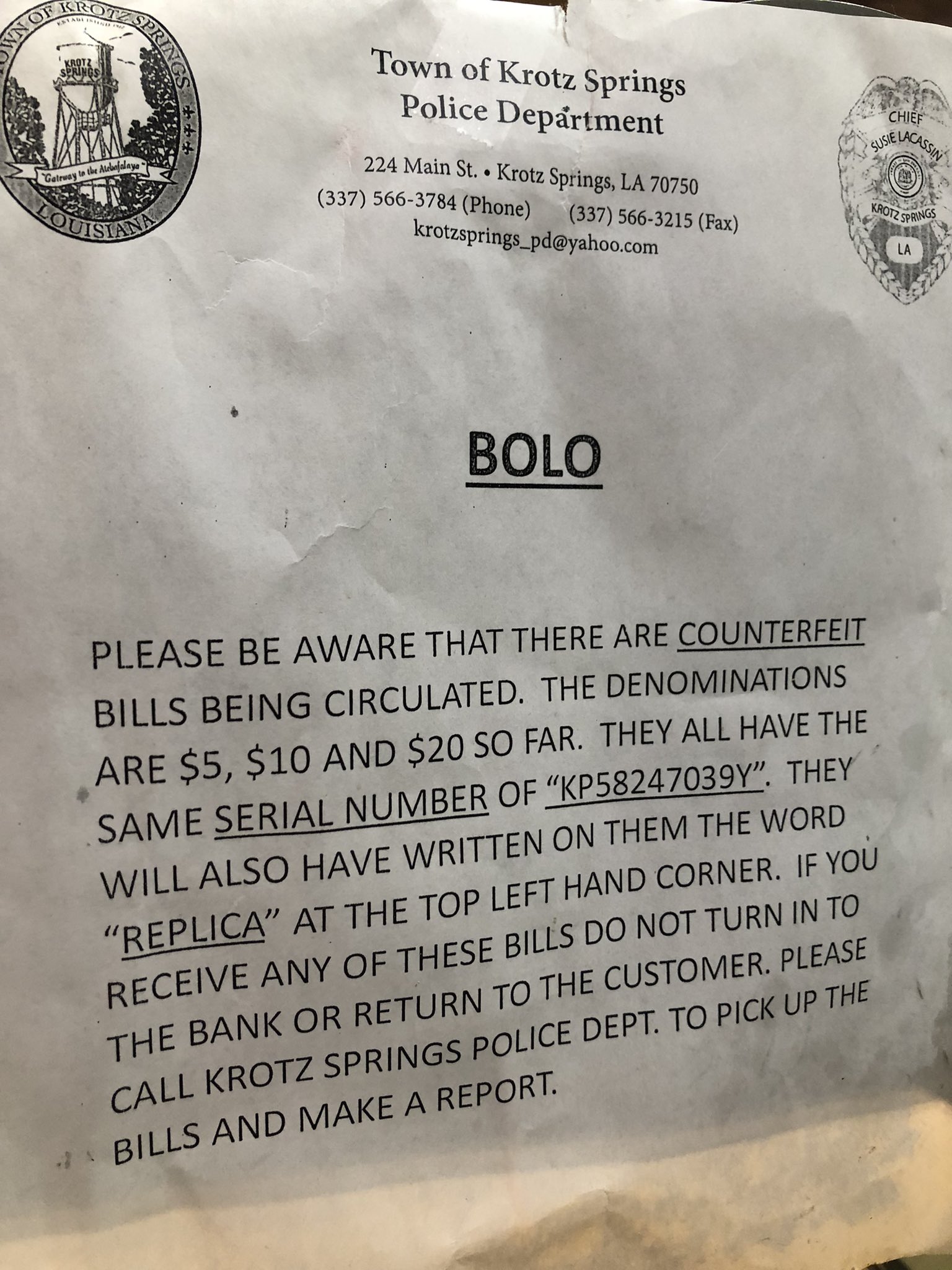
Providentially, not long ago, I spotted this “be on the lookout” (BOLO) warning from the police department of a small town near me. It was posted near a store’s cash register, where all the clerks could see it and be ready when counterfeit bills came their way.

It’s imperative that we study our Bibles and know them well. That knowledge of Scripture is like a filter that can catch all sorts of bad teaching before it has a chance to take root in our brains. But it’s only half the story. We also have to be familiar with the counterfeit teachings and teachers prevalent in evangelicalism today, and warn our churches, friends, and loved ones about them.

This is the complete picture of discernment given to us in Scripture. So, yeah, use the counterfeit money illustration to your heart’s content, but make sure you tell the whole story.