Mailbag

The Mailbag: “Who, exactly, are you?”

The following is the full text of an email I received, minus the signature. Below the full text, I’ve broken the email down (in bold) with my answers interspersed (in regular type).

Michelle Lesley,

Hello. I googled ‘false teachers’ to see what all I could find in preparation for a sermon series on 2Peter, and I came across your website. After reading quite a bit more than I expected to about many men and women I have found to be spurious teachers, I began to wonder just who you are. I began to wonder just who you endorse when you have scrutinized so many people and found them wanting. The strange thing is that I can find no independent information about you-only what is available on your website. I have given up on finding anything about you that hasn’t been approved by you and your staff. That leads me to wonder what other people have said about you that I cannot find it. While I am not in doubt on much of what I read on your site, I am concerned that by controlling all the information that comes to the average person trying to find out just who you are you are hiding something or you are doing your utmost to present the best image you can. That concerns me and influences how I interpret your information on the site. I don’t care who you are, to be fully honest, I am only skeptical about someone who controls all the information available about them. No Wikipedia entry? That’s rather odd for someone as outspoken about false teachers as you are. You seem rather solid on your position on those you have shared articles about or written criticisms on their behavior. You may be completely right in your assessments, but your lack of transparency through what I see as the throttling of information about you raises red flags as to your integrity. If I am wrong and there are independent articles providing unbiased biographical information, then I would appreciate a link.

Thank you (or your staff) in advance for your response,

Michelle Lesley,
Hello.

Hello. Thank you for getting my name right and for giving me this opportunity to say, for those who may not know, even though it’s right up there at the top of the blog, my name is, indeed, Michelle Lesley. Michelle has two L’s. Michelle is my first name, not Lesley or Leslie. Lesley is my real last name because Lesley is my husband’s surname. (I once had someone accuse me of having an anonymous Facebook page because she thought I was using my first and middle names rather than my first and last names.) “Lesley” is spelled with an “-ey” at the end, not an “-ie”.

I say all of this because it fascinates me that a not insignificant number of people can look at my name at the top of this blog, on Facebook, on Twitter (Instagrammers get a little more grace since my IG handle doesn’t include my full name), type MichelleLesley.com to get to my blog, or type MichelleLesley…@… .com to email me, and still begin their correspondence with “Dear Michele / Leslie / Lesley”. (And, no, with the number of people who do this, they can’t all be dyslexic.)

“Fascinates,” I said, not “angers”. I love y’all, and I’m sure I’ve gotten plenty of people’s names wrong myself. So I just thought I would throw that information out there for those who might not know. Howdy. It’s nice to meet you. I’m Michelle Lesley. :0)

I googled ‘false teachers’ to see what all I could find in preparation for a sermon series on 2Peter, and I came across your website. After reading quite a bit more than I expected to about many men and women I have found to be spurious teachers, I began to wonder just who you are.

I’m Michelle Lesley. See above. If you want to know more about me, you can click on the Welcome & FAQs tab, the Bio tab, and the Statement of Faith tab in the blue menu bar at the top of this page. That’s what they’re there for.

I hope you found my materials helpful, but if I may say, I find it very odd that a pastor (I’m assuming from your reference to a “sermon series”) would write an email like this.

I began to wonder just who you endorse when you have scrutinized so many people and found them wanting.

I’m assuming you found the people I’ve “scrutinized” at the Popular False Teachers & Unbiblical Trends tab in the blue menu bar at the top of this page. How did you not see the Recommended Bible Teachers tab just under that? If you “wonder just who I endorse,” that’s where you’ll find the information you’re looking for.

The strange thing is that I can find no independent information about you-only what is available on your website.

What do you suggest I do about that? Call the Associated Press and demand that they do a story on me or something? It’s somehow my fault that I’m not famous or interesting enough for Time, or People, or Newsweek to come bang on my door and beg for an interview? Why are you complaining to me about this? Why don’t you go to whatever media outlet you consider credible and ask them why they haven’t published anything about me?

I have given up on finding anything about you that hasn’t been approved by you and your staff.

“Staff”. I had a good laugh over that one for at least five minutes. I would love to have a staff, but I’m not Beth Moore or Joyce Meyer or somebody like that. This is a one woman operation, except for my husband, who manages my speaking engagements. I’m flattered, but you’re grossly overestimating me and the size of this ministry.

That leads me to wonder what other people have said about you that I cannot find it.

Really? I just Googled my name, and several of the hits included interviews I’ve done and things others have written about me.

But, again, how is it my fault nobody is interested in publishing whatever information it is you’re looking for about me? This is surreal, and definitely one of the strangest emails I’ve ever received.

While I am not in doubt on much of what I read on your site,

Then what’s your problem with “who I am”? My blog says who I am. Why do you doubt that part but not the rest of what’s on my site?

I am concerned that by controlling all the information that comes to the average person trying to find out just who you are

Originally, I thought maybe you were just new to the internet, but you clearly know how to Google, email, and navigate a blog. But anyone who’s technologically savvy enough to be able to do those things surely can’t think that I can “control all the information that comes to the average person trying to find out just who you are”. Do you really think I have control over Google results? And if I did, why wouldn’t I get rid of the ones that speak unfavorably of me?

…you are hiding something or you are doing your utmost to present the best image you can.

You caught me. I’m really a purple Martian here on earth to spy out all the best Cajun restaurants and steal their recipes because the food on Mars is terrible. That’s what I’m hiding. This women’s discipleship thing is just my cover so that reporters won’t find me and expose me for the thieving extra-terrestrial I am.

That concerns me and influences how I interpret your information on the site.

But you already said, “I am not in doubt on much of what I read on your site,” (above), so I can only take that to mean that the lack of outside sources reporting on who I am has influenced you to trust the information on my site.

I don’t care who you are, to be fully honest,

If you don’t care, why did you take precious time out of your day to write this email?

I am only skeptical about someone who controls all the information available about them.

I don’t. I can’t. Nobody can. The reason you can’t find whatever information it is that you’re looking for about me is because nobody has published it – it does not exist – not because I’m “controlling” it.

No Wikipedia entry? That’s rather odd for someone as outspoken about false teachers as you are.

Anybody out there want to write a Wikipedia entry on me so this gentleman’s curiosity will be satisfied?

You do understand, don’t you, that Wikipedia is one of the least reliable sources out there? That most high school teachers won’t even allow their students to use it as a source for papers? It’s editable by the public. Anybody can get on Wikipedia and say anything about anything or anybody.

Furthermore, although I’m flattered, you are again waaaaaaay overestimating my reach, and the general public’s and the visible church’s interest in false teachers. Guess who else doesn’t have a Wikipedia page? Chris Rosebrough. Justin Peters. Costi Hinn. Todd Friel. Gabriel Hughes. All of them have much larger platforms than I do, and most have been in discernment-type ministries for much longer than I have.

(And just for fun I checked a few other fairly “big” names in my theological circles. Guess what? Phil Johnson and Steve Lawson don’t have Wikipedia pages, either.)

You seem rather solid on your position on those you have shared articles about or written criticisms on their behavior.

You’d prefer I was wishy-washy about it? I don’t post gossip or things I’m not sure about. That would be wrong and unbiblical. Yes, I am absolutely solid on what the Bible says about the things and people I address.

You may be completely right in your assessments, but your lack of transparency through what I see as the throttling of information about you raises red flags as to your integrity.

Can somebody out there please explain to me how to “throttle” publicly available information about oneself? How can I get control of Google, Big Social, the internet, the media, Western Union, town criers, and carrier pigeons?

Because, come to think about it, there are a few slanderers out there whose articles and commentary about me I’d like to get rid of. So, somebody please tell me how to do it. I’ll just wait right here.

If I am wrong and there are independent articles providing unbiased biographical information, then I would appreciate a link.

Or, you know, you could go straight to the source and ask me. Isn’t that what authors of “independent articles providing biographical information” on living people do? They go straight to the source – the subject of the biography. Nobody knows my biographical information better than I do. If you think somebody like me has reporters and biographers following me around and observing me every day, you are completely out of touch with reality.

What on earth is it that you want to know about me, anyway, that isn’t on my blog, or that you couldn’t just ask me? My shoe size? Where I went to grammar school? My favorite ice cream flavor?

8. Loma Heights Elementary. Peanut Butter and Chocolate. You’re welcome.

Thank you (or your staff) in advance for your response

You’re welcome. I don’t have a staff.

And now I’d like to know: Who exactly are you? You signed your name to your email, but no title or credentials. I don’t even know for sure whether or not you’re a pastor. I Googled your name, but it’s common enough that my search yielded information for a bunch of different people who share your name. I don’t know which, if any of them is you. So I have no information about you. Not even a Wikipedia page.

You’ve got all kinds of information about me that I’ve voluntarily and publicly provided here on the blog, on social media, and in publicly available interviews, and if there was something else about me you wanted to know, all you had to do was ask. I’ve got nothing on you except your name. You wouldn’t even provide me any information about yourself privately in your email.

Who’s “hiding,” “controlling,” and “throttling,” information about himself, now? Whose “lack of transparency” should be “raising red flags as to [his] integrity”? Where’s my link to an independent article providing unbiased biographical information about you?


If you have a question about: a Bible passage, an aspect of theology, a current issue in Christianity, or how to biblically handle a family, life, or church situation, comment below (I’ll hold all questions in queue {unpublished} for a future edition of The Mailbag) or send me an e-mail or private message. If your question is chosen for publication, your anonymity will be protected.


Random Ramblings Ruminations Resources

Random Ramblings, Ruminations, and Resources

Can you believe it’s been almost two whole years since I published a 4R?

Some of you are like, “What’s a 4R? Does it come with French fries or a house salad?”

No, silly rabbit. It’s just shorter than writing out “Random Ramblings, Ruminations, and Resources”. Try to keep up.

If you’re new to the blog or your memory is so terrible that you don’t have the capacity to commit every microscopic nuance of my blog to memory…

…I have a Google Docs file I’ve entitled “Scratch Pad”. Whenever I get a good idea for an article, I jot down the gist of it there. Then, when it’s one of those “meh” weeks when I’m not overwhelmingly passionate about anything in particular, or when I just want to address several small things rather than one big thing, I can thumb through those ideas for some inspiration. And sometimes, I throw in some announcements, updates, and other stuff, too.

So – if you’re tracking – 4R is basically stuff and things and whatnot and such.

And GIFs. Wonderful, wonderful GIFs.

OK, enough chit chat. Let’s get this party started…

Sold Out, But Keep An Eye Out

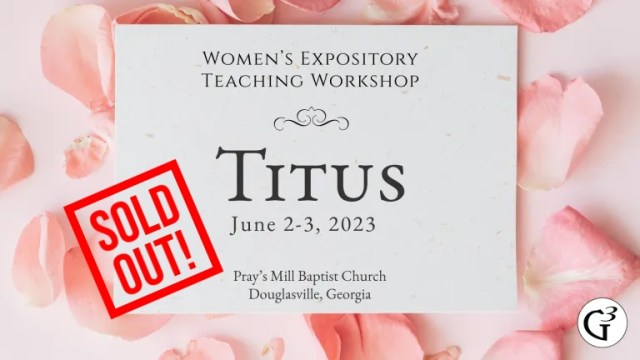
Finally. Finally, finally, FINALLY – hallelujah! – G3 Ministries is holding its first ever Expository Teaching Workshop for Women… and I’m sorry to tell you…it’s already sold out. Like, within just a few days of them barely announcing it at all. That’s how many godly women desperately want to be trained to properly teach God’s Word to other women and children.

Why am I telling you this if it’s sold out? Because I’m hoping G3 will continue to hold more of these in the future and I want you to be able to go! My advice? Connect with G3 (follow them on social media, get the app, sign up for their email list, etc.) so you’ll be one of the first to know when the next workshop will be held, and register immediately when it’s announced.

(If you managed to get registered for this one before it sold out, I will see you there!)

I Do It Myself

“I do it myself.”

Whether you’re a mom, an aunt, a grandmother, or babysitter, you’ve heard a toddler say this at some point. Maybe he’s trying to put on a sock, or she’s trying to fit a puzzle piece into a puzzle. We’re standing right there, ready and able to show them how to do it or do it for them, and yet, “I do it myself.”. That child would rather struggle with that sock or puzzle piece for five, ten, fifteen minutes than let us help.

Why?

Because that child knows something about life that we don’t know about Bible study. “I do it myself” brings with it rewards that having someone show you, or do it for you, just doesn’t. It brings with it the joy of figuring it out for yourself, the satisfaction of accomplishment, the firsthand learning that sticks with you that spoon feeding just doesn’t bring.

That child doesn’t want you breathing down his neck. He will fight you off if you try to help. Because he knows that “I do it myself” is better. That child grows past the milk of spoon feeding, and someone else showing him how, or doing it for him, to the meat of growing in maturity and independence and self-feeding.

Why is it that so many Christians never grow past the milk of someone spoon feeding them Bible study to the “I do it myself” of studying straight from the text of Scripture?

“I do it myself” is a normal part of child development. If a child never moved into the “I do it myself” stage we would consider that child unhealthy. We would take him to the doctor to find out what’s wrong. Why don’t we see that as unhealthy in our spiritual lives, in our Bible study lives?

We need to learn this concept when it comes to individual Bible study. Canned studies, a “mommy” breathing down your neck, showing you how to do it, or doing it for you, gets in the way of what you can learn – what God can uniquely tailor to you as an individual – when you do it yourself.

Yes, you may struggle. Yes, there will be trial and error. Yes, you probably won’t know what you’re doing at first. But that is part of the learning process. You can’t gain mastery of a skill if you never attempt to do it by yourself. And when it comes to mastering the skill of Bible study, the joy is not in, “Look at me, I did it all by myself!” but in, “Wow! God really did speak to me through His Word! Look how God has grown me! God showed me this great and amazing thing!”.

God gets the glory. We rejoice in His work in us through His Word. That joy is absent, and can never be achieved, when someone else is showing us how or doing it for us. It’s a joy we’ll never experience without “I do it myself.”

And speaking of Bible studies…

I know, I know, normally by this time of the year I’ve already started our new spring Bible study on the blog. That’s because, normally, sometime around October-ish, I’ve already prayerfully decided what book, passage, or topic the study is going to center on, and I’ve started my preparatory study and writing.

This year, for whatever reason God may have ordained, I have really struggled to settle down on the subject of our next study. I have been back and forth and forth and back in prayer about a number of different ideas.

Late last week, I started working on what I thought would be the right passage for the study, but it still just didn’t feel right. You know, like when you accidentally put your left shoe on your right foot? It’s still a good shoe, it’s just in the wrong place at the moment. And I started thinking… “What about a topical study on discernment? Maybe that would be a good idea.”. Several passages started coming to mind, but I didn’t have time to give it much thought…

…until a few hours later, when a reader emailed me looking for a Bible study on -you guessed it- discernment.

So I got up yesterday morning, and I started studying and sketching out an outline, and this time the shoe fit. I need a little time to study, so we won’t be starting right away, but our next Bible study will be a topical study on the subject of biblical discernment.

I debated whether or not to share that experience with y’all, because a lot of evangelicals would say that was “God ‘speaking’ to me”.

It wasn’t.

There was no Divine voice. There were no words. (That’s what the word “speaking” means. Words mean things.) God no longer talks to people directly the way He spoke to our fathers before us.

That was God answering my prayers for wisdom and guidance. That was God providentially arranging circumstances in His perfect timing. That was God helping me make up my mind.

God’s normal providence is wonderful.

Flashback (I hope)

Well, here’s a blast from the fairly recent past that ought to just bless your socks right off your little tootsies. Occasionally, I dabble (read: goof off) in various forms of creative writing. Here’s a little ditty I wrote (to be sung in your head to the tune of The Beatles’ Yesterday) a couple of years ago during that which shall not be named. Have fun. :0)

Quarantine

Quarantine

It’s a result of COVID-19

Stay at home and simply do nothing

Oh I am tired of quarantine

Quarantine

I can only see friends on a screen

But work is now a pants-less Zoom meeting

There are some perks to quarantine

Toilet paper’s gone

And from church we stay away😭

I’ve gained 20 pounds

From Netflix and snacks all day

Quarantine

Many weeks of social distancing

Wash your hands and cover when coughing

We’ll see an end to quarantine 

We will survive this quarantine😃

There’s a song in the air…

I really enjoy listening to these brothers. I get a kick out of the fact that they’re doing Southern gospel all the way over in India. (Maybe they’re in southern India! :0) But they sing other styles, too. Check out the Living Stones Quartet’s channel!

Complementarianism, Rock Your Role

The Mailbag: Questions about the role of women in the church

A reader recently left a comment containing numerous questions on my article Rock Your Role: Jill in the Pulpit (1 Timothy 2:11-12). Her individual questions are in bold type below with my answers in regular type.

If you have questions about the role of women in the church, I recommend not only that article, but all of the articles in my Rock Your Role series. Jill, Rock Your Role FAQs, and The Mailbag: Counter Arguments to Egalitarianism seem to answer the questions I’m asked the most, so you may want to start with those.


some honest questions here

Thanks for asking. I hope my answers will help. I’d like to preface my answers with some biblical information I hope will be helpful to all of my readers when addressing questions and issues like this:

You did not say whether or not you are a genuinely regenerated Christian, nor was I able to infer from your questions whether or not you are. This is going to be crucial to your understanding and accepting the biblical answers I’m about to give you, because Scripture makes clear to us that people who aren’t saved do not embrace the things of God. They aren’t even able to understand them in any meaningful way.

The natural person does not accept the things of the Spirit of God, for they are folly to him, and he is not able to understand them because they are spiritually discerned.

1 Corinthians 2:14

Scripture is also clear that those who belong to Christ will obey His written Word, while those who do not belong to Christ -even if they claim to be Christians- don’t obey His written Word.

And by this we know that we have come to know him, if we keep his commandments. Whoever says “I know him” but does not keep his commandments is a liar, and the truth is not in him, but whoever keeps his word, in him truly the love of God is perfected. By this we may know that we are in him: whoever says he abides in him ought to walk in the same way in which he walked.

1 John 2:3-6

Sometimes when we read hard truths in the Bible, we initially struggle to accept them, but genuinely born again Christians are on a general trajectory of increasing in their love for, understanding of, and submission to God’s written Word. False converts (unsaved people who think they’re saved) and unsaved people are on the opposite trajectory and increasingly disdain, harden their hearts against, and rebel against God’s written Word.

If, in examining your own heart, you (or someone else reading this) find yourself on that second trajectory regarding this or any other biblical issue, let me offer you some resources that will help and that are much more urgent for you than the issue of the role of women in the church:

What must I do to be saved? (in the blue menu bar at the top of this page) You must repent and believe the biblical gospel.

Am I Really Saved? A First John Check-Up If you’re not really sure whether or not you’re saved, you may find it helpful to work through my Bible study on 1 John.

Searching for a new church? (in the blue menu bar at the top of this page) If you’re saved, you need to be a faithful, invested member of a doctrinally sound local church. Among many other things, that’s where you’ll learn the biblical answers to questions like the ones you’ve asked below.

As I said in the Jill article:

Godly women don’t look for ways to get around Scripture.
Godly women look for ways to obey Scripture.

If you already know Christ as Savior, awesome! It’s wonderful that you’re asking questions and learning more about Scripture so you can grow in Him.

Now, let’s tackle your specific questions…


—if the letter to Timothy was a letter to him and we are reading his mail, then what about the other NT letters written to the various churches? Are we also not reading their mail and what God was meaning for them to do?

I would encourage you to read that paragraph again carefully. I’ve bold-typed some of the more salient points:

First Timothy (along with 2 Timothy and Titus) is one of the pastoral epistles. It was written by Paul to young pastor Timothy as sort of a job description and operations manual for pastors, elders, and the church. So right off the bat, an important point we often miss about 1 Timothy is that it was written to a man, Timothy, a pastor, who would use this letter to train his elders (also men) and, subsequently, his congregation. That doesn’t mean that 1 Timothy doesn’t apply to women, or shouldn’t be studied by women, or that women aren’t required to obey 1 Timothy. It just means that when we open the letter of 1 Timothy, we need to understand that we, as women, are reading somebody else’s mail. Mail that pertains to us, yes, but mail that’s addressed to Timothy, and by extension, to pastors and elders today. That will help us better understand the tone and perspective of the passage.

So, you could think of it like this: the pastoral epistles (1&2 Timothy and Titus) have three “levels,” if you will, of who they’re addressed to: a) immediate: Timothy and Titus, b) by extension: all other / subsequent pastors and elders, c) with application to every church, Christian group, and individual Christian.

The other epistles, generally speaking, have two “levels” of who they’re addressed to: a) immediate: a specific church or people group of Christians (the church at Colossae, the church at Ephesus, etc.) b) by extension: all other / subsequent churches, groups of Christians, and Christian individuals.

There’s a sense in which, from Genesis through Revelation, we’re “reading somebody else’s mail,” because we were not alive when any of the books of the Bible were written, so we were not the original audience of any of Scripture. That being said, the Bible is still God’s word to us, through those original audiences. All of it, when correctly handled, applies to us in one or more ways, and we are required to obey God’s commands, instructions, laws, and teachings to New Testament Christians, no matter where in the Bible they are located.


—What about women who are called to preach? Like slave Sojourner Truth and 2 quaker women called to preach against slavery in the south USA civil war times. Were they wrong? sinning? going against scripture?

I don’t know who the Quaker women are that you’ve referred to, and I’m not overly familiar Sojourner Truth or any of her “sermons,” but I think you may be conflating and confusing a few things here. Let’s see if we can untangle them.

  1. As I mentioned in my preface remarks, just because someone claims to be a Christian (or history has led us to believe they were Christians) does not mean they have actually been born again. I don’t know whether or not any of these women were truly Believers, and neither do you. Sojourner said and did some things that might cause one to wonder, and, while there could be individuals who get saved while still in Quakerism, the Quaker belief system, generally speaking, is not biblical, and therefore, not Christian.
  2. Making civil speeches against slavery (or on any other topic) is not “preaching” even if the speech maker or others called it preaching. “Preaching” is defined by Scripture alone, not by culture or common parlance. Preaching is the proclamation of God’s rightly handled, written Word for the edification of the church.
  3. If any of these women were actually preaching – proclaiming God’s Word or exhorting people from God’s Word – in a co-ed gathering, then yes, they were “wrong, sinning, and going against Scripture” because God’s written Word prohibits women from doing that as I explained at length in the Jill article. And when God’s written Word says not to do something and we do it anyway, that’s called sin.
  4. God doesn’t call women to preach or pastor. God has never called a single, solitary woman to preach. Ever. First, because God doesn’t give extra-biblical revelation like that. He tells us exactly who He has called to preach (and who He hasn’t) in 1 Timothy 2:11-3:7 and Titus 1:5-9. Second, because, even if He did give extra-biblical revelation, God is not a man that He should lie or change His mind, and He already told us in His Word that women aren’t to pastor, preach to, or teach men, or exercise authority over men in the gathering of the church body.

—Paul gives “commands” about operating under patriarchy and slavery, both part of Roman society. He does not talk against either yet today we Christians abhor slavery but still support patriarchy. Why?

Because patriarchy was God’s design and command and antebellum American slavery wasn’t. I’m not totally sure exactly what you mean by Roman “patriarchy” and the “commands” Paul gave about it, which passages you’re referring to, or what all you many have in mind about patriarchy and slavery as you asked this question, so I can only give you a very general answer.

  • Instructing Christians on how to behave in a godly way when they’re in the middle of ungodly circumstances is not the same thing as God condoning or approving of those ungodly circumstances. There were many Christians who obeyed Scripture’s instructions while in concentration camps during World War II. That doesn’t mean God was in favor of concentration camps.
  • Antebellum American slavery was “man stealing” (which was a different type of slavery than that practiced during New Testament times), and is prohibited by Scripture.
  • Male headship was established by God at Creation and is continually buttressed and re-established throughout the Bible:

Look at the overall general pattern of male headship and leadership in Scripture. First human created? A man. The Patriarchs? As the word implies – all men. Priests, Levites, Scribes? Men. Heads of the twelve tribes of Israel? Men. Major and minor prophets? Men. All kings of Israel and Judah? Men. Noahic, Abrahamic, Mosaic, and Davidic Covenants? All established between God and men. Authors of Scripture? Men. The forerunner of Christ? John the Baptist – a man. Messiah? A man. All of the apostles? Men. All of the pastors, elders, and deacons of churches in the New Testament? Men. Founder and head of the church? Christ – a man. Leader and head of the family? Men. – from: The Mailbag: Counter Arguments to Egalitarianism

Anyone – including the Romans of Paul’s time – who stepped outside of God’s commands regarding patriarchy and slavery was in sin.


—-in Ephesians 5:21 and following verses Paul tells 4 different groups to submit. He uses 2 different forms. For people and spouses he uses the form that means to submit as to one another. For children/slaves he uses the form that means to submit to an authority. Why weren’t women included under the same one as children/slaves?

I’m sorry, but this question is impossible to answer because neither slaves nor children are mentioned in Ephesians 5:21-33 (or even in 5:1-20). If by “following verses” you meant elsewhere in Ephesians or in other places in the New Testament, you should have specified those passages so I could look at them, understand what you’re talking about, and explain them to you in context.

I also don’t know where you’re getting your information about “two different forms” (of the word “submit,” I’m assuming), so I have no way of knowing whether or not that’s accurate, and since I don’t read Greek, and I suspect you don’t either, I prefer to stick to reliable English translations rendered by experts in the biblical languages.

All I can say is, since I don’t know which passages you’re referring to, I don’t know why, allegedly, two different forms of the word submit were used. All I can tell you is – you know whether or not you’re a wife, and you know what the English word “submit” means, and if you’re married, Scripture’s instruction to you in Ephesians 5:22-33 (and elsewhere in Scripture) is to submit to your husband.

There is nowhere in Scripture where husbands are commanded to submit to their wives or that husbands and wives are to “mutually submit” to one another. Many egalitarians try to make Ephesians 5:21 say that, but that is a twisting of Scripture. Notice that verse 21 isn’t even a complete sentence. If you read verse 21 in context (i.e. – read verses 1-21) it should be obvious that Paul is addressing the church, not married couples, and that verse 21 is referring to being unselfish and putting others in the church first. (Check your cross-references on that verse. One of them is probably Philippians 2:3.) See why I keep harping on “rightly handled Scripture”?


—-why do churches send women who say they are called to preach to the mission field?

Because they’re in sin. Those churches are either ignorant of Scripture’s commands about women preaching, or they’re in rebellion against those commands. Both are shameful, and both are sin.

If it is wrong here in the US for a woman to preach/pastor why is it ok in a foreign land?

It isn’t. If it’s a sin in the United States, it’s a sin in Kenya, Croatia, Uruguay, Sri Lanka, Australia, Antarctica, and everywhere else on the planet (and off the planet if God ever allows humans to live on the moon or something like that).

—-why did Jesus break the rules about women? He talked with them, obeyed his mom at the party, let them learn of spiritual things, defended them, the woman at the well was the first evangelist and women were the first to see the empty tomb (all these things broke rules/laws about women and their testimonies were outlawed in that time and place) What was the point of doing this if women were going to be told they could not preach/teach and their only purpose to be wife/mom/homebodies? It does not make sense to me.

Where does the Bible say any of those things, though? Most of the things you’ve listed aren’t God’s law, they were secular law, Pharisaical law, or cultural custom, not commands of God. Jesus never broke any of God’s laws that are spelled out in the Bible. That would be sin, and we know Jesus never sinned. He wasn’t bound by man’s laws, and certainly not if they contradicted God’s Word. That’s why He and the Pharisees butted heads so often. They were trying to bind Him to their man-made laws (which often contradicted Scripture), which they sinfully equated to Scripture. By ignoring man-made laws and customs about women (while obeying God’s law about them) Jesus re-elevated the women He came into contact with to their rightful biblical place.

Let’s look:

  • “He talked with them…defended them” – There’s nothing in Scripture telling men they can’t talk to or defend women. Men talk to women all over the Bible and there are many places in Scripture where men are called upon to take up arms to defend women and children.
  • “Obeyed His mom at the party” – I assume you’re talking about the wedding at Cana. I just want to make sure we’re all understanding this correctly. From an earthly perspective, Jesus was obeying or acquiescing to His mother. However, Jesus, while fully man, was also fully God. He knew exactly what He was going to do next. Mary’s request was in line with His pre-ordained plan to turn the water into wine, and thus, in addition to the miracle, also gave Him an opportunity to set us an example of honoring His mother. Had she requested something that was not in line with His plan to turn the water into wine, He would have honored her in another way, but he would not have “obeyed” her request.
  • “Let them learn of spiritual things” – Not only does Scripture not prohibit women from learning spiritual things, women are commanded to “learn of spiritual things” from Genesis to Revelation. When Adam told Eve, “Hey, God said we can’t eat from this one tree right here,” that was a spiritual thing a woman learned. Deuteronomy 6:7 commanded the Israelites to teach God’s Word to their children, not just their sons. Ezra taught God’s law to “both men and women and all who could understand what they heard”. I also addressed this concept in the Jill article: First Timothy 2:11 (immediately before 2:12, which prohibits women from pastoring, preaching ,etc.) says “Let a woman learn quietly with all submissiveness.” God (remember, Jesus is God) commanded pastors to make sure women had the opportunity to “learn of spiritual things”.
  • “the woman at the well was the first evangelist” – Welllll, technically, no. We don’t even know for sure if she was a Believer when she went back to town and told everyone to come see Jesus. But OK, let’s go with that for a minute. Again, Scripture doesn’t prohibit women from relaying the gospel to lost people they encounter, it commands it of all Christians. (If you’re not clear on the difference between evangelism and preaching/pastoring, listen here.)
  • “women were the first to see the empty tomb…their testimonies were outlawed in that time and place” – I know a woman’s testimony in court was considered unreliable, but I’m not positive it was actually “outlawed”. But even if it was, that would have been a secular law. God’s Word doesn’t outlaw it. Yes, perhaps Jesus allowed women to be the first eyewitnesses to His resurrection in part to honor these women who had followed Him so faithfully, and to demonstrate that the testimony of women isn’t unreliable just because they’re women.

What was the point of doing this if women were going to be told they could not preach/teach and their only purpose to be wife/mom/homebodies? It does not make sense to me.

Because, as I said, Jesus elevated women to their rightful biblical place. He didn’t lower them to the wrongful, unbiblical place of modern day feminism and its rebellion against Scripture.

But really listen to what you’re saying here. I hope you didn’t mean to do this, but you just dismissively swept aside God’s high, holy, good, and biblical calling on the lives of most Christian women to be godly wives and mothers and manage their households well for the glory of God.

“Their only purpose…” Seriously? I don’t mind telling you I’m personally offended that you just insulted what I’ve dedicated my heart, soul, and life to for the past 30 years. You’re saying it doesn’t matter because I wasn’t pastoring or preaching to men. Never mind that I continually poured God’s Word into the six beautiful children He blessed us with. Never mind that I’ve gotten up every day for three decades – with no pay or vacation time, mind you, 24/7/365 – and striven to be a godly example, encouragement, and helpmeet to my husband. Never mind that I’ve taught and discipled more women and children at my church than I can count. No, all of that is worthless because I wasn’t preaching to or teaching men. That women’s teaching is only valuable if they’re teaching men. You may not have meant that, but that’s the effect of what you said. I’m not trying to be unnecessarily harsh with you, I’m trying to give you just enough of a healthy, biblical sting that you’ll realize that you’ve been influenced more by what the world values for women than what God values for women.

Godly women honor and respect the high calling and unique gifting women have to disciple other women and to raise up the next generation of godly men and women by discipling our own, and other, children. Because this is such a weighty and arduous responsibility, we consider it a blessing that God has not also burdened us with the responsibility to preach, teach the Scriptures to men, or exercise authority over men in the context of the gathering of the church. Rather, we encourage the men who have been given this responsibility, leaving godly women free and unfettered to carry out the ministry God has given us. – from: The Mailbag: Counter Arguments to Egalitarianism


I have so many more questions and seeking lots of help to find the answers. The scripture says to study to show yourself approved. I hope this applies to women too!

It absolutely does! I’m glad you’re asking questions and seeking to learn! And you’re right, as I’ve referred to throughout this article, 2 Timothy 2:15 says:

Do your best to present yourself to God as one approved, a worker who has no need to be ashamed, rightly handling the word of truth.

2 Timothy 2:15

As I said at the beginning, the best place to get your questions answered and to learn how to rightly handle Scripture is in a doctrinally sound local church. Ask a godly older woman in your church to disciple you. (Not sure what that’s all about? Listen here and here.) “Pester” your pastor (he’ll love it!). And study, study, study, directly from the text of Scripture (listen here, and check out the Bible studies tab in the blue menu bar at the top of this page).

Thanks for any insight you can give me.

You are most welcome. It is my pleasure to serve you in Christ.


If you have a question about: a Bible passage, an aspect of theology, a current issue in Christianity, or how to biblically handle a family, life, or church situation, comment below (I’ll hold all questions in queue {unpublished} for a future edition of The Mailbag) or send me an e-mail or private message. If your question is chosen for publication, your anonymity will be protected.
Abortion

Abolition or Pro-Life?

Originally published June 8, 2022

Sanctity of Life Sunday is this Sunday, January 22.

Do you know the differences between the abolition movement and the pro-life movement? It’s a good thing for all Christians to be informed about.

Watch A Storm Comes Rolling Down the Plain, then listen in to our A Word Fitly Spoken interview with Brett Baggett, one of the key figures in the documentary.

I also thought this interview with Samuel Sey, Nathaniel Jolly, and Ekkie Tepsupornchai on the Truth Be Known podcast was insightful and helpful:

Mailbag

The Mailbag: Potpourri (Remarriage after divorce… Spiritual gifts… Spiritual warfare at Bible study… Pants at church)

Welcome to another “potpourri” edition of The Mailbag, where I give short(er) answers to several questions rather than a long answer to one question.

I like to take the opportunity in these potpourri editions to let new readers know about my comments/e-mail/messages policy. I’m not able to respond individually to most e-mails and messages, so here are some helpful hints for getting your questions answered more quickly. Remember, the search bar (at the very bottom of each page) can be a helpful tool!

Or maybe I answered your question already? Check out my article The Mailbag: Top 10 FAQs to see if your question has been answered and to get some helpful resources.


I am wondering what your thoughts are on remarriage post divorce?

Great question, but let me tweak it just a little bit. “My thoughts” on remarriage after divorce are irrelevant. As Christians, what we want to know is what the Bible has to say about it. Unfortunately, every situation is different, so I can’t give you a simple answer that would apply to every single situation out there. But here are a few general biblical principles:

  • God makes clear throughout Scripture that He doesn’t like divorce and that He intends marriage to be for life.
  • There are two biblical grounds for divorce: adultery and abandonment. It is not a sin for a Christian to initiate a divorce when his/her spouse is guilty of one of these. Remarriage after a divorce for one of these two reasons is biblically permissible and is not a sin for the Christian.
  • But even in cases where there are biblical grounds for divorce, God does not require it. Scripture is saturated with the teachings of repentance, forgiveness, and reconciliation, even after heinous sin, and if reconciliation is in any way possible after a spouse’s sin, that is the route that should be pursued, with copious amounts of pastoral counseling.

If you are a Christian who has been divorced (either before or after salvation) and you’re thinking about remarriage, my best counsel would be this: If you’re not already joined to a doctrinally sound church, find one and join it immediately, then set up an appointment with your pastor so he can shepherd you through applying Scripture to your particular situation. (If, for some reason, you can’t go to a doctrinally sound pastor for counsel, check out the Biblical Counseling Resources tab in the blue menu bar at the top of this page.)

Additional Resources:

The Mailbag: Is it all right for a Christian to get divorced?

The Mailbag: Must I reconcile with my abusive ex-husband?

Remarriage Forbidden?

DivorceCare


I have been thinking about cessationism and spiritual gifts for single women in the church—especially those who have been converted later in life with no prospects of marriage or child rearing in their future. What are they to do, and how does the Reformed church help these women find and nurture their spiritual gifts for the service of the church?

I’m so glad you asked. Every Christian is given at least one spiritual gift by God to use for serving the church. (I’m a little confused as to what marriage and parenting have to do with that. God gives spiritual gifts to every Christian, regardless of his or her station in life, and spiritual gifts are primarily for serving the church, not the family.)

There are a variety of spiritual gifts, but because the sign gifts have fulfilled their function and ceased, miracle working, healing, extra-biblical revelation (prophecy), and the ability to spontaneously speak a foreign language (“tongues”) are not among the gifts God bestows today.

“The Reformed Church,” as you’ve termed it, isn’t really a monolithic entity. There are all kinds of Reformed churches. You would have to ask each individual local church how they help their members find and nurture their spiritual gifts.

Personally, I do not recommend so-called spiritual gifts tests. However, I have developed a resource that I think will help Christians who are trying to find a place of service in the church as well as discover their spiritual gifting (and for churches who are trying to help their members with that). It’s called The Servanthood Survey.


I am one of the leads of a prayer group that also does a Bible study. We are doing chapter by chapter in the Old Testament. Most of the ladies are name it and claim it and speaking prophecy, casting out demons, health and prosperity expectations, one speaks in tongues, etc. I have disagreed with this which has upset the women for the sake of unity. I have stayed to try to give the opportunity to share Biblical Gospel, but it wears me out after each session. I let the pastor know. He’s planning changes to the group and I’ve let him know I’m not going to lead the group anymore. I feel like I’m letting God down. I also need to think of my spiritual well being. This is a Wesleyan church BTW. I plan on using your Bible studies. Your thoughts will be appreciated.

Having been in a few situations like this, I can certainly understand how spiritually, and therefore emotionally and physically draining this kind of thing is. This is true spiritual warfare.

I’m not quite clear as to whether or not you’re a member of this church, but if you are, you shouldn’t be. Any church, Wesleyan or not, that condones, encourages, or fails to teach biblically about “name it and claim it and speaking prophecy, casting out demons, health and prosperity expectations, [speaking in] tongues, etc.” is not a doctrinally sound church, and it’s no place for genuinely regenerated Christians. You can’t have “unity” with false doctrine and, very likely, false converts.

You’re not letting God down. On the contrary, you need to run, not walk, out of that den of demonic activity as fast as you can and find a doctrinally sound church to join.

It’s admirable that you’ve tried your best to teach these women biblically, but you cannot continue to be a member of this church. And even God the Father, Jesus, and their admonitions in Scripture don’t teach us to keep pursuing indefinitely people who have rejected biblical truth:

  • Think about Old Testament Israel. God pursued them, disciplined them, sent them prophets, performed miracles – the whole works – and He bore with them in their idolatry and disobedience for hundreds of years. But not forever. He eventually sent them into exile.
  • Remember the story of Jesus and the rich young ruler? Did Jesus chase him down and keep trying to convince him once he rejected biblical teaching from Jesus Himself? No. He let him go. What about the father of the prodigal son? Dad lets that rebel leave. (You can probably think of many more examples.)
  • Matthew 7:6: Do not give dogs what is holy, and do not throw your pearls before pigs, lest they trample them underfoot and turn to attack you.
  • Mark 6:11: And if any place will not receive you and they will not listen to you, when you leave [this phrase assumes they will leave], shake off the dust that is on your feet as a testimony against them.

Go. Get out of there while the gettin’s good.

Additional Resources

The Mailbag: How should I approach my church leaders about a false teacher they’re introducing?

The Mailbag: What is the New Apostolic Reformation?


So I’ve been going to this new small church I found, seemingly very sound and conservative. The first time I went, I wore flowy pants, not immodest at all in my opinion. And I noticed all the women wearing skirts or dresses, and so I felt out of place. And I also attended a father/daughter camping trip, and lo and behold, all the girls are wearing skirts to this camping trip.

I am not a dress wearing type of girl. I have usually worn jeans to church, I try to dress it up and look feminine and also wear makeup.

I don’t like feeling self-conscious, and I don’t want to look like I’m some sort of feminist by wearing pants. And I feel like I’m less of a Christian woman if I wear pants to church. But at this new church, I’m one of maybe a few other women who has worn pants. I also don’t want to just start wearing dresses and skirts to church JUST because I want to live up to this standard I feel the church is setting. I have talked to the leadership there and they said I’m fine wearing pants. I But I still feel like I’m out of place. How do you think I should be thinking about this?

Nobody likes to stick out like a sore thumb. I get it. Personally, I kinda like to blend into the wallpaper wherever I go, if possible.

And I think that’s the heart of your dilemma – you feel self-conscious and it makes you uncomfortable, and you want that uncomfortable feeling to go away. (Go back to your original email and count how many times you said “I feel” or referred to your feelings.)

This isn’t an issue of modesty, because you’re neither outlandishly (you said a few other women had worn pants) or provocatively dressed. This isn’t an issue of the other women or anyone else unbiblically judging you for wearing pants (at least you didn’t say that anywhere in your email). And though you describe the situation as, “this standard I feel the church is setting,” you said you had talked to the elders and they said you were fine wearing pants. So the church is not actually setting this standard, you just feel that it is because of your own self-consciousness.

This isn’t about other people, this is about you. What you’ve got here is a battle of the feelings. Feeling 1: I don’t want to feel self-conscious by wearing pants. Feeling 2: I dislike wearing dresses. Welp, as I see it you’ve got three options:

  1. Wear pants and stop worrying about it. Focus on worship or whatever activity you’re at and stop focusing on yourself and how you’re dressed. (We’re not supposed to be focusing on ourselves anyway. That’s a form of pride and narcissism. You might want to explore that with the Lord in prayer. Go back to your original email and count how many times you used the words “I” and “me”.) After a while you’ll get used to it and that self-conscious feeling will fade. And besides that, maybe those other pants-wearing women will be emboldened to wear pants once they see you wearing them. You could start a trend!
  2. Wear a dress and stop worrying about it. How do you know you’re not a dress-wearing kind of girl if you don’t give it a good faith effort? Try it for six months. It’s not going to kill you. It might grow on you. You never know.
  3. Find another doctrinally sound church in the area where more women wear pants. This is an option, but, honestly, I would not recommend it. It sounds like you’ve found a good church and God is trying to do some sanctifying work in your heart and life. Don’t kick against or run away from what He’s trying to do, submit to it and grow to greater Christlikeness.

And one last thing- from the way you described everything, I’d be willing to bet that nobody at your church is fretting about you wearing pants as much as you are. I encourage you – hang in there, stop looking down at your pants, start looking up at the Lord, and walk with Him as He works this out.

(And before I hear from the “women can’t wear pants” crowd: The Mailbag: May Christian Women Wear Pants?)


If you have a question about: a Bible passage, an aspect of theology, a current issue in Christianity, or how to biblically handle a family, life, or church situation, comment below (I’ll hold all questions in queue {unpublished} for a future edition of The Mailbag) or send me an e-mail or private message. If your question is chosen for publication, your anonymity will be protected.