Church, Ministry, Parenting

Throwback Thursday ~ Anonymous Parent’s Letter to a Youth Pastor

Originally published September 23, 2013

Trevin Wax is one of my favorite bloggers.1 Today he wrote an absolutely awesome piece called Anonymous Youth Pastor’s Letter to a Parent. It talked about some of the struggles youth pastors go through and how we as parents of youth can support our kids’ youth pastors better. I commented that the next article should come from the parent’s perspective, and that, being a parent of youth, boy, could I write that article. One of Trevin’s readers suggested I go ahead and write it, and I thought it sounded like a fun and challenging project, so here’s the result.  (The first three paragraphs are an homage to Trevin’s letter.)


CAVEAT: This is addressed to an amalgam or “everyman” youth pastor, not to any of my kids’ youth pastors/workers past or present. In fact, some of the things I mention in the letter are things my kids’ youth pastors got RIGHT that I really appreciated.


Dear Youth Pastor,

I need to get something off my chest.

When I first put my child into your youth group, you told me how excited you were to be showing my kids what it means to love Jesus, be part of His Church, and grow as a Christian. You told me you were praying for my child and that you had his back. You had high hopes for the youth ministry.

I had high hopes too. But I must confess that I am frustrated right now because I feel like you’re working against me, not with me.

My husband and I are Christian parents doing our best to pour the gospel into our children every day.  We understand that we are the ones responsible to God for the spiritual upbringing of our children, and we take that responsibility seriously. Very seriously. And that includes what he is exposed to in youth group.

“Let no one look down on your youth” notwithstanding, you’re 25. I love you all to pieces, but you know nothing about parenting a teenager. I repeat: nothing. No, the fact that you and your wife have an infant or a three year old does not qualify you as a veteran parent. I have a couple of decades of life experience and parenting on you. I remember being 25. It was that glorious time of my life when I knew everything and had fresh ideas that people in their 40s just wouldn’t understand because they had passed the “cool” stage of life.

Look deep into my eyes, Bub. I am your future.

Listen to me when I explain to you that my kids don’t need another peer. They need mature, godly leadership. Not a buddy. Not an idol to be emulated with the latest clothes from Abercrombie, the hippest glasses frames, edgy tattoos and piercings, and enough product in your hair to put bouffanted church ladies to shame.

You are not a rock star.

You’re a teacher. You’re a caretaker of young souls, and you’re influencing them for eternity. One way or the other. And one day, you’ll stand in front of God and answer for the way you led my, and other parents’, children. Makes your knees knock a little, doesn’t it? Good. It should.

So, when I drop my child off at your youth Bible study or Sunday School class, here’s what I expect. When you say you want to “show my kids what it means to love Jesus, be part of His Church, and grow as a Christian,” I expect that to mean that you will teach them the Bible. Not some watered down, comic book, MTV, “What does this verse mean to you?” version of a Bible story, but the whole counsel of God. I want you to put more time and effort into prayer and studying God’s word so you can teach it properly than you put into hooking up the oh-so-fabulous light show and making inane videos that appeal only to the basest nature of eighth grade boys.

Do you know what these kids are learning in school? If they can be expected to learn Shakespeare and higher math, you can expect them to learn sound biblical doctrine.

When you’re choosing a Bible study curriculum or DVD, or you’re looking at a Christian camp or concert to take the kids to, do your homework. Just because somebody claims to be a Christian author, speaker, pastor, or worship leader doesn’t make it true. Where is this person, doctrinally? What’s his church background and training? Listen to his sermons. Examine the lyrics of her songs. Read some of his books. Does this person rightly divide the Word of truth? Does he exalt Christ and revere God’s word? Does he call sinners- my child and the other children in your youth group- to repentance and faith in Christ, or are his sermons an exercise in navel gazing and nagging about how to be a better person?

Lead my children to serve the church. And I’m not talking about getting paid to do it, either. They’re old enough to help clean up after Wednesday night supper, help in the nursery, assist with a children’s class, serve at a senior citizens’ banquet, work at a church work day, help set up chairs and tables, etc. Over the last few years, the youth group has become the entitlement community of the church, always asking for handouts and rarely giving anything back. Let’s teach them to serve. Because the youth that serve today will be the adults that serve tomorrow.

Teach my children that a mission trip is not a glorified vacation, and that missions isn’t just feeding the hungry or building houses for the homeless. Missions is proclaiming the gospel before and after and while they’re doing those things. Teach my children how to share the gospel properly and encourage them to do it often.

Lead by example:

1. Plan ahead and be organized. If you know you’re going to need to do six fundraisers for youth camp, start them in September and space them out over a few months. Don’t wait until mid-April and have one every weekend. Show up on time. Secure your parent chaperones and drivers well in advance. Follow through on what you say you’re going to do.

2. Obey those in authority over you. Whether that means following the pastor’s instructions or obeying the speed limit and not putting 20 people in a 15 passenger van, when you flout the rules, you’re tacitly teaching my kids to do the same.

3. Be a man, not an overgrown adolescent. Boys, especially, need to see strong examples of what it means to be a godly man, and these are becoming rarer and rarer in the church. They already know how to be adolescents. Show them how to be men.

4. Prioritize safety and chaperonage. Do you know how many horror stories I’ve heard about children dying in church van wrecks on the way back from youth camp, and youth sneaking off and having sex during a lock in? I don’t want that to be my kid. I love him far more than you could ever think about loving him. Don’t be lax about keeping him safe and monitoring his whereabouts and behavior.

And, finally, my dear youth pastor, know that I love you and want to come alongside you and help in any way I can. You see, my husband used to be a youth pastor, so I know it’s a tough and often thankless job. I’m praying for you as you seek to disciple that band of crazed teenagers in the youth room.

Go with God, dear youth pastor. Go with God.


1Keep in mind that this was written in 2013. I no longer follow Trevin Wax and I don’t know much about what he’s up to these days except that he’s still with TGC, which I don’t recommend.


Psalm 119 Bible Study

Psalm 119: The Glory of God’s Word ~ Lesson 3

Previous Lessons: 1, 2,

Read Psalm 119:17-32

Recall the things from the introductory lesson that you wanted to keep in mind as you study the text of Psalm 119.

Don’t forget to read in complete sentences instead of stopping at the end of each verse.

Questions to Consider

1. Review your notes from last week’s lesson. Does that passage relate to this week’s passage? How? Do you notice any repeated words, thoughts, or themes?

2. For what purpose does the psalmist ask God to “deal bountifully” with him? (17) When Christians today ask God to “deal bountifully” with them do you think this is what they have in mind? Is it what you have in mind?

3. Think about the approximate time period during which the psalms were written (you may wish to look back at the resources in lesson 1 – link above). Which books of the Bible would the psalmist have had access to? What two kinds of writing – poetry, historical narrative, prophecy, law, or didactic – compose the bulk of those books? (Think and answer first, then scroll down to *.) So when the psalmist uses words like “law,” “commands,” “statutes,” and “rules,” he’s usually using those terms interchangeably with “Scripture” (all of it that he had access to), but in another sense he can be referring specifically to God’s laws. In verse 18, how does he characterize God’s law? Think specifically about the law portions of the Old Testament (the 10 Commandments, Levitical law, etc.). What are some “wondrous things” you see in God’s law? What are some “wondrous things” you see in the other portions of the Scriptures the psalmist had access to?

4. Consider 20-22 together. What is God’s disposition toward those who forsake His Word? Toward those who keep it? Why does this cause the psalmist to “long after” God’s Word? What role does God’s Word play in the psalmist’s relationship with God? Make the connection between this and your own relationship with God.

5. 18, 26-27, 29 – What is the main idea of these verses? Is the psalmist asking God for better reading comprehension skills? Is He saying Scripture is so confusing he doesn’t understand what it means? What, exactly, is he asking God for? What is the illumination of Scripture? Who initiates and drives illumination (18,32)? Why do we need God to illumine Scripture to us? What role does the indwelling Holy Spirit play in illumination? Does God illumine Scripture to unbelievers? Why or why not? How does the doctrine of illumination fit with the concept that God’s Word is “living and active“? Describe the experience of God illuminating His Word to you, personally.

6. Which verses describe the comfort of God’s Word during hard times? What is the psalmist’s perspective or desire regarding God’s Word in these verses?

7. One of the themes you will probably notice in Psalm 119 is those who love and keep God’s law versus those who disobey God’s law. In what ways or verses did you see that theme in today’s passage? What are some other themes you’re beginning to notice? How does the psalmist connect Scripture to each of those themes? Watch for those themes to be repeated in future passages. You may wish to make a list of them to refer to throughout this study.

8. What does today’s passage teach us about the nature and character of God?

*Question 3: At that point in history, the psalmist would have had access to the Pentateuch (Genesis – Deuteronomy), probably Joshua, Judges, and Ruth, and possibly some or all of 1&2 Samuel and some of Psalms. The bulk of these books is historical narrative and law.


Praying Psalm 119

Have you ever tried praying the psalms? I want to encourage you to try praying part of Psalm 119 back to God each week of this study. (If you’re familiar with my other studies, this will take the place of the weekly “Homework” section.)

The psalms are uniquely suited for praying back to God, both verbatim and conceptually, because they are often written as prayers – as though the psalmist is talking to God. Did you notice that about today’s passage? In which verses?

What is a concept or thought for your own life that the Holy Spirit impressed on your heart or convicted you about from today’s passage? Is there a particular verse(s), or maybe the whole passage, that you would like to pray back to God verbatim? Whatever your “prayer point” from today’s lesson, pray it at least daily until we get to the next lesson.


Suggested Memory Verse

Holidays (Other), Marriage

Love and Marriage

Love is in the air….

It’s almost Valentine’s Day, and you’re probably getting bombarded from every angle with the world’s idea of love, romance, and marriage. But what does the Bible have to say about that? And how about some “been there, done that” godly counsel from your older sisters in Christ?

Between us, my A Word Fitly Spoken podcast co-host, Amy Spreeman and I have over 60 years experience as wives. We recently sat down and recorded Love and Marriage, an episode about biblical love and godly marriage. Have you listened yet?

You might also enjoy some of my articles on marriage:

A No-Bull Marriage: Four Lessons from Mr. & Mrs. Samson

The Mailbag: I “feel led” in a different direction from my husband

9 Ways NOT to Fight with Your Husband

My Husband Brought Me Flowers Today

Marriage: It’s My Pity Party and I’ll Cry if I Want To ~ 7 Ways to Take Your Focus Off Yourself and Put it Back on Christ

Thinking about going to a romantic movie with your sweetie? Check out my review: Redeeming Love: Rants, Raves, and Reviews.

And, if you’re looking for some sentimental classic CCM love songs1 for V-Day (my husband and I had the first four in our wedding :0) …

(My husband and I recorded this duet together before our wedding
and had it played during our unity candle.)

1I’m not recommending or endorsing any of these musicians. Some of them are fine. Some aren’t. Vet anybody you’re considering following.

Holidays (Other), Marriage

Throwback Thursday ~ My Husband Brought Me Flowers Today

Originally published June 27, 2014

“I’m so tired of flowers,” sighed the elderly woman in the TV commercial as my jaw hit the floor. She had just described how her husband of fifty years, seated next to her, brought her flowers on their first date, and every year since had given her the same bouquet on that day.

And she was tired of flowers.

It wasn’t enough that she had a husband who stayed with her for fifty years. Or that he actually remembered the day of their first date every year. Or that he was caring enough to send her flowers on that date. Or that he was sentimental and romantic enough to send her the same flowers every year.

No. She was tired of flowers. She wanted the product the commercial was trying to sell.

I wanted a shoe to throw at the TV.

My husband brought me flowers today. I know, in the picture they look rather more like birthday candles than flowers. That’s because, technically, my flowers were birthday candles.

I was getting ready for our youngest son’s birthday party. I had already made a trip to the store and thought I had everything I needed. Until I discovered I was nearly out of baking powder. My husband was out running errands, so I sent him a text asking if he could pick some up for me. He did. No problem. Until I remembered I didn’t have any candles for the birthday cake. And he had already left the store. And it was raining.

“And it was raining.” I say that like it’s just so pedestrian, like it’s some normal, everyday thing, which, in south Louisiana in June, I assure you, it is not. Every day, yes. Normal, no. Remember that scene in one of those ’90’s “asteroid crashes into the earth” movies where the asteroid has just hit and the man and his daughter are standing on the beach watching the huge resulting tidal wave roll in to engulf them? Well if, instead of the beach, you can imagine yourself trying to navigate a WalMart parking lot with a buggy full of groceries and four kids in tow in the middle of that tidal wave, you’ll have some idea of what monsoon season is like down here.

And you know what my husband did when I asked him to go get birthday candles in that mess? He did it gladly. No complaints. No asking, “Why didn’t you think about this sooner?” He just walked in the house, soaked and smiling, and handed me the candles.

No bouquet could have been better.

Ladies, my husband has a lot of faults. I’ll bet yours does too. Because just like us, they’re sinful human beings. Often, like the lady in the commercial, we trample over a dozen roses to plant our feet in a briar patch. We overlook the ways our husbands are a blessing to us and focus only on our complaints.

Maybe he didn’t get you exactly what you wanted for your birthday, but does he work hard every day to support your family? So, he didn’t notice your new haircut right away. Does he give the kids their bath every night? Yes, his dirty socks are constantly on the floor in front of the hamper, but didn’t he change the oil in the car yesterday?

1 Thessalonians 5:16-18 says:

Rejoice always, pray without ceasing, give thanks in all circumstances; for this is the will of God in Christ Jesus for you.

The next time you’re tempted to complain about your husband’s shortcomings, why not praise God instead for a way that he has blessed you or done something admriable? And let’s make sure to thank our husbands for those little “flowers” they bring us every day.


This article was originally published at Satisfaction Through Christ.
Psalm 119 Bible Study

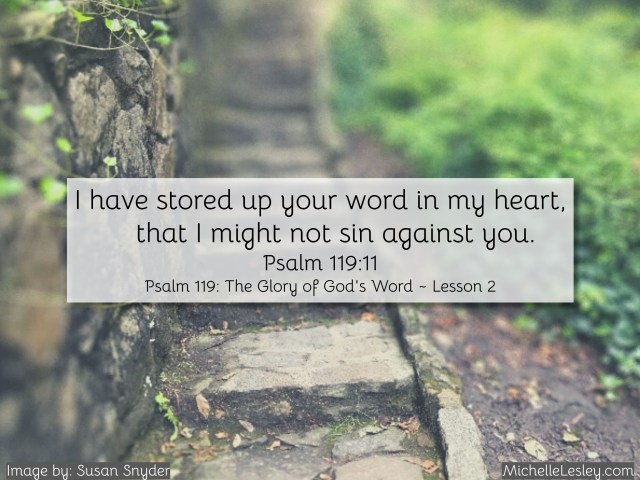
Psalm 119: The Glory of God’s Word ~ Lesson 2

Welcome, ladies! Just a reminder, please do not skip Lesson 1 from last week (link below). Not only will it answer any questions you may have about the study itself, but if you want to study Psalm 119 properly, you must do the background work contained in Lesson 1.

Previous Lessons: 1

Read Psalm 119:1-16

Questions to Consider

1. Review your notes from last week’s introductory lesson. What are some things to keep in mind as you begin to study the text of Psalm 119 today?

As you study, it will probably help you grasp and absorb the psalmist’s meaning better if you read in complete sentences instead of stopping at the end of each verse. For example, notice the comma at the end of verse 2. Verse 2 is not the psalmist’s complete thought. Read all the way through to the period at the end of verse 3, and consider verses 2 and 3 together as the complete thought.

2. List all the synonyms for “Scripture” in this text. How many of the verses in this passage contain a term that means “Scripture”? How would you define each of these terms? Are there subtle shades of difference in what these various terms mean? (You may wish to use a lexicon such as Strong’s to check your work after you have defined these words.) Why would the psalmist choose so many different words that all essentially mean “Scripture”?

3. Do verses 1-3 remind you of another passage of Scripture? How are these verses structurally different from those verses? Why, how, and for what is a person blessed in verses 1-3? What does it mean for a person’s way to be “blameless”? (1)

4. What is the orientation of the psalmist’s heart toward keeping God’s law? Does he view it as a drudge and a burden? Does he want to obey God’s Word, or does he grudgingly do it because he has to? Which words and phrases from today’s passage support your answers? How does this compare to the New Testament’s view of obedience to Scripture? What is the orientation of your heart toward obeying Scripture?

5. How does the psalmist’s love for Scripture, and for obeying Scripture, impact his worship of God (7,12) and his love for God? Which words and phrases from today’s passage support your answers? How does this compare to the New Testament’s view of obedience to Scripture being an indicator of one’s love for God? What does your level of obedience to Scripture and your attitude toward obeying Scripture say about your love for God? Is your love for God reflected by your obedience to Scripture? Explain, in your own words, the relationship between loving and obeying Scripture and loving and obeying God.

6. Which parts of today’s passage can you accomplish in a way that’s pleasing to God without the indwelling and empowering of the Holy Spirit? Is it possible for a lost person to truly love and obey God’s Word? Is it possible for a saved person not to truly love and obey God’s Word? What does this tell you about people who claim to be Christians, yet live in unrepentant sin, or have an unbiblical worldview?

7. Notice the verses that mention body parts (eyes, heart, etc.). How does the psalmist use or relate each of those body parts to his love for Scripture? How does this reflect the idea that love for God isn’t just a private feeling we have internally, but that we use our bodies to love God externally by acting in obedience?

8. How does storing up God’s Word in our hearts guard us against sin? (11) How can we be intentional, purposeful, and proactive about storing up God’s Word in our hearts?

9. Connect today’s passage with the concept that Jesus is the Word.


Praying Psalm 119

Have you ever tried praying the psalms? I want to encourage you to try praying part of Psalm 119 back to God each week of this study. (If you’re familiar with my other studies, this will take the place of the weekly “Homework” section.)

The psalms are uniquely suited for praying back to God, both verbatim and conceptually, because they are often written as prayers – as though the psalmist is talking to God. Did you notice that about today’s passage? In which verses?

What is a concept or thought for your own life that the Holy Spirit impressed on your heart or convicted you about from today’s passage? Is there a particular verse(s), or maybe the whole passage, that you would like to pray back to God verbatim? Whatever your “prayer point” from today’s lesson, pray it at least daily until we get to the next lesson.


Suggested Memory Verse