Abortion, Guest Posts

Guest Post: On the Subject of Abortion

If your theology pretty much matches up with mine (as outlined in the “Welcome” and “Statement of Faith” tabs) and you’d like to contribute a guest post, drop me an e-mail at MichelleLesley1@yahoo.com, and let’s chat about it.

On the Subject of Abortion
by Lisa Matthews

A Brief Word from Michelle:

When Lisa first contacted me about writing a guest post on abortion, she sent me this video of a speech she made at a recent pro-life rally. I thought it was so powerful and inspiring that I wanted to include it with her article. Lisa’s speech starts around the 16 minute mark.


We are the only creation of God’s with “choice” or free will. Our animal friends have natural instincts and generally do not have the mental capacity to change their behavior. Human beings do. We make decisions and act based on those decisions. As believers, we understand that our behaviors should freely be submitted to the will of God. However, in our society today, we are led to believe that all choice is autonomous; in the world’s view we are under our own authority. This is one of Satan’s many lies.

Unbelievers have not placed themselves under the subjugation of the Lord. They are blinded and live as subordinates to the god of this world, that god being Satan. Dear brothers and sisters, we must not be blinded; we are children of the King and must live as such. Our birthright establishes freedom in Christ and freedom from the bondage of the lost. Therefore, you and I are required to manifest outwardly what we have inwardly become.

The church overwhelmingly assists the poor, hungry, widowed and homeless. We have school supply drives, Thanksgiving dinners and celebrate our Lord’s birth with gifts to the fatherless and single mothers. We exist, in part, to show the love of Christ to a dying world. However, on the subject of abortion, our silence is deafening. The third Sunday in January is “National Sanctity of Life Sunday”, but a drive around my large city sadly reveals a mere handful of the more than 1,500 churches participating in this solemn day. The scourge of abortion has ravaged our world and has silenced our church. Where are we? As a body, do we even know the “National Sanctity of Life Sunday” exists?

Abortion is unquestionably the murder of the unborn; it is the biblical equivalent to the children sacrificed to the pagan gods. It is a life created by God and taken unlawfully by man. The 6th Commandment states, “Thou Shall Not Murder” (Exodus 20:13). It seems straightforward as Christ followers to recognize the cruel and vicious act of abortion. Sadly, our inactivity is revealing; it’s revealing of our hearts and our relationship with Jesus. How can we justify what God condemns? How can we remain silent when the blood of innocents cries out?

I come from a place of experience and not of condemnation. I was a young woman afraid and ashamed. That shame silences many of us and the guilt keeps us in the shadows when we are given the opportunity to stand for life. False teachings and the church’s unresponsiveness to the harsh reality of abortion provide justification. Our guilt and shame stems from being complicit. We have family, friends and church members who have played a part in the death of an unborn child. We hide our faces in humiliation and remorse. We’ve also suffered trauma and consequences stemming from our actions. I admit and accept responsibility for the sin of abortion. Thank God for His grace, mercy, forgiveness and a post-abortive healing Bible study.

As a Christian and a Black American, it’s personal to me. In the United States of America 36% of abortions are performed on Black women while they make up less than 7% of the population (source, source). The act of abortion in our nation would be considered genocide in any other context. Our children are being murdered at an alarming rate; we can no longer remain silent or indifferent.

On June 4, 2019, the fourth abortion mill was opened in Charlotte, North Carolina. This Planned Parenthood is located squarely in a historically Black neighborhood. Today, Planned Parenthood is continuing the racist and eugenics policies of their founder Margaret Sanger. In New York City, more Black children are aborted than born.

Ephesians 1:7 says, “In Him we have redemption through His blood, the forgives of our trespasses, according to the riches of His grace.” There is hope! We can turn from our sin and stand in the gap for the unborn. We can reject the sin of indifference and join our hardest hit communities and protest. The body of believers does not have the option to be reticent. Titus 2:3-5 tells older women to teach to younger women. The truth about abortion is no exception. We are tasked to speak to our sisters and friends, our daughters and neighbors, our discipleship partners and mentees. The testimony of our lips should mirror the testimony of our lives.

With regard to abortion, society of today’s message is loud, forceful, unrelenting and false. Pray that our message continues to be hope and love solely based on the gospel. When our hearts and minds agree with God, He will equip us for every task He places before us. In Esther chapter 4, Mordecai warned Esther about being silent. We too, are in precarious times. As residents of the United States, we live in a constitutional republic. We are afforded rights and access to real participation in government. Use your voice to speak for the voiceless, comfort the broken-hearted and vote for protections for our unborn children.

If you have been through the trauma of abortion, thankfully, you are not alone. If you have an unexpected pregnancy, want to get involved in the pro-life movement or need healing for post-abortive trauma, there is help. There are many godly organizations and resources available to you.

Surrendering the Secret, founded by Pat Layton, directs those heart broken by a past abortion to Biblical healing. God’s Ballot provides a resource for Christians “to honor God with their votes during every election.” Love Life is committed to “creating a culture where families stop running to abortion centers and start running to the local church.” Lastly, Care Net provides a national directory of pregnancy resource centers. Local pregnancy resource centers provide real alternatives to abortion and connect expectant mothers with churches, individuals and other organizations to assist with any needs that may arise in their lives.¹

Jesus was clear in Luke 12:48, “Everyone to whom much is given, of him much will be required…”. Our salvation and adoption into the family of God is a tremendous gift. It’s more than we deserve and more than we can ever repay. Jesus has paid our debt; out of gratitude we live a life of service. Please join me in supporting the broken, protecting the unborn and appointing legislators who respect our God’s design.


¹Note from Michelle: I am not very familiar with any of these organizations/resources and do not endorse any of them which deviate from Scripture or my theology as outlined in the “Welcome” and “Statement of Faith” tabs at the top of this page. As with any organization/resource, please thoroughly vet the theology of these before joining or using them.

Lisa was a single mother for 15 years before meeting her husband of 7 years, David. They are parents to one adult daughter. A Volunteer Chaplain at the Mecklenburg County Jail, an Area Coordinator for the Search for Jesus Internet Evangelism ministry, President of the Mecklenburg Black Republican Club and a Voter Registration Chair for the Mecklenburg County Republican Party.
Salvation, Sanctification

Throwback Thursday ~ Sinatra Saints and Developing Disciples

Originally published September 7, 2018

“I don’t get it. I just don’t get it.”

My friend, who’s also in women’s ministry, and I were discussing a phenomenon we’re seeing more and more among professing Christian women (and among men, too, I’m sure). I call it “Sinatra Sin-drome”.

Most of us are too young to be able to remember Frank Sinatra in his heyday, but one of the songs he was best known for was My Way. The lyrics open with a man who’s near death looking back over his life. He recounts his adventures and regrets, the good times and the bad, but no matter what came his way, he faced life on his own terms. “I did it my way,” is the refrain woven into the fabric of the entire song. The last stanza is especially telling:

For what is a man, what has he got?
If not himself, then he has naught
To say the things he truly feels and not the words of one who kneels
The record shows I took the blows and did it my way.¹

This man kneels all right. He kneels at the altar of self. Nobody else is going to tell him what to do. He’s going to do what he wants to do.

Most of the women my friend and I were discussing are either savvy enough or self-deceived enough that they would never dream of even thinking in these clear-cut terms, much less stating them so boldly. And yet, for many, their hearts beat to the rhythm of My Way.

One example of this kind of mindset – though it may have been an isolated incident in the lives of some women – came out in some of the comments on my recent Mailbag article, Should Christian women cover up while breastfeeding?. The sentiment behind the words from several women was, “What the Bible says about the shame of nakedness and denying self to serve others means less to me than: the law that says I have a right…the culture where I live that says it’s OK…my personal experience with the way my baby nurses that demands that I not cover up.”

It came out in a rather puzzling conversation I had with a reader, “B”, who sent me the link to my article on Priscilla Shirer and demanded to know why I think Priscilla is a false teacher (even though the article, which “B” claimed to have read, clearly demonstrates from Scripture why she’s a false teacher). It wasn’t that “B” didn’t have the information and Scriptures right in front of her, it was that she didn’t like what Scripture says about Priscilla. She loves Priscilla Shirer, so she’s willing to put her own feelings above what Scripture says.

It comes out constantly with the issue of women preaching to, teaching, and exercising authority over men in the church setting in violation of 1 Timothy 2:12. “I feel called to preach.” “It’s OK if I teach this co-ed Sunday School class because I have my pastor’s/husband’s permission.” “I can preach a sermon to a mixed audience at this event, because it’s not in a church, it’s at a Christian conference.”

And it always comes out when the topic is Christian women dressing modestly. “I can wear what I want! If men have issues with lust, that’s their problem. They can just avert their eyes.”

Now, let’s be clear, any time you or I or anyone else sins, we are – consciously or subconsciously – saying through that sinful thought, word, or action, “I don’t care what the Bible says about this, I want to do what I want to do.” I’m sure my own words and actions have shouted that rebellion against God loud and clear on many occasions.

But there’s a difference between…

A Developing Disciple
A Christian who is striving to do things God’s way, who occasionally stumbles into sin or gives in to a momentary weakness of the flesh. When confronted with what Scripture says on the subject, she sorrowfully repents and submits to God’s Word.

and

A Sinatra Saint
A person who claims to be a Christian and generally aligns with what the Bible says as long as it agrees with her. When confronted with what Scripture plainly says about her beliefs or actions, she doesn’t repent, but digs in her heels and attempts to justify herself, often with claims like, “Well that’s just your opinion/interpretation,” or “That’s not really what that passage means.”

Sometimes it can be hard to come to grips with a difficult passage of Scripture that challenges something you’ve believed or done your whole life. (Hey, I’ve been there. It’s no picnic.) But the difference between a Developing Disciple and a Sinatra Saint is that the Developing Disciple will grapple with the passage with an overall desire to properly understand and submit to that Scripture, even if it’s hard, while, for the Sinatra Saint, it’s a no-brainer. Her opinions, feelings, or personal experiences win. Because it’s not just that one isolated issue, it’s her whole outlook and approach to life.

Am I saying that a woman who thinks it’s OK to let it all hang out while she’s nursing her baby isn’t saved? Of course not. What I’m saying is that if your general approach to life is, “I’m doing it my way and if the Bible wants to align with me, fine, and if not, that’s fine, too,” you’d better start examining your heart pretty carefully against Scripture to discover whether or not you’re actually saved.

Why? Because that’s what the Bible says. And if you claim to be a Christian, the Bible is your authority in life, not yourself.

And I will give you a new heart, and a new spirit I will put within you. And I will remove the heart of stone from your flesh and give you a heart of flesh.
Ezekiel 36:26

Therefore, if anyone is in Christ, he is a new creation. The old has passed away; behold, the new has come.
2 Corinthians 5:17

This isn’t just flowery, poetic language. When Christ saves a person, he literally changes that person into a new type of creature with a different way of thinking, different likes and dislikes, different goals, different responses.

Imagine if you had a magic wand and could change a house cat into an elephant. When the cat was a cat, he wanted to chase mice. Now that he’s an elephant, he’s afraid of mice. As a cat, he craved tuna, but as an elephant, he turns his trunk up at meat, preferring an herbivorous diet. No more baring his claws to scratch at an enemy; now he tramples and uses his tusks to ward off danger. The coziness of hearth and home? Nope. The elephant prefers the wide open savanna.

And all of that is nothing compared to the radical transformation that takes place in the heart of someone who has been genuinely regenerated by Christ.

Christ changes our mindset from the mind set on the flesh to the mind set on the Spirit:

For those who live according to the flesh set their minds on the things of the flesh, but those who live according to the Spirit set their minds on the things of the Spirit. For to set the mind on the flesh is death, but to set the mind on the Spirit is life and peace. For the mind that is set on the flesh is hostile to God, for it does not submit to God’s law; indeed, it cannot. Those who are in the flesh cannot please God. You, however, are not in the flesh but in the Spirit, if in fact the Spirit of God dwells in you. Anyone who does not have the Spirit of Christ does not belong to him.
Romans 8:5-9

Christ changes our will – from desiring what Satan desires to desiring what God desires:

You are of your father the devil, and your will is to do your father’s desires.
John 8:44a

Now may the God of peace…equip you with everything good that you may do his will, working in us that which is pleasing in his sight, through Jesus Christ, to whom be glory forever and ever. Amen.
Hebrews 13:20a,21

Christ changes our behavior from willful disobedience to joyful obedience:

“Why do you call me ‘Lord, Lord,’ and not do what I tell you?”
Luke 6:46

If you love me, you will keep my commandments. John 14:15  Whoever has my commandments and keeps them, he it is who loves me. John 14:21a  For this is the love of God, that we keep his commandments. And his commandments are not burdensome. 1 John 5:3

Whoever says “I know him” but does not keep his commandments is a liar, and the truth is not in him,
1 John 2:4

And by this we know that we have come to know him, if we keep his commandments.
1 John 2:3

Christ changes us from His enemies to His friends:

You adulterous people! Do you not know that friendship with the world is enmity with God? Therefore whoever wishes to be a friend of the world makes himself an enemy of God.
James 4:4

They are…haters of God
Romans 1:29b,30a

The friendship of the Lord is for those who fear him, and he makes known to them his covenant.
Psalm 25:14

You are my friends if you do what I command you. No longer do I call you servants, for the servant does not know what his master is doing; but I have called you friends, for all that I have heard from my Father I have made known to you.
John 15:14-15

Christ changes us from believing Satan’s lies to believing God’s truth:

Why do you not understand what I say? It is because you cannot bear to hear my word. You are of your father the devil, and your will is to do your father’s desires. He was a murderer from the beginning, and does not stand in the truth, because there is no truth in him. When he lies, he speaks out of his own character, for he is a liar and the father of lies. But because I tell the truth, you do not believe me. Which one of you convicts me of sin? If I tell the truth, why do you not believe me? Whoever is of God hears the words of God. The reason why you do not hear them is that you are not of God.”
John 8:43-47

Has there been a radical transformation like that in your heart and life as a result of repenting of your sin and placing your faith in Christ? You can be your own authority and have “I did it my way,” as the theme song of your life, but you can’t do that and be a Christian too. The two are mutually exclusive. It doesn’t matter if you’ve walked an aisle, made a “decision”, prayed a prayer, been baptized, joined a church, are a “good person”, and do all sorts of good deeds, if your heart and your desires aren’t generally oriented toward Christ, growing toward in Him and away from self, you aren’t saved.

But that can be remedied right now. The gospel is right there, ready for you to repent of your sins and believe. Take some uninterrupted time alone with God and measure your life and your heart against the plumb line of His Word. Is it “I did it my way,” or “I’ll do it Thy way.”?

Are you a Developing Disciple or a Sinatra Saint?


¹My Way. AZLyrics. https://www.azlyrics.com/lyrics/franksinatra/myway.html
Prayer Bible Study

Sweet Hour of Prayer: Lesson 2

Previous Lessons: 1

Read 1 Samuel 1

Hannah’s First Prayer

Questions to Consider

1. Are you familiar with what is going on in the history of Israel at this time? If not, use this synopsis (or another Bible Book Background) to bring you up to speed.

2. Carefully read verses 1-9. In your own words, briefly summarize the circumstances in Hannah’s life leading up to her first prayer (in 10-11).

3. Examine verses 10,15,16. What words are used to describe Hannah’s emotional and spiritual state? It has often been said that prayer shouldn’t be our last resort – that we shouldn’t wait until circumstances are desperate before we pray. Does it seem like that’s what’s going on here with Hannah, that she only turned to God as a last resort, or that this was the culmination of many prayers over the years? On what, from chapter 1, are you basing your answer? Compare 10,15,16 with 18b. How did Hannah’s emotional and spiritual state change after pouring her heart out to God? What can we learn from Hannah’s first prayer about pouring our hearts – our feelings – out to God?

4. Where did Hannah go to pray? (9-10) Why do you think it was important to her to pray at the temple? (Hint: Examine what she says about the house of the Lord and the “presence of the Lord” in 21,22,24). Could God only hear her, or would He only be willing to answer her, if she were praying in His house? True or false: God hears us better and our prayers carry more weight if we’re praying in church, or at the front of the sanctuary (at the “altar”) during a special time of the worship service, than if we’re praying at home, in the car, etc.?

5. Examine the content of Hannah’s first prayer. (11) What is Hannah praying for, and for whom? Is it OK to pray for the things our hearts long for? Why or why not?

“O Lord of hosts,” – How does Hannah start off her prayer? How does she address God? Compare this with the beginning of the Lord’s Prayer. How should this inform our own prayers?

“if you will indeed look on the affliction of your servant and remember me and not forget your servant” – What is Hannah seeking in this part of her prayer? Compare Hannah’s thoughts and request here with Hagar’s characterization of God as, “a God of seeing…I have seen him who looks after me.”

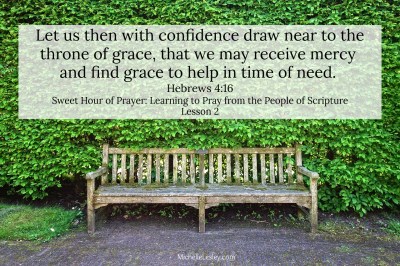
“but will give to your servant a son,” – How would you describe Hannah’s request? Is she timid and equivocating, or bold, direct, and specific? How does Hebrews 4:16 relate to this part of Hannah’s prayer?

“then I will give him to the Lord all the days of his life, and no razor shall touch his head.” – (Use your footnotes and cross references if you’re not familiar with what Hannah is talking about here.) Hannah includes a vow, or promise to God, with her prayer, which is not something we’re accustomed to doing. Most of us have probably heard the story of the guy on his deathbed who promises God that if He will just let him live, he’ll live a good life, go to church every week, etc. We’ve been taught that’s “bargaining with God” and that we shouldn’t do that. Is Hannah bargaining with God in that same sense? What, from today’s passage would lead you to say “yes” or “no”? Have you ever made a vow to God in prayer? Did you keep that vow? Why might it be wise or unwise to make a vow to God when requesting something in prayer? Look up the word “vow” in a concordance. Does vowing seem to be more of an Old Testament thing or a New Testament thing? Why do you think that is?

6. Examine verse 19. Did Hannah go in to worship the Lord before or after He answered her prayer? Was her worship an attempt to manipulate God into giving her what she wanted, a response to knowing for a fact that He was going to give her what she wanted, or was her worship simply part of who she was as someone who loved God, regardless of whether or not He gave her what she wanted? Do you worship God continuously, whether or not He gives you what you’ve asked for in prayer?

7. Read 19-20. Did Hannah and Elkanah sit idly by and wait for God to provide a miraculous conception? What did they do? If you need a job, do you pray for God to send you a job and then sit on the couch watching TV and waiting for someone to call and ask you to come work for them, or do you ask God to provide a job and then read the want ads, fill out applications, and go on interviews? Explain how God blesses and answers prayer through the normal, day to day means and methods He has established. Is it any less “miraculous” for God to answer prayer through normal means and methods than to answer prayer in extraordinary way? Why? How did Hannah honor and recognize God for answering her prayer? (20b) How was Samuel, for the rest of his life, just by virtue of his name, a testimony to God answering prayer?

8. Study 21-28. Did Hannah keep the vow she made to the Lord? Why is this important? What was Hannah’s testimony of God’s answer to her prayer? (26-28) How do you think this impacted Eli? How can it be an encouragement to your pastor and your brothers and sisters in Christ to share with them how God has answered your prayers or worked in your life? We often share prayer requests. We don’t often share God’s answers. How might sharing God’s answers to prayer encourage others to pray?


Homework

•Think about one of the aspects of Hannah’s prayer we studied today – pouring out your heart to God, honoring His name in your prayers, worship, God’s work through normal means, etc. – and apply this aspect to your own prayer life this week.

•How has God answered a prayer or worked in your life in some way? Encourage your pastor, and share it with him!


Suggested Memory Verse

(Every week of our study, you’ll see a suggested memory verse like the one above. You are welcome to grab the memory verse pic to use as your screensaver or wallpaper on your phone or computer, print it out and stick it somewhere you’ll see it frequently, or use it in any other way you wish to help you memorize the verse.)

Discernment

Kelly Minter

If you are considering commenting or sending me an e-mail objecting to the fact that I warn against certain teachers, please click here and read this article first. Your objection is most likely answered here. I won’t be publishing comments or answering emails that are answered by this article.


This article is kept continuously updated as needed.

I get lots of questions about particular authors, pastors, and Bible teachers, and whether or not I recommend them. Some of the best known can be found above at my Popular False Teachers tab. The teacher below is someone I’ve been asked about recently, so I’ve done a quick check (this is brief research, not exhaustive) on her.

Generally speaking, in order for me to recommend a teacher, speaker, or author, he or she has to meet three criteria:

a) A female teacher cannot currently and unrepentantly preach to or teach men in violation of 1 Timothy 2:12. A male teacher or pastor cannot allow women to carry out this violation of Scripture in his ministry. The pastor or teacher cannot currently and unrepentantly be living in any other sin (for example, cohabiting with her boyfriend or living as a homosexual).

b) The pastor or teacher cannot currently and unrepentantly be partnering with or frequently appearing with false teachers. This is a violation of Scripture.

c) The pastor or teacher cannot currently and unrepentantly be teaching false doctrine.

I am not very familiar with most of the teachers I’m asked about (there are so many out there!) and have not had the opportunity to examine their writings or hear them speak, so most of the “quick checking” I do involves items a and b (although in order to partner with false teachers (b) it is reasonable to assume their doctrine is acceptable to the false teacher and that they are not teaching anything that would conflict with the false teacher’s doctrine). Partnering with false teachers and women preaching to men are each sufficient biblical reasons not to follow a pastor, teacher, or author, or use his/her materials.

Just to be clear, “not recommended” is a spectrum. On one end of this spectrum are people like Nancy Leigh DeMoss Wolgemuth and Kay Arthur. These are people I would not label as false teachers because their doctrine is generally sound, but because of some red flags I’m seeing with them, you won’t find me proactively endorsing them or suggesting them as a good resource, either. There are better people you could be listening to. On the other end of the spectrum are people like Joyce Meyer and Rachel Held Evans- complete heretics whose teachings, if believed, might lead you to an eternity in Hell. Most of the teachers I review fall somewhere in the middle of this spectrum (leaning toward the latter).

If you’d like to check out some pastors and teachers I heartily recommend, click the Recommended Bible Teachers tab at the top of this page.


Kelly Minter
Not Recommended

The “about” page of Kelly Minter’s web site used to describe false teacher, Beth Moore, as “one of [Kelly’s] favorite bible [sic] study teachers.” Kelly also said, “Beth’s teachings were much of what God used in my earlier life to teach and transform me…”.  (This information has been removed from Kelly’s website since the original publication of my article on her in 2016.)

And, indeed the most glaring theological problem with Kelly is that she considers Beth Moore to be “one of my spiritual mothers.”

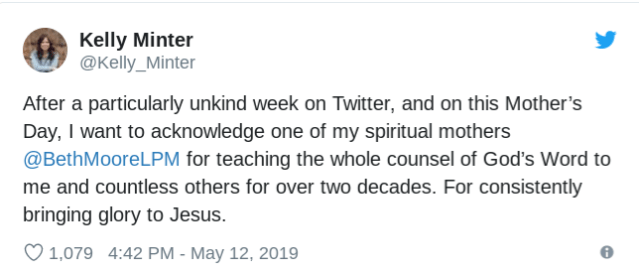
The “particularly unkind week on Twitter” Kelly is referring to is doctrinally sound Christians biblically rebuking Beth Moore for coyly announcing that she would be preaching the Sunday morning sermon at her home church on Mother’s Day 2019. Where Beth Moore…

  • preaches to men in violation of Scripture
  • consistently allegorizes, mishandles, and takes Scripture out of context
  • partners with demonstrably false teachers and heretics
  • is on a trajectory toward affirming homosexuality
  • not only refuses biblical correction in all these areas but publicly taunts, insults, and name-calls those who rebuke her…

…Kelly thinks Beth has taught her “the whole counsel of God,” “brings glory to Jesus,” and is worthy of being her “spiritual mother.” If Kelly thinks these things, she is at the very least so undiscerning, or so unknowledgeable of the many Scriptures that condemn these things, or she knows that Scripture condemns these things but disregards Scripture in favor of her love for Beth, that she should not be teaching anyone, but should be sitting in a good local church under the teaching of a solid pastor so she can learn Scripture and sound doctrine.

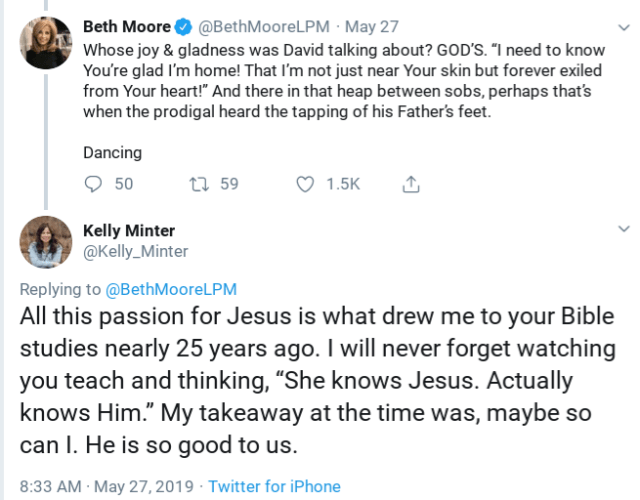
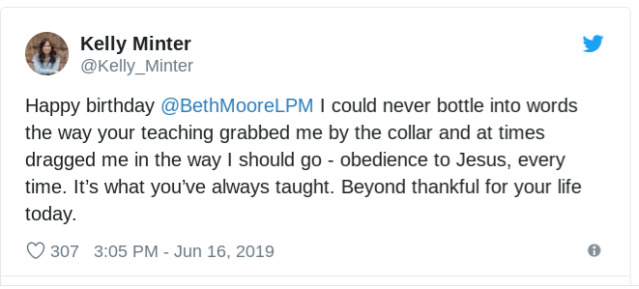
More of Kelly honoring Beth:

If Kelly has such a fundamental misunderstanding of biblical obedience that she thinks Beth Moore – who defies Scripture in a myriad of ways – has taught her (“and countless others”) to obey Jesus, do you think she is qualified to teach the Bible to you or the women of your church, either in person or through the use of her materials?

Beth Moore is also fond of Kelly, (“I LOVE HER, I LOVE HER, I LOVE HER, I LOVE HER!!”) and has featured three of Kelly’s Bible studies during her summer Bible study series on her LPM blog: No Other Gods, Ruth and Nehemiah.

Since Beth Moore preaches to men, it is not surprising that we would find Kelly has preached to men as well. While it is commendable that Kelly doesn’t seem to preach to men often, and the FAQ page for her “Cultivate” conferences specifically says that these conferences are for women, it is troubling that she has preached in a Sunday worship service as recently as 2019 and that the woman she considers her mentor has no qualms about preaching to men.

Kelly seems to have unbiblical ideas about how people should study the Bible. In this video she recommends that people who want to understand the Bible need to get a study (in addition to her own, she recommends Beth Moore and Priscilla Shirer) and “if you feel comfortable” get involved in a church to study “in community”. The biblical model for being taught Scripture is to join a church – this is not optional – and be taught the Word by the pastor, elders, and teachers. Doctrinally sound studies can sometimes be helpful, but they are supplementary to church instruction, not the primary source of instruction.

Kelly maintains friendly relationships and/or ministry partnerships with a plethora of false and problematic teachers. Here, Kelly recommends not only Beth Moore and Priscilla Shirer, but also Jen Hatmaker, Jennie Allen, Jennifer Rothschild, Lisa Harper, and Margaret Feinberg. Kelly has guest blogged for Priscilla Shirer, and is an admirer of Christine Caine. Kelly has been featured on Angie Smith’s blog, is a fan of Catholic mystic, Henri Nouwen, and was included in The Faithful, a book of collected Bible studies by Kelly, Priscilla Shirer, Beth Moore, Jennifer Rothschild, and Lisa Harper. Kelly will be partnering with Lysa TerKeurst at a conference in October 2019, with Christine Caine at a LifeWay women’s leadership forum in November 2019, and with Beth Moore, Priscilla Shirer, Jackie Hill Perry, and Jennifer Rothschild at LifeWay Women Live in 2020 (Kelly also appeared at the 2019 LifeWay Women Live with Christine Caine, Lysa TerKeurst, Lisa Harper.) Kelly has partnered with these and other false/problematic teachers at various other events, but I don’t wish to belabor the point. Kelly has little discernment and is disobeying Scripture’s admonition not to partner with false teachers.

When a women’s Bible study teacher is willing to preach to men and shows such a dearth of discernment, she is not someone you or the women of your church should follow or receive teaching from.

Answering a Fool, Mailbag

The Mailbag: Answering a Fool #3


Answer a fool according to his folly,
lest he be wise in his own eyes.
Proverbs 26:5

There’s a lot of foolishness masquerading as Christianity these days. Occasionally, I get e-mails and messages showcasing this type of foolishness. It needs to be biblically corrected so these folks can stop “being wise in their own eyes,” repent, and believe and practice the truth of Scripture. From time to time, I’ll be sharing those e-mails in The Mailbag with a biblical corrective, not only so the e-mail writer can be admonished by Scripture, but to provide you with Scriptures and reasoning you can use if you’re ever confronted with this kind of foolishness.


(This reader’s blog comment {in blue},
responding to this article, is reprinted in full.)

You are a liar and devils tool. There is no role for corporate discernment. God doesn’t need you to defend His flock from false teachers, when did God become powerless or when did His flock become unintelligent or indiscernible? How come it’s OKY you who can discern? And just remember the same standard which you use to judge others, God will use to judge you.

Allllllllllrighty then. Let’s break this down.

You are a liar and devils [sic] tool. 

A liar is someone who intentionally deceives other people or says something she knows is not true. I have done neither. If there is something in my article that is incorrect, I assure you it was an innocent and unintentional mistake. If you could kindly specify exactly what you think I have gotten wrong with the evidence or rightly handled Scripture to back up your assertion, I will gladly correct my mistake.

As for being the “devil’s tool,” could you please explain how someone who points out biblical error and points people to the truth of Scripture is being used by the devil? The devil is the one who twists and misuses Scripture in order to lead people into error. Was Jesus the “devil’s tool” when He publicly pointed out and biblically corrected the unscriptural teachings of the scribes and Pharisees? How about PeterPaulJohnJude, and others whom God the Holy Spirit inspired to write the Scriptures that rebuke false teachers and false doctrine? Were these men the “devil’s tool” too?

When you accuse the brethren (me) without biblical cause or evidence, and in the face of Scripture that proves your accusations to be unfounded, what you’re doing is called slander and unbiblical judgment, and you are the one who is being used as a tool of the devil.

There is no role for corporate discernment.

I honestly have no idea what this means. “Corporate” means “a large company or group.” In Christian circles, when we use the term “corporate,” we usually mean the gathering of the church body. I’m an individual, not a group, so I really don’t have a clue as to how this statement applies to me.

Furthermore where does the Bible say or teach this? If you’re going to make a biblical assertion, you need to back it up with rightly handled, in context Scripture. There’s tons of New Testament evidence that God does want the church as a body and individual Christians to practice discernment, but I don’t know which verses to provide you with to refute your point, because I don’t know what your point is.

God doesn’t need you to defend His flock from false teachers,

God doesn’t “need” anybody. He doesn’t “need” you to rebuke me either. Did you consider that before you wrote your comment? Why didn’t you just remain silent and trust Him to convict me of whatever sin you think I’ve committed? Or is it that it’s OK for you to call someone on the carpet for what you perceive to be violations of Scripture, but it’s not OK for me to do so? Hypocrisy, much?

As I clearly stated in the very first paragraph of the article (which I’m assuming you read since you commented on it), people have written to me asking whether or not certain teachers are doctrinally sound. The articles I’ve written are answers to these readers’ questions.

Titus 2:3 says:

Older women likewise are to be reverent in behavior, not slanderers or slaves to much wine. They are to teach what is good,

Teaching women the truth of God’s Word about false teachers, discernment, or any other biblical issue is good. Some other passages you might want to consider:

I appeal to you, brothers, to watch out for those who cause divisions and create obstacles contrary to the doctrine that you have been taught; avoid them. For such persons do not serve our Lord Christ, but their own appetites, and by smooth talk and flattery they deceive the hearts of the naive.
Romans 16:17-18

Here’s Paul, under the inspiration of the Holy Spirit, warning fellow Christians to “watch out for” and “avoid” false teachers. You know what else Paul said? “Imitate me.

Beloved, although I was very eager to write to you about our common salvation, I found it necessary to write appealing to you to contend for the faith that was once for all delivered to the saints. For certain people have crept in unnoticed who long ago were designated for this condemnation, ungodly people, who pervert the grace of our God into sensuality and deny our only Master and Lord, Jesus Christ…save others by snatching them out of the fire;
Jude 3-4,23a

Jude, under the inspiration of the Holy Spirit, exhorts the church to fight for the purity of biblical doctrine and to save those who are vulnerable to false doctrine, “snatching them out of the fire.”

“So you, son of man, I have made a watchman for the house of Israel. Whenever you hear a word from my mouth, you shall give them warning from me. If I say to the wicked, O wicked one, you shall surely die, and you do not speak to warn the wicked to turn from his way, that wicked person shall die in his iniquity, but his blood I will require at your hand. But if you warn the wicked to turn from his way, and he does not turn from his way, that person shall die in his iniquity, but you will have delivered your soul.
Ezekiel 33:7-9

God commands Ezekiel to warn people away from their sin and says He will hold Ezekiel responsible if he fails to warn them.

But I guess God didn’t “need” Paul or Jude or Ezekiel or any of the people in the congregations they were writing or speaking to or, by extension, Christians today, “to defend His flock from false teachers,” right?

So whoever knows the right thing to do and fails to do it, for him it is sin.
James 4:17

It’s clear from Scripture that warning people away from sin and false doctrine is “the right thing to do.” You’re asking me to stop doing the right thing. It would be a sin for me to stop, and it’s a sin for you to demand that I stop. And now that you know that warning people away from false teachers is the right thing to do, that means if you fail to do so, that’s sin for you.

So the real question here is not, “Why am I warning others about false teachers,” but “Why aren’t you?”.

when did God become powerless or when did His flock become unintelligent or indiscernible?

OK, so following your logic, why does every single book of the New Testament (except Philemon) address the issue of false doctrine or false teachers? Why did God have so many of the Old Testament prophets rebuke the false prophets of their day – false prophets who, much like today’s false teachers, would say “thus saith the Lord” and then tell the people things God had not said, or things that were in direct contradiction to what God had said? Was He so powerless that these New Testament writers had to write books and letters (“blog articles,” if you will) warning against false doctrine and false teachers and these Old Testament prophets had to publicly denounce the false prophets?

When did His flock become unintelligent or undiscerning? Let’s dispense with “unintelligent” because that has nothing to do with being discerning. Some of the most intelligent people in evangelicalism with strings of academic letters behind their names are some of the most undiscerning Christians out there – seminary presidents and professors, denominational heads, CEOs of Christian retail outlets. And there are people who have very little in the way of intelligence or education who are very discerning.

When did God’s people become undiscerning? In Genesis 3, when a serpentine false teacher, “a liar and a tool of the devil,” walked up to Eve, twisted God’s Word and said, “Did God really say…?”. And lack of discernment has been a pervasive problem ever since.

How come it’s OKY [sic] you who can discern? (I think you mean “only”?)

It’s NOT only I who can discern. Praise God, there are lots of Christians out there who are discerning. The people who have written asking me about these false teachers are discerning (because they want help understanding whether or not they’re being taught sound doctrine). There are other writers and teachers doing the good and hard work of teaching discernment. Pastors, elders, deacons, Bible teachers, church members, podcasters, authors, parachurch ministries. They are out there warning fellow Christians against false teachers in their venues just like I am in my venue, and I thank God that they are! I wish every pastor and local church were so diligent about teaching discernment that I wouldn’t have to write discernment articles any more.

But the vast majority of them aren’t. In fact, the vast majority are throwing the doors of the sheep pen wide open to the wolves in sheep’s clothing and welcoming them in. And until that changes, somebody has to warn those vulnerable sheep. Like I said before, why aren’t you helping to warn them?

And just remember the same standard which you use to judge others, God will use to judge you.

The standard I use to biblically judge the observable behavior and teaching of evangelical teachers is Scripture, and that’s the standard God will judge me (and everyone else) by. I am totally OK with that because I am doing my best to be obedient to Scripture, and when I’m disobedient to Scripture I repent.

Can you say the same? What standard do you use for judging me and others? Let’s just put the opening and closing lines of your comment together:

You are a liar and devils tool.
And just remember the same standard which you use to judge others, God will use to judge you.

What standard are you using?

I’d like to leave you with a few passages of Scripture to consider:

“I tell you, on the day of judgment people will give account for every careless word they speak, for by your words you will be justified, and by your words you will be condemned.”
Matthew 12:36-37

Judge not, that you be not judged. For with the judgment you pronounce you will be judged, and with the measure you use it will be measured to you. Why do you see the speck that is in your brother’s eye, but do not notice the log that is in your own eye? Or how can you say to your brother, ‘Let me take the speck out of your eye,’ when there is the log in your own eye? You hypocrite, first take the log out of your own eye, and then you will see clearly to take the speck out of your brother’s eye.
Matthew 7:1-5

O Lord, who shall sojourn in your tent?
Who shall dwell on your holy hill?
He who walks blamelessly and does what is right
and speaks truth in his heart;
who does not slander with his tongue
and does no evil to his neighbor,
nor takes up a reproach against his friend;
in whose eyes a vile person is despised,
but who honors those who fear the Lord;
who swears to his own hurt and does not change;
who does not put out his money at interest
and does not take a bribe against the innocent.
He who does these things shall never be moved.
Psalm 15


If you have a question about: a Bible passage, an aspect of theology, a current issue in Christianity, or how to biblically handle a family, life, or church situation, comment below (I’ll hold all questions in queue {unpublished} for a future edition of The Mailbag) or send me an e-mail or private message. If your question is chosen for publication, your anonymity will be protected.