Podcast Appearances

The Everyday Ministry Podcast Guest Appearance: Women in Ministry

It was so fun to appear as a guest on The Everyday Ministry Podcast last week! Listen in as James, Krist, and I discuss complementarianism, how pastors can help women minister effectively in their churches, and more!

You can also subscribe to The Everyday Ministry Podcast on iTunes and Google Play, and be sure to follow them on Facebook and Twitter!

Here are a few articles I’ve written about some of the topics we covered in the podcast:

How a Little Acorn Helped Reassure a Nut Like Me
Testify
Rock Your Role: Jill in the Pulpit
Let Me Count the Ways: 75 Ways Women Can Biblically Minister to Others
Deaconesses and Female Deacons
Servanthood
Bible Studies
Rock Your Role FAQs


Got a podcast of your own or have a podcasting friend who needs a guest? Need a speaker for a women’s conference or church event? Click the “Speaking Engagements” tab at the top of this page, drop me an e-mail, and let’s chat!

Mailbag

The Mailbag: Christian Women Working, Using Birth Control, and Limiting Family Size


I have a question [as] to what your convictions are about a woman working at all in the first place, in reference to your answer to the question “Is it ok for a woman to make more than her husband?

What also is your position on birth control or having a planned family size? You are very openly pro life, and amen to that, but it seems you also are supportive of a woman working outside of her home, and with that I can only generalize and forgive me if I am wrong, that you also support a woman limiting her family size because a mother of many children, which is usually the natural order of things when no contraceptives are used, would very difficultly work and also be able to look well to the ways of her household. Can you clear your position up for us wondering? Thank you Michelle! God bless you!

Thank you so much for your questions and kind remarks. These are important issues that women and their husbands need to prayerfully consider in order to arrive at a biblical conclusion for their family.

One thing it’s imperative to remember is that situations differ vastly from family to family. We can easily slip into a pattern of thinking that “every family is just like mine so every family ought to make the same decisions we’ve made,” and even to consider our family’s decisions as the biblical standard for every family. That’s not the case, and that’s not a biblical way of regarding others. It’s important to broaden our view to realize there are scads of family difficulties, logistics, and situations that we’ve never had to face before and that two families can make different decisions on these issues – due to the unique circumstances God has placed them in – and still both be in obedience to God.

The reason it’s possible for two families to make different decisions on these issues is because the Bible doesn’t give any clear cut commands that women should never “work at all in the first place,” or that family size should never be limited, or that no form of birth control should ever be used. We may have strong convictions about these things, but God does not specifically prohibit them in His Word, and that’s what we have to go by, not only when making decisions about our own families, but also when considering the decisions other families have made.

I took a closer look at what God’s Word says (and doesn’t say) about women working in my Mailbag article Stay at Home Dads? I would encourage you to read that article and look up the Scriptures I referenced, but, long story short, the Bible does not make an across the board prohibition that no woman may ever work to earn income. In fact, we see several examples of women in Scripture working, and God does not condemn these women for doing so. In some circumstances, it is perfectly biblical for women to work.

I think the confusion you may be experiencing stems from the fact that you’re assuming several “facts not in evidence” when it comes to women working outside the home. Your questions seem to be predicated on the idea that “working woman” necessarily means a married woman who has small children and who doesn’t want children to get in the way of her career. That may be the case for some women who work but it’s not the case for every woman. Not every woman is married. God has not blessed every woman with children. Some women have children who are grown and on their own. Some women are single mothers and have no choice but to work. Some women have disabled husbands who can’t work. Some women can work part time from home (or outside the home) and their jobs don’t interfere with raising their children and managing their households. Occasionally, when a couple marries, the wife is already well established in a lucrative career, while the husband hasn’t had the same educational/career opportunities, and regardless of how hard he works, and considering all other circumstances, the wife and husband agree that it just makes more financial sense for a particular season of their family’s life for her to work and for the husband to stay home with the kids. We cannot make a blanket statement that godly women in these circumstances, working outside the home (or from home), are necessarily violating Scripture. As I said, we need to be aware of the vast array of circumstances taking place in various families, and not judge those families by our own.

Your next question was about birth control and limiting family size. Again, we must look to Scripture to see what it says.

Since the Bible was written in a time before birth control pills and surgical sterilization were invented, naturally it does not address those specific types of birth control, or, really, any type of birth control. People have tried to make the case that a couple of passages address the issue of what we might call “natural family planning”:

The story of Onan describes Onan engaging in coitus interruptus (withdrawal) and God subsequently putting Him to death. This passage is sometimes offered as evidence that God is against even “natural” birth control. However, all you have to do is read the passage in context, and it’s clear that it wasn’t that particular sexual act itself that cost Onan his life, but his selfishness in refusing to obey what would later become the law of levirate marriage.

1 Corinthians 7:5 permits husbands and wives to engage in mutually agreed upon periods of abstinence which could be stretched like Silly Putty into a biblical endorsement of the rhythm method (natural family planning), but again, the context of the verse makes it clear that the abstinence mentioned in this verse is not for the purposes of birth control, it’s for the purposes of concentrated prayer, sort of a “fasting from sex” idea.

So birth control, even natural forms of it, is not really addressed in Scripture. It’s neither prohibited nor endorsed. And as a consequence, limiting the size of one’s family isn’t addressed either because that wasn’t normally, biologically-speaking, a realistic option.

The Bible does, however, speak to the issue of abortion. Abortion is the murder of an innocent human being, so all the biblical passages prohibiting murder also prohibit abortion. This includes any form of birth control that kills an already conceived baby.

Another biblical principle I think it’s important to take into consideration is that the Bible seems to assume that procreation is one of the main goals of both sex and marriage. While God created sex to be pleasurable, gratifying our desire for physical ecstasy is dessert, not the main course of sex, as our libidinous 21st century sexual ethic would have us believe. God created marriage as the boundary lines for sexual activity, and the foundation for creating families. The Bible knows nothing of a man and woman getting married and proactively deciding for fleshly or selfish reasons (career, travel, freedom, spending habits, etc.) not to have children. The Bible takes for granted that married couples who are physically able will form families by having children. That is His plan for propagating human life.

The Bible also views children as a blessing to families and views motherhood as an honor, a vocation worthy of respect and value. I’m very disturbed at the increasing attitude in our society, and even among some Christians, that children are an annoying inconvenience and a hindrance to women pursuing their own personal goals. I remember seeing a billboard ad for condoms a few years ago that featured a picture of a screaming toddler emblazoned with the caption, “You should have used X Brand condoms.” Recently I saw a TV commercial for an IUD that said something along the lines of, “It’s easier to make an appointment with your doctor to get this IUD than to deal with a thee year old.”

And just last night, I saw part of a sitcom in which a stay at home mom comes home from a night out with friends (all career women) and complains to her husband that ever since the kids were born she’s been stuck at home, that her friends are doing exciting things and all she’s doing is raising kids, that she needs to get out of the house and do something. So she decides to get a job. As if being a mother is an unexciting burden and she’s not really doing anything worthwhile.

Children are a precious gift of God and deserve to be treated with love and dignity, to feel like they’re wanted and valued by the person they love most in the world – Mom.

So taking all of these things into consideration, where does that leave us when it comes to making godly decisions about these three issues of women working, birth control, and limiting the size of one’s family?

Here are some biblical conclusions we can draw:

•Christians should not have abortions or use any type of abortifacient birth control. Barrier methods, true contraceptives (birth control that prevents conception), surgical sterilization (tubal ligation/vasectomy), and natural family planning are not sinful in and of themselves, but we need to prayerfully consider whether or not we have sinful or selfish reasons for wanting to use them.

•As with any decision, Christians should examine their motives for wanting to use birth control, limit their family size, and for wanting Mom to work outside the home. Are these motives sinful, fleshly, selfish, based on a lack of trust in God? If so, that’s the root issue that needs to be dealt with, because Christians should have biblical and godly motives for their decisions, not sinful ones. Godly decisions spring from godly motives.

•Generally speaking, in families with children at home, God’s pattern is for Mom to stay home, manage the household and raise the children, and for Dad to support the family financially. For many couples today, that will necessitate limiting the size of their family at least to a degree. The Duggars might be able to support 20 children on Jim Bob’s salary alone, but that is not the case for most families. Most couples will, at some point, have to make a decision as to whether or not they are physically and financially able to care for additional children, or if having additional children will force Mom to get a job, leaving a day care or someone else to raise the children.

•Because God’s general pattern for families is for Mom to stay home and Dad to work, husbands and wives should try to follow this pattern if at all possible. Explore all possibilities of reducing expenses, bringing in extra income, and keeping Mom at home:

  • Cut your expenses- Move to a cheaper area or into cheaper, possibly smaller, housing. Get a cheaper vehicle. Cut extraneous expenses like cable, going out to eat, recreational shopping, buying name brands, mani-pedis, gym memberships, organizations that require dues, lawn and housekeeping services, etc.
  • Think outside the box when it comes to employment. Bringing in income doesn’t have to mean working outside the home 9 to 5 as someone else’s employee. What about working online or starting your own business? Creating/crafting things and selling them online? Taking in laundry, ironing, or sewing? Babysitting? Homeschooling other people’s children? Working a late night or early morning shift while the kids are sleeping?
  • I highly recommend the late Larry Burkett’s book Women Leaving the Workplace: How to Make the Transition from Work to Home. It came out in 1995, before the internet was really a thing, so it doesn’t have much information on working online, websites you can go to, etc., but most of the practical advice he gives is timeless, and it’s easy to think of online alternatives to some of the “analog” things he mentions.

•Christian wives need to remember to obey Scripture’s instruction to submit to their husbands. If your husband does not want you to work outside the home or has made another decision (that does not violate clear Scripture) about one of these three issues, you are to lovingly and graciously submit to that decision. Remember, there isn’t an explicit biblical command (outside of the prohibition of abortifacients) one way or the other about any of these three issues, but there is an explicit command that you’re to submit to your husband.

•Pray. Making wise and godly decisions about things that aren’t prohibited or endorsed by Scripture can be tough, but this is one of the ways God grows us in dependence on Him. Ask Him for guidance and wisdom. He delights to answer such prayers.

•Get counsel. Set up an appointment with your pastor for counseling or contact a biblical counselor. It can be very helpful to get objective biblical advice when you’re working through these issues.

In some seasons of life and family circumstances it can be perfectly biblical for a woman to work, as long as her home and family remain her first priority and do not suffer because of her working. Abortifacients should never be used by Christians, and Christians should carefully and prayerfully consider whether or not they have godly motives for wanting to limit their family size or use non-abortifacient types of birth control. Christian couples need to make certain they aren’t violating any explicit commands of Scripture, seek to align themselves with biblical principles, and prayerfully make the wisest and most godly decisions for their families that they can about each of these issues.


If you have a question about: a Bible passage, an aspect of theology, a current issue in Christianity, or how to biblically handle a family, life, or church situation, comment below (I’ll hold all questions in queue {unpublished} for a future edition of The Mailbag) or send me an e-mail or private message. If your question is chosen for publication, your anonymity will be protected.

Uncategorized

Hurricane Barry


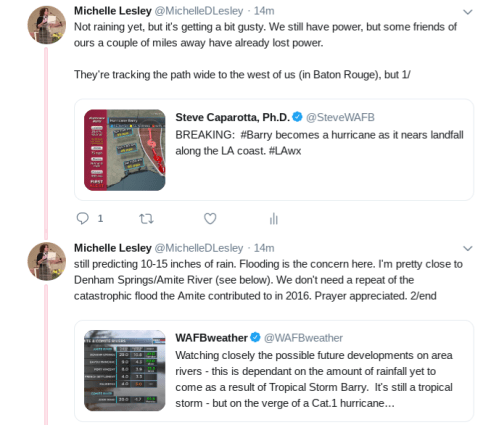
Hi, friends. I wanted to send out a brief heads up and a prayer request. As you might have heard on the news, Hurricane Barry is impacting south Louisiana. As of Saturday morning (7/13), when I’m writing this, the models (see above) have the track skirting to the west of Baton Rouge, where I live, but they are still predicting 10-15 inches of rain.

Saturday 10:00 a.m.:

Everybody in my area would greatly appreciate your prayers. The main concern is flooding, since the Mississippi River has been at flood stage for so long. Additionally, we had a major flood in 2016 – to which the Amite River (see pic above) was a major contributor – and a few people in this area still aren’t back in their homes from that. (The Amite is just a couple of miles from me. The Mississippi is 15ish miles from me.)


Sunday 11:30 a.m. Update: Barry has finally arrived and brought some rain with him, but, to be honest, we’ve had regular thunderstorms that have been worse. The only way this storm seems different is the occasional minor gust of wind. We did have 3 or 4 tornado warnings about 90 minutes ago (after, of course, I sent my 19 year old to the store for a gallon of milk for breakfast! Mom of the year, here.) I don’t know if any actually materialized or touched down, but we didn’t see any if they did. A few twigs and sticks have fallen out of our trees.

If you caught the Fox News report on Barry from Baton Rouge this morning, why weren’t you at church? :0) Anyway the reporter was standing on the (Mississippi) river side of the levee and you could see that the water level was up past the tree line. That’s not because of the hurricane. That’s because the river has been at flood stage for a while. It has looked like that for weeks. That’s good news because that’s the most dramatic shot they could find to get on camera. So far we haven’t heard of any flooding in my immediate area, and they have re-forecast the crest of the Amite River at Denham Springs (see pic above) to 24 feet which is below flood stage.

At my house, we still have power and internet. Our satellite has gone out, but if you have satellite TV, you know that it goes out any time it rains anyway. Hopefully, Barry is on his way out like an unwelcome house guest. :0)


The heads up part is that the winds and flooding may cause us to lose power, so if you don’t see me blogging as usual this week, it’s not that I suddenly became a millionaire and ran off to Hawaii. :0) I’ll be back as soon as power is restored and things are settled down.

This week’s Mailbag article is already pre-scheduled and coming your way tomorrow.

Blessings to you and thanks for your prayers.

Southern Baptist/SBC

The 11th Commandment: 6 Principles for Boldly and Biblically Breaking It

Every organization has them. Those unwritten rules that everybody seems to know. That newcomers learn through whispered admonitions or perhaps by inadvertently breaking them. The Southern Baptist Convention – and probably a lot of other denominations and parachurch ministries – has them too, and one that more and more people are learning about has, tongue in cheek, been dubbed “The 11th Commandment”:

Thou shalt not publicly criticize
other Southern Baptist leaders.

It seems to apply mostly to the upper echelons of SBC leadership: entity heads, celebrity pastors and authors, seminary leaders, the SBC president, the head of LifeWay. Basically anybody with power, position, or name recognition.

And we’re not talking about slandering or lying about someone. Naturally, that would be sinful and worthy of reproof. We’re talking about anything negative or critical even if it’s biblically correct and necessary.

I don’t know anyone personally¹ who has told me he’s/she’s been in this situation, but I’ve heard several stories from reliable sources over the past few years of pastors, people who work for LifeWay, SBC seminary employees, etc., who would like to speak publicly, biblically, and truthfully about sinful situations or unbiblical decisions in the SBC, but are reluctant to do so for fear of losing their jobs or positions. (On a smaller scale, I have heard from plenty of women who have been spiritually abused and bullied into silence, or out of their own churches, by church leadership for daring to speak out against LifeWay-endorsed false teachers.)

Think about that for a minute. This is a purportedly Bible-believing Christian organization in which doctrinally sound Christians are afraid to publicly stand for biblical truth for fear of retaliation from other Christians. Hush up. Cover up. Don’t shine the light of Scripture into the dark corners of the SBC.

This is an organization which, not so many years ago, battled to preserve the concepts of the inspiration, infallibility, and inerrancy of the Bible. A Bible which says:

Walk as children of light (for the fruit of light is found in all that is
good and right and true)

Take no part in the unfruitful works of darkness, but instead expose them. Ephesians 5:8b-9,11

If we truly believe these words are breathed out by God (inspiration), completely trustworthy (infallible), and without error (inerrant), how can there be a culture of back room intimidation in the SBC?

Why isn’t the Scripture we say we believe being obeyed?

Sin. People are sinning and it’s negatively impacting fellow Believers. Just like when I sin it negatively impacts fellow Believers. Just like when you sin it negatively impacts fellow Believers.

Anyone¹ who is helping to create a culture of intimidation against fellow Believers for speaking out in accordance with Scripture is in sin and needs to repent and be forgiven by the grace and mercy of Christ.

But, often, when we’re sinned against, even by brothers and sisters in Christ, the person sinning against us doesn’t repent right away (or sometimes, ever). She continues in her sin against us. Although we might be able to talk to the person and encourage her with Scripture to do what is right in the eyes of the Lord, we can’t change her heart. Only the Holy Spirit can convict someone of sin and give her the gift of repentance.

So, as leaders continue to attempt to enforce the “11th Commandment,” the only remaining decision to be made by those feeling pressured into silence is, “How do I respond to this? Do I speak out and risk my job, my reputation, my church, and a peaceful life for my family, or do I remain silent?”. I would encourage these folks to prayerfully consider the following biblical principles about this issue.

1.
Be Wise

As Ecclesiastes tells us,

For everything there is a season, and a time for every matter under heaven:…a time to keep silence, and a time to speak;

Don’t just let your default response be to keep your head down and your mouth shut regardless of the issue that comes your way. There are times when it is biblically valid to remain silent, but there are also times when we are required by Scripture to speak up, regardless of the personal cost. You must ask God for wisdom to discern how to respond biblically to each situation, and then you must act accordingly, trusting God with the outcome.


2.
Know the Issues

You’ve got to know your Bible and know where Scripture lands on various issues. That goes hand in hand with making a wise decision about whether to speak out or remain silent. Using wine versus grape juice for the Lord’s Supper isn’t a make or break New Testament issue for the church, so you probably won’t want to risk your job over something at that level of adiaphora, but false teachers who are wreaking spiritual havoc on your denomination and the church when you have the power and the platform to biblically denounce it? Speaking out on that issue is all over the Old and New Testament, and you’ll want to be sure you follow Scripture appropriately in your particular situation.


3.

Count the Cost

“If anyone comes to me and does not hate his own father and mother and wife and children and brothers and sisters, yes, and even his own life, he cannot be my disciple. Whoever does not bear his own cross and come after me cannot be my disciple. For which of you, desiring to build a tower, does not first sit down and count the cost, whether he has enough to complete it? Otherwise, when he has laid a foundation and is not able to finish, all who see it begin to mock him, saying, ‘This man began to build and was not able to finish.’ Or what king, going out to encounter another king in war, will not sit down first and deliberate whether he is able with ten thousand to meet him who comes against him with twenty thousand? And if not, while the other is yet a great way off, he sends a delegation and asks for terms of peace. So therefore, any one of you who does not renounce all that he has cannot be my disciple. Luke 14:26-33

Have you counted the cost of being Jesus’ disciple? It’s high. Jesus says you “cannot be My disciple” if you aren’t willing to sacrifice relationships with your closest loved ones in favor of Christ and His Word. If you aren’t willing to sacrifice your physical life. If you aren’t willing to bear your own cross and follow after Him. If you don’t renounce all that you have. That includes your job, your reputation, comfort, ease, and security for your family, your church, your friends, book deals, speaking engagements, and sitting at the cool kids’ lunch table with evangelical celebrities. Jesus was despised and rejected by men. Are you, His servant, greater than your Master?


4.
Don’t Miss Your Calling

Then Mordecai told them to reply to Esther, “Do not think to yourself that in the king’s palace you will escape any more than all the other Jews. For if you keep silent at this time, relief and deliverance will rise for the Jews from another place, but you and your father’s house will perish. And who knows whether you have not come to the kingdom for such a time as this?” Esther 4:13-14

Go back and read the entire book of Esther. One of the main ideas of this little book is this:

Any position, power or platform you have is given to you by God,
and you are not merely to preserve and protect it, but to steward it for His purposes.

Just like God didn’t make Esther queen as an end in itself, God didn’t give you that job at LifeWay or that position at a seminary for you to protect it at any cost. He gave it to you as a means to an end – His glory, and the furthering of His Kingdom. Esther was willing to risk death, divorce, even banishment to speak up because she realized God had put her in the position of queen as a means of bringing about His purpose of delivering God’s people. Is it possible that’s why God put you in the position you’re in – to give you the voice and platform to speak out so others could be informed and inspired to stand up for biblical truth? Don’t let fear of the consequences rob you of the joy and honor of being used by God to bring about His purposes.


5.
In His Steps

Jesus. John the Baptist. Peter. Paul. Isaiah. Jeremiah. Samuel. Gideon. The Minor Prophets. All of these men (and more) spoke out against ungodliness among the people of God, and all of them paid dearly for it. Maybe some of them were afraid. Maybe some of them were concerned about their families and livelihoods. But all of them put God’s Kingdom and His people ahead of personal concerns and trusted that if they did what was right in God’s eyes, He would take care of them. And the same God who never failed them will never fail you.

Let the boldness and bravery of these men inspire you to be unwaveringly courageous. Let their unflagging resolve inspire you to forge ahead with no turning back. Let the depth of their faith inspire you to take God at His Word and believe Him for everything. We still need heroes of the faith today. Be the next one by following in the footsteps of the heroes of Scripture.


6.
Share in Suffering

Share in suffering as a good soldier of Christ Jesus.
2 Timothy 2:3

Suffering for the name of Christ and the truth of His Word is such a major theme of the New Testament I couldn’t begin to list all the passages that address it. When you’re a servant of Christ, suffering the same reproach He suffered from the same kind of people for the same reasons isn’t an option. It goes with the territory.

Second Timothy 3:12-13 says:

Indeed, all who desire to live a godly life in Christ Jesus will be persecuted, while evil people and impostors will go on from bad to worse, deceiving and being deceived.

And not only is suffering the reproaches of Christ guaranteed, we need to grasp the fact that this kind of suffering is an honor for the Believer.

And when they had brought [Peter and the apostles], they set them before the council. And the high priest questioned them, saying, “We strictly charged you not to teach in this name, yet here you have filled Jerusalem with your teaching, and you intend to bring this man’s blood upon us.” But Peter and the apostles answered, “We must obey God rather than men…and when they had called in the apostles, they beat them and charged them not to speak in the name of Jesus, and let them go. Then they left the presence of the council, rejoicing that they were counted worthy to suffer dishonor for the name. Acts 5:27-29, 40-41

Read the whole account in Acts 5:17-42. Men of God were threatened, imprisoned, and subsequently beaten, by their “denominational leadership” for boldly proclaiming the Word of God to the people of God in the house of God. And those men of God got back up, dusted themselves off, and rejoiced because God Himself had seen fit to bless them with this honor.

We’ve got to radically transform our perspective on suffering for the name and Word of Christ:

  • We need to internalize and embrace the prospect of suffering rather than fearfully kicking against it and avoiding it.
  • We’ve got to fully wrap our minds around the fact that we won’t just suffer at the hands of unbelievers outside the church, we’ll also be persecuted by unbelievers (and sometimes even Believers) inside the church.
  • And finally, we not only desperately need to see suffering the reproaches of Christ as an honor rather than an embarrassment, we need to support, encourage, and stand with fellow Believers who are being persecuted rather than being ashamed to be counted with them.

When you face an “11th Commandment” issue there are some hard questions you need to ask yourself: Am I embracing the prospect of suffering for Christ, or avoiding it? Am I grasping the fact that the attempt by other Christians to silence me on a biblical issue is persecution? Am I ashamed of God’s Word and ashamed of being counted with those who are standing for it? Am I choosing to stay silent because that is the biblically wise decision regarding an inconsequential matter or am I just being a coward? Am I fearing God or fearing earthly consequences? Those are questions only you can answer through prayer and by rightly dividing and applying God’s Word.


Sometimes it is biblically wise to remain silent, but in the times when Scripture requires us to boldly take a stand for Christ and for His Word, we dare not seek to avoid suffering by caving in to the pressure of the 11th Commandment.

But if the watchman sees the sword coming and does not blow the trumpet, so that the people are not warned, and the sword comes and takes any one of them, that person is taken away in his iniquity, but his blood I will require at the watchman’s hand. Ezekiel 33:6


¹I am not personally privy to specific examples of specific people intimidating others or being intimidated by someone, so this article is not aimed at any specific person/people. This article is about the principles surrounding the “11th Commandment”.
1&2 Timothy Bible Study

1 & 2 Timothy: Lesson 12

Previous Lessons: 1, 2, 3, 4, 5, 6, 7, 8, 9, 10, 11

Read 2 Timothy 4

Questions to Consider

1. Recalling that 2 Timothy was written as a letter, no chapter and verse markings, notice how chapter three flows into chapter four. Read 3:15-4:2a. What is the focal point of these verses?

2. We’ve seen charges in previous chapters, and chapter 4 starts off with a charge. Break down the charge in verses 1-2,5 into three sections:

1. The seriousness and grave responsibility of the charge– Describe the gravity and weightiness of this charge to Timothy and all other pastors. How does this type of charge compare to others you’re familiar with, such as the swearing in of a witness in court or the President taking the oath of office?

2a. What are pastors being charged to do?– Think about some of the shenanigans you may have seen in the church- pastors preaching about movies, conducting interviews with Christian (or not) celebrities during the sermon time instead of preaching, pastors who preach “God told me” extra-biblical revelation, sermons that consist mainly of jokes and personal stories, etc. Considering the seriousness of the charge to “preach the Word” do pastors have the leeway – before God – to do such things?

2b,5. In what manner are pastors to carry out this charge?- What does it mean to “be ready in season and out of season”? What do the words reprove, rebuke, and exhort mean? What would that look like in your church, from your pastor? Why would a pastor need to exercise “complete patience”? If a pastor shies away from preaching about certain biblical issues, is he correctly carrying out the charge to give “complete teaching”? What do each of the points in verse 5 mean, and how should pastors carry them out as they preach the Word?

3. Keeping this serious charge to pastors in mind, examine 3-4 light of 1-2,5. Notice that verse 3 starts with a pivot point, “for,” which, in this context, means “because.” Why does the Holy Spirit, via Paul, hammer so hard on preaching the Word in 1-2? Because 3-4. Explain what verses 3-4 mean.

If “people will not endure sound teaching” (3) and will “turn away from listening to the truth” (4), what is the point of pastors preaching the Word (2)? If people are just going to turn away anyway, why bother? Think about this in light of these passages. Who is the church for? How does preaching the Word benefit the sheep (Believers) a) by nourishing them with Scripture and b) by drawing a line of distinction between true Believers and false converts who only want their itching ears scratched? How does this line of distinction help us with evangelism? How does it help the spiritual health of the church?

4. Examine verses 6-8. Notice that verse 6 starts with “for” (because). Why (6-8) is Paul passing down all these instructions in 1-2 Timothy to Timothy especially, and to all pastors?

5. Put yourself in Paul’s shoes as you read 6-22. Recall where Paul is as he’s writing this (go back to the introduction in lesson 8 {link above} if necessary), and what is transpiring (16). Notice the theme of being deserted by others. How many times does Paul mention others deserting him? Does he seem to want revenge for this? Who is Paul’s comfort when deserted by others? (17-18) Do you get the impression Paul feels sorry for himself? Does he focus on His circumstances or does he choose to focus on spiritual truths? Make a list of the spiritual truths he focuses on in these verses. How could you apply and focus on these comforting spiritual truths the next time you’re in a difficult or lonely situation?

Compare the “faithful to the finish” life of Paul to other Bible characters (Solomon, Uzziah, etc.) you’re familiar with who started the race well, but turned from God later in life. Ask God to help you run the race well and finish faithful.


Homework

Do you think the “time has come” (3)? What is one way you have personally seen verses 3-4 fleshed out in the church today? How would this situation have been helped or changed if the pastor had taken seriously his charge in verses 1-2? Take some time to pray for those involved in that situation.

Have you ever seen a “verse 3-4 situation” in which the pastor did take seriously his charge to preach the Word, reprove, rebuke, etc., and the story had a happy ending with repentance and restoration to the truth of the gospel? Consider dropping a note to the pastor thanking him for obeying God in that situation.


Suggested Memory Verse