1&2 Timothy Bible Study

1 & 2 Timothy: Lesson 4

Previous Lessons: 1, 2, 3

Read 1 Timothy 3

Questions to Consider

Question 1 is drawn from lesson 14 of my Imperishable Beauty study of biblical womanhood. If you have completed that study, you may wish to review your notes from lesson 14.

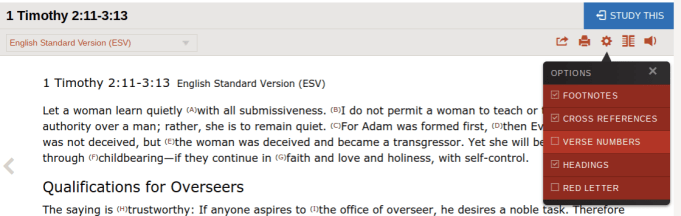
1. Recall that when the Bible was written, there were no chapter and verse numbers. (Those were added much later.) First Timothy would have read like one long, continuous letter or e-mail. So let’s reconnect the end of chapter 2 to the beginning of chapter 3. Click here, then click on the “options” icon and uncheck the box next to “verse numbers”.

Now read the passage, noting the flow of thought and how the end of chapter 2 is interconnected with chapter 3. What is the main idea of this passage? How does this passage demonstrate that God views both men and women as having important roles to play in the life of the church in Timothy’s day and now? Is the role of men or the role of women discussed first in this passage? How could the phrase “ladies first,” the idea of chivalry, and the biblical concept of servanthood describe this passage? Describe how men biblically filling out their role of leadership is actually serving the women (and other men) of the church.

(OK, now click the verse numbers back on and return to 1 Timothy 3 – link above.)

2. What is an overseer? Name two terms we more commonly use today for the office of overseer. What is a deacon? Read Acts 6:1-6. What was (and is today) the main duty of the pastor/elder versus the main duty of the deacon?

3. Make two 4-column charts, one for pastors/elders, one for deacons. In the first column of each chart, list each qualification for the office. In the second column, explain what that qualification means. (For example: What does it mean to be “sober-minded” or “double-tongued”? In the third column, explain why this qualification is important in the character of the man and/or in carrying out the duties of the office. In the fourth column, place a check mark if this is a requirement for both pastor/elder and deacon. Which of the qualifications are common to both offices? Which are different? Explain the reasons for the commonalities and differences in qualifications. How is it beneficial to the church for men in these offices to have these qualifications?

4. Describe how verses 14-16 could serve as the key verses or a summary statement for the books of 1&2 Timothy. Closely examine the two parts of verse 15. Which is the “what to do” part, and which is the “why we’re to do it” part? If 15 tells us the “what” and the “why,” what does 16 tell us?

5. As you’ve read through Old Testament books, have you ever noticed how many times God reminds His people of who He is and what He has done when He’s speaking with them? Refresh your memory, and compare this OT way of God with the NT way we’ve seen God remind His people in 1 Timothy of who Jesus is, and that every “what,” “how,” and “why,” of His instructions always points back to the “Who” of Jesus.


Homework

1. If you’d like to study more about the differences between God’s role for women in the church and men in the church, check out these articles:
Rock Your Role FAQs
Jill in the Pulpit
Deaconesses and Female Deacons

2. Do some research on how your church selects men for the position of pastor, elder, and deacon. Are the qualifications in 1 Timothy 3 (and Titus 1) the highest priority in the selection process? Are there other qualifications (seminary degree, age, etc.) your church requires for these offices? Are these extra qualifications biblical and wise, or unbiblical?


Suggested Memory Verse

Mailbag

The Mailbag: Potpourri (Pianist leading worship, hosting a women’s event, re-baptism…)

Welcome to another “potpourri” edition of The Mailbag, where I give short(er) answers to several questions rather than a long answer to one question. I also like to take the opportunity in these potpourri editions to let new readers know about my comments/e-mail/messages policy. I’m not able to respond individually to most e-mails and messages, so here are some helpful hints for getting your questions answered more quickly. Remember, the search bar can be a helpful tool!

In these potpourri editions of The Mailbag, I’d also like to address the three questions I’m most commonly asked:

“Do you know anything about [Christian pastor/teacher/author] or his/her materials? Is he/she doctrinally sound?”

Try these links: 
Popular False Teachers /
 Recommended Bible Teachers / search bar
Is She a False Teacher? 7 Steps to Figuring It Out on Your Own
(Do keep bringing me names, though. If I get enough questions about a particular teacher, I’ll probably write an article on her.)

“Can you recommend a good women’s Bible study?”

No. Here’s why:
The Mailbag: Can you recommend a good Bible study for women/teens/kids?
The Mailbag: “We need to stop relying on canned studies,” doesn’t mean, “We need to rely on doctrinally sound canned studies.”.

“You shouldn’t be warning against [popular false teacher] for [X,Y,Z] reason!”

Answering the Opposition- Responses to the Most Frequently Raised Discernment Objections


Usually The Mailbag is all about mail I’ve received from readers, but today, I want to start by sending a thank you note to you!

Thank you from the depths of my heart to each and every one of you who donated so graciously and made it possible for me to speak at the Cruciform Conference in Indianapolis this October. I was floored by your generosity and it was a great way to celebrate my birthday. I’m so honored that you would partner with me in ministry to the ladies at the conference. Thank you and God bless you.

(I tried to make sure I sent an individual thank you message/e-mail to each donor, but if you donated anonymously or I somehow missed being notified of your donation, I apologize and hope you’ll accept my thanks here.)

If you’re going to be in the area, come on out to Cruciform. It will be a blessing to you, and I’d love to meet you!


I’m the pianist at my church, and my pastor has asked me to select the hymns for our worship services because it takes a lot off him and helps him out. I select the songs from a certain hymnal and two other doctrinally sound sources. Am I in an unbiblical position of “leading” the worship service when I select these songs?

This is a great question. It’s so encouraging when Christian women want to be godly in every aspect of their ministry at church!

No, that’s not leading, that’s serving your pastor and your church. Basically what you’ve got here is a body of songs your pastor already approves of, and he has asked you to whittle it down to four or five songs each week from this pre-approved “list”.

If you choose a song he doesn’t like for some reason or that doesn’t fit with what he’s preaching that week, he always has the prerogative to say, “This song isn’t a fit this week. Could you please choose a different one?” In essence, you’re presenting him with suggestions and he makes the final decision, so he’s still the one in the position of authority. I used to do the same thing for my husband when he was a minister of music at one of our former churches.

Thank you for serving your pastor and your church!


I loved your article Women’s Events on a Shoestring Budget. The funding tips encouraged me to put on an event for our ladies, but our small church has never done anything like this before. What kind of event should we have and how should we get started?

I was so encouraged to get a couple of questions like this in response to my article. Even at a small church (and sometimes especially at a small church) a women’s event can really help refresh and build up the ladies of your church. It can be a great outreach to the ladies of your community, too.

I would recommend starting small and then growing year by year. For example, if I were in a church with an attendance of 50-150, I would start with an in-house (only ladies from your own church) mini-conference. A Saturday morning simple breakfast (coffee, doughnuts, fruit – food that’s easy to get, serve, and handle), followed by a local speaker (maybe the pastor’s wife at a sister church, or even one of the ladies in your own church) and a couple of songs. You could end there, or possibly have a time of discussion around the tables afterward, or just allow the ladies to hang around and fellowship with each other.

The next year, you could build on that. Maybe the speaker does two sessions with a break between, and you invite/publicize to other local churches. The following year, you could do an overnight retreat or you could expand the conference to an all day thing and have more than one speaker. If you start small and grow your event each year, you’ll learn things you should and shouldn’t do differently along the way, and you won’t be biting off more than you can chew the first time out.

Another thing that might be a good idea is to have a meeting with all of your ladies and ask them what kind of event they’d like. You might be thinking “conference” and they might be thinking “movie night”. It’s good to brainstorm and take the pulse of your ladies on what they’d prefer.

You could also get the men of your church involved in putting together and serving at your conference or event. I spoke at one conference where the men of the church actually put on the conference for their ladies – to honor and thank them. That was one happy bunch of ladies!

Just remember what I said in the article: Don’t try to compete with the expensive glitz, glam, and giveaways of mega-conferences. You do you, your church or host organization…And remember, it’s the caring and hospitality of the hosts that will make the greatest impact on your attendees, not the swanky food, decorations and swag bags.


I wanted to let you know I saw an inappropriate advertisement on your blog.

Thank you so much for letting me know. Rest assured, I don’t choose those ads, nor do I have any control over them. I can’t even see them from my end. I’m in the process of considering some formatting changes to the blog that may (or may not) put an end to the ads.

In the meantime, my article Advertising Redux explains what you can do to avoid those inappropriate and annoying ads on my site and on other sites as well.


I have a friend who was baptized as an infant, but since she was baptized in the name of the Trinity, she feels as though she can not be re-baptized as an adult believer. How would you speak to her?

I’ll bet that’s kind of a challenging road to navigate as her friend, isn’t it? Without a great deal more information I’m hesitant to give a definitive answer, but hopefully I can point both of you in a helpful direction.

I’m assuming if your friend is considering being baptized, she’s either a member of a local church or a candidate for membership at a local church. The first thing I would want to make sure of is that she’s in a doctrinally sound local church, because the second thing I’m going to advise is that she set up an appointment with her pastor to discuss this issue of baptism. (If the church she’s in isn’t doctrinally sound, getting her into one that is is job one, not baptism. Check out the Searching for a new church? tab at the top of this page.)

Different churches and denominations have different understandings of baptism. Her pastor can explain to her how her church views baptism, why it is requiring(?) her to be re-baptized for membership, and how it understands Trinitarian paedo (infant) baptism versus credo (Believer’s) baptism.

Once she has sat down with the pastor and had all of her questions answered, she will need to search the Scriptures, pray for wisdom, and make sure her understanding of baptism lines up with that of the church she’s considering being baptized into. If it does not, she will need to further study the Scriptures to determine whether or not her personal view of baptism is indeed biblical. If it is but does not align with her current church, she will probably need to find a new church whose view on baptism she agrees with.


If you have a question about: a Bible passage, an aspect of theology, a current issue in Christianity, or how to biblically handle a family, life, or church situation, comment below (I’ll hold all questions in queue {unpublished} for a future edition of The Mailbag) or send me an e-mail or private message. If your question is chosen for publication, your anonymity will be protected.

Church, Obedience

Neo-Pharisaism

Has anyone ever called you a Pharisee? I’ve lost count of the number of times I’ve been called that name by professing Christians from all walks of life. And let’s not try to sugar coat it, when somebody uses that term, it’s not meant as a compliment. It can be anything from rage-fueled “Christian profanity” to a well-intentioned but biblically misinformed attempt to quash perfectly scriptural words or actions  – but it’s a pejorative term, whatever the motive behind this name-calling might be.

The Bible first introduces us to the Pharisees in the gospels, during the ministry of John the Baptist, and right away, it’s clear that anybody who’s truly on God’s side of the aisle is going to have a problem with these dudes. “You brood of vipers!” is the first sentence spoken to or about the Pharisees.

But why? Why was this group of respected Jewish leaders and Bible scholars consistently painted in such a negative light by John, Jesus, and the Apostles?

Because the Pharisees were the false teachers of Jesus’ day. They were teaching the false doctrine of legalism – the idea that Jews could earn right standing with God by obeying His laws. And because they didn’t want to even come close to disobeying God’s law, they came up with their own man-made laws that were way more restrictive than God’s laws. The Pharisees required the people to obey those man-made laws and said people who broke them were sinning.

It was kind of like having a pool in your back yard with a fence around it. The pool was sin. The fence around it was God’s law. The Pharisees came along and put an additional fence around the perimeter of the property, keeping people out of the back yard altogether. Only God didn’t say we couldn’t use and enjoy the yard, He just said, “Stay out of the pool.”¹

And then Jesus arrived on the scene and put His foot down – God’s law reigns supreme, not man’s law. For those who follow God from the heart, His commands are not burdensomenot a yoke of slavery. And by burdening the people with laws God had not commanded, and setting those laws on equal footing with God’s laws, the Pharisees were the ones in sin.

But this just didn’t compute to the prideful, hypocritical, self-righteous Pharisees. They were so set in their ways and ensconced in their power and position that they doubled down on their false doctrine to the point that their self-deception led them to view simply obeying God’s law as written – nothing added, nothing taken away – as sin.

This is why we see the Pharisees losing their cotton-pickin’ minds over Jesus and the disciples plucking and eating (harvesting and threshing to the Pharisees) kernels of grain on the Sabbath, and Jesus healing (“working”) on the Sabbath, both of which – eating and doing acts of charity – were lawful.

The legalist Pharisees saw Jesus and His followers as antinomians – those who were a threat to the people of God by preaching license, disobedience, and “everybody can do what’s right in his own eyes.”

My how the pendulum has swung in the other direction.

Today what we have is antinomians calling some of Jesus’ followers Pharisees because these modern-day antinomians believe that striving to obey God’s Word as written – nothing added, nothing taken away – is legalism.

Is it wrong to label everyone an antinomian who has called a brother or sister in Christ a Pharisee? After all, antinomianism is heresy. It’s a pretty serious charge – not one that should be casually and superficially flung around. Well, so is the charge of legalism, which these folks are leveling every time they call someone a Pharisee. If they’re going to dish out charges of heresy, they ought to be man or woman enough not to cry foul when that same charge is leveled against them.

But the truth is, among average Christians, there are very few actual full-blown legalists or full-blown antinomians. As with nearly every other aspect of Christianity, there’s a spectrum of antinomianism and legalism with heresy on either end, and the majority of Christians falling somewhere in the middle. Most genuinely born again Christians hover somewhere around that sweet spot in the middle that we would call obedience to Scripture, but we all have a general fleshly tendency toward legalism or antinomianism. And furthermore, we can tend toward one or the other in various issues in our lives. There are issues in my life in which I tend toward antinomianism out of fear of man, or because I want to give in to the desires of my flesh. And, there are issues in my life in which I tend toward legalism out of pride or a lack of trust in God. We can all fall into the ditch of antinomianism or legalism depending on the circumstances and our personal weaknesses and sins.

So when I say that Christians today who call their brothers and sisters in Christ Pharisees are antinomians, I don’t mean that the vast majority of them are full-on heretics who think Christians can go out and sin as much as they want and nobody has to obey Scripture. Honestly, I’ve never even met anybody like that. I’m talking about Christians who tend toward antinomianism when it comes to the specific area of ecclesiology. What does that look like in the life of the church? Often, it takes the shape of overlooking sin instead of dealing with it biblically in order not to make waves or hurt someone’s feelings. It can also find itself in those who get on the bandwagon of the latest Christian – or worldly – fad, method, celebrity, or worldview, and chiding those who rightly deem it unbiblical. A few examples I’ve experienced or been told of:

Do you expect Christians to be at church every week unless Providentially hindered? That’s legalism. You’re a Pharisee.

Dare to speak up against false teachers? That’s legalism. You’re a Pharisee.

Think worship should be reverent and orderly rather than evangeltainment hoopla? That’s legalism. You’re a Pharisee.

Do you believe it’s sin when women preach/teach the Scriptures to men or hold unbiblical authority over men in the gathered body of Believers? That’s legalism. You’re a Pharisee.

Have you ever asked why your church doesn’t practice church discipline? That’s legalism. You’re a Pharisee.

Do you warn your friends in apostate churches of the false doctrine they’re being taught? That’s legalism. You’re a Pharisee.

But who’s really the Pharisee today? Well, just like in Jesus’ day, it’s people who might (or might not) know Scripture, but they’re not handling it correctly. Sometimes, it’s well-known Christian leaders protecting their position and power. Sometimes it’s the people in the pew who like the status quo in evangelicalism, their church, or their family just fine, thank you very much, and they don’t want you bringing the Bible in and messing everything up.

Who’s today’s Pharisee? It’s often the person calling other Christians Pharisees.

As you might expect, the legalist Pharisees of Jesus’ day had hundreds of very specific, clearly defined laws you had to obey: You could only walk so many steps on the Sabbath. You had to wash your hands in a certain manner. You probably even had to fold your underwear a specific way.

Our modern-day antinomian-leaning “neo-Pharisees” have just a few nebulous, loosely defined rules of which they, not Scripture, are the final arbiters:

  • You can’t be unloving.
  • You can’t hurt people’s feelings.
  • You can’t rock the boat.
  • Why can’t we all just get along?

And though it was relatively easy to count the number of steps you took on the Sabbath or make sure your underwear stacked up at a 90° angle so you could stay on the right side of the legalistic Pharisees’ rules and regulations, it’s much harder to tell whether or not you’re obeying the neo-Pharisees’ laws.

Their laws, though few in number, are subjective, broadly interpreted and applied, and constantly changing. Charges of being “unloving,” for example, are not supported by Scripture passages in their proper context clearly defining biblical love, but are based on the personal feelings and opinions of the person leveling the charge. A “peace, love, and harmony” definition of “unity” is frequently prized over fidelity to Scripture. What was right last month could suddenly be wrong next week because it has upset someone.

It’s not easy to hit such a fast-moving target, and practically anything you say or do (even if it’s straight from Scripture) that rubs the neo-Pharisee the wrong way is going to break one of these rules – man-made rules that they insist other Christians keep or those other Christians either aren’t saved or are sinning. So while the quality of their rules is antinomian-ish, the application of their rules is legalistic. This is fleshing itself out in dozens of different ways in evangelicalism.

Case in point: progressive Christians who have taken up the social justice cause, particularly as it relates to race. One recent example – if you don’t see whiteness (whatever that means) as wicked and something you need to renounce, you’re not being loving to people who have darker skin than yours, and you’re hurting their feelings, and you’re refusing to get along with them. So because you’re breaking these laws the neo-Pharisees have made, you’re sinning at best and not saved at worst. But what is whiteness, precisely? How can I tell whether or not I’ve fully renounced it? What if I’ve fully renounced it in the eyes of one person but not another? Who is supposed to pronounce me absolved of this so-called sin? And daring to ask any of these questions or push back against these ideas can earn you the label of Pharisee.

Another example I’m hearing more and more people say they’ve been taken to task about is tone. For some neo-Pharisees, it doesn’t matter how gently, kindly, and patiently you state a difficult biblical truth, if it hurts someone’s feelings or rocks the boat, you’ve been unloving and said it in a harsh tone. And you’ll probably get called a Pharisee.

But who is the judge of my tone or yours? One person’s “harsh tone” is another person’s “matter of fact tone”. One person’s “loving tone” is another person’s “spineless tone”. I once wrote an article about a certain false teacher about which I was told my tone was too harsh by some and too nice by others – about the same article! We all have different personal, subjective opinions about tone. The problem is that the neo-Pharisee is elevating her opinion about what constitutes an acceptable tone to the level of Scripture. Because if you use what she thinks is the wrong tone, you’re sinning.

So what is the solution to this messy morass of legalism, antinomianism, and neo-Pharisaism we suddenly find ourselves in in evangelicalism?

The Bible.

We must become good students of the Bible so we know exactly what it says – and doesn’t say. The Bible doesn’t condemn anyone as wicked based on the shade of her skin. But it does tell me I’m to love my brothers and sisters in Christ. It tells me that God shows no partiality and I shouldn’t either. The Bible doesn’t qualify which tones of voice are harsh and which are acceptable. When it talks about speaking the truth in love, it’s talking about motivation of heart – which only I can know and only God can judge – not tone of voice. Am I motivated by love? Does the Bible say we need to be faithful to the gathering of Believers or not? Does it really say women can’t preach to men or not? Is that person actually a false teacher according to Scripture or not? We need to know Scripture, so we can rightly obey Scripture, so that no one will actually be a Pharisee.

We’ve all got to do our best to present ourselves to God “as one approved, a worker who has no need to be ashamed, rightly handling the word of truth.” (2 Timothy 2:15) When I lean too far toward legalism, I need Scripture to pull me back to that sweet spot of simple biblical obedience. When you lean too far toward antinomianism, you need the Bible to bring you back to center on diligent biblical obedience. We need to help each other, iron sharpening iron, not call each other names.

Let’s get rid of Pharisaism once and for all and simply spur one another on toward holiness and obedience to God’s Word.


Additional Resources:

Sacrificing Truth on the Altar of Tone

What Does it Mean to “Play the Pharisee Card”?

Basic Training: Obedience: 8 Ways To Stop Making Excuses and Start Obeying Scripture


¹Pool photo courtesy of Protect-A-Child Pool Fence Company
Bible, Old Testament

Throwback Thursday ~ 6 Reasons You Need to Stay Hitched to the Old Testament

Originally published May 18, 2018

Oops, he did it again. Only it wasn’t an “oops”, it was quite intentional.

In a recent sermon, Andy Stanley declared that the modern church needs to “unhitch” the gospel from the Old Testament. He attempted to draw a parallel between James’ pronouncement in Acts 15 that Gentiles did not have to convert to Judaism prior to becoming Christians with the difficulty some non-Christians today have with some of the gory, hard to understand, or otherwise distasteful (to them) passages of the Old Testament (for example: God’s various commands to Israel to utterly destroy all people in certain nations). The apostles cut out the requirement for circumcision to make things easier for Gentiles who wanted to come to Christ, he reasons, so the 21st century church should basically divorce itself from the Old Testament to make it easier for lost people who have a problem with certain Old Testament passages to come to Christ.

There’s only about a million problems with this line of thinking, and, honestly, the more I investigate what Stanley said and his subsequent explanations of why he said it and what he meant, the angrier it makes me. That a man with a master’s degree from a decent seminary, who’s a pastor of several churches, a best-selling “Christian” author, and a leadership and church growth guru to thousands of pastors across the globe should say, or even believe, such things is reprehensible. If he were generally doctrinally sound and this was the first “iffy” thing he had ever said, I’d be inclined to extend grace and give him the benefit of the doubt. But this is somebody with every theological advantage who should know better, yet still has been on a trajectory of attempting to deconstruct the New Testament church for quite some time now. (For more on Andy Stanley’s aberrant theology, click the “Popular False Teachers” tab at the top of this page.)

So, for the sake of my own blood pressure, I’m just going to throw out a few of the most embarrassingly obvious errors here, and let better people than I handle the blow-by-blow.

1. Andy Stanley is not an apostle personally commissioned by Christ to set up the New Testament church. James and those other guys mentioned in Acts? They were. Andy doesn’t have the authority to change New Testament ecclesiology, which is permanently and inextricably hitched to the Old Testament.

2. Acts is generally a descriptive book, not a prescriptive one. While there are certain principles we can learn from Acts and follow, it’s a history of the establishment of the first century church, not a step by step list of instructions to implement in today’s church. If there were a church today that was insisting Gentiles become Jews before they could become Christians, Acts 15 would be applicable. But I don’t know of any churches like that, do you?

3. The two church scenarios Andy is trying to make analogous aren’t. No church I know of requires unbelievers to understand, agree with, or even have read whatever Old Testament passages Andy thinks are problematic prior to becoming a Christian.

Furthermore, how many lost people are actually out there saying, “I recognize I’m a sinner in need of a Savior. I want to repent of my sin and place my faith in Christ for salvation, but I just can’t, because of 1 Samuel 15:2-3.”? People who bring up Old Testament passages like that when confronted with the gospel are presenting excuses for rejecting the gospel, not looking for ways to embrace it.

4. Shoving difficult passages of Scripture into the broom closet is not how God has instructed the church to handle His holy Word. We’re to be “a worker who has no need to be ashamed, rightly handling the word of truth.” (2 Timothy 2:15b) We don’t get rid of challenging passages, we dive into them, study them, and explain them to others.

The Old Testament is absolutely essential to New Testament Christianity, and a rich blessing to the church, individual Christians, and lost people, besides. Here are six reasons you and your church should stay hitched to the Old Testament.

1.
God says so

All Scripture is breathed out by God and profitable for teaching, for reproof, for correction, and for training in righteousness, that the man of God may be complete, equipped for every good work. 2 Timothy 3:16-17

That should be the end of any discussion of ditching any part of Scripture for any reason. God could not have been clearer. “All Scripture” means all Scripture, from Genesis 1:1 to Revelation 22:21. And every single verse of Scripture is profitable. Even the genealogies. Even the inventories. Even the Levitical law. There is stuff in every single verse of the Bible that is useful and beneficial to us. God says so (and He says so in the New Testament, by the way).

2.
You need the Old Testament
to understand the New Testament

Can you come to a saving knowledge of Christ by reading only the New Testament? Yes. But it’s kind of like saying, “I know American history,” when you’ve only studied the years 1900 to the present. The New Testament was birthed out of the Old Testament. The gospel is the culmination of Old Testament doctrine. Jesus Himself is the ultimate fulfillment of every Old Testament prophecy and covenant.

And then there are all the New Testament details that need explaining. Who are these Jews and how did they come to be God’s people? Why do they have such a problem with Gentiles? What are these laws the Pharisees keep talking about? If Jesus is the “second Adam”, who was the first Adam? What on earth is circumcision anyway? And…Hebrews? What’s that all about?

3.
The Old Testament teaches how we CAN’T be saved

Therefore the Law has become our tutor to lead us to Christ, so that we may be justified by faith. Galatians 3:24 (NASB)

and how from childhood you have been acquainted with the sacred writings, which are able to make you wise for salvation
through faith in Christ Jesus. 2 Timothy 3:15

How was the Old Testament Law our tutor to lead us to Christ? How was it able to make Timothy wise for salvation through faith in Christ Jesus? It shows us the futility of thinking we can keep the law to earn righteousness. It shows us that right standing with God always comes by repentance and faith, not works. How many times have you shared the gospel with someone only to hear her say some variation of, “I’m OK with God and I’m going to Heaven because I’m a good person.”? Really? Take a stroll through the Old Testament, and watch how “good” God’s chosen people were. He spelled everything out for them, sent them prophets to tell them exactly what He wanted them to do, performed amazing miracles right before their eyes, and they still couldn’t be “good people.” And you, a pagan, think you can do better?

Remember the old saying, “You can lead a horse to water, but you can’t make him drink.”? Some smarty pants came up with the rejoinder, “Yes, but you can feed him salt.” The Old Testament is our salt. Its lessons in the futility of trying to be good makes us thirsty for the Living Water we find in the New Testament.

4.
The Old Testament vividly shows us
God’s wrath against our sin

I’m not saying the Old Testament only shows us God’s wrath against sin, because it also shows us His compassion, mercy, and love. I’m also not saying the New Testament doesn’t show us God’s wrath. It does, but in a different way than the Old Testament does. In the New Testament, the main ways we see God’s wrath against sin is when it’s poured out on Christ at the cross, and the wrath of God that’s yet to come as it’s described in Revelation.

When it comes to God’s wrath against me, personally, for my individual sin, those demonstrations of God’s wrath can feel a little detached sometimes. But in the Old Testament, I see, in vivid detail, the horrific plagues God rained down on Pharaoh for his sin. I see the ground open up and swallow Korah for his rebellion. I see God immolating Nadab and Abihu for offering illegal worship. I see the once mighty and majestic Nebuchadnezzar forced out into the wilderness to live like an animal because he took God’s glory for himself. And when I know that God doesn’t change – that His wrath towards my sin as a lost person burns just as hot as it did toward those Old Testament rebels – well, it can hit a lot closer to home and convince me of my need to run to the cross and throw myself on the mercy of Christ.

5.
The Old Testament teaches by example

The largest portion of the Old Testament is history and biography. Most of the New Testament is didactic. The New Testament gives us the subject matter we need to learn. The Old Testament puts flesh and blood on it and shows us what it’s like for real, flawed people just like you and me to walk it out. In the New Testament, we learn “by grace are you saved through faith.” In the Old Testament, we see just how God accomplished that in the life of Noah, who found grace in the eyes of the Lord. In the New Testament we learn what it means to repent. In the Old Testament, we walk with David through the loss of his child and his grief over his sin with Bathsheba. In the New Testament, we learn that the godly will face persecution. In the Old Testament, we stand next to Shadrach, Meshach, and Abednego refusing to bow to an idol, even if it means being burned alive. The New Testament gives the facts of the matter. The Old Testament says, “For example…”.

6.
The Old Testament is a warning to the church

People are people. God’s people of the Old Testament are not significantly different from God’s people today. We’re all made in the image of God. We’re all tempted by similar things.

If you begin studying the Old Testament, you can’t help but notice some of the same themes running through the story of God’s people back then that run through our story today. Idolatry. Ecumenism. Doing what’s right in our own eyes. Going through the motions of religious activity without true repentance and faith. Depending on our own power and resources rather than depending on God. False prophets. Persecution and derision of those who stand firmly on God’s Word by those who claim to be His people. Fickle hearts and tickled ears. Oh sure, we might be a little more sophisticated and subtle about it, but, as Solomon put it:

What has been is what will be, and what has been done is what will be done, and there is nothing new under the sun. Ecclesiastes 1:9

And because the Old Testament shows us more direct interpersonal interaction between God and His people, we get to see exactly how God feels about all of those things. We hear what He has to say about it. We see how He responds to it. And, if we’re wise, we take heed to those warnings, humble ourselves, and grow in our fear of the Lord and our desire to please Him with holy living and clean worship.


I could give far more than a mere six reasons why the Old Testament is so vital, a precious blessing, and such a spiritual treasure trove. It tells us where we, and the world around us, came from. It shows us the beauty and precision of worship. It extols the charm of Creation. It displays God’s power, grace, trustworthiness, mercy, justice, His plan for mankind, and all of His other attributes. And so much more.

Are there some passages in the Old Testament that are hard to understand or accept at first blush? Sure. But they’re not keeping anybody from coming to Christ. People reject Christianity, not because of difficult Old (or New) Testament Scriptures, but because they love their sin more than Jesus. And that’s no reason to unhitch anything or anyone from the beauty, the joy, and the benefits of the Old Testament.

How has the Old Testament been profitable in your walk with the Lord?

1&2 Timothy Bible Study

1 & 2 Timothy: Lesson 3

Previous Lessons: 1, 2

Read 1 Timothy 2

Questions to Consider

1. Briefly review the theme or purpose of the book of 1 Timothy from lesson 1 (link above). Who is the ultimate Author of this book? Are the ideas and instructions in this book God’s ideas and instructions, or something Paul came up with on his own? Who was the original audience of this book?

2. You may be familiar with the little hermeneutical rule of thumb, “Whenever you see therefore in a verse, you need to find out what it’s there for.” “First of all, then,…” at the beginning of verse 1 serves the same purpose as “therefore” (in fact, some translations render that phrase as “therefore” instead of “first of all, then”). God, through Paul, is saying, “Because of all that stuff I told you in chapter 1, do what I’m about to tell you to do in chapter 2.” Review 1 Timothy 1 and/or lesson 2 (link above). What are the main issues addressed in chapter 1?

3. Make a “bullet point” list of each instruction given to Timothy and the church in chapter 2. Now make the connection between the two chapters – how can the church’s obedience to the instructions in chapter 2 fix the issues brought out in chapter 1?

4. Which group of verses is the focal point, or main idea, of chapter 2?

  • 1-3
  • 4-7
  • 8-10
  • 11-15

Read each of these groupings of verses and describe how each of them revolves around the idea that God desires to save people (4). Notice how the words, “I desire then” (8) and “likewise also” (9) point back to the focal passage. Why did God put the gospel smack dab in the middle of these instructions about how the congregation is to behave?

5. Why does Paul again cite his qualifications and credentials? (7)

6. Why does God want His church to pray for others, including kings and leaders? (1-2) What is the immediate desired outcome of this kind of prayer? (2) What is the long-term desired outcome of this kind of prayer? (3-4) Think about the political and cultural context surrounding the church at Ephesus. How could the church at Ephesus and the church today leading “a peaceful and quiet life, godly and dignified in every way” (2) lead to people getting saved (3-4)?

7. Does verse 8 mean that only men should pray when the church is gathered together? (Use your footnotes)

Questions 8-12 are drawn from lessons 15 and 14 (respectively) of my Imperishable Beauty study of biblical womanhood. If you have completed that study, you may wish to review your notes from those lessons.

8. Examine verses 9-10. Describe how women are not to adorn themselves and how they are to adorn themselves. Are things like braids, jewelry, and clothes intrinsically sinful, or is Paul giving cultural examples to illustrate a theological point he’s making? What is that point? What is it about the bent of women’s hearts that would cause God to give this instruction to women in the context of the home and the church, but not to give this instruction to men at all? How does it benefit the church for us to “wear”, or portray, godliness by adorning ourselves modestly and with good works?

9. Study verses 11-15. What is the first word of verse 11? Think about women’s social status and value in Paul and Timothy’s culture, and in many cultures since that time, even today. Why does the Holy Spirit instruct pastors to “let” women learn? What does this teach us about the responsibility God places on us as women to learn His Word? Would you categorize verse 11 as a “do this” or “don’t do this” verse?

10. Examine verse 12. Is this mainly a “do this” or “don’t do this” verse? What two things does the Holy Spirit say women are not to do in the gathering of the church body? What does He say women are to do? Think about God’s nature and character. Does He ever give instructions arbitrarily or just to spoil our fun? Why does God give us commands and instructions, generally speaking? Are the instructions in verse 12 good for women and for the church?

11. Take a look at 13-14. God kindly gives not one, but two reasons for His instructions in verses 11-12. What are those two reasons? How do they fall in line with God’s design for male headship and leadership across biblical history in the hierarchical structures He has set up?

12. Verse 15 can be a little cryptic to us today because we equate the word “saved” with salvation. Does verse 15 mean that women gain salvation by having children? How do we know it doesn’t? The NASB helpfully, and more accurately, renders this word as “preserved.” We don’t feel it much today, but think about the stigma women (particularly Jewish women) carried at the time this was written simply because they were daughters of Eve. Paradise was lost and the curse of sin entered the world because of a woman, many men thought, and they viewed and treated women accordingly. Yet who was chosen to bring the Messiah into the world? And following in her footsteps, a major way godly women can “save” or “preserve” the reputation, esteem, and value of womankind is to “continue in” what 3 godly character traits? (15) Because if they continue in those three godly character traits, they will be raising up a godly seed to the Lord (even if the children they bear aren’t perfect like Mary’s child was.) :0)


Homework

If you’d like to study more about modesty (9-10), check out these articles:
Imperishable Beauty: Lesson 15- A Beautiful Portrayal of Biblical Womanhood in the Church
The Mailbag: Potpourri (Calvinism, Baptism, Modesty…)

If you’d like to study more about the role of women in the church (11-15), check out these articles:
Imperishable Beauty: Lesson 14- A Beautiful Position in the Church
Jill in the Pulpit (1 Timothy 2:11-12)
Order in His Courts: Silencing Women? (1 Corinthians 14:33b-35)


Suggested Memory Verse