Guest Posts, Ministry, Prayer

Guest Post: 7 Ways You Might Not Know You Need to Pray for Your Pastor ~ Part 1

If your theology pretty much matches up with mine (as outlined in the “Welcome” and “Statement of Faith” tabs) and you’d like to contribute a guest post, drop me an e-mail at MichelleLesley1@yahoo.com,
and let’s chat about it.
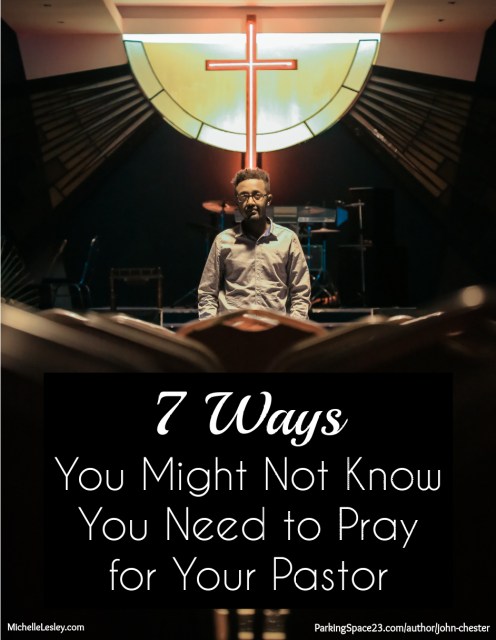
7 Ways You Might Not Know
You Need to Pray for Your Pastor
Part 1

by Pastor John Chester

Being a pastor is odd. There is no other way to put it. It is entirely unique. No other profession or vocation or calling is like pastoral ministry. That is not to say it is better or more noble. It isn’t, it’s just different. Really different. (And it is certainly not to say that I am somehow superior, better, more valuable to the Kingdom, or holier. As one of my favorite seminary professors said to a class of future pastors, “You know why God calls men like you to pastoral ministry? Because you were the worst available.”)  

But pastoral ministry is unique, it is a unique job, it is a unique calling, and it is a unique lifestyle. And every pastor needs prayer, desperately. Most believers pray for their pastors (Thank you!). One of the questions I am often asked is, “How can I pray for you?” I am always happy to answer, but frankly I don’t think I have ever thought to ask for prayer related to the uniqueness of pastoral ministry. I know that you want to pray effectively and specifically for your pastor, so I am going to let you in on some inside baseball. Here are seven things you may not know about pastoral ministry and your pastor.

He is often under deep conviction

You know that sermon on that hard text that had you squirming in your seat about eight minutes in because the Word of God was so clear and strong in saying that you are in sin? Well your pastor has lived in that passage all week and has probably been thinking about it for weeks or even months. I remember after I had preached James 3:1-12 a dear saint coming up to me after the worship service and saying how hard it was to sit through that message because of how convicting it, and that text was. I said something along the lines of, “I know, we all fail to control our tongue as we should,” but what I was thinking was, “I know and if you think it was hard to listen to for 45 minutes, imagine studying for 45 hours for those 45 minutes.”

Don’t get me wrong, it is a great blessing to spend so much time and to be able to spend so much time studying God’s Word, even and especially the deeply convicting passage. Full stop. Yet is also true that it is emotionally draining to spend so much time in those passages. A few years ago I received an angry email from a visitor to the church (the time stamp on the email indicated that he must have written it on his phone in the parking lot), and his complaint was he didn’t feel uplifted by the sermon. Of course he didn’t feel uplifted by the sermon, no one did. Like everyone else, he was deeply convicted by it, the text was Mark 9:42-50, where Jesus says if your hand causes you to sin cut it off. I was preaching that sermon to myself when I was walking the dog on Thursday morning. Of the many things that I didn’t expect in pastoral ministry this is probably the most significant one.

How to pray for your pastor: Pray that when he is under powerful conviction of his own sinfulness the Lord would use it to conform him to the image of Christ, that he would feel the power and weight of forgiveness in Christ and that the Lord would bring passages like Colossians 2:13-15 and Psalm 103:10-13 to his mind.

He works a lot

I’ll not beat around the bush, I don’t know a single pastor that works less than 55 hours a week. Most of them work 60+ hours a week. Most church member know their pastor works a lot, but here is what you might not realize – the smaller the church, as a rule, the more hours the pastor works. It is very easy to think (or not to think about it at all) that your pastor doesn’t have the workload and responsibility of that famous pastor with a huge church, but he does, and probably much more to boot. It goes without saying that small church pastors spend as much time laboring in prayer and study as pastors with big churches (at least they should).

But small church pastors do something (often everything) else too; they are often the chief maintenance man, the church secretary, the webmaster, the youth pastor, the counseling pastor, the director of Christian education, etc., as well as the preaching pastor. Maybe you think, “Sure, but our church has three staff pastors and a secretary.”. To put that into perspective, the large church associated with my seminary has 14 staff pastors, staff elders who oversee non-pastoral areas of responsibility, and a veritable army of support staff and compensated interns. And that is in no way a criticism of that church. I rejoice that there are so many hands to make the work lighter, but the thing is that huge church has no more kinds of ministry going on that your small church. Your church probably doesn’t have a thousand kids in Sunday School, but it has Sunday School. Your church may not have hundreds of people in counseling at a time, but your pastors counsel people. You get the idea.

How to pray for your pastor: Pray that he would find refreshment in his work, that the Lord would move in the hearts of the saints to motivate them to do the work of the ministry (Ephesians 4:12), that the Lord would provide him with the rest and respite he needs (remember everyone is different), and the Lord would protect him from the deleterious health effects of overwork.(Bonus tip: encourage him to take actual vacations and days off and respect them.)

He is a man apart

I don’t mean that pastors are somehow different or better than other Christians, what I mean is that other Christians as well as non-Christians act like it. One of the strangest things to me when I moved from seminary to ministry – a move that entailed a cross country move to a place where no one knew me – was that everyone acted as if my first name was “pastor.” And the first 7,367,489 times someone called me “pastor” in conversation, I said, “Call me John.” But as the years have gone by I’ve learned to stop saying that, not because I’ve come to think of my self as different, but because no one has listened. And I get it. I never thought of my pastor, especially before I went to seminary, as just “Ron,” and, truth be told, I still think of him more as “Pastor Ron” than “Ron.” I think it is good for people to love and esteem their pastor – after all they are worthy of double honor (1 Tim 5:17) – but it is strange to be that person.

And if it’s odd being treated that way in the church it is even stranger being treated as a man apart outside of the church. I’ve had a handyman (who I learned was Hindu) sent by my landlord to paint an outside railing tell me he was going to do an extra good job because I was a holy man. My neighbors all are very stiff and formal with me. When I went to a gym in the smaller town I drove through on the way to the church, a hush would fall over the locker-room whenever I walked in because word had gotten around the gym that I was a pastor. The pharmacy tech at the drug store (who is also Hindu) asks me for marital advice, and I could go on.

Putting it all together it adds up to, functionally, a man apart, and that can be tough. (And this applies to your pastor’s wife too. A dear saint in the church one introduced my wife to one of her friends as “the First Lady of the church.” Often pastor’s wives experience profound loneliness. Don’t forget to pray for them too.)

How to pray for your pastor: Pray that he would be satisfied in the Lord, that his marriage would be a sweet friendship (Proverbs 5:18), that the Lord would bless him with friendships with local likeminded pastors, and that he would maintain the friendships he forged before pastoral ministry.

He is not always hungry

This one may seem trivial, but trust me it is important, especially if you love your pastor. Ask yourself this, when was the last time your pastor visited that you didn’t offer him something (probably a baked good) to eat.  I can count on one finger the times I’ve been in someone’s house when someone hasn’t offered me something to eat. And every time it is offered I accept, because I know it has been prepared with love and the last thing I would want to do is make someone feel unloved or rejected because I refused what they had prepared for me. Yet, often, I eat it knowing I shouldn’t. I love desert – one look at me would confirm it – but I really don’t need it on Wednesday afternoon at 2:00 p.m. It can really be an act of love not to offer it.

A few weeks ago was the one time I was in someone’s home where they didn’t offer me something to eat. This family was relatively new to the church and wanted to talk about how they could serve, so we set a time for me to come over. And make no mistake, this is the kind of home visit every pastor loves and looks forward to. But I try to eat clean, and I was dreading the pastry I was sure was going to be offered. When I came over and it was suggested that we sit at the dining room table, I was sure that there was going to be a coffee cake on it, but there wasn’t.  I was grateful and greatly blessed when I was simply offered something to drink. I don’t think it is a coincidence that both the husband and wife had long personal histories of formal ministry in local churches.

And as a corollary let me say this (and I realize I am about to step on some toes), your pastor may not like Chik-Fil-A.  I would estimate that at least 75% of the time someone asks me to meet them for lunch they suggest CFA. I know that it is approaching heresy to say it, but CFA is just fast food, it is not an especially spiritual place to eat. If your pastor is not someone who eats at Taco Bell or Wendy’s regularly, he probably is not someone who wants to eat at CFA all the time.

How to pray for your pastor: Pray that he would eat a healthy diet and get adequate exercise.


John Chester is the pastor of Piedmont Bible Church, a Grace Advance church plant in Haymarket, Virginia. Prior to ministry John worked as a lacrosse coach, a pizza maker, a writer, a marketing executive, and just about everything in between. He hails from The City of Champions: Pittsburgh, Pennsylvania, and is blessed to be married to his wife Cassandra. Read John’s blog articles at ParkingSpace23, and read more of John’s excellent posts for Michelle Lesley here.


This concludes part 1 of John’s article.
Be sure to come back next Tuesday for Part 2.


Pastors and pastor’s wives-
What would you add to this list of things that church members
may not know to pray for their pastors about?

Mailbag

The Mailbag: Will you review my book?

I’ve written a book. Will you please read and review it or give me some feedback on it?

Every time I receive this e-mail from an author, I just want to reach through the screen and hug her. I’ve been in her shoes.

When my book, Jacob: Journaling the Journey, was in print I, too, had to write to bloggers and Christian newspapers and magazines asking them to write a review of my book. It’s a good way to introduce potential readers to your work and encourage them to buy a copy or twenty.

I never liked soliciting reviews for two reasons: First, it’s kind of like asking a boy out on a date – it’s an awkward and weird feeling that you’re essentially saying, “Do you like me enough to say ‘yes’ to me?”. Then, there’s the agonizing wait to see whether or not you’re going to be rejected. Second, I always felt like I was asking the person to invest an enormous amount of time and work, and all I was able to give her in return was my thanks and a copy of my book. It felt like asking someone for a huge favor that I’d never be able to repay.

So my heart goes out to those fledgling authors who are having to cold call bloggers for reviews. It ranks right up there with having a tooth pulled.

Now that the shoe is on the other foot and people are asking me to write reviews of their books, I have a much different perspective. Far from feeling like authors are asking me for a humongous favor, it would be my joy to serve and encourage each and every one of them by writing up shining and supportive reviews for all.

Unfortunately, for a number of reasons, I find that I can’t:

📖 There aren’t enough hours in the day to read and review, in a timely manner, all of the books I receive inquiries about. And, I can’t bring myself to say “yes” to some authors and “no” to others.

📖 I’ll just be perfectly transparent with y’all, I’m very undisciplined right now when it comes to book reading. I study my Bible. I read lots of articles. But for some strange reason, I’m not reading many books – even books of my own choosing – at this season of my life. I can’t really figure it out because I’ve lived my whole life with my nose in a book, but…there it is.

📖 Writing a book review (especially when you have a relationship with the author) is kind of like a friend showing you her new baby and saying, “Isn’t she cute?”. Fortunately, I happen to think all babies are cute, but…with books, not so much. And the last thing I want to have to do is tell a friend, or even a stranger, that her book has a face only a mother could love. I’m an author. I know what it’s like to hear that. It’s no bueno.

Every once in a blue moon, I’ll write a brief recommendation of a book I’ve picked up of my own volition and taken my sweet time reading because I think it’s something my readers would enjoy or benefit from. I can do that without the pressure of a deadline or worrying about hurting an author’s feelings.

Also, I try to compensate for the fact that I don’t write book reviews myself by publishing reviews written by guest posters. If you would like to write a book review as a guest poster, or if you’re an author who has a blog-less friend ready to write a review but needing a platform to post it on, drop me an e-mail and let’s chat about it.

While I’m honored and humbled that anybody out there might want my opinion on her book, and I dearly wish I could write a review for everyone who asks, I’m afraid that – with rare exceptions for people I’m extremely close to or who have served as mentors to me – for this season of my life, the answer has to be an across the board “no”.


If you have a question about: a Bible passage, an aspect of theology, a current issue in Christianity, or how to biblically handle a family, life, or church situation, comment below (I’ll hold all questions in queue {unpublished} for a future edition of The Mailbag) or send me an e-mail or private message. If your question is chosen for publication, your anonymity will be protected.

Church, Top 10

Top 10 Features Your Church Website Needs

One of my favorite parts of this ministry can be found at the Searching for a New Church? tab at the top of this blog. Whether you’re moving to an unfamiliar area or you’re forced to leave your current church due to false doctrine, it can be difficult to find a doctrinally sound church to join.

I’m trying, in my own small way, to make that easier. In addition to providing church search engines and biblical resources delineating the things you should look for in a church, I’ve asked my readers to recommend any doctrinally sound churches they’re familiar with. They have generously given of their time to respond, and I’m overjoyed to report that we’ve had many happy “matchmakings” of brothers and sisters in Christ to wonderful church families.

I recently culled through and organized the nearly 250 reader-recommended churches into an easily navigable master list. I wanted to make sure the list was as helpful as possible, so I provided the web site of every church on the list. Which means I’ve looked at a lot of church websites lately. Most have been very helpful and well-designed. A few, well… let’s just say there was room for improvement.

If you want your church’s website to be helpful to visitors considering your church, as well as to your members, here are ten features (in no particular order…well, except #1) that would be beneficial:

1.
A Website

In other words, your church needs to have a website. All of the 250 churches on my master list have a website (or at least a Facebook page), so I’m guessing that means the vast majority of churches have some sort of website. However, in the past, I have attempted to find information on a particular church only to discover that they had no online presence.

When somebody puts your church’s name into Google and the only hits they get are Yelp or Yellow Pages listings, that communicates something about your church: “We don’t really care whether outsiders can find out information about our church in order to visit.” or “We are stubbornly digging our heels in against technology, even though it would benefit others.” or “We are an elderly congregation that won’t make the effort to understand how to use technology.” (Please don’t try to tell me technology is too complicated for elderly folks. My 97-year-old grandmother has a Facebook page and understands computer guts better than I do.)

Also, while having a Facebook page for your church is great (see below), I would recommend that you also have a web site. Many people, for various reasons, are not on Facebook, and even if your page is public, they have no idea how to navigate a Facebook page if they land on it. There are many free and simple web site hosts out there with a wide variety of designs such as WordPress, Free Church Websites, Doodlekit, and others. Ask around at other churches, examine a variety of church websites, or just Google “website builder”, and play around with the results until you find something that works for your church.

Finally, make the web address for your church simple, logical, and as brief as possible. If the name of your church is First Baptist Church of Anytown, make it something like FBCA.com or FirstBaptistAnytown.org, not PleaseComeVisitOurChurch.com or John316.org.


2.
A Facebook Page

What? I thought you just said we needed a website! Right. It’s very helpful to have both, for potential visitors as well as members. For visitors, a Facebook page has a friendlier, more interactive feel to it than just a web page. On your website they get “Just the facts, ma’am”: your address, statement of faith, staff, etc. On your Facebook page, they get to see the day to day goings on that members are involved in, comments from members, pictures, and so forth. For members, a Facebook page means up to the minute announcements and prayer requests, and a way to stay connected with their church family between Sundays.

But just as having no website can send the wrong message, having only a Facebook page and no website can also send a negative message: “We’re a young, hip church. We don’t care enough about the non-tech savvy crowd to make our information easily available to them.” or “Senior citizens aren’t welcome here.”

And notice, I specifically said a “Facebook” page. Yes, there are problems with Facebook, but it is the platform the majority of people on social media use. Maybe you personally prefer Google+ or Twitter, but if you want to reach the greatest number of people, go with Facebook. And be sure to post your Facebook address on your website, and your website address on your Facebook page, so that anybody landing on one will easily be able to click over to the other.


3.
The Church’s Accurate, Specific Physical Address

“Off Highway 20, just past the tire factory” isn’t specific enough for people who aren’t familiar with the area and are trying to input your address into their GPS or maps app. Give the specific, correctly spelled, street name and number, and be sure to include Dr., Ave., St., etc., especially if there’s another street in your town with an identical name (ex: Oak Dr. and Oak St.). Then, if you want to give additional landmarks, that would be helpful. Also include the full, correctly spelled name of your city and state (believe it or not, I’ve run across a few church websites that never mention which state they’re located in). People unfamiliar with your area may not know what DFW, NOLA, or Jax means.

Be sure that if the address of your church has recently changed, or if you’re temporarily meeting in another location for some reason, that you immediately update this information on your website, social media, etc. If people make the effort to get up, get dressed, and visit your church, only to arrive at your abandoned, old location, that’s a surefire way to make a bad first impression and practically guarantee that they won’t come back.

Put your physical address on the home page in an easily visible spot. Most of the church websites I visited did this beautifully, but it was annoying that some of them required me to hunt around for the address for several minutes. Was it on the “contact” page? The “about” page? The “FAQ” page? Don’t you want people to be able to find your address so they can visit?

4.
The Church’s Contact Information

This should include the church e-mail address, phone number, and mailing address at a minimum. It’s preferable to have these on the home page, but if that’s absolutely impossible, at least put them under a clearly marked, easily accessible tab marked “contact information”. Not under something less specific like the “about”, “learn more”, or “Got questions?” tab. Not under something cutesy or vague like a “Walk the journey with us” tab. Contact information. If you don’t have your social media icons on your home page, this would be a good place for those as well. You want potential visitors as well as members to be able to get in touch with your church, and most people don’t use phone books anymore.

If you use a website contact form rather than providing an actual e-mail address, be sure somebody in the church office is assigned to check those messages daily and respond to them in a timely manner. I’ve had the misfortune of trying to contact several churches through their website forms and never receiving a response. Likewise, someone should be checking and returning voice mails in a timely manner. Failing to respond to messages makes a bad impression on potential visitors and aggravates your members.


5.
Statement of Faith And Denominational Affiliation

It disturbs me that so many churches seem to be trying to hide their denominational affiliation or are being vague about their statement of faith in order to be “seeker sensitive” and not “turn people off”. That foolishness needs to stop. It’s deceptive, which is another word for lying, which is a sin. Churches need to unashamedly tell people who they are and what they stand for. If you’re so ashamed of the denomination you’re affiliated with that you feel the need to hide it from people, you don’t need to be part of that denomination any more.

Don’t depend on your church’s name to state your denomination for you. “Calvary Baptist” could mean Southern Baptist, Independent Baptist, American Baptist, Missionary Baptist, Reformed Baptist, etc. You can offer any caveats or explanations you like, but be up front about which tribe you belong to. If I’m specifically looking for a Southern Baptist church, I want to know if that’s what you are before I waste a bunch of time slogging through your website in an attempt to find out. And the same holds true if I definitely don’t want a Southern Baptist church. Don’t bait-and-switch me.

Your statement of faith should be specific, biblical, and include Scripture references. I think the Baptist Faith and Message 2000 is an excellent template to follow. And, indeed, if the denomination you belong to has a solid, specific statement of faith on its website, why reinvent the wheel? Just link to it and say, “this is what we believe.” The same goes for any creeds or confessions your church holds to. Give the text or link to a site that gives the full text.

Having no statement of faith or a flimsy statement faith on your website raises immediate red flags. Not having a statement of faith says you’re hiding what you believe, or what you believe is so unimportant that you forgot to put it on the website. A flimsy statement of faith (A handful of short, extremely broad statements with no Scripture references like, “We believe the Bible is God’s Word.” Yeah? So do about 80% of Americans, most of whom aren’t even Christians.) says your church is doctrinally flimsy or wishy-washy.


6.
A Gospel Presentation

Most of the time, people perusing church websites to find information on how to visit your church are already Christians, but sometimes a false convert or a run of the mill lost person will happen upon your site. Christians should seize every opportunity to share the gospel with the lost, and putting a gospel presentation on your website is an easy way to do so.

If it’s a written explanation of the plan of salvation, make sure it’s long enough to be specific and accurate, but short enough that people will actually read it. Or, you could post a video like the one to your upper left, or maybe one that your pastor has recorded. Or, if your denomination’s website has a good gospel presentation page, you could link to that.


7.
Sermons

Christians looking for a new church want to know what the preaching is like. Church members who are out sick or traveling want to listen to any sermons they might have missed. A lost person who “stumbles across” (hey, we all know that’s Providence, right?) your website could listen to your pastor preach and get saved.

If you have the technology to record your pastor’s sermons and put them on the church website, do it! It can only serve as a benefit and a blessing. And if you don’t have that recording technology, prayerfully consider investing in it.


8.
Staff

It helps potential visitors feel more at home if they can get to know a little bit about the pastor they’ll be listening to or the youth director who oversees their children’s Sunday School department. A little personal information is nice, but be sure to also include some “resume” type of information, such as where he went to seminary and how many years of experience he has. A few websites I’ve looked at have included  the names of well-known pastors and authors or books that have been influential on the pastor’s spiritual life or philosophy of ministry. I find those very insightful.

9.
What to Expect

Some churches include a page on their website that gives all the details a first time visitor would want to know. If you have a welcome center where they can meet someone who will show them around, explain where it is and which exterior door is closest to it. Do you have visitor parking? Give directions to it or post a diagram. What time and in which room(s) are the worship service, Sunday School classes, etc.? Where is the nursery? Are there special accommodations for disabled visitors? Is next Sunday the monthly potluck? How do people usually dress for the worship service? Is a map or directory of the campus available? Ask new members what information they found helpful on your church’s website and what improvements could be made.

10.
Updates

If your church website has the same interface it had in 1997, it’s time for an update. Get a more streamlined, user-friendly, contemporary looking layout. It doesn’t have to look like something out of Star Wars, but it shouldn’t look like the site you had when the internet was brand new and AOL was the hottest thing going, either.

Make sure that when people click on the “about” or “contact information” or “staff” tab that there’s actually something there once they get there, not a “404 Error. This page does not exist.” type of thing. Old looking websites with pages that don’t work are not the way to introduce your church to the world. They send the message that, “Nobody here really knows what they’re doing, technologically speaking. Somebody tried to put a web page together about 20 years ago, but it was too hard, or she got too busy, and she gave up, and nobody else cared enough to handle this project.”

Additionally, keep the information on your website up to date. Sermons should be posted within a week or two max. Your calendar page should be the current month with up to date events, not the calendar from last September. If a staff member has left, the staff page shouldn’t look like he’s still there. As previously mentioned, all of your contact information should be kept up to date.

Not Absolutely Necessary, But Extremely Helpful:
Recommended Resources

More and more churches are dedicating a section of their website to a list of recommended books (and sometimes, blogs, websites, and music, as well) on various theological topics such as salvation, eschatology, marriage, etc. I’m sure this is a wonderful resource for their own members who want to study up on these topics, but I’ve found it is the fastest and easiest way to tell where a church stands, theologically, depending on which authors’ materials are recommended. If I were looking for a new church, the book page of the church’s website is the first page I’d check out. It often says more, specifically, about the church’s theology than the statement of faith page.


Your church website can be wonderfully helpful to potential visitors and church members alike. Take some time to make it the best, most welcoming and informative introduction to your church you can.

What are some helpful things you think should be included
on church websites for potential visitors? For church members?

Apologetics

Throwback Thursday ~ There’s No Such Thing as an Atheist Part 1: The Battlefield of the Mind

Originally published March 12, 2009

There’s No Such Thing as an Atheist Part 2  Part 3

There’s no such thing as an atheist. Or even an agnostic, for that matter.

An atheist is someone who says there is no God. An agnostic is someone who says we don’t or can’t know whether or not there is a God.

I recently heard someone say that there are no atheists, only rebellious people. The more I think about that statement, the truer it rings. Why? Because it is impossible not to know there is a God.

It first enters our consciousness that there is a God when we simply look around at our surroundings. The Bible says:

For since the creation of the world His invisible attributes, His eternal power and divine nature, have been clearly seen, being understood through what has been made, so that they are without excuse. Romans 1:20

All things came into being through Him, and apart from Him nothing came into being that has come into being. John 1:3

It’s as simple as looking around and saying, “Wow. Look at all this stuff. How’d it all get here?”

The other day, I was involved in a discussion with a non-Christian who was wondering how anyone could possibly disbelieve evolution. Laying aside all the details, I believe the thing that most bothers many Christians about the philosophy behind the theory of evolution as well as the Big Bang theory is that, in many cases, these theories are not an attempt to describe how God might have created the universe, but how the universe might have come into being without God.

It couldn’t have. There’s no way.

We know this, not only through the attributes of the things we’re observing – that the botany, biology, chemistry, astronomy, physics, etc., of Earth work too well together and are too intricate and complex to have happened by mere accident or coincidence – but also in the way we think about the things we’re observing.

Have you ever looked at anything – your car, your dishwasher, your computer, your favorite painting – wondered about its origins, and come to the conclusion that it simply materialized of its own volition out of thin air? Of course, you haven’t. We don’t think that way because that goes against every iota of life experience we’ve ever had. If we see an object, we know someone made it. Our experience feeds the logical way we think about this relationship between an object and its maker.

In addition to the overwhelming scientific evidence and intricacies, and our life experience which God has provided to show us that He made this place, Romans 1:20 (above) tells us that the design of our brains is pre-programmed to make the connection between creation and Creator. We could not be “without excuse” if we were intellectually incapable of comprehending the relationship between the two, nor if we had not been created to think logically and rationally, deducing conclusions from the evidence available to us.

Our minds bear witness to the existence of God, in that:

  • since there is such an intricately detailed, well designed creation, it must have been made by an intelligent, powerful Being.
  • all of our life experiences lead us to the conclusion that if something exists, someone made it.
  • our minds think logically and deduce conclusions from the evidence we observe.
  • we have intelligence and are able to comprehend the relationship between a creation and its creator.
Women of Genesis Bible Study

The Women of Genesis: Lesson 30- Potiphar’s Wife

Previous Lessons: 1, 2, 3, 4, 5, 6, 7, 89, 10, 11, 12, 13, 14, 15, 16, 17, 18, 19, 20, 21, 22, 23, 24, 25, 26, 27, 28, 29

📖📖📖📖📖

Read Genesis 39

📖📖📖📖📖


Questions to Consider

1. Briefly review lesson 28 (link above) to refresh your memory on the storyline of Joseph, then read today’s passage. Why do you think Joseph’s story starts in chapter 37, is “interrupted” by the story about Judah, his sons, and Tamar in chapter 38, and then picks back up in chapter 39?

2. How did Potiphar (1) come to acquire Joseph?

3. Carefully examine the description of Potiphar in verses 1-2 and Potiphar’s house, status, and living conditions in verses 1-6. Make a list of the things we can infer about “Mrs. Potiphar” from this information- where and how she lived, her social status, socioeconomic level, etc. Was it likely that Mrs. Potiphar was a Believer in the one true God?

4. Read verses 6-19, closely examining Mrs. Potiphar’s words and actions. Write a character sketch of Mrs. Potiphar, adding in the information from your list from question 3. What adjectives would you use to describe Mrs. Potiphar?

5. Describe Mrs. Potiphar’s outward sins. Outward sin can always be traced back to an inward sinful thought or attitude of heart. What was Mrs. Potiphar’s inward sin? How is lust a form of coveting? When a person covets or lusts after something or someone that doesn’t belong to her, what does that tell us about her attitude toward what she already has and the God who blessed her with those things?

6. The New Testament equates coveting with idolatry. Why?

7. Imagine you are a biblical counselor, and a modern day, recently born again Mrs. Potiphar comes to you for help with her struggle against lust and coveting. Considering questions 5 and 6, what sinful heart attitude would you help her to identify as the cause of her lust and coveting?

In previous lessons, we have explored the biblical model of repentance: putting off the old self (stop doing the sin), renewing your mind (learn what the Bible says about this sin), and putting on the new self (replacing sinful actions with godly actions). How could you apply these passages, using the put off/renew/put on model, to Mrs. Potiphar’s root sin of discontentment? How could thankfulness to God and serving others be the godly opposite of coveting and lust?

8. In what ways was Joseph’s righteous behavior a testimony to the one true God? How could 2 Timothy 3:12-13 apply to his situation in this chapter? Does God guarantee us that things will always go smoothly if we’re obedient to Him? If not, why should we obey Him?

9. Consider this chapter in light of current events of apparently godly men being accused of sexual harassment, abuse, and misogyny. Apply Proverbs 18:17 to both situations: “The first to plead his case seems right, Until another comes and examines him.” Why is it important to carefully and biblically examine those making accusations as well as the accused, so that the guilty are punished and the innocent are not? What were the consequences of a false accusation for Joseph, and how did God care for him? (19-23)


Homework

Do you struggle against the sin of a discontent heart like Mrs. Potiphar did, causing you to lust for and covet things, people, or life circumstances that God has not chosen to give you? Examine and repent of your sin using the put off/renew/put on model. List one Bible verse to memorize that will help you with the “renew” stage. List three specific godly actions you can do (put on) to replace sinful actions (put off). This week, memorize your verse and carry your list with you to remind you of the godly action you can take when you’re tempted to sin. Pray daily, asking God to strengthen you to resist temptation and obey Him.


Suggested Memory Verse

But the Lord was with Joseph and showed him steadfast love and gave him favor in the sight of the keeper of the prison.
Genesis 39:21