Women of Genesis Bible Study

The Women of Genesis: Lesson 11- Sarah and Hagar

Previous Lessons: 1, 2, 3, 4, 5, 6, 7, 8,Β 9, 10

πŸ“–πŸ“–πŸ“–πŸ“–πŸ“–

Read Genesis 16:1-6

πŸ“–πŸ“–πŸ“–πŸ“–πŸ“–


Questions to Consider

1. Briefly review lessons 9 and 10 (links above) about Sarah and what brought her to this place in her life in chapter 16. Compare and contrast Sarah’s position in life to Hagar’s position in life.

2. How old was Abraham when God first called him and promised to make him a great nation? How old was he when Ishmael was born? So, approximately how many years had he and Sarah been trying to conceive? (3)

3. What do Sarah’sΒ wordsΒ in verse 2, “the Lord has prevented me from bearing children” tell us about her belief in God’s sovereignty and control over her situation? What do herΒ actions in the remainder of verse 2 and 3 tell us about her belief in God’s sovereignty and control over her situation? Whose sovereignty did she really trust, God’s or her own? If Sarah trusted that God was the One who had closed her womb, why did she not trust that God would open it?

4. Think back to the promises of offspring God made to Abraham, of which Sarah was aware. Note the repeated phrase, “I will…” in all of God’s promises. Did God, at any time, ask Sarah or Abraham for their help in accomplishing these things? Did God know about Sarah’s barrenness? Did He ever suggest a surrogate mother for the offspring He promised? Whose idea was using Hagar as a surrogate? Was this an idea Sarah got from God or from her surrounding culture?

5. Think about Sarah’s relationship with God and her response to His promises. How did Sarah’s actions demonstrate that she did notΒ believe God’s word,Β trust God’s character to keep His promise, nor accept andΒ submitΒ to God’s timetable?

6. Compare Sarah’s plan to give Hagar to Abraham, and the problems that resulted, to Genesis 2:24. Has plural marriage or fathering children through adultery ever been pleasing to God? As a godly husband, how should Abraham have responded to Sarah’s plan? HowΒ didΒ he respond? (2,4)

7. Compare and contrast the influence Sarah had over Abraham (2-4) with the influence Eve had over Adam (Genesis 3:6-12). Was either woman, in these two incidents, a good steward of the influence God gave her? Why or why not? Was either man a good steward of the headship of his home God gave him? Why or why not?

8. What were some of the negative consequences of Sarah’s actions for herself, for Abraham, and for Hagar? (4-6) Would these things have happened if Sarah had obediently trusted God to keep His promise instead of taking matters into her own hands?

9. How does the story of God promising a long awaited son to a woman unable to conceive foreshadow the incarnation of Christ? What are some things that might have happened if Mary had taken matters into her own hands instead of trusting and obeying God?


Homework

Sarah’s words told one story about her belief in God’s sovereignty, but her actions told another story. Think about the situations in your life right now. Do youΒ believe God’s Word,Β trust God’s character to keep His promises in His Word, andΒ accept andΒ submitΒ to God’s timetable? Write down one way your actions could better line up with what you profess to believe, and implement it over the next week.


Suggested Memory Verse

So she called the name of the Lord who spoke to her, β€œYou are a God of seeing,” for she said, β€œTruly here I have seen him who looks after me.”
Genesis 16:13

Mailbag, Speaking Engagements

The Mailbag: Potpourri (Joni’s testimony, “Messy”, Female seminary profs…)

Welcome to another β€œpotpourri” edition of The Mailbag, where I give short(er) answers to several questions rather than a long answer to one question. I also like to take the opportunity in these potpourrri editions to let new readers know about my comments/e-mail/messages policy. I’m not able to respond individually to most e-mails and messages, so here are some helpful hints for getting your questions answered more quickly. Remember, the search bar can be a helpful tool!


Our church has a ministry for the homeless where once a week, lunch is provided and a Bible Study is given usually by a woman, occasionally by a man to a mixture of both men and women. Some might be saved, probably most are not. What are your thoughts in regard to this situation from a Biblical perspective?

Great question! I’ve answered it in #11 of my article Rock Your Role FAQs.


We watched a video of Joni Eareckson Tada speaking at a recent Shepherds Conference. She gave her testimony and shared the meaning of Scripture and what some Greek words were so there was teaching going on as well as testimony. I know she is thought of highly but I was wondering about her speaking and teaching to groups of men.

Joni is not someone I follow closely, though I did read her first book, Joni, when I was a teenager. John MacArthur heads up the Shepherds Conference, which is a conference for men in church leadership, particularly pastors (“shepherds”).

Just to give a little background for anyone not familiar with him, Dr. MacArthur is a staunch complementarian and is a doctrinally sound pastor, teacher, and author I am happy to recommend to my readers. He would never invite a woman to preach at ShepCon nor invite a doctrinally unsound speaker. So I trust Dr. MacArthur’s judgment and reasons for inviting her to speak – that he was not inviting her to preach.

That foundation being laid, there are instances in which it is perfectly biblically appropriate for a woman to speak in front of a co-ed Christian group or a group of Christian men, and giving her testimony – so long as she does not veer off intoΒ preaching (instructing and/or exhorting men in the Scriptures) – is one of them. I’ve written more about that, giving examples, in these articles:

Rock Your Role FAQs (#7, 14)

The Mailbag: Should women give testimonies and reports, lead prayer and worship in church?

I have not listened to the talk Joni gave at ShepCon. It is possible that I would think her explanations of Scripture crossed the line into teaching, but it is also possible I would not. I just can’t say since I haven’t listened to it. (I would not consider giving the definition of a Greek word or two to be the type of biblical instruction prohibited by 1 Timothy 2:12.)

I would be more inclined to look at Joni’s history and intentions. Did she come to ShepCon with the intent of preaching or instructing men in the Scriptures? Does she have a track record of preaching sermons or giving Bible instruction to men at conferences? If the answer to both is no and she is normally very careful to stay within the parameters of biblical womanhood, I’d be inclined to extend grace on any bobbles she made during her testimony at ShepCon. It’s a very fine line to walk, and I’m sure I would probably make a few mistakes too if I were in that situation.

Update: Thanks to reader DebbieLynne (see comments section) for the heads up that Joni actually gave her testimony at the Strange Fire Conference (2013, also spearheaded by John MacArthur), not at the Shepherds Conference. Strange Fire was co-ed rather than men only. Whether or not women were in attendance at the conference doesn’t really change my answer to the reader, but it’s good to have the facts straight.


Is it OK for women to teach pastors-in-training at seminaries?

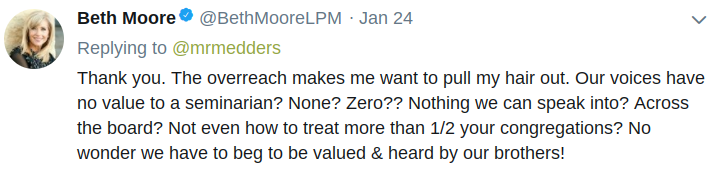
John Piper recently answered this question on an episode of Ask Pastor John. You should read his response for yourself (it’s not long), but, essentially his answer was that experienced pastor-mentors should be training up young pastors, and since it is unbiblical for women to serve as pastors themselves, they lack the experience necessary to mentor pastors-in-training. And, my word, the egalitarian world had a fit – including Beth Moore and her daughter Melissa (who helps run Beth’s ministry):

While I consider him to be a generally doctrinally sound brother in Christ, I’m not particularly a fan of John Piper, but I do want to say that I think his answer was taken wildly out of context by those pushing unbiblical agendas, that he was treated shabbily by many on social media, and that I thought his answer was very good, biblical, and just plain old made sense. Women are not qualified to serve as pastors. Why on earth would we want them training pastors? Moreover, what student wouldn’t want the most qualified and experienced professors he could get for his tuition money?

Let’s say you were the dean of the neurosurgery department at a medical school. A gentleman, totally blind from birth, comes in and applies for a position teaching surgical practicum (cutting, suturing, removing tumors, etc.). He has held positions teaching various subjects at other universities so his ability to impart information is not in question, but he has never performed surgery in his life because he’s blind. Would you hire him to train neurosurgeons to perform brain surgery?

The reason Dr. Piper’s answer caused a bit of a kerfuffle is that he limited his answer to the question he was asked. Imagine that. He was asked if women should train pastors and that’s the question he answered. The agenda-driven screaming neemies took his answer of “no” to mean that no woman should ever teach anything to anyone in any seminary anywhere ever. That is not what Dr. Piper said. He said women should not train men for the pastorate.

I would have answered the same way. However, if I were to expand on Dr. Piper’s answer, what I would further explain is that most seminaries (at least the ones I’m familiar with) do far more than simply train men for the pastorate. Take the seminary my husband attended for example, New Orleans Baptist Theological Seminary. If you’ll click on the “Academics and Admissions” tab at the top of the page and examine the various degree and non-degree programs, you’ll find that most of them are not strictly preaching programs. There are programs for women’s ministry and children’s ministry (Surely we wouldn’t say women are unqualified to teach in these areas?), college ministry, urban ministry, music ministry, missions, counseling, languages, and many more. There’s nothing wrong with women teaching things like music theory, finance, general education classes like math, history, and English, archaeology, legal issues, languages, business, etc., even in a seminary.

There are definitely some classes women shouldn’t be teaching in seminaries, but there are plenty of other classes that would be fine for them to teach.


Since we’ve become parents my husband and I have mostly attended churches that were larger and offered childcare. We were saved out of Mormonism eight years ago which has its own order of services and no childcare provided for the main service, but I don’t know what to expect from a Christian service that doesn’t offer childcare. I don’t know what will be expected of me and my family. I have a four-year-old and I worry that he will end up running around or asleep on the pew. Do we call ahead? Pack a busy bag? Are snacks alright? How do you ever get anything out of the service for yourself?

Before I answer, I want to encourage readers who are experienced church members to really let this precious sister’s question sink in and inform the way you respond to visitors and new members. Increasingly, the people who are new to your church will have very little church background. Church culture may be old hat to you, but it’s like landing on Mars to many of them. They have no idea where to go or what to do, and they don’t speak Christianese. Make sure you warmly welcome and encourage newbies and let them know that it’s OK to ask questions.

I think my article Churchmanship 101: Training Your Child to Behave in Church will help with some practical tips and expectations. You should not allow your child to run around the sanctuary during the worship service any more than you would allow him to run around a restaurant if you went out to eat, or a store if you were shopping, but I would not get overly stressed about him making a few minor noises or dropping the occasional Bible during church. If a church doesn’t offer childcare, they’re surely used to children making a little noise during the service from time to time. Sermon-time naps at four years old are not the end of the world, but you’ll want to curb those as he approaches school-age (if he can stay awake all day in school, he can stay awake for 30 minutes or an hour in church).

Until your child gets into the routine of attending worship and learns how you expect him to behave, you may not get very much out of the service. That’s just one of those parts of being a mom that we all have to accept – like stretch marks :0) But if you will be consistent and diligent as you train your child, he’ll get with the program soon enough.

When you ask if you should “call ahead”, if what you mean is calling the church office prior to Sunday and asking any questions you might have, that is a super idea! Most pastors I know would be delighted to chat on the phone or in person to welcome you to the church and help you feel at ease. That is the point at which I would ask about snacks. Different churches have different policies about food and drink in the sanctuary. I’ve never heard of one that wouldn’t allow a baby bottle, but some may not be keen on the idea of Cheerios ground into their carpet. You could also ask if they have a “cry room”. Some churches have set aside a room near the sanctuary where you can take a fussy baby or jumpy toddler. Many of them have the sermon “piped in” so you can listen until you go back into the worship service. You might also want to ask if the worship service is recorded and posted online so you can listen at home to any parts of the sermon you may have missed. Never be afraid to ask an honest and polite question.


I have been hearing the word messy a lot in reference to our lives..has this word replaced the word sin?

Well…I suppose it may have for those who are trying to sand off the sharp edges of the gospel, but the biblical term is sin, so that’s the correct word to use, despite how popular “messy”, or any other trendy word, might be.


Can you recommend any doctrinally sound female speakers for women’s events?

(I promise this is an actual question I recently received, not one I made up for promotional purposes! :0)

Yes, me. Click the “Speaking Engagements” tab at the top of this page for more information.

If I’m not really your cup of tea, or I’m too far away for your travel budget, I happily recommend any of the women listed under the “Recommended Bible Teachers” tab at the top of this page (although I’m not positive all of them do speaking engagements).


If you have a question about: a Bible passage, an aspect of theology, a current issue in Christianity, or how to biblically handle a family, life, or church situation, comment below (I’ll hold all questions in queue {unpublished} for a future edition of The Mailbag) or send me an e-mail or private message. If your question is chosen for publication, your anonymity will be protected.

Basic Training

Basic Training: 5 Ways to Face Tests and Trials Biblically

For more in the Basic Training series, click here.

Your car breaks down and you don’t have the money to get it fixed.

Your child develops a behavior problem, and you have no idea how to help her.

Somebody royally messed something up at work and now you have to figure out how to fix it.

You’re smack dab in the middle of a tenuous situation at church instigated and exacerbated by THAT lady.

Anybody who tells you, “Come to Jesus and all of your problems will be over,” is selling something. The Christian life is not a stroll through a flowery meadow with never a bump in the road. In fact, sometimes it’s just one big pile of poo after another.

The truth is, if you come to faith in Christ, you’re going to continue to have some of the same kinds of general “that’s life” poo that you had before. People at work will keep messing up. Your child will still pour nail polish on your new white rug (Why do you have a white rug if you have children?). Your neighbor will back into your fence (again) and drag her feet about fixing it (again).

So what’s the point of coming to Christ if you’re just going to keep having problems?

Because the point of coming to Christ is not for Him to make all your problems disappear, it’s for Him to redeem you from your sin and propitiate God’s wrath against you. That’s why the symbol of Christianity is a cross, not a magic wand. So how does God want us to face those tests and trials of life in a biblical, Christian way?

1.
Recognize God’s Purpose in Testing You

There are scads of blessings and benefits that come along with repentance and faith in Christ, and one of them is that poo now has a purpose. (I sense some of you have had enough of the word poo. OK, moving on…)

What is the purpose of all these aggravations, sorrows, and worrisome circumstances that keep coming your way?

Count it all joy, my brothers, when you meet trials of various kinds, for you know that the testing of your faith produces steadfastness. And let steadfastness have its full effect, that you may be perfect and complete, lacking in nothing.
James 1:2-4

Not only that, but we rejoice in our sufferings, knowing that suffering produces endurance, and endurance produces character, and character produces hope,
Romans 5:3-4

Besides this, we have had earthly fathers who disciplined us and we respected them. Shall we not much more be subject to the Father of spirits and live? For they disciplined us for a short time as it seemed best to them, but he disciplines us for our good, that we may share his holiness. For the moment all discipline seems painful rather than pleasant, but later it yields the peaceful fruit of righteousness to those who have been trained by it.
Hebrews 12:9-11

Those difficult situations we face in life – whether they come as a consequence of our sin, a consequence of our Christlikeness, or simply a consequence of living in a post-Fall world – are the tools God uses to make us more like Jesus. Obediently bearing up during hard times develops steadfastness and maturity, endurance, character, and hope, holiness, peace, and righteousness.

You want those Christlike characteristics, don’t you?

I do too. But I’ll be honest – my flesh is not crazy about the fact that God often pulls a chisel out of His toolbag instead of a feather duster. And once again, we’re back to the cross versus the magic wand. We want God to “abracadabra” us into Christlike character. God points us to the cross.

2.
Look at Tests and Trials Through Jesus’ Eyes

…let us run with endurance the race that is set before us, looking to Jesus, the founder and perfecter of our faith, who for the joy that was set before him endured the cross, despising the shame, and is seated at the right hand of the throne of God.
Hebrews 12:1c-2

Jesus was not some crazy masochist who enjoyed being beaten, mocked, nailed to a cross, and having the wrath of God poured out on Him for our sin. That was not fun. It was not pleasant. It was such a unique kind of awfulness that a whole new word had to be invented to describe it: excruciating. It was such a horrifying specter that it caused Jesus to sweat blood as He prayed in Gethsemane, “My Father, if it be possible, let this cup pass from me.”

God does not require you to enjoy pain, suffering, inconvenience, stress, or aggravation any more than He required Jesus to enjoy it. What Jesus did was to focus on “the joy set before Him” – the results of His suffering and the great and glorious things it would accomplish – to help Him endure the suffering. That’s what God wants us to pattern our approach to suffering after – Jesus. We don’t look at the circumstance itself. We look past the circumstance to how God is going to be glorified, how He’s going to grow us in Christlikeness, what we’re going to see Him do in answer to prayer, and whom He might save as a result of the circumstance. We look at the finish line. The winner’s circle. We focus on those things to help us get through the pain and exhaustion.

3.
Remember the Nature and Character of God

Or which one of you, if his son asks him for bread, will give him a stone? Or if he asks for a fish, will give him a serpent? If you then, who are evil, know how to give good gifts to your children, how much more will your Father who is in heaven give good things to those who ask him!
Matthew 7:9-11

God is not some nasty bully sitting up there in Heaven arbitrarily messing your life up for His own personal entertainment like a kid setting ants on fire with a magnifying glass on a sunny day. He’s your Father. He loves and cares for you. Like any good parent, He wants what He knows is good for you more than He wants you to be fat and happy. He’s in complete control of what happens or doesn’t happen to you.

If something unpleasant comes into your life, go back to what you know to be true of God. God is not trying to harm or punish you. He has sovereignly allowed or caused this thing to happen because He is your Father who loves you and wants to do something good for you. He wants to work in your heart and life for your benefit, the benefit of others, and to glorify Himself through this circumstance.

4.
Don’t Worry

Yeah, right. If you’re anything like me, your first thought when faced with a problem is “Oh no. I’ll never get through this one. What if this happens? What if that happens?” Suddenly, in your mind, you’re ten miles down the road in Armageddon-land.

God does not sovereignly put circumstances into your life to give you a platform for worrying. It is never God’s will for you to worry. It is always God’s will for you to trust Him. If you’re worrying about your circumstances, you are not doing God’s will. God puts difficult circumstances into our lives to give us the opportunity to exercise our “trust muscles”. Worrying is just another way of saying, “God, I don’t trust you in this. I don’t believe you’re in control in this situation. I’ve got to be the one to figure this out and handle it.” If God is big enough and powerful enough to save you, He is big enough and powerful enough to carry you, protect you, provide for you, comfort you, and reassure you through whatever He places in your path. Trust Him.

(And a special note to my fellow Reformed brothers and sisters – as I preach this to myself – if anybody shouldn’t worry, it’s us. We are the “God is sovereign over everything” people! It is utterly ridiculous to believe that God is sovereignly in control of every aspect of salvation, that He providentially foreordains the activity of every atom of the universe, and then turn around and worry that He can’t or won’t handle something as measly as a repair bill or a surly co-worker.)

Trust in the Lord with all your heart,
and do not lean on your own understanding.
Proverbs 3:5

Fear Not: 9 Biblical Ways to Trade Worry for Trust

5.
An Opportunity for Obedience

In the same way that God doesn’t place situations in your life as an opportunity to worry but as an opportunity to exercise trust in Him, He does not place situations in your life in which you have no choice but to disobey Him, but rather, as opportunities to stretch, trust Him, and obey His Word in spite of how difficult it might be. Anybody can be obedient when things are awesome. Obedience during the hard times is what grows you.

No temptation has overtaken you that is not common to man. God is faithful, and he will not let you be tempted beyond your ability, but with the temptation he will also provide the way of escape, that you may be able to endure it.
1 Corinthians 10:13

In your struggle against sin you have not yet resisted to the point of shedding your blood.
Hebrews 12:4

In all your ways acknowledge him,
    and he will make straight your paths.
Proverbs 3:6

Commit your way to the Lord; trust in him, and he will act.
Psalm 37:5

Can’t find a doctrinally sound church nearby? Yes, that’s difficult, but God is not OK with you sitting down and resigning yourself to disobeying Him by giving up the search just because it’s hard. No man will step up and lead at church? They might be disobeying God, but we ladies don’t have God’s permission to violate His Word by teaching or exercising authority over the men of the church just because it would be a lot more convenient to do so.

Convenience, comfort, and smooth sailing are not the be all end all of life. The character that God wants to build in you, the glory He wants to bring Himself, the good He wants to do to others through your obedience during hard times is far more important. But you’ll never experience those amazing things if you take the easy way out by sinning. Have you stood against sin to the point of bloodshed? Have you prayed that God would provide you a way to resist temptation and obey Him? Are you committing your way to the Lord and trusting Him to work everything out? If you want God to accomplish His purposes through the sticky situations of your life, you’ve got to stand firm and obey Him no matter how great the challenge.

Basic Training: Obedience: 8 Ways To Stop Making Excuses and Start Obeying Scripture


We may not like difficult situations very much, but for those of us who know Christ, we can rejoice in knowing that God has a purpose for them. The highest purpose – to make us more like Jesus. He does that for us because He loves us. And while we might still wish for Him to bop us with a magic wand and instantly make us patient or steadfast or peaceful, God created us, and He knows that suffering and difficulties are the best way to accomplish those things. So just as Christ endured the cross for the joy set before Him, we can endure any difficult situation God blesses us with, knowing that He’s doing it for our good and His glory. And that’s definitely something to rejoice about.


Women of Genesis Bible Study

The Women of Genesis: Lesson 10

Previous Lessons: 1, 2, 3, 4, 5, 6, 7, 89

πŸ“–πŸ“–πŸ“–πŸ“–πŸ“–

Read Genesis 13-15

πŸ“–πŸ“–πŸ“–πŸ“–πŸ“–


Questions to Consider

1. Briefly review lesson 9 (link above) about Sarah. Other than 13:1, this week’s passage does not mention Sarah. But as you read 13-15, read it understanding that, even though she is not mentioned, Sarah is experiencing all these things in some form or fashion because she’s married to Abraham. So, we learn from 13:1 that Sarah again had to pack up and move. In 13:2-7, we learn that Sarah was wealthy and likely managed a large household. Write down what else you can – carefully and reasonably – surmise about Sarah from chapters 13-15.

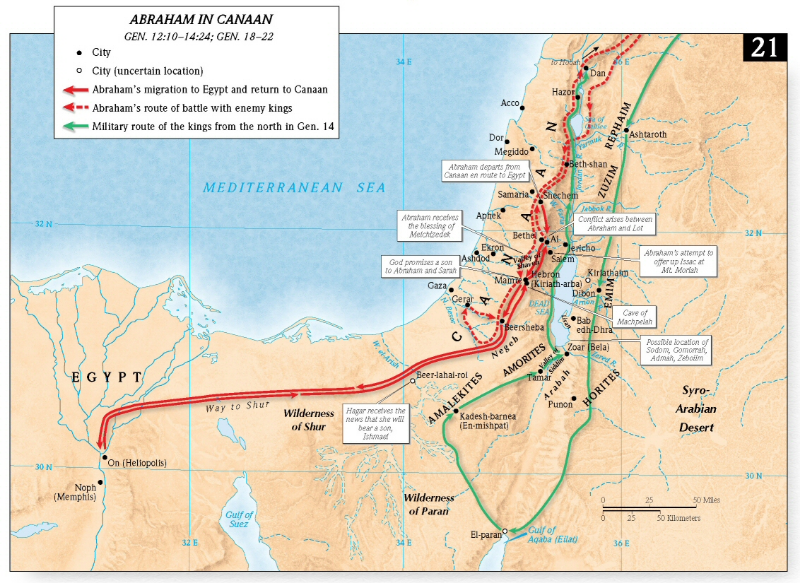
2. What/where was “the Negeb“? (13:1)? Trace Abraham’s, Sarah’s, and Lot’s trip from Egypt (13:1) back to “between Bethel and Ai” (13:2) on the map below. Find the remainder of the locations mentioned in 13-15 on the map.

3. Read Proverbs 3:5-6. How do we see Abraham trusting God and God directing Abraham’s paths in chapter 13? Canaan, where Abraham settled (13:12), eventually became known as what? How does chapter 13 demonstrate God’s sovereignty?

4. What does chapter 13 teach us about making wise and godly decisions? Can you look back on an incident in your life where you had to trust the Lord and make the wisest, most God-honoring decision you could? How did God “direct your paths” in that situation?

5. List all of the things God promised Abraham in chapters 13-15. Can you find the passages of Scripture where these promises came true?

6. Examine the instances in chapters 13-15 where Abraham worshiped the Lord. How would you characterize his worship? What caused him to worship?

7. Compare 15:6 to Romans 4 and Galatians 3. What does the Holy Spirit want New Testament Believers to understand about faith from Abraham’s example?

8. Compare and contrast Abraham’s interaction with God in chapter 15 about what God was promising him to Zechariah’s interaction with God about what God was promising him. How were Abraham’s and Zechariah’s reactions to God’s promises similar? How were they different? How and why did God react differently to Abraham’s questions than to Zechariah’s questions?


Homework

Compare Genesis 14:17-24 with Hebrews 7. How is Melchizedek a type of Christ? Why would the writer of Hebrews (14:13) refer his audience back to Melchizedek as an illustration of Christ as eternal high priest?


Suggested Memory Verse

And [Abram] believed the Lord, and he counted it to him as righteousness.
Genesis 15:6

Uncategorized

Just So URL Know…


Just a little announcement…

I’ve changed the blog’s URL from MichelleLesleyBooks.com to MichelleLesley.com. Same blog, same content, just drop the “books” and you’re good to go. For the next year, the old address will seamlessly automatically redirect you to the new address.

I’m trying to make my way around the web to change the site address anywhere I have it listed, but after seven years with the old address, I can’t begin to remember all the nooks and crannies I need to search out and correct.

If you happen to see my old web address listed somewhere, I surely would appreciate a heads up so I can get over there and update it to the new address.

And if you’ve been so kind as to link to my blog or any of my articles on your own web site, the old address will work just fine for the next year, but after that, the links will need to be changed to the new URL or they won’t work.

Why the change? I originally moved over to WordPress from Blogspot because I was told it was a better platform for marketing and publicity for my book which we were trying to get off the ground at the time. I wanted to use MichelleLesley.com when I was getting settled in at WP, but someone else had already purchased and was using that domain (Can you believe there are TWO of us? :0) So I stuck “books” on the end of the address because the blog was originally intended to be the vehicle for promoting and selling my first book and any to come in the future.

So now that my book is out of print, the “books” part is cumbersome and doesn’t make much sense, AND MichelleLesley.com is finally freed up for me to use, so, voila!