Holidays (Other)

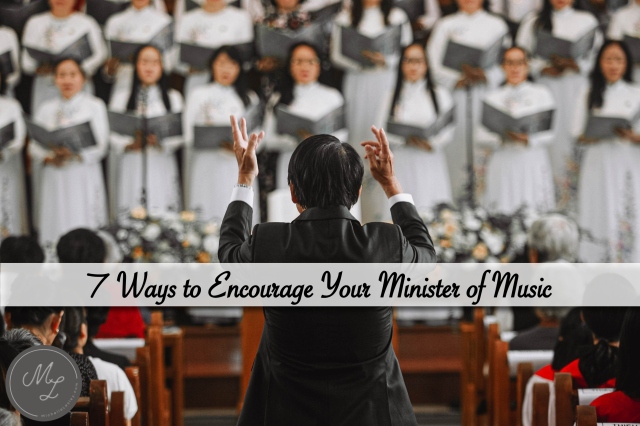
7 Ways to Encourage Your Minister of Music

Originally published November 18, 2014
Numerous articles have been written about how you, as a church member, can be an encouragement to your pastor- how you can constructively praise his sermon, pray for him, get him a great gift for Pastor Appreciation Month, etc. These are good things. Please be sure to support your pastor. Being a pastor is one of the toughest and most thankless jobs out there, and if youโ€™ve read the statistics you know pastors need and deserve all the encouragement they can get.

Your preaching pastor isnโ€™t the only person on your churchโ€™s staff who needs your support. So does your minister of music.

But your preaching pastor isnโ€™t the only person on your churchโ€™s staff who needs your support. So does your minister of music. And, having been married to one for over twenty years, I can tell you there arenโ€™t many articles out there letting you know how church members can encourage their ministers of music. Ready to show some love? Here are seven ways you can be an encouragement to your minister of music.

1.
Make practice a priority.

Before you join the choir or praise team or volunteer to play an instrument, find out how much of a time commitment it will be, and consider whether or not you can diligently keep that commitment. Once youโ€™ve joined or volunteered, attend rehearsals, worship services, and performances faithfully, and be sure to arrive on time. You have no idea how much it means to your minister of music that he can count on you.

2.
Get to church on time.

Think about how you would feel if you planned a dinner party, worked hard all week cooking and cleaning, and then one of the couples you invited carelessly showed up halfway through the meal. Youโ€™d probably think that was kind of rude and feel somewhat discouraged. Thatโ€™s sort of the way a minister of music can feel when people (especially the same people every week) habitually arrive late to church for non-emergency reasons. Not only that, but itโ€™s a distraction to others when you come in late, plus youโ€™re missing out on praising God and getting your heart prepared to receive His Word during the sermon. Being on time and ready for worship benefits everybody!

3.
Sing!

If you were in a meeting at work or in a college class, would you pick up your knitting, clip your nails, walk around the room chatting with friends, or bury your nose in your phone the whole time? Probably not, yet, over the years I have seen church members do all these and more during the music portion of the worship service. Itโ€™s disrespectful to the God weโ€™re supposed to be worshiping and to the minister of music who is trying to do the work God has called him to. On the other hand, I love it when we get in the car after church and my husband says, with a smile on his face, โ€œWow, they were really singing today!โ€ We have an incredible Savior who has given us the privilege of praising Him, so letโ€™s take Him up on it. Sing out! You can worship and be an encourager all at the same time.

4.
Smile!

Itโ€™s pretty disheartening for a minister of music to stand up front, giving it all heโ€™s got, and then look out over the congregation and see a bunch of people looking like theyโ€™d rather be at the dentist. Think about Who youโ€™re singing to and all the reasons why youโ€™re singing to Him, and I challenge you to keep a frown on your face! Just the simple act of smiling while youโ€™re singing will do wonders for your minister of music (and for you!).

5.
Think before you complain.

Has your minister of music said or done something thatโ€™s clearly a sin or false doctrine? If so, you have a biblical obligation  to go to him -kindly and in love- and talk to him about it directly.

Is your complaint a matter of personal preference- style of music, whether or not he wears a tie, etc.? Give it 24 hours. Does it still seem just as important? Could you possibly be a servant to him (and others in the congregation whose opinion is the opposite of yours) by overlooking an offense and not complaining?

If you do feel the need to voice your concern (and there are valid concerns that arenโ€™t sin-related), approach your minister of music the way you would want to be approached. Instead of, โ€œTurn that dadgum volume DOWN!โ€ how about, โ€œI was wondering if it would be possible to ask the sound tech to lower the volume in the house speakers a little? My babyโ€™s ears are very sensitive and she gets fussy when itโ€™s that loud. I hate missing worship when I have to take her out to the lobby.โ€ Instead of, โ€œHymns are so boring. I donโ€™t see why we have to sing them half the time,โ€ how about, โ€œI really loved those two worship songs we sang this morning! Do you think we might be able to sing more songs like that soon?โ€ Christ wants us to be kind to one another, so show your minister of music a little โ€œGolden Ruleโ€ love.

6.
Speak encouraging words often.

Itโ€™s been our experience, and seems to be the general consensus among ministers of music, that the most common kind of feedback they get is negative feedback. People are much quicker to complain than affirm. Buck the trend. Did he choose one of your favorite songs for the service? Did a certain song help you to understand one of Godโ€™s attributes better? Did the choir do a nice job on their anthem? Are you praying for him? Tell him. He appreciates it more than you know.

7.
Show tangible appreciation.

It is amazing what even the smallest gift can do to lift my husbandโ€™s spirits. A card of appreciation (I have come across cards that he has saved for years), something related to one of his hobbies, a church member buying him lunch at a fast food place. They might be small items monetarily speaking, but their message is, โ€œI care about you, and I appreciate your hard work.โ€ And thatโ€™s priceless.

We have been blessed over the last two decades to serve at several churches that had members who were very good at encouraging their minister of music. Their love and support made my husbandโ€™s ministry a joy. What are some ways you can think of to encourage the minister of music at your church and spread that same kind of joy?

Faith

Throwback Thursday ~ Obedience Matters

Originally published April 7, 2010

He who turns away his ear from listening to the law,
Even his prayer is an abomination.

Proverbs 28:9

Can you believe God would ever call prayer an abomination?

Imagine you have a teenage son or daughter (not such a stretch for some of us!) who always says the right thing (OK, that’s a stretch):

“I’ll be glad to clean up my room, Mom.”

“All right! Liver and onions for supper again! Mom, you’re such a great cook!”

“I love you, Mom.”

“I’m so thankful to have you and Dad as parents!”

“Mom and Dad, I appreciate you. Keep up the great work!”

“My parents always make the best and wisest decisions!”

Granted, that’s not going to happen in this lifetime, but wouldn’t you receive such praise gratefully if it were offered? Would you be more inclined to extend curfew? Lend out the car keys more often? Buy that new outfit she’s been begging for?

Now what if you found out that, while your child was saying all these wonderful things to and about you, she was cheating on tests at school, lying to you about where she had been, using drugs, or sneaking around with a boy you didn’t want her to see? How much would all that praise mean to you then? Would any of it matter if your child were living in willful disobedience?

How much more are our prayers, our praise, our worship, an affront to a holy God if they are drawn from the well of a rebellious heart?

Our prayers, our praise, our worship, are an affront to a holy God if they are drawn from the well of a rebellious heart.

The call to take up our crosses daily and follow Him is a call to complete surrender and obedience. It’s not:

“I’ll obey if I feel like it.”

“I’ll obey if it doesn’t conflict with what I want to do.”

“I’ll obey if it’s convenient.”

“I’ll obey if it’s fun.”

“I’ll obey if people will praise me for it.”

It’s doing what God tells us to do when and how He tells us to do it. Trust me, Jesus didn’t feel like dying on the cross. It wasn’t convenient, it wasn’t fun, and, in that moment, nobody praised Him for it.

But He did it anyway.

Because He was obedient.

How can we who bear His name expect that He would call us to less?

Has the LORD as much delight in burnt offerings and sacrifices As in obeying the voice of the LORD? Behold, to obey is better than sacrifice, And to heed than the fat of rams. For rebellion is as the sin of divination, And insubordination is as iniquity and idolatry…

1 Samuel 15:22-23a

May our prayers, praise, and worship spring from a consecrated lifestyle, in full submission to the Savior, so the Lord will not say of us:

…this people draw near with their words and honor Me with their lip service, but they remove their hearts far from Me…

Isaiah 29:13

Go ahead and get your praise on…but get your obedience on first.

Go ahead and get your praise onโ€ฆbut get your obedience on first.

Church, Discernment

Throwback Thursday ~ Nine Reasons Discerning Women Are Leaving Your Church

Originally published July 24, 2015

Earlier this week, Thom Rainer, president and CEO of LifeWay, pubished a blog article entitled Six Reasons Why Women May Be Leaving Your Church. Although I am not particularly a fan of Dr. Rainer (due to his allowing materials from false teachers to be sold at LifeWay), I thought this article was a good one, and I agreed with several of the issues he raised, especially, that these issues need to be addressed by church leadership.

As a ministry wife and someone in the field of women’s ministry myself, I, too, have noticed women leaving the church. Not just women in general, but a certain subset of church-attending ladies: discerning women. While Scripture is pretty clear that we can expect women (and men) who are false converts to eventually fall away from the gathering of believers, why are godly, genuinely regenerated women who love Christ, His word, and His church, leaving their local churches?

While Scripture is pretty clear that we can expect false converts to eventually fall away, why are godly, genuinely regenerated women who love Christ, His word, and His church, leaving their local churches?

1.
Eisegetical or otherwise unbiblical preaching

Discerning women don’t want to hear pastors twist God’s word. The Bible is not about us, our problems, and making all our hopes and dreams come true. We don’t want to hear seeker-driven or Word of Faith false doctrine. We don’t need self-improvement motivational speeches or a list of life tips to follow. We want to hear a pastor rightly handle God’s word from a trustworthy translation and simply exegete the text.

2.
The worship hour has become a variety show

Skits, guest stars, movie clips, dance routines, rock concerts, elaborate sets, light shows, and smoke machines. We didn’t sign on for Saturday Night Live on Sunday. This is supposed to be church. Get rid of all that junk, turn the lights on, give us solid preaching, prayer, and some theologically sound songs we can actually sing, and maybe we’ll stick around.

We didn’t sign on for Saturday Night Live on Sunday. This is supposed to be church.

3.
Women in improper places of church leadership

The Bible could not be more clear that women are not to be pastors, instruct men in the Scriptures, or hold authority over men in other capacities in the church. If your church has a female pastor, worship leader, or elders, or if women are teaching and leading men in Sunday school, small groups, or from the platform in the worship service, or if women are heading up certain committees, departments, or ministries which place them in improper authority over men, you’re disobeying Scripture, and we don’t want to help you do that by attending your church.

4.
Children are being entertained, not trained

There’s nothing wrong with a bit of play time or crafts for younger children, but we want our children trained in the Scriptures, not entertained for a couple of hours. We want their teachers to open God’s word and read and explain it to them at a level they can understand. We want them memorizing verses, learning to pray, and demonstrating an age-appropriate comprehension of the gospel. We want them to understand that church is joyful, yet, serious, not a Jesus-laced party at Chuck E. Cheese. We need church to bolster the Scriptural training we’re giving our kids at home.

5.
Women’s “Bible” Studies

The majority (and I don’t use that term flippantly) of churches holding women’s Bible studies are using materials written by Beth Moore, Priscilla Shirer, Joyce Meyer, Lysa TerKeurst, Sarah Young, and others who teach unbiblical ideas and false doctrine. Not minor denominational differences of opinion. Not secondary and tertiary unimportant issues that can be overlooked. False doctrine. While we long to study God’s Word with other women, discerning women will not sacrifice sound doctrine nor the integrity of Scripture to do so.

While we long to study God’s Word with other women, discerning women will not sacrifice sound doctrine nor the integrity of Scripture to do so.

6.
Ecumenism

Is your church partnering with other “churches” whose orthodoxy and/or orthopraxy are at odds with Scripture? “Churches” which approve of homosexuality or female pastors, or which hold to an unbiblical soteriology (grace plus works, baptismal regeneration, Mary as co-redemptrix with Christ, etc.)? Are you partnering with those who deny the biblical Christ altogether such as Muslims, Jews, Jehovah’s Witnesses, Hindus, Mormons, or Buddhists? Discerning women know Scripture forbids yoking ourselves to unbelievers and we want no part of it.

7.
Ageism

Look around at your pastor and staff, your lay leadership, your music team, the “face” of your church. How many of those people are over 40? Usually, discernment and spiritual maturity come through walking with the Lord over many years, yet, increasingly, by design, churches are run by twentysomething pastors, staff, and other leadership, who are often spiritually immature and/or lack the wisdom and life experience that come with age. The staff is often specifically structured this way in order to attract young people to the church. The counsel and wisdom mature, godly men and women have to offer is brushed off as old fashioned, and middle aged and older church members feel alienated and unwanted. While there are those among the twentysomething set who are godly and growing into maturity, discerning women value the wisdom and teaching of their godly elders.

8.
The “troublemaker” label

Discerning women who see unbiblical things happening in their churches and stand up for what God’s Word says about biblical ecclesiology and teaching are often vilified and labeled as troublemakers. We are called haters, threats to unity, complainers, gossips, negative, and a myriad of other scornful names. All this for wanting things done according to Scripture. Can you blame us for shaking the dust off our high heels and leaving?

Discerning women are often vilified and labeled as troublemakers. Can you blame us for shaking the dust off our high heels and leaving?

9.
Spineless or stiff-necked pastors

Discerning women have little respect for, and find themselves unable to submit to the authority of pastors who see people in their churches acting overtly sinful or propagating false teaching yet are so afraid of confrontation that they will not set things right. By the same token, we cannot continue to attend a church in which we bring scriptural evidence of false teaching or sin to the pastor and he outright denies the biblical truth we present to him. We cannot be members of churches in which pastors will not submit to Scripture or carry out biblical mandates.

Frequently, the discerning women you see tearfully leaving your church have been there for years. Sometimes they leave your church because it was never doctrinally sound to begin with, and God has opened their eyes to this as they grow and mature in Christ. Sometimes they leave because false doctrine and unbiblical practices have crept in and taken over a church that was once a refuge of trustworthy biblical teaching. Either way, these things should not be.

Maybe it’s not that discerning women are leaving the church, but that the church is leaving them.

Maybe it’s not that discerning women are leaving the church, but that the church is leaving them.


Additional Resources

Rock Your Role articles

Searching for a new church?

Church, Discernment, Worship

Throwback Thursday ~ The Way We Wor(ship)

Originally published on May 22, 2013

mt_sinai

And you shall set limits for the people all around, saying, โ€˜Take care not to go up into the mountain or touch the edge of it. Whoever touches the mountain shall be put to death.  No hand shall touch him, but he shall be stoned or shot; whether beast or man, he shall not live.โ€™ When the trumpet sounds a long blast, they shall come up to the mountain.โ€
Exodus 19:12-13

From Cain and Abel to the Israelites in the wilderness to Ananias and Sapphira, God sets limits on the way we may approach Him. He has always said “whosoever will” may come to Him, but He is just as exacting about the way in which we come to Him today as He was back then.

It’s no small matter that many people in the Bible were put to death for approaching God in anything less than an attitude of utmost awe, fear, and reverence for His holiness. Uzzah touched the Ark of the Covenant. Nadab and Abihu offered strange fire before the Lord. The Corinthians took the Lord’s Supper in an unworthy manner.

I recently heard Perry Noble, a well known leader of a seeker sensitive megachurch, who has done such things as having his church’s band play AC/DC’s “Highway to Hell” on Easter Sunday, say, “I’m willing to offend the church people to reach people for Jesus.” When asked where he drew the line at what was too offensive in church, he went on to say, “Iย probablyย wouldn’t have a stripper on stage…” and continued to justify using worldly and irreverent antics in church in order to “bring people to Jesus.”

But Perry has missed the point. Worship isn’t about people and what they like or don’t like. It isn’t about entertaining people and making sure they have some sort of enjoyable or emotional experience. It isn’t about attracting the attention of people.

Worship is about God.

What does God think? How does He want to be worshiped? What does He find offensive?

God is not the God of “anything goes.” If you doubt that, go back to the Old Testament and read His precise instructions on constructing the tabernacle, offering sacrifices, the behavior and duties of priests and Levites, and so on. Anything goes? Far from it.

Christ should be the sun in our solar system of worship. Just as the sun’s gravity exerts just the right force on each planet, keeping them revolving around it in exactly the right path, so, when Christ is at the center of our worship, every song, every prayer, every word spoken will fall into exactly the right orbit around Him.

What about your church? The next time you attend a worship service, sit back and view it through the lens of discernment. Is it designed to make you happy? Comfortable? Entertained? Emotional? Or is every element of the service centered on Christ– His holiness, His sacrifice for sin, His love and grace — leading you to exalt Him and forget about yourself?

Pastors and worship leaders, one day you will answer to God for the way you led your church. Do you design worship services to attract and hold the attention of people, manipulate their emotions, and entertain them, or do you sit at your desk, pray, and consider what will please God, how you can best lift up the name of Christ, expose His glory, and keep things centered on Him? God has not called you to be a shock jock, stand up comedian, or motivational speaker. He has called you to preach Christ and Him crucified.

Let’s stop the silliness and stupidity, and repent. Worship is serious business.

Church, Complementarianism, Worship

Throwback Thursday ~ Six Questions for a Potential Church

Originally published March 27, 2015

church questions1

Have you ever had to look for a new church? Even with recommendations from godly friends, it can be hard to know which churches and pastors are doctrinally sound, and, of those doctrinally sound churches (because you certainly don’t want to go to one that isn’t doctrinally sound), which ones would be a good fit for your family.

There are lots of great articles out there with good, probing questions you should ask about the theology and doctrine of a church you’re considering. (I would recommend this one, this one, and this one. Also, make sure you understand these doctrinal issues and that the church you’re considering lines up with Scripture on these issues.) However, there are times when the answers to these types of questions don’t give you the whole picture of what is actually going on in a church on a day to day basis. In other words, sorry to say, a church can give you all the right answers on paper (or on their web site), but their practices don’t mirror those answers. Additionally, there are some non-doctrinal issues that are important to know about that questions about soteriology, baptism, biblical inerrancy, etc., won’t give you the answers to.

My husband and I are currently looking for a new church for our family. Since we are Southern Baptist and somewhat familiar with the handful of Southern Baptist churches we’re looking at, we already know the answers to the most important questions (the inspiration of Scripture, the divinity of Christ, the way of salvation, etc.) But I want to zoom in a little more on the finer points of belief and practices of these churches, so here are some questions I might ask the pastor of the church we would potentially join.

1.
Which Christian authors have had the biggest impact on your life, beliefs, and ministry?

When I ask this question (and look over the pastor’s shoulder at the titles on his bookshelf), I’m listening for the names of authors and pastors, living or dead, that I know are committed to sound biblical doctrine. If I hear a name like Joyce Meyer, TD Jakes, Andy Stanley, Steven Furtick, Perry Noble, Rick Warren, Beth Moore, or any Word of Faith or New Apostolic Reformation personality, I’m going back to ask more probing doctrinal questions. If I hear multiple names like those, I’m outta there.

2.
Are you/this church complementarian or egalitarian?

Now you may not be familiar with those terms but any Christian pastor should be. It is a current issue in evangelicalism, and it’s part of his job to stay abreast of such things. I’m not looking for a pastor to be an expert on this topic, but he should be familiar with the terms and have a working understanding of the issues at play as well as the applicable Scriptures, and he should embrace and practice complementarianism as the biblical position.

Because I have been given the right “on paper” answer to this question in the past only to find out later that the church’s practices didn’t match up with its profession, I will probably ask the follow up question: “In what positions of leadership are women currently serving? Do any of them hold authority over men or instruct men in the Scriptures?” If I hear that women are (or would be allowed to in the future) teaching co-ed adult Sunday School classes, giving instruction during the worship service, serving on committees in which they hold biblically inappropriate authority over men, etc., that’s problematic.

3.
Can you give me some examples, from any time during your career as a pastor, of church
discipline issues that have arisen and
how you have handled them?

I’m looking for three things here. First, what does this pastor think constitutes a church discipline issue? If he thinks it’s necessary to discipline a female church member for wearing pants instead of a skirt, that’s an issue, because he’s disciplining someone who’s not sinning. If he doesn’t think it’s necessary to discipline church members who are unmarried yet cohabiting, that’s an issue because he’s not disciplining people who are sinning. Church discipline should only be exercised over unrepentant sinful behavior.

Second, is he afraid to exercise church discipline? Generally speaking, someone who has been a pastor for many years and has never handled a church discipline issue is either woefully ignorant of the biblical requirement of a pastor to rebuke those in sin, or he is afraid to rock the boat because he might get fired. Both of these are huge red flags.

Third, how does he exercise church discipline? Does he follow the steps outlined in Matthew 18 and other Scriptures with a heart to see the church member repent and be reconciled to Christ and the church body? Is he harsh and condemning? Is he firm enough in his resolve to carry all the way through to disfellowshipping a church member if necessary?

4.
How much oversight do you (or an
associate pastor or elder) have over the
women’s ministry at this church?

With this question, I’m trying to find out how much the pastor knows about what’s actually going on inside the women’s ministry (if they have one) and how much responsibility he takes to make sure all teaching and activities are in line with Scripture. Does he research and approve all teaching materials before a women’s Bible study commences? Does a women’s ministry director have complete autonomy over all materials and activities? Are all of the women in leadership positions in the women’s ministry godly and spiritually mature? Would any of the women’s ministry leadership raise a stink if someone showed them from Scripture that a Bible teacher whose materials they use or a women’s ministry activity they enjoy is unbiblical?

5.
Does the music ministry at this church follow a
minister of music model or a concert model?

There’s nothing wrong with Christian concerts per se, but my husband and I feel strongly (notice, I did not say “the Bible says”) that the worship service is not the place for one. We believe that a minister of music, preferably one who is ordained to the ministry, should lead and take responsibility for the church’s worship in a pastoral role. He should be trained in the Scriptures, preferably at seminary, in order to rightly handle and apply them to the music portion of the worship service and other music programs. He should also be trained in music theory and conducting so that he is able to lead in the practical aspects of music.

By contrast, we do not believe that making the music portion of the service like a concert, in which a band gets up and plays in a dark room with a laser light show and a smoke machine and the congregation can sing along if they want to, if they happen to know the songs, and if they are able to follow the ad libbing of the lead singer, is conducive to worship. We believe this tends to make the worship band into entertainers and the congregation into spectators, whereas the minister of music model fosters an atmosphere of “we’re all pulling together to do the work of worship as a unified body.”

This is not about contemporary music versus hymns, it is about one worship model versus another. It is our conviction (again, not a biblical mandate, but our strongly held conviction) after more than two decades in music ministry ourselves, that the minister of music model – regardless of the genre of worship music used – is the one most conducive to strong, biblical congregational worship. So this is something we’re going to want to know about, even though it is not necessarily a doctrinal issue.

6.
Do you preach topically or expositorily or both?

Topical preaching is when the pastor selects a topic to preach on (parenting, money, etc.) and uses biblical passages that apply to that topic to form his sermon. Pastors who preach expositorily usually preach through a book of the Bible from beginning to end before moving on to the next book.

Both are valid forms of preaching as long as God’s word is rightly handled and applied. However, it has been my experience that pastors who preach exclusively topically have more of a tendency to lift Bible verses out of their context in order to make them fit the topic they’re preaching. This is usually not as much of an issue for pastors who preach expositorily because they are simply preaching the Word, verse by verse, in its context.

Additionally, expository preaching gives church members a better understanding of Scripture and how it fits together, and exposes them more thoroughly to a wider range of biblical truth than exclusively topical preaching does. Therefore, I am looking for a pastor whose preaching style leans mostly towards expository, but who isn’t afraid to preach topically if he believes the church needs instruction on a certain topic.

So, those are some of the questions I’m thinking about asking. What questions would you ask when considering a new church?


For more resources on finding a new church, or what to look for in a church, click the Searching for a new church? tab in the blue menu bar at the top of this page.