Christian women, Complementarianism, Ministry, Sin

Women Preaching: It’s Not a Secondary Doctrinal Issue

Originally published August 3, 2018

When it comes to Christianity, are the specifics of what people believe important?

I think most of us would answer a resounding “yes” to that question. Of course, the various concepts we believe are important. You can’t just believe anything you like and still be a Christian. There are certain things you must believe in order to become a Christian at all, and there are certain things you will come to believe because you are a genuinely regenerated Christian. But what are those things, and how do we know which is which?

You can’t just believe anything you like and still be a Christian.

Maybe you’ve heard the terms “essential doctrines” or “primary, secondary, and tertiary theological issues” or “first, second, and third tier levels of doctrine”? For years, theologians have been attempting to organize beliefs of the Christian faith – all drawn from the Bible, naturally – into nice neat categories in order to make things a little simpler. As someone who thrives on organization and categories, I’m grateful for their efforts. But if you begin to study this categorization of beliefs, you’ll find that we haven’t reached an across the board consensus yet.

Generally speaking, “essential”, “primary”, or “first tier” doctrines are those which you, biblically, have to believe in order to become a Christian and/or be considered a Christian. For example:

✢ Sin is a thing, and I am a sinner.

✢ God exists and is the supreme authority of the universe.

✢ Jesus was God in human flesh.

✢ Jesus rose bodily from the grave.

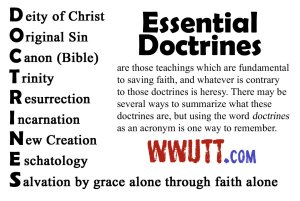
See how this works? If you don’t believe you’re a sinner, you’re not saved. If you don’t believe in the bodily resurrection of Christ, you’re not saved. Here’s how our friend, Pastor Gabriel Hughes, briefly outlines essential doctrines:

(Gabe later tweaked the acrostic a little and added an “S”, which I think is helpful.)
The vast majority of brand new Christians have only the most basic understanding of most of these tenets at the moment of salvation. But it’s not an issue of fully understanding – or else we’d all have to be theologians in order to get saved – it’s an issue of believing. Someone who is genuinely regenerated may not completely understand how the Trinity works (honestly, no one does), but when she’s introduced to the biblical idea of the Trinity, she believes it, learns more about it, and does not reject it.

There is typically agreement among most reputable theologians regarding what constitutes first tier doctrine. Scripture is clear about these things, and several of these issues were settled long ago by the church fathers in assorted church councils (Nicea, Chalcedon, etc.)

Secondary issues are routinely defined as non-salvific but still extremely biblically important, if not quite as biblically clear-cut as primary issues. Doctrines surrounding baptism (credo versus paedo, affusion versus immersion), for example, are usually cited as a secondary issue. A disagreement on a secondary issue doesn’t mean one person is saved and another isn’t, but it normally prevents close partnership in ministry activities involving these issues. For example, my Presbyterian friends and I can join together in pro-life ministry, but we would most likely not plant a church together.

Tertiary issues are non-salvific, less immediately urgent, biblical issues in which the Bible is even less clear-cut and open to wider (yet still biblical) interpretation. These are issues over which Christians can disagree and still maintain close doctrinal fellowship, even in the same church, if they’re in agreement on first and second tier doctrine. Eschatology – the order and timing of events at Jesus’ second coming – is a doctrine that’s often considered third tier. Someone can hold a different eschatological view than mine, yet, for the most part, it shouldn’t affect our ability to worship together, work together, or participate in the ordinances together in the same church.

Some theologians add a fourth category – issues of adiaphora, conscience, or Christian liberty. Usually these are issues of much less importance that the Bible either doesn’t specifically address, or doesn’t give commands about one way or the other. Individual Christians may use biblical principles to inform their consciences and decide for themselves. These would be things like whether or not to take your child trick-or-treating or deciding whether to dress formally or casually for church.

While theologians are largely in agreement about primary doctrines, there is wider spread disagreement on which doctrines are secondary and tertiary (many consider eschatology to be a second tier doctrine, for example) and whether or not there is a need for a category of adiaphora, since such issues are normally not considered to be “doctrinal” issues. In fact, there’s enough space for disagreement that pastors and theologians often wisely refrain from making concrete lists of secondary and tertiary doctrines.

But when we’re talking about the different levels of doctrine, what you won’t find is questions like these: Is murder a first, second, or third tier doctrine? What about gossip? Rape? Adultery? Lying? Gluttony? Pride?

And it’s not because these issues aren’t important or because the Bible doesn’t address them. It’s because they’re in a different category from the other issues: the category of sin. They aren’t doctrines upon which salvation hinges, they aren’t open to interpretation, and the Bible is clear that we are absolutely not to do these things.

The category of doctrine deals with beliefs. The category of sin deals with behavior.

In 2005, Dr. Albert Mohler wrote an excellent article about the different levels of doctrine entitled A Call for Theological Triage and Christian Maturity. He carefully explains the importance of each level of doctrine and what it covers in a plea to keep each level’s urgency in its proper place of significance during discussion, debate, and decision-making.

It was a helpful article to which I always refer people who have questions about tiers of doctrine, and I agree with Dr. Mohler’s thoughts in the article wholeheartedly1 …except on one point:

“In recent years, the issue of women serving as pastors has emerged as another second-order issue.”

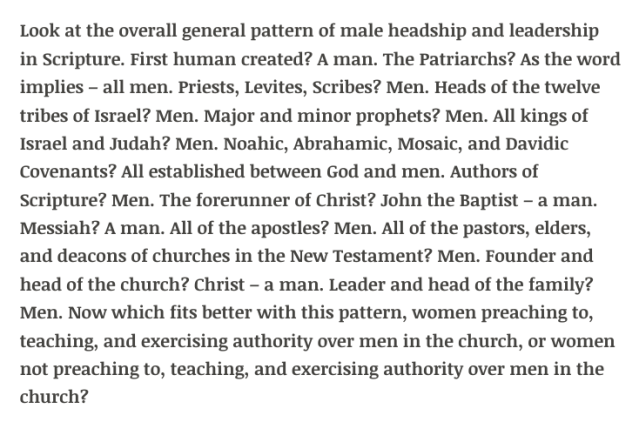
Women serving as pastors, women preaching, women teaching men Scripture, and women exercising authority over men in the gathering of the Body is not a secondary issue. Nor is it a primary or tertiary issue. It does not belong in the category of “doctrine” in the same way baptism and eschatology do. It belongs in the category of sin in the same way murder, gossip, and adultery do. Let’s take a look at the reasons for this.

Women serving as pastors, preaching, teaching men Scripture, and exercising authority over men in the gathering of the Body is *not* a secondary issue. Nor is it a primary or tertiary issue. It is a sin.

I do not permit a woman to teach or to exercise authority over a man; rather, she is to remain quiet. 1 Timothy 2:12

(The preponderance of Scripture supports and affirms this concept, so to keep things simple, we’ll use this verse as an exemplar.)

✢ The prohibition in 1 Timothy 2:12 is a clear command against a certain behavior. And when we behave in a way God has prohibited, that is called “sin”. All of the tenets in the three levels of doctrine are affirmative statements regarding beliefs (you must believe in the resurrection of Christ, we believe in baptism by immersion, etc.). None of them are commands, in the negative, against sinful behavior (Thou shalt not murder, I do not permit a woman to teach… etc.)

✢ Secondary and tertiary doctrines can be open – to varying degrees – to biblical interpretation. Every stripe of non-heretical eschatological thought can provide you with chapter and verse passages that can, depending on the angle from which you approach the subject, be biblically plausible and scripturally supported. There is no biblical support for anything God prohibits. No one can cite a properly handled, in context Bible verse in which God says, “It’s OK to commit adultery,” or “Women are allowed to preach.” There can be multiple views on a secondary or tertiary issue that can all be considered biblical, but there can only be one view of sin that is biblical.

✢ Differing beliefs on true secondary and tertiary issues are not sin. My Presbyterian friends have a different view of baptism than I do. That doesn’t mean either of us is sinning. I may think their interpretations of the verses they believe support paedo baptism are incorrect, but they are not breaking any of God’s commands. Differing behavior (again, we see the distinction between doctrinal belief and sinful behavior) on issues of sin is sin. If someone behaves differently from God’s command about lying, she is sinning. If a woman behaves differently from God’s command in 1 Timothy 2:12, she is sinning.

✢ Differing beliefs on secondary and tertiary issues are not born of disobedience and rebellion toward God. Usually, it’s quite the opposite. When someone has studied a theological issue enough to hold a particular position on it, it’s usually because she is striving to please God and to be biblical in her beliefs. Differing behavior on issues of sin is born out of disobedience and rebellion toward God. Someone who steals has already decided in her heart that her desires are better than God’s command. A woman who knowingly holds improper authority over men in her church is doing so because she has already decided to defy God’s clear command against such.

✢ Because different beliefs on secondary and tertiary issues are not born of rebellion and are not sin, they do not require church discipline. Sin does require church discipline. If someone in your church is openly dishonoring her parents, she is sinning and should be subject to church discipline. If a woman is pursuing a career as a pastor, she is sinning and should be subject to church discipline. 

Since the publication of Dr. Mohler’s article (and perhaps as a result of others teaching the same thing) the idea of the violation of 1 Timothy 2:12 being a “secondary doctrine” has spread in a most unhelpful way, leading many Christians to treat the issue in a c’est la vie, “We can just agree to disagree on this,” manner.

No, we cannot.

The idea of the violation of 1 Timothy 2:12 being a “secondary doctrine” has spread in a most unhelpful way, leading many Christians to think “We can just agree to disagree on this.”. No, we cannot.

We would not say, “We can agree to disagree,” on lying or adultery or homosexuality or abortion, and we cannot say it about women preaching, teaching men, or holding unbiblical authority, either. We disciple and teach a sister in Christ who is unaware of what the Bible says on these matters, and if she is committing any of these sins, we begin the process of church discipline. But it would not be loving toward her, or honoring God, to allow her to continue in biblical ignorance or in willful sin.

Furthermore, the violation of 1 Timothy 2:12 brings with it dangers to the church that true secondary and tertiary issues, and even many sins, do not…

The violation of 1 Timothy 2:12 brings with it dangers to the church that true secondary and tertiary issues, and even many sins, do not…

She may not say it with her lips, but when a woman preaches to men in defiance of Scripture, she’s teaching false doctrine through her behavior. What is the false doctrine she’s teaching? “I don’t have to obey God’s Word, and neither do you. If there’s a part of the Bible you don’t like, you’re free to disregard it.” If your pastor stood up in the pulpit on Sunday morning and said that in words, you’d run him out of town on a rail, and rightly so. Neither should a woman be able to teach that same false doctrine via her actions.

Additionally, I have mentioned several times when dealing with this issue that women preaching to men is highly correlated with women teaching other forms of false doctrine. I have researched scores of women teachers. Every single one of them who unrepentantly teaches men also teaches false doctrine in some other aspect of her theology (usually progressivism, Word of Faith, or New Apostolic Reformation). In other words, if a woman teaches men, you can just about take it to the bank that she also teaches additional false doctrine. False doctrine and heresy are infecting the church – via female preachers – at an alarming rate.

We dare not simply “agree to disagree” on this.

The violation of God’s command that women are not to instruct men in the Scriptures nor hold improper authority over men is a sin like any other. It is not a doctrinal issue in the same sense that other second and third tier doctrines are. If left undisciplined, however, it can lead to first tier doctrinal issues infiltrating a church and eventually destroying it. It is detrimental to the church to label and treat any sin as a secondary doctrinal issue.

Additional Resources

Is Women Preaching a Secondary Issue? on A Word Fitly Spoken

What Are Essentials and Non-Essentials? on A Word Fitly Spoken

Christian Liberty on A Word Fitly Spoken

The importance of Primary and Secondary Doctrines on the Truth Be Known Podcast


1In the years since 2018, when this article was originally written, Dr. Mohler has said, done, and supported various biblically questionable things, leading some to question whether or not he has “gone woke”. While I don’t support his stance on those questionable things, I also don’t believe he has reached the point at which I need to warn against him (although I don’t proactively recommend him, either). To my knowledge, at this time, he is still generally doctrinally sound.

Complementarianism, Mailbag

The Mailbag: Women teaching men- Questions from a young reader

Originally published March 14, 2022

I received this very astute line of questioning from a young lady who left a comment on one of my articles. The comment and questions were rather lengthy, so I’ve broken it up into portions in order to answer it in an organized way. If you need to read the entire comment, uninterrupted, for context or ease of understanding, scroll down, reading only the portions in bold.


Hi! Just to let you know, though it may seem, I have no intention of being rude in this question, and genuinely want to know your response to this. I am only in 9th grade, so I have a lot to learn, and want to know what you think about my comment...Thank you, and I am very curious to find out what you think about my questions and things that I might have misunderstood or missed.

That’s awesome! I wish I had been thinking as deeply about these things as you are when I was in the ninth grade. And, rest assured, your questions didn’t seem rude to me at all. I’m so glad you want to learn! I hope you’ll understand that my answers aren’t meant to be rude either, although they may not be quite what you’re expecting or wanting to hear.

You didn’t mention whether or not you’re a Christian or what your church background, if any, is, so let me just start off by saying, if you’ve never been genuinely born again, my answers might not make much sense. I would encourage you, even if you’re pretty sure you’re saved, to examine the materials at the What must I do to be saved? tab in the blue menu bar at the top of this page before moving ahead.

I was just wondering, if women are not allowed to teach men, and you are a woman and this blog is public to men and women, then aren’t you technically providing biblical insight and evangelizing to whatever gender is reading this to inform them of the Bible?

Nope. I’ve answered that question in detail in my article Are Female Bloggers Violating Scripture by “Teaching” Men?

Additionally, “evangelism” and “teaching” (“providing insight” isn’t really a biblical category) are two different, separate things. You might find our podcast episode Women Preaching the Gospel? helpful for understanding the distinction.

Also, the book of Timothy, like you said, was a letter written from Paul to Timothy, so this was just the teachings that Paul gave to Timothy as instructions for the churches, and not necessarily coming from God.

I’m afraid that’s one of the things you’ve misunderstood. This wasn’t just a letter from one human being to another. The words in 1 Timothy, just like every word of every book of the Bible are from the very lips of God Himself. Second Timothy 3:16 tells us that “All Scripture is breathed out by God.” There aren’t some parts of Scripture that are from God and others that aren’t. It all comes from God, from Genesis 1:1 to Revelation 22:21.

First and second Timothy and Titus are what we call the pastoral epistles (“epistle” means “letter”). That means they are God’s instructions, written through His human instrument, Paul, to Timothy and Titus and every pastor who came after them, about how to run the church.

I know Paul was a prophet and one argument could be that he got this information from God,

No, Paul was not a prophet, he was an apostle. And, as I discussed above, the Bible says that all Scripture is breathed out by God, so “Paul got his information from God” is the only argument that can be made, especially for Christians. Because, for Christians, the Bible is our authority on what to believe, not human arguments, opinions, and ideas.

but even prophets (besides Christ) make mistakes in their instructions to others,

I’m afraid that’s also incorrect. There’s not a single prophet in the Bible who, when speaking as a prophet to people on God’s behalf ever made one iota of a mistake about what He said. There were false prophets (who received the death penalty for saying they spoke for God when God had not really spoken to them), but none of God’s true prophets – like Isaiah, Jeremiah, Micah, Habakkuk, etc. – ever got anything wrong or “made mistakes in their instructions to others” when speaking on behalf of God.

such as Abraham, who instructed people to be stoned for certain sins,

I think you mean “Moses” here. Abraham wasn’t a prophet, and I don’t recall any instance in Scripture in which Abraham “instructed people to be stoned for certain sins”. Moses didn’t either. God did. God gave Moses the law on Mt. Sinai, and Moses wrote it down and taught it to the people.

and you can see that it was unlawful in God’s eyes

I’m sorry, but that’s incorrect as well. Since God is the One who gave the laws about stoning people for certain sins, He would never have said that someone properly obeying His law was doing something unlawful. That would be like God saying He was wrong when He made that law. And, of course we know that God is never wrong.

and you can see that it was unlawful in God’s eyes when Jesus told the priests about to stone Mary of Magdala that they should not stone her because they have sinned as well and God sees all sins as the same.

I think you’re talking about the story of the adulterous woman in Luke 7-8, right? Again, I’m sorry, but there are many things that need to be corrected here:

  • Stoning a woman caught in adultery was not “unlawful in God’s eyes”. It was lawful. God is the one who gave this law. The scribes and Pharisees correctly cited the law in 8:5.
  • Jesus wasn’t speaking to the priests, He was speaking to the scribes – experts in the law (which was an important point of this passage) – and Pharisees.
  • The text does not say the unnamed woman was Mary Magdalene.
  • Look carefully at the passage. In which verse does Jesus say “they should not stone her”? Answer: He didn’t say, “Don’t stone her.”. On the contrary, He said that they could commence with the stoning as long as whichever one of them was without sin cast the first stone.
  • He also didn’t say they couldn’t stone her because “they have sinned as well”. Every lawful stoning that has ever taken place on planet earth was carried out by sinners, because (except for Jesus) every human being is a sinner.
  • The Bible doesn’t say that God “sees all sins as the same” (In fact, we can see in the way that God deals with various sins in various ways throughout Scripture that this isn’t true.), so Jesus would never have said this nor given it as a reason that these men should not have stoned this woman.

Jesus didn’t say the law against stoning an adulteress was wrong. That would have been equal to saying God was wrong for giving that law. He didn’t tell the men not to obey the law, either. The key to understanding this story is in verses 4-7:

4 they said to him, “Teacher, this woman has been caught in the act of adultery. 5 Now in the Law, Moses commanded us to stone such women. So what do you say?” 6 This they said to test him, that they might have some charge to bring against him. Jesus bent down and wrote with his finger on the ground. 7 And as they continued to ask him, he stood up and said to them, “Let him who is without sin among you be the first to throw a stone at her.”

They didn’t care about this woman or what happened to her. They didn’t care about the man who was sinning right along with her. They didn’t care that this sin wrecked the man’s and woman’s lives. They didn’t care that God’s law had been broken. They didn’t care that adultery grieves the heart of God. They didn’t care.

All of those things were just a means to an end for them. All they cared about was trying to get the advantage over Jesus. To trick Him into saying something they could use against Him so they could discredit Him or bring Him up on charges with the Sanhedrin (Jewish court). And they were using God’s precious and holy Word as a tool to accomplish this evil goal. They were blasphemously using God’s own Word against Him.

That is the entire point of this story. God’s Word is His representation of Himself to us. It is our lifeline to Him, because it is how we come to know Christ as Savior. It should be revered as high and holy, not twisted and abused for wicked purposes.

This is just one example of many things that God’s prophets have taught wrongly.

No, none of the things you’ve mentioned, nor the corrections I’ve given, have demonstrated that any true prophet of God has ever taught anything wrong when it comes to prophecy or commands of Scripture. Second Peter 1:20-21 tells us:

…knowing this first of all, that no prophecy of Scripture comes from someone’s own interpretation. For no prophecy was ever produced by the will of man, but men spoke from God as they were carried along by the Holy Spirit.

So, since times were different in the first century and women were not seen as important to men, couldn’t this have been something Paul told Timothy to do based off of his own understandings culturally?

No. Again, 1 Timothy is a passage of God-breathed Scripture, not Paul’s personal human opinion. It was not based on Paul’s human understanding (see 2 Peter 1:20-21, above), culturally, or in any other way. This is God’s command to pastors, based solely on God’s reasons.

And God kindly shares those reasons with us in verses 13 and 14 of 1 Timothy 2:

11Let a woman learn quietly with all submissiveness. 12 I do not permit a woman to teach or to exercise authority over a man; rather, she is to remain quiet.

13 For Adam was formed first, then Eve; 14 and Adam was not deceived, but the woman was deceived and became a transgressor.

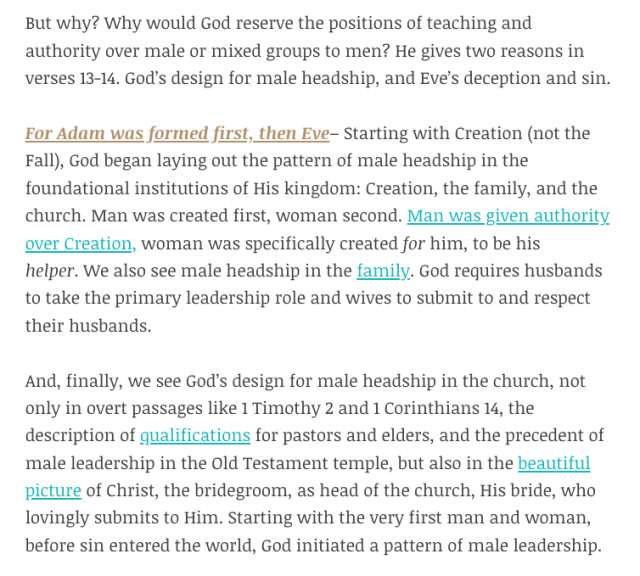
God gives us two reasons for His command that women are not to teach or exercise authority over men in the gathering of the church body: the creation order and pattern of male headship (13), and the fact that the woman was the one who was deceived into sin (14).

That’s why. Not culture, not Paul’s personal opinions, not because men didn’t value women at the time, not because the women in that particular church at that particular time were unruly or false teachers, not for any of the man-made theories that people have come up with. God tells us exactly why He made this rule for the church in verses 13-14. I’ve discussed this in greater detail in my articles Rock Your Role: Jill in the Pulpit and The Mailbag: Counter Arguments to Egalitarianism. Here are a few of the pertinent excerpts:

You’ve asked some really great questions here, and your reasoning skills are sharp. It was my pleasure to serve you by answering your comment. Keep asking questions, studying, and learning all God has to teach us through His authoritative, inspired, all-sufficient written Word.


If you have a question about: a Bible passage, an aspect of theology, a current issue in Christianity, or how to biblically handle a family, life, or church situation, comment below (I’ll hold all questions in queue {unpublished} for a future edition of The Mailbag) or send me an e-mail or private message. If your question is chosen for publication, your anonymity will be protected.

Mailbag

The Mailbag: Potpourri (Catholic book, Baptist church… Sharing Michelle’s blog with husband/church… Is posting “preaching”?… Husband wants to stay at unbiblical church)

Welcome to another “potpourri” edition of The Mailbag, where I give short(er) answers to several questions rather than a long answer to one question.

I like to take the opportunity in these potpourri editions to let new readers know about my comments/e-mail/messages policy. I’m not able to respond individually to most e-mails and messages, so here are some helpful hints for getting your questions answered more quickly. Remember, the search bar (at the very bottom of each page) can be a helpful tool!

Or maybe I answered your question already? Check out my article The Mailbag: Top 10 FAQs to see if your question has been answered and to get some helpful resources.


I have a question on a Carol Mader. Our church is a Baptist church and we are using a book called ‘kids travel guide to the fruit of the spirit”. When I check Carol out I find she’s Catholic? What are your thoughts?

I’m not familiar with Carol, but no Christian should be attending a church of any denomination where the pastor is OK with using Bible study, discipleship, etc. materials written by Catholics. Catholicism is not Christianity any more than Mormonism is.

The first thing I would encourage you to do is to make absolutely certain that Carol is, indeed, Catholic. I Googled her name, and several different Carol Maders popped up, including at least one who’s Catholic (also one who’s a retired Episcopal priest). The results also included the Amazon page selling books similar to the one you mentioned, by someone named Carol Mader. However, I was unable to verify that the Carol Mader who wrote those books is the same person as one of the Catholic Carol Maders.

But perhaps you have a more reliable source that unequivocally states that the Carol Mader who wrote the book is Catholic. In that case, I would encourage you to go to your pastor and kindly and gently ask him if he knows that this woman is Catholic. If he knows and doesn’t care, or tries to make you feel like you’re the bad guy for bringing this up, it’s time to find a new church. If he seems surprised and apologetic, immediately stops the use of the book, this was a one time goof on his part, and everything else about your church is doctrinally sound, forgive him and move on. Here are some resources that may help:

The Mailbag: How should I approach my church leaders about a false teacher they’re introducing?

Roman Catholicism: Mass Confusion at A Word Fitly Spoken


I am greatly appreciative of everything you have written [on your blog] and I wish I could read it all at once. There is so much good information. I desperately want to share this with my husband and church, but how can I do that as you are a woman, and then you would be teaching men? Thank you so much.

You’re very welcome. Thank you for your kind words. I’m glad my materials have been helpful, and it is my pleasure to serve you -and all of my readers- in Christ.

Let’s clear up a few things it sounds like you might be confused about or conflating, and I’ll share with you some resources that will give you fully-orbed answers to the several different questions implicit in your comment:

◇ Scripture’s prohibition against women instructing men in the Scriptures has a very specific context: in the gathering of the church body. There are many differences between the home and the church. They are two separate entities God has established in different ways for different purposes, and we need to keep them separate in our minds, especially when we study Scripture.

It might help to think about some of the obvious differences. Do you take up an offering or observe the ordinances of baptism and the Lord’s Supper in your home? Do you submit to your pastor in the same way you submit to your husband? Do you make sure everyone in your church is fed three meals a day and do all their laundry for them? These things may sound silly, but they help to illustrate that the church and the home run differently and have different purposes. Having a private conversation with your husband at home about something biblical you’ve learned (which is fine, biblically) is not the same thing as preaching it to your church from the pulpit (which is not).

Rock Your Role: Jill in the Pulpit

Rock Your Role FAQs

◇ Whether you verbally explain what you’ve learned to your husband, hand him one of my articles to read, or a random man stumbles across my blog and reads it, I am not violating Scripture’s prohibition against teaching men (and neither are you).

Are Female Bloggers Violating Scripture by “Teaching” Men?

◇ As far as sharing with your church or others, there’s certainly no problem with sharing my articles on social media, emailing them to a friend, etc. There’s also no reason you can’t share them with other women at church. However, if you’re going to be sharing them with more than a few other women, or reading one of my articles in a women’s class you teach, etc., run it by your pastor first, as a courtesy. He not only deserves to know what’s going on in his flock, he’s also responsible to God for what’s being taught in His church.

Rock Your Role Series

I answered this same basic question (with a few slight differences) to another reader a few years ago here (second question) in case it’s of interest.

I have been posting Scripture on my Facebook page every morning for the last six months. My friends are both male and female. Sometimes to make a verse more understandable I will explain who is speaking or who is being addressed. I’m starting to feel uncomfortable when I do this because I’m afraid I’m preaching. I check my study Bible before including clarifications to make sure I’m not misleading anyone. My gut is telling me I need to just state the verse. I pray about it and am wondering if it’s the Spirit convicting me. Thank you for your help.

It’s very important that Christians listen to our consciences so we don’t sin against them. If your conscience bothers you about posting the explanations, by all means, don’t do it. For you to do so would mean that you believe posting the explanations is sin, but you’re going to do it anyway. Don’t do that.

But while it’s important that we not sin against our consciences, it’s equally important that our consciences are informed by rightly handled, in context Scripture. And, in a nutshell, your conscience is a bit misinformed.

Though I wouldn’t suggest going to the extreme of habitually posting lengthy diatribes aimed specifically at men, railing at them about how they can be more godly men, pastors, husbands, or fathers, there’s nothing unbiblical about posting a verse with a few clarifying remarks to a general audience. Biblically, that is not preaching.

I would encourage you to prayerfully consider the materials I’ve provided the previous reader as well as this one Sisters Are Part of the Family of God, Too!. If, after reading, praying, and studying the pertinent Scriptures you still think it’s better not to post the explanations, that’s OK. Don’t. If your conscience is clear, and you decide it’s OK to post them, then you can do that. A few other options you might consider that your conscience may find acceptable:

  • Post enough of the surrounding verses to make the context clear so you don’t have to explain.
  • Use brackets. This is a perfectly acceptable grammatical device, especially in an informal setting like social media. For example: if the verse begins, “And he said to them…” and it’s clear from the surrounding context that it’s Jesus speaking to the disciples, then bracket that part of the verse with the antecedents replacing the pronouns for clarity: “And [Jesus] said to [the disciples]…”.
  • Use a direct quote from your study Bible or a reliable commentary instead of using your own words. Remember to use quotation marks, and cite your source.
  • When you post the verse, include a link to a (doctrinally sound) sermon, article, Bible study video / podcast, etc. that explains the verse and its context.


I have found myself in the situation of looking for another church because of women being allowing to preach occasionally in our current church, but my husband wants to remain. Should I come under his authority and remain also or do you think it’s ok to follow my own convictions? I feel somewhat conflicted.

I’m so sorry. I know that must be really difficult. Sadly, this is an issue wives face more often than you’d think. I hope these articles, though they may not match your situation exactly, will be of help to you.

The Mailbag: My husband wants to stay at an unbiblical church.

The Mailbag: A Lost Husband, a Saved Wife, and an Apostate Church


If you have a question about: a Bible passage, an aspect of theology, a current issue in Christianity, or how to biblically handle a family, life, or church situation, comment below (I’ll hold all questions in queue {unpublished} for a future edition of The Mailbag) or send me an e-mail or private message. If your question is chosen for publication, your anonymity will be protected.

Mailbag

The Mailbag: Potpourri (Women Bible Translators… Doctrinally sound deliverance ministry… Brain fog and Bible/book reading)

Welcome to another “potpourri” edition of The Mailbag, where I give short(er) answers to several questions rather than a long answer to one question.

I like to take the opportunity in these potpourri editions to let new readers know about my comments/e-mail/messages policy. I’m not able to respond individually to most e-mails and messages, so here are some helpful hints for getting your questions answered more quickly. Remember, the search bar (at the very bottom of each page) can be a helpful tool!

Or maybe I answered your question already? Check out my article The Mailbag: Top 10 FAQs to see if your question has been answered and to get some helpful resources.


This was a wonderful article. I was curious how the question about women translating sermons would apply to people who translate the Bible into a new language. Usually they are in a team. But if a lady was working as part of a team would she not have to discuss Scripture with men and theology and doctrine in discussing proper word use? Would this be preaching to men and therefore not a job allowed women?

A very thoughtful question! It is always good to think about various applications of God’s Word.

I want to start my answer with a simple exercise that I hope will help all of my readers to distinguish “preaching” from “not preaching”. Assuming you attend any approximation of a doctrinally sound church, I want you to picture what your pastor does when he steps in front of the congregation during the worship service on Sunday morning. What does it look like? Is he holding a private small group discussion about doctrine or other biblical topics? Is he writing a blog article? Is he sharing the gospel one on one with a lost person? Is he posting a Bible verse on social media? Is he being interviewed? Is he recording a podcast?

No (And yet, women have been accused of “preaching to men” for doing all of these things). He is standing there, alone, exhorting, proclaiming, and teaching (hopefully expositorially) the written Word of God to the assembled local church body.

If you ever wonder whether someone is “preaching,” compare what he or she is doing to that mental picture of your pastor. Does it look basically the same? If not, it’s probably not preaching.

Let’s put a woman working on a Bible translation team through that grid. She’s working in some sort of office-type setting, using Bible translation software on her computer, doing research, interviewing native speakers, meeting with colleagues for discussions about various words, passages, etc. Does that look like what your pastor does on Sunday morning? I hope not, because that’s not what a pastor is supposed to be doing on Sunday morning. He’s supposed to be preaching the Word to the assembled local church.

The Bible prohibits women from pastoring, preaching to men, instructing men in the Scriptures, and holding authority over men in the gathering of the Body – the church – not in collaborative, non-preaching, situations like this outside the local gathering.

In fact, we have an example of this in Scripture, in Acts 18, where Priscilla and her husband, Aquila, took Apollos aside privately and “explained to him the way of God more accurately”. Priscilla is never rebuked or spoken negatively about in Scripture for having done this. In fact, Paul commends her and gives thanks for her as a helper to him and the church in Romans 16.

Are there some positions in Bible translation organizations that only qualified pastors should hold? Probably. Are there situations in which a doctrinally sound, biblically qualified pastor should make the final decision on doctrinal issues that may arise? Most likely. But generally speaking, most of the time there’s no biblical problem with a woman serving on a Bible translation team. And if there is, it’s not because Bible translation equals preaching.


I recently tried to leave the Word of Faith church, but experienced tough demonic problems. I have realized I have a spirit (not the Holy Spirit) moving in me. Are there any non NAR deliverance resources you can point me to? 

I have read the Bible 12 times cover to cover, just to share with you I am not a brand new believer and am familiar with the Scripture if you would like to share something in there.  

Yes, a doctrinally sound local church. I’m not trying to blow you off or oversimplify your problem. I’m telling you that when you experience problems like this, God’s solution is for you to go to your pastor for counsel, not to some parachurch “deliverance” ministry (even if it’s doctrinally sound, not that there is such a thing). Your pastor is responsible for shepherding your soul. Your pastor knows you, and he and your church family can walk with you through this situation 24/7.

Your pastor can also help you understand what the Bible says about what you’re experiencing. I have no doubt that you might be experiencing some sort of demonic oppression or harassment, but no one who is genuinely born again can be possessed by a demon because she is indwelt by the Holy Spirit. And reading the Bible does not equal being a Believer (I’m not saying you think it does.). There are plenty of atheists who have read the Bible numerous times. So, to come straight to the point, either you’re not genuinely saved and you might be possessed, or you are genuinely saved, and you’re misunderstanding what’s actually going on with you, spiritually. A good pastor can help you sort that out according to Scripture.

If you aren’t already in a doctrinally sound local church, find one today at the Searching for a new church? tab (in the blue menu bar at the top of this page) and make an appointment with the pastor. Explain your situation, and ask for help.

Additional Resources

What does the Bible say about demon possession? at GotQuestions

Am I Really Saved? A First John Check Up (Bible study)

Deliverance Deception playlist by Doreen Virtue


I am struggling with brain fatigue/fog and wonder if you have any advice to help me and others suffering from this frustrating problem. When I sit down to read the Bible, I can’t read more than a few verses before I feel the fatigue, and I remember nothing. It is affecting my quiet time with God. I would appreciate what Scripture has to say about this and how I can work around or overcome it.


I have a short stack of Christian books I want to read. My issue is that I have very poor reading concentration and comprehension which turns an otherwise leisurely and enjoyable pastime into a laborious and frustrating trial. I would appreciate any Biblical insight into how to overcome this disabling problem so I can enjoy reading.

I thought it was interesting that I received these very similar questions from two different readers within just a few days of each other.

This is really less a theological question than a practical one, so let me offer you what I’ve got, and then, readers, leave your tips and suggestions of what has worked for you in the comments section:

  • If your issues are neurological, ask your neurologist for help and suggestions.
  • Eat right, and get plenty of rest and exercise.
  • Cut way back on your TV and social media time. TV and social media train your brain to have a short attention span and to be distractable.
  • When it’s time to focus on Scripture or your book, get alone in a quiet room with no distractions. Turn off your phone, music, TV, etc. Use a white noise app or video if you need to.
  • Use the audio option on your Bible app or listen to Justin Peters or Gabriel Hughes read the Bible to you.
  • Find the audio book version of the book you’re trying to read.
  • Once you’re able to build up your focus as you listen to the audio version of your Bible or book, try reading along for a certain portion of that time. You might want to start with a goal of 5 minutes of reading along, then increase it by a minute every few days or so.
  • When you’re able to read along with the audio for 15-30 minutes, gradually start weaning yourself off the audio a few minutes at a time.
  • Set small, achievable time limit goals for your listening, listening/read along, and reading, and gradually increase them.
  • Take notes as you listen. The quality of the notes doesn’t matter when you first start out. Listening for something (anything!) to write down will help you focus.
  • Memorize Scripture and meditate on it throughout the day.
  • Write Scripture. Just find a passage you like and copy it down word for word (handwritten) as many times as you like. It will help you memorize Scripture and also keep your focus on reading it as you’re copying it.

Readers, any other suggestions that have worked well for you? Comment below.


If you have a question about: a Bible passage, an aspect of theology, a current issue in Christianity, or how to biblically handle a family, life, or church situation, comment below (I’ll hold all questions in queue {unpublished} for a future edition of The Mailbag) or send me an e-mail or private message. If your question is chosen for publication, your anonymity will be protected.

Mailbag

The Mailbag: Potpourri (Teaching Dad the Bible… Event planning… Children’s Sunday School)

Welcome to another “potpourri” edition of The Mailbag, where I give short(er) answers to several questions rather than a long answer to one question.

I like to take the opportunity in these potpourri editions to let new readers know about my comments/e-mail/messages policy. I’m not able to respond individually to most e-mails and messages, so here are some helpful hints for getting your questions answered more quickly. Remember, the search bar (at the very bottom of each page) can be a helpful tool!

Or maybe I answered your question already? Check out my article The Mailbag: Top 10 FAQs to see if your question has been answered and to get some helpful resources.


My parents have not attended a church as their home church for years. I have tried to encourage them to seek out a church family and how important it is but this has not happened for various reasons. My mom had been asking about Bible study and I offered to her I could study with her a few times a month at her home with one of your studies. I’m not sure where my Dad sits with Christ. If he decides he wants to sit at the table and listen is that ok or should I stop and say something- I’d be disobeying God?

I’m sorry. I know that’s a tough dilemma to be in with your parents because you care about them so much.

It’s wonderful that your mother is at least interested in Bible study! What could be better than God convicting and convincing her of the gospel, sin, the need for a good church, and so on. I would encourage you to jump on that opportunity right away!

If I might offer a suggestion, I would encourage you to start either by working through the Scriptures and materials at my gospel presentation page, What Must I Do to be Saved?, with her, or working through my Bible study on 1 John, Am I Really Saved?, or both.

There are two reasons for this: a) when someone has been out of church that long with little desire to return, the most likely reason is that she was never genuinely saved in the first place, and b) if she’s not saved, Bible study, for the purpose of growing in Christ, is not going to work, because she’s not yet in Christ. (You can and should still do Bible study with an unbeliever, though, if she’s willing, because God can use any part of His Word to draw her to Himself for salvation.)

All of the above is also true for your dad. If he’s unsaved, any Bible study he listens to would come under the heading of evangelism, and it is not unbiblical for a woman to share the gospel with a man (see #11 here).

If he is saved, what would be ideal is if your husband, brother, or another man who’s a Believer could disciple him and do Bible study with him, because he needs a godly man to teach him how to be a godly man. That’s not something you as a woman can do.

But if that’s not possible at this time, there’s no reason not to include him in the study you’re doing with your mother. The Bible prohibits women from pastoring, preaching to men, instructing men in the Scriptures, and holding authority over men in the gathering of the Body – the church – not in private, at home, family situations which, one way or the other, are almost certain to be temporary.

In fact, we have an example of this in Scripture, in Acts 18, where Priscilla and her husband, Aquila, took Apollos aside privately and “explained to him the way of God more accurately”. Priscilla is never rebuked or spoken negatively about in Scripture for having done this. In fact, Paul commends her and gives thanks for her as a helper to him and the church in Romans 16.

Enjoy your study time with Mom and Dad.


At our church which seems to be very theologically sound, my husband and I have got the OK to put together a marriage weekend. Various sessions. Please know I never actively seek a leading role however it seems if a person has an idea the job defaults to them. What are some safe parameters in this situation?

Great question. It’s always good to think these things through. When you say you’re “putting together” a marriage weekend, what that means to me is that you’re planning it. You’re deciding the date and time, making sure the sanctuary or other space at the church is available, making up fliers, finding a speaker(s), decorating, planning the menu, scheduling the caterer … you know – event planning.

Your pastor should certainly vet and approve the speaker(s) and all the other details, but event planning is not prohibited for women anywhere in Scripture.

If you’re asking me whether or not you should speak or teach at the conference, if you’re doctrinally sound, you know your Bible well, and you’re able to teach, there’s no reason why you shouldn’t teach the women at the conference. You should not teach the men. Those are really the only parameters you need. A couple of extra resources you might find helpful:

Rock Your Role: Jill in the Pulpit

Rock Your Role FAQs


I completely agree with simply teaching from the Bible vs. canned studies for adults, but what about children’s Sunday school? Various ages. Packaged curriculums have some fun bright coloured worksheets and applicable songs, etc., with the lessons. Answers in Genesis has small video clips. Not trying to make Sunday School a party but children enjoy music and visuals. Would love your thoughts.

I have taught every age from bed babies through adult women in Sunday School, so you’ve come to the right place! Appropriate hymns and songs – especially Scripture memory songs, in Sunday School – are great for any age class. For the youngest children, there’s certainly nothing wrong with coloring sheets or brief videos after the Bible lesson and to supplement the Bible lesson. All of those things can be a way of reinforcing the biblical concepts you’ve taught the children in the Bible lesson. But I would suggest gradually weaning them off the coloring sheets and videos once they hit about third or fourth grade, and replacing them with more time focused on discussing the passage, Scripture memory, prayer, etc.

When it’s time for the Bible lesson, read it to the children straight from the Bible, not a quarterly, booklet, photocopy, etc. You might want to use a children’s Bible for younger children, then move to a simply worded translation for older children, stopping along the way, of course to ask questions and make sure everyone understands. Even at the youngest ages, you want to model studying and teaching straight from the text of Scripture rather than relying on a “canned” study.


If you have a question about: a Bible passage, an aspect of theology, a current issue in Christianity, or how to biblically handle a family, life, or church situation, comment below (I’ll hold all questions in queue {unpublished} for a future edition of The Mailbag) or send me an e-mail or private message. If your question is chosen for publication, your anonymity will be protected.