Christian women, Complementarianism

Toxic (Evangelical) Femininity

Toxic masculinity. It’s a buzzword that’s gaining momentum as it’s bandied about in pop culture like a shuttlecock over a badminton net. There’s a clinical definition of the term (which, in the ivory towers of the scholarly world is, properly, “hegemonic masculinity“):

Hegemonic masculinity is defined as a practice that legitimizes men’s dominant position in society and justifies the subordination of women, and other marginalized ways of being a man. Conceptually, hegemonic masculinity proposes to explain how and why men maintain dominant social roles over women, and other gender identities, which are perceived as “feminine” in a given society.

And then there’s the sort of similar working definition of the huddled masses: Anything a man does that others, especially women, don’t like that can, by any stretch of the imagination, be blamed on the fact that he’s a man.

If a man cuts you off in traffic, it’s not that he’s a jerk or didn’t see you, it’s toxic masculinity. If a man holds a door open for a woman, it’s not that he’s polite and helpful, it’s toxic masculinity. If a man leaves his socks on the bathroom floor, it’s not that he’s sloppy and has no home training, it’s toxic masculinity. In other words, he’s not doing these things because he’s a polite or rude or aggressive or helpful human being, it’s because he’s a man who just wants to keep women down and exercise dominance over them.

Pardon my French, but what a bunch of malarkey.

Yes, I’m sure there’s a fringe element of men out there whoย consciouslyย think they’re better than women, that women shouldn’t have any rights or hold any positions of responsibility, blah, blah, blah. And you know what? They’re considered fringe kooks, and rightly so. But I’m not buying this business of these elitist gnostics telling us that every little move a man makes is a subconscious act of belittling women or exercising domination over them, and neither should you. It’s like the race-baiters who say that every single white person is racist, deep down, and this latent racism manifests itself in everything we do, from the way we tie our shoes to the breakfast cereal we buy at the store. We’re just not aware of it, supposedly.

Poppycock.

You want to know where this notion of toxic masculinity came from? It sprang from the loins of toxic feminism. Zoom out and look at the big picture. This is a manufactured concept, baptized in the (assumed) credibility of academia, designed to help women leverage power and control over men. How? By denigrating them at every turn, thereby convincing the world that men are intrinsically bad and women are good and must be elevated to prominence. Call me crazy if you want to, but it doesn’t take a prophet or the son of a prophet to look down the road and see that the feminist end game here is a matriarchal world where women rule and men drool. And there are plenty of brazen females out there who would openly and unashamedly admit this.

That, however, is not my concern. Sinners gonna sin, and God’s going to deal with them in His own way and in His own good time.

My concern is the way this attitude is fleshing (pun intended) itself out in Christian families and the visible church, and creeping into evangelical women’s (and men’s) hearts. Because, whether or not we’d like to admit it, this worldliness is advancing upon us, and we need to be aware of – and biblically approach – the facets of this issue that are already at our doorstep:

On the Top of the World Looking Down on Creation

I actually laughed out loud when reading some of the academic definitions of so-called toxic masculinity. There seemed to be an air of, “We just don’t understand it! This pattern of male dominance seems to transcend all cultures and time periods!”

Well here’s a really academic response to that: Duh.

I mean, you have to wonder if these researchers and scholars have ever said toย  themselves, “I wonder if there’s a reason for that. I wonder if this tendency in men that defies time and culture can be traced back to a pinpointed source.”

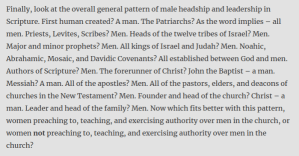
There is, and it can. It’s called Creation, and God is the one responsible. God created man first and then woman. God created husbands to lead and wives to be helpers. God set up the Old Testament patriarchal society that became the nation of Israel, which was led by male tribal heads and, later, male kings. God established male leadership in the temple, and subsequently, in the church. The major and minor prophets were male, Jesus was male, the apostles were male, the writers of Scripture were male. And all of this traces back to that one moment in Genesis 2 in which God decided to create man first and hard-wire him to lead, protect, and git ‘er done. Broadlyยน speaking, the reason we see a generalยน pattern of male leadership across time and culture is because God set those wheels in motion.

As Christians, we recognize that sinful men sometimes abuse the positions of leadership God has given them, but that doesn’t negate the entire pattern and call for us to turn it on its head. We study our Bibles and embrace and submit to the way God has instructed men and women to behave in the roles He has bestowed upon us.

(Don’t) Do the Woke-Emotion

One of the components of God’s creative work that adds inexplicable beauty to this world is the tender-heartedness, passion, and empathy He built into women in a uniquely feminine way. Emotions. Feelings. God created them, and they areย good. What a dreary and heartless world this would be if women didn’t bring nurturing, caring, sympathy, and love to the table. God uses us to soften the hard edges of life and make the planet pleasantly inhabitable.

But along with that good gift comes the challenge to steward it wisely and in obedience to God so that we may use it to glorify Him rather than dishonoring Him.

I see Christian women wisely stewarding their emotions to the glory of God every day as they care for their husbands and families, friends and co-workers, and serve in their churches. It is a beautiful picture of the mature fruit of biblical womanhood.

Unfortunately, I also see the exact opposite. I see (ostensibly) Christian women who scream like banshees any time their pastor preaches on the passages of Scripture dealing with women’s roles in marriage or the church. I’ve seen women who claim to believe and follow the Bible throw an everloving fit when someone points out – from Scripture – that their favorite women’s “Bible” study author is a false teacher. I see women formulating their beliefs and practices about God, worship, the Bible, their own behavior, their families, and their churches based on their own personal opinions, experiences, and feelings rather than on rightly handled Scripture.

And, just like secular feminists demand domination over men because they feel oppressed, have experienced sexism, or resent the world’s history of male dominion, I see Christian women letting their emotions rule the day as they demandย unbiblical solutions to their real or perceived personal experiences with men and male leadership.

The anger, the outrage, the hurt feelings, and being offended are nearly as evident in evangelicalism as they are in society at large.

Godly women are not ruled by their feelings. We are ruled by the Bible. We make our feelings submit to and obey God’s Word. We don’t make decisions based on what we like or don’t like, or what makes us feel good about ourselves. We base our decisions on what the Bible says. When our feathers get ruffled, we take a step back and evaluate the situation with rightly handled Scripture. Maybe we’re upset because someone actually sinned against us, but maybe we’re upset because our pride or vanity was wounded, or our unbiblical notions were biblically challenged, or because God used someone to expose an idol we’re worshiping. Maybe it’s not that the other person sinned, but that we’re in sin. Those hurt feelings could be a wake up call from God to humble ourselves and repent.

Ladies, weย must learn to put our feelings aside and act on the objective truth of God’s Word instead of our fickle and deceptive emotions. If we display the same sorts of fleshly emotionalism as unsaved women, how are we being salt and light in the world, pointing the way to Christ? We’re supposed to be set apart and different from the world.

Why Can’t a Woman Be More Like a Man?

Because – speaking of salt and light – embracing and submitting to our biblical roles in the family and in the church sets us apart from the world. Now, more than ever, we have a unique opportunity to be counter-cultural – simply by obeying God’s Word.

Women being hired as pastors and teaching and exercising authority over men in the church and leading denominations and becoming popular evangelical conference speakers with co-ed audiences – that’s what the worldย expects because that’s the way they do things. But a Christian woman who happily puts her foot down and refuses to teach men in the church setting or joyfully insists on submitting to her husband? That’sย different. It’s against the grain, not the norm.

Remember that out of the ordinary burning bush that caught Moses’ attention and he turned aside out of curiosity to investigate? And remember how, when Moses was watching it burn, wondering what in the world was going on, that God called to him out of that fiery shrub – “Follow Me.”? God can do the same thing with our obedience to Scripture.

Lost people see this anomaly of our “weird” behavior, and they want to know what in the world is going on. Why do we act differently than they do? And that’s when we get to explain it to them. We get to share the gospel. God can call to them out of our passionate burning for Christ and His Word, “Follow Me.”.

People in darkness gravitate toward light. Salt makes people thirsty. Do we care more about giving them the Light of the World and the Living Waterย or our own selfish and fleshly desires for power and position? Our embrace of and obedience to the biblical roles God has laid out for us as Christian women is one gateway to sharing the gospel with the lost.


Toxic femininity is worldlyย and fleshly. It has no place in Christian homes and churches. How do we combat it? We take up the sword. We submit to the authority and sufficiency of Scripture. We recognize that God is the authority in our lives, not self, and that we are to obey Him at any cost – even at the cost of our convenience and pleasure. We trade our desires for His.


ยนI’m well aware that there are plenty of exceptions to this generalization. I’m referring to a broad pattern across time and culture, here. There are many biblical ways women can contribute and lead in the family, society, and the church.
Mailbag

The Mailbag: Potpourri (Heretical church music, Mistranslating 1 Tim. 2:12, Books for women…)

Welcome to another โ€œpotpourriโ€ edition ofย The Mailbag, where I give short(er) answers to several questions rather than a long answer to one question. I also like to take the opportunity in these potpourri editions to let new readers know about my comments/e-mail/messages policy. Iโ€™m not able to respond individually to most e-mails and messages, so here are someย helpful hintsย for getting your questions answered more quickly.ย Remember, the search bar can be a helpful tool!


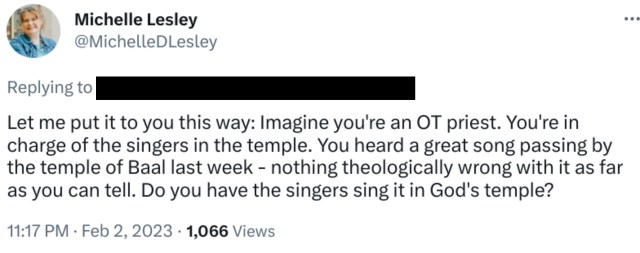
I need guidance in approaching the worship director of the church I started attending 6 months ago (haven’t joined yet) due to his frequent use of Bethel/Jesus Culture/Hillsong/Elevation Church music. I stand there in silence most of the worship time because I just donโ€™t feel comfortable singing those songs. I donโ€™t want to meet with him and be that person who is critical and legalistic but I feel convicted that someone needs to. Should I go talk to the pastor first (we have somewhat of a relationship since Iโ€™ve met with him a couple times and agree with his theology)?

It’s awesome that you are discerning enough to know that music from these heretical and New Apostolic Reformation organizations shouldn’t be used by any church. I encourage you to keep having those “powers of discernment trained by constant practice” of distinguishing good from evil (Hebrews 5:14).

I also want to encourage you that inquiring about the theology of a church or its music – especially as someone who is deciding whether or not to join that church – is not being “critical and legalistic”. That is what scoffersย say about discernment issues, but it is not theย biblicalย way of viewing “contending for the faith”. Do not allow ungodly people with their unbiblical personal opinions to deter you or even make you feel bad for doing what is right and good and godly.

I agree with you that someone needs to address the issue of the music. It is possible that’s why God put you into this church at this time – to pray for the church, the minister of music, and the pastor about this, and to lovingly explain the issues.

Since I’m not personally involved in the situation, I can’t offer any advice as to whether to approach the minister of music or the pastor first. I would suggest you pray and ask God to give you the wisdom to know which one of them to speak to first, and trust Him to direct your paths. You might want to consider which of these men you feel will be more receptive to what you have to say. If you go to the minister of music first and he brushes you off, I would encourage you to go to the pastor next. I think both of their responses will help you decide whether or not you want to join this church.

Here are some resources that may help:

The Mailbag: How should I approach my church leaders about a false teacher theyโ€™reย introducing?

Hillsongโ€™s Theology of Music andย Worship

The Mailbag: Should Christians listen to โ€œRecklessย Loveโ€?

Popular False Teachers (further information on Hillsong, Bethel, Jesus Culture, Steven Furtick)


A popular Christian apologist I follow says that the prohibition against women preaching, teaching Scripture to men, and holding authority over men in the church in 1 Timothy 2:12 is translated incorrectly.

I do not permit a woman to teach or to exercise authority over a man; rather, she is to remain quiet.

He says it should not be translated as “woman” and “man” “but as “wife” and “husband”, and that he believes Bible translators mainly translate it as man woman due to tradition (i.e. men have historically been the pastors and teachers in the church).

This is why linguists – professional experts in the biblical languages – are hired to translate Scripture, not apologists.

Bible translators (of reliable translations) are true to the text, not church tradition or personal convictions. Furthermore, when translators are working on the text, it is not a lone individual who writes down what he thinks the Greek words say and that’s the Bible you end up reading. There are teams of translators, linguists, editors, and even computer experts who work on the text. They check, and double check, each other’s work. So even if one translatorย was translating according to tradition or opinion, it would be caught by others and not allowed to slip through the cracks.

All of the most reliable English translations translate the words as “man” and “woman”, not “husband” and “wife”.

And just for kicks, I checked this verse in about a dozen of the less reliable translations, and every single one of them translates it “man” and “woman”. Even versions that got other parts of verse 12 incorrect still use “man” and “woman.” For goodness sake, evenย The Messageย andย The Passion “Translation” possibly the two worst English versions of the Bible (They’re not even translations.ย The Message is a paraphrase, written by someone who endorsed the heresy-laden bookย The Shack and has made statements affirming homosexuality. Andย Passion is the new New Apostolic Reformation version of the Bible, based, supposedly, on new revelation directly from God.) both say “man” and “woman”. And the NAR is totally OK with female preachers, so you know they’re not using “man” and “woman” due to tradition.

So we’ve got one apologist who’s of the opinion that it should be “husband” and “wife” against scads of translators who are experts in their fieldsย andย whack job NAR “translators” who approve of female pastors, who all use “man” and “woman”. You would thinkย someone out of all of those people would have translated it “husband” and “wife” if that was the correct translation. It’s telling that even “translators” who push the egalitarian agenda won’t go so far as to change it to “husband” and “wife”.ย I think the apologist is somewhat out of his depth here.

A few more quotes from said apologist:

Verse 11 and following is directed at women in the context of their relationship with a man to whom they are supposed to be entirely submissive. That is a marriage relationship…1 Timothy 2 talks about the relationship between husband and wife; itโ€™s chapter 3 that talks about church leadership.”

No, verse 11 is not directed at women. Neither are any of the other verses in chapter two or the rest of the book. First Timothy is a pastoral epistle. It was directed at Timothy by the Holy Spirit via Paul as sort of a “policy and procedure manual” for the church. This passage is not talking to women about their marriages, it is talking to pastors and elders about how to run the church. Verses 11-12 are talking about the role and behavior of women (all women, not just wives) in the church setting. They are not to instruct men in the Scriptures or exercise authority over men. Thatย  definitely “talks about church leadership” by excluding women from leadership roles that place them in authority over, or instructing, men.

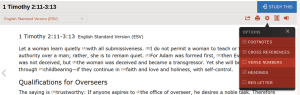
And keep in mind that when 1 Timothy was written, there were no chapter and verse markings. The text was one continuous flow. If you begin reading in 2:11 and go through 3:13 (try reading it here, adjusting the settings to remover chapter and verse markings), I believe there’s a strong case to be made that 2:11-15 is actually theย introduction to the qualifications for pastors, elders, and deacons. The passage (2:11-3:13) starts by stating who is disqualified from those positions and whyย (2:11-15) and then moves on to who is qualified and how (3:1-13).

Furthermore, if you’ll take a look at verses 8-10ย of chapter two, which immediately precede the verses in question (11-12) and provide context, you’ll see more instructions to both men and women. Are only husbands to pray? Are only wives to dress modestly and respectably and adorn themselves with good works? What about single men and women, divorced men and women, widows and widowers?

No other place in Scripture teaches that all women should be under the authority of all men in the church. If this passage is to be interpreted the traditional way, this makes a new and unusual pattern of submission.

And this passage (1 Timothy 2:12) doesn’t teach that either. The statement that women are not to have authority over men doesn’t flip around to mean that all men are in authority over all women. That’s fallacious logic, silly reasoning, and patently unbiblical. The text says what it says and that’s it. You can’t turn it inside out and make an inference from an incorrect converse. That’s being a poor workman and mishandling Scripture.

It’s abundantly clear that “man” and “woman” are the correct translation in 1 Timothy 2:12. If anyone is being more loyal to an agenda than to the text here, it’s the apologist, not the translators.

Rock Your Role: Jill in the Pulpit (1 Timothyย 2:11-12)

I Know Greek, So That Verse Is Wrong!


What do you recommend as daily devotionals for children, ages 2 and 10? I am looking to start daily Bible time with the kids before we start school.

I don’t recommend “canned” Bible studies and devotionals, but rather teaching straight from Scripture itself. I’ve explained this more, including a few suggestions for teaching your children, in my articleย The Mailbag: Can you recommend a good Bible study for women/teens/kids?

If you’re looking at a 5-10 minute time frame, you might want to work your way through Proverbs one verse at a time, or possibly some of the shorter Psalms. I usually set aside a 30 minute block of time and read through a book with my boys one chapter a day, asking questions and explaining things along the way. If you’d like, feel free to use any of my studies at the “Bible Studies” tab at the top of this page, selecting and simplifying the questions you feel are most appropriate for your children.


How can I subscribe to your blog via e-mail?

If you’re on a computer, there’s a little box in the left sidebar where you can enter your e-mail address:

Inline image

I don’t know if your phone is the same as mine or not, but here’s what the e-mail sign-up on my phone looks like:

Inline image


I was wondering if you had a list of recommended books for women. I’m trying to offer an alternative to anย NAR book that has nice ideas and some good thoughts but also strays into Spiritual Formation and, of course, really off-base hermeneutics.ย 

I don’t really know of any off-hand along those lines that I would recommend. The problem with “Christian” books for women by women is that most of them contain false doctrine. A couple of suggestions:

1. The Bible. If you’re looking for a book with nice ideas and good thoughts, Psalms might be a good place to start. Getting grounded in God’s Word and digging deep into Scripture itself is the best way to guard your ladies against the false doctrine you’re describing.

2. There’s no reason women can’t read books authored by men. If you already have a particular doctrinally sound book in mind that was authored by a man, go right ahead and use that one. I would recommend any of the male authors under my “Recommended Bible Teachers” tab (as well as any of the female authors listed there). You might also find the kind of book you’re looking for at GTY or Ligonier.


If you have a question about: a Bible passage, an aspect of theology, a current issue in Christianity, or how to biblically handle a family, life, or church situation, comment below (Iโ€™ll hold all questions in queue {unpublished} for a future edition ofย The Mailbag) or send me anย e-mail or private message. If your question is chosen for publication, your anonymity will be protected.


Share Your Testimony

Testimony Tuesday: Karen’s Story

Karen’s Story

From the Pulpit to Repentance

Several have asked me to share my journey from the pulpit to repentance. Ten years ago, my husband and I were Charismatic ministers. We served together as Associate Pastors of a church in Texas. I was on the preaching schedule with the men, monthly. Yes, I got the accolades and approval of the church, and the association we were involved with untilโ€ฆ. The grace of God reached down and pulled my husband and me both back to the Word of God and out of the fire.

Here is a snapshot of the journey, our journey. It is hard to share. In fact, I have shared our story with select few. Sure, this will bring fiery darts my way, but I really couldn’t care less. I trust that this will help open the eyes of those seeking Truth.

I met my husband in an evangelical church, he was a youth pastor at the time. Both of us were from very Biblically based churches. My husband was the son of a Baptist minister. As a student at Biola College, I remember the warning given to the students by my professor, Dr. Curtis Mitchell, against tongues and the unbiblical Charismatic movement. Truth is, I was curious as most college age young people. I found myself wondering if Dr. Mitchell knew what he was talking about.

I met my husband my sophomore year of Biola. He had a full time job and was a youth pastor. He had a ministry to teens and the kids loved him. He was everything that I prayed and asked God for. We were married one year after we met. I wish I could say we lived happily ever after. When you are on Godโ€™s team, attacks come, and they are very real. As a young couple, we found ourselves in two churches, both with serious issues.

After one year of marriage, he was offered a position as a youth pastor at the beach, one block from the ocean. It was an awesome church where we were both very happy. The youth group was growing, kids’ lives were being changed, and parents were grateful. All was well until . . . the senior pastor asked a friend of his to become the Associate Pastor. The new staff member immediately began to breed distrust between the staff. He had an agenda, to bring a copy of the Satan bible into the youth group and have the kids read it. We found ourselves in a spiritual battle that we had never anticipated. We did not want to cause a church split so my husband resigned. (We found out later that this man had a history of going from church to church and causing splits!)

Another local Baptist church contacted my husband. His youth pastor was being transferred by his full-time job, and Phil was asked to step in.

Things were going well at the new church. The youth group was thriving. Nine months in to the job, the senior pastor was asked to resign, the music directorโ€™s wife divorced him, and then the music director committed suicide. Upset, discouraged, angry at God were only some of my emotions. I wanted to quit the ministry. We both were so discouraged. It was at that point that Phil decided that he was through with the ministry. We were done!

The last two churches had taken their toll on us. We hardly read the Bible, only attended church. Our marriage was having issues and another baby was on the way. We were trying to keep ourselves together, no one knew the depth of our pain and discouragement. Looking back, I can see clearly that what happened to us was a direct attack from the enemy.

In the midst of the pain, I knew that the God was the answer. Not wanting anything more to do with the traditional church, I gravitated towards the popular charismatic movement. Some of my family had gone that direction, they seemed happy โ€“ so I thought maybe thatโ€™s what we needed.

Looking back. I now see now that it was all a trap. The discouragement with the church, the hurt, thinking that God let us down . . . we were slowly being destroyed. I got into the Charismatic movement first. I started by going to meetings, listening to TBN, talking to my family. Phil tried to warn me but being hard headed, stubborn and thinking I knew more than he did (he wasnโ€™t reading his Bible so what could he say to me????) I took the bait and had my first experience. I say “experience” because everything seemed to be an experience from that point on. To be truthful, I did feel happier, read my Bible, (substituted the KJV with the Amplified version), and was nicer to live with. He decided that because I had made some positive changes that maybe I was on to something. He jumped in with me and we started attending a Charismatic fellowship. Please note as I write from this point on, the progression . . .

Discouragement, mad at God, feeling empty, Charismatic appeals, we take the bait.

At no time did we consult Godโ€™s Word on any of the teaching we were hearing. The Bible was used in the sermons with enough truth that we bought into the lie.

We moved our family to Tulsa. Phil enrolled in Rhema but half way through the first year, he left school. We look back and see the grace of God even in that situation. In the meantime, we had become friends with another couple and she and I were convinced we were supposed to be ministers. Women ministers were all the rage, and all were serving with their husbands, so why not us? We all continued in the Word of Faith churches in Tulsa, voraciously reading every book, attending meetings. At one point, we all decided to be ordained. After applying and being interviewed, we were ordained along with many other couples.

We found a church that was growing and we got involved. We thought we could use our โ€œministry giftsโ€ there. We did become leaders in the church. I led a womanโ€™s group and together we did a weekly care group in our home. We were being destroyed emotionally as the church was spiritually abusive. It was taking its toll on everyone, including our kids. We both began to see how the Word of God was being twisted from the pulpit to say things that were not there and there was no demonstration of the love of God.

One morning, while having my quiet time, I read an article about spiritually abusive churches and the signs of a toxic, abusive environment. Everything I read we were experiencing. It was clear that we had to leave.

I went to my husband with tears streaming down my face and shared what I believed God was saying. I trusted him to make a family decision. It was the next Sunday that the pastor stood up and said to the congregation, โ€œIf you are called to this church, you are called to me.โ€ Walking out, my husband looked at me and said, โ€œWe are done.โ€ We quit the fellowship with a resignation letter and never looked back.

A job change was in the air. We both got jobs in Dallas, TX. We left Oklahoma and never looked back. Our daughter moved to Seattle and within a few years, our son did the same. We were all out of Oklahoma!

After a couple of years, we decided to go back to church but did not know where to go. Someone had invited us to attend a little Charismatic start up church and we went. We fell in love with the Filipino pastor and his dear wife. We started going and helping them. The pastor invited us to be on staff and he submitted papers for our ministerial license. (We had rescinded our other ministry certificates years earlier). We became co-associate pastors. We loved the people and we both preached one Sunday a month. Phil and I had begun our personal studies at home, using the KJV Bible. We studied the Emergent Church and saw how it was infiltrating the organization. We read John MacArthur’s book, Charismatic Chaos, and scales began to fall from our eyes. Everything that John MacArthur wrote in his book was 100% accurate. We had experienced it first hand and had lived it.

When I saw that I had not held to the faith that was once delivered to the saints, tears of repentance gushed. I cried for weeks. I had wronged the Lord. I had been duped, taken the bait of Satan, and strayed way off the track. Phil had his own similar moment with the Lord. The beautiful part of this testimony is that each of us came to the same place at the same time using the same Bible. God, in his grace, had snatched us out of the fire. We now had a decision to make. We then drafted a letter of resignation to the organization and walked away.

We were done. We had each other, we had Godโ€™s Word. We had already walked away from Word of Faith in Tulsa, and now we walked away from everything Charismatic. The circle was complete. We went into Babylon but God brought us out. We found a Biblical church where women are in their place. I have never looked back.

If you are reading this, I plead with you to think Bible, read your Bible, stop listening to Charismatic/Word of faith/Emergent church and women preachers. We tossed books, tapes, cdโ€™s, Bibles. Our library was quite large. Yes, we tossed our huge library in the trash.

Today we stand on Godโ€™s Word. I donโ€™t need to preach to be fulfilled. God has given me a national platform in a dental organization. I influence women all over the country and as God gives opportunity, I share his grace. I found my place in Christ, in my marriage, and in my church. I am 100% fulfilled being the person God has called me to be.

Today I stand heart- broken as I look across Christianity and see the deception. With tears, I am humbled and grateful for Godโ€™s grace, His forgiveness, His love, and the Truth of His Word.

We have come full circle โ€“ back to the Bible and the roots we were raised with. I pray that you too will find the Truth. Seek and Ye shall find. Here is a clue . . . Truth is in Godโ€™s Word!


Ladies, God is still at work in the hearts and lives of His people, including yours! Would you like to share a testimony of how God saved you, how He has blessed you, convicted you, taught you something from His Word, brought you out from under false doctrine, placed you in a good church or done something otherwise awesome in your life? Private/direct message me on social media, e-mail me (MichelleLesley1@yahoo.com), or comment below. Your testimony can be as brief as a few sentences or as long as 1500 words. Letโ€™s encourage one another with Godโ€™s work in our lives!

Mailbag

The Mailbag: Potpourri (Calvinism, Baptism, Modesty…)

Welcome to another โ€œpotpourriโ€ edition ofย The Mailbag, where I give short(er) answers to several questions rather than a long answer to one question. I also like to take the opportunity in these potpourri editions to let new readers know about my comments/e-mail/messages policy. Iโ€™m not able to respond individually to most e-mails and messages, so here are someย helpful hintsย for getting your questions answered more quickly.ย Remember, the search bar can be a helpful tool!


I was very troubled by a recent stance the discernment ministry Lighthouse Trails has taken –ย calling Calvinism heresyย – and wondered if you had seen it. Itโ€™s one thing to just have a difference of opinion on Calvinism, but to put it this category?ยน

Yes, I saw it when they made the big announcement on social media a few months ago. I expressed my disappointment to LT and have decided, going forward, not to use their materials or point readers to them as a trustworthy resource. There are several reasons for this:

1. The tone used in most of the LT anti-Calvinist posts, comments, and articles was derisive and condemnatory at best. There is no place for that among Believers, regardless of their stance on Calvinism (frequent readers will note I don’t recommend Reformed resources that take this sort of tone either).

2. It was clear from the LT materials I read that they don’t even have a complete and accurate understanding of what Calvinism is. Indeed, some of what they addressed was not Calvinismย (which is biblical Christianity)ย but Hyper-Calvinismย (which is heresy). That does not speak well of a discernment ministry. You must have a correct understanding of a doctrine before attempting to address it biblically, especially if you’re going to come to the conclusion that something is “another gospel” (heresy) as LT did with Calvinism.

3. Addressing a doctrine they haven’t thoroughly researched, as well as anathematizing something that is clearly biblical Christianity (even if they don’t agree with it), calls the discernment and biblical understanding of the entire organization into question and casts doubt on LT’s previous and future evaluations of doctrine. In other words, if they’re going to make this egregious an error over such a simple – and settled – biblical construct, how can any of their conclusions on other, more nuanced aspects of theology be trusted?

Here are some additional resources you may find helpful:

What is Calvinism? by Maurice Roberts

Calvinism & the Bible by Brian Godawa

What’s the Difference Between Arminianism, Calvinism and Hyper-Calvinism?ย by Tom Ascol

Calvinism Is Not Hyper-Calvinism by Josh Buice


I had viewed the Gospel Message video embedded on your site and had concern for the presentation. It is apparent you have hermeneutical concern for today’s God study, so I wanted to clarify what your view may be on baptism.

I hold to a Reformed Southern Baptist, credo-baptist understanding of baptism. You can find further details at these links:

Statement of Faithย (tab at top of this page)

Basic Training: Baptism

(Remember, the search bar and the tabs at the top of the blog are your friends! :0)


I have only recently come to understand 1 Timothy 2:12. However, why do we so passionately receive verse 12, yet neglect verse 9? Why do people choose which parts of the Bible to obey?

No Christian should be making a conscious choice to disobey any command(s) of Scripture that pertains to Christians. Willful disobedience is sin which needs to be repented of, and might even indicate that the person is not saved. Genuinely regenerated Christians desire from the heart to keep God’s commands.

I am not sure whether your question is based on your own church (or local churches you’re familiar with) in which women embrace their biblical roles but are dressing immodestly, or if you’re seeing a lot of attention focused on verse 12 (in books, online articles, conferences, organizations, sermons, social media, etc.) and not as much on verse 9.

If it’s the latter, I would say that you’re seeing a lot of attention focused on verse 12 rather than verse 9 for the same reason you see firemen hosing down a house that’s on fire rather than hosing down one that’s not. When the day comes that celebrity “Christian” women get up on stage dressed immodestly, write books about how dressing immodestly is perfectly biblical, form organizations to push the immodest dress agenda, hold conferences extolling immodest dress, and encourage other women to dress immodestly as they worship, I think you’ll see the same kind of pushback with verse 9 that you’re seeing now with verse 12.

If what you’re asking about is women at your church who embrace their biblical roles but seem not to be obeying verse 9, first make sure you have a correct understanding of what verse 9 is talking about:

likewise also that women should adorn themselves in respectable apparel, with modesty and self-control, not with braided hair
and gold or pearls or costly attire,

a) The context of 1 Timothy, including chapter 2, is instructions for the gathering of the church. So, while Christian women should dress in a way that glorifies God at all times simply because we belong to Christ, this particular verse is about how we dress for church, not for a gala, the beach, or the gym.

b) “Braided hair and gold or pearls” are examples – much like head coverings – of specific things that were considered immodest in the time and culture in which 1 Timothy was written. If a woman comes to your church with her hair in a French braid or wearing an understated pearl necklace, she is notย necessarily dressing immodestly. There is nothing intrinsically immodest about gold, pearls, or braids, but rather the meaning a culture attaches to them or the statement they make in a particular venue.

c) The term “modest” has more than one meaning in this verse. It does mean to dress in a way that is not sexually provocative (“respectable apparel”). But in the same way we would use the phrase “a modest income” or “a modest home”, it also means to dress in a way that’s not flashy (which, in the first century meant bling like gold, pearls, and extravagantly braided hairstyles), and that doesn’t attempt call attention to yourself or show off your wealth (“costly attire”).

So, in this sense, a woman who walks into the average American church wearing a dress she got at Target is probably not dressing immodestly, whereas a woman who walks in wearing uber-expensive designer clothes, shoes, and handbag, and dripping with jewels probably is, necklines and hemlines notwithstanding. That goes for outlandish apparel or clothing that’s meant to grab attention as well. If your hair is three shades of green and fashioned into a unicorn horn, that’s going to be immodest in most churches. If you walk into church wearing scuba gear or a space suit, that also fits what this verse means by immodest.

In a nutshell, we’re to fit in, not to beย a distraction from worship with our clothes and coifs.ย You are not supposed to be the center of attention in church, God is.

If this is an issue with the women of your church in general, or with one woman in particular, set up an appointment with your pastor and get some counsel from him on the best way to address the situation.


I have a bone to pick with you.

This is a verbatim quote of the opening line of the reader’s e-mail. Normally, I would just hit “delete” without giving such rudeness the time of day, but I thought I’d make an example of it instead. Ladies, rudeness and displays of self-centered anger dishonor Christ, and if you’re e-mailing someone like me who struggles against the sin of impatience, you’re not only tempting a sister in Christ to sin, but you’re probably not going to get a hearing.

I have personally known [female Bible teacher you’ve written about] for over 30 years.

The name of the teacher is irrelevant, but it is not someone I’ve warned against nor whom I consider a false teacher. Additionally, this reader bases her defense of said Bible teacher (below) on knowing her personally and on the reader’s personal opinions and experiences, not on what Scripture says, which does not speak well of what she has learned from the Bible teacher. I don’t think the reader’s rudeness or her lack of biblical understanding are a fair representation of this particular teacher, so that’s another reason I’m leaving her name out.

She gets permission from her husband and her pastor [and the male head of her ministry] before she teaches with men in the audience…I have met some of the men on the board and they have no problem [with her] lecturing with men in the audience.

Please point me to the passage of Scripture, chapter and verse, that says a husband, pastor, or ministry head or board can give a woman permission to do something God has prohibited.ย No one has the authority to say “yes” where God has said “no.” I’ve addressed in detail this idea of a woman teaching men “under her husband’s/pastor’s authority” in my articleย Fencing off the Forbidden Fruit Tree.

Additionally, it does not matter how many people give approval to something or how important they are – that is not what makes something right or biblical. God is the arbiter of right and wrong, biblical and unbiblical, not people.

When you see the men in audience she is giving a lecture not teaching.

But you just said in the previous sentence, “She gets permission from her husband and her pastor before she teaches with men in the audience.” Which is it?

Furthermore, it doesn’t matter whether you call it preaching, teaching, lecturing, sharing, proclaiming, exhorting, or delivering a soliloquy, if it’s instructing men in the Scriptures in the gathered body of Believers, it violates 1 Timothy 2:12, and it’s sin.

The men chose to listen to [her] lead the lectures.

That’s true. That means that they areย also guilty of violating 1 Timothy 2:12, not that they are guilty and she is not.

You need to come to [one of this Bible teacher’s events]. You will see what is actually being done and said.

When I wrote the article you read about this Bible teacher, I provided videos of her teaching, quotes from her materials, and other objective, verifiable evidence of what she says, does, and teaches. That’s not “what is actually being done and said”?

I am basing my evaluation of this teacher’s words and actions on Scripture, not on my personal experience. I don’t need to be physically present at one of her events in order to do that.

[This Bible teacher] and other teachers: When [this Bible teacher] gets an invitation to speak she asks God if she should do it or not. So you need to ask God if [she] is sinning because she only goes wherever God sends her.

I believe what the reader is addressing here is that I have pointed out as unbiblical that the Bible teacher in question has joined in ministry activities with demonstrably false teachers.

God has given us His written Word. Whatever He might subjectively “tell” us in prayer does not override what He has objectively told us in the Bible. God gave His answer to her question about 2,000 years ago in 2 John 9-11, Romans 16:17-18, 2 Corinthians 6:14-18, and many other passages. If someone is invited to partner in ministry with false teachers, her answer is to be “no.” God is not “sending her” to partner with false teachers because He has already instructed her not to do that in His written Word. And if she is so learned in the Scriptures that she’s qualified to be a Bible teacher, she should already know that without having to ask Him. And if you’ve known her for thirty years, she should have taught you that by now as well. I don’t need to “ask God if she is sinning,” I only have to open my Bible and read what He’s already said about it.

Before you say anything about a Christian speaker you need to do more research and go to that ministry personally.

“More research” meaning, “keep researching until you agree with me”? I did multiple hours of research on the article you read. I sufficiently substantiated every point I made with Scripture and accurate, verifiable evidence from the teacher’s own words and actions.

As I previously stated, my conclusions about the Bible teacher are not based on my personal experience, so there is no need for me to visit the ministry in person. If you’re alluding toย Matthew 18:15-20, that passage does not apply to commenting on and evaluating a teacher’s publicly available statements and materials as I’ve explained in detail in my articleย Answering the Opposition- Responses to the Most Frequently Raised Discernment Objectionsย (#1).


ยนPlease note, I do not participate in, nor provide a forum in the comments section for, Calvinism-Arminianism debates. Please refer to the Welcome tab (top of this page) for comment guidelines before commenting.

If you have a question about: a Bible passage, an aspect of theology, a current issue in Christianity, or how to biblically handle a family, life, or church situation, comment below (Iโ€™ll hold all questions in queue {unpublished} for a future edition ofย The Mailbag) or send me anย e-mail or private message. If your question is chosen for publication, your anonymity will be protected.

Mailbag

The Mailbag: Potpourri (Spanking, Women teaching men, Working a homosexual “wedding”…)

Welcome to another โ€œpotpourriโ€ edition of The Mailbag, where I give short(er) answers to several questions rather than a long answer to one question.

I like to take the opportunity in these potpourri editions to let new readers know about my comments/e-mail/messages policy. Iโ€™m not able to respond individually to most e-mails and messages, so here are some helpful hints for getting your questions answered more quickly. Remember, the search bar (at the very bottom of each page) can be a helpful tool!

Or maybe I answered your question already? Check out my article The Mailbag: Top 10 FAQs to see if your question has been answered and to get some helpful resources.


Can you share some Scripture with us that supports the idea that spanking is not abuse? I am genuinely curious as I have a young toddler of my own and go back and forth between the idea of spanking or not spanking.

The first way we know that a loving, properly administered spanking by godly parents is not abuse is that God would not tell us to do it if it were. The God who does not even want us abusing animals (see passages like Proverbs 12:10, Exodus 23:5, Deuteronomy 25:4) would certainly never tell us to abuse our children.

To equate proper spanking with abuse or to pejoratively call spanking “hitting” is a worldly idea, not a biblical one. The world’s (Satan’s) agenda is to get people to believe that spanking is abuse so that they will stop doing it. Since spanking began falling out of favor several decades ago, the cumulative result has been a greater number of children sinning with impunity and not being brought up in the discipline and instruction of the Lord, which is exactly what Satan wants. (Yes, I understand that is a general statement. There are always exceptions, but exceptions don’t negate the rule.) Christians parents might choose not to spank, but they may not biblically accuse others of abuse who choose to spank.

Beyond that, let me direct you to some resources that not only give you the Scriptures but give instruction in those Scriptures as well:

What the Bible Teaches About Spanking by Denny Burk (there are several additional resources linked in this article)

Capitol Hill Baptist Church Core Seminars: Parenthood Class 7- The Rod of Correction

Parenting in an Anti-Spanking Culture by John MacArthur

Shepherding a Child’s Heart by Tedd Tripp

How should Christians discipline their children? What does the Bible say? at Got Questions


We occasionally have guest speakers at our Wednesday church services that worry me. Charlotte Gambill [co-lead “pastor” of LIFE “Church”] for instance. I am a firm believer that women should not be teachers of Scripture to men, but I guess my question is this, should I leave my church because this is allowed in these Wednesday evening gatherings?

Well…I mean, I don’t mean this to sound facetious or anything, but sin is sin no matter what time of day or day of the week it takes place on. While there are certain circumstances in which it might be biblically appropriate for a woman to address a mixed gathering of Believers, preaching and teaching Scripture during a worship service is not one of them. And certainly no church or other Christian organization should be affirming a female “pastor” in her sin by inviting her to be a guest speaker for any sort of event.

I would not just quietly slip out the door, though. Set up an appointment to discuss the matter with your pastor. (You might want to use the principles and suggestions in my article How should I approach my church leaders about a false teacher theyโ€™re introducing? as a guide.) His response about the matter will probably tell you everything you need to know about whether or not you should begin looking for a new church.


Do you have a page on your website on how you verbally share the gospel with others?

I don’t recall ever having written an article on my approach in witnessing, but here’s what I would recommend.

1. Listen to Todd Friel’s Witness Wednesday every week on Wretched Radio. Todd is very good at opening up conversations with random strangers and quickly transitioning to a gospel presentation. (You might also want to order the resource Terrified.)

2. Watch the witnessing encounters in Ray Comfort’s Living Waters University YouTube videos. Ray has a standard (nearly the same, verbatim, every time) way of presenting the gospel and makes it look so easy!

These are the guys I attempt to emulate when witnessing as I trip all over my tongue and stammer around. You would do much better to follow their example than to follow mine.


If a Christian has a job as a banquet server doing weddings and one day thereโ€™s a gay wedding and the person is scheduled to work, would that be sinful to work and serve guests at the gay wedding? Would you say this is just like a Christian baking a cake for a gay wedding or is it different?

I think this is different. A business owner has the freedom to choose which jobs and clients he will accept and which he will not (at least, in America, he is supposed to have this freedom). An employee does not have any say so in which clients the business will and won’t serve. So, the employer is serving the client, but the employee is serving the employer.

If you feel uncomfortable working at homosexual “weddings,” try talking to your boss about it. Maybe you could volunteer to work a different shift, or in a different position in the business that would not require you to work at weddings. If your conscience bothers you a great deal about it, that’s totally understandable, and you might want to begin looking for a new job. Set up an appointment with your pastor for biblical counsel on this situation if it’s a decision that’s really weighing on you.

Basic Training: Homosexuality, Gender Identity, and Other Sexual Immorality

Should Christians Attend Homosexual โ€œWeddingsโ€?


I know women should not be pastors, but is it OK for women to teach men Scripture outside of church?

It depends on what you mean by “teach Scripture” and “church”. If you’re asking about sharing the gospel with someone, that’s not teaching Scripture to men in the church, it’s evangelizing those outside the church, and that’s fine. If you’re talking about teaching a Bible study to a mixed group in someone’s home, we need to remember that the church is not a building, it’s Believers, and that the churches in existence when 1 Timothy 2:12 was written were meeting in homes. So, that would be a “no.”

I think my article Rock Your Role FAQs might be helpful as you explore this more.


What do you think about _____ teacher, author, or ministry? Is he/she/it doctrinally sound?

I’m so sorry I don’t have the time to research all the teachers and ministries I’m asked about. If you’re trying to find out whether or not you should be following a certain person or organization, I encourage you to do the research and find out. Here are the steps I take when researching someone:

Is She a False Teacher? 7 Steps to Figuring it Out on Your Own


If you have a question about: a Bible passage, an aspect of theology, a current issue in Christianity, or how to biblically handle a family, life, or church situation, comment below (Iโ€™ll hold all questions in queue {unpublished} for a future edition of The Mailbag) or send me an e-mail or private message. If your question is chosen for publication, your anonymity will be protected.