Prayer Bible Study

Sweet Hour of Prayer: Lesson 1- Introduction

Welcome to our new study, Sweet Hour of Prayer: Learning to Pray from the People of Scripture!

“Lord, teach us to pray,” the disciples implored Jesus. Sometimes, no matter how close we are to Christ, we can feel unsure and awkward in prayer. Am I doing it right? Using the correct words? Asking within God’s will?

Over the next several weeks we’ll take a look at the topic of prayer through the example left to us by our brothers and sisters from the Old and New Testament. As we study it is my hope that your “hour of prayer” will become sweeter and sweeter.

You may wish to review my philosophy of Bible study at the “Bible studies” tab at the top of this page. My studies are designed to teach you how to study the Bible for yourself, which is why I don’t provide answers to the questions in the lessons.

My studies are also designed to be very flexible. You may answer all, any, or none of the questions in each lesson. All of my studies are self paced, so take as long or as short of a time in the passage and with the questions as you like. If, as you’re studying the text, the Holy Spirit leads you to focus on an aspect of the passage I haven’t addressed in the questions, awesome! Park yourself there and learn what He wants you to learn. These lessons are meant to be a tool for you to use as you see fit during your personal study time, not a school project where points are taken off if you don’t complete it the way the teacher wants.

As with all of my studies and articles, I use hyperlinks liberallyThe main Scripture for each lesson will be linked at the beginning of the lesson, and there will be additional links in the lesson questions. Whenever you see a word in red, click on it, and it will take you to a Scripture, article, or other resource that will help as you study.


Introduction to Sweet Hour of Prayer

Part of my philosophy of Bible study is that our main “diet” should be systematic, expositional study of the text. In other words: pick a book of the Bible, start at the beginning, and study it through to the end. Then, pick another book and start again. This method of studying helps us understand passages in their context and correctly apply them to our lives, and helps us avoid eisegesis, taking passages out of context, and incorrectly applying them.

However, there is a place for the study of a biblical topic such as peace, sin, the family, God’s wrath, or biblical womanhood. For example: if you’re struggling to trust God because of a sudden circumstance in your life, you don’t have time to study through every book of the Bible to learn what the Bible says about trusting God. You may need to spend some time in focused study on passages from various books that deal specifically with the topic of trusting God, and that’s OK. My goal with this study is not only that you learn what the Bible has to say about the topic of prayer, but also to demonstrate how to do a topical study properly so you can do topical studies on your own when the need arises.

Normally, in the introductory lesson to my studies, we take a look at the author of the book of the Bible we’re studying, the audience he wrote it to, the historical setting of the book, and other “backstory” issues. But because this is a topical study, and we’ll be examining passages from various books of the Bible, we’ll have to briefly address those issues as needed in each lesson.

So in the introduction to this study, I’d like to address two items in your “backstory.”

Salvation

If you’re not saved, this study isn’t going to be very helpful to you, because prayer is about talking to Someone we are in right relationship with, and if you aren’t saved, you aren’t in right relationship with God.

This week, before we tackle prayer, I’d like everyone – even if you know beyond a shadow of a doubt that you’re saved – to work through the Scriptures in my article Basic Training: The Gospel. Do you understand the biblical gospel? Have you truly repented of your sin and trusted Christ as Savior? Spend some time alone with God examining your heart and life against these Scriptures. If you’re unsure whether or not you’re genuinely saved, I would encourage you to put this study aside and work through my study Am I Really Saved?: A First John Check Up first. You can’t approach God in prayer if you don’t belong to God.

Expectations and Presuppositions

What do you expect out of this study? What kinds of ideas or preconceived notions are you carrying into this study? Take some time to answer the following questions.

1. When you hear the word “prayer,” what do you think of?

2. Without looking in your Bible, jot down five or ten things you think the Bible teaches about prayer.

3. What does your church teach about prayer? Does your church hold regular prayer meetings? Is there someone in your church that you look up to as a good example of how to pray?

4. What Scriptures come to mind when you think about prayer?

5. Why are you interested in a study about prayer, and what do you hope to get out of this study?

6. What are the strengths and weaknesses of your prayer life? What are some things you’d like to improve about your prayer life?

Take some time in prayer this week to begin preparing your heart for this study. If there’s a specific issue you struggle with when it comes to prayer, ask God to teach you the truth of His Word about that issue and strengthen your prayer life in that area. Write down your prayer and review it when the study is over to see how God answered you through the study of His Word. I’m excited to have you join me in this journey of discovering what God’s Word has to say about prayer!

Sweet hour of prayer! sweet hour of prayer!
That calls me from a world of care,
And bids me at my Fatherโ€™s throne
Make all my wants and wishes known.
In seasons of distress and grief,
My soul has often found relief
And oft escaped the tempterโ€™s snare
By thy return, sweet hour of prayer!

Sweet hour of prayer! sweet hour of prayer!
The joys I feel, the bliss I share,
Of those whose anxious spirits burn
With strong desires for thy return!
With such I hasten to the place
Where God my Savior shows His face,
And gladly take my station there,
And wait for thee, sweet hour of prayer!

Sweet hour of prayer! sweet hour of prayer!
Thy wings shall my petition bear
To Him whose truth and faithfulness
Engage the waiting soul to bless.
And since He bids me seek His face,
Believe His Word and trust His grace,
Iโ€™ll cast on Him my every care,
And wait for thee, sweet hour of prayer!

Sweet hour of prayer! sweet hour of prayer!
May I thy consolation share,
Till, from Mount Pisgahโ€™s lofty height,
I view my home and take my flight:
This robe of flesh Iโ€™ll drop and rise
To seize the everlasting prize;
And shout, while passing through the air,
Farewell, farewell, sweet hour of prayer!
William Walford 1845

Biblical Womanhood Bible Study

Imperishable Beauty: Lesson 17- The Most Beautiful Girl in the Worldโ€ฆerโ€ฆBible- Finale

Previous Lessons: 1, 2, 3, 4, 5, 6, 7, 8, 9, 10, 11, 12, 13, 14, 15, 16

Read These Selected Scriptures

It’s been a beautiful 17 weeks studying biblical womanhood with you! Today, we’re bringing things to a close as we reflect on all we’ve learned. Links to all previous lessons are located above.

Questions to Consider

1. We started this study by looking at the Proverbs 31 woman (lessons 2-3), often considered the icon of biblical womanhood. In subsequent lessons, we tried to answer the question, “If the Proverbs 31 woman really is the ideal to attain to, how do we get there from here?”. And we’re finishing up today by looking back again at the Proverbs 31 woman. Is she really the quintessential picture of biblical womanhood? How do all the other Scriptures we’ve studied flesh out the ideal described in Proverbs 31?

2. What does verse 10 mean? Consider verse 10 in light of lessons 4-6. How does the fact that you were uniquely created by God (4), that your identity is found in Christ (5), and that you are a vital member of the Body of Christ (6), provide a foundation to build on for becoming the rare, excellent, godly woman?

3. Examine verses 11-12 in light of lesson 11. What are some of the ways you can be obedient to Scripture that will enable you to do your husband good and not harm, benefit him, and enable his heart to trust in you?

4. Consider verse 17 in light of lessons 7-9. How do knowing and loving God’s Word (7), obeying God’s Word (8), and sharing the gospel (9), dress you with strength and make your arms strong?

5. What is the general motif of verses 17, 22, 25? Compare these verses to the concept of “adorning” we studied in lesson 15. With what “clothing” should a godly woman “dress” or adorn herself?

6. Examine verse 26 in light of lessons 13-16. How can we open our mouths with wisdom and teach kindly through our position in the church (14), our portrayal of biblical womanhood in the church (15), and our proclamation of God’s Word (16) in the church? What are the unique opportunities single women (13) have to teach and model wisdom and kindness in the church?

7. Examine verses 27-28 in light of lessons 10-13. How can we diligently look well to the ways of our households and families as daughters (10), wives (11), mothers (12), and single women (13)?

8. In what specific areas has God grown you in biblical womanhood during the course of this study? What would you say was your most important takeaway from this study?


Homework

Go back over the questions in the “Expectations and Presuppositions” section of lesson 1. Have any of your answers changed? How or why? Did you get out of this study what you were hoping to get out of this study (#6)? Explain.


Suggested Memory Verse

Give her of the fruit of her hands, and let her works praise her in the gates.
Proverbs 31:31

Biblical Womanhood Bible Study

Imperishable Beauty: Lesson 16- A Beautiful Proclamation in the Church

Previous Lessons: 1, 2, 3, 4, 5, 6, 7, 8, 9, 10, 11, 12, 13, 14, 15

Read These Selected Scriptures

In our last lesson, we examined how we can beautifully portray biblical womanhood in the church. Today, we’ll finish up our section on biblical womanhood in the church by looking at how godly women can beautifully proclaim the Word of God in the Body of Christ.

Questions to Consider

1. Briefly review lessons 14-15 (links above), noting the instructions God has given to and about women regarding our role in the church. What are the do’s and don’ts God has laid out for us, especially in 1 Timothy 2:12, regarding teaching and authority in the gathered Body of Believers (the church)?

2. Examine the first two passages (Titus 2 and 2 Timothy 2) of Scripture. Recalling that these books are pastoral epistles, to whom are these instructions primarily addressed? To which venue (home, marketplace, church, etc.) do these instructions primarily apply?

In the Titus 2 passage, the Holy Spirit gives instructions for which individuals (1, 7-8)/groups (2, 3, 4-5, 6, 9-10)? Examine the instructions for Titus and for each group. Are they instructed toย be something (character), orย do something (actions), or both? Why does God instruct Titus and these groups to be and do these things? What is the point of all this godly character and behavior? (“so that”: 5b, 8b, 10b)

Who, in the Titus 2 passage, is instructed to “teach”? (1&7, 3-4) Why do you think God singles out only the pastor and older women with the instruction to teach and train? Who is the pastor to teach? Who are older women to teach and train? (4) Using the context of these verses, what age or station in life would you infer this passage means by “older” women? “Young” women? If it is the responsibility of older women to teach and train young women, what is the responsibility of the young women?

Examine verse 3 carefully. Is this a “do” verse or a “be” verse, or both? Which instruction comes first, “be” (character) or “do” (action)? Would it be biblically accurate to say that older women without the godly character described in the first part of verse 3 should not be doing the action (teaching) in the last part of verse 3 – that godly character is a prerequisite for teaching younger women?

Examine 3b-4a: “They are to teach what is good, and so train the young women…”. Does this sound like a command, or is it optional/a suggestion? If it is a command, doesn’t that make the character instructions in 3a a command as well? Take a moment to prayerfully evaluate yourself. How are you doing on the “be” and “do” of verses 3-4?

As you continue to examine 3b-4a- is there a difference between “teaching” and “training“? Could it be biblically accurate to say that teaching is to impart knowledge, and training is to show someone how to apply that knowledge to real life situations? (For example, teaching someone the rules and regulations of basketball in a classroom-type setting, versus putting that person on a basketball court and training her to apply those rules with basketball in hand.) Which comes first in 3b-4a, teaching or training? What does 3b say older women are to teach? What do 4a-5a say older women are to train younger women to be and do? Is it possible to train Christian women “to love their husbands and children, to be self-controlled, pure, working at home, kind, and submissive to their own husbands,” without firstย teaching them “what is good” – what the Bible says about how to do these things and why they should do them? Is it wise to attempt to train Christian women in these thingsย withoutย basing them in Scripture?

Even though 2 Timothy 2:15 is primarily addressed to pastors, does it still apply to others who teach God’s Word? How should this verse inform your teaching and training of younger women? Whose approval should you be seeking when handling God’s Word? What does this verse mean when it says “Do your best” so you will have “no need to be ashamed”? What does it mean to “rightly handle the Word of Truth”?

3. Carefully read the 2 Timothy 3 passage. How does the Holy Spirit describe people’s attitudes and actions during the last days? (2-5) Considering what He says these people will do in 5-6a, are the people He’s describing in 2-5 Christians or non-Christians? Church-goers or non-church-goers? What does it mean to have theย appearanceย of godliness, but deny its power? (5a) How do verses 8-9 describe these same people from 5a? What term might we use for people like this today? How are we to regard such people? (5b) Why are we to “avoid such people” (5b), and who are “them” (6a)? Why does verse 6 specify “weakย women” instead of saying “men” or “people”? How do verses 6-7 describe these at-risk women?

If the (2 Timothy 3) weak woman, unable to arrive at a knowledge of the truth and captured by false teachers who oppose the truth, is one of the (Titus 2) young women in the church, is she going to have a truthful, biblical understanding of how and why “to love their husbands and children, to be self-controlled, pure, working at home, kind, and submissive to their own husbands”? How can the (Titus 2) older woman “rightly handle the Word of Truth” and “teach what is good” to this younger woman? What sorts of good things from Scripture would this older woman need to teach the younger woman? Have you ever seen a scenario like this in your church? How would you apply the Scriptures we’re looking at to that scenario?

4. Look at the final three passages (1 Timothy 2, 2 Timothy 1 & 3). Besides women, what is another part of the church whom women are uniquely gifted to teach? (You may wish to go back to lesson 14 (link above) and re-read the paragraph near the end of the lesson which begins with, “Verse 15 can be a little cryptic…”. ). Who were Lois and Eunice? (1:5) To which child did they teach the Scriptures? (1:2,3:15) What did he go on to do as an adult? Who are some other men from Scripture who had mothers who trained them in godliness? Describe the impact Christian women can have on the church by training children in godliness and the Word.

5. Considering all of today’s passages, which two groups of people in the church has God blessed women to proclaim the Word to? If women wereย notย teaching other women and children in the church, would the church be healthy?


Homework

Egalitarians often cite the women listed in Romans 16 and Priscilla and Aquila’s conversation with Apollos as evidence that God is OK with women preaching or instructing men in the church. How would you answer this argument? Examine both passages. Does Romans 16 say any of the women listed taught or preached? Was Priscilla’s and Aquila’s private conversation with Apollos the same as Priscilla teaching or preaching to the gathered Body of Believers? Would Paul have commended any of these women in Romans 16 if they had disobeyed his instructions in 1 Timothy 2:12?


Suggested Memory Verse

Do your best to present yourself to God as one approved,ย a workerย who has no need to be ashamed, rightly handling the word of truth.
2 Timothy 2:15

Biblical Womanhood Bible Study

Imperishable Beauty: Lesson 15- A Beautiful Portrayal of Biblical Womanhood in the Church

Previous Lessons: 1, 2, 3, 4, 5, 6, 7, 8, 9, 10, 11, 12, 13, 14

Read These Selected Scriptures

In lesson 14 we looked at the beauty of women’s position in the church. Today, we’ll examine how our character can beautifully portray biblical womanhood in the church.

Questions to Consider

1. Briefly review lesson 14 (link above). What did you learn about the position women occupy in the church? As you study today’s lesson think about some of the ways you can portray biblical womanhood to others from that position.

2. Carefully examine the 1 Corinthians 11 passage. (As you study this passage, it may help to keep in mind that, unless widowed, virtually every adult woman in the church would have been married. That was the cultural norm. So Paul is able to use the terms “women” and “wives” nearly interchangeably. Click on the “Read These Selected Scriptures” link above and read the footnote (c) for verse 5.)

Compare the format of this introduction (2-3) to the format of the introduction of the letters to three of the seven churches in Revelation. Describe this format noting how the word “but” acts as a pivot point for all four passages.ย For what does Paul commend the Corinthian church? (2) “But” in what area of church life does Paul imply the Corinthians are not “getting it”? (3) Explain what verse 3 means as it applies to the day-to-day functioning of the church both in Corinth and today. What is the authority “flow chart” for the church?

Verse 3 serves as the main idea or theme of this passage. What is the main theological point God is trying to drive home to the church?

To what event in biblical history is Paul referring in 7b-9? Compare these verses with 1 Timothy 2:12-14. Explain how the creative order (man created first, woman second / man as head, woman as helper) is the cornerstone of the authority structure (3) in the family and the church.

In 4-5 and 14-15, Paul uses two separate examples from Corinthian culture that demonstrate the differences between men and women in order to illustrate the concept of the hierarchy of authority in the church. What are those two examples? Is God commanding that Christian women today must have long hair and must cover their heads when praying? Is God commanding that Christian men today must have short hair and must never cover their heads while praying?

In Corinthian culture, one of the ways women could portray biblical womanhood in the church was to signify by wearing their veils that they embraced submitting to their husbands and to the authority structure of the church. Can you think of any similar ways women can portray biblical womanhood today?

3. Examine the 1 Timothy 2 and 1 Peter 3 passages. What is the venue or setting for the instructions in each? (You may need to look at more of each chapter.) Locate the word “but” in each of these passages (2:10, 3:4), noting the concept that comes before the word “but” and after it. Describe how women areย notย to adorn themselves. “But” describe how womenย are to adorn themselves.ย Are things like braids, jewelry, and clothes intrinsically sinful, or is Paul again giving cultural examples to illustrate a theological point he’s making? What is that point? What is it about the bent of women’s hearts that would cause God to give this instruction to women in the context of the home and the church, but not to give this instruction to men at all? As godly women, where is our focus to be? How does it benefit the church for us to “wear”, or portray, biblical womanhood by adorning ourselves modestly and with good works?

What similar themes do you see in these two passages and the 1 Corinthians 11 passage? How do these three passages work together to demonstrate to us how we may live out biblical womanhood in the church?

4. Locate, in the 1 Timothy 2 (10), 1 Peter 3 (6), and 1 Timothy 5 (10) passages the phrases about doing good works. How are good works a major responsibility of women in the church, and a main way we display biblical womanhood?

Explain the context of the 1 Timothy 5 passage. The passage is talking about women who are _______. But a large part of this passage talks about how these women lived and served the church prior to becoming widows. Make a two column list. On one side, list the good works of all the women (widowed, married, young widows, any believing woman, etc.) mentioned in this passage. On the other side, list some specific ways you and other women in the church can carry out these good works today.

What are the “bad works” to be avoided in this passage? How can focusing on doing good works help us to avoid the bad works?

5. Study the remaining passages (Luke, Acts, Romans, 1 Corinthians) in today’s lesson. How did the women who followed Jesus, Dorcas, Lydia, and Priscilla (Prisca) each portray biblical womanhood in the church by their character and good works? To whom did they minister? How did the church benefit from each of them robustly living out God’s plan for women in the church?


Homework

If you’d like to read more about some of the passages from today’s lesson, you might enjoy the following articles:

Rock Your Role: A Head of the Times- Head Coverings for Christian Women?

The Mailbag: Potpourri (Calvinism, Baptism, Modestyโ€ฆ)

Rock Your Role: Oh No She Di-int! Priscilla Didnโ€™t Preach, Deborah Didnโ€™t Dominate, and Esther Wasnโ€™t an Egalitarian


Suggested Memory Verse

Nevertheless,ย in the Lord woman is not independent of man nor man of woman;ย for as woman was made from man, so man is now born of woman. Andย all things are from God.
1 Corinthians 11:11-12

Biblical Womanhood Bible Study

Imperishable Beauty: Lesson 14- A Beautiful Position in the Church

Previous Lessons: 1, 2, 3, 4, 5, 6, 7, 8, 9, 10, 11, 12, 13

Read These Selected Scriptures

For the past few lessons, we’ve looked at biblical womanhood in the family. Today, we’ll begin looking at biblical womanhood in the church setting, examining the beautiful position God has given women in the gathering of the Body.

Questions to Consider

1. Read Galatians 3:28 (if you have a moment, read all of chapter 3 for a fuller view of the context). What does this verse, especially in light of the remainder of chapter 3, mean? What does it mean to be “one in Christ Jesus”? How does this verse speak to the concept of unity in the church? How does this verse speak to the equal value of every person in the eyes of God? When it comes to a soul being saved, is there any difference between a woman or man, slave or freeman, Jew or Greek? Do Greeks have to repent more than Jews? Does Jesus have to work harder to save women than men?

2.ย Briefly review the topics of lessons 4-9 (links above). Are any of these concepts (identity in Christ, being created by God, etc.) specific to one sex, or do they apply to all people? Make two lists: “Things Christians Are” and “Things Christians Do”. List about 5-10 things Christians are (ex: forgiven, ambassadors for Christ) and things Christians do (ex: pray, show mercy). Are any of the things you listed specific to men only or women only? Considering all the things the Bible says Christians are and Christians do, what would you estimate is the percentage of thingsย all Christians are to be and do versus the percentage of things that are only for men or only for women?

3. Examine the 1 Corinthians passage. Verse 33 is kind of the “theme verse” of 1 Corinthians 14. What is the main subject of this chapter? (Hint: See section heading here). What is the venue (home, church, marketplace, etc.) in which the instructions of chapter 14 apply? (33b) Briefly skim over the rest of chapter 14. What was the overall, “for the greater good,”ย reason for the instruction to women in v. 34-35? What were some other activities and people the Holy Spirit, via Paul, placed restrictions on in chapter 14? Why? What is the main priority of chapter 14? Does the instruction in 34-35 mean that women may never utter a word once they step through the doors of the church? How do you know that? Whatย do these instructions mean, and how do they apply to women in the church today? What do these instructions teach us about our responsibility to pay attention to the preaching and teaching of the Word and learn from it? How can this passage help us to see the value and edification in discussing the Scriptures at home with our husbands?

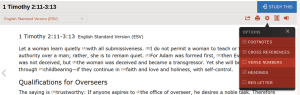
4. Go to the 1 Timothy and Titus passages by clicking on the “Read These Selected Scriptures” link at the top of today’s lesson. Recall that when the Bible was written, there were no chapter and verse numbers. (Those were added much later.) First Timothy and Titus would have read like one long, continuous letter or e-mail. Click on the “options” icon and uncheck the box next to “verse numbers”.

Now read the 1 Timothy passage, noting the flow of thought and how the end of chapter 2 is interconnected with chapter 3. What is the main idea of this passage? (OK, now click the verse numbers back on. :0)

What is the first word of verse 11? Think about women’s social status and value in Paul and Timothy’s culture, and in many cultures since that time, even today. Why does the Holy Spirit instruct pastors to “let” women learn? What does this teach us about the responsibility God places on us as women to learn His Word? Would you categorize verse 11 as a “do this” or “don’t do this” verse?

Examine verse 12. Is this mainly a “do this” or “don’t do this” verse? What two things does the Holy Spirit say women are not to do in the gathering of the church body? What does He say womenย are to do? Think about God’s nature and character. Does He ever give instructions arbitrarily or just to spoil our fun?ย Whyย does God give us commands and instructions, generally speaking? Are the instructions in verse 12 good for women and for the church?

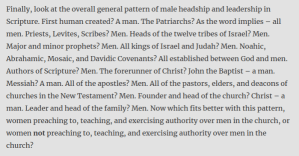
Does God haveย to give us the reasons behind His instructions, or is “because I said so” sufficient reason for us to obey Him? Take a look at 13-14. God kindly gives not one, but two reasons for His instructions in verses 11-12. What are those two reasons? How do they fall in line with God’s design for male headship and leadership across biblical history in the hierarchical structures He has set up?

The 11-15 passage starts with a “do this” verse (11), followed by a “don’t do this” (12) “and here’s why” (13-14) section, then finishes up with another “do this” verse (15).

Verse 15 can be a little cryptic to us today because we equate the word “saved” with salvation. Does verse 15 mean that women gain salvation by having children? How do we know it doesn’t? The NASB helpfully, and more accurately, renders this word as “preserved“. We don’t feel it much today, but think about the stigma women (particularly Jewish women) carried at the time this was written simply because they were daughters of Eve. Paradise was lost and the curse of sin entered the world because of aย woman, many men thought, and they viewed and treated women accordingly. Yet who was chosen to bring the Messiah into the world? And following in her footsteps, a major way godly women can “save” or “preserve” the reputation, esteem, and value of womankind is to “continue in” what 3 godly character traits? (15) Because if they continue in those three godly character traits, they will be raising up a godly seedย to the Lord (even if the children they bear aren’t perfect like Mary’s child was :0)

So we’ve seen the position womenย are to occupy in the church, followed by the positions womenย aren’t to occupy, and that’s followed, in the 1 Timothy 3 and Titus 1 passages by the p_____s m__ are to o____.

According to the 1 Timothy 3 and Titus 1 passages, which positions are men to occupy in the church? What is an overseer? (Use your cross-references if necessary.) Go through these two passages circling any words or phrases that indicate that pastors, elders, and deacons are to be men. Are these positions open to all men in the church?

Examine each of the three sections (1 Timothy 3:1-7, 3:8-13, and Titus 1:5-9) individually. How could the wife of a pastor, elder, or deacon help him, or make things easier for him, to meet the biblical requirements for his office? (Ex: How could a pastor’s wife make it easier for him to be hospitable?)


Homework

If you’d like to dig deeper on some of these passages, you may enjoy reading the following articles from myย Rock Your Role series:

All Things Being Equal (Galatians 3:28)

Order in His Courts: Silencing Women? (1 Corinthians 14:33b-35)

Jill in the Pulpit (1 Timothy 2:11-12)


Suggested Memory Verse

There is neither Jew nor Greek, there is neither slave nor free, there is no male and female, for you are all one in Christ Jesus.
Galatians 3:28