Christian women, Complementarianism, Ministry, Sin

Women Preaching: It’s Not a Secondary Doctrinal Issue

When it comes to Christianity, are the specifics of what people believe important?

I think most of us would answer a resounding “yes” to that question. Of course, the various concepts we believe are important. You can’t just believe anything you like and still be a Christian. There are certain things you must believe in order to become a Christian at all, and there are certain things you will come to believe because you are a genuinely regenerated Christian. But what are those things, and how do we know which is which?

You can’t just believe anything you like and still be a Christian.

Maybe you’ve heard the terms “essential doctrines” or “primary, secondary, and tertiary theological issues” or “first, second, and third tier levels of doctrine”? For years, theologians have been attempting to organize beliefs of the Christian faith – all drawn from the Bible, naturally – into nice neat categories in order to make things a little simpler. As someone who thrives on organization and categories, I’m grateful for their efforts. But if you begin to study this categorization of beliefs, you’ll find that we haven’t reached an across the board consensus yet.

Generally speaking, “essential”, “primary”, or “first tier” doctrines are those which you, biblically, have to believe in order to become a Christian and/or be considered a Christian. For example:

โœข Sin is a thing, and I am a sinner.

โœข God exists and is the supreme authority of the universe.

โœข Jesus was God in human flesh.

โœข Jesus rose bodily from the grave.

See how this works? If you don’t believe you’re a sinner, you’re not saved. If you don’t believe in the bodily resurrection of Christ, you’re not saved. Here’s how our friend, Pastor Gabriel Hughes, briefly outlines essential doctrines:

(Gabe later tweaked the acrostic a little and added an “S”, which I think is helpful.)
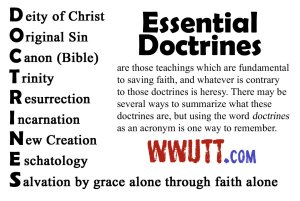
The vast majority of brand new Christians have only the most basic understanding of most of these tenets at the moment of salvation. But it’s not an issue of fully understanding – or else we’d all have to be theologians in order to get saved – it’s an issue of believing. Someone who is genuinely regenerated may not completely understand how the Trinity works (honestly, no one does), but when she’s introduced to the biblical idea of the Trinity, she believes it, learns more about it, and does not reject it.

There is typically agreement among most reputable theologians regarding what constitutes first tier doctrine. Scripture is clear about these things, and several of these issues were settled long ago by the church fathers in assorted church councils (Nicea, Chalcedon, etc.)

Secondary issues are routinely defined as non-salvific but still extremely biblically important, if not quite as biblically clear-cut as primary issues. Doctrines surrounding baptism (credo versus paedo, affusion versus immersion), for example, are usually cited as a secondary issue. A disagreement on a secondary issue doesn’t mean one person is saved and another isn’t, but it normally prevents close partnership in ministry activities involving these issues. For example, my Presbyterian friends and I can join together in pro-life ministry, but we would most likely not plant a church together.

Tertiary issues are non-salvific, less immediately urgent, biblical issues in which the Bible is even less clear-cut and open to wider (yet still biblical) interpretation. These are issues over which Christians can disagree and still maintain close doctrinal fellowship, even in the same church, if they’re in agreement on first and second tier doctrine. Eschatology – the order and timing of events at Jesus’ second coming – is a doctrine that’s often considered third tier. Someone can hold a different eschatological view than mine, yet, for the most part, it shouldn’t affect our ability to worship together, work together, or participate in the ordinances together in the same church.

Some theologians add a fourth category – issues of adiaphora, conscience, or Christian liberty. Usually these are issues of much less importance that the Bible either doesn’t specifically address, or doesn’t give commands about one way or the other. Individual Christians may use biblical principles to inform their consciences and decide for themselves. These would be things like whether or not to take your child trick-or-treating or deciding whether to dress formally or casually for church.

While theologians are largely in agreement about primary doctrines, there is wider spread disagreement on which doctrines are secondary and tertiary (many consider eschatology to be a second tier doctrine, for example) and whether or not there is a need for a category of adiaphora, since such issues are normally not considered to be “doctrinal” issues. In fact, there’s enough space for disagreement that pastors and theologians often wisely refrain from making concrete lists of secondary and tertiary doctrines.

But when we’re talking about the different levels of doctrine, what you won’t find is questions like these: Is murder a first, second, or third tier doctrine? What about gossip? Rape? Adultery? Lying? Gluttony? Pride?

And it’s not because these issues aren’t important or because the Bible doesn’t address them. It’s because they’re in a different category from the other issues: the category of sin. They aren’t doctrines upon which salvation hinges, they aren’t open to interpretation, and the Bible is clear that we are absolutely not to do these things.

The category of doctrine deals with beliefs. The category of sin deals with behavior.

In 2005, Dr. Albert Mohler wrote an excellent article about the different levels of doctrine entitled A Call for Theological Triage and Christian Maturity. He carefully explains the importance of each level of doctrine and what it covers in a plea to keep each level’s urgency in its proper place of significance during discussion, debate, and decision-making.

It was a helpful article to which I always refer people who have questions about tiers of doctrine, and I agree with Dr. Mohler’s thoughts in the article wholeheartedly1 …except on one point:

“In recent years, the issue of women serving as pastors has emerged as another second-order issue.”

Women serving as pastors, women preaching, women teaching men Scripture, and women exercising authority over men in the gathering of the Body is not a secondary issue. Nor is it a primary or tertiary issue. It does not belong in the category of “doctrine” in the same way baptism and eschatology do. It belongs in the category of sin in the same way murder, gossip, and adultery do. Let’s take a look at the reasons for this.

Women serving as pastors, preaching, teaching men Scripture, and exercising authority over men in the gathering of the Body is *not* a secondary issue. Nor is it a primary or tertiary issue. It is a sin.

I do not permit a woman to teach or to exercise authority over a man; rather, she is to remain quiet. 1 Timothy 2:12

(The preponderance of Scripture supports and affirms this concept, so to keep things simple, we’ll use this verse as an exemplar.)

โœข The prohibition in 1 Timothy 2:12 is a clear command against a certain behavior. And when we behave in a way God has prohibited, that is called “sin”. All of the tenets in the three levels of doctrine are affirmative statements regarding beliefs (you must believe in the resurrection of Christ, we believe in baptism by immersion, etc.). None of them are commands, in the negative, against sinful behavior (Thou shalt not murder, I do not permit a woman to teach… etc.)

โœข Secondary and tertiary doctrines can be open – to varying degrees – to biblical interpretation. Every stripe of non-heretical eschatological thought can provide you with chapter and verse passages that can, depending on the angle from which you approach the subject, be biblically plausible and scripturally supported. There is no biblical support for anything God prohibits. No one can cite a properly handled, in context Bible verse in which God says, “It’s OK to commit adultery,” or “Women are allowed to preach.” There can be multiple views on a secondary or tertiary issue that can all be considered biblical, but there can only be one view of sin that is biblical.

โœข Differing beliefs on true secondary and tertiary issues are not sin. My Presbyterian friends have a different view of baptism than I do. That doesn’t mean either of us is sinning. I may think their interpretations of the verses they believe support paedo baptism are incorrect, but they are not breaking any of God’s commands. Differing behavior (again, we see the distinction between doctrinal belief and sinful behavior) on issues of sin is sin. If someone behaves differently from God’s command about lying, she is sinning. If a woman behaves differently from God’s command in 1 Timothy 2:12, she is sinning.

โœข Differing beliefs on secondary and tertiary issues are not born of disobedience and rebellion toward God. Usually, it’s quite the opposite. When someone has studied a theological issue enough to hold a particular position on it, it’s usually because she is striving to please God and to be biblical in her beliefs. Differing behavior on issues of sin is born out of disobedience and rebellion toward God. Someone who steals has already decided in her heart that her desires are better than God’s command. A woman who knowingly holds improper authority over men in her church is doing so because she has already decided to defy God’s clear command against such.

โœข Because different beliefs on secondary and tertiary issues are not born of rebellion and are not sin, they do not require church discipline. Sin does require church discipline. If someone in your church is openly dishonoring her parents, she is sinning and should be subject to church discipline. If a woman is pursuing a career as a pastor, she is sinning and should be subject to church discipline. 

Since the publication of Dr. Mohler’s article (and perhaps as a result of others teaching the same thing) the idea of the violation of 1 Timothy 2:12 being a “secondary doctrine” has spread in a most unhelpful way, leading many Christians to treat the issue in a c’est la vie, “We can just agree to disagree on this,” manner.

No, we cannot.

The idea of the violation of 1 Timothy 2:12 being a “secondary doctrine” has spread in a most unhelpful way, leading many Christians to think “We can just agree to disagree on this.”. No, we cannot.

We would not say, “We can agree to disagree,” on lying or adultery or homosexuality or abortion, and we cannot say it about women preaching, teaching men, or holding unbiblical authority, either. We disciple and teach a sister in Christ who is unaware of what the Bible says on these matters, and if she is committing any of these sins, we begin the process of church discipline. But it would not be loving toward her, or honoring God, to allow her to continue in biblical ignorance or in willful sin.

Furthermore, the violation of 1 Timothy 2:12 brings with it dangers to the church that true secondary and tertiary issues, and even many sins, do not…

The violation of 1 Timothy 2:12 brings with it dangers to the church that true secondary and tertiary issues, and even many sins, do notโ€ฆ

She may not say it with her lips, but when a woman preaches to men in defiance of Scripture, sheโ€™s teaching false doctrine through her behavior. What is the false doctrine sheโ€™s teaching? โ€œI donโ€™t have to obey Godโ€™s Word, and neither do you. If thereโ€™s a part of the Bible you donโ€™t like, youโ€™re free to disregard it.โ€ If your pastor stood up in the pulpit on Sunday morning and said that in words, youโ€™d run him out of town on a rail, and rightly so. Neither should a woman be able to teach that same false doctrine via her actions.

Additionally, I have mentioned several times when dealing with this issue that women preaching to men is highly correlated with women teaching other forms of false doctrine. I have researched scores of women teachers. Every single one of them who unrepentantly teaches men also teaches false doctrine in some other aspect of her theology (usually progressivism, Word of Faith, or New Apostolic Reformation). In other words, if a woman teaches men, you can just about take it to the bank that she also teaches additional false doctrine. False doctrine and heresy are infecting the church – via female preachers – at an alarming rate.

We dare not simply “agree to disagree” on this.

The violation of God’s command that women are not to instruct men in the Scriptures nor hold improper authority over men is a sin like any other. It is not a doctrinal issue in the same sense that other second and third tier doctrines are. If left undisciplined, however, it can lead to first tier doctrinal issues infiltrating a church and eventually destroying it. It is detrimental to the church to label and treat any sin as a secondary doctrinal issue.

Additional Resources

Is Women Preaching a Secondary Issue? on A Word Fitly Spoken

What Are Essentials and Non-Essentials? on A Word Fitly Spoken

Christian Liberty on A Word Fitly Spoken

The importance of Primary and Secondary Doctrines on the Truth Be Known Podcast


1In the years since 2018, when this article was originally written, Dr. Mohler has said, done, and supported various biblically questionable things, leading some to question whether or not he has “gone woke”. While I don’t support his stance on those questionable things, I also don’t believe he has reached the point at which I need to warn against him (although I don’t proactively recommend him, either). To my knowledge, at this time, he is still generally doctrinally sound.

Calvinism/Arminianism, Mailbag

The Mailbag: Should I leave a Wesleyan church?

Readers, please note:
Comments attempting to debate Calvinism vs. Arminianism, or questioning the salvation of Calvinists or Arminians, will not be published.

A few years ago, we had to leave our church. In the area we live in, church teaching is mostly fluffy and there’s a lot of worldliness. We “settled” for a church in which we know the pastor and his wife personally. The pastor lives the Word he preaches.

The problem I have with the church is the doctrine of the denomination. They are a Wesleyan holiness background – Arminian. This past year I’ve done some doctrine study on my own to understand the differences in the Calvinism / Arminian camps more fully. I do not agree with some of the doctrinal stances of the church. Are these big enough issues to leave? Am I being too critical?

Finding a doctrinally sound church is probably the number one problem I hear about from readers, and it just breaks my heart. I dearly wish every church out there taught sound doctrine so this would no longer be an issue for Christians. If your pastor preaches sound doctrine and makes sure it’s taught in your church, be sure to give him a hug and tell him thank you.

I needed a quick brush up on Wesleyan theology, and some of my readers may not be too familiar with it, so let me start off with recommending two brief articles: Wesleyan-Holiness Theology and Who are the Wesleyans, and what are the beliefs of the Wesleyan Church?

Though much of what Wesley originally taught was biblical and doctrinally sound, two major doctrines were not: sinless perfection (also known as entire sanctification) and the idea that a genuinely regenerated Christian can lose her salvation.

Wesley recorded the experiences of others whom he had no doubt were delivered from all sin and filled entirely with the pure love of God.”

Whether one defines “perfection” as “completely without sin” or “growth and maturity in Christ,” the idea that either can be achieved in a human lifespan in this fallen world should be a no-brainer for anyone who’s truly born again and who takes a few minutes for introspection and logical thought – no prooftext needed.

The fallenness of this world will never stop providing temptations for Christians to sin. Those temptations will be there, and you will continue to give in to them until the moment you die, regardless of how long you live. Furthermore, the longer you grow in holiness, the more God opens your eyes to sins of the heart that you didn’t even realize you were committing. Bitterness, complaining, jealousy, idolatry, pride… The longer you live, the more sinful you realize you are. Ask the finest Christian you know, on his death bed, if he no longer gives in to temptation, if he no longer sins, if he has reached the point of complete spiritual maturity, and he will say to you, with Paul, “Wretched man that I am! Who will deliver me fromย the body of thisย death?”.

Christian, you know your heart and your walk with the Lord – can you imagine ever getting to any point in your life at which you could say you were as perfectly sinless and mature as Jesus was?

The belief that someone who has been genuinely born again in Christ can lose her salvation is directly refuted by multiple passages of Scripture. The reason it can look to us as though someone has lost or forfeited her salvation – “deconstructed” or “left the faith,” if you will – is because, although many can fake it pretty well, that person was never genuinely saved in the first place. I’ve discussed the Scriptures dealing with the false doctrine of losing one’s salvation in my article The Mailbag: Can unforgiveness cause you to you lose yourย salvation?.

Let me also clarify that, while Wesleyans who hold to the tenets outlined in the articles on Wesleyism linked above areย Arminians*, not all Arminians would agree with all of the tenets of Wesleyan theology. (Kind of an “All Wesleyans are Arminians, but not all Arminians are Wesleyans,” thing.)

*Just a little FYI for Christians who find themselves in discussions about Arminianism. ArmInian is spelled with an “I” in the middle. An ArmEnian (with an “E” in the middle) is a citizen of the Asian nation of ArmEnia. It is quite possible to be either a Calvinist Armenian or an Arminian Armenian :0)

To illustrate, I know a great many Southern Baptists whose beliefs could technically be classified as Arminian, but they would reject the Wesleyan notions of sinless perfection and the idea that a genuinely regenerated Christian can lose his salvation.

There’s a broad spectrum of Arminianism. Some Arminian churches are so biblical and handle God’s Word so well that a Calvinist could joyfully join one and find minimal disagreement with the preaching and teaching. I am Reformed and I happen to be a member of just such a church.

Finally, in addition to the formal doctrines of sinless perfection, losing one’s salvation, and Arminianism taught by Wesley, a lot can happen in 250+ years, and while I’m sure there are some small pockets of sound doctrine in individual Weseleyan churches somewhere out there, Wesleyism is now fraught with false doctrine of all sorts. This false doctrine mostly manifests itself as progressivisim (wokeness, egalitarianism, social justice, affirmation of perversion, etc.), but there are also examples of New Apostolic Reformation false doctrine as we saw a few years ago in the Asbury “Revival”.

You don’t state which Wesleyan doctrine(s) you find troublesome, so I’m not comfortable saying whether or not you’re being too picky and whether or not you should leave this church.

Another factor at play is how hard this pastor hammers the doctrines you’re uncomfortable with. A pastor who, for example, reluctantly keeps sinless perfection in the back closet because the church sign says “Wesleyan” but never talks about it from the pulpit is a different situation from a pastor who regularly preaches on sinless perfection and says you can’t be saved if you don’t believe this doctrine.

You also need to consider what your other options for churches are if you leave this one. Are there any churches within achievable driving distance that are more doctrinally sound than the one you’re attending? (You might find the resources in the “Searching for a new church?” tab at the top of this page to be helpful.)

The final piece of the puzzle, and probably the determining factor, is your husband. What does he think about all of this, and how is he leading your family? Is he saved? Generally doctrinally sound? I’m surmising the two of you are at least somewhat on the same theological page since you left the last church together and settled on this one together. If he is not leading you to sin, you will need to submit to his decision on this matter.

My counsel would be for you and your husband to make an appointment with your current pastor to ask questions and find out where he stands on all the Wesleyan doctrines. Then, you and your husband should take some time (a few weeks, a few months, whatever it takes) to search the Scriptures and pray about it together, as well as look at your options for other churches. Give your husband your input and let him know you’ll support whatever decision he makes.


Additional Resources

What is Arminianism, and is it biblical? at Got Questions

Calvinism vs. Arminianism – which view is correct? at Got Questions

Arminianism and Calvinism at Theopedia


If you have a question about: a Bible passage, an aspect of theology, a current issue in Christianity, or how to biblically handle a family, life, or church situation, comment below (Iโ€™ll hold all questions in queue {unpublished} for a future edition of The Mailbag) or send me an e-mail or private message. If your question is chosen for publication, your anonymity will be protected.


Calvinism/Arminianism, Church, Holidays (Other), Reformation Day

The Five Solas of the Protestant Deformation

This year marks the 500th anniversary of the beginning of the Protestant Reformation. October 31, 2017 will commemorate the date in 1517 when Martin Luther famously nailed his 95 theses – a list of grievances against the Catholic church for unbiblical doctrines and practices – to the door of Castle Church in Wittenberg, Germany.

Lutherโ€™s calls for reform spread quickly throughout Europe, inspiring the likes of church fathers Ulrich Zwingli (Zurich), John Calvin (Geneva), and John Knox (Scotland) to join the effort in their own locales. As they worked to address the issues raised in Lutherโ€™s document, these men codified what we know today as the โ€œFive Solas of the Reformation,โ€ the basis of Protestant church doctrine. The five solas are:

1. Sola Scripturaโ€“ Scripture alone is the basis for all church doctrine, belief, and practice. (2 Timothy 3:16-17)

2. Sola Gratiaโ€“ Salvation is by grace alone. It is an unmerited gift of God based solely on His goodness, not our own (because we donโ€™t have any). (Ephesians 2:8-9)

3. Sola Fideโ€“ Salvation is through faith alone. Faith is a gift bestowed by God. We are saved only by placing that faith in Christโ€™s finished work on the cross, not by doing good works or by any other attempts to earn salvation. (Ephesians 2:8-9)

4. Solus Christusโ€“ Salvation is found in Christ alone. As Acts 4:12 says, โ€œAnd there is salvation in no one else, for there is no other name under heaven given among men by which we must be saved.โ€

5. Soli Deo Gloriaโ€“ God saves man for Godโ€™s glory alone, and Believers are to live our lives to glorify Him alone. (Romans 11:36)

The five solas should be the foundation of the church’s orthodoxy (beliefs or doctrine) and our orthopraxy (church practices). But over the past five centuries there’s been a declension. A downgrade. The church has become deformed from the beautiful biblical portrait of a bride “without spot or wrinkle or any such thing, that she might be holy and without blemish” because we’ve functionally replaced the Five Solas of the Reformation with pragmatic, and often idolatrous, solas of our own making…

No longer is Christian doctrine and practice governed strictly by sola Scriptura, especially among Christian women. Now it’s all about our own personal feelings, opinions, and life experiences. Won’t go to a church that preaches sin and repentance because it offends your sensibilities? You’ve become accepting of homosexual “marriage” because someone you love dearly has adopted that lifestyle? Believe God is in the habit of talking to people because you’ve “heard His voice”? Then you’re basing your doctrine and practices on your own feelings and experiences rather than on what the Bible says.

The Christian’s instructions for life and godliness are found in only one place: the Bible. We do not squish Christianity into the mold of what makes us happy, what we agree with, our relationships with others, or the things we’ve experienced. We start with the Bible and we bring everything else in our lives – everything we think, feel, believe, say, and do – into submission to it. If a personal feeling, opinion, or experience conflicts with Scripture, it is wrong. We don’t change Scripture to fit our perspective, we change our perspective to fit Scripture.

We don’t change Scripture to fit our perspective, we change our perspective to fit Scripture.

If you want to know what road the modern church is headed down simply pick up your Bible and turn to… the Old Testament. Especially the verses that say “everyone did what was right in his own eyes.” Jesus said the way to greatness was humility, servanthood, and anonymity. We want glory, recognition, and applause. God says, “walk in My ways.” We say, “I’ll consider that if it fits in with my plans, is agreeable to me, and makes me look good to others.” We “welcome” the Holy Spirit into His own church as though we own the place. We are so used to being on the throne of our own lives that we use words like “letting” or “allowing” God to do something without even realizing it. We don’t ask, “Is it pleasing to God?”, we say, “If it’s pleasing to me, it must be pleasing to God.” Goodbye soli Deo gloria. Hello soli ego gloria.

Instead of asking, “Is it pleasing to God?”, we say, “If it’s pleasing to me, it must be pleasing to God.”

More and more, “Christians” are driven by the selfish greed of “What can God do for me?” rather than the pursuit of holiness. So-called Christian teachers who will scratch itching ears are sought out, and an abundance of hucksters are at the ready, eager to “give the people what they want” in order to make a fast buck.

These people who claim the name of Christ care nothing about following in His footsteps – or even knowing what those footsteps are – craving instead the temporal creature comforts of wealth, success, popularity, health, self esteem, and influence. They want to be told what their flesh wants to hear, and they want to believe that’s Christianity. Share in Christ’s sufferings? Never. Away with the Via Dolorosa. Lead us down the primrose path.

Share in Christ’s sufferings? Never. Away with the Via Dolorosa. Lead us down the primrose path.

Spotlights. Merch. Audiences of thousands. Agents. Entourages. Sometimes it’s hard to tell the Christian celebrities from the secular. The star-struck church has created its own caste system in which biblical fidelity is measured by how many books you’ve sold, the number of attendees at your megachurch or conferences, and the size of your audience on social media. That many followers? That number of bestsellers at the Christian retail chain? She must know what she’s talking about. We’ll use her books for our women’s “Bible” study – no vetting necessary! But that 85 year old pastor who’s been faithfully expositing the Word to his rural congregation of twenty for the better part of his life? No kudos. No esteem for honorable servants of the Lord such as he. We want glitz and glam and hype and bling. We want to be cutting edge, relevant, and attractional. Because maybe – just maybe – some of that glory will rub off on us. And so it goes – we follow the latest and greatest Christian authors, bands and personalities, attracted more to their pretty faces, stylish clothes, and charisma than to sound doctrine, while Christ’s sheep, relegated to a dark corner of the sanctuary, bleat to simply be fed the Bread of Life and the Living Water.

The star-struck church has created its own caste system in which biblical fidelity is measured by how many books you’ve sold, the number of attendees at your megachurch or conferences, and the size of your audience on social media.

What’s hot rightthisminute? What’s the current style, the latest trend, the fad du jour? The Church of What’s Happening Now wants to know. Whether it’s today’s Christian bestseller that simply every small group is using now, dahling, or caving to whichever way the wind is blowing today when it comes to the world’s sexual morality, if we can just ride the viral wave of the immediate we can get people in the doors, money in the offering plate, and souls into Heaven. Maybe.

Vox populi, vox Dei? Have we forgotten how uncool it was to be the only one building an ark before rain was invented? That idol worship was the latest thing going in Jeremiah’s day? That it was the crowds who cried “Crucify Him!”?

The God of the Bible is not hip and groovy. He’s seen as hopelessly out of touch with current morals and values. A doddering old fool who just can’t seem to get with the times. His holy ways are antiquated and obsolete. We’re modern and educated and wise to the ways of the world. We know better how His church and our lives should run.

The God of the Bible is not hip and groovy.

Just what is it we’re building our Christian doctrine and practices on these days? ‘Cause it sure isn’t the unadulterated written Word of God and the original five solas. Maybe it’s time we took a good hard look at how far we’ve slidden in the last five hundred years. How far we’ve strayed from the purity of Scripture and doctrine the Reformers worked so hard for, were imprisoned and persecuted for, were martyred for.

Maybe it’s time for another Reformation.


Additional Resources:

NEW! Why We’re Protestant: The Five Solas of the Reformation and Why They Matter by Nate Pickowicz

What was the Protestant Reformation? at Got Questions

5 Questions and the 5 Solas at The Cripplegate

Reformation Resources to Feed Your Heart and Mind at G3 Ministries

Entertainment, Movies, Sanctification

Don’t Get Your Theology from the Movies

I recently received the kindest e-mail from a sweet lady at a movie subscription service – sort of a “family-friendly” version of Netflix – asking me to write an article pointing my readers to the movie subscription service (hereafter: “MSS”) as a resource for whatever issue I was addressing in the article:

I am hoping to hear your advice on some ways to relay valuable lessons to others in a post on your page. Maybe you have used a book or a movie to help someone better understand how to deal with bullying. Or maybe you have used parables from the Bible to demonstrate how to deal with a tough situation. We would love our movies to be a resource for your readers to utilize as a tool, since we have many relevant Christian movies and shows.”

This is a brilliant and creative marketing/publicity strategy, and I really admire whoever it was at the MSS who came up with and implemented this idea. It’s grassroots, it reaches their target audience, they get to harness the creativity and energy of the bloggers they contact, and it’s free. Very smart.

Nice people, smart marketing, a variety of attractive products, the desire to help others, a company built on wholesome morality- what’s not to endorse, right? And if they were selling hand cream or light bulbs or waffle irons, I’d agree.

The thing is, when you sell something, that product is supposed to correctly fill a need your potential customers have. You sell hand cream to people with dry hands, light bulbs to people wondering why they’re sitting around in the dark, and waffle irons to people who want to enjoy breakfast in their jammies rather than driving across town to IHOP.

But this MSS is not selling you the right tool for your problem. Though I’m sure they have the noblest of intentions, they’re attempting to sell you a waffle iron to rake your yard with: movies as theology.

Though I’m sure they have the noblest of intentions, they’re attempting to sell you a waffle iron to rake your yard with: movies as theology.

I like movies. I watch them all the time with my family (at home- have you seen the price of a movie ticket lately?!?!). But movies are for leisure time fun and entertainment, not for proper instruction on how to live a godly life or the way to solve personal problems, and certainly not for what to believe about God, as we’ve recently seen with The Shack debacle. When Christians have issues, questions, and problems, we don’t go to the movies, we go to the Bible.

When Christians have issues, questions, and problems, we don’t go to the movies, we go to the Bible.

God’s word is the primary source document for Christians. It is the authority that governs our thoughts, words, and deeds. It is the sufficient answer to any question we might have about life and godliness. Above any other advice, instruction, help, or input, we need the Bible, and we can rest assured that its counsel is always right and trustworthy since its words come straight from the lips of God.

But just for the sake of argument, let’s try it the MSS’s way. Let’s say you do have the problem of being bullied. And let’s say this MSS has a good movie about a character in similar life circumstances to yours who overcomes being bullied. So you watch it, hoping to get some advice on how to handle your own problem. You’re a Christian, so, by definition, you want to address the situation without sinning, in a way that pleases God, and, hopefully, in a way that is conducive to sharing the gospel with the bully.

How do you know whether or not the character in the movie overcame her bullying problem in a godly way? That’s right- you have to open your Bible, study it, and compare what she did in the movie with rightly handled, in context Scripture. So why not just go straight to the Source and spend the hour and a half you invested in the movie studying Scripture instead?

Another issue with watching movies to learn how to solve your problems or teach you how to live rightly is that doing so subtly trains you in poor hermeneutics. It trains you to follow the example of a character who is just as broken, sinful, and unwise as you are instead of looking directly to the perfect, holy, infallible instruction of God Himself. Which is often the way people incorrectly read the Bible.

As I’ve previously mentioned, there are two main types of Scripture: descriptive and prescriptive. Like a movie, descriptive passages describe something that happened: Noah built an ark. Esther became queen. Paul got shipwrecked. These passages simply tell us what happened to somebody. Prescriptive passages are commands or statements to obey. Donโ€™t lie. Share the gospel. Forgive others.

If we wanted to know how to have a godly marriage, for example, we would look at passages like Ephesians 5:22-33, 1 Corinthians 7, and Exodus 20:14,17. These are all passages that clearly tell us what to do and what not to do in order to have a godly marriage.

What we would not do is look at Davidโ€™s and Solomonโ€™s lives and conclude that polygamy is Godโ€™s design for marriage. We would not read about Hosea and assume that God wants Christian men to marry prostitutes. We would not read the story of the woman at the well and think that being married five times and then shacking up with number six is OK with Jesus. All of which is the same reason we should not be watching movies – even “Christian” movies – as a resource for godly living.

“But,” the kind MSS lady would probably reassure me, “our MSS also has non-fiction videos of pastors and Bible teachers that could be helpful.” And indeed they do. There are a handful of documentaries on missionaries, some of the Reformers, current moral and societal issues, and Bible teaching that look like they could be solid. The problem is, they’re mixed in with the likes of Joyce Meyer, John Hagee, Henri Nouwen, Greg Laurie, a plethora of Catholic leaders, and even those who don’t claim to be Christians like Betty White, Frank Sinatra, and Liberace. The few videos with good teaching are combined with many that teach worldly ideas, signs and wonders, mysticism, Bible “codes” and “secrets,” false prophecy, faulty eschatology, and other false doctrine.

It’s a great example of why God tells Christians we’re not to receive false teachers nor to partner with them, as, sadly, this MSS has chosen to do. Mixing biblical truth with false teaching confuses people. A little leaven leavens the whole lump.

When a little bit of truth is mixed in with the false, how are we to know which is which? We have to do exactly what the Bereans did with Paul- examine the teachings against Scripture, accept what matches up and reject what doesn’t. Again, why spend the time and confusion searching for, hoping you’ve found, and watching a video you’re not sure will teach you biblical truth when you could simply pick up your Bible, study it, and confidently believe what God says about the issue instead?

There are some good, clean movies on this MSS that would make for an enjoyable evening of family fun, and there’s certainly nothing wrong with that. But for instruction in holy living and resolving the dilemmas of life in a godly way, we need to use the right tool for the job: the Bible.

Rake your yard with a rake, not a waffle iron.

Rake your yard with a rake, not a waffle iron.

Doctrinally Sound Teachers

Even More Biblically Sound Blogs and Podcasts by Christian Women

even-more-blogs-podcasts

This article has been updated and moved. You can now find it at:

Doctrinally Sound Christian Women to Follow โ€“ 3