Ruth Bible Study

Ruth: Lesson 3

Previous Lessons: 1, 2

Ruth 2

Now Naomi had a relative of her husband’s, a worthy man of the clan of Elimelech, whose name was Boaz. And Ruth the Moabite said to Naomi, “Let me go to the field and glean among the ears of grain after him in whose sight I shall find favor.” And she said to her, “Go, my daughter.” So she set out and went and gleaned in the field after the reapers, and she happened to come to the part of the field belonging to Boaz, who was of the clan of Elimelech. And behold, Boaz came from Bethlehem. And he said to the reapers, “The Lord be with you!” And they answered, “The Lord bless you.” Then Boaz said to his young man who was in charge of the reapers, “Whose young woman is this?” And the servant who was in charge of the reapers answered, “She is the young Moabite woman, who came back with Naomi from the country of Moab. She said, ‘Please let me glean and gather among the sheaves after the reapers.’ So she came, and she has continued from early morning until now, except for a short rest.”

Then Boaz said to Ruth, “Now, listen, my daughter, do not go to glean in another field or leave this one, but keep close to my young women. Let your eyes be on the field that they are reaping, and go after them. Have I not charged the young men not to touch you? And when you are thirsty, go to the vessels and drink what the young men have drawn.” 10 Then she fell on her face, bowing to the ground, and said to him, “Why have I found favor in your eyes, that you should take notice of me, since I am a foreigner?” 11 But Boaz answered her, “All that you have done for your mother-in-law since the death of your husband has been fully told to me, and how you left your father and mother and your native land and came to a people that you did not know before. 12 The Lord repay you for what you have done, and a full reward be given you by the Lord, the God of Israel, under whose wings you have come to take refuge!” 13 Then she said, “I have found favor in your eyes, my lord, for you have comforted me and spoken kindly to your servant, though I am not one of your servants.”

14 And at mealtime Boaz said to her, “Come here and eat some bread and dip your morsel in the wine.” So she sat beside the reapers, and he passed to her roasted grain. And she ate until she was satisfied, and she had some left over. 15 When she rose to glean, Boaz instructed his young men, saying, “Let her glean even among the sheaves, and do not reproach her. 16 And also pull out some from the bundles for her and leave it for her to glean, and do not rebuke her.”

17 So she gleaned in the field until evening. Then she beat out what she had gleaned, and it was about an ephah of barley. 18 And she took it up and went into the city. Her mother-in-law saw what she had gleaned. She also brought out and gave her what food she had left over after being satisfied. 19 And her mother-in-law said to her, “Where did you glean today? And where have you worked? Blessed be the man who took notice of you.” So she told her mother-in-law with whom she had worked and said, “The man’s name with whom I worked today is Boaz.” 20 And Naomi said to her daughter-in-law, “May he be blessed by the Lord, whose kindness has not forsaken the living or the dead!” Naomi also said to her, “The man is a close relative of ours, one of our redeemers.” 21 And Ruth the Moabite said, “Besides, he said to me, ‘You shall keep close by my young men until they have finished all my harvest.’” 22 And Naomi said to Ruth, her daughter-in-law, “It is good, my daughter, that you go out with his young women, lest in another field you be assaulted.” 23 So she kept close to the young women of Boaz, gleaning until the end of the barley and wheat harvests. And she lived with her mother-in-law.


The Holy Bible, English Standard Version. ESV® Permanent Text Edition® (2016). Copyright © 2001 by Crossway Bibles, a publishing ministry of Good News Publishers.


Questions to Consider

1. What is the backdrop of activity/time of year (23) as this chapter opens?

2. What is gleaning? Who was gleaning to provide for according to Levitical law? Where did Ruth and Naomi fit into this law? What sorts of things would Boaz have done to obey this law? (cf. 15,16) How is gleaning an example of God’s love and care for all of His people? How can the gleaning laws serve as an example to the church today?

3. Did Ruth know who Boaz was before she got home and Naomi told her? (19-20) Did Boaz know who Ruth was? How does this demonstrate God’s sovereignty, providence (2-3- Did Ruth really just “happen” to come to Boaz’s field?), the infallibility of His plans, and the truth of verses such as Proverbs 3:5-6?

4. Examine verses 1, 4, 8-16. Write a brief character sketch or description of Boaz. Boaz is a type of Christ. What are some aspects of Boaz’s character that point ahead to the character of Christ? How does Boaz’s (an Israelite) open arms welcome of Ruth (a non-Israelite foreigner) point ahead to God’s inclusion of Gentiles in salvation?

5. Since the story of Ruth and Boaz points so strongly to Christ and to the inclusion of Gentiles in salvation, may we assume that verses 10-12 mean that we will find favor with God, and that He will save us, on the basis of our own good works? Why not?

6. Compare verse 20 with Naomi’s outlook and attitude in chapter 1. How has her focus and perspective changed? How can thankfulness and recognizing how God has blessed us change us from bitter “Maras” to pleasant “Naomis”?

7. Which fruit of the Spirit is most prominently displayed by Ruth to Naomi and Boaz to Ruth? Ask God to grow you in this area and help you find ways to display it to others.


Homework

Boaz’s kindness toward Ruth gave Him an opportunity to “share the gospel” (12-13) – so to speak – with her. This week, look for opportunities to take the time to show kindness to others. Be ready to share the gospel, or even just a tract, with anyone who is receptive.

Obedience, Sanctification

Throwback Thursday ~ Order My Steps

Originally published November 4, 2010

Whatever I command you, you shall be careful to do; you shall not add to nor take away from it. Deuteronomy 12:32

Remember long division? Some of us probably remember it fondly. For others, it was a nightmare of ghoulish proportions. Likely, most of us can still remember how to do it.

Ever tried to teach it to an eight year old?

That was my life last week.

If you think about it, it’s really not that any of the steps in long division are that hard. You have to know your times tables and you have to know how to subtract. That’s pretty much it as far as mathematical operations go. The tough part is working step by step and getting all the steps in the right order. One number out of place, one step out of order, and the whole thing falls apart.

And then, so does your eight year old.

The Old Testament is the story of long division. God told His people what to do, how to do it, and in what order to do it…

Bring Me the firstfruits, then you can use what is left.

Marriage first, then sex.

Work six days, then rest.

Put Me first in everything.

He spelled it all out for them, even carved it in stone, and still, they couldn’t get it. Many times, the majority of them gave up even trying and openly rebelled. For others, initially desiring to be obedient, striving became the order of the day. They added layers and layers of rules on top of the ones God had given to protect themselves from even coming close to breaking God’s original commands. And somewhere along the way, they lost the heart of God, and began to worship rule-keeping. Their steps were out of order at the deepest and most basic level, and things fell apart for them. Often. And badly.

But don’t judge the Israelites harshly. We do exactly the same thing. Some of us rebel. Some of us strive. And both ways are equally displeasing to God.

Because the first step in coming to God is to realize and admit that we can’t get it right. God never intended that we should be saved and in right standing with Him by keeping His Law and doing good deeds. Galatians 3:24 tells us that the whole purpose of the Law was to show us that we can’t keep it, and to lead us to throw ourselves upon the mercy of God for forgiveness and salvation.

Does God desire our obedience? Of course. But not as a way to garner His favor or to outweigh the bad things we’ve done. Because it’s not our outward behavior itself that pleases Him, it’s a heart that’s wholly His. He desires that we obey out of a heart of love and gratitude to Him for saving us.

Love Him first, then obedience will be a natural outflow.

Just take it one step at a time.

Ruth Bible Study

Ruth: Lesson 2

Previous Lessons: 1

Ruth 1

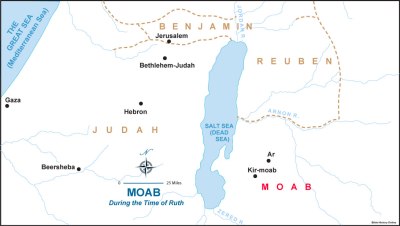
Photo courtesy of bible-history.com

In the days when the judges ruled there was a famine in the land, and a man of Bethlehem in Judah went to sojourn in the country of Moab, he and his wife and his two sons. 2 The name of the man was Elimelech and the name of his wife Naomi, and the names of his two sons were Mahlon and Chilion. They were Ephrathites from Bethlehem in Judah. They went into the country of Moab and remained there. 3 But Elimelech, the husband of Naomi, died, and she was left with her two sons. 4 These took Moabite wives; the name of the one was Orpah and the name of the other Ruth. They lived there about ten years, 5 and both Mahlon and Chilion died, so that the woman was left without her two sons and her husband.

6 Then she arose with her daughters-in-law to return from the country of Moab, for she had heard in the fields of Moab that the Lord had visited his people and given them food. 7 So she set out from the place where she was with her two daughters-in-law, and they went on the way to return to the land of Judah. 8 But Naomi said to her two daughters-in-law, “Go, return each of you to her mother’s house. May the Lord deal kindly with you, as you have dealt with the dead and with me. 9 The Lord grant that you may find rest, each of you in the house of her husband!” Then she kissed them, and they lifted up their voices and wept. 10 And they said to her, “No, we will return with you to your people.” 11 But Naomi said, “Turn back, my daughters; why will you go with me? Have I yet sons in my womb that they may become your husbands? 12 Turn back, my daughters; go your way, for I am too old to have a husband. If I should say I have hope, even if I should have a husband this night and should bear sons, 13 would you therefore wait till they were grown? Would you therefore refrain from marrying? No, my daughters, for it is exceedingly bitter to me for your sake that the hand of the Lord has gone out against me.” 14 Then they lifted up their voices and wept again. And Orpah kissed her mother-in-law, but Ruth clung to her.

15 And she said, “See, your sister-in-law has gone back to her people and to her gods; return after your sister-in-law.” 16 But Ruth said, “Do not urge me to leave you or to return from following you. For where you go I will go, and where you lodge I will lodge. Your people shall be my people, and your God my God. 17 Where you die I will die, and there will I be buried. May the Lord do so to me and more also if anything but death parts me from you.” 18 And when Naomi saw that she was determined to go with her, she said no more.

19 So the two of them went on until they came to Bethlehem. And when they came to Bethlehem, the whole town was stirred because of them. And the women said, “Is this Naomi?” 20 She said to them, “Do not call me Naomi; call me Mara, for the Almighty has dealt very bitterly with me. 21 I went away full, and the Lord has brought me back empty. Why call me Naomi, when the Lord has testified against me and the Almighty has brought calamity upon me?”

22 So Naomi returned, and Ruth the Moabite her daughter-in-law with her, who returned from the country of Moab. And they came to Bethlehem at the beginning of barley harvest.


The Holy Bible, English Standard Version. ESV® Permanent Text Edition® (2016). Copyright © 2001 by Crossway Bibles, a publishing ministry of Good News Publishers.


Questions to Consider

1.  Briefly review the background and setting of the book of Ruth from lesson 1 (link above).

2. What does verse 1 tell us about the period of Israel’s history in which the events of the book of Ruth take place? As we learned in lesson 1, Jair was most likely judging Israel at this time. What else does verse 1 tell us was happening in Israel as the story opens?

3. Describe the sequence of events in verses 1-5 in your own words. Who are each of the people in this passage, and how are they related to one another? What is an Ephrathite?

4. On the map, trace Naomi’s family’s journey to and from Moab. What does the Old Testament tell us about Moab and the Moabites? Were they enemies or allies of Israel? Were they worshipers of God or of idols? What had happened the last time Israel joined with Moab? Did God want His people mingling with the Moabites?

5. Compare Naomi and Ruth’s journey (6) from the pagan land of Moab back to Israel, the Promised Land of God’s people, with the prodigal son’s journey from the pig pen back to his father’s house. How can both of these stories symbolize passing from death in sin to life in Christ?

6. In verses 8-13, what is Naomi’s main concern for Ruth and Orpah? Considering the culture and socio-economic status of women at that time, was this a valid concern? But considering the fact that Ruth and Orpah would be returning to a life of idolatry (15) if they stayed in Moab, why didn’t Naomi concern herself more with their spiritual state and urge them to come back to Bethlehem with her? Is it possible Ruth was already a believer and didn’t want to stay in a land of idolatry? Could this have been one of the things on Ruth’s mind in verses 16-17? (Note Ruth’s mention of “God” in 16 and her invoking of “the Lord” in her vow in 17).

7. Look at the footnotes on verse 20. What do the names “Naomi” and “Mara” mean? Describe Naomi’s outlook and attitude in verses 20-21. The Bible tells us to give thanks in all circumstances. Naomi had certainly been through some sad and difficult times, but she had many things to be thankful for. What were some of those things? What impact might it have had on the women of Bethlehem (19) if Naomi had testified to God’s love, care, and faithfulness in her adversity instead of spewing bitterness?

8. Which of God’s attributes do we see displayed in this chapter? Point to examples in the text of God’s sovereignty, provision, guidance, and other attributes you see.


Homework

Like Naomi, sometimes we can get so wrapped up in our own problems and suffering that we don’t think about what our attitude, words, and demeanor are saying to others about God. Think about a difficult time you’ve experienced in the past (or may be experiencing now). How did you talk about it to others? With bitterness and complaints? What were some things you could have been thankful to God for in that situation? What impact might it have had on those around you if you had testified to God’s love, care and faithfulness instead? Might your testimony about God’s goodness during your suffering have led to an opportunity to share the gospel with someone?

Ruth Bible Study

Ruth: Lesson 1

Welcome to our new study of Ruth! There are so many captivating facets to the book of Ruth: it’s a snippet of Old Testament history, a beautiful romance, a demonstration of God’s love and value of women, a foreshadowing of Christ- our Redeemer. Over the next several weeks, we’ll be taking a look at all these treasures – and more – that God has for us to discover through Ruth’s story.

Let’s get started!

Introduction to the book of Ruth:

Before we begin studying a book of the Bible, it’s very important that we understand some things about that book. We need to know…

Who the author was and anything we might be able to find out about him or his background.

Who the audience of the book is: Jews or Gentiles? Old Testament Israelites or New Testament Christians? This will help us understand the author’s purpose and approach to what he’s writing.

What kind of biblical literature we’re looking at. We approach books of history differently than books of wisdom, books of wisdom differently than books of prophecy, etc.

What the purpose of the book is. Was it written to encourage? Rebuke? Warn?

What the historical backdrop is for the book. Is Israel at war? At peace? In exile? Under a bad king? Good king? Understanding the historical events surrounding a piece of writing help us understand what was written and why it was written.

When the book was written. Where does the book fall on the timeline of biblical history? This is especially important for Old Testament books which are not always arranged in chronological order.

So this week, before we start studying the actual text of the book of Ruth, we need to lay the foundation to understanding the book by finding the answers to these questions.

Read the following overviews of the book of Ruth, taking notes on anything that might aid your understanding of the book, and answer the questions below:

Bible Introductions: Ruth at Grace to You

Overview of the Book of Ruth at Reformed Answers

Book of Ruth at Got Questions

1. Who wrote the book of Ruth? Does the fact that we don’t definitively know the author’s name mean we can’t trust the biblicality of this book?

2. What is the approximate date Ruth was written? During what period of Israel’s history (kings, exile, judges, antediluvian, etc.) was Ruth written?

3. Considering the period of Israel’s history during which Ruth was written, who do you think is the intended audience of the book of Ruth? Why?

4. Which genre of biblical literature is the book of Ruth: law, history, wisdom, poetry, narrative, epistles, or prophecy/apocalyptic? What does this this tell us about the approach we should take when studying this book versus our approach to books of other genres?

5. What is the theme or purpose of the book of Ruth?

6. Who are the main characters in the book of Ruth?

7. Where do the events in the book of Ruth take place? (Sometimes, a good Bible map like this one or this one can be helpful.)

8. What else did you learn about Ruth or the setting of this book that might help you understand the text of the book better?

Ezra Bible Study

Ezra: Lesson 11

ezra-study-e1465330077513

Previous Lessons: 1, 2, 3, 4, 5, 6, 7, 8, 9, 10

Ezra 10

While Ezra prayed and made confession, weeping and casting himself down before the house of God, a very great assembly of men, women, and children, gathered to him out of Israel, for the people wept bitterly. And Shecaniah the son of Jehiel, of the sons of Elam, addressed Ezra: “We have broken faith with our God and have married foreign women from the peoples of the land, but even now there is hope for Israel in spite of this. Therefore let us make a covenant with our God to put away all these wives and their children, according to the counsel of my lord and of those who tremble at the commandment of our God, and let it be done according to the Law. Arise, for it is your task, and we are with you; be strong and do it.” Then Ezra arose and made the leading priests and Levites and all Israel take an oath that they would do as had been said. So they took the oath.

Then Ezra withdrew from before the house of God and went to the chamber of Jehohanan the son of Eliashib, where he spent the night, neither eating bread nor drinking water, for he was mourning over the faithlessness of the exiles. And a proclamation was made throughout Judah and Jerusalem to all the returned exiles that they should assemble at Jerusalem, and that if anyone did not come within three days, by order of the officials and the elders all his property should be forfeited, and he himself banned from the congregation of the exiles.

Then all the men of Judah and Benjamin assembled at Jerusalem within the three days. It was the ninth month, on the twentieth day of the month. And all the people sat in the open square before the house of God, trembling because of this matter and because of the heavy rain. 10 And Ezra the priest stood up and said to them, “You have broken faith and married foreign women, and so increased the guilt of Israel. 11 Now then make confession to the Lord, the God of your fathers and do his will.Separate yourselves from the peoples of the land and from the foreign wives.” 12 Then all the assembly answered with a loud voice, “It is so; we must do as you have said. 13 But the people are many, and it is a time of heavy rain; we cannot stand in the open. Nor is this a task for one day or for two, for we have greatly transgressed in this matter. 14 Let our officials stand for the whole assembly. Let all in our cities who have taken foreign wives come at appointed times, and with them the elders and judges of every city, until the fierce wrath of our God over this matter is turned away from us.” 15 Only Jonathan the son of Asahel and Jahzeiah the son of Tikvah opposed this, and Meshullam and Shabbethai the Levite supported them.

16 Then the returned exiles did so. Ezra the priest selected men, heads of fathers’ houses, according to their fathers’ houses, each of them designated by name. On the first day of the tenth month they sat down to examine the matter; 17 and by the first day of the first month they had come to the end of all the men who had married foreign women.

18 Now there were found some of the sons of the priests who had married foreign women: Maaseiah, Eliezer, Jarib, and Gedaliah, some of the sons of Jeshua the son of Jozadak and his brothers. 19 They pledged themselves to put away their wives, and their guilt offering was a ram of the flock for their guilt. 20 Of the sons of Immer: Hanani and Zebadiah. 21 Of the sons of Harim: Maaseiah, Elijah, Shemaiah, Jehiel, and Uzziah. 22 Of the sons of Pashhur: Elioenai, Maaseiah, Ishmael, Nethanel, Jozabad, and Elasah.

23 Of the Levites: Jozabad, Shimei, Kelaiah (that is, Kelita), Pethahiah, Judah, and Eliezer. 24 Of the singers: Eliashib. Of the gatekeepers: Shallum, Telem, and Uri.

25 And of Israel: of the sons of Parosh: Ramiah, Izziah, Malchijah, Mijamin, Eleazar, Hashabiah, and Benaiah. 26 Of the sons of Elam: Mattaniah, Zechariah, Jehiel, Abdi, Jeremoth, and Elijah. 27 Of the sons of Zattu: Elioenai, Eliashib, Mattaniah, Jeremoth, Zabad, and Aziza. 28 Of the sons of Bebai were Jehohanan, Hananiah, Zabbai, and Athlai. 29 Of the sons of Bani were Meshullam, Malluch, Adaiah, Jashub, Sheal, and Jeremoth. 30 Of the sons of Pahath-moab: Adna, Chelal, Benaiah, Maaseiah, Mattaniah, Bezalel, Binnui, and Manasseh. 31 Of the sons of Harim: Eliezer, Isshijah, Malchijah, Shemaiah, Shimeon, 32 Benjamin, Malluch, and Shemariah. 33 Of the sons of Hashum: Mattenai, Mattattah, Zabad, Eliphelet, Jeremai, Manasseh, and Shimei. 34 Of the sons of Bani: Maadai, Amram, Uel, 35 Benaiah, Bedeiah, Cheluhi, 36 Vaniah, Meremoth, Eliashib, 37 Mattaniah, Mattenai, Jaasu. 38 Of the sons of Binnui: Shimei, 39 Shelemiah, Nathan, Adaiah, 40 Machnadebai, Shashai, Sharai, 41 Azarel, Shelemiah, Shemariah, 42 Shallum, Amariah, and Joseph. 43 Of the sons of Nebo: Jeiel, Mattithiah, Zabad, Zebina, Jaddai, Joel, and Benaiah. 44 All these had married foreign women, and some of the women had even borne children.


The Holy Bible, English Standard Version Copyright © 2001 by Crossway Bibles, a publishing ministry of Good News Publishers.


Questions to Consider:

1. In chapter 9, Ezra prayed a beautiful prayer of repentance for Israel’s corporate sin, which you may wish to briefly review, as it led to the events in chapter 10. What specific sin do chapters 9 and 10 deal with? Why had God commanded His people not to commit this sin?

2. What does verse 1 say Ezra was doing? The people of Israel? Explain the impact and example Ezra’s genuine (6-7) repentance and contrition had on the people. Why is it important for our pastors, elders, and teachers to model contrition, repentance, and other godly traits and habits for us today? Do you set a godly example for others to imitate?

3. Why did Shecaniah say “even now there is hope for Israel in spite of [our sin]”? (2) What was Israel’s hope? Compare Israel’s hope for God’s mercy and forgiveness of sin in response to true repentance with 1 John 1:9. Why does God’s forgiveness bring hope? How does God’s response to repentance in both the Old and New Testament demonstrate His immutability?

4. What did the proclamation say would happen to anyone who failed to appear for the assembly? (7-8) How did the people respond? (9) How do the concepts of “covenant” (3), “oath” (5), and the details of, and Israel’s response to the proclamation indicate the gravity with which they regarded their sin? Why are gravity and grief proper responses to our sin?

5. In this chapter, God’s people divorced their unbelieving, pagan spouses. Is this chapter a command for Christians today to divorce their unbelieving spouses? How can we be sure it is not? How do these two passages on divorce (Ezra 10 and 1 Corinthians 7:12-16) demonstrate the importance of understanding the difference between descriptive and prescriptive passages? (For more on divorce in Ezra 10, click here and scroll about 2/3 of the way down to the paragraph that begins “And one issue comes to the floor…”) How does this chapter show us what it means to take the actions necessary to turn from our sin and walk in repentance?

6  Do verses 12-14 indicate that Israel was trying to put off repenting or that they wanted to go about repenting in a thorough and orderly way? How many months did the repentance and divorce process take? (16b-17a) Which classes of people went first in the repentance and divorce process? (18, 23) Followed by which class? (25) How does this order again stress that the leaders of God’s people must set a godly example?