Wednesday's Word

Wednesday’s Word ~ Deuteronomy 30

circumcise heart

Deuteronomy 30

โ€œAndย when all these things come upon you, the blessing and the curse, which I have set before you, andย you call them to mind among all the nations where theย Lordย your God has driven you,ย 2ย andย return to theย Lordย your God, you and your children, and obey his voice in all that I command you today, with all your heart and with all your soul,ย 3ย then theย Lordย your Godย will restore your fortunes and have mercy on you, and he willย gather you again from all the peoples where theย Lordย your God has scattered you.ย 4ย If your outcasts are in the uttermost parts of heaven, from there theย Lordย your God will gather you, and from there he will take you.ย 5ย And theย Lordย your God will bring you into the land that your fathers possessed, that you may possess it.ย And he will make you more prosperous and numerous than your fathers.ย 6ย Andย theย Lordย your God will circumcise your heart and the heart of your offspring,ย so that you will love theย Lordย your God with all your heart and with all your soul, that you may live.ย 7ย And theย Lordย your God will put all these curses on your foes and enemies who persecuted you.ย 8ย And you shall again obey the voice of theย Lordย and keep all his commandments that I command you today.ย 9ย Theย Lordย your God will make you abundantly prosperous in all the work of your hand, in the fruit of your womb and in the fruit of your cattle and in the fruit of your ground.ย For theย Lordย will again take delight in prospering you, as he took delight in your fathers,ย 10ย when you obey the voice of theย Lordย your God, to keep his commandments and his statutes that are written in this Book of the Law, when you turn to theย Lordย your God with all your heart and with all your soul.

11ย โ€œFor this commandment that I command you todayย is not too hard for you, neither is it far off.ย 12ย It is not in heaven, that you should say, โ€˜Who will ascend to heaven for us and bring it to us, that we may hear it and do it?โ€™ย 13ย Neither is it beyond the sea, that you should say, โ€˜Who will go over the sea for us and bring it to us, that we may hear it and do it?โ€™ย 14ย But the word is very near you. It is in your mouth and in your heart, so that you can do it.

15ย โ€œSee,ย I have set before you today life and good, death and evil.ย 16ย If you obey the commandments of theย Lordย your Godย that I command you today,ย by loving theย Lordย your God, by walking in his ways, and by keeping his commandments and his statutes and his rules,ย then you shall live and multiply, and theย Lordย your God will bless you in the land that you are entering to take possession of it.ย 17ย But ifย your heart turns away, and you will not hear, but are drawn away to worship other gods and serve them,ย 18ย I declare to you today, that you shall surely perish. You shall not live long in the land that you are going over the Jordan to enter and possess.ย 19ย I call heaven and earth to witness against you today, that I have set before you life and death,ย blessing and curse. Therefore choose life, that you and your offspring may live,ย 20ย loving theย Lordย your God, obeying his voiceย and holding fast to him, forย he is your life and length of days, that you may dwell inย the land that theย Lordย swore to your fathers, to Abraham, to Isaac, and to Jacob, to give them.โ€


The Holy Bible, English Standard Version Copyright ยฉ 2001 by Crossway Bibles, a division of Good News Publishers.


Questions to Consider:

1. To whom was this chapter written?

2. What are “all these things, the blessing and the curse which I have set before you” in verse 1? (Hint: Read Deuteronomy 28)

3. What are some of the material ways God promises to bless Israel if they will repent of their sin and obey Him (1-10)? Does God make these same promises of material prosperity to Christians today? Compare these promises to Israel with these promises God makes to Christians. Is God being inconsistent?

4. What would “I will circumcise your heart” (v. 6) have meant to an Old Testament Israelite? What does it mean for Christians today?

5. Was Israel capable of obeying God the way He was asking them to? (11-14) How does God enable Christians today to obey Him?

Wednesday's Word

Wednesday’s Word ~ Numbers 25

num 25 3


Numbers 25

While Israel lived inย Shittim,ย the people began to whore with the daughters of Moab.ย 2ย These invited the people to the sacrifices of their gods, and the people ate and bowed down to their gods.ย 3ย So Israel yoked himself to Baal of Peor. And the anger of theย Lordย was kindled against Israel.ย 4ย And theย Lordย said to Moses,ย โ€œTake all the chiefs of the people andย hangย them in the sun before theย Lord,ย that the fierce anger of theย Lordย may turn away from Israel.โ€ย 5ย And Moses said toย the judges of Israel,ย โ€œEach of you kill those of his men who have yoked themselves to Baal of Peor.โ€

6ย And behold, one of the people of Israel came and brought a Midianite woman to his family, in the sight of Moses and in the sight of the whole congregation of the people of Israel, while they wereย weeping in the entrance of the tent of meeting.ย 7ย When Phinehasย the son of Eleazar, son of Aaron the priest, saw it, he rose and left the congregation and took a spear in his handย 8ย and went after the man of Israel into the chamber and pierced both of them, the man of Israel and the woman through her belly. Thus the plague on the people of Israel was stopped.ย 9ย Nevertheless,ย those who died by the plague were twenty-four thousand.

10ย And theย Lordย said to Moses,ย 11ย โ€œPhinehas the son of Eleazar, son of Aaron the priest, has turned back my wrath from the people of Israel, in that heย was jealous with my jealousy among them, so that I did not consume the people of Israel inย my jealousy.ย 12ย Therefore say,ย โ€˜Behold, I give to him my covenant of peace,ย 13ย and it shall be to him and toย his descendants after him the covenant ofย a perpetual priesthood, because he was jealous for his God and made atonement for the people of Israel.โ€™โ€

14ย The name of the slain man of Israel, who was killed with the Midianite woman, was Zimri the son of Salu, chief of a father’s house belonging to the Simeonites.ย 15ย And the name of the Midianite woman who was killed was Cozbi the daughter ofย Zur, who was the tribal head of a father’s house in Midian.

16ย And theย Lordย spoke to Moses, saying,ย 17ย โ€œHarass the Midianites and strike them down,ย 18ย for they have harassed you with theirย wiles, with which they beguiled you in the matter ofย Peor, and in the matter of Cozbi, the daughter of the chief of Midian, their sister, who was killed on the day of the plague on account of Peor.”


The Holy Bible, English Standard Version Copyright ยฉ 2001 by Crossway Bibles, a division of Good News Publishers.


Questions to Consider:

1. What verse 1 mean when it says, “the people began to whore with the daughters of Moab”?

2. Why was God angry with Israel (v.3)?

3. How does 2 Corinthians 6:14-18 relate to Numbers 25:1-5?

4. Why does God not want His people to fraternize with unbelievers?

5. Is this chapter a descriptive or a prescriptive passage? How can we know that this passsage is not telling us it is all right for Christians to kill idol worshipers today?

Law- Old Testament, New Testament, Sunday School

Woe is We ~ Sunday School Lesson ~ 11-9-14

10411357_871793486194920_2743410473784962078_n

These are my notes from my ladiesโ€™ Sunday School class this morning. Iโ€™ll be posting the notes from my class here each week. Click here for last week’s lesson.

Through the Bible in 2014 ~ Week 45 ~ Nov. 2-8
Luke 18:15-21:38, Mark 11-13, John 12, Matthew 22-25
Woe Is We

Matthew 23

Background:
The Pharisees* were the movers and shakers in Jewish religious life. They held positions of authority in the Sanhedrin (Jewish governing council) and temple, and generally concerned themselves with keeping and enforcing what they perceived to be proper law and order within Judaism.

The main problem with the Pharisees (as Jesus so often, and rightly, pointed out) was that they had added hundreds of their own laws on top of God’s laws and equated the keeping of their laws with the keeping of God’s laws. We often look back through history and chide them for this (sometimes deservedly, sometimes hypocritically), but let’s keep something in mind: they had seen what disobedience to God’s law had caused. Warfare, siege, starvation, bloodshed, exile. It was horrific. But instead of seeking to love God with all their hearts and obey Him out of that love, they started “double fencing.” If God put up a “no trespassing” fence around, say, working on the Sabbath (doing your regular job/work instead of resting and worshiping), the Pharisees backed up about 100 yards and put up an additional fence to make sure you wouldn’t break that law. You couldn’t walk more than a certain number of steps- that might lead to working. You couldn’t rub grain in your hands to hull it and eat it (Luke 6:1-2)- that was too much like working.

One of the things Jesus was trying to show people, including the Pharisees, was that a right relationship with God was about loving Him, not rule-keeping. This scared the Pharisees. It probably sounded too loosey-goosey. They were afraid that if Israel didn’t maintain strict adherence to the law, anarchy would break out and result in an even harsher judgment from God than they had previously experienced. And since Jesus was spearheading this movement away from the heavy burden of Pharisaical law, the Pharisees wanted to get rid of Him.

As we approach chapter 23, the Pharisees’ approach to getting rid of Jesus had been largely passive aggressive instead of direct. Hoping to show Jesus for the blasphemer they thought He was, they spent most of chapter 22 trying to trick Him into saying something they could nail Him on. Taxes, the resurrection of the dead (that was actually the Sadducees), the greatest Commandment. They couldn’t seem to trip Him up. Jesus, having answered all their thinly veiled questions, turns the tables on the Pharisees, and manfully addresses them, and their sin, directly, pulling no punches.

Intro to Woe (23:1-12)
Jesus prefaces what he is about to say to the scribes and Pharisees by addressing the disciples and the gathered crowd. He wants to make sure the people understand that there is a difference between God’s law, which is good, and the Pharisees’ perversion of God’s law, which is bad. The people were to keep God’s law as it was presented in Scripture (3), not as it had been built upon by the Pharisees. Furthermore, whatever good motive the Pharisees might have started out with in making all these extra laws (i.e. keeping the people from breaking God’s law), their motive had now morphed into attention and honor-seeking (3-7). They were no longer motivated by a genuine concern for God’s people and holiness, but by a desire for accolades and prominence. Jesus wanted the people to be careful not to fall into that trap themselves (8-10), especially the disciples, who would soon be heading up the New Testament church. They were to humble themselves and serve those they shepherded, not become “celebrity pastors.”

Woes 1&2 (13-15, Luke 3:8, Genesis 15:6)
It’s interesting that the Pharisees were so proud of their Abrahamic heritage (“We have Abraham for our father…” Luke 3:8) but they forgot what God declared to be the theme of Abraham’s life- righteousness through faith, not law-keeping:

And he [Abraham]believed the Lord, and he counted it to him as righteousness. Genesis 15:6

The Pharisees were believing and teaching a false doctrine of righteousness by works, not faith. They were teaching this both to the Jews under their care (13) and to any Gentiles who might be seeking the one true God (15). False doctrine, even if it sounds good and holy to the ear, even if it seems to be “Bible-ish,” even if it’s being preached by someone in religious authority, sends people to Hell. Jesus says so right here. The only gospel that saves is the one Jesus preached, the one that is true to God’s word.

Woe 3 (16-22, Matthew 5:34, Exodus 20:16, Proverbs 12:22, John 14:6)
These days, nobody seems to give a second thought to saying, “I swear to God,” to make people believe them, even when they’re lying. People place their hands on a Bible in court, swear to tell the truth, and then perjure themselves, fearing only the legal consequences, not the spiritual. The Pharisees were a little more concerned that God might zap them if they used His name to convince someone of their honesty, all the while deceiving him. Their deceitfulness was so pervasive that they had devised a list of things they could swear by that wouldn’t bring down God’s wrath even if they were lying. But they were only deceiving themselves. It didn’t matter what they swore by, because everything belongs to God and is under His control. God’s command is not to lie (Ex.). Period. He says that “lying lips are an abomination” (Pr.) The God who says, “I am THE TRUTH,” (Jn.) wants us to be so in love with truth that truth is all we speak, rather than seeing how many lies we can get away with.

Woe 4 (23-24)
The tithe didn’t really cover these tiny little herbs, but the Pharisees dutifully measured out a tenth of everything to show their righteousness. But they were so focused on the metrics of righteousness that they had lost the heart of righteousness. That’s why we see them, in several instances, not rejoicing that a blind or crippled person had been healed, but chastising Jesus for healing the person on the Sabbath. Notice that Jesus didn’t say they were wrong to tithe, only that they should not have forgotten to love and serve their neighbors while doing so. Their religion had become a rigid skeleton of laws and regulations, do’s and don’t’s. No heart, no flesh.

This is one that so many churches today are guilty of without even realizing it. When we focus on man-made rules and traditions to the extent that we don’t notice the people we’re trampling on in the process, or we cannot help people because we’ve backed ourselves into a corner with our own rules (and please notice, I’m talking about man-made rules here, not strict adherence to sound doctrine, which is required by Scripture), we are doing exactly what Jesus was scolding the Pharisees for.

Woes 5&6 (25-28, 1 Samuel 16:7b)
1 Samuel 16:7b says:

For the Lord sees not as man sees: man looks on the outward appearance, but the Lord looks on the heart.โ€

And what Jesus saw in the Pharisees’ hearts was people who were dead (27) in their sins (25). They concerned themselves only with appearing righteous to others, not with the actual condition of their hearts. Because they were unsaved, the best the Pharisees could do was to put on a facade of holiness, and they worked hard to maintain that facade. Jesus tried to explain to them that if their hearts were right with God through faith, humility, and repentance, a righteous outward appearance would be a natural overflow of the righteousness inside. Righteousness isn’t about what we do, it’s about who we are in Christ. It isn’t about behaving like a good person, it’s about trusting in the only good Person who ever lived and having His goodness credited to our accounts.

Woe 7 (29-36)
Jesus is already pretty torqued, but you mess with His faithful servants, and He goes ballistic. Remember all the prophets we read about in our study of the Old Testament and the way many of them were treated? Many of them were murdered by God’s people simply for speaking God’s word to them. And here came the Pharisees, patting themselves on the back, decorating tombs, and saying, “Well, of course we would never have done such a thing.” Hogwash. They were already plotting to kill Jesus (in fact, by now, they had already tried stoning Him and throwing Him off a cliff), and they would go on to martyr 11 of the 12 apostles as well as others of Jesus’ followers in the early church era. Anybody who spoke the truth of God rather than what the Pharisees wanted to hear was in just as much danger as an unpopular Old Testament prophet.

Some Christians are very much the same today. They read the gospel accounts of the Pharisees plotting against, and crucifying, Jesus and think to themselves, “I would never do that,” but if a fellow Christian calls them to repent of obvious sin, or shows them that they’re following false doctrine or a false teacher, they immediately attack that person as “judging,” “unloving,” “divisive,” etc.

Whoa (37-39)
Christ’s public teaching ministry was over with this final diatribe. Having completed these seven woes, what is His tone? Is it angry? Condemning? No, it is sorrowful. One of the defining characteristics of Jesus is that, no matter how much we have sinned, He loves us. And, in the same way you can be absolutely furious with your child yet still love him, Jesus loved these Pharisees. It grieved Him that they preferred their sin of a fake relationship with God to a real relationship with God. God is not the cruel taskmaster the Pharisees’ endlessly burdensome law-keeping implied. In Christ, there is freedom from the yoke of the law– the freedom to love God and obey Him from the heart. That’s what Jesus wanted for the Pharisees. He didn’t want to punish them; He wanted to set them free. Free from duty and drudgery. Free from facades and fear. Free to rest in Christ and enjoy their Father rather than slaving away for Him.

And that’s what Jesus wants for us, too. He obeyed the Law perfectly for us so we wouldn’t have to (because we can’t). And when we trust that He did that for us, He gives us the righteousness that He earned with His law-keeping. Jesus sets us free from the need to strive, to try harder, to pull ourselves up by our own bootstraps. He sets us free to love and enjoy Him.

Whoa.

*Who Were the Sadducees and the Pharisees? by Got Questions?

Wednesday's Word

Wednesday’s Word ~ Jeremiah 23

1937485_824377827603153_712723081626384146_n

Jeremiah 23:

โ€œWoe to the shepherds who destroy and scatter the sheep of my pasture!โ€ declares the Lord. 2 Therefore thus says the Lord, the God of Israel, concerning the shepherds who care for my people: โ€œYou have scattered my flock and have driven them away, and you have not attended to them. Behold, I will attend to you for your evil deeds, declares the Lord. 3 Then I will gather the remnant of my flock out of all the countries where I have driven them, and I will bring them back to their fold, and they shall be fruitful and multiply. 4 I will set shepherds over them who will care for them, and they shall fear no more, nor be dismayed, neither shall any be missing, declares the Lord.

5 โ€œBehold, the days are coming, declares the Lord, when I will raise up for David a righteous Branch, and he shall reign as king and deal wisely, and shall execute justice and righteousness in the land. 6 In his days Judah will be saved, and Israel will dwell securely. And this is the name by which he will be called: โ€˜The Lord is our righteousness.โ€™

7 โ€œTherefore, behold, the days are coming, declares the Lord, when they shall no longer say, โ€˜As the Lord lives who brought up the people of Israel out of the land of Egypt,โ€™ 8 but โ€˜As the Lord lives who brought up and led the offspring of the house of Israel out of the north country and out of all the countries where he had driven them.โ€™ Then they shall dwell in their own land.โ€

Lying Prophets
9 Concerning the prophets:

My heart is broken within me;
all my bones shake;
I am like a drunken man,
like a man overcome by wine,
because of the Lord
and because of his holy words.
10 For the land is full of adulterers;
because of the curse the land mourns,
and the pastures of the wilderness are dried up.
Their course is evil,
and their might is not right.
11 โ€œBoth prophet and priest are ungodly;
even in my house I have found their evil,
declares the Lord.
12 Therefore their way shall be to them
like slippery paths in the darkness,
into which they shall be driven and fall,
for I will bring disaster upon them
in the year of their punishment,
declares the Lord.
13 In the prophets of Samaria
I saw an unsavory thing:
they prophesied by Baal
and led my people Israel astray.
14 But in the prophets of Jerusalem
I have seen a horrible thing:
they commit adultery and walk in lies;
they strengthen the hands of evildoers,
so that no one turns from his evil;
all of them have become like Sodom to me,
and its inhabitants like Gomorrah.โ€
15 Therefore thus says the Lord of hosts concerning the prophets:
โ€œBehold, I will feed them with bitter food
and give them poisoned water to drink,
for from the prophets of Jerusalem
ungodliness has gone out into all the land.โ€

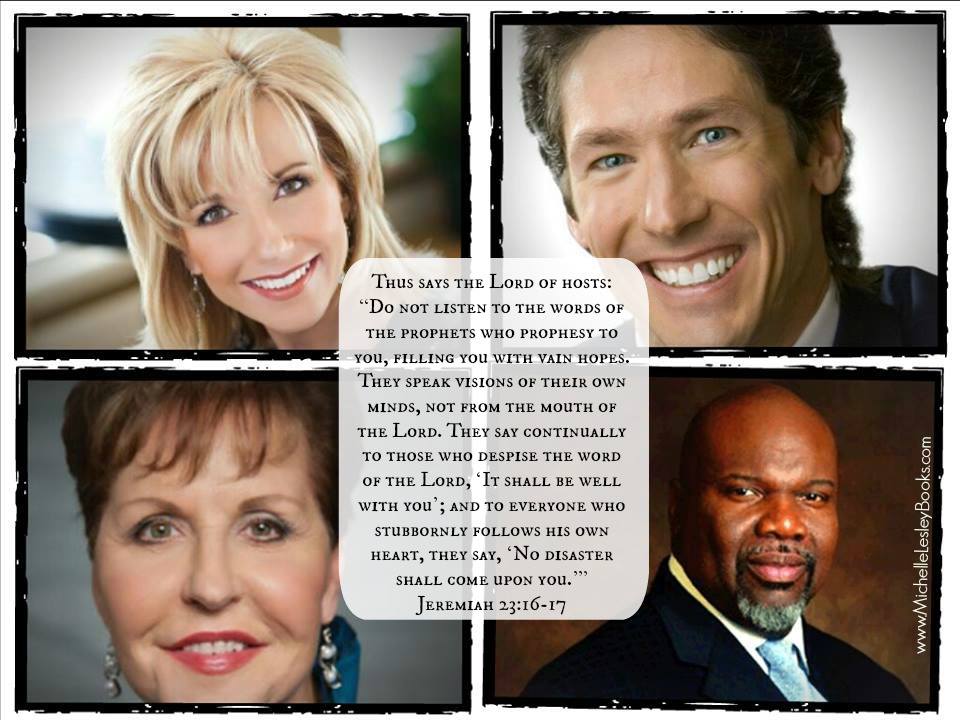
16 Thus says the Lord of hosts: โ€œDo not listen to the words of the prophets who prophesy to you, filling you with vain hopes. They speak visions of their own minds, not from the mouth of the Lord. 17 They say continually to those who despise the word of the Lord, โ€˜It shall be well with youโ€™; and to everyone who stubbornly follows his own heart, they say, โ€˜No disaster shall come upon you.โ€™โ€

18 For who among them has stood in the council of the Lord
to see and to hear his word,
or who has paid attention to his word and listened?
19 Behold, the storm of the Lord!
Wrath has gone forth,
a whirling tempest;
it will burst upon the head of the wicked.
20 The anger of the Lord will not turn back
until he has executed and accomplished
the intents of his heart.
In the latter days you will understand it clearly.

21 โ€œI did not send the prophets,
yet they ran;
I did not speak to them,
yet they prophesied.
22 But if they had stood in my council,
then they would have proclaimed my words to my people,
and they would have turned them from their evil way,
and from the evil of their deeds.

23 โ€œAm I a God at hand, declares the Lord, and not a God far away? 24 Can a man hide himself in secret places so that I cannot see him? declares the Lord. Do I not fill heaven and earth? declares the Lord. 25 I have heard what the prophets have said who prophesy lies in my name, saying, โ€˜I have dreamed, I have dreamed!โ€™ 26 How long shall there be lies in the heart of the prophets who prophesy lies, and who prophesy the deceit of their own heart, 27 who think to make my people forget my name by their dreams that they tell one another, even as their fathers forgot my name for Baal? 28 Let the prophet who has a dream tell the dream, but let him who has my word speak my word faithfully. What has straw in common with wheat? declares the Lord. 29 Is not my word like fire, declares the Lord, and like a hammer that breaks the rock in pieces? 30 Therefore, behold, I am against the prophets, declares the Lord, who steal my words from one another. 31 Behold, I am against the prophets, declares the Lord, who use their tongues and declare, โ€˜declares the Lord.โ€™ 32 Behold, I am against those who prophesy lying dreams, declares the Lord, and who tell them and lead my people astray by their lies and their recklessness, when I did not send them or charge them. So they do not profit this people at all, declares the Lord.

33 โ€œWhen one of this people, or a prophet or a priest asks you, โ€˜What is the burden of the Lord?โ€™ you shall say to them, โ€˜You are the burden, and I will cast you off, declares the Lord.โ€™ 34 And as for the prophet, priest, or one of the people who says, โ€˜The burden of the Lord,โ€™ I will punish that man and his household. 35 Thus shall you say, every one to his neighbor and every one to his brother, โ€˜What has the Lord answered?โ€™ or โ€˜What has the Lord spoken?โ€™ 36 But โ€˜the burden of the Lordโ€™ you shall mention no more, for the burden is every man’s own word, and you pervert the words of the living God, the Lord of hosts, our God. 37 Thus you shall say to the prophet, โ€˜What has the Lord answered you?โ€™ or โ€˜What has the Lord spoken?โ€™ 38 But if you say, โ€˜The burden of the Lord,โ€™ thus says the Lord, โ€˜Because you have said these words, โ€œThe burden of the Lord,โ€ when I sent to you, saying, โ€œYou shall not say, โ€˜The burden of the Lord,โ€™โ€ 39 therefore, behold, I will surely lift you up and cast you away from my presence, you and the city that I gave to you and your fathers. 40 And I will bring upon you everlasting reproach and perpetual shame, which shall not be forgotten.โ€™โ€


The Holy Bible, English Standard Version Copyright ยฉ 2001 by Crossway Bibles, a division of Good News Publishers.


Questions to Consider:

1. What is the purpose of theย bookย ofย Jeremiah? Which genre(s) of biblical literature (prophecy, epistle, narrative, wisdom, etc.) is the book of Jeremiah? What is the historical backdrop for this book?

2. Who are the “shepherds” in 1-4? Compare these shepherds to the “thieves and robbers,” “strangers,” and “hired hands” (false teachers), the gatekeeper (faithful pastors; also here), and the Good Shepherd (Jesus; also here) in John 10. What have they done that they should not have done? What have they failed to do that they should have done?

3. Who is “the righteous Branch” (5) and “the Lord is our righteousness” (6)?

4. How does this chapter of Jeremiah point us ahead to Jesus’ first and second coming? Take note of all of the instances in this chapter in which God says, “I will” do thus and so, such and such will happen, and “the days are coming when…”. Which of these things were accomplished in Jesus’ first coming, and which will be accomplished when He comes back?

5. Make a chart with the following columns and fill it out as you start at the beginning of chapter 23 and work your way through to the end:

False prophets characterized:

Things false prophets say:

How God says things should or will be:

God’s true word characterized:

God characterized:

God’s judgment on false prophets:

How God’s people should respond to false prophets:

Do you see any similarities between the false prophets of Jeremiah’s day and the false teachers of today? What do today’s false teachers promise and “prophesy”? Does God characterize today’s false teachers the same way as the false prophets of Jeremiah’s day, and will He judge them the same way? What should be our (the church, and individual Christians) response be to false teachers today?

Faith, Old Testament, Suffering, Sunday School, Trust

But Even If He Does Not… ~ Sunday School Lesson ~ 9-21-14

Shadrach

These are my notes from my ladiesโ€™ Sunday School class this morning. Iโ€™ll be posting the notes from my class here each week. Click here for last week’s lesson.

Through the Bible in 2014 ~ Week 38 ~ Sep. 14-20
Daniel, Ezra 1-6, Psalm 137, Haggai
But Even If He Does Not…

Exile. God has been warning Israel of the consequences of idolatry for centuries and has finally brought it to fruition. Last week we saw Ezekiel comfort the people with the good news that God’s anger and their punishment would not last forever, but today we find them smack dab in the middle of their time as Babylonian expatriates. How could they live as God’s people while being punished in a pagan nation? How could they please Him apart from temple sacrifices and offerings? Shadrach, Meshach, and Abednego are going to show us.

Daniel 3

The Problem- 1-7 (Exodus 20:1-6)
Here, the stage is set for the drama that is about to unfold. Nebuchadnezzar set up a 90 foot tall (probably much of that was a large base), 9 foot wide statue of himself, and commanded everyone under his rule to worship it. Emperor/king worship was not uncommon at any time during the Old or New Testament periods. While the emperor’s ego certainly must have played into this, it was mainly about loyalty and obedience to that leader and his rule. He was trying to preclude any hint of sedition while reinforcing to the people that he had control over every aspect of their lives. This was an especially important message to drive home to all of the governmental officials (2), because they were the ones most likely to slaughter the emperor and stage a coup.

From the emperor’s perspective, emperor worship also had less to do with actual religion and worship than submission to his absolute rule. Nebuchadnezzar and nearly everyone else in Babylon worshiped a panoply of gods, which was fine with Nebuchadnezzar as long as none of those gods superseded him and his rule in the eyes of his subjects. He was to be esteemed and obeyed above all others. That’s where our young Hebrew friends found themselves butting heads with Nebuchadnezzar’s new law. God is not OK with his people worshiping any other god before, besides, instead of, or in addition to Him. He is the only God, and He alone is to be worshiped, even if your life is on the line.

The Persecution- 8-12 (2 Timothy 3:12, John 15:18)
Shadrach, Meshach, and Abednego were three of the Judean exiles. We saw in chapter 1 that they, along with Daniel, were godly young men who risked their lives to be obedient to God’s commands. By the end of chapter two, Nebuchadnezzar had promoted them to prominent positions in his government. This is probably why the Chaldeans accused them– they were jealous. As with Daniel’s accusers in 6:4-5, they likely could not find any other grounds on which to discredit Shadrach, Meshach, and Abednego because they were upstanding, ethical, loyal citizens.

Satan hates God and anyone who loves and serves Him. John 15:18 says,

If the world hates you, know that it has hated me [Jesus] before it hated you.

Because of this hatred, Satan will do anything in his power to get God’s people to turn away from Him or sin against Him. He is the force behind all persecution, and he often uses his own servants to attack God’s servants. This was true for Shadrach, Meshach, and Abednego, and it is true for us today. Second Timothy 3:12 says,

Indeed, all who desire to live a godly life in Christ Jesus will be persecuted,

If we love God and strive towards holiness, we will find ourselves under attack at times.

The Predicament- 13-15
Being a child of God can often mean facing scary situations in which we are tempted to cut corners or sin. Shadrach, Meshach, and Abednego were tempted to bow down to the image the first time when the music played. Here, the heat is turned up because they’re standing in front of the man who holds their lives in his hands, and they face the same temptation a second time. Why not just do it? God will understand and forgive them, right?

The Profession- 16-18 (Psalm 115:3, Romans 8:28)
Although it’s tempting to think that way, we can’t, and Shadrach, Meshach, and Abednego prove this out beautifully. They would rather die than disobey their true King. And notice the strength of their testimony in the simple fact that they needed no time to consider Nebuchadnezzar’s offer (16). Immediately, they answered that their minds were made up. Under no circumstances would they bow to the image.

Why? Because they knew nothing was going to happen to them? No. We know that because we have the rest of the story. We have to remember that this was a real event happening to real people in real time, the same way things happen to us. They didn’t know what was going to happen next. For all they knew, they were toast. Yet they stood and boldly declared that God was able to do anything and they trusted Him no matter what.

But even if he does not…Those are probably the most important words in this story. To Shadrach, Meshach, and Abednego, God was still God, still worthy of worship and obedience, whether he spared their lives or not. Can we say the same?

There are a lot of false teachers out there that will tell you it is always God’s will for you to be healed, wealthy, successful. And if you’re not, it’s your fault because of your lack of faith. But the Bible clearly teaches the opposite. If God had not saved Shadrach, Meshach, and Abednego, could anyone say it was due to their lack of faith? Did God refuse to take away Paul’s thorn in the flesh because of his lack of faith? Were 11 of the 12 disciples martyred because they lacked faith?

The truth is, Our God is in the heavens; he does all that he pleases. (Ps.) God does what He does for His glory and our good. And, much like when we take our children to the doctor for a shot, what’s good for us can be scary and painful. What if God doesn’t heal you? What if your child dies? What if your marriage isn’t reconciled? What if you lose your job? For those that love God and are called out to His purposes, He works all things together for good (Rom.) He has not promised us an easy way, but a difficult way. But He has promised to be with us all the way. Can we stand in faith with Shadrach, Meshach, and Abednego and say, but even if He does not…?

The Peril and the Protection- 19-30
If we were writing this story, it would probably end right after verse 18 with Nebuchadnezzar so impressed with Shadrach, Meshach, and Abednego that he backed down and honored them for their courage and integrity. But God’s didn’t want Nebuchadnezzar to be impressed with Shadrach, Meshach, and Abednego. God wanted Nebuchadnezzar to be impressed with Him.

If you’ll notice, God did not rescue Shadrach, Meshach, and Abednego after their profession of Him. Things got worse. Nebuchadnezzar got angrier. The fire got hotter. God did not rescue them before they got tied up. Or before they got to the furnace. Or before they were thrown into the furnace. Or before they hit the bottom of the furnace. God allowed these three men who loved Him and were loyal to Him above all else to hit bottom before He rescued them. He didn’t rescue them from the furnace, He rescued them through the furnace.

God (possibly the preincarnate Christ in a theophany) was with them in the fire and, eventually, He brought them out on the other side. What do you think that did for their faith in Him? How much more intimately did they know Him, how much more thankful were they, and how much more intensely did they worship Him after God walked through the fire with them?

It’s the same for us. We grow to know and love God so much more intimately, when, instead of rescuing us from trials, He walks through them with us. I would not know and trust God as provider the way I do today had He not walked with me through some very difficult situations that only He could provide for. Others know God as healer or comforter or strength because of what He has walked through with them.

And what happened to Shadrach, Meshach, and Abednego wasn’t just about them, personally. God had a broader purpose for their suffering, and also for Daniel’s experience in the lions’ den. In those two incidents (and others), God got to pull back the curtain and reveal Himself to pagan people who desperately needed Him. He showed that He was superior to their gods, that they needed to repent and turn to Him, and that He loves His children. It had always been God’s plan to make Himself known to the Gentiles as well as the Jews, and here were God’s first missionaries. If these four men hadn’t gone through what they went through, Nebuchadnezzar and the rest of watching Babylon would not have seen God. What they went through showcased the great God they served.

Likewise, our trials can be an opportunity to point people to the Christ who has rescued us from the ultimate fire, and who can rescue them as well. Even if He does not…is a glorious opportunity to shine the spotlight on our great, mighty and merciful God.