Women of Genesis Bible Study

The Women of Genesis: Lesson 13- Sarah

Previous Lessons: 1, 2, 3, 4, 5, 6, 7, 8,ย 9, 10, 11, 12

๐Ÿ“–๐Ÿ“–๐Ÿ“–๐Ÿ“–๐Ÿ“–

Read Genesis 17:1-18:15

๐Ÿ“–๐Ÿ“–๐Ÿ“–๐Ÿ“–๐Ÿ“–


Questions to Consider

1. Briefly review lessons 11 and 12 (links above).

2. Read Genesis 16:16ย and 17:1. How many years passed between the birth of Ishmael and the appearance of the Lord in 17:1?

3. Compare 17:1-8 with Genesis 15:1-6. Write out the stipulations of the Abrahamic Covenant. Think further ahead into Old Testament history (Exodus-ish). What is God laying the foundation for here with Abraham? How does Abraham serving as the “cornerstone” as it were, of the nation of Israel point ahead to Christ as the cornerstone of Christianity?

4. What was the sign that a person was under the Abrahamic Covenant? (17:9-14) What were the “policies and procedures” regarding circumcision in this passage? Are Christian men today required by Scripture to be circumcised? What is the New Testament sign that a person is in Christ and under the new covenant of grace?

5. Why do you think both the covenant and the sign of the covenant were male-centric? Why didn’t God make the covenant with Abrahamย and Sarah? Why circumcision, which was specifically male-only, instead of something like ear-piercing which could have also been performed on females?

6. Why did God change Abram’s name to Abraham (17:5), and Sarai’s name to Sarah (17:15)?ย  What did their former and new names mean? Why didn’t God change Hagar’s name?

7. Compare and contrast Abraham’s reaction to the news of Sarah’s impending pregnancy (17:15-18) to Sarah’s reaction to this news (18:10-12). How were their reactions similar? How were they different? How did God respond to Abraham’s reaction? (17:19-21) To Sarah’s? (18:13-15) From God’s individualized responses to each of them, what can you infer about the differences between Abraham’s and Sarah’s thoughts and concerns about the upcoming pregnancy? Why do you think God picked the name Isaac for their son? (see footnote on 17:9, Genesis 21:5-7)

8. Examine more closely Sarah’s response to the news of her impending pregnancy in 18:11-15. Recall or review (lesson 11) Sarah’s failure to trust God. How does her initial reaction here againย demonstrate that she did not believe Godโ€™s word, or trust Godโ€™s character to keep His promise?

9. Verse 18:12 begins with the word “So”, indicating that the reason Sarah reacted the way she did was because of the information in verse 11. What circumstances (11) were Sarah’s reaction (12) based on? Did she have more faith in the her circumstances and her own personal experience, or in God and His Word? In that moment, was her faith rightly or wrongly placed? Examine Hebrews 11:11. Even though Sarah initially failed to trust God and wrongly placed greater faith in her circumstances and experiences, did her heart, her faith, and her trust remain that way?

10. Carefully examine 18:1-10. What can we learn about the customs of Middle Eastern hospitality at that time? What were some of Sarah’s duties and appropriate behaviors in welcoming guests according to her culture?

11. Review the verses in this passage that specifically talk about Sarah. What else can we learn about her character or her faith that set a good, or bad, example for us as Christian women today?


Homework

“Is anything too hard for the Lord?” Even though Sarah’s initial reaction to God and His Word was one of unbelief and distrust, God brought her along and grew her into someone who was commended for her faith in Hebrews 11 (often called the “roll call of the faithful” or “the Hall of Faith”).ย  Think back over your walk with the Lord. Can you think of a Scripture you once rejected in disbelief or rebellion that you now embrace and obey? A life situation in which God grew your faith in Him? What circumstances, Scriptures, or people did God use to bring you along from unbelief to belief, disobedience to obedience, distrust to trust? Spend some time in prayer thanking God for growing you through that situation.


Suggested Memory Verse

Is anything too hard for the Lord? At the appointed time I will return to you, about this time next year, and Sarah shall have a son.
Genesis 18:14
Women of Genesis Bible Study

The Women of Genesis: Lesson 12- Sarah and Hagar

Previous Lessons: 1, 2, 3, 4, 5, 6, 7, 8,ย 9, 10, 11

๐Ÿ“–๐Ÿ“–๐Ÿ“–๐Ÿ“–๐Ÿ“–

Read Genesis 16

๐Ÿ“–๐Ÿ“–๐Ÿ“–๐Ÿ“–๐Ÿ“–


Questions to Consider

1. Briefly review lesson 11 (link above) since it is basically part 1 of the lesson on chapter 16. Refresh your memory on Sarah’s “trust issues” with God.

2. Read verses 1-6 from Hagar’s perspective. What was Hagar’s station in life? (1) The ESV renders Hagar’s position as “servant”, but to our 21st century mindset, it might be more helpful to use the NIV and CSB’s renderingย of “slave”.

3. As a slave, what rights would Hagar have had over her personhood? Over her own body? Was Hagar asked if she wanted to sleep with Abraham or serve as a surrogate? Examine Genesis 30:1-8. In a “surrogacy by slave” situation, the baby was considered by society and the family to be whose child, the slave’s or the wife’s? Did Hagar have any rights to her own son? What are some thoughts or emotions Hagar may have experienced as she went through this situation?

4. When we read a story like this one, it’s very important that we understand the culture of the time. Imagine hearing this story on tomorrow night’s newscast. A man and his wife buy a female slave. The wife gives the slave to the husband for him to forcibly impregnate, with the plan that the resulting child will belong to the couple. It sounds like a TV crime drama on human trafficking, and, indeed, if this happened today in America, the husband and wife would both be criminally liable for their actions. In what ways can viewing this story through our current worldview help us to see the sin involved in what Abraham and Sarah did to Hagar? In what ways can a 21st century perspective lead us to misunderstand this story? How does understanding Abraham’s, Sarah’s, and Hagar’s culture, and the way it would have viewed slavery and slave surrogacy, help us to understand this story correctly? Does culture or era change whether or not something is a sin?

5. In Sarah’s and Hagar’s culture, the main way women achieved status, and were viewed as blessed and successful by society, was by bearing children, particularly sons. How does this piece of cultural information help you understand both Sarah’s and Hagar’s reactions in verses 4-6?

6. In lesson 11, we looked at how Abraham, as a godly husband, should have responded in verse 2. Did Abraham lead his wife in a godly way in verse 6? How could he have led her in a godly way? How did Hagar react to Sarah’s harsh treatment? (6)

7. Read verses 7-16. How many times is the phrase “angel of the Lord” used? Who is the angel of the Lord? Many theologians consider this appearance of the angel of the Lord to be a Christophany. What evidence do you see in this passage that might point to that conclusion?

8. What character trait did Hagar seem to be lacking in verse 4? How might her obedience to God’s instruction to her in verse 9 have grown her in that aspect of her character? Compare verses 9-10 to James 4:10.

9. Examine the end of verse 11 and the footnote. What does the name Ishmael mean? Compare this with what Hagar calls God in verse 13, and the name of the well in verse 14 (see footnotes). What would all of these descriptions of the character of God have meant in Hagar’s life? What does it mean in your life that God hears and sees you?

10. Compare and contrast Hagar’s trust and obedience to the Lord in 7-16 to Sarah’s distrust and disobedience to the Lord in 1-6.

11. Compare verses 7-16 with Luke 1:26-38, and make a list of any similarities you see. How does Hagar’s story point us ahead to Christ?


Homework

Read my articleย 5 Ways to Face Tests and Trials Biblicallyย and apply it to either Sarah’s or Hagar’s (or both) situation in chapter 16. What was God’s purpose for the test she went through? What were some opportunities she had to obey God in her situation? What would her words and actions have been like if she had trusted God more?


Suggested Memory Verse

So she called the name of the Lord who spoke to her, โ€œYou are a God of seeing,โ€ for she said, โ€œTruly here I have seen him who looks after me.โ€
Genesis 16:13

Christian women, Church, Discernment, Guest Posts

Guest Post: Building a Biblically Healthy Women’s Ministry (by a pastor, for pastors)

If your theology pretty much matches up with mine (as outlined in the โ€œWelcomeโ€ and โ€œStatement of Faithโ€ tabs) and youโ€™d like to contribute a guest post, drop me an e-mail at MichelleLesley1@yahoo.com,
and letโ€™s chat about it.


Building a Biblically Healthy Women’s Ministry
(by a pastor, for pastors)

by Pastor John Chester

It is no secret that I am not a fan of discernment ministries, and that I think the concept of Biblical discernment is grossly misunderstood by many. But that in no way means that I donโ€™t think telling truth from error and sound theology from errant (or even heretical) theology is unimportant.

And nowhere is it more important than in womenโ€™s ministry. The reason I say that is simple, more than 50% of the people in our churches are either women or they are growing into women. According to The Pew Research Center 55% of those attending Evangelical churches are women.ย 

Yet womenโ€™s ministry is often not thought of much by us pastors, I think because we view โ€œwomenโ€™s ministryโ€ as a thing or program, rather than ministry to women who make up more than half of the congregation we are charged to shepherd. And so we spin it off to someone else or put it on our benign neglect list so that we can concentrate on โ€œmore importantโ€ things. But nothing is more important than the souls of the women of the church. And practically speaking, any error introduced in a womenโ€™s Bible study will work its way through whole families and infect the whole church.

With that in mind, let me offer some tips to guard against error in your churchโ€™s womenโ€™s ministry.

Preach The Bible

The pulpit sets the tone for the church and everything that the church does, or at least it should. The good news is that even the smallest church with the least talented preacher can have a strong pulpit, because the strength of the pulpit depends on what is preached, not the preacher. What the church needs is a healthy dose of Bible. And by a healthy dose, I mean all that should be preached is the Bible.

It is the Scripture that is inspiredย and the Word of God that is living and active,ย and it is the word of God that makes your pulpit strong, not your ability. No one needs your ten tips on having a more productive quiet time or your five steps toward a healthy marriage even if you sprinkle them with a few verses. The people the Lord hasย entrusted to you need to hear from Him, not you. Your job as a preacher is to decrease while the whole counsel of God is declared. By all means, illustrate, explain, introduce, conclude and apply the text, just stick to the text!

Why this is so important for womenโ€™s ministry and guarding the women of your church from error is that it will trickle down in to the church’s Bible studies. If on Sunday (and whenever else you preach) the women of the church get a strong dose of Godโ€™s truth, they are going to be better able to spot error and less susceptible to it. And when they see that you have a high view of Scripture, they will develop a high view of Scripture too. When they see you are a Berean who evaluates everything in light of what Scripture says, they will be more likely too as well.

And as a corollary, when youโ€™re preaching the Bible, use it as an opportunity to teach the church, women included, how to think about and interpret the Bible. Iโ€™m not saying that the pulpit is a place for a discourse on the grammatico-historic hermeneutic, but it is a place to (often) say things like โ€œthis would have meant to the original readersโ€ or โ€œcontext determines meaningโ€ or โ€œWhenever you see a ‘therefore,’ ask yourself, ‘What is the ‘therefore’ there for?’.โ€ These may be throwaway phrases to you, but they teach the congregation, including the women, how to approach Scripture.

Pay Attention

This seems very basic but it needs to be said, you need to know what is going on, what is being taught and what materials are being used. And you need to read any material being used in any class or study. Read, not skim, not look up on the internet, not ask your seminary alumni group on Facebook, but actually read. Need I remind you that you will give an account for how you cared for the souls the Lord entrusts to you? When you stand before God to give an account, โ€œWell, I Googled it,โ€ is not going to be good enough.

You need to pay attention to what is popular in the world of womenโ€™s ministry too. The women in your church buy and read more books than the men. Pay attention to what is out there, and donโ€™t be afraid to address any errors that are gaining traction inย โ€œchurchianityโ€.

Be The Bad Guy

What I mean by that is be willing to be the one to take the heat. Be willing to veto a book, a curriculum, or even a topic that the womenโ€™s Bible study wants to use, and be willing to have the leader lay the blame for the veto on you. I would much rather have someone say to me, โ€œWe wanted to use ________ book. Why did you say to use ________ instead?โ€ than have a bad book used, or quash the joy of the womenโ€™s Bible study leader if she became an object of scorn. And quite frankly (and this actually happened to me) I would rather have the womenโ€™s Bible study leader mad at me, than to have the women be taught something that is wrong.

Invest In Your Leaders

I am genuinely baffled by the lack of investment in womenโ€™s leaders. We pastors will often go out of our way to invest both time and treasure in a young man we think might one day have a significant ministry in our church (or dare we hope and pray) or even go into pastoral ministry themselves.. But we often fail to invest our time and treasure in women who have a significant ministry in our churches right now. Might I suggest that the bare minimum you should do for every Bible study leader (man or woman) is to provide basic instruction in hermeneutics. A great resource is Grasping Godโ€™s Word by Scott Duvall and Daniel Hays, and there is an excellent companion workbook that makes teaching basic hermeneutics a snap.ย I promise you that if you teach the teachers of the women in your church how to approach Scripture, it will rub off.

Invest time and invest treasure too. Provide at your (or the churchโ€™s) expense good reliable resources for deeper study to leaders of your churchโ€™s womenโ€™s Bible study. If the women are going through a book of the Bible (with an approved curriculum as the guide) provide reliable (and accessible) commentaries on that book. If the womenโ€™s Bible study is topical or using a topical book as a guide, provide some other good books for deeper study and reading.ย 

Be Approachable

The women of your church need to feel comfortable sending you an email, shooting you a text or even Facebook messaging you with a question. They should even feel OK picking up the phone and calling you if need be. I get the wisdom in erecting hedges and being careful how you interact with women. But you canโ€™t shepherd effectively if you treat over half of your congregation as walking third rails. Rest assured the women of the church will pick up on your reluctance to interact with them and they will be reluctant to approach you with any questions, doctrinal or otherwise.

If you are married, this is one area where your wife can really help you. Her saying โ€œyou should ask my husbandโ€ will go a long way. And as a corollary one of the worst things that can come out of your mouth when a woman from your church asks you a theological question is โ€œyou should ask my wife.โ€

If you are like me you will have to work at this. The one thing I can say that always gets a laugh from my wife is, โ€œIโ€™m a people person.โ€ Itโ€™s not that I donโ€™t love people, itโ€™s that I tend toward shyness, and Iโ€™m not super outgoing. So I work at being an accessible resource for the women of the church, and you can too. And who knows, you may one day be rewarded with a call where a newer believer asks โ€œIs it true that the Israelites ate the scapegoat?โ€. (That is a real question I got from a real woman in the church and why it is so important that women feel like they can pick up the phone and call you.)

Write

Your pulpit ministry and other teaching at the church is not enough. You need need to be regularly writing. As Al Mohler observed, โ€œLeadership is about communication, and much of that communication is necessarily writtenโ€ฆleaders must learn to write and to set time aside for writing.โ€

But you say you donโ€™t have time. Mohler, one of the busiest men on the planet offers this helpful bit of advice, โ€œYou do what you have to do.โ€ I contribute to a group blog with other pastors and a couple of former seminary professors. We all write with an audience in mind – our own church. Why? For two reasons, it builds a resource library that they can access, and it allows us to address issues that we may not get to address in a systematic fashion from the pulpit. Iโ€™ve covered topics like the various approaches to apologetics, what goes into a worldview, basic pneumatology, basic anthropology, how to bring Scripture to bear on anxiety, the sanctifying power of suffering, and much more. And yes I have written some things that would fall into the broad category of discernment, like why our church isnโ€™t charismatic, the danger of letting a prolife social gospel supplant the biblical gospel and the respect for life that flows from it, why assisted suicide is unbiblical and even why events like Together 2016 (which for the record took place in our proverbial back yard) should be avoided. I write because I want to educate the church, especially the women of the church, who as a rule read more, about these issues.

Be willing to Sacrifice

Whatever cherished activity or ministry is keeping you from being all in on your churchโ€™s ministry to the women of the church, give it up! Let me give you an example. I love our menโ€™s Bible study, so much so that I had the next three topics for the study preplanned. But currently there is no overlap in our church between the women qualified to lead a womenโ€™s Bible study and the women with the desire and time to do so. So the Wednesday night Menโ€™s Bible study I have taught since the church opened has been tabled and replaced with a coed midweek Bible study. Sure, I had planned on going through the topics covered in Men Counseling Men edited by John Street, but instead I am teaching an Old Testament survey course geared to Christians of both genders. Truth be told Iโ€™d rather be with the guys, but that is not the best thing for the church, and as pastors we should lead in counting others (including the women of the church) as more significant than ourselves.

I could go on and on, but Iโ€™ll close with this; it breaks my heart that Michelle asked me to write this guest post. When she asked me to write this post she said that multiple women had contacted her and asked if there was anything about how important it is to help church ladies tell truth from error that they could print out and give to their pastors. For shame! No one should be more concerned with the spiritual well being and growth of the women in the church than their pastors. That in some places and in some cases that is not true is a blight on our brotherhood. This is a profound failure to fulfill the charge of 1 Peter 5:1-4, and there is no excuse for it. As the Apostle said:

So I exhort the elders among you, as a fellow elder and a witness of the sufferings of Christ, as well as a partaker in the glory that is going to be revealed: shepherd the flock of God that is among you, exercising oversight, not under compulsion, but willingly, as God would have you; not for shameful gain, but eagerly; not domineering over those in your charge, but being examples to the flock. And when the chief Shepherd appears, you will receive the unfading crown of glory.


John Chester is the pastorย of Piedmont Bible Church, a Grace Advance church plant in Haymarket, Virginia. Prior to ministry John worked as a lacrosse coach, a pizza maker, a writer, a marketing executive, and just about everything in between. He hails from The City of Champions: Pittsburgh, Pennsylvania, and is blessed to be married to his wife Cassandra. Read John’s blog articles at ParkingSpace23.


Note from Michelle: I first had the pleasure of “meeting” John when I read and responded to this excellent article of his on ParkingSpace23. While he and I have a couple of differences on discernment ministry, I think the world of him as a brother in Christ, pastor, and fellow blogger. I literally teared up when I first read this guest post, because I wish every church could have a pastor like John.


ALTHOUGH I DO MY BEST TO THOROUGHLY VET THE THEOLOGY OF THE BLOGGERS WHO SUBMIT GUEST POSTS, IT IS ALWAYS POSSIBLE FOR THINGS TO SLIP THROUGH THE CRACKS. PLEASE MAKE SURE ANY BLOGGER YOU FOLLOW, INCLUDING ME, RIGHTLY AND FAITHFULLY HANDLES GODโ€™S WORD AND HOLDS TO SOUND BIBLICAL DOCTRINE.
Women of Genesis Bible Study

The Women of Genesis: Lesson 11- Sarah and Hagar

Previous Lessons: 1, 2, 3, 4, 5, 6, 7, 8,ย 9, 10

๐Ÿ“–๐Ÿ“–๐Ÿ“–๐Ÿ“–๐Ÿ“–

Read Genesis 16:1-6

๐Ÿ“–๐Ÿ“–๐Ÿ“–๐Ÿ“–๐Ÿ“–


Questions to Consider

1. Briefly review lessons 9 and 10 (links above) about Sarah and what brought her to this place in her life in chapter 16. Compare and contrast Sarah’s position in life to Hagar’s position in life.

2. How old was Abraham when God first called him and promised to make him a great nation? How old was he when Ishmael was born? So, approximately how many years had he and Sarah been trying to conceive? (3)

3. What do Sarah’sย wordsย in verse 2, “the Lord has prevented me from bearing children” tell us about her belief in God’s sovereignty and control over her situation? What do herย actions in the remainder of verse 2 and 3 tell us about her belief in God’s sovereignty and control over her situation? Whose sovereignty did she really trust, God’s or her own? If Sarah trusted that God was the One who had closed her womb, why did she not trust that God would open it?

4. Think back to the promises of offspring God made to Abraham, of which Sarah was aware. Note the repeated phrase, “I will…” in all of God’s promises. Did God, at any time, ask Sarah or Abraham for their help in accomplishing these things? Did God know about Sarah’s barrenness? Did He ever suggest a surrogate mother for the offspring He promised? Whose idea was using Hagar as a surrogate? Was this an idea Sarah got from God or from her surrounding culture?

5. Think about Sarah’s relationship with God and her response to His promises. How did Sarah’s actions demonstrate that she did notย believe God’s word,ย trust God’s character to keep His promise, nor accept andย submitย to God’s timetable?

6. Compare Sarah’s plan to give Hagar to Abraham, and the problems that resulted, to Genesis 2:24. Has plural marriage or fathering children through adultery ever been pleasing to God? As a godly husband, how should Abraham have responded to Sarah’s plan? Howย didย he respond? (2,4)

7. Compare and contrast the influence Sarah had over Abraham (2-4) with the influence Eve had over Adam (Genesis 3:6-12). Was either woman, in these two incidents, a good steward of the influence God gave her? Why or why not? Was either man a good steward of the headship of his home God gave him? Why or why not?

8. What were some of the negative consequences of Sarah’s actions for herself, for Abraham, and for Hagar? (4-6) Would these things have happened if Sarah had obediently trusted God to keep His promise instead of taking matters into her own hands?

9. How does the story of God promising a long awaited son to a woman unable to conceive foreshadow the incarnation of Christ? What are some things that might have happened if Mary had taken matters into her own hands instead of trusting and obeying God?


Homework

Sarah’s words told one story about her belief in God’s sovereignty, but her actions told another story. Think about the situations in your life right now. Do youย believe God’s Word,ย trust God’s character to keep His promises in His Word, andย accept andย submitย to God’s timetable? Write down one way your actions could better line up with what you profess to believe, and implement it over the next week.


Suggested Memory Verse

So she called the name of the Lord who spoke to her, โ€œYou are a God of seeing,โ€ for she said, โ€œTruly here I have seen him who looks after me.โ€
Genesis 16:13

Women of Genesis Bible Study

The Women of Genesis: Lesson 10

Previous Lessons: 1, 2, 3, 4, 5, 6, 7, 89

๐Ÿ“–๐Ÿ“–๐Ÿ“–๐Ÿ“–๐Ÿ“–

Read Genesis 13-15

๐Ÿ“–๐Ÿ“–๐Ÿ“–๐Ÿ“–๐Ÿ“–


Questions to Consider

1. Briefly review lesson 9 (link above) about Sarah. Other than 13:1, this week’s passage does not mention Sarah. But as you read 13-15, read it understanding that, even though she is not mentioned, Sarah is experiencing all these things in some form or fashion because she’s married to Abraham. So, we learn from 13:1 that Sarah again had to pack up and move. In 13:2-7, we learn that Sarah was wealthy and likely managed a large household. Write down what else you can – carefully and reasonably – surmise about Sarah from chapters 13-15.

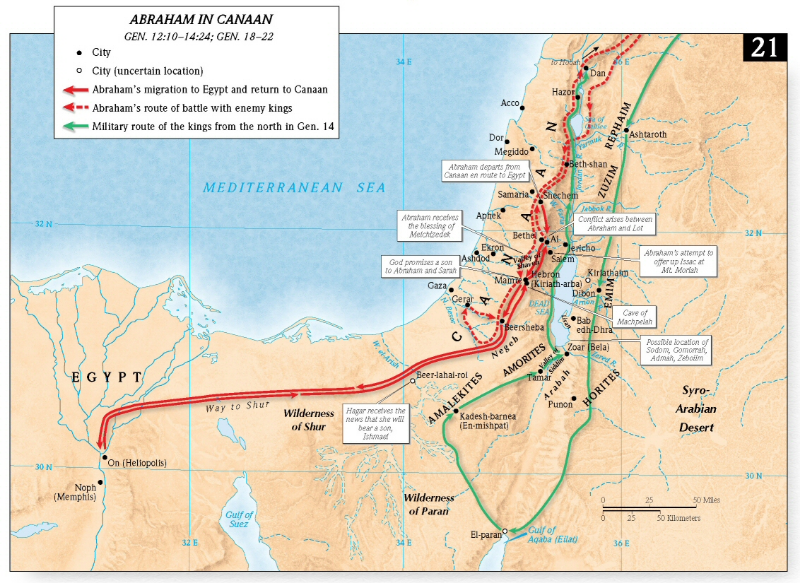
2. What/where was “the Negeb“? (13:1)? Trace Abraham’s, Sarah’s, and Lot’s trip from Egypt (13:1) back to “between Bethel and Ai” (13:2) on the map below. Find the remainder of the locations mentioned in 13-15 on the map.

3. Read Proverbs 3:5-6. How do we see Abraham trusting God and God directing Abraham’s paths in chapter 13? Canaan, where Abraham settled (13:12), eventually became known as what? How does chapter 13 demonstrate God’s sovereignty?

4. What does chapter 13 teach us about making wise and godly decisions? Can you look back on an incident in your life where you had to trust the Lord and make the wisest, most God-honoring decision you could? How did God “direct your paths” in that situation?

5. List all of the things God promised Abraham in chapters 13-15. Can you find the passages of Scripture where these promises came true?

6. Examine the instances in chapters 13-15 where Abraham worshiped the Lord. How would you characterize his worship? What caused him to worship?

7. Compare 15:6 to Romans 4 and Galatians 3. What does the Holy Spirit want New Testament Believers to understand about faith from Abraham’s example?

8. Compare and contrast Abraham’s interaction with God in chapter 15 about what God was promising him to Zechariah’s interaction with God about what God was promising him. How were Abraham’s and Zechariah’s reactions to God’s promises similar? How were they different? How and why did God react differently to Abraham’s questions than to Zechariah’s questions?


Homework

Compare Genesis 14:17-24 with Hebrews 7. How is Melchizedek a type of Christ? Why would the writer of Hebrews (14:13) refer his audience back to Melchizedek as an illustration of Christ as eternal high priest?


Suggested Memory Verse

And [Abram] believed the Lord, and he counted it to him as righteousness.
Genesis 15:6