Here are a few of my favorite recent online finds…
“Complementarian interpretation of Scripture holds that God’s creation purpose for man and woman entails equality of individual value but also distinct roles.” Our friends over at Crossway give us 5 Myths about Complementarianism.
“You’ve heard it repeatedly on radio, podcasts, and TV. You’ve read it in various books and articles. You’ve even heard it in your pastor’s sermon. The problem: it’s a lie: 50% of all marriages end in divorce.” The Cripplegate helpfully explains why everything you know about American divorce statistics, including the divorce rate among Christians, is probably wrong in The 50% Lie.
“‘No’ to a husband’s advances is a big deal in a marriage. A godly wife can certainly say “no” but she will also be alert to the way her response might be taken by her husband. Understanding and compassion can go a long way at these moments.” CCEF explores the sensitive subject of marital intimacy in “Not tonight dear”… men rejected.
On his most recent episode of Ask Anything, Dr. Albert Mohlertackles a number of interesting questions, not the least of which is (from a Southern Baptist perspective) Should women preach the Sunday sermon in church? (8:58).
Here are a few of my favorite recent online finds…
In February’s edition of Favorite Finds, I mentioned that I was hoping to have the opportunity to see the movie Patterns of Evidence: The Moses Controversy, which was in theaters in mid-March. Well, life intervened and I wasn’t able to get to the theater when it was playing, so I guess I’ll have to wait for it to come out on Netflix or something. Did you see the movie? What did you think of it? I’d love to hear a little feedback…or maybe you’d like to write a review of the movie as a guest post?
“…since loving Christ entails loving the Church; it’s time for you now to heed the summons of God’s Word and go back into a local church, a local expression of the Body of Christ.” I really appreciate Jennifer Brogdon’s* gentle and compassionate approach to encouraging wounded saints to go back to church (especially compared to my usual “bull in a china shop” treatment of the same topic) in her article Go Back to the Local Church.
If you’re looking for great listening and reading material, you cannot go wrong with Steve Lawson. I highly recommend him. Here’s an excerpt from his sermon It Will Cost You Everything. (Subtitles in various languages available.)
*I’m not very familiar with these writers or all the content at these blogs. I do not endorse anything you might find at these sites that conflicts with my theology as outlined at the Welcome and Statement of Faith tabs at the top of this page.



 “Complementarian interpretation of Scripture holds that God’s creation purpose for man and woman entails equality of individual value but also distinct roles.” Our friends over at Crossway give us 5 Myths about Complementarianism.
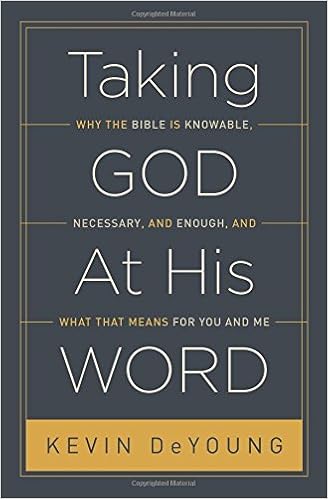 How about a free book? Here’s the PDF of Kevin DeYoung’s book Taking God at His Word: Why the Bible is Knowable, Necessary, and Enough, and What that Means for You and Me.
 “You’ve heard it repeatedly on radio, podcasts, and TV. You’ve read it in various books and articles. You’ve even heard it in your pastor’s sermon. The problem: it’s a lie: 50% of all marriages end in divorce.” The Cripplegate helpfully explains why everything you know about American divorce statistics, including the divorce rate among Christians, is probably wrong in The 50% Lie.
 “I’m not sad that I’m not and couldn’t be a church planter or lead pastor. I don’t feel restricted or resentful. Instead, I feel full.” I always appreciate the voices of sisters in Christ who are leading unashamedly under the banner of strong, biblical complementarianism. Complementarianism is a blessing, not a burden, so I really enjoyed
  “…since loving Christ entails loving the Church; it’s time for you now to heed the summons of God’s Word and go back into a local church, a local expression of the Body of Christ.” I really appreciate Jennifer Brogdon’s* gentle and compassionate approach to encouraging wounded saints to go back to church (especially compared to my usual “bull in a china shop” treatment of the