Discernment, False Teachers, Idolatry, Old Testament, Sunday School

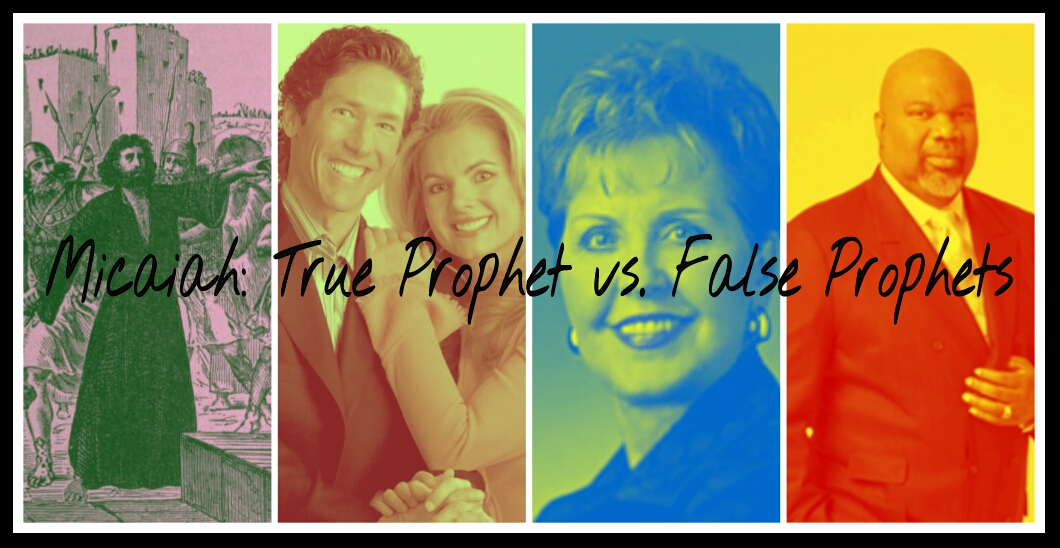
Micaiah: True Prophet vs. False Prophets ~ Sunday School Lesson ~ 7-6-14

Photos courtesy of cristoraul.com, Joyce Meyer Ministries, TD Jakes Ministries, and TBN
Photos courtesy of cristoraul.com, TBN, Joyce Meyer Ministries, and TD Jakes Ministries

These are my notes from my ladiesโ€™ Sunday School class this morning. Iโ€™ll be posting the notes from my class here each week. Click here for last week’s lesson.

Through the Bible in 2014 ~ Week 27 ~ June 29- July 5
1 Kings 22-2 Kings 13, 2 Chronicles 18-24, Obadiah, Psalm 82-83
Michaiah: True Prophet vs. False Prophets

1 Kings 22:1-40

Setting the Stage
Ahab was one of the most wicked kings ever to sit on the throne of Israel. The previous chapter (21:25) says “There was none who sold himself to do what was evil in the sight of the Lord like Ahab”. He has just been confronted by Elijah for his numerous abominations, and has humbled himself and repented.

Getting back what’s mine (1-4, 20:34)
Israel had had peace for three years, but it was bothering Ahab that Syria still had control of the city of Ramoth-gilead, when Ben-hadad (Syria’s king) had promised to return all of the cities Syria had captured during his father’s reign as part of his terms of surrender (20:34). Ahab asked Judah’s king, Jehoshaphat, to join him in recapturing the city, and Jehoshaphat agreed.

Not just any prophet will do (5-12, 18:1ff, 20:26)
Jehoshaphat was a godly man and knew that the right thing to do would be to inquire of the Lord before going into battle. Why do you think Ahab didn’t suggest this? What do we know about Ahab’s walk with the Lord? We know from 20:26 that he was an idolator, from chapter 18 that he was a Baal worshiper and had led Israel into Baal worship, and that he also supported the golden calf worship centers that Jeroboam had set up. So, when Ahab summoned 400 of his favorite prophets in order to appease Jehoshaphat, do you think they were true prophets of the Lord, or false prophets of idolatry? They were false prophets.

Tell him what he wants to hear
Was Ahab’s desire to hear and obey the word of the Lord? Was it the desire of the 400 prophets to truly hear and accurately report the word of the Lord? We can answer a resounding “no” to both questions. Ahab’s desires were, a) to hear what would make him happy, b) to make Jehoshaphat happy by granting his request and calling up so called “prophets of the Lord” and c) for Jehoshaphat to hear that they wold be successful so that Jehoshaphat would agree to go into battle with him. The “prophets'” desire was to keep the king happy and thus stay alive and prosper in their positions.

How do you spot a false prophet?
The 400 prophets certainly seemed to be prophets of the Lord. They brought a positive, encouraging message and made Ahab happy. Zedekiah (11) even prefaced his message with “Thus says the Lord,” the same words all true prophets of the Lord used. And all the prophets predicted triumph and that the Lord would give the battle into the king’s hand, words spoken on many previous occasions to other kings by true prophets of the Lord. So, why would Jehoshaphat think these were not true prophets of the Lord?

1. Where they were coming from (Deuteronomy 13:1-5)
Jehoshaphat knew that these guys were coming from a temple to a false god, even if they called those golden calves “God”. They were idolators so they were breaking God’s law in word and in practice.ย Deuteronomy 13:1-3a, 5a says:

If a prophet or a dreamer of dreams arises among you and gives you a sign or a wonder, and the sign or wonder that he tells you comes to pass, and if he says, โ€˜Let us go after other gods,โ€™ which you have not known, โ€˜and let us serve them,โ€™ you shall not listen to the words of that prophet or that dreamer of dreams…. But that prophet or that dreamer of dreams shall be put to death, because he has taught rebellion against the Lord your God,

When it came to the office of prophet, true prophets stayed true to the one true God of the Bible, and His word, in what they proclaimed as well as what they practiced in their daily lives and in their jobs as prophets (Isaiah and Jeremiah are good examples of true prophets). It did not matter how many times a person claimed to speak for God or used godly sounding terminology. If he led people to worship idols, he was a false prophet.

2. Whom they were prophesying for
Sometimes (but not always) the person the being prophesied for was an indication of whether or not the prophet was a true prophet. In this case we have Ahab, who we know was not genuinely seeking the Lord. Ahab was about Ahab, and nobody else. We can look at his life and see that he would not be seeking out the type of prophet who would be telling him the truth of God’s word. He was merely using the appearance of seeking the Lord to get what he wanted. False prophets are always happy to oblige such people.

3. Did the message come true? (Deuteronomy 18:21-22)
Deuteronomy 18:21-22 tells us:

And if you say in your heart, โ€˜How may we know the word that the Lord has not spoken?โ€™โ€” when a prophet speaks in the name of the Lord, if the word does not come to pass or come true, that is a word that the Lord has not spoken; the prophet has spoken it presumptuously. You need not be afraid of him.

If a prophet’s message did not come true, he was not to be believed, because he was a false prophet. He was also to be put to death. As we see later in this chapter, these prophets’ predictions of victory for Ahab did not come true.

Today’s false prophets
False prophets are not relegated to the Old Testament. We also find them in the New Testament and throughout history. We have many false prophets today. While some actually claim the title of “prophet,” most go by the title of “pastor,” “Bible teacher,” or “Christian author.” False prophets such as Joyce Meyer, Joel and Victoria Osteen, and TD Jakes, to name some of the most popular ones, preach encouraging messages to make people happy, use Bible verses (usually twisted and/or out of context) and other Christian sounding terminology, and tell you that you’ll be victorious over life’s problems, or that you’ll be successful or wealthy or healed. But how do they measure up against the false prophet test, above?

1. Where are they coming from?
Meyer, Jakes, and the Osteens (and numerous others) all preach the prosperity gospel in one form or another. They teach that it is never God’s will for you to be sick or poor, that if you are experiencing suffering it’s because of your lack of faith, and that because we are little gods, we have the same power God has to speak things (like health and wealth) into existence.

Additionally, TD Jakes is a modalist (a false view of the Trinity), Joyce Meyer has a number of false soteriological beliefs, and all of them, because they are teaching people to believe in a golden calf of their own making that they call Jesus, are leading people into idolatry.

2. Who are they prophesying for?
In most cases, people who follow false teachers today are not like Ahab. They think what they’re getting from these false teachers is biblical Christianity. Sometimes, however, what they’re really looking for isn’t Christ, but the “stuff” (happiness, encouragement, healing, a better life, money) they think Christ will give them. And when you look to Christ for stuff instead of looking to Christ for Christ, you’re probably going to end up following a false teacher, because that’s what they promise. 2 Timothy 4:3-4 says:

For the time is coming when people will not endure sound teaching, but having itching ears they will accumulate for themselves teachers to suit their own passions, and will turn away from listening to the truth and wander off into myths.

3. Does the message come true?
People like Meyer, Jakes, and the Osteens have millions of followers whom they promise health, wealth, and the realization of all their dreams and goals on a weekly basis. Out of all those millions of listeners, how many do you think are always healthy? How many get terminal diseases and aren’t healed? How many send in their “seed offering” and still can’t pay their bills? How many have failed businesses or never see their dreams come true? If one of these preachers promises anyone, even once, that “God says…” and it doesn’t come true, he is a false prophet.

Just because someone says what we want to hear (as the 400 prophets did for Ahab) doesn’t mean he is telling us the truth of God’s word.

Micaiah: True Prophet of the Lord (13-28)
A number of things tell us that Micaiah was a true prophet of the Lord:

True prophets don’t bow to what’s popular (13-14)
Do you find it interesting that Ahab didn’t want to summon Micaiah because he knew Micaiah’s message would be against him (8)? The messenger (13) also seemed to know this. Perhaps it was because Ahab (and the messenger) already knew he was living in constant sin and that the Lord’s hand was against him. The messenger, already sensing what Micaiah’s prophecy would be, tried to get him to go along with the crowd, but Micaiah would have none of it. He would only speak the truth of God’s word.

Today it’s popular to go along with the crowd that preaches that God wants everybody to be happy and successful, that you can have God and still hang on to your sin, etc. But today’s true prophet will only speak the truth of God’s word, even if it isn’t the popular thing to do.

True prophets speak the truth even when the truth is unpleasant (15-18)
It would have been much easier for Micaiah to just parrot what the other prophets had said. He knew that what he had to tell Ahab was not going to be what Ahab wanted to hear and that he was risking his life by upsetting him, but Micaiah still boldly gave God’s entire message.

Today’s true prophets can be heard saying unpleasant things such as “Jesus is the only way of salvation,” “Homosexuality is a sin,” and “God uses suffering to make you more like Christ.” They might be risking their jobs, but they don’t leave out of their sermons the parts of the Bible that are uncomfortable for people.

True prophets warn people about, and confront, false prophets (19-25)
It wasn’t enough for Micaiah just to speak the word of the Lord concerning the outcome of the battle. God, in yet another act of mercy towards Ahab, wanted Ahab to know that he was being lied to by these false prophets so that he could repent and believe the true word of the Lord.

Today’s true prophets don’t just proclaim God’s word, they warn fellow Christians about false doctrine and false teachers so that they can repent of their false belief and believe the true word of the Lord.

True prophets will risk everything for the truth of God’s word (26-28)
Micaiah knew his life was on the line, but he knew something even more important. God’s word is true, and he was willing to stake his life on it. He would not compromise the truth or attempt to soften his message just to save his own skin.

True prophets of today, especially those who live in countries hostile to the gospel, stake their lives and their families’ lives on the gospel. Often, they are martyred for their faith, but they refuse to compromise the truth or soften God’s word just to save their own skin, their jobs, or anything else.

God will accomplish His word (29-40, 21:19)
Ahab arrogantly tried to subvert God’s word by disguising himself, hoping that if a king were to die that day, it would be Jehoshaphat. But in the end, we see that God’s word always prevails. Not only did Micaiah’s prophecy come true, so did Elijah’s (21:19).

We can trust that God’s word — both the unpleasant parts and His glorious promises– will always be accomplished.

Additional Resources:
Joyce Meyer at carm.org
The False Teachers: TD Jakes at challies.com
TD Jakes at carm.org
Joel Osteen and “Joel-likeness” at challies.com
Lessons I’ve Learned from False Teachers at challies.com


Celebrity Pastors, Discernment, False Teachers, Social Media

Four Reasons Why It Matters Who We Share, Pin, and Re-Tweet

facebook-large

Scroll…scroll…wince…

Scroll…scroll…wince…

I find myself wincing a bit when I see people โ€“who I know genuinely love Jesusโ€”sharing, pinning, and re-tweeting quotes from false teachers such as Joel Osteen, Joyce Meyer, T.D. Jakes, and Christine Caine, just to name a few. Why? What’s wrong with the encouraging, even biblical, at times, things these people say?

First of all, let me back up a little. What is a โ€œfalse teacherโ€? A false teacher is someone who is billed as a Christian pastor or Bible teacher who habitually and unrepentantly writes, teaches, or preaches things that conflict with the clear teaching of Scripture. For example, all four of the people I listed above teach some version of the prosperity gospel, the false teaching that is most rampant in the Western church today. Additionally, T.D. Jakes adheres to the false doctrine of modalism, and Joyce Meyer and Christine Caine blatantly disobey the Bibleโ€™s teaching that women are not to be pastors or instruct men in the Scriptures in the church.

These days, it can be difficult to keep up with who teaches sound doctrine and who does not, especially when pastors and teachers we thought were theologically orthodox seem to be turning apostate at an alarming rate. I myself have been a fan of more than one popular writer/teacher/preacher that I later realized was a false teacher (Joyce Meyer was one of them.) as I delved into what they actually taught and believed and compared it to Godโ€™s word. I know first hand that itโ€™s easy to think that these people are good biblical teachers and preachers when what they say sounds good, makes us feel good, and has an occasional Bible verse sprinkled in.

th (1)

Because Iโ€™ve been there myself and know how easy it can be to be drawn in by false teachers, I donโ€™t have any less respect for folks who re-tweet the occasional Osteen-ism of the day. In fact, I have more respect for them, because I know they love the Lord, theyโ€™re making an effort to find biblical teaching to listen to, and they have the courage to try to share the gospel with their friends and family via social media. Those are all fantastically good things, and they are to be commended.

But, still, the quotes we share and the people who said them matter. Why?

The quotes we share and the people who said them matter. Here are four reasons why…

1.
Lost peopleโ€™s eternities are at stake.

Seriously? From hitting the โ€œshareโ€ button on a false teacherโ€™s status? Seriously. I donโ€™t think thatโ€™s overstating the gravity of the matter. Thereโ€™s no way to take the possibility of an eternity in hell too seriously.

Think about it: You have an unsaved Facebook friend. Sheโ€™s getting to the point in her life where she figures itโ€™s time to get her stuff together, so she starts looking into this whole Jesus thing. Where to start? Sheโ€™s never even set foot inside a church. Aha! She remembers youโ€™re a Christian. Maybe youโ€™ll have a good lead for her. As sheโ€™s thinking about all this, you share Joyce Meyerโ€™s status, and it appears in your friendโ€™s news feed. โ€œAh,โ€ your friend thinks, โ€œthis must be a good Bible teacher if my Christian friend follows her.โ€ So she โ€œlikesโ€ Joyce Meyerโ€™s Facebook page and follows her on Twitter. Then she starts watching her on TV. Buys some of her books. Maybe attends one of her conferences. Because your friend has zero knowledge of the Bible, she believes everything Joyce Meyer says. It sounds good. It makes her feel good. Sheโ€™s hearing a few out of context Bible verses here and there. But the problem is that Joyce Meyer doesnโ€™t teach the Jesus of the Bible. She teaches a false god of her own creation. And if your friend doesnโ€™t put her faith in the true Jesus of the Bible, sheโ€™s just as lost as she was before. Only now she thinks sheโ€™s a Christian. And you canโ€™t convince her otherwise.

Sound far fetched? Maybe. Maybe not. But if thereโ€™s even the slightest chance something like that could happen, is it really worth justifying that status share? Furthermore, is it worth even following a teacher who could lead someone you love to an eternity in hell?

2.
It gives false teachers free publicity and a broader platform.

One thing I was very surprised to learn when I first began the process of having my book published1 is that publishers want non-fiction writers to have a built in audience, or โ€œplatform,โ€ before they will publish your book. That means youโ€™re already doing speaking engagements and/or have a decent sized ministry, have lots of followers on social media, etc. As I once explained to someone, โ€œYou donโ€™t get your book published and then become [celebrity Bible teacher] you have to be [celebrity Bible teacher] in order to get published.โ€

human-334110_640

Social media stats are a big factor in a celebrity preacherโ€™s/teacherโ€™s platform. If T.D. Jakes suddenly lost the majority of his social media followers, you can bet the TV stations heโ€™s on and the conferences he gets invited to would be taking a serious look at whether or not theyโ€™d continue to affiliate with him, because it would indicate that his audience is shrinking.

Conversely, when we re-pin, re-post, or re-tweet these folks, their social media stats go up. They not only get a broader platform on social media from which to spread their unbiblical teaching, they continue to get more book, radio, TV, and other media deals, get invited to speak at more conferences, and even start exporting their false teaching overseas (โ€œmissionsโ€) to people who have never heard the gospel before and have no way of knowing theyโ€™re being lied to.

When we promote false teachers on social media, we bear some of the responsibility for the spread of their false doctrine.

If anyone comes to you and does not bring this teaching, do not receive him into your house or give him any greeting, for whoever greets him takes part in his wicked works.

2 John 10-11

When we promote false teachers on social media, we bear some of the responsibility for the spread of their false doctrine.

3.
It is disobedient to Scripture.

Often, when a Christian is told sheโ€™s following a false teacher, the common response is, โ€œOh, I just chew up the meat and spit out the bones,โ€ meaning that she takes to heart the โ€œgoodโ€ things the false teacher has to say and ignores the bad.

The question is: where does the Bible say this is the correct way to deal with false teachers? Answer: it doesnโ€™t. In fact Scripture says exactly the opposite.

For starters, Galatians 1:6-9 says that if anyone preaches a different gospel (such as the prosperity gospel) from the one thatโ€™s set down in Scripture, โ€œlet him be accursed.โ€ โ€œAccursedโ€ means โ€œdamned,โ€ sentenced to hell for eternity.

1 Timothy 4:7 and Titus 3:10 say that we are to have nothing to do with people who teach โ€œirreverent or silly mythsโ€ or cause division by teaching false doctrine.

2 Corinthians 6:14-16 tells us not to be joined together or partner with unbelievers, lawlessness, darkness, Belial (the devil), or idols.

1 Corinthians 5:7-13 tells us that when a person infiltrates the church who claims to be a Christian, yet is greedy, an idolater, or a swindlerโ€” all of which are things that prosperity preachers are guilty ofโ€” we are to โ€œcleanse out the old leaven.โ€ We are โ€œnot to associateโ€ with them. We are to โ€œpurge the evil person from among you.โ€

Titus 1:10-16 says of false teachers, โ€œThey must be silenced,โ€ because they teach โ€œfor shameful gain what they ought not to teach.โ€ Paul instructs Titus to โ€œrebuke them sharply,โ€ and that, โ€œthey profess to know God, but they deny him by their works. They are detestable, disobedient, unfit for any good work.โ€

The entire second chapter of 2 Peter paints a dismal picture of the motives, the behavior, and the fate of false teachers:

โ€œBecause of them, the way of truth will be blasphemed.โ€

โ€œIn their greed they will exploit you with false words.โ€

They will โ€œbe destroyed in their destruction, suffering wrong as the wage for their wrongdoing.โ€

โ€œThey are blots and blemishes, reveling in their deceptions, while they feast with you.โ€

โ€œThey entice unsteady souls.โ€

โ€œFor them the gloom of utter darkness has been reserved.โ€

โ€œThey promise them [people who listen to their false teaching] freedom, but they themselves are slaves of corruption.โ€

The entire epistle of Jude is dedicated to exhorting Christians to โ€œcontend for the faith that was once for all delivered to the saints.โ€ Of false teachers, Jude says:

โ€œCertain people have crept in unnoticed who long ago were designated for this condemnation, ungodly people, who pervert the grace of our God into sensuality and deny our only Master and Lord, Jesus Christโ€ฆWoe to them!โ€

Thereโ€™s more, because a large portion of the New Testament is dedicated to exhorting Christians to stay away from false doctrine and rebuke those who teach it, but I think you get the picture. Is it obedient to Christ and to His word to follow and promote someone He says is damnable? People who teach another gospel, such as the prosperity gospel, are the enemies of Christ. Who are we going to side with, Christ or His enemies?

People who teach another gospel, such as the prosperity gospel, are the enemies of Christ. Who are we going to side with, Christ or His enemies?

 4.
It is unloving and disloyal to our Master.

th

Think about the person you love the most in this world. Maybe itโ€™s your spouse, your child, a parent, or a friend. Next, think about your favorite celebrity, perhaps a movie star, a TV personality, or a famous author or athlete. Now try to imagine that that celebrity, in interviews with journalists, on talk shows he appears on, at personal appearances and speaking engagements, in books he writes, etc., routinely tells lies about the character of your dearest loved one. And thousands, maybe millions, of people believe him.

Would you continue to be a fan of that celebrity?

What if your loved one found out you were a fan of that celebrity? How would she feel to know you were a fan of someone who spreads lies about her?

If we wouldnโ€™t follow someone who lies about a loved one, how much less should we as Christians have anything to do with a celebrity preacher, teacher, or author who drags the name of our precious Savior through the mud and lies about the gospel?

How can we as Christians have anything to do with a celebrity preacher, teacher, or author who drags the name of our precious Savior through the mud and lies about the gospel?

Friends, for all of these reasons and more, letโ€™s stop promoting these false teachers on social media by publicizing their quotes and other materials. Looking for an encouraging quote to share? Thereโ€™s nothing better than a verse of Scripture. Because Scripture can offer people something that false teachers canโ€™t: truth and hope. As Jesus Himself said,

โ€œSanctify them in the truth; your word is truth.โ€ John 17:17


ยนMy book, Jacob, Journaling the Journey is no longer in print, and thatโ€™s a good thing! I wrote it before learning good hermeneutics and how to handle Godโ€™s Word properly. You can probably still find copies of it at online merchants, but I would not recommend that you buy or use it. If you want a good Bible study, the best thing is to simply pick up the Bible and study it for yourself. Right now, I have no plans to rewrite Jacob for future re-release.

Celebrity Pastors, Discernment, False Teachers, Word of Faith Movement

Of Mega-Blogs and Molotov Cocktails

megablogs molotov

I Look Down on Young Women With Husbands and Kids, and I’m Not screaming-womanSorry,ย screamed the headline. Quite an attention grabber. It certainly grabbed mine. So, of course, I read the article.

It was brash. Extremist. Rude. Rather one dimensional and completely devoid of nuance. And it made me mad, too, since I used to be a young woman with a husband and kids. (“Used to be,” as in, I still have the husband and kids and I’m still a woman, but “young” would be a stretch at this point.)

I was all set to write a blog post in response about the value of wifing, mothering,ย andย working outside the home. You know, whatever God has called you to. So as prep for my article, I read the article again. And again.

And, like a toddler yanking at the hem of my skirt to get my attention, an epiphany pushed and shoved its way into my consciousness.

It wasn’t real.

Or maybe I should say: I suspect it wasn’t 100% sincere.

Have you ever visited a mega-blog like Buzzfeed or Mashable? They churnย out tons of cheap content every day, glasscandy-532959which means lots of hits on their web sites and lots of posts that go viral, which means lots of money from advertisers. (Nothing wrong with that, but it’s usually not terribly deep stuff. Sometimes people want a little mind candy, and that’s OK.)

Guess what? Lots of people want a piece of that pie and it’s easier to copycat than to innovate, so there are lots of other upstarts out there trying to become the next mega-blog. Like Thought Catalog, which published the aforementioned article on young women with husbands and kids.

As they say, there’s no such thing as bad publicity, and in a PR move that would make even Miley Cyrus chartreuse with envy, Thought Catalog threw out a Molotov cocktail of an article, stood back, and watched the crowd gather. Nearly a quarter of a million shares on Facebook. Almost 2000 re-tweets. Over 11,000 comments. From a PR standpoint, there’s pretty much no choice but to admire them.

Is Amy Glass, the author of the article, a real person? Maybe she is, or maybe it’s a pseudonym for someone who works for Thought Catalog as a content writer. If she’s a real person, are these her genuine thoughts and feelings, or did she throw in a hearty dose of hyperbole to push her readers into clicking, tweeting, sharing, pingback-ing, and writing response articles?

I don’t know.

There’s a lot of deception going on out there these days (I’m not saying Thought Catalog is being deceptive. Honestly, I haven’t poked around over there enough to know.) and it’s not just “out there.” It’s inside the walls of the church, as well.

joel_osteen-false_prophetThere are plenty of “Buzzfeed” pastors, leaders, and Christian authors who are throwing out cheap content and bombshells…

…2014 is going to be the year God turns everything around for you!
…Just say what you want! If you can say it, you can have it!
…God wants you to achieve all your dreams, so reach for the stars!

Joyce-MeyerThe glass breaks, the flames fly, and the crowd gathers. Their churches are overflowing with people. Their books become best sellers. They’re invited to speak at all the big conferences. And when the little guys start copying them and their methods, they know they’ve arrived.

But are they telling you the truth? And if you’re one of their devotees, how do you know whether or not they’re telling you the truth? Do you even want to know, or are you just happy with being entertained or being told what you want to hear?

There’s a way to find out. Get your Bible out and study it. Don’t just give it a surface reading– do the work and dig. Use the brain God gave you and pursue the knowledge of His word. Ask Him to open your eyes to understand the truth of Scripture. Love God with your mind, not just your emotions. Don’t be deceived.

Because theyย hated knowledge
andย did not choose the fear of theย Lord,
would have none of my counsel
andย despised all my reproof,
therefore they shall eatย the fruit of their way,
and haveย their fill of their own devices.
For the simple are killed byย their turning away,
andย the complacency of fools destroys them;
butย whoever listens to me will dwell secure
and will beย at ease, without dread of disaster.
Proverbs 1:29-33

Bible, Church, Creation, Discernment, Evolution, False Teachers, New Apostolic Reformation, Prayer, Word of Faith Movement, Worship

Keep On Keeping Up: 6 More Issues Christians Need Guidance About From Our Pastors ~ Part 2

14333562683841

Recently,ย I read a great article by Justin Peters entitledย โ€œIgnorance Is Not An Option.โ€ย I would call this article a response to that one, but it’s really more of a…well, I guess you could call it a “ricochet”. Last week, in Part 1 of this article, I discussed five current issues in evangelicalism that we folks in the pew need some guidance on from our pastors. Following are six more issues we all, pastors and church members alike, need to learn about and and keep a biblical perspective on.

Creation vs. Evolution:ย ย Sorely missing from some pulpits these days is the exhortation to Christians that the Bible is our final authority on every issue in life and that we are called toย believe God’s word-ย believe it intelligently, yes, but believe it, even in the face of worldly opposition. This admonition does not begin with Genesis 3, it begins with Genesis 1. ย We are called to believe that God created the world and that He created it the way the Bible says He created it.

*Resources:
Answers in Genesis– From Creation apologetics to scholarly scientific articles to colleges that teach Creation to VBS curricula, you would be hard put to find a more comprehensive, gospel-centered Creation resource.
The Case for a Creatorย by Lee Strobel

Denominationalย Differences:ย Do you know the basics of what the major Christian denominations teach (salvation, baptism, communion, membership, etc.) and the differences between their doctrine and the doctrine of your own denomination? Are you aware that some denominations which are considered by many to be “Christian” hold to doctrines- including soteriology- that conflicts with God’s word? Are you fairly well acquainted with the doctrines of the denomination or religion that is predominant (or secondary if your own denomination predominates) in your area? Pastoral instruction on the basics of other denominational beliefs (as well as their own!) can be quite helpful as we church members relate to friends and family members or help new church members who come from a different denominational background.

Resources:ย 
GotQuestions.orgย For a brief overview of most of the major religions and denominations, type “Methodist,” “Mormon,” etc., in the search box.

For more detailed information, find the denomination’s main web site and click on their “statement of faith” or “what we believe” page (Keep in mind that there are several different “flavors” of Baptist, Presbyterian, Lutheran, etc., whose doctrines and practices may vary significantly from each other.), or get to know local pastors of other denominations and just ask what they teach.

The Word of Faith Movement:ย ย Used almost interchangeably with the term “prosperity gospel,” anti-biblical Word of Faith concepts such as the “little gods” doctrine (we have a divine nature), health and wealth prosperity (it is never God’s will for you to be sick or poor, and if you are, it’s because of your lack of faith), positive confession (Our words have the power to create reality or speak things into existence. Conversely, negative words create negative circumstances.), and twisted teachings about tithing (“sow your seed so God will multiply it back to you”), among others, are infiltrating unsuspecting churches at an alarming rate, and many are being deceived.

Because church members are often introduced to these doctrines by seemingly innocuous, popular speakers and leaders such as Joel Osteen, Joyce Meyer, Christine Caine, Hillsong personnel, Robert Morris, John and Lisa Bevere, John Hagee, Kari Jobe, and Judah Smith, whose materials are sold at Christian stores, conferences, and web sites, church members, and even some pastors, have no way of knowing they’re encountering false teaching unless they understand sound biblical doctrine and have a modicum of discernment skills. ย It is now more necessary than ever for Christians to be trained in the basics of hermeneutics and discernment.ย 

Resources:
A Call for Discernmentย by Justin Peters
Word Faith Movementย at Stand Up For the Truth
Sound the Alarm: The Dangers of the Word of Faith Movementย by Emmanuel Davis
A Softer Prosperity Gospel: More Common Than You Think at 9Marks

The New Apostolic Reformation:ย Hopefully, your church members have never encountered NAR leaders, doctrines, or manifestations, or, if they have, were immediately turned off by its weirdness and because it is so blatantly anti-biblical. NAR takes the Word of Faith movement, and –BAM!–ย kicks it up a notch. But, as a gateway drug can lead to addiction and addiction can lead to a fatal overdose, so exposure to Joel Osteen can lead to T.D. Jakes to Benny Hinn toย holy laughter,ย strange “anointings,”ย glory clouds of gold dust,ย tremoring, false prophecy, and being “drunk in the Spirit.” This is signs and wonders on steroids.

The NAR is also largely responsible for many of the corrupt teachings on prayer (mainly throughย Bethel Church in Redding, California) that have become popular in recent years, such as: contemplative/centering prayer, lectio divina, the International House of Prayer, Sozo prayer, healing rooms, and soaking prayer, as well as the false teaching of dominionism.

Resources:
False Spirits Invade the Church: Part 1, Part 2, Part 3ย  A Documentary by Andrew Strom
Love and Death in the House of Prayerย by Jeff Tietz of Rolling Stone

The Emergent/Emerging Church Movement:ย Ever heard the old joke, “The only rule is…there are no rules!” Well, replace the word “rule” with “doctrine” and you’ve got a somewhat loose definition of the emergent church. It’s a post-modern mix of ethereal non-traditionalism, feelings, experiences, and mysticism as a means of worship, anti-absolute truth, ideological inclusivism, and anything goes universalism, topped off with a heaping helping of “did Godย reallyย say…?“. Everything in the Bible, from moral absolutes to the divinity of Christ to the atonement to every other jot and tittle of the Word is questioned, if not outright denied. The only doctrine is…there is no doctrine. And, unfortunately, we church members can find any number of emergent books and materials on the shelves at our local Christian bookstores.

Resources:
What is the Emerging Church? by CARM.org
Exposing the Emergent Movement by Stand Up For the Truth

Bible Translations and Paraphrases, Study Bibles, and Theme Bibles:ย If the members of your church are carrying the LOLCat Bibleย or the KLV (yes, folks, that’s the Klingon Language Version of the Bible {Thanks a lot, Aaron. I’ll never be able to unsee that.}) into the sanctuary every week, you probably need more doctrinal intervention than I’m qualified to offer. But, while there are a number of theologically sound study Bibles and theme Bibles out there, there are some that may be just as theologically off base as the gospel according to kitty cats and Star Trek. Joyce Meyer’s Everyday Life Bible, Joel Osteen’s Hope for Today Bible, Sarah Young’s Jesus Calling Devotional Bible, and T.D. Jakes’ Woman Thou Art Loosed Bible are a few that come to mind. (Notice that these are all sold on a Christian web site right alongside materials that teach sound doctrine.)

Are you somewhat familiar with the most common Bible translations being used today, and which ones are the most accurate? Do your church members understand the difference between a translation and a paraphrase? What about gender neutral Bibles? There is such a variety of Bible options available today that the members of your congregation could likely use some guidance in selecting an accurate translation for studying God’s word.

Resources:ย 
BibleGateway.com– Just about every Bible translation and paraphrase you can imagine, all on line, all free. Compare a few versions side by side, and, if you’re thinking of buying a new version, try it out at BG before you buy.
Comparison of English Bible Translations
Translation Comparison Charts
How the Use of Some Bible Versions Can Twist God’s Truth at The Sacred Sandwich

*The resources given are obviously not an exhaustive list. For the most part, they are resources I have used myself, found to be helpful, and trust to be generally doctrinally sound. There are many other wonderful resources out there, but our most important resource is to compare all things and people to God’s word in context.

Calvinism/Arminianism, Celebrity Pastors, Cessationism/Continuationism, Church, Complementarianism, Homosexuality

Keep On Keeping Up: 5 Issues Christians Need Guidance About from Our Pastors ~ Part 1

14333566699421

Read Part 2 of this article, “Keep On Keeping Up: 6 More Issues Christians Need Guidance About From Our Pastors” here.

"Ignorance? Of Benny Hinn? A man in Brownโ€™s position claiming ignorance of Benny Hinn would be tantamount to an Olympic swimmer claiming ignorance of Michael Phelps or for a high level employee of Microsoft claiming ignorance of Bill Gates."
“Ignorance? Of Benny Hinn? A man in Brownโ€™s position claiming ignorance of Benny Hinn would be tantamount to an Olympic swimmer claiming ignorance of Michael Phelps or for a high level employee of Microsoft claiming ignorance of Bill Gates.”

Last week, I read a great article by Justin Peters entitled “Ignorance Is Not An Option.”ย In the article, Dr. Peters addresses a recent incident in which “charismatic theologian, author, and radio host Dr. Michael Brown” claimed not to know about the reputation and heresy of Benny Hinn, one of the most notorious false teachers in the Word of Faith movement. I know about him. You probably know about him. How could someone in Dr. Brown’s position not know at least the basics about Benny Hinn and why no Christian should endorse him?

It got me thinking- “ignorance is not an option” applies to far more than this one, isolated incident. We church members desperately need our pastors to keep up with at least the basics of current trends and thought in evangelicalism, and in theology and doctrine.

Why? There is a tsunami of materials, ideas, and personalities out there, and church members- even though we should seek to keep abreast, ourselves -need help sorting through it all. What’s biblical? What’s not? Also, pastors need to be informed about who and what they endorse (even tacitly), lest they encourage their church members to follow a person or doctrine that is not in line with God’s word.

So, what, specifically, are some of those current trends that we folks in the pew need our pastors to keep up with? Here are a few, along with some great resources to spare pastors some leg work:

Celebrity Pastors and Christian Authors: Do you know who Joyce Meyer, Matt Chandler, Rick Warren, Joel Osteen, John Piper, John MacArthur, Andy Stanley, Steven Furtick, Beth Moore, Mark Driscoll, Tony Campolo, David Platt, and Rachel Held Evans are (just to name a few)?

Do you know why your people should or shouldn’t be listening to/reading them? What about any controversies surrounding them?ย Do you have a general awareness of whether they have a track record of, and are currently teaching, sound doctrine or false doctrine?

Church members may not know the answers to these questions, but they’re walking into Christian bookstores and buying their books, re-tweeting them, and listening to their podcasts. If a church member comes and asks you about one of these pastors/authors, what will your recommendation be? We church members need our pastors not to go by the pastor/author’s popularity, whether what they write or say sounds pleasing to the ear, how many books they’ve sold, that their stuff is sold at a store you think is trustworthy, or how big their church is. Whether we know it or not, we need your deciding factor to be:ย Does what they teach consistently match up with God’s word (in context)?

*Resources:
Fighting for the Faith: Listen regularly, or make good use of the search box. Chris Rosebrough has analyzed the teaching of nearly all of the people in the list above as well as many others.
Apprising Ministries: While I sometimes feel Ken Silva’s tone is too sharp, his posts are saturated with links to articles and videos of questionable teachers (plus tons of other resources) that you can check out for yourself.

Complementarianism vs. Egalitarianism:ย In a nutshell, complementarianism is the view that God’s roles for men and women in marriage and in the leadership of the church are different, yet equally important. Wives are to submit to their husbands, and husbands are to lovingly lead their wives and children. The roles of pastor and elder are reserved to men, and women are not to teach the Bible to men or hold authority over men in the church.

Egalitarianism basically says that there are no gender restrictions on any positions in the church, including that of pastor, and that husbands and wives are to be “mutually submissive” to one another, removing any distinctive definition of headship.

The church, and women, especially, have been heavily influenced by culture on this issue, but what does God’s word say about it?

Resources:
Complementarianism vs. Egalitarianism- Which View Is Biblicaly Correct?ย by GotQuestions.org
The Council on Biblical Manhood and Womanhood

Cessationism vs. Continuationism:ย Didย the “miracle” or “sign” gifts such as speaking in tongues/other languages, healing, visions, direct revelation from God, raising the dead, etc., come to an end with the closing of the canon or death of of the last apostle, or do these gifts continue in the same way today?

Resources:ย 
Strange Fireย Conference audio from John MacArthur
Continuationism and Cessationism: An Interview With Dr. Wayne Grudem- Part 1ย and Part 2ย by Tim Challies

Calvinism vs. Arminianism:ย  I don’t think I could boil down the tenets of Calvinism or Arminianism to a brief paragraph in any sort of way that wouldn’t have people on both sides hot under the collar. This has been a strenuously debated topic, particularly for Southern Baptists, for the last several years.

So, let me just say, and I’m sure everyone on both sides can agree, it is extremely important to know whatย the Bible saysย about our sin nature, free will, election and predestination, and whether or not a person can lose his salvation. These are weighty issues with eternal consequences that shouldn’t be dealt with lightly or in a way that seeks to reinforce our own opinions at the expense of what God’s word says.

Resources:ย 
Calvinismย and Arminianism by Theopedia.com

Homosexuality In the Church:ย Homosexuality is certainly not the only sin out there, but it’s the sin that’s the hottest topic right now. Do you know the Scriptures that address homosexuality? Do you know how to answer the canard: “Christians say that homosexuality is against God’s law, yet they eat shellfish and wear garments of mixed fabrics, which is also against God’s law,”? What would you tell a church member who thinks it’s not loving to call homosexuals to repent of their sin and trust Christ or that godly “love” means we should validate their sin? Do you know how to help Christians who are former homosexuals deal with temptation to their old sins? Is it biblical to allow unrepentant, practicing homosexuals to serve in leadership positions in the church? Things like this may be going on in your own denomination, so it’s important for church members to be trained in what God’s word actually says.

Resources:ย 
Homosexuality by CARM.org
How Can We Help Christians Who Are Struggling with Homosexual Desires? by John Piper
Homosexuality and the Modern Church by Robert Gagnon and Tony Reinke

*The resources given are obviously not an exhaustive list. For the most part, they are resources I have used myself, found to be helpful, and trust to be generally doctrinally sound. There are many other wonderful resources out there, but, naturally, our most important resource is to compare all things to God’s word in context.

ย 

Read Part 2 of this article, “Keep On Keeping Up: 6 More Issues Christians Need Guidance About From Our Pastors”ย here.