Isn’t Thanksgiving a wonderful holiday? It’s a whole day set aside for feasting and thanking God for all of the glorious things He has done for us. And what’s a celebration without great music? Here, in no particular order, are my top 10 picks for beautiful and joyful songs of Thanksgiving. (Click on the titles of the videos without screen lyrics for a lyric sheet in case you’d like to sing along!)
Thanksgiving is a whole day set aside for feasting and thanking God for all of the glorious things He has done for us. And what’s a celebration without great music?
It’s the iconic song of Thanksgiving, and for good reason. Won’t it be amazing to one day “gather together” with our brothers and sisters from all over the world to offer thanks and praise to our great and glorious God?
2. O Give Thanks
This was a new one for me this year, but it’s already a favorite. With its phenomenal theology and singability, this one is probably already a Thanksgiving staple in many churches.
3. Now Thank We All Our God
“With hearts and hands and voices.” We thank God in our hearts and by singing and praying to Him, but let’s not forget to serve Him, and others, as an act of thanks as well.
4. Give Thanks
This song quickly became a Thanksgiving standard in the 90’s. I love the way it points us to the simple truth of being thankful for Christ.
5. Come, Ye Thankful People, Come
Sit down and read over the lyrics of this one if you have a moment. The hymnist beautifully weaves together the idea of harvest time and God’s provision for us with the idea that we are God’s “crop,” wheat and tares sown together. And one day “the Lord our God shall come, and shall take the harvest home.”
Did you know this song had verses? I have to say I feel a little cheated. I’ve been singing this song all my life and never knew of the three precious verses about thankfulness in this song. We need to bring them back!1
How often do we forget to thank God for the simple things? The beauty of the earth, the love of family and friends, the church, and Christ, God’s best gift of all.
8. I Thank You, Lord
I’m sorry, but if this song doesn’t have you dancing across the kitchen with the turkey, you’d better check your praise thang to make sure it ain’t broke. “I thank you Lord. You’ve been so good to me.” Not a thing wrong with that! (Sorry, I couldn’t find a lyrics sheet.)
What a lovely treat from the chorale of The Master’s University. When’s the last time you counted your blessings? Thanksgiving is a great day to start, but don’t forget to keep counting (and thanking God) all year through!
10. He Has Made Me Glad
Drawn from Psalm 100 and 118, this sweet little song reminds us of the joy of simply being in God’s presence and thanking Him for who He is.
What’s your favorite Thanksgiving song, or song of thanks and praise to God?
What’s your favorite Thanksgiving song, or song of thanks and praise to God?
1I appreciate this sweet sister sharing her rendition of Thank You, Lord, for Saving My Soul, but I’d like to get a higher quality video of this song (I scoured YouTube and Vimeo, and this was the absolute best I could find that included the verses). I’m looking for, at minimum, a duet, but preferably a quartet, ensemble, or choir (from a reasonably doctrinally sound church) version, a capella or accompanied, original, not modernized. It should include all of the verses, high quality audio, and high quality vocal talent. I can’t offer to pay you, all I can offer you is some exposure every year at Thanksgiving when I re-run this article. Interested? Put it on YouTube and send me the link.
I have not exhaustively vetted these musicians and songwriters, and I do not endorse any of them whose lives or beliefs conflict with Scripture or my beliefs as outlined in the Statement of Faith or Welcome tabs at the top of this page.
I’ve been married to a minister of music for over 20 years. My husband has served at many different churches in a variety of capacities: on staff, interim, supply, revivals, conferences, retreats, etc. Over those 20+ years and in those various capacities, I’ve observed a number of things about him, pastors, church musicians, and congregations from a unique vantage point.
Now, with a little help and a lot of input from a few sister minister of music’s wives, it’s true confession time. Time for us to tell all, here in Part 2 of Real Ministers of Music’s Wives of Anychurch, U.S.A.
Turn Your Radio On, and Listen to the Music in The Air The minister of music understands that there are songs we love to sing along with on Christian radio or Spotify that we’d also like to sing in church, and, in a lot of cases, he’d probably like to, too. There are a variety of reasons why the songs we like might not get sung in church:
It’s a solo. Most of the songs we hear on the radio (especially contemporary ones) are written and performed as solos, and don’t work for congregational singing because: the timing is difficult for a large group to follow, there are too many spontaneous riffs and change ups, there are complicated and/or numerous bridges and tags that are difficult for large groups to follow, etc. Not every song works for large group singing.
The lyrics contain faulty or watered down theology. The minister of music’s job is to lead us in worship. We can’t worship if we’re singing something that conflicts with God’s Word or doesn’t focus on Him and His nature, character, and deeds.
The accompanists aren’t comfortable with it. A lot of the songs people want to sing in the worship service can be difficult for pianists and other instrumentalists whose main experience is in other genres of music. While every musician should strive to improve his skills, the minister of music doesn’t want to put his accompanists on the spot if they’re uncomfortable with the technical requirements of the music.
Your minister of music isn’t comfortable with it.If the minister of music is in his 60’s he may not feel he can carry off a top ten CCM song made popular by somebody in his 20’s, especially if he doesn’t have a worship band equal to the one we’re used to hearing on the radio.
There’s no sheet music available. Or it’s not available in the right key or for the right instruments, etc.
It’s “off limits”. Occasionally, and for various reasons, the pastor, elders, or others in leadership over the minister of music will make a decision that a certain song is not to be used in the worship service. Depending on the circumstances, there may not be a diplomatic way to explain this to people who love that song and want to sing it in church.
Play Us a Song, You’re the Piano Woman Just by way of information, not every minister of music’s wife plays the piano. I’m one of them. Sorry. I wish I could.
One Singular Sensation Regardless of how many pop stars got their start by singing in church, the purpose of the worship service is to worship God. There are many wonderful and talented soloists who, in humility and faithfulness, pour their hearts out to God in song at their local churches and do a great job of it. There are also a few divas on their way up the ladder looking for a stepping stone to greatness. Church isn’t American Idol. Find a karaoke bar.
Show a Little Bit of Love and Kindness It’s always encouraging for a minister of music to hear that he did a great job with the choir or that you really worshiped this morning. It’s encouraging when a pastor mounts the platform for his sermon and says thank you, or “I really liked that song,” or refers back to/quotes one of the songs during his sermon. Little things like that go a long way, so offer your minister of music a word of encouragement when you can.
Also, if your church participates in pastor appreciation month (usually the month of October), please don’t forget your minister of music, youth pastor, associate pastor, etc. They all work hard to shepherd you, and it doesn’t feel good to be left out.
War- What is it Good For? The worship wars (contemporary worship music vs. traditional hymns) are alive and well. Sometimes, rather than being a general in that war, our minister of music might just be a casualty of it.
Everybody has particular genres of music that we’re most comfortable with. When a different style comes along, it can be jarring. It can cause angst. It can cause arguments. But when we worship God, our focus is not to be on what makes us happy or comfortable. Often, we get so concerned about whether the worship at church pleases or offends us that we don’t stop to think about whether it pleases or offends God.
But that’s the main concern of the minister of music. Which songs, regardless of style, will be pleasing to the Lord and lead people into truth about Him? While he’s trying to do his best to sort this out week by week, he’s possibly being pulled in a variety of directions by a variety of people over style. How many people will leave the church if we sing more hymns than contemporary songs? How many people will stop giving in the offering if we sing more contemporary songs than hymns? Who’s going to accost me after church and complain? How will the pastor and elders react to this week’s order of service? It can be a lot of pressure and take his focus off of where it needs to be: what will be pleasing to God?
Just as one man’s trash is another man’s treasure, the songs we don’t like might just be someone else’s favorite. What if we looked at singing the songs we don’t particularly like as a way to serve and encourage our brothers and sisters in the congregation who do like those songs?
Why’s Everybody Always Pickin’ on Me? There’s no nice, sweet way to say this, so I’m just gonna throw it out there. Church members can sometimes be mean. I mean, mean. Let me hasten to add that most of the time, most church members are not. The majority of church members are kind, loving, supportive, and definitely appreciated by the pastor and staff. However, the others are definitely out there. I have seen church members treat pastors, ministers of music, and other church staff the way I wouldn’t treat a dog. There’s no excuse for that.
The minister of music isn’t perfect. There may be times when he does something unbiblical or hurtful and at those times, it’s necessary for the appropriate person to talk with him, under the provisos of Matthew 18, about whatever is wrong. But there are other times when people get their feathers ruffled –even though the minister of music hasn’t done anything wrong or unbiblical—simply because their personal preferences haven’t been catered to.
It’s OK to talk with our ministers of music about things, even personal preferences, but let’s do it in an encouraging and helpful way rather than a griping or attacking way. Screaming, threatening, name calling, constant complaints, and nasty anonymous notes and emails are never appropriate, and if that’s what is transpiring, then the problem is not with the minister of music it’s with the person who’s acting that way. If we know that a member of our church is acting that way towards anyone, pastor, staff, or layperson, we must intervene and be a catalyst for making things right.
God calls us to encourage one another and build each other up, so let’s get at it! Let’s try to affirm our ministers of music (and pastors and other staff!) whenever we’re able!
What’s something you can do to be an encouragement to your minister of music?
I’ve been married to a minister of music for over 20 years. My husband has served at many different churches in a variety of capacities: on staff, interim, supply, revivals, conferences, retreats, etc. Over those 20+ years and in those various capacities, I’ve observed a number of things about him, pastors, church musicians, and congregations from a unique vantage point.
Now, with a little help and a lot of input from a few sister minister of music’s wives, it’s true confession time. Time for us to tell all…
Sing, Sing a Song… Singing is often the only opportunity church members have (besides the offering) to take an active role in worship. Let’s all take advantage of it!
The music portion of the worship service is just that: worship and service, but sometimes we can slip into thinking of it as “filler time” before the “main event” of the sermon. If we’re spending the music time chatting with our friends, checking Facebook on our phones, knitting, or clipping our nails (sadly, yes, I’ve seen all of those happen) aren’t we robbing God and ourselves of the precious few hours per week we set aside for worship? Is it fair to God to spend the time we’re supposed to be worshiping on these kinds of distractions? God commands our worship and God deserves our worship. So, let’s give God our full attention and worship Him!
R-E-S-P-E-C-T – find out what it means to your minister of music. The minister of music doesn’t just roll out of bed on Sunday morning, jump up on the platform, and wave his arms around for thirty minutes. He works hard during the week to plan a worship service that honors God and grows and trains the congregation spiritually. He often does so amid a number of challenges: the varied talents of his accompanists, a hymn request by the pastor or a church member, bugs in the sound system, musicians going out of town, the choir soloist getting the flu. He rehearses with the instrumentalists, the praise team, the choir, and others. When he stands in front of us to lead the music, he deserves the same respect we give the pastor when he preaches or a teacher imparting knowledge or someone at work who’s making a presentation: our attention.
Someone To Watch Over Me Singing in the choir or on the praise team kinda goes hand in hand with being a minister of music’s wife, so we’re often up on the platform near our husbands. I need to tell you a little secret:
We can see you out there.
It is incredibly encouraging to see people who are focused on Christ and engaged with Him as they’re worshiping. It’s obvious they’re communing with their Savior and thinking about Him as they sing. It makes the minister of music feel like he’s been successful in helping them connect with the Lord in worship.
On the other hand, it’s very discouraging to see people with their hands stuffed in their pockets, not singing, or, conversely, mindlessly rattling off lyrics, and with a countenance that says, “I’d rather be at the dentist.” I once saw a televised worship service where the congregation was singing the hymn, “All that Thrills My Soul is Jesus.” It would be difficult to describe just how unthrilled most of them looked. The word “corpses” comes to mind.
Jesus said to love the Lord with all our heart, soul, mind, and strength. When we engage all four of those areas in worship, we’re not just pleasing Him by our obedience, He’s growing us into stronger, more mature Believers. And that’s the best encouragement of all for our minister of music.
Where He Leads Me, I Will Follow We minister of music’s wives are blessed that our husbands have, for the most part, worked under pastors who are supportive and set a great example for their congregations. Pastors, you have an enormous influence on your congregation even when you’re not aware of it. And one area in which you may not be aware that church members are watching and emulating you, even when we’re not aware of it, is during the music portion of the worship service.
Your congregation can see you during the worship time, whether you’re sitting on the stage or in a pew. What you convey with your own behavior about the importance of worship, we will absorb and reflect. If you are engaged and sing heartily to the Lord, we will get the message that you think God is worthy of all of our worship and we will follow suit. If you spend the worship time engaged in other activities, we will get the message that worship time is more like the coming attractions before a movie than a time to join in and commune with the Lord through what we sing.
Additionally, when your congregation is actively engaged in worship, it gets our hearts prepared to soak up the message you have for us in your sermon. So, when you’re worshiping with gusto, you’re not only setting a great example, you’re also getting people right where you want them: ready to drink in God’s word!
Part two of this article is on its way!
What are some things you appreciate about your minister of music or worship leader?
Why do churches do church the way churches do church?
Ever thought about that? Moreover, have you ever thought about why churches take for granted that they have to do certain things or do things a certain way? Is there an unspoken assumption at your church that you have to have a sermon outline in the bulletin (or for that matter, that you have to have a bulletin), that Vacation Bible School is a non-negotiable event, or that the deacons absolutely must wear ties when serving the Lord’s Supper? Has it gone on for so long that now “it goes without saying”?
Don’t get me wrong- sermon outlines and bulletins can be very helpful, VBS is a great outreach, and I’m in favor of more men wearing ties to church, period. And I’m not talking about irrefutable biblical truths, either, such as, “faith in Christ is the only way of salvation,” or “God created the world,” or “women are not to instruct or hold authority over men in the church.” What I’m trying to get at here is that there are lots of church practices, preferences, and philosophies that we take as axiomatic. We never question them. We just assume they’re true. We act on them as though they’re immutable laws of physics or something. And every once in a while, somebody notices this and wants to change things up.
When it’s an axiom that’s been around for a few decades, the people who hold to that particular ideal are often chided (sometimes deservedly, sometimes not) by those who are pressing for changes. They’re called “inflexible” or “enslaved to tradition.” They’re labled as the “We’ve never done it that way before,” or “We’ve always done it this way,” people.
But have we ever stopped to think that, in many cases, the changes people seek to make today are the outmoded preferences of tomorrow? Often, we’re not making the church better or more biblical, we’re just adding a new premise here or trading one axiom for another there. Like rearranging deck chairs on a cruise ship. Or the Titanic.
Let’s take a look at some of those new axioms that have materialized over the last couple of decades and are now assumed to be a “given” when it comes to ecclesiology.
1. Pastors need to “cast vision,” and churches need a vision/mission statement. No, they don’t. Christ is the head of the church, the CEO, if you will. Therefore, He is the only one whose place it is to have a vision for the church and to set a mission statement for it. And He has already done that for us. It was one of the last items on His agenda before leaving earth. It’s called the Great Commission:
And Jesus came and said to them, “All authority in heaven and on earth has been given to me. Go therefore and make disciples of all nations, baptizing them in the name of the Father and of the Son and of the Holy Spirit, teaching them to observe all that I have commanded you. And behold, I am with you always, to the end of the age.” Matthew 28:18-20
2. Churches have to be attractional. Should you invite people to church? Absolutely. Should you be kind and welcoming to visitors? Of course. But that’s not what “attractional” means these days. Attractional means assimilating church into the culture so that lost people will think it’s a cool and groovy place and will flock through the door in droves. That’s why you see pastors coming out onto a stage and giving a Tonight Show-esque monologue while dressed like a teenager at a concert, churches playing music that sounds like what you hear on the radio (sometimes music that is on the radio) accompanied by bands that mimic whichever artist is popular at the moment, no choirs, no pews, no crosses, no pulpits, no hymnals, but a Starbucks in the lobby. Everything a sinner is used to in his daily life. Everything that will make him perfectly comfortable.
Where is this model of doing church found in the Bible? If you answered, “nowhere,” you’d be correct. The church, by definition, is made up of believers. Christ Himself is what is attractional to people who have genuinely been born again. And when we meet together, we have one purpose: to worship and grow in Him. The Bible never tells the church to make itself look like the world to bring lost people into the church. Christ tells us, believers, the church, to go out and make disciples, to go out into the highways and byways and urge the lost to trust Christ so that His house might be filled…with believers.
3. Church should be fun. Nope, not going to find that one in the Bible either. Worshiping Christ should bring us the deepest joy we can fathom, but that’s not the same thing as rock concert, bouncy house, stand up comedian, outlandish props and gimmicks, music video back up dancers, cash and prizes giveaway, “fun”. Church should be joyful, welcoming, warm, and pleasant. It should also be reverent, solemn, and, often, serious. Worshiping Christ, handling and learning His word, partaking of communion and baptism– these are not frivolous things, and the climate of the church should reflect that.
4. When it comes to the size of a local church, bigger is not only better, but more spiritual. I see articles from denominational leaders and church growth gurus all the time that start with the presupposition that if your church isn’t constantly growing until you’ve reached thousands in attendance and have to go multi-site, you need to get on that problem, pronto. Or that if your attendance numbers are “stuck” around the 200 or 300 mark, it’s a crisis that needs to be addressed. Pastor, you need to do something about that. It’s assumed that you want to do something about that.
Says who? Says people who have made a lot of money selling church growth materials and want to make more, that’s who. The fact of the matter is, mega churches are the exception, not the rule. The average size of a church in the U.S. is 186 people, and 94% of church goers attend a church of under 500 members.
There are many perfectly legitimate and biblical reasons why a local church might be small. Smaller churches foster intimacy in fellowship, accountability in discipleship, and make it easier for pastors to shepherd individuals and small groups. Certainly, a church should welcome any newcomers wishing to join and should seek to minister to the surrounding community, but if zeal for the gospel is in place, there is no shame in being a small church.
5. Our worship music has to be contemporary. Why? No, really. Why does it have to be pop-contemorary style? Because we’ll lose or fail to attract young people? First of all, there are plenty of young people who, believe it or not, like hymns and traditional worship music. Why aren’t we concerned about alienating them? What about the older people who like hymns? What about the young people who like country music, or classical music, or rap, or screamo, or death metal, or opera? How come we don’t cater to any of their musical preferences (assuming that’s the basis on which you choose the genre of worship music) during the worship hour?
Up until the early ’80’s or so, when you went to church, you expected to sing hymns out of a hymnal. There’s nothing wrong with adding new songs here and there to the church’s repertoire, but there is something wrong with trying to replicate what’s going on in the world in order to entice lost people into the church. When people go to a funeral they expect to hear funeral music. When they go to a fais do do they expect to hear Cajun music. And have you seen how incensed people get when somebody tries to put a fresh spin on the National Anthem? It’s perfectly all right for church music to sound churchy. We don’t need to apologize for that.
6. Leaving a church (or deciding not to join one) because you don’t like contemporary worship music is selfish, petty, and reeks of spiritual immaturity. Really? I thought you just said we had to use contemporary music to get young people to join and keep them from leaving. Are they selfish, petty, and spiritually immature for having their music preference catered to? Why don’t they have to suck it up and sing hymns? Would you go to a church that used only a genre of music you hate, like rap or opera? Does that make you selfish, petty, and spiritually immature?
It’s time we stopped shaming people for wanting to leave a church that has changed to a genre of music or a worship style that they hate. There will be times in every church when a particular song (or maybe even several) is sung that you don’t like. That’s normal no matter which genre your church uses. But music is a huge part of our worship services, and if, even after making an effort to embrace the music, you are so distracted by the genre that you’re incapable of focus on Christ, you need to go to a church- a doctrinally sound one, mind you – where you can worship.
We make a lot of assumptions about the way we should do church. Maybe it’s time to start questioning some of them.
We’ve got to stop meeting like this…only once or twice a year, that is. When I first started 4R, I kind of envisioned it as a four or five times a year feature, and now we’re at about once a year. Well, life happens, I guess.
Have you been following the story of James Coates, Pastor of GraceLife Church in Edmonton, Alberta, Canada? He was recently arrested and imprisoned for obeying God rather than men by refusing to stop holding church services and refusing to bar those who desperately wanted to attend from coming in to worship, among other official Covid-related reasons that were given. The restrictions on gathering in that particular are are so strict they have effectively shuttered churches. (No, they cannot hold services outside {Have you ever been to Canada in February? I haven’t, and even I know that’s a ridiculous suggestion.} No, “online church” is not the same as gathering in person and it is not a biblical long-term substitute for gathering in person.)
I’m not alerting you to this situation in order to debate whether or not James and GLC should have given in to the draconian demands of their local government. (Frankly, I was shocked and downright embarrassed at some of the cruel and critical comments that were made about James and GLC- by people who profess to be Christians – on my social media platforms Wednesday when I posted about this. And after everything I’ve seen in ministry, it takes a lot to shock and embarrass me. Those folks ought to be ashamed of themselves. No such comments will be allowed on this article or my social media platforms. They will be deleted and you will be blocked.)
I’m asking you to pray.
Pray for James, his wife, Erin, and their children, and GLC. (If the name Erin Coates sounds familiar it might be because she was one of my sister speakers at the Open Hearts in a Closed World online conference last summer, and coming up again this summer.)
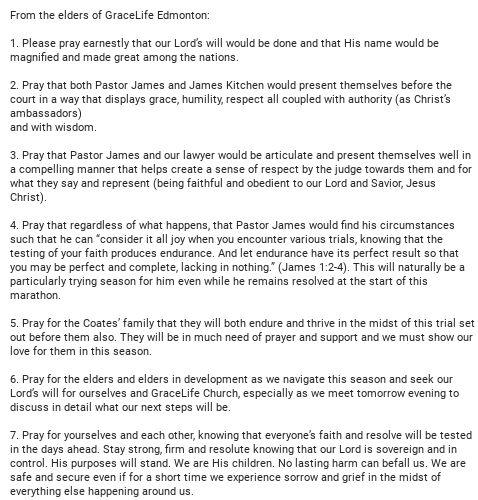
The elders of GLC have suggested these prayer points:
Erin’s Instagram handle is @erincoates80 if you’d like to follow her. Here is her most recent update as of the time I’m writing this:
“What is something tangible you can do? Open your churches. Worship Christ. Practice the one anothers, sing your hearts out, let your pastor see your eyes as he preaches the word of God to you. Don’t underestimate this task in your life. Obey Christ with all you have.”
You’ve heard that old joke, right? One Sunday morning, the minister of music announced from the pulpit, “In honor of Miss Doretha’s 80th birthday, we’re going to let her choose three hymns today.” Miss Doretha jumped breathlessly to her feet, scanned the room, and began pointing: “I’ll take him, him, and him!”
Well some young whippersnapper took it upon herself (a few years ago, but I only saw it recently) to pick 10 Christian Hymns That Need to Be Put to Rest. At least I’m inferring from the tone of the article that the author, Jennifer, is a young whippersnapper, because – I’m sorry, I’m honestly not trying to be mean here, but to me she comes off as a bit immature and shallow.
Or maybe I’m just old and curmudgeonly, having reached the “GET OFF MY LAWN!” stage of life.
Jennifer’s argument for putting several of these hymns out to pasture seems to be, “This hymn is too hard for people to understand,” or “People don’t understand what these words mean”.
By her logic, we should ditch the King James Version of the Bible, the Puritans (certainly Jonathan Edwards – my stars, have you ever tried to read his stuff?), the Reformers, and the early church fathers.
Schools should stop teaching Shakespeare, Beowulf, and Chaucer. And we should probably get rid of some of our patriotic songs too (I mean who knows what a “rampart” is, anyway?)
It’s just further reflective of the worldly attitude of dumbing things down to the level of people’s sloth (excuse me – “laziness” – since some may not know what “sloth” means).
How about, instead of getting rid of hymns and words people don’t understand, pastors and ministers of music take a second and teach the congregation what those words and hymns mean? Or the congregation could pull their phones out and Google it. We do that with everything else – why not do it with hard words and build our vocabularies and our knowledge base?
But there are some hymns that need to go due to theological issues with their lyrics. I’ve got two picks and then I’ll let you get in on the game. Click on the titles for lyrics. (Please note, I don’t really know anything about the people performing these songs, but I’m guessing I wouldn’t recommend them since it’s pretty hard to find doctrinally sound Christians singing songs that aren’t.)
It pains me to list this hymn as one that needs to be put to rest because I’ve been singing it all my life and have a deep sentimental attachment to it. Also the music is lovely, and I really do think the hymnist’s heart was in the right place when he wrote it. But…
The entire tenor of the first verse reminds me of a mom nagging her reluctant child to befriend the snaggle-toothed, bespectacled, nerdy little kid on the playground who’s running around offering his entire Hot Wheels collection if somebody – anybody – will just please, pleeeeeeeeeze, be his friend. Jesus is not some pitiful little weirdo whose day would be made if you would do Him the honor of sitting at His lunch table. He is loving and kind, yes, but He is also King of Kings and Lord of Lords, and we humbly bow the knee to Him.
And don’t even get me started on verse two. People who are dead in their sins can’t “take one step toward the Savior,” my friend. Christ has to raise us from the dead to new life in Christ.
This was the (depending on your age) Shout to the Lord, or Oceans, or Way Maker of my day, kiddies, and I have lots of fond memories attached to it, too. It was the song you sang at youth camp, and sometimes – if your minister of youth and music was cool, like ours was – during Sunday night church. (Some of my contemporaries will remember that we used to yell out, “Praise God!” after the phrase, “I’ll shout it from the mountaintop.”).
Whether or not the composer intended to base the opening words of this song – “It only takes a spark to get a fire going” – in Scripture, it evokes James 3:5b, which, in the most popular modern translation around the time this song was written said:
Consider what a great forest is set on fire by a small spark.
Which would be all well and good except for context, context, context. Because James 3:3-6 says:
When we put bits into the mouths of horses to make them obey us, we can turn the whole animal. 4 Or take ships as an example. Although they are so large and are driven by strong winds, they are steered by a very small rudder wherever the pilot wants to go. 5 Likewise, the tongue is a small part of the body, but it makes great boasts. Consider what a great forest is set on fire by a small spark. 6 The tongue also is a fire, a world of evil among the parts of the body. It corrupts the whole body, sets the whole course of one’s life on fire, and is itself set on fire by hell.
What do you think? Are there any hymns you think could be mothballed because of their unbiblical lyrics? Comment below and share. But play by the rules:
It has to be a non-contemporary hymn. Let’s say anything written between the first century and 1980.
The original audience of Hebrews was first century Christians from Jewish backgrounds. Slavery to Law-keeping was so ingrained that the Holy Spirit gave them a chapter of “Old Testament Survey” (let the seminarian understand).
In this portion of the chapter, He demonstrates to them that the central figure of their faith, the one in whom they had their biological, tribal, and spiritual inheritance – Abraham – left them a legacy, not of Law-keeping, but of faith. Abraham believed God, and that is what was credited to him as righteousness, not any good deeds that he might have done. And, indeed that is the preeminent truth of the entire Old Testament: faith in God and in the Christ to come, not good works.
We are part of that same spiritual legacy of faith today. No amount of good works will save you: being a nice person will not save you, going to church, giving offerings, and serving at church will not save you, being baptized will not save you, praying to saints and other religious rituals will not save you, parroting a “sinner’s prayer” will not save you.
Only repenting of your sin and trusting that Christ’s death, burial, and resurrection paid the penalty for your sin of an eternity in hell will save you.
If you’ve never placed your faith in Jesus and been completely changed into a new creature in Christ with Christlike desires and a hatred for sin, how about doing that today? Check out the What Must I Do to Be Saved? tab in the blue menu bar at the top of this page for more information.