Easter, Forgiveness, Gospel, Old Testament, Salvation, Sunday School, Types and Shadows, Women

Easter with the King: The Story of Nabal, Abigail and David ~ Sunday School Lesson ~ 4-20-14

sunday school

These are my notes from my ladies’ Sunday School class this morning. I’ll be posting the notes from my class here each week. Click here for last week’s lesson.

Through the Bible in 2014 ~ Week 15 ~ Apr. 13-19
1 Samuel 18-31, Psalm 11, 59,7,27,31,34,52,56,120,140-142,17,35,54,63,18
Easter with the King: The Story of Nabal, Abigail and David


Since the whole Bible points to Jesus, the whole Bible tells the story of the gospel. Even the Old Testament. Even the story of David, Abigail, and Nabal.

1 Samuel 25:2-42

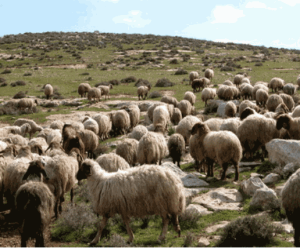
flock of sheep in israelFilthy Rich (2)
3000 sheep/1000 goats was definitely rich (even today it wouldn’t be too shabby). While cattle are more valued in our culture for their meat, milk, and leather, sheep and goats were more valued in Israel for these, and also for sacrifices. Sheep and goats were Israel’s “pantry on the hoof.”

I Pity the Fool (3)
The name “Nabal” means “fool.” As we have seen throughout the OT, names weren’t just random labels. They told something about the person’s character or life, where he was from, who he was related to, etc. Sometimes names were changed to reflect life circumstances: Ben-oni (son of my sorrow) to Benjamin (son of the right hand- Genesis 35:18), Naomi (pleasant) to Mara (bitter- Ruth 1:20), Simon (God has heard) to Peter (rock- Matthew 16:18).

It seems odd, even by Israel’s standards, to name an infant “fool,” but we have no way of knowing whether this was the case or whether he acquired this name later in life after earning it by his behavior.

“Abigail” means “My father is joy.”

An Offer You Can’t Refuse? (4-13, Deuteronomy 22:1-4, 18:7, 21:11, 15:7-8, Leviticus 19:10, 23:22)
This incident hits our Western ears as odd or inappropriate, even presumptuous or akin to extortion, but Middle Eastern hospitality etiquette and neighborliness, not to mention God’s Law was, and still is, much different from ours in many cases.

Nabal did not ask David to guard his shepherds and flocks. Indeed, he probably didn’t even know David was doing so unless the shepherds told him when they brought the sheep in for shearing. (And since “one cannot speak to him” {17} maybe they didn’t.) David, however, when he met up with the shepherds, took it upon himself, out of his own good will, to look out for them. Maybe he had sympathy for them because he had also been a shepherd.

michael-corleoneDavid and his men likely put their lives on the line numerous times protecting Nabal’s livelihood. And he didn’t do it with an “I scratch your back; you scratch mine” attitude, thinking he would later demand pay from Nabal. He also didn’t take advantage of the shepherds (such as extorting sheep/goats in exchange for protection) while they were with him. David was obeying the spirit of all those “good neighbor laws” we read about (ex: Deuteronomy 22:1-4). The law is not just “don’t harm your neighbor,” but also, “do good to your neighbor.”

Remember, these shepherds were alone out in the wilderness with the flocks. There was no police force or army to protect them from raiding bands of Philistines. If the Philistines saw a thousand goats and 3000 sheep and wanted them, they just took them and captured or killed the shepherds. No legal redress, no sheep insurance. Nabal’s entire portfolio was at stake. You would think once he found out what David had done –for free and out of the goodness of his heart—Nabal would be extremely grateful. But was he? Nope.

David’s men arrived, explained themselves, and asked politely for whatever food Nabal could spare (kind of hard to make groceries when you’re on the run living in caves). They did not demand his best, and they did not demand he provide enough for their entire company of 600 men. They had even come on a feast day when Nabal was celebrating his wealth, should have been in a good mood, and should have had plenty of extra food on hand. And notice this telling little phrase, “they said all this to Nabal in the name of David, and then they waited.” (9) Now here’s one way Middle Eastern culture is similar to Southern culture. If someone was standing there telling you about all those nice things he had done for you, how long would it take before you gleefully interrupted him and offered him everything under the sun in thanks? Well, Middle Easterners aren’t as shy about interrupting as we are, and furthermore, they would take it as the highest insult if you didn’t take everything they offered.

Not Nabal, though. First, he pretended not to know who David was. Pretty ridiculous, since David’s conquests were well known throughout Israel (18:7, 21:11- even outside Israel), not to mention the fact that he was next in line for the throne. Next, he insulted David’s men by accusing them of lying about working for David. Of course, if he had been interested in finding out whether or not that was true, he could have brought his shepherds in and asked them if these were the guys who had protected them.

David’s men went back and reported what had happened. David’s immediate response was for everyone to “strap on his sword.” It seems like kind of an extreme response to us, but we have to keep a few things in mind. First, the Law. Nabal was breaking both the letter and the spirit of it. While there was no specific law covering a band of mighty men coming to you and asking for food on a feast day, there were laws about taking care of people who were hungry and poor, such as the gleaning laws (Leviticus 19:10, 23:22).

Deuteronomy 15:7-8 says: “If among you, one of your brothers should become poor, in any of your towns within your land that the Lord your God is giving you, you shall not harden your heart or shut your hand against your poor brother, but you shall open your hand to him and lend him sufficient for his need, whatever it may be.”

When we read through Ruth, we saw Boaz doing a great job of fulfilling this law for Ruth and Naomi. Here, Nabal is showing the exact opposite of Boaz’s kindness and generosity.

Second, Nabal’s actions showed disregard and ingratitude for God’s provision and blessing. God blessed Nabal with wealth and protected that wealth (through David) without Nabal even knowing about it. Do we see any evidence that Nabal was humbled that God should do such a thing for him, or thankfulness to God for what He had provided? No. We see only selfishness, stinginess, and a blatant disregard for God as sovereign provider.

Finally, David’s response was likely an answer to Nabal’s accusations. “He wants to know who David is? He wants to know whether or not my men are lying? Well, let’s go show him the answer to his questions and see if he changes his tune.”

The Go-Between (14-31, John 12:14-15)
Abigail was quite a remarkable woman. This was not the first time Nabal had acted this way. He had a long standing history of being harsh and worthless (“son of Belial” is also applied to Satan in 2 Corinthians). And here, Abigail was going behind his back and defying him. This was no small thing for any wife in Israel. But for Abigail, it could have meant a beating or worse when Nabal found out. It’s possible she was even risking her life. And for what? To save him. Without his knowledge that she was saving him. Without his knowledge that he even needed saving.

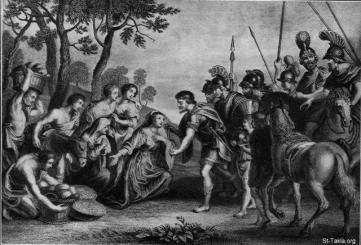
Why in the world would Abigail want to save someone who was probably making her life a living hell? She could have just let David and his men handle Nabal. Certainly he would have www-St-Takla-org--abigail-entreats-mercygotten what he deserved. But she stepped in because it was the right thing to do. It was right to obey God by providing for David and his men. It was even right to protect her husband from his own foolishness and bringing David’s wrath down upon himself. But even more, she did it because she loved God, and maybe even her husband, too.

She sent the gift on ahead (19) to appease David’s wrath, then presented herself to him on Nabal’s behalf. Notice that she got down off her donkey (23). Kings rode donkeys. Rich people and people of high standing rode donkeys. She left her wealth and position behind and got as low as she could get, bowing down, humbling herself, and submitting herself to David. For Nabal.

Then Abigail did something even more remarkable. She said (24-25), “On me alone, my lord, be the guilt. Please let your servant speak in your ears, and hear the words of your servant. Let not my lord regard this worthless fellow, Nabal, for as his name is, so is he.” She—a completely innocent party to Nabal’s sin (25)—voluntarily takes on the guilt and consequences of his sin. (Is this starting to sound familiar?) In v. 28, she asked David to “Please forgive the trespass of your servant.” It wasn’t her trespass, but Nabal’s. She was asking forgiveness for him.

The King’s Response (32-35)
David blessed Abigail, not just for her prudence and godliness, but also because she had satisfied his wrath and kept him from exercising it on Nabal. Her gift was sufficient, and David granted her petition to extend forgiveness to Nabal.

Happily Ever After (36-42)
Well, except for Nabal. Abigail had to tell Nabal what she had done. She’d been gone for a while and had taken quite a bit of food out of the house. No sense trying to cover it up. Hopefully Nabal would be grateful she saved him from certain death. When she told him, did he repent? Humble himself? The text doesn’t say that he did. It says “his heart died within him.” It’s generally believed this means that Nabal had a stroke (especially since it further says that he “became as stone” and lived for ten more days). Did he become enraged at what Abigail had done, and this physical exertion contributed to a stroke? We can’t know for certain. What seems unlikely is that he genuinely repented, because God “struck Nabal and he died.” As we’ll see later with David, while we usually do suffer the consequences of our sin, God shows mercy and forgiveness to the repentant.

David was thankful he had not taken matters into his own hands and that God had handled the situation. Justice had been served. And for her faithfulness, Abigail—who considered herself the lowliest of servants, only fit to wash the feet of other servants—ascended to the position of Queen. Back on her donkey where she belonged, exalted out of humility to sit at the right hand of the king.

The Backstage Gospel (Psalm 14:1, Philippians 2:6-8, 9-11)
Often, in stories like this, the characters aren’t just playing themselves, they’re playing out the parts of the gospel.

As with Nabal, God blessed His people richly with life, family, provisions, and all kinds of other blessings she wasn’t even aware of. The people didn’t ask God to do these things. God, the Good Shepherd, did these things for them out of the goodness of His own heart, the same way David had done for Nabal. But, as with Nabal the fool, “The fool says in his heart, ‘There is no God.’ They are corrupt, they do abominable deeds, there is none who does good.” (Ps. 14) The same way David presented himself to Nabal and told him what he had done for him, God, over and over, reminded Israel of the way He had protected and provided for them. But just as Nabal rejected David, so, Israel rejected God, and rebelled against Him in favor of their own sin and selfishness. And, like David, God’s wrath was inflamed.

Enter Jesus. Just as Abigail intervened on behalf of Nabal, Jesus intervened on behalf of Israel and all mankind. Just like Abigail, He laid down His life to save us. Before we ever knew Him. Before we ever knew we needed saving. Why? Why would He even want to save us Nabals? He could have let God exercise His wrath on us. We certainly deserve it. But in the same way that Abigail acted in love and in doing what was right, Jesus loved His Father and us enough to fulfill righteousness and to bring God glory by staying His hand of wrath.

In the same way that Abigail got down off her donkey, leaving behind all prestige and humbling herself to the lowest position possible—a servant only worthy of washing other hp-crossshadowservants’ feet— Jesus “though he was in the form of God, did not count equality with God a thing to be grasped, but emptied himself, by taking the form of a servant [one who washed other servants’ feet], being born in the likeness of men. And being found in human form, he humbled himself by becoming obedient to the point of death, even death on a cross.” (Phil. 2:6-8) And for whom? Us Nabals. “On me alone, my Lord, be the guilt,” Jesus said, even though, like Abigail, He was completely innocent. He voluntarily took on the guilt and consequences of our sin when He died in our place on the cross, and He did it to win forgiveness for us.

Jesus sent this offering of His life for the atonement of our sin on ahead of Himself to the Father, and God’s wrath was satisfied. Jesus’ offering was sufficient, and God granted His petition to extend forgiveness to the likes of us. And just as David picked Abigail up from her humility and she ascended to the position of queen, Jesus ascended to sit at the right hand of the King, and “God has highly exalted him [Jesus] and bestowed on him the name that is above every name, so that at the name of Jesus every knee should bow, in heaven and on earth and under the earth, and every tongue confess that Jesus Christ is Lord, to the glory of God the Father.” (Phil. 2:9-11)

This story didn’t have a happy ending for Nabal, because Nabal didn’t repent and submit himself to God. Nabal ended up taking the guilt and consequences for his sin himself (death) instead of gratefully humbling himself and being thankful for the gift of Abigail’s intervention and David’s forgiveness. But the rest of us Nabals can have a happy ending. Jesus has paid the price for our sin with His death, burial, and the resurrection we celebrate today. He completely satisfied the wrath of God on our behalf. It is finished. Forgiveness has been purchased with His blood. If we will humble ourselves, repent of our sin, and accept the beautiful gift of forgiveness God is extending to us at the request of His Son, we can be reconciled to God now and live happily in the ever after.

Easter, Gospel, Salvation

Check Out My New Post at Satisfaction Through Christ!

Starting today, I’m a contributing blogger at Satisfaction Through Christ. It’s a great Christian women’s blog covering Christian living, home making, marriage and family, ministry, crafts, DIY, reviews and giveaways, recipes, and more!

Head on over to STC and subscribe via e-mail. Be sure to check out our social media links: like STC on Facebook, follow on Twitter, Pinterest, Instagram, and all our other outlets!

Check out my shiny new post: The Daily Wonder of Easter

easter3


But, see, the thing is, Christians never move past our need for
hearing the gospel again and again. Young or old. Newly saved or seasoned saint.

We need the gospel…


Gospel, Homosexuality, Salvation, Sin

The Hole in World Vision’s Gospel: UPDATE #2

Update #2: Some readers wrote me with some concerns about this article. I have done my best to address those concerns here.

Update: World Vision released this statement today (March 26) reversing its earlier decision. It’s my prayer that this decision is born of genuine repentance (which would truly be cause for rejoicing!) rather than a reaction to negative PR and loss of donors. 

th

Earlier this week, World Vision’s U.S. President, Richard Stearns, publicly announced that the relief organization would change its employment policy and begin hiring practicing, unrepentant homosexuals who are legally “married.” Understandably, many in the evangelical community (including me) are shocked and saddened that this Christian organization would decide to bow its knee to the world instead of to God’s word.

But all Stearns’ bloviating about “unity,” whether or not World Vision now endorses homosexual “marriage” in the political arena, and uniformity of hiring practices is gnat straining. The camel is in the headline: “gay Christians.” And ever since World Vision opened up its throat wide enough to swallow that dromedary, it’s been gulping down the gnats as a chaser.

There is no such thing as a “gay Christian.”

There just isn’t. When a person comes to Christ for salvation, he doesn’t cling to, rationalize, or defend his sin, whatever it may be. He abandons it and flees to the cross for mercy and forgiveness. That’s why there’s no such thing as a “Christian prostitute” or a “Christian murderer” or a “Christian thief” or a “Christian hatemonger,” and there’s no such thing as a “Christian homosexual.”

There are people who repent of those things, are graciously saved by God, and who may continue to struggle against those sins:

Or do you not know that the unrighteous will not inherit the kingdom of God? Do not be deceived: neither the sexually immoral, nor idolaters, nor adulterers, nor men who practice homosexuality, nor thieves, nor the greedy, nor drunkards, nor revilers, nor swindlers will inherit the kingdom of God. And such were some of you. But you were washed, you were sanctified, you were justified in the name of the Lord Jesus Christ and by the Spirit of our God.
1 Corinthians 6:9-11

You see, the good news of the gospel is not that Jesus accepts you the way you are. Because the way you are -whether you’re a homosexual, an idolater, a thief, a drunk, or the average Jane down the street- is a putrid, rotten, decomposing corpse. Dead. That’s what you are: dead. I’m talking Lazarus in the tomb, dead. “Lord, he stinketh,” dead. D-E-A-D, dead in your trespasses and sins.

Now, just who is this puny little so-called “Jesus” Stearns (and many others) speaks of who just leaves people in that awful condition? Not any Jesus that’s found in the Bible, that’s for sure.

The good news of the gospel is that Jesus loved you enough to go to the cross to take the punishment for your sin so He could raise you from the dead and give you life. Holy life. Forgiven life. Peaceful life. Joy-filled life. Jesus isn’t in the business of holding the hands of cadavers. He’s in the resurrection business. And Christians are supposed to be about the business of carrying the deceased to the feet of Christ so He can do His mighty and miraculous work.

But, I guess World Vision isn’t, anymore.

And it’s both shameful and abominable that an organization that claims the name of Christ would spinelessly cave to Satan’s twisting of God’s word about salvation, because, ultimately, people’s eternities are at stake here. When someone has the life-giving truth of the gospel, refuses to extend it to people, and tells them lies that keep them in bondage to sin, that someone has blood on his hands.

Soteriology is the foundation of ecclesiology, even for para-church ministries. And World Vision’s foundation has a huge crack in it.

Bible, Gospel, Salvation

Sunday School Lesson ~ 10-20-13

sunday school

These are the notes from my ladies’ Sunday School class this morning. I’ll be posting the notes from my class here each week. They will be in outline form, so if you have any questions, need more details, or have a suggestion for a topic of study, please feel free to leave a comment below.

Click here for the 10-6-13 lesson.

What is salvation? What is the gospel? (Cont’d)

 We have spent several weeks looking at the “whys” and “wherefores” of salvation. Today, we’re simply reading the account of the “Who” and the “how”.

John 18:13-24- Trial before Ex- High Priest Annas (2:00 a.m.)

13 First they led him to Annas, for he was the father-in-law of Caiaphas, who was high priest that year. 14 It was Caiaphas who had advised the Jews that it would be expedient that one man should die for the people.

Peter Denies Jesus

15 Simon Peter followed Jesus, and so did another disciple. Since that disciple was known to the high priest, he entered with Jesus into the courtyard of the high priest,16 but Peter stood outside at the door. So the other disciple, who was known to the high priest, went out and spoke to the servant girl who kept watch at the door, and brought Peter in. 17 The servant girl at the door said to Peter, “You also are not one of this man’s disciples, are you?” He said, “I am not.” 18 Now the servants and officers had made a charcoal fire, because it was cold, and they were standing and warming themselves. Peter also was with them, standing and warming himself.

The High Priest Questions Jesus

19 The high priest then questioned Jesus about his disciples and his teaching. 20 Jesus answered him, “I have spoken openly to the world. I have always taught in synagogues and in the temple, where all Jews come together. I have said nothing in secret. 21 Why do you ask me? Ask those who have heard me what I said to them; they know what I said.” 22 When he had said these things, one of the officers standing by struck Jesus with his hand, saying, “Is that how you answer the high priest?” 23 Jesus answered him, “If what I said is wrong, bear witness about the wrong; but if what I said is right, why do you strike me?” 24 Annas then sent him bound to Caiaphas the high priest.

Mark 14:53-72- Trial before High Priest Caiaphas (3:30 a.m.)

Jesus Before the Council

53 And they led Jesus to the high priest. And all the chief priests and the elders and the scribes came together.54 And Peter had followed him at a distance, right into the courtyard of the high priest. And he was sitting with the guards and warming himself at the fire. 55 Now the chief priests and the whole council were seeking testimony against Jesus to put him to death, but they found none.56 For many bore false witness against him, but their testimony did not agree. 57 And some stood up and bore false witness against him, saying, 58 “We heard him say, ‘I will destroy this temple that is made with hands, and in three days I will build another, not made with hands.’”59 Yet even about this their testimony did not agree.60 And the high priest stood up in the midst and asked Jesus, “Have you no answer to make? What is it that these men testify against you?” 61 But he remained silent and made no answer. Again the high priest asked him, “Are you the Christ, the Son of the Blessed?” 62 And Jesus said, “I am, and you will see the Son of Man seated at the right hand of Power, and coming with the clouds of heaven.”63 And the high priest tore his garments and said, “What further witnesses do we need? 64 You have heard his blasphemy. What is your decision?” And they all condemned him as deserving death. 65 And some began to spit on him and to cover his face and to strike him, saying to him, “Prophesy!” And the guards received him with blows.

Peter Denies Jesus

66 And as Peter was below in the courtyard, one of the servant girls of the high priest came, 67 and seeing Peter warming himself, she looked at him and said, “You also were with the Nazarene, Jesus.” 68 But he denied it, saying, “I neither know nor understand what you mean.” And he went out into the gateway and the rooster crowed.69 And the servant girl saw him and began again to say to the bystanders, “This man is one of them.” 70 But again he denied it. And after a little while the bystanders again said to Peter, “Certainly you are one of them, for you are a Galilean.” 71 But he began to invoke a curse on himself and to swear, “I do not know this man of whom you speak.”72 And immediately the rooster crowed a second time. And Peter remembered how Jesus had said to him, “Before the rooster crows twice, you will deny me three times.” And he broke down and wept.

Luke 22:66-71- Trial before the Sanhedrin (6:00 a.m.)

Jesus Before the Council

66 When day came, the assembly of the elders of the people gathered together, both chief priests and scribes. And they led him away to their council, and they said, 67 “If you are the Christ, tell us.” But he said to them, “If I tell you, you will not believe, 68 and if I ask you, you will not answer. 69 But from now on the Son of Man shall be seated at the right hand of the power of God.” 70 So they all said, “Are you the Son of God, then?” And he said to them, “You say that I am.” 71 Then they said, “What further testimony do we need? We have heard it ourselves from his own lips.”

Matthew 27:3-10

Then when Judas, his betrayer, saw that Jesus was condemned, he changed his mind and brought back the thirty pieces of silver to the chief priests and the elders,saying, “I have sinned by betraying innocent blood.” They said, “What is that to us? See to it yourself.” And throwing down the pieces of silver into the temple, he departed, and he went and hanged himself. But the chief priests, taking the pieces of silver, said, “It is not lawful to put them into the treasury, since it is blood money.” So they took counsel and bought with them the potter’s field as a burial place for strangers. Therefore that field has been called the Field of Blood to this day. Then was fulfilled what had been spoken by the prophet Jeremiah, saying, “And they took the thirty pieces of silver, the price of him on whom a price had been set by some of the sons of Israel, 10 and they gave them for the potter’s field, as the Lord directed me.”

John 18:28-38- Trial before Pilate (6:30 a.m.)

Jesus Before Pilate

28 Then they led Jesus from the house of Caiaphas to the governor’s headquarters. It was early morning. They themselves did not enter the governor’s headquarters, so that they would not be defiled, but could eat the Passover.29 So Pilate went outside to them and said, “What accusation do you bring against this man?” 30 They answered him, “If this man were not doing evil, we would not have delivered him over to you.” 31 Pilate said to them, “Take him yourselves and judge him by your own law.” The Jews said to him, “It is not lawful for us to put anyone to death.” 32 This was to fulfill the word that Jesus had spoken to show by what kind of death he was going to die.

My Kingdom Is Not of This World

33 So Pilate entered his headquarters again and called Jesus and said to him, “Are you the King of the Jews?”34 Jesus answered, “Do you say this of your own accord, or did others say it to you about me?” 35 Pilate answered, “Am I a Jew? Your own nation and the chief priests have delivered you over to me. What have you done?” 36 Jesus answered, “My kingdom is not of this world. If my kingdom were of this world, my servants would have been fighting, that I might not be delivered over to the Jews. But my kingdom is not from the world.” 37 Then Pilate said to him, “So you are a king?” Jesus answered, “You say that I am a king. For this purpose I was born and for this purpose I have come into the world—to bear witness to the truth. Everyone who is of the truth listens to my voice.” 38 Pilate said to him, “What is truth?”

After he had said this, he went back outside to the Jews and told them, “I find no guilt in him.

Luke 23:5-17- Trial before Herod (7:00 a.m.)

But they were urgent, saying, “He stirs up the people, teaching throughout all Judea, from Galilee even to this place.”

Jesus Before Herod

When Pilate heard this, he asked whether the man was a Galilean. And when he learned that he belonged to Herod’s jurisdiction, he sent him over to Herod, who was himself in Jerusalem at that time. When Herod saw Jesus, he was very glad, for he had long desired to see him, because he had heard about him, and he was hoping to see some sign done by him. So he questioned him at some length, but he made no answer. 10 The chief priests and the scribes stood by, vehemently accusing him. 11 And Herod with his soldiers treated him with contempt and mocked him. Then, arraying him in splendid clothing, he sent him back to Pilate. 12 And Herod and Pilate became friends with each other that very day, for before this they had been at enmity with each other.

13 Pilate then called together the chief priests and the rulers and the people, 14 and said to them, “You brought me this man as one who was misleading the people. And after examining him before you, behold, I did not find this man guilty of any of your charges against him. 15 Neither did Herod, for he sent him back to us. Look, nothing deserving death has been done by him. 16 I will therefore punish and release him.”

Mark 15:6-15a- Second trial before Pilate (7:30 a.m.)

Pilate Delivers Jesus to Be Crucified

Now at the feast he used to release for them one prisoner for whom they asked. And among the rebels in prison, who had committed murder in the insurrection, there was a man called Barabbas. And the crowd came up and began to ask Pilate to do as he usually did for them.And he answered them, saying, “Do you want me to release for you the King of the Jews?” 10 For he perceived that it was out of envy that the chief priests had delivered him up. 11 But the chief priests stirred up the crowd to have him release for them Barabbas instead. 12 And Pilate again said to them, “Then what shall I do with the man you call the King of the Jews?” 13 And they cried out again, “Crucify him.” 14 And Pilate said to them, “Why, what evil has he done?” But they shouted all the more, “Crucify him.”15 So Pilate, wishing to satisfy the crowd, released for them Barabbas,

John 19:1-16

Then Pilate took Jesus and flogged him. And the soldiers twisted together a crown of thorns and put it on his head and arrayed him in a purple robe. They came up to him, saying, “Hail, King of the Jews!” and struck him with their hands. Pilate went out again and said to them, “See, I am bringing him out to you that you may know that I find no guilt in him.” So Jesus came out, wearing the crown of thorns and the purple robe. Pilate said to them, “Behold the man!” When the chief priests and the officers saw him, they cried out, “Crucify him, crucify him!” Pilate said to them, “Take him yourselves and crucify him, for I find no guilt in him.” The Jews answered him, “We have a law, and according to that law he ought to die because he has made himself the Son of God.” When Pilate heard this statement, he was even more afraid. He entered his headquarters again and said to Jesus, “Where are you from?” But Jesus gave him no answer. 10 So Pilate said to him, “You will not speak to me? Do you not know that I have authority to release you and authority to crucify you?”11 Jesus answered him, “You would have no authority over me at all unless it had been given you from above. Therefore he who delivered me over to you has the greater sin.”

12 From then on Pilate sought to release him, but the Jews cried out, “If you release this man, you are not Caesar’s friend. Everyone who makes himself a king opposes Caesar.” 13 So when Pilate heard these words, he brought Jesus out and sat down on the judgment seat at a place called The Stone Pavement, and in Aramaic Gabbatha.14 Now it was the day of Preparation of the Passover. It was about the sixth hour. He said to the Jews, “Behold your King!” 15 They cried out, “Away with him, away with him, crucify him!” Pilate said to them, “Shall I crucify your King?” The chief priests answered, “We have no king but Caesar.” 16 So he delivered him over to them to be crucified.

Mark 15:16-19 (6-9 a.m.)

Jesus Is Mocked

16 And the soldiers led him away inside the palace (that is,the governor’s headquarters), and they called together the whole battalion. 17 And they clothed him in a purple cloak, and twisting together a crown of thorns, they put it on him.18 And they began to salute him, “Hail, King of the Jews!”19 And they were striking his head with a reed and spitting on him and kneeling down in homage to him. 20 And when they had mocked him, they stripped him of the purple cloak and put his own clothes on him. And they led him out to crucify him.

Luke 23:26-33

The Crucifixion

26 And as they led him away, they seized one Simon of Cyrene, who was coming in from the country, and laid on him the cross, to carry it behind Jesus. 27 And there followed him a great multitude of the people and of women who were mourning and lamenting for him. 28 But turning to them Jesus said, “Daughters of Jerusalem, do not weep for me, but weep for yourselves and for your children.29 For behold, the days are coming when they will say, ‘Blessed are the barren and the wombs that never bore and the breasts that never nursed!’ 30 Then they will begin to say to the mountains, ‘Fall on us,’ and to the hills, ‘Cover us.’ 31 For if they do these things when the wood is green, what will happen when it is dry?”

32 Two others, who were criminals, were led away to be put to death with him. 33 And when they came to the place that is called The Skull, there they crucified him, and the criminals, one on his right and one on his left.

Luke 23:34a, 35-37, 39-43

34 And Jesus said, “Father, forgive them, for they know not what they do.” 35 And the people stood by, watching, but the rulers scoffed at him, saying, “He saved others; let him save himself, if he is the Christ of God, his Chosen One!” 36 The soldiers also mocked him, coming up and offering him sour wine 37 and saying, “If you are the King of the Jews, save yourself!” 39 One of the criminals who were hanged railed at him, saying, “Are you not the Christ? Save yourself and us!”40 But the other rebuked him, saying, “Do you not fear God, since you are under the same sentence of condemnation? 41 And we indeed justly, for we are receiving the due reward of our deeds; but this man has done nothing wrong.” 42 And he said, “Jesus, remember me when you come into your kingdom.” 43 And he said to him, “Truly, I say to you, today you will be with me in Paradise.”

John 19:19-27 (9 a.m. – 12 p.m.)

Pilate also wrote an inscription and put it on the cross. It read, “Jesus of Nazareth, the King of the Jews.” 20 Many of the Jews read this inscription, for the place where Jesus was crucified was near the city, and it was written in Aramaic, in Latin, and in Greek. 21 So the chief priests of the Jews said to Pilate, “Do not write, ‘The King of the Jews,’ but rather, ‘This man said, I am King of the Jews.’” 22 Pilate answered, “What I have written I have written.”

23 When the soldiers had crucified Jesus, they took his garments and divided them into four parts, one part for each soldier; also his tunic. But the tunic was seamless, woven in one piece from top to bottom, 24 so they said to one another, “Let us not tear it, but cast lots for it to see whose it shall be.” This was to fulfill the Scripture which says,

“They divided my garments among them,
and for my clothing they cast lots.”

So the soldiers did these things, 25 but standing by the cross of Jesus were his mother and his mother’s sister, Mary the wife of Clopas, and Mary Magdalene. 26 When Jesus saw his mother and the disciple whom he loved standing nearby, he said to his mother, “Woman, behold, your son!” 27 Then he said to the disciple, “Behold, your mother!” And from that hour the disciple took her to his own home.

Mark 15:33-35 (12-3 p.m.)

33 And when the sixth hour had come, there was darkness over the whole land until the ninth hour. 34 And at the ninth hour Jesus cried with a loud voice, “Eloi, Eloi, lema sabachthani?” which means, “My God, my God, why have you forsaken me?” 35 And some of the bystanders hearing it said, “Behold, he is calling Elijah.” 

John 19:28

28 After this, Jesus, knowing that all was now finished, said (to fulfill the Scripture), “I thirst.” 

Mark 15:36

36 And someone ran and filled a sponge with sour wine, put it on a reed and gave it to him to drink, saying, “Wait, let us see whether Elijah will come to take him down.” 

John 19:30

30 When Jesus had received the sour wine, he said, “It is finished,” and he bowed his head and gave up his spirit.

Luke 23:46

46 Then Jesus, calling out with a loud voice, said, “Father, into your hands I commit my spirit!” And having said this he breathed his last.

Matthew 27:51-56

51 And behold, the curtain of the temple was torn in two, from top to bottom. And the earth shook, and the rocks were split. 52 The tombs also were opened. And many bodies of the saints who had fallen asleep were raised, 53 and coming out of the tombs after his resurrection they went into the holy city and appeared to many. 54 When the centurion and those who were with him, keeping watch over Jesus, saw the earthquake and what took place, they were filled with awe and said, “Truly this was the Son of God!”

55 There were also many women there, looking on from a distance, who had followed Jesus from Galilee, ministering to him, 56 among whom were Mary Magdalene and Mary the mother of James and Joseph and the mother of the sons of Zebedee.

John 19:31-42 (3-6 p.m.)

Jesus’ Side Is Pierced

31 Since it was the day of Preparation, and so that the bodies would not remain on the cross on the Sabbath (for that Sabbath was a high day), the Jews asked Pilate that their legs might be broken and that they might be taken away. 32 So the soldiers came and broke the legs of the first, and of the other who had been crucified with him.33 But when they came to Jesus and saw that he was already dead, they did not break his legs. 34 But one of the soldiers pierced his side with a spear, and at once there came out blood and water. 35 He who saw it has borne witness—his testimony is true, and he knows that he is telling the truth—that you also may believe. 36 For these things took place that the Scripture might be fulfilled: “Not one of his bones will be broken.” 37 And again another Scripture says, “They will look on him whom they have pierced.”

Jesus Is Buried

38 After these things Joseph of Arimathea, who was a disciple of Jesus, but secretly for fear of the Jews, asked Pilate that he might take away the body of Jesus, and Pilate gave him permission. So he came and took away his body. 39 Nicodemus also, who earlier had come to Jesus by night, came bringing a mixture of myrrh and aloes, about seventy-five pounds in weight. 40 So they took the body of Jesus and bound it in linen cloths with the spices, as is the burial custom of the Jews. 41 Now in the place where he was crucified there was a garden, and in the garden a new tomb in which no one had yet been laid. 42 So because of the Jewish day of Preparation, since the tomb was close at hand, they laid Jesus there.

Matthew 27:60-66 (6 p.m. Friday – 6  p.m. Saturday)

and [Joseph] laid [Jesus’ body] in his own new tomb, which he had cut in the rock. And he rolled a great stone to the entrance of the tomb and went away. 61 Mary Magdalene and the other Mary were there, sitting opposite the tomb.

The Guard at the Tomb

62 The next day, that is, after the day of Preparation, the chief priests and the Pharisees gathered before Pilate 63 and said, “Sir, we remember how that impostor said, while he was still alive, ‘After three days I will rise.’64 Therefore order the tomb to be made secure until the third day, lest his disciples go and steal him away and tell the people, ‘He has risen from the dead,’ and the last fraud will be worse than the first.” 65 Pilate said to them, “You have a guard of soldiers. Go, make it as secure as you can.” 66 So they went and made the tomb secure by sealing the stone and setting a guard.

Mark 16:1-3

The Resurrection

When the Sabbath was past, Mary Magdalene, Mary the mother of James, and Salome bought spices, so that they might go and anoint him. And very early on the first day of the week, when the sun had risen, they went to the tomb. And they were saying to one another, “Who will roll away the stone for us from the entrance of the tomb?”

Matthew 28:2-4

And behold, there was a great earthquake, for an angel of the Lord descended from heaven and came and rolled back the stone and sat on it.His appearance was like lightning, and his clothing white as snow. And for fear of him the guards trembled and became like dead men.

John 20:1b-18

and [the women] saw that the stone had been taken away from the tomb. So she ran and went to Simon Peter and the other disciple, the one whom Jesus loved, and said to them, “They have taken the Lord out of the tomb, and we do not know where they have laid him.” So Peter went out with the other disciple, and they were going toward the tomb. Both of them were running together, but the other disciple outran Peter and reached the tomb first. And stooping to look in, he saw the linen cloths lying there, but he did not go in. Then Simon Peter came, following him, and went into the tomb. He saw the linen cloths lying there, and the face cloth, which had been on Jesus’ head, not lying with the linen cloths but folded up in a place by itself. Then the other disciple, who had reached the tomb first, also went in, and he saw and believed; for as yet they did not understand the Scripture, that he must rise from the dead. 10 Then the disciples went back to their homes.

Jesus Appears to Mary Magdalene

11 But Mary stood weeping outside the tomb, and as she wept she stooped to look into the tomb. 12 And she saw two angels in white, sitting where the body of Jesus had lain, one at the head and one at the feet. 13 They said to her, “Woman, why are you weeping?” She said to them, “They have taken away my Lord, and I do not know where they have laid him.” 14 Having said this, she turned around and saw Jesus standing, but she did not know that it was Jesus. 15 Jesus said to her, “Woman, why are you weeping? Whom are you seeking?” Supposing him to be the gardener, she said to him, “Sir, if you have carried him away, tell me where you have laid him, and I will take him away.” 16 Jesus said to her, “Mary.” She turned and said to him in Aramaic, “Rabboni!” (which means Teacher). 17 Jesus said to her, “Do not cling to me, for I have not yet ascended to the Father; but go to my brothers and say to them, ‘I am ascending to my Father and your Father, to my God and your God.’” 18 Mary Magdalene went and announced to the disciples, “I have seen the Lord”—and that he had said these things to her.

Matthew 28:11-15

The Report of the Guard

11 While they were going, behold, some of the guard went into the city and told the chief priests all that had taken place. 12 And when they had assembled with the elders and taken counsel, they gave a sufficient sum of money to the soldiers 13 and said, “Tell people, ‘His disciples came by night and stole him away while we were asleep.’ 14 And if this comes to the governor’s ears, we will satisfy him and keep you out of trouble.” 15 So they took the money and did as they were directed. And this story has been spread among the Jews to this day.

1 Corinthians 15:3-8

For I delivered to you as of first importance what I also received: that Christ died for our sins in accordance with the Scriptures, that he was buried, that he was raised on the third day in accordance with the Scriptures, and that he appeared to Cephas, then to the twelve. Then he appeared to more than five hundred brothers at one time, most of whom are still alive, though some have fallen asleep. Then he appeared to James, then to all the apostles. Last of all, as to one untimely born, he appeared also to me. 

http://www.abideinchrist.com/messages/harmonycrucifixion.html

http://www.tektonics.org/harmonize/greenharmony.htm

Bible, Gospel, Salvation, Sin, Sunday School

What is salvation? What is the gospel? ~ Sunday School Lesson ~ 9-22-13

sunday school


I recently started teaching a women’s Sunday School class at my church. Right now we are taking a look at some of the challenging questions and issues we face as Christians. I’ll be posting the notes from my class here each week. Click here for last week’s lesson.

What is salvation? What is the gospel?

I. What is the one thing Jesus can do for us that we can’t do for ourselves?

II. Why do we need salvation?

A. Creation was perfect (Genesis 1, key verse: 31): “It was good.”

B. Fall of man (Genesis 3). What does this have to do with us today?

1. Death entered the world as a result of the fall  (Romans 5:12, 15-19)

2. Sin “genetically altered” every person from Adam on (Psalm 51:5) and now we are all sinners.

III. How do we know we need salvation?

A. The Law

1. The Law shows us what sin is (Romans 7:7-11)

2. The Law shows us we are guilty of breaking it (James 2:10-11)

3. The Law is written on our hearts and condemns us when we do wrong (Romans  2:15)

4. The Law shows us the futility of trying to keep it and leads us to cry out to God for help. (Galatians 3:10-11, 23-24)

IV. Extra Study Resources:

A. “How Did the Fall Affect Humanity?”  ~ Got Questions Ministries

B. “Law”  ~ Theopedia.com

C. “The Law and the Gospel” by John MacArthur

D. “The Gospel” by Matt Chandler

This lesson will be continued next week.