Colossians Bible Study

Colossians: Lesson 3

Previous Lessons: 1, 2

Colossians 1:15-29

He is the image of the invisible God, the firstborn of all creation. 16 For by him all things were created, in heaven and on earth, visible and invisible, whether thrones or dominions or rulers or authorities—all things were created through him and for him. 17 And he is before all things, and in him all things hold together. 18 And he is the head of the body, the church. He is the beginning, the firstborn from the dead, that in everything he might be preeminent. 19 For in him all the fullness of God was pleased to dwell, 20 and through him to reconcile to himself all things, whether on earth or in heaven, making peace by the blood of his cross.

21 And you, who once were alienated and hostile in mind, doing evil deeds, 22 he has now reconciled in his body of flesh by his death, in order to present you holy and blameless and above reproach before him, 23 if indeed you continue in the faith, stable and steadfast, not shifting from the hope of the gospel that you heard, which has been proclaimed in all creation under heaven, and of which I, Paul, became a minister.

24 Now I rejoice in my sufferings for your sake, and in my flesh I am filling up what is lacking in Christ’s afflictions for the sake of his body, that is, the church, 25 of which I became a minister according to the stewardship from God that was given to me for you, to make the word of God fully known, 26 the mystery hidden for ages and generations but now revealed to his saints. 27 To them God chose to make known how great among the Gentiles are the riches of the glory of this mystery, which is Christ in you,the hope of glory. 28 Him we proclaim, warning everyone and teaching everyone with all wisdom, that we may present everyone mature in Christ. 29 For this I toil, struggling with all his energy that he powerfully works within me.


The Holy Bible, English Standard Version Copyright © 2001 by Crossway Bibles, a publishing ministry of Good News Publishers.


Questions to Consider:

1. At the end of lesson 2 (link above), we saw that Paul gave a brief recap of the gospel (13-14). How was that a good introduction to the passage we’re looking at today? What is the overall theme of today’s passage?

2. Jehovah’s Witnesses use verse 15 to support their idea that Christ was a created (non-eternal) being. Is that what this verse means? What sort of ideas would the term “firstborn” have brought to the minds of first century Jews (and even gentiles)? Verse 15 says that Christ is the firstborn of all creation. Verse 18 says that He is the firstborn from the dead. How do these two positions of Christ “bookend” His supremacy over every aspect of the universe?

3. List the specific roles Christ plays in creation in verses 15-17. Why would it have been important for Paul to emphasize Christ’s role in creation? What did this (as well as verse 19) indicate to his audience about Christ’s deity and His relationship with God the Father?

4. As previous verses emphasized Christ’s deity, what are the references to His humanity in verses 19 and 22? Part of the heresy that was creeping into the Colossian church was elements of mysticism that would later morph into gnosticism. How would the proper Christology Paul was trying to teach them – including Christ being 100% God and 100% man simultaneously (the hypostatic union) – combat that heresy? Why is it important that we, as Christians, believe that Christ was both fully God and fully man? How would it affect Christ’s work on the cross if he had been less than God or less than human? How might understanding the hypostatic union better help you to love Christ more?

5. What do verses 24-29 tell us about Paul’s relationship with and care fo the Colossian church? What was his goal for this church? (28-29) Is this the goal of the leadership at your church? How can verse 28 guide us as we seek to make disciples today? Do we put the same effort and energy into discipleship that Paul did? (29)


Homework:

Read back through the tenets of gnosticism (link in #4). Are there any sort of gnostic beliefs in the church today? Write down some ways biblical Christology (the study of who Christ is, what He did, and why) could combat these false beliefs.

Colossians Bible Study

Colossians: Lesson 2

Previous Lessons: 1

Colossians 1:1-14

Paul, an apostle of Christ Jesus by the will of God, and Timothy our brother,

To the saints and faithful brothers in Christ at Colossae:

Grace to you and peace from God our Father.

We always thank God, the Father of our Lord Jesus Christ, when we pray for you, since we heard of your faith in Christ Jesus and of the love that you have for all the saints, because of the hope laid up for you in heaven. Of this you have heard before in the word of the truth, the gospel, which has come to you, as indeed in the whole world it is bearing fruit and increasing—as it also does among you, since the day you heard it and understood the grace of God in truth, just as you learned it from Epaphras our beloved fellow servant. He is a faithful minister of Christ on your behalf and has made known to us your love in the Spirit.

And so, from the day we heard, we have not ceased to pray for you, asking that you may be filled with the knowledge of his will in all spiritual wisdom and understanding, 10 so as to walk in a manner worthy of the Lord, fully pleasing to him, bearing fruit in every good work and increasing in the knowledge of God. 11 May you be strengthened with all power, according to his glorious might, for all endurance and patience with joy, 12 giving thanks to the Father, who has qualified you to share in the inheritance of the saints in light. 13 He has delivered us from the domain of darkness and transferred us to the kingdom of his beloved Son, 14 in whom we have redemption, the forgiveness of sins.


The Holy Bible, English Standard Version Copyright © 2001 by Crossway Bibles, a publishing ministry of Good News Publishers.


Questions to Consider:

1. Who wrote this epistle? (1) To whom was it written? (2) Who was Epaphras, and what was his connection to the church at Colossae? (7) You may wish to go back to lesson 1 (link above) and review just a bit.

2. How would you classify the first two verses of this chapter? (instruction, rebuke, greeting, worship, etc.?) List the characteristics of the Colossian church that have been reported to Paul. (4, 6, 8) Do these things describe your church? Does Paul seem to regard this church as one that is overtly rebellious, worldly, or sinful? Describe Paul’s overall tone in this passage.

3. In verse 3, what two things does Paul say “we” (he, Timothy, and possibly others) do regarding the Colossian church? List and define the five things Paul says they pray for the Colossian church. (9-10) Do you pray similar things for your own church and for yourself? Why was it important for Paul and Timothy to pray for the Colossian church? Why is it important for you to pray for your own church? Take a moment now to pray through these five requests for your church and yourself.

4. What did we learn in lesson 1 about the situation of the Colossian church that would lead Paul to wish the Holy Spirit to empower them (11) to endure, have patience, have joy, and give thanks? (11-12) How are these characteristics important to your church, and the church at large, today?

5. In verses 13-14, Paul gives a mini-recap of the gospel. Explain in your own words what Paul is saying in these two verses. What does it mean in verse 12 that God has “qualified” the Colossian Christians to “share in the inheritance of the saints”? What is that inheritance, and how did God qualify them? How does this apply to Christians today? Peeking ahead a few verses, why is this recap of the gospel a good precursor to the topic Paul is about to introduce?


Homework:

Think about your church’s unique needs in light of the five things Paul prayed for the Colossian church. Make a list of some specific ways you can pray that your church will be “filled with the knowledge of His will,” “walk in a manner worthy of the Lord,” etc., and include these during your daily prayer time this week.

Christmas

The Shepherds’ Gospel

And in the same region there were shepherds out in the field, keeping watch over their flock by night. And an angel of the Lord appeared to them, and the glory of the Lord shone around them, and they were filled with great fear. 10 And the angel said to them, “Fear not, for behold, I bring you good news of great joy that will be for all the people. 11 For unto you is born this day in the city of David a Savior, who is Christ the Lord.12 And this will be a sign for you: you will find a baby wrapped in swaddling cloths and lying in a manger.”13 And suddenly there was with the angel a multitude of the heavenly host praising God and saying,

14 “Glory to God in the highest,
    and on earth peace among those with whom he is pleased!”

15 When the angels went away from them into heaven, the shepherds said to one another, “Let us go over to Bethlehem and see this thing that has happened, which the Lord has made known to us.” 16 And they went with haste and found Mary and Joseph, and the baby lying in a manger. 17 And when they saw it, they made known the saying that had been told them concerning this child. 18 And all who heard it wondered at what the shepherds told them. 19 But Mary treasured up all these things, pondering them in her heart. 20 And the shepherds returned, glorifying and praising God for all they had heard and seen, as it had been told them.

Luke 2:8-20

The Christmas story just wouldn’t be the same without the shepherds, would it? Just a bunch of blue collar guys out doing their jobs one night, when God stepped in and gave them a story they’d be telling for the rest of their lives. We don’t know their names or how many of them there were, but they’re more than just pieces of our nativity sets. They’re a picture of the gospel.

Just a bunch of blue collar guys out doing their jobs one night, when God stepped in and gave them a story they’d be telling for the rest of their lives.

Called Out of Darkness Into Light

The shepherds had no idea God would reveal His Son to them that night. They were just going about their lives, day in and day out, oblivious, until God intervened and brought them the good news of Christ. In a similar way, the Bible says that we walk through life day after day, dead in our trespasses and sins, until that glorious moment when God draws us to Himself, opens our eyes to the gospel, and makes us alive in Christ.

The Clean for the Unclean

The nature of the job put shepherds frequently in contact with the remains of dead animals and insects, rendering them often, if not nearly perpetually, ceremonially unclean according to Mosaic law. While unclean, they were separated from fellowship with God. They were not allowed to enter the temple to worship until they had offered a lamb to atone for their sin. And God chose these unclean men – guilty under the law – to be the first to meet His perfectly clean and spotless Lamb who would offer Himself to make the final atoning sacrifice for their sin, and ours. Through Christ, we are no longer separated from God by our sin and guilt.

God chose these unclean men – guilty under the law – to be the first to meet His perfectly clean and spotless Lamb who would offer Himself to make the final atoning sacrifice for their sin, and ours.

Given, Not Earned

Because the shepherds had no way of knowing Christ would suddenly be revealed to them, there was nothing they could do to prepare for His coming or make themselves worthy of Him. God met them right where they were – dirty, smelly, and lower class – and brought them to Christ. Not because they were good people or had earned this honor with commendable deeds, but for God’s own reasons and His own glory.

There’s nothing we can do to earn our salvation either. None of us are righteous, all of our so called “good deeds” are like filthy rags, and it’s impossible for us to please God in any way before coming to faith in Christ. Jesus meets us right where we are – dirty, smelly, and in the middle of our sin – and saves us. Not because we’re worthy, but for God’s own reasons and His own glory.

Faithful Messengers for God’s Glory

The angel knew God personally and faithfully declared His word to the shepherds for God’s glory. Those of us who know Christ must faithfully proclaim the gospel, from the Word of God, to others. Proclaiming the good news of Christ brings glory to God.

Hear, Believe, Respond

When the shepherds heard the message of Christ, they immediately believed it and responded by coming to Him. In the same way, when we hear the good news of the gospel, Christ calls us to repent of our sin, believe unto salvation, and follow Him.

Do Tell

Once the shepherds had met Christ face to face, they couldn’t keep it to themselves. With great joy, they went out and told others about Him. Some must have believed them. Others, perhaps not. But the news they spread made an impact on everyone who heard it. If only we would share the good news of Christ far and wide as the shepherds did! Some will believe. Some won’t. But God’s word always impacts people and accomplishes His purposes.

Once the shepherds had met Christ face to face, they couldn’t keep it to themselves. With great joy, they went out and told others about Him.

O Worship the King

How could the shepherds help but worship, praising and glorifying God, for all they had seen and heard and all God had done for them? And how can we, after all we have seen and heard from God’s Word, and all He has done for us, help but worship, praise, and glorify our King?

Just a crew of rag tag shepherds tending the sheep that would be sacrificed in the temple. But not for long. A new Shepherd had been born. The Good Shepherd who lays down His life for His sheep. The Lamb of God who takes away the sin of the world.
Wednesday's Word

Wednesday’s Word ~ Colossians 2

For further study on the book of Colossians, try my study, Colossians.

col 2 4

Colossians 2

For I want you to know how great a struggle I have for you and for those at Laodicea and for all who have not seen me face to face, that their hearts may be encouraged, being knit together in love, to reach all the riches of full assurance of understanding and the knowledge of God’s mystery, which is Christ, in whom are hidden all the treasures of wisdom and knowledge. I say this in order that no one may delude you with plausible arguments. For though I am absent in body, yet I am with you in spirit, rejoicing to see your good order and the firmness of your faith in Christ.

Therefore, as you received Christ Jesus the Lord, so walk in him, rooted and built up in him and established in the faith, just as you were taught, abounding in thanksgiving.

See to it that no one takes you captive by philosophy and empty deceit, according to human tradition, according to the elemental spirits of the world, and not according to Christ. For in him the whole fullness of deity dwells bodily, 10 and you have been filled in him, who is the head of all rule and authority. 11 In him also you were circumcised with a circumcision made without hands, by putting off the body of the flesh, by the circumcision of Christ, 12 having been buried with him in baptism, in which you were also raised with him through faith in the powerful working of God, who raised him from the dead. 13 And you, who were dead in your trespasses and the uncircumcision of your flesh, God made alive together with him, having forgiven us all our trespasses, 14 by canceling the record of debt that stood against us with its legal demands. This he set aside, nailing it to the cross. 15 He disarmed the rulers and authorities and put them to open shame, by triumphing over them in him.

16 Therefore let no one pass judgment on you in questions of food and drink, or with regard to a festival or a new moon or a Sabbath. 17 These are a shadow of the things to come, but the substance belongs to Christ.18 Let no one disqualify you, insisting on asceticism and worship of angels, going on in detail about visions, puffed up without reason by his sensuous mind, 19 and not holding fast to the Head, from whom the whole body, nourished and knit together through its joints and ligaments, grows with a growth that is from God.

20 If with Christ you died to the elemental spirits of the world, why, as if you were still alive in the world, do you submit to regulations— 21 “Do not handle, Do not taste, Do not touch” 22 (referring to things that all perish as they are used)—according to human precepts and teachings? 23 These have indeed an appearance of wisdom in promoting self-made religion and asceticism and severity to the body, but they are of no value in stopping the indulgence of the flesh.


The Holy Bible, English Standard Version Copyright © 2001 by Crossway Bibles, a publishing ministry of Good News Publishers.


Questions to Consider:

1. What “plausible arguments” was Paul afraid the Colossian Christians would be “deluded” (4) by? (see 8, 11, 13, 16) How could the things Paul said in verses 2-3 prevent this? Had they already been led astray by false teaching? (5)

2. One of the major false teachings of Paul’s day was gnosticism. Which words/phrases in verse 8 might be speaking of gnosticism? Of the Judaizers? How does Paul refute the major tenets of gnosticism in verses 9-10? How can Christians apply verse 8 today?

3. In verses 11-13, which New Testament rite does Paul compare with the Old Testament rite of circumcision? How are these two rites similar? How are they different? Do these verses mean that Christians should not circumcise their baby boys? Did Paul think baptism was important?

4. What does verse 16 mean in light of the agenda the Judaizers were pushing? What does verse 17 tell us about the Old Testament feasts, ceremonies, sacrifices, etc.? How did they point to Christ, and how did Christ fulfill them? What does this tell us about the Hebrew Roots Movement and other “Christian” pastors or churches who say we must observe Old Testament ceremonies, calendars, or holidays?

5. What is the overall point Paul is trying to make in this chapter about Christianity versus false teachings such as gnosticism and the teachings of the Judaizers? (4, 10, 13-15, 19, 23) How can we apply this point today?

Old Testament, Wednesday's Word

Wednesday’s Word ~ 2 Chronicles 15

2 chron 15 15

2 Chronicles 15

The Spirit of God came upon Azariah the son of Oded, and he went out to meet Asa and said to him, “Hear me, Asa, and all Judah and Benjamin: The Lord is with you while you are with him. If you seek him, he will be found by you, but if you forsake him, he will forsake you. For a long time Israel was without the true God, and without a teaching priest and without law, but when in their distress they turned to the Lord, the God of Israel, and sought him, he was found by them. In those times there was no peace to him who went out or to him who came in, for great disturbances afflicted all the inhabitants of the lands. They were broken in pieces. Nation was crushed by nation and city by city, for God troubled them with every sort of distress.But you, take courage! Do not let your hands be weak, for your work shall be rewarded.”

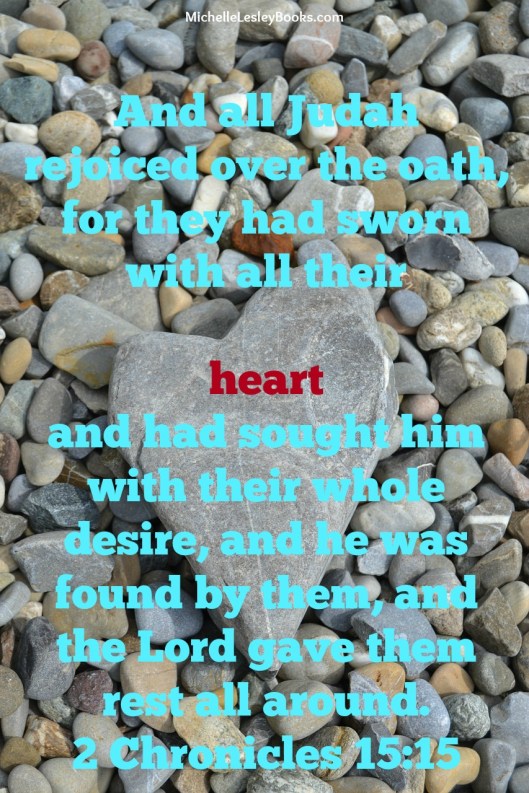
As soon as Asa heard these words, the prophecy of Azariah the son of Oded, he took courage and put away the detestable idols from all the land of Judah and Benjamin and from the cities that he had taken in the hill country of Ephraim, and he repaired the altar of the Lord that was in front of the vestibule of the house of the Lord. And he gathered all Judah and Benjamin, and those from Ephraim, Manasseh, and Simeon who were residing with them, for great numbers had deserted to him from Israel when they saw that the Lord his God was with him. 10 They were gathered at Jerusalem in the third month of the fifteenth year of the reign of Asa.11 They sacrificed to the Lord on that day from the spoil that they had brought 700 oxen and 7,000 sheep.12 And they entered into a covenant to seek the Lord, the God of their fathers, with all their heart and with all their soul, 13 but that whoever would not seek the Lord, the God of Israel, should be put to death, whether young or old, man or woman. 14 They swore an oath to the Lord with a loud voice and with shouting and with trumpets and with horns. 15 And all Judah rejoiced over the oath, for they had sworn with all their heart and had sought him with their whole desire, and he was found by them, and the Lord gave them rest all around.

16 Even Maacah, his mother, King Asa removed from being queen mother because she had made a detestable image for Asherah. Asa cut down her image, crushed it, and burned it at the brook Kidron. 17 But the high places were not taken out of Israel. Nevertheless, the heart of Asa was wholly true all his days. 18 And he brought into the house of God the sacred gifts of his father and his own sacred gifts, silver, and gold, and vessels. 19 And there was no more war until the thirty-fifth year of the reign of Asa.


The Holy Bible, English Standard Version Copyright © 2001 by Crossway Bibles, a division of Good News Publishers.


Questions to Consider:

1. Who was Asa? Was he a godly or ungodly man? What are the two alternatives and their consequences that Asa was given by Azariah in verse 2?

2. Why did Azariah recite Israel’s history for Asa in verses 3-6? Why was Israel “without the true God, and without a teaching priest and without law” (3) for a long time? (Hint- see verse 8). What happened when Israel repented? (4)

3. Why was it so important to get rid of all the idols (8) to the point that the death penalty was imposed on anyone who would not seek the Lord (13)? Does God really take idolatry that seriously? If God considers idolatry so awful, how does this apply to the church, and individual Christians, today?

4. Getting rid of all the idols was an act of r_______. This was followed by sacrifices to God and an oath that the people would seek only Him. These were acts of w_______. How do the “big picture” ideas in this chapter of sin, followed by repentance and faith, followed by forgiveness and worship, foreshadow the gospel?

5. How do verses 12 and 15 connect to Matthew 22:34-38? How do Asa’s actions in verse 16 relate to Matthew 10:34-37?