Book Reviews, Guest Posts

Guest Post: A Review of Jennie Allen’s “Anything: The Prayer that Unlocked My God and My Soul”

If your theology pretty much matches up with mine (as outlined in the “Welcome” and “Statement of Faith” tabs) and you’d like to contribute a guest post, drop me an e-mail at MichelleLesley1@yahoo.com,
and let’s chat about it.
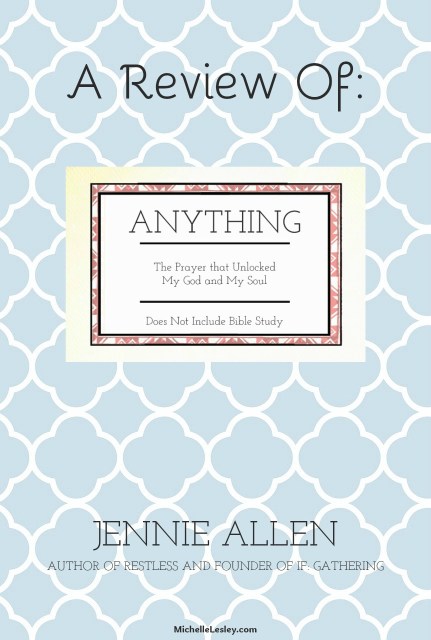
A Review of Jennie Allen’s
Anything: The Prayer that Unlocked My God and My Soul

by Carol Coppens

Many years ago, when I was in the 6th grade, I was taught that when doing a book report, even if I didn’t like the book, I should try to say something good about it. That was fine teaching at the time and I think it has made me a better writer, this trying to see both sides. I’m not in school any longer though and these days, I’m bound less by trying to see the good and more to pointing out the multiple errors of books like Anything. If you’re a Jennie Allen fan, you won’t like what I have to say but I can’t stay silent.

Anything is a poorly written book. It’s an irreverent book. It’s a book that will never help any woman discover the totality of God’s plan of redemption, His sovereignty, His wrath which rests on the unregenerate, nor His holy fury at those who presume to speak for Him. This is not a book that will help you to dive deep into the character of God and to know Him better but instead, Jennie’s book is a tedious, self absorbed, experience driven, hermeneutically unsound, over-stepper of scriptural boundaries, mish-mash of emotionalism and repetitive “wrecked-ness”. Here are some of the specific faults that I see.

Even in these days of relativity, where the only rule that seems to apply is that there are to be no rules at all, there are still a few that are necessary. One of the rules of basic English grammar is, if you’re going to use an adjective (remember that word from English class?) you’d better do your homework and find out exactly what that word means, in the context in which you plan to use it.

The word reckless is used multiple times in this book. Jennie describes childlike faith as living “simply, recklessly.” On pg. 97, she writes that she and her husband, “now lay in the hands of a reckless, invisible God.” Page 143 tells of her realization that people are going to think they are foolish for adopting, saying, “that goes with almost any act of recklessness, even reckless love.” Maybe she thought the word sounded powerful and kind of daring when she penned it but the definition of reckless is “without thinking or caring about the consequences of an action.”

Describe human beings as reckless as much as you like, because we all certainly can be, but when a writer uses the word reckless to describe almighty God, that person has crossed over into blasphemy and I would shudder to think that I had written such a thing about the God I will eventually have to give an account to. Some of the other words she uses to describe God are, “unsafe”, “wildly unpredictable”, “radical”, “ridiculously radical” and she also writes that “God is still not very practical.” Exactly where are the chapters and verses for these descriptions of God, Jennie?

In many places, Jennie adds words to Scripture that are not there. Space hinders me from listing them all, so one example will have to do. On page 184, she speaks for Jesus and writes, “as if he were letting us in on the secret, Jesus whispered back to his father, this will all be worth it. Wait till they are with us and see our glory. Just wait till all of this work and suffering and pouring out is over and we are in heaven together forever. Just wait.”

This conversation is, of course, recorded nowhere in Scripture but the words “do not exceed what is written”, definitely are. Jennie would do well to read and meditate deeply on that verse in 1 Corinthians 4. When we imagine that God is speaking to us apart from Scripture, we can easily be led to enter very dangerous territory.

An example of her flawed interpretations of Scripture is on page 37. Jennie quotes Hosea 2:14-17 but then she blatantly misinterprets God’s promise to restore Israel to Himself, as a “dramatic metaphor” about those of us who chase other loves. I say, leave Biblical interpreting to those who know about these things, Jennie. If you think that you’ve been given a new interpretation of these verses that no other person has ever had before, you’re just plain wrong. God was promising restoration to Israel in these verses and nothing else.

She also does emotional and hermeneutical callisthenics with God’s call to Abraham to sacrifice Isaac (pgs. 69-70). Jennie’s theory is that God was punishing Abraham for his overwhelming love for his son that, according to her, had usurped God as Abraham’s first love. If she had thoughtfully studied these Bible passages or, if she truly understood God’s plan to ultimately save His elect, she would know that the sacrifice of Isaac and the ram God substituted for the boy, was a shadow of God’s own sacrifice of His son Jesus Christ on the cross. There is no excuse for such lazy interpretation of the sacred Scriptures. In these current times, the proliferation of false and misleading doctrine abounds. Having the correct interpretation of Scripture is of paramount importance because our eternal futures depend on understanding correctly, what God is saying to us.

On page 102, Jennie asks “so how do we actually let God change us?” Finally, I thought, a good solid question after having read page after page of drivel. Can an explanation of justification and sanctification be far behind? Sadly, they weren’t even hinted at and she goes on to tell a rather horrific (as a mother I cringed) story of telling her two oldest children to climb up a cliff and jump off! For Jennie, jumping is the key. Either “jump or crawl down” and “the more we jump and see our God come alive around us, the more we jump without fear – and the bigger the cliffs get”, she says. As the Peanuts character Charlie Brown was known to exclaim, good grief!

In the final analysis, the biggest problem I had with this book (and I slogged through it twice) was my knowing that, from the time of her “vision” in the night that Jennie feels was definitely from God, the wheels of the IF: Gatherings began to turn. For those readers who still might be unfamiliar with IF, they are para-church organization, begun by Jennie, that has no scriptural basis or authority. The gatherings happen outside of the local churches and their oversight, supposedly to accomplish something, ie. discipling women, that only churches are charged to do, in Scripture. In this case, the ends do not justify the means.

Because all the women involved in IF cannot possibly be born again, spirit filled, doctrinally sound, mature women with the spiritual gift of teaching, the possibilities for unscriptural philosophies and practices entering in to local churches, families and society at large, are enormous. I see this movement as no less than a calculated move of Satan against women, a frontal attack on the sufficiency of Scripture and a throwing off of the direct commands of God, in His Word, for both married and single women. Jennie Allen might believe that her “call” to begin IF was of God, but I do not.

So, at the end of the day, would I recommend this book to anyone? Absolutely not! What I do recommend instead is simply this – read your Bible, always praying that God will illuminate your mind with His truth. Get involved with a biblically solid church and pray for God to open doors for you to serve there. There is no substitute for a godly, biblically saturated, discerning Christian woman and one only gets that way by hard work and study. The Scriptures do not open themselves to the slothful. When a woman is mature in Christ and can properly discern truth from error then and only then it will come to pass that the writings of the Jennie Allens of this world will be seen for what they truly are, rubbish.

With a grateful nod to my 6th grade English teacher, I suppose I could say one good thing about this book and that is, that it wasn’t any longer.


Carol and her husband Mike live in a small town, on the shores of Lake Erie, in Ontario, Canada. She was 49 years old when Christ called her to be His disciple. A love for the pure truth of God’s Word fuels her passion to expose false teaching and especially that kind which has women as its primary target.


ALTHOUGH I DO MY BEST TO THOROUGHLY VET THE THEOLOGY OF THose WHO SUBMIT GUEST POSTS, IT IS ALWAYS POSSIBLE FOR THINGS TO SLIP THROUGH THE CRACKS. PLEASE MAKE SURE ANYone YOU FOLLOW, INCLUDING ME, RIGHTLY AND FAITHFULLY HANDLES GOD’S WORD AND HOLDS TO SOUND BIBLICAL DOCTRINE.
Discernment, False Doctrine, False Teachers, New Apostolic Reformation, Podcast Appearances

Throwback Thursday ~ Echo Zoe Radio Guest Appearance: The New Apostolic Reformation

Originally published March 14, 2017


logo

Last week, I once again had the pleasure of sitting down and chatting with my friend Andy Olson as his guest on the Echo Zoe Radio podcast.

Click here to listen in

as we talk about the New Apostolic Reformation– their beliefs, and how NAR false doctrine can creep into your church. And don’t forget to subscribe to the podcast and follow Echo Zoe on Facebook and Twitter!


Got a podcast of your own or have a podcasting friend who needs a guest? Click the “Speaking Engagements” tab at the top of this page, drop me an e-mail, and let’s chat!

Mailbag

The Mailbag: Potpourri (Orange Curriculum, Jesus went to hell?, 1 Tim. 2:12 only for Ephesus?…)

Welcome to another “potpourri” edition of The Mailbag, where I give short(er) answers to several questions rather than a long answer to one question. I also like to take the opportunity in these potpourrri editions to let new readers know about my comments/e-mail/messages policy. I’m not able to respond individually to most e-mails and messages, so here are some helpful hints for getting your questions answered more quickly. Remember, the search bar can be a helpful tool!


In the Apostles Creed, there is a section that states Christ descended into hell and was resurrected. Isn’t that what Joyce Meyer teaches? What about the part about the “holy catholic church: the communion of the saints”? Is that talking about Catholicism and the mass?

These are very common questions (I threw in the second part about Catholicism and the mass, since that’s also commonly asked.), and it’s good to ask, because if you’re confused, other people probably are, too.

The Apostles’ Creed says:

I believe in God, the Father Almighty,
the Creator of heaven and earth,
and in Jesus Christ, His only Son, our Lord:
Who was conceived of the Holy Spirit,
born of the Virgin Mary,
suffered under Pontius Pilate,
was crucified, died, and was buried.
He descended into hell.
The third day He arose again from the dead.
He ascended into heaven
and sits at the right hand of God the Father Almighty,
whence He shall come to judge the living and the dead.
I believe in the Holy Spirit, the holy catholic church,
the communion of saints,
the forgiveness of sins,
the resurrection of the body,
and life everlasting.
Amen.

It’s a beautiful, basic reiteration of the gospel which many churches and ministries use as part of their official statement of faith. Some churches even recite the Apostles’ Creed during their worship services.

The earliest written record of the creed is from AD 390, in Greek, so you can imagine that some of the terminology used had different connotations back then than those terms have in 21st century America.

Providentially, my friend, Pastor Gabe Hughes, was also recently asked this same question and addressed it both on his podcast and in a WWUTT video, so I’m going to let him do the “heavy lifting” of Scripture and history in the resources below and just give you the short and sweet version:

📜 You’re quite right in saying that Joyce Meyer teaches that Jesus went to hell between His death on the cross and His resurrection. The Bible doesn’t say this anywhere, and this is a heretical teaching. Just one of the multiple reasons no Christian should follow Joyce Meyer.

📜 The word “hell” in the Apostles’ creed is based on a mistranslation or confusing translation. The literal meaning of the phrase is that he descended into the grave or was buried.

📜 You might have noticed that the word “catholic” in the creed starts with a lowercase “c” rather than a capital “C”. The noun “catholic” with a lowercase “c” simply means the universal church – all genuinely regenerated Believers across the globe, past, present, and future. Roman Catholicism is (or at least by rules of grammar is supposed to be) denoted by a capital “C”.

📜 “Communion” in the creed does not refer to the Roman Catholic mass or even to the Protestant Lord’s Supper. A clearer word to us today would be “fellowship” or “unity”. The sense is that Believers commune with on another. 

Some churches have modernized and clarified the creed by replacing these phrases with “He descended into the grave” or “He descended to the dead” and “the holy Christian church.”

Additional Resources:

WWUTT Podcast #645– Gabe expands on the above video at the 30:15 mark

The Apostles’ Creed: Its History and Origins at Faithlife Blog


I was wondering if you could post your articles in a larger font. I have an old computer that messes up when I try to make the font bigger. My old eyes are a real struggle.

At first, I thought I was the only one having this problem, but I’ve gotten this question a couple of times, so I know it’s not just my own aging eyes :0)

I’m going to play around with the font a little bit and see if I can find one that’s bigger. Just a few things to understand as I’m working on it: WordPress gives me a limited number of fonts to choose from, and the sizes of those fonts are pre-set. In other words, I can’t set it to 12 point or 18 point, I can only choose from tiny, small, normal, large, and huge. (Right now it’s set on “normal” if you can believe that. “Tiny” is virtually invisible.)

Additionally, when I change the font size, it doesn’t just change the size of the font in the body of my articles, it also changes the size of things like the tags (to the immediate upper left of every article), the sidebar (far left of the page), and the tab titles (top of the page), which, as you can see, are already much larger than the font in the article body. When the font of those texts gets larger, it throws the layout of the whole page out of whack. You might not notice it on a desktop computer with a large monitor, but it can be problematic for people who are viewing the blog on a phone or tablet.

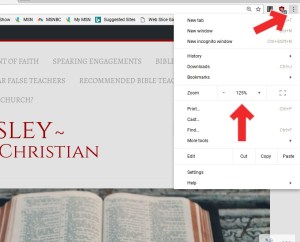
Like I said, I’ll play around with it and see what I can do, but if I’m not able to enlarge the font, there are two workarounds that may help:

1. The reader said she’s unable to change her screen magnification, but it works for me and might work for others. Here’s what it looks like on my computer. Maybe yours is similar:

2. If worse comes to worst, you can highlight and copy the body of the article, paste it into your word processing program, and enlarge the font accordingly.


I have been leading a women’s small group at our church for a couple of years now. My husband and I have decided to leave the church because, even after confronting leadership about the direction the church is being led doctrinally, they continue to espouse unsound doctrine. What do you think is a wise way to tell the ladies I will no longer be teaching? Do I tell them we are leaving? If so, do I tell them why? What do you think you would do?

It’s hard to say exactly what I would do because every situation and every church is different. But I can tell you that the first thing I would do is talk it through with my husband and ask his advice. There have been many times when he has had very good ideas about how to address (or not address) certain issues, and he will sometimes bring out an aspect of the situation that I hadn’t thought of before. I would encourage you to do that first, and also to make sure you’re submitting to your husband in whatever ways might be applicable in this situation.

My inclination is to advise you to take the “the less said, the better” route with regard to the whole class. (There may be other venues, such as you and your husband meeting with the elder board, in which you’ll need to clearly spell out all the problems, but let’s just focus on the class right now.)

I would probably wait until the end of the very last class and say something generic, like, “I’ve really enjoyed leading this class, but I wanted to let you know I won’t be teaching any more. I encourage you to continue studying God’s Word and growing in Christ. Class dismissed.” Then, go home fairly quickly.

The next level is going to be women coming up to you individually and asking why you won’t be teaching any more. Unless she’s a very close friend, I’d still keep it pretty generic: “We love our brothers and sisters at this church, but we’re finding we disagree with some of the doctrine that’s being taught here, and we’ll be going to a new church.”

For very close friends, you might wish to disclose more about the doctrinal problems, but do so wisely, making sure your focus is on doctrine, not on personal conflicts with the pastor or others. You don’t want people jumping to the wrong conclusion about why you’re leaving.

I really would not talk to people about leaving other than discreetly informing those who need to know. If you give details or talk about it a lot there could be an ugly blow up, and most people will make wrong assumptions about why you’re leaving.


Do you have any information on the Orange Curriculum for children’s Sunday School?

The main thing I know about the Orange Curriculum (or Orange Strategy) is that it is put out by Andy Stanley’s “church”. That’s enough for me to warn people to stay far, far away from it. Andy Stanley is a Scripture-twisting false teacher. You don’t want your children being taught by him or his disciples.

My friend Amy Spreeman over at Berean Research was asked the same question by a reader. I refer you to her article, Parents: If your church is “Turning Orange…” for more details.


How would you respond to someone’s who says that [1 Timothy 2:12] was meant only for that time and culture?

It’s one of the most common arguments made by people who are looking for an acceptable way to rebel against God’s clear command, “I do not permit a woman to teach or to exercise authority over a man; rather, she is to remain quiet.” I have never had a woman who was humbly seeking to deny herself and obey Scripture make this argument, only those who stubbornly want to have their own way despite what the Bible says, yet simultaneously want to cloak themselves in the appearance of obeying Scripture.

God gave us His exact reasons for this command in verses 13 and 14 (almost as if He somehow knew this argument was coming!), and those reasons weren’t restricted to the women in the first century Ephesian church. The first reason was the Creative order – Adam was formed first, then Eve. The second reason is that Eve was deceived. Both of those reasons are universal (applying to all women and churches everywhere regardless of era or culture). It makes no sense that these two reasons related to Eve would apply only to first century Ephesus any more than it would make sense for them to apply only to tenth century Damascus or seventeenth century Paris.

Next, examine the context of 1 Timothy 2. There are all sorts of instructions to the church in that chapter. Was the instruction to pray for governmental leaders (1-2) limited to the first century Ephesian church? Were only the men of the first century Ephesian church to pray without quarreling (8)? Was modesty (9-10) only required of women in the first century Ephesian church? Then why pick out this one instruction in verse 12 and claim it was limited to that time and culture?

Finally, look at the overall general pattern of male headship and leadership in Scripture. First human created? A man. The Patriarchs? As the word implies – all men. Priests, Levites, Scribes? Men. Heads of the twelve tribes of Israel? Men. Major and minor prophets? Men. All kings of Israel and Judah? Men. Noahic, Abrahamic, Mosaic, and Davidic Covenants? All established between God and men. Authors of Scripture? Men. The forerunner of Christ? John the Baptist – a man. Messiah? A man. All of the apostles? Men. All of the pastors, elders, and deacons of churches in the New Testament? Men. Founder and head of the church? Christ – a man. Leader and head of the family? Men. Now which fits better with this pattern, women preaching to, teaching, and exercising authority over men in the church, or women not preaching to, teaching, and exercising authority over men in the church?

But the truth is, you can have all the biblical evidence in the world, and it’s not going to convince someone who’s in rebellion against Scripture because self is reigning on the throne of her heart. She’s not concerned with actually obeying God’s Word, she just wants to be able to claim that Scripture supports what she wants to do, either to look good to others or to attempt to drown out the Holy Spirit’s conviction of her sin.

Additional Resources:

Jill in the Pulpit 

Ten Things You Should Know About 1 Timothy 2:11-15 and the Relationship Between Men and Women in the Local Church at The Council on Biblical Manhood and Womanhood (CBMW) This is a refutation of the most common egalitarian arguments against the plain meaning of 1 Timothy 2:11-15.


If you have a question about: a Bible passage, an aspect of theology, a current issue in Christianity, or how to biblically handle a family, life, or church situation, comment below (I’ll hold all questions in queue {unpublished} for a future edition of The Mailbag) or send me an e-mail or private message. If your question is chosen for publication, your anonymity will be protected.

Discernment, False Doctrine

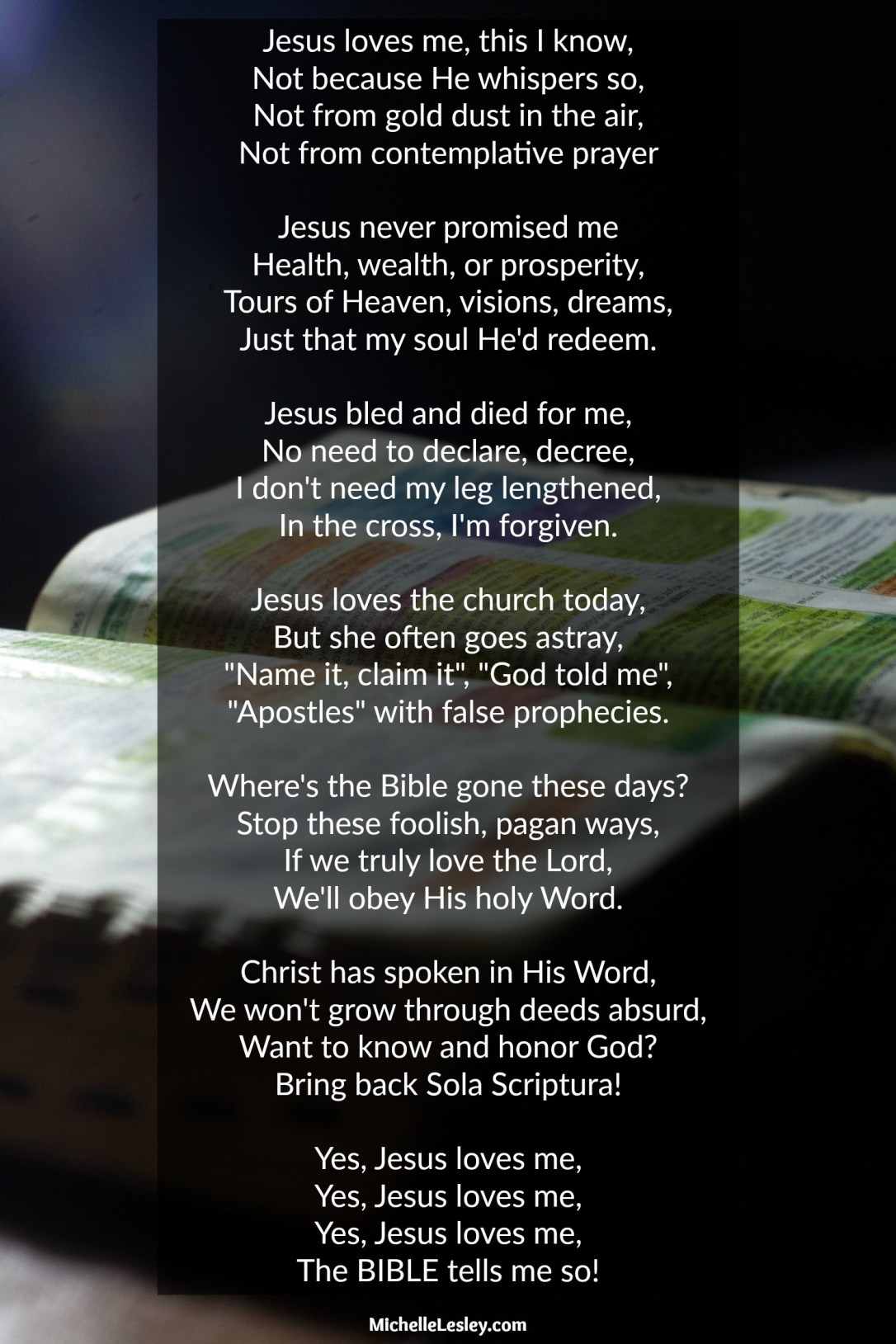
Jesus Loves Me: The “Contending for the Faith” Version

Every now and then I do a little creative writing. I posted this to Facebook on Sunday, and people seemed to like it, so I thought I’d share it here for those who aren’t on social media.

Favorite Finds

Favorite Finds ~ February 27, 2018

Here are a few of my favorite recent online finds…

Sheologians posted a great episode: Almost: Our Encouragement & Concern with the IF:Gathering. They explained some of the things that attract women to this conference as well as the theological problems with it. They have also published a follow up blog post, Almost: an addendum since releasing this episode. I’ve added both to my resources on IF at the Popular False Teachers tab at the top of this page.


Tim Challies simply and handily explains 2 Timothy 3:6-7 in this 2016 article, Capturing Weak Women.


Women’s Hope Project recently started a new Bible study on Galatians on their podcast. A free study guide is available.


All main sessions, breakout sessions, and Spanish sessions of the 2018 G3 Conference: Knowing God- A Biblical Understanding of Discipleship have been uploaded to the G3 app, so download the app to access some awesome teaching. All of the sessions were phenomenal, but if you only have time for a few, I’d recommend starting with the (three) Martha Peace and (two) Justin Peters breakout sessions. You can also register for next year’s conference on missions and get the early registration rate.

 

Do you enjoy writing? Even if you don’t, I think you’ll like these 7 Writing Tips from Charles Spurgeon.