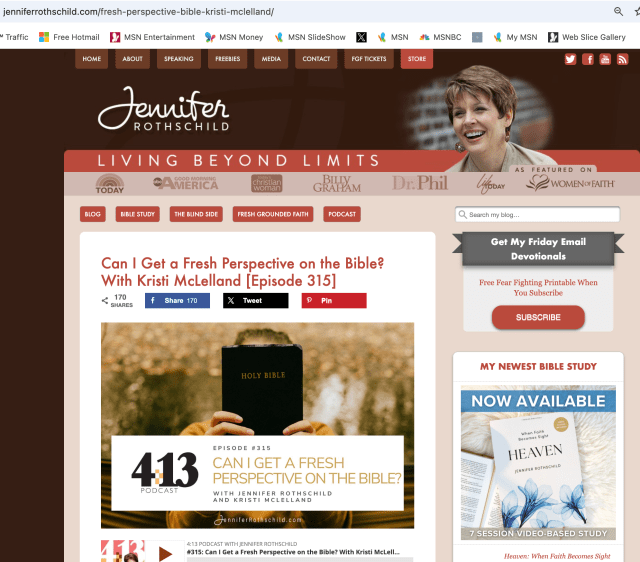
Not long ago, I had the pleasure of appearing as a guest on The Plumb Line Radio Show with Jay Rudolph to chat about the authority and sufficiency of Scripture. Why are we to submit to God’s Word as the authority by which we live our lives? Is Scripture enough for us to live by, or do we need extra-biblical revelation and experiences? Listen in to these two brief interviews and find out!
If you’re in the vicinity of Des Moines, Omaha/Lincoln, Phoenix, Pittsburgh, San Diego, New York City, Jacksonville, Chicago, or Kansas City, you can listen to The Plumb Line on your local Christian radio station. Click here to find out which radio stations carry The Plumb Line and when. If you don’t live near one of those markets, you can always follow and listen on Spotify.
Got a podcast of your own or have a podcasting friend who needs a guest? Need a speaker for a women’s conference or church event? Click the “Speaking Engagements” tab in the blue menu bar at the top of this page, drop me an e-mail, and let’s chat!
If you are considering commenting or sending me an e-mail objecting to the fact that I warn against certain teachers, please click here and read this article first. Your objection is most likely answered here. I won’t be publishing comments or answering emails that are answered by this article.
This article is kept continuously updated as needed.
I get lots of questions about particular authors, pastors, and Bible teachers, and whether or not I recommend them. Some of the best known can be found above at my Popular False Teachers tab. The teacher below is someone I’ve been asked about recently, so I’ve done some research on her.
Generally speaking, in order for me to recommend a teacher, speaker, or author, he or she has to meet three criteria:
a) A female teacher cannot currently and unrepentantly preach to or teach men in violation of 1 Timothy 2:12. A male teacher or pastor cannot allow women to carry out this violation of Scripture in his ministry. The pastor or teacher cannot currently and unrepentantly be living in any other sin (for example, cohabiting with her boyfriend or living as a homosexual).
b) The pastor or teacher cannot currently and unrepentantly be partnering with or frequently appearing with false teachers. This is a violation of Scripture.
c) The pastor or teacher cannot currently and unrepentantly be teaching false doctrine.
In some cases, I am not very familiar with the teachers I’m asked about (there are so many out there!) and have not had the opportunity to examine their writings or hear them speak, so most of the research I do involves items a and b (although in order to partner with false teachers (b) it is reasonable to assume their doctrine is acceptable to the false teacher and that they are not teaching anything that would conflict with the false teacher’s doctrine). Partnering with false teachers and women preaching to men are each sufficient biblical reasons not to follow a pastor, teacher, or author, or use his/her materials.
Just to be clear, “not recommended” is a spectrum. On one end of this spectrum are people like Nancy Leigh DeMoss Wolgemuth and Kay Arthur. These are people I would not label as false teachers because their doctrine is generally sound, but because of some red flags I’m seeing with them, you won’t find me proactively endorsing them or suggesting them as a good resource, either. There are better people you could be listening to. On the other end of the spectrum are people like Joyce Meyer and Rachel Held Evans- complete heretics whose teachings, if believed, might lead you to an eternity in Hell. Most of the teachers I review fall somewhere in the middle of this spectrum (leaning toward the latter).
If you’d like to check out some pastors and teachers I heartily recommend, click the Recommended Bible Teachers tab at the top of this page.
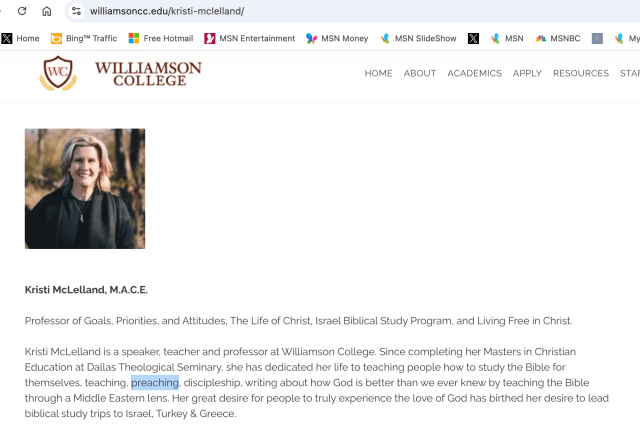
Kristi is on the Ministry Leadership faculty at Williamson (screenshot), where she teaches classes in “Goals, Priorities, and Attitudes,” “The Life of Christ, the “Israel Biblical Study Program,” and “Living Free in Christ”. One can only presume that since Williamson is co-ed, the college is fine with her “preaching,” and the fact that she’s training students in “Ministry Leadership,” that she is helping train men for the pastorate.
…and the bestselling author of” several books and Bible studies. “Kristi teaches the Bible in its historical, cultural, geographic, and linguistic contexts. She encourages believers to be postured to receive what the living God is saying through communally experiencing Scripture. Kristi teaches about the goodness of God, often experienced through table fellowship, practicing hospitality, and collaborative wisdom.”
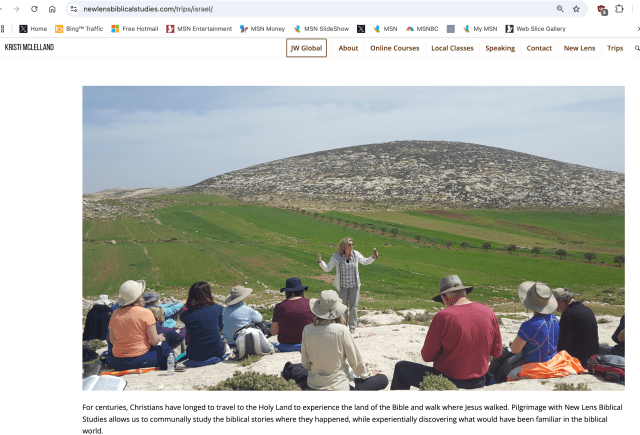
“…Kristi has taught and shepherded thousands…Kristi began leading biblical study trips to Israel in 2008. Her study trips to the biblical lands, along with her Pearls podcast and in-person and online courses, help Westerners discover and appreciate the Bible within the framework in which it was written. This new lens offers a deeper look into what the biblical characters meant by what they did, said, and wrote, inviting us to better experience the God who is constantly pursuing us. Kristi has a Masters in Christian Education from Dallas Theological Seminary and has dedicated her life to teaching people how to study the Bible.”
I’ve added bold italics to several words and phrases above to highlight some red flags. Often, you can surmise, with some level of accuracy, what are going to be the biblical issues with a teacher you’re not familiar with merely by reading the “about” page of her website.
You’ll notice the heavy emphasis on “experiencing” God rather than growing in Christ through the study and teaching of His written Word, prayer, and sound preaching and teaching at church.
The Bible doesn’t teach us to be “postured to receive what the living God is saying” (i.e. to me, personally, today, in a self-centered hermeneutic). This is another phrase that suggests extra-biblical revelation via personal, subjective experience rather than studying the text of Scripture to discover what God has already said.
In Scripture, “shepherding” is a term reserved for literal shepherds, Jesus, and pastors, not just anyone who leads or teaches in a church or parachurch ministry, and not for women who rebel against Scripture and unbiblically insert themselves into the position of pastor (as is the case with Kristi). You will not find this term implied or applied to women anywhere in the New Testament.
Kristi says she teaches “people” how to study the Bible. Not “women”. “People” – men and women.
When someone tells you who she is, believe her.
Kristi Is a Female “Pastor”
Kristi doesn’t merely preach to men at co-ed events like most of the other female teachers I write about, she has actually been on staff at a church for several years in the position of “Teaching Pastor”. This is a clear and direct violation of Scripture and constitutes ongoing, unrepentant sin.
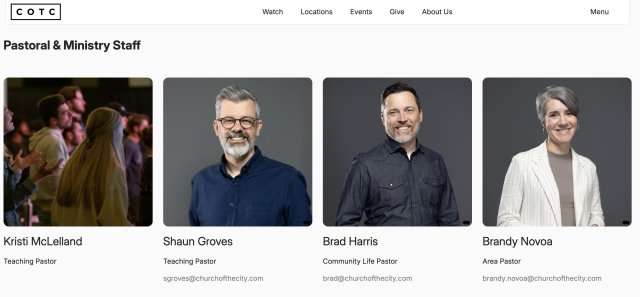
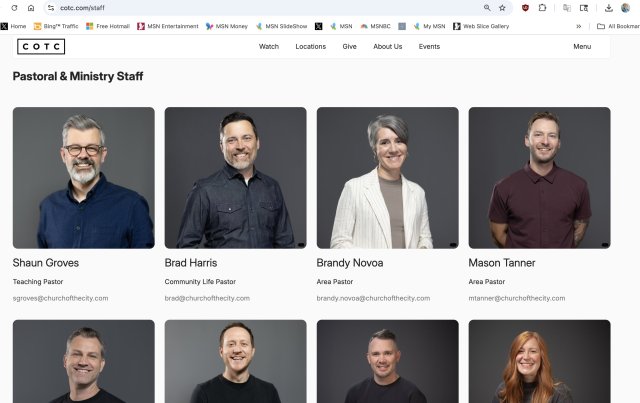
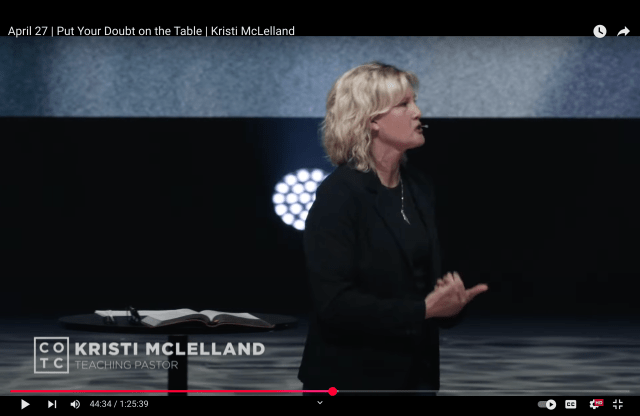
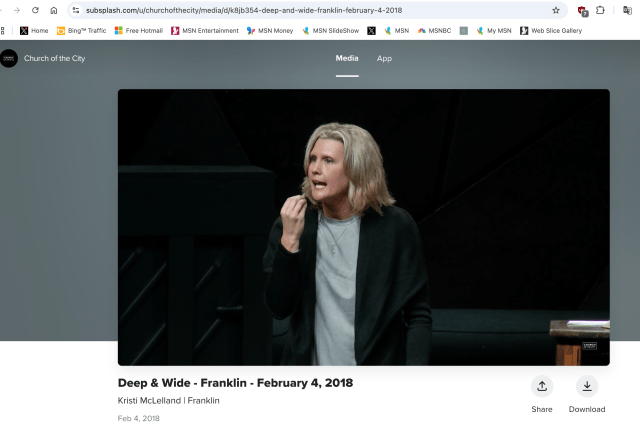
Kristi preached her first recorded sermon at COTC on February 4, 2018. Up until at least April 27, 2025, Kristi held the position of “Teaching Pastor” at Church of the City in Franklin, Tennessee. Sometime between February 26, 2025, when I took this screenshot of the “Pastoral & Ministry Staff” page at COTC’s website…
…Kristi was removed from the “Pastoral & Ministry Staff” page. Her April 27, 2025 “sermon” is currently the most recent one at COTC’s YouTube channel, and it still introduces her as “Teaching Pastor”:
Whether Kristi has actually resigned her position or has merely been removed from the staff page to avoid being called to account for her sin remains to be seen.
Prior to working as a “pastor” at COTC, Kristi was on staff at Strong Tower Bible Church in Nashville, Tennessee. Though Kristi didn’t “carry the title of pastor,” p.3, of the October 2013 church newsletter is careful to tell us*, according to her LinkedIn page, she was the “Director of Women’s Ministry and Adult Christian Education [i.e. discipleship],” which, in addition to the fact that she was occasionally preaching the Sunday sermon at least as early as 2015, indicates that she was functioning in the role of a pastor, even without the title.1
*(Readers might find it interesting that STBC was careful to make clear that none of the women they referred to in 2013 were pastors, yet today, STBC’s female “pastors” are proudly listed on the church website and outnumber the lone male pastor three to one {the pastor’s wife is also the “Pastor of Belonging”}. This is what happens when a church begins allowing women to take on roles the Bible restricts to men.)
This is probably overstating the obvious since I’ve already mentioned that, as a member of the “Ministry Leadership” faculty at Williamson College, Kristi helps train men for the pastorate, and, that as a “pastor” on staff at two different churches, she obviously preached to men, so I won’t belabor the point, but we will press on.
Kristi regularly and unrepentantly violates Scripture by preaching to and instructing men in the Scriptures. Here are just a few of the scores of examples available:
Church of the City
(Obviously, in each example, there are men in the audience since these are all sermons during the church worship service.)
Below is a partial listing of the sermon archives at the COTC website for Kristi’s many “sermons” – nearly 70 of them at this time. Kristi has also taught – also nearly 70 times – COTC Daily, a church-wide daily Bible teaching video.
Kristi’s earliest recorded “sermon” at the COTC website: February 4, 2018…
Mother’s Day, May 9, 2021– 54:51: In case you still aren’t convinced Kristi preaches to men, she is happy to settle that for you once and for all. “This teaching is not just for women. So can I just hear some noise from all the men in the room to let me know that you’re here?”
The Lord’s Supper
Perhaps one of the most viscerally vile aspects of a woman pillaging the pulpit is the stomach-turning scene of her desecrating the Lord’s Table by presiding over it. Kristi has administered the Lord’s Supper numerous times at COTC. here are just a few examples:
July 17, 2022 124:59: COTC apparently practices open communion (anyone present is invited to participate regardless of whether or not the person is saved). The elements have already been placed at everyone’s seat, and Kristi says nothing to fence the table (i.e. at a bare minimum, explain that only those who are Believers should partake). There’s also no explanation of the gospel or a call to repent and believe it.
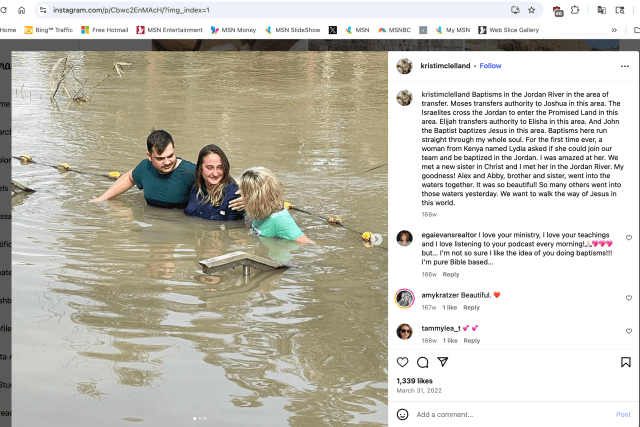
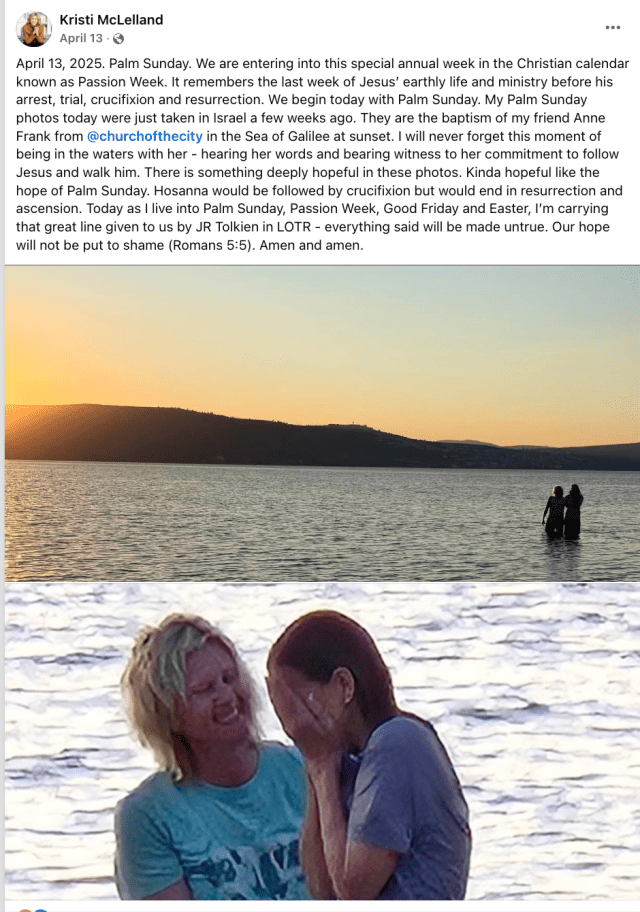
Although I haven’t run across any photos or video of Kristi performing baptisms at COTC, it’s reasonable to assume that she has or that she at least would be allowed to if she wanted to, because there’s plenty of video of other female “pastors” of COTC performing baptisms, and Kristi certainly performs baptisms in other venues.
Baptism, like the Lord’s Supper, is an ordinance of the local church, not an individualized personal activity, and should be presided over within the parameters of the church by pastors and elders. What you see below is neither.
A Weekend with Kristi McLelland at Discovery Church, Newton, North Carolina. The first night was “a co-ed event where both men and women are able to learn a new way to look a (sic) scripture (sic).”
A few different “sermons” at Journey Church in Brentwood, TN. Here’s one where she’s introduced by Journey’s “Pastor Susie”:
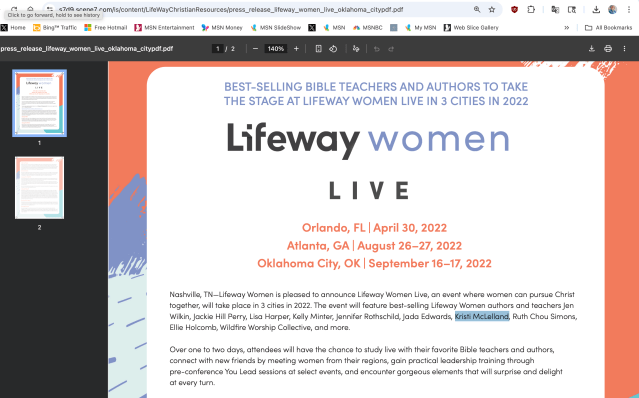
Feast is the branding for Kristi’s Lifeway Women conference tour, this year in Denver, Ft. Worth, and Atlanta. At the FAQ page, a frequently asked question is “Can men attend this event?”. Answer: “Men are more than welcome to attend…”.2
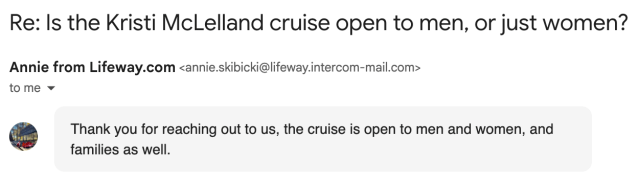
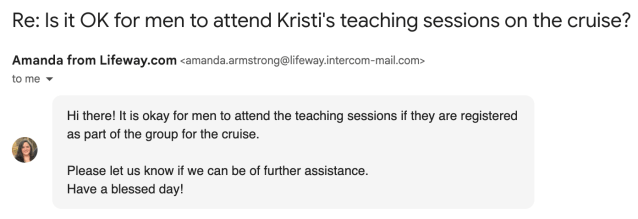
Cruise with Kristi McLelland: Voyage Through the New Testament World is coming up in April 2026. Since the Lifeway info. page doesn’t specify that this event is limited to women (and since they use the “Kristi teaches people” {rather than women} phraseology at least twice), I emailed and asked, point blank, if the cruise is open to men and if men are allowed to attend Kristi’s teaching sessions.2
The Bible commands us over and over not to associate ourselves or have anything to do with false teachers or those who claim to be Christians, yet live in willful unrepentant sin (persistent false teaching, including the false teaching of women “pastoring” or “preaching to men3, being one of those sins). In fact, to associate with false teachers and fail to rebuke them for their false doctrine disqualifies pastors from ministry. Dare we expect any less from female teachers?
Unfortunately, unrepentantly yoking with other false teachers is another sin Kristi unrepentantly engages in. Teachers are under a stricter judgment, and this is another disqualifying sin.
By her own choice, Kristi’s life and ministry are absolutely saturated with false and problematic teachers, virtually to the exclusion of doctrinally sound teachers. But even if she wanted to partner with doctrinally sound teachers, she wouldn’t be able to find one who would be willing. Doctrinally sound teachers don’t partner with women who unrepentantly rebel against Scripture by becoming “pastors”.
There are so many examples of Kristi partnering with other false teachers that it would be impossible to cite them all, but here is a sampling:
Kristi is a frequent guest on TBN’s Better Together. If you’re not familiar, it’s a little bit like a “Christian” version of The View without the studio audience. A group of several (varying) women’s “Bible” study celebrities discuss life issues and biblical topics. And, par for the course for TBN, they’re all problematic at best, raging heretics at worst. (There’s a reason TBN is often wryly dubbed the “Total Blasphemy Network”.)
To date, Kristi has appeared on at least 46 episodes of Better Together (you can watch excerpts here) with false teachers including:
And more episodes are upcoming. Here’s Kristi’s Instagram reel from April 9 on the set where she, Lisa Harper, Toni Collier, and others are about to film more episodes.
Lifeway Women is the women’s division of Lifeway, and an entity of the Southern Baptist Convention (like our seminaries, mission boards, etc., are entities). It is the online platform for all things women’s ministry – Bible studies, women’s conferences, a blog, a podcast, and so on – for use and purchase by individuals and churches.
I’ve researched and written articles on about 2/3 of the women Lifeway Women platforms, enough to tell you that the prototypical women’s author/speaker they seek out – to to write their women’s “Bible” studies, speak at their women’s conferences and so on – preaches to men, teaches false doctrine, and yokes with other false teachers, all of which violates Scripture. Additionally, some are woke (like Jackie Hill Perry) and at least one identifies as a “same sex attracted Christian” (Rebecca McLaughlin). I recommend that women use Lifeway Women’s endorsement as a litmus test of who to avoid.
Kristi’s earliest appearance at Lifeway Women seems to have been a July 2, 2019 blog article called Creating Space for Sabbath. This was probably around the time Lifeway Women signed her as a women’s “Bible” study author, as Lifeway staff confirmed to me that they published her first study, Jesus & Women in “early 2020”.
As I mentioned previously, Kristi was preaching to men and functioning as a “pastor” at least as early as 2015. In this February 2023 video, she says (39:12) that she’s “in my 6th year” of being on the teaching staff of COTC Franklin, which would mean she was hired there in 2018, before Lifeway Women brought her on board.
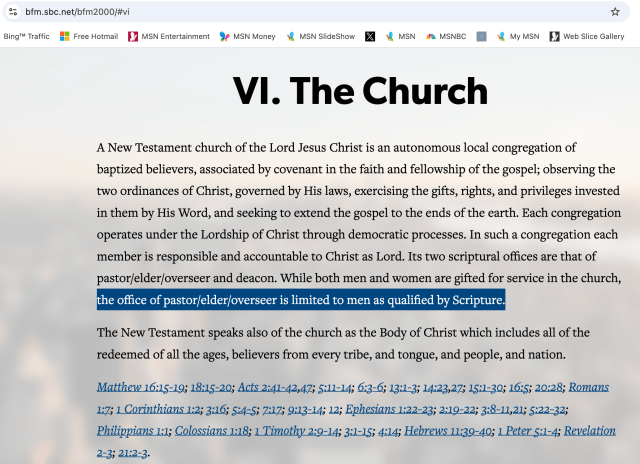
What does that mean, my fellow Southern Baptists, and why should you care? That means that Lifeway Women knewKristi was currently working as a “pastor” when they decided to platform her. And despite our crystal clear statement of faith, the Baptist Faith and Message, which states unequivocally that only biblically qualified men may be pastors, they went ahead and hired her to teach and disciple Southern Baptist (and other) women anyway, and have continued to employ and platform her, knowing she’s a “pastor,” for the past 6-7 years.2
(If you’re not already outraged over all of that, I would encourage you to spend some time pondering this high-handed, flagrant, and audacious slap-in-the-face sin against Almighty God and every Southern Baptist on the planet, and ask the Lord to stir up in you a good, holy, righteous, zealous fury in this matter for the glory of His name and His Word, and the sake of His precious daughters. This is spiritual abuse, and we’ve been played.)
Of course, as a Lifeway Women platformed author/speaker, Kristi has been a guest on numerous episodes of Marked and other Lifeway Women productions. Most recently, Kristi did a seven week stint on Marked teaching her study, The Gospel on the Ground.
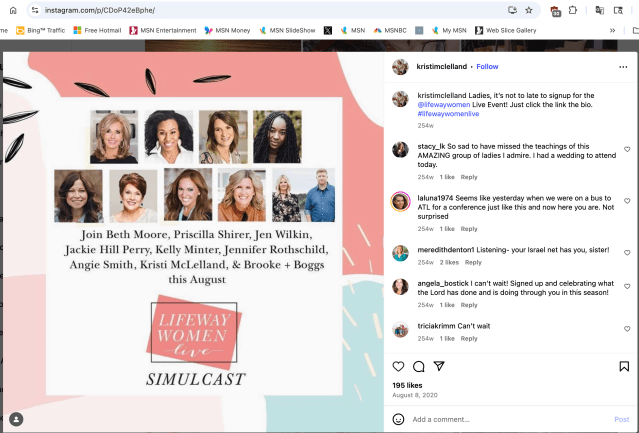
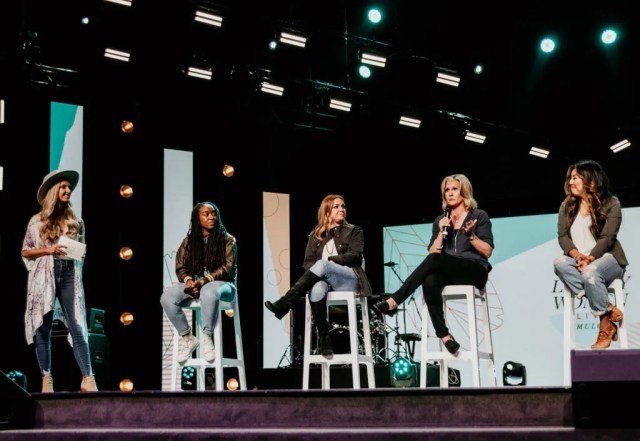
Lifeway Women Live 2020
Lifeway Women Live 2021. Photo courtesy of Lifeway Newsroom. Seated L-R: Jackie Hill Perry, Angie Smith, Kristi McLelland, and Ruth Chou Simons
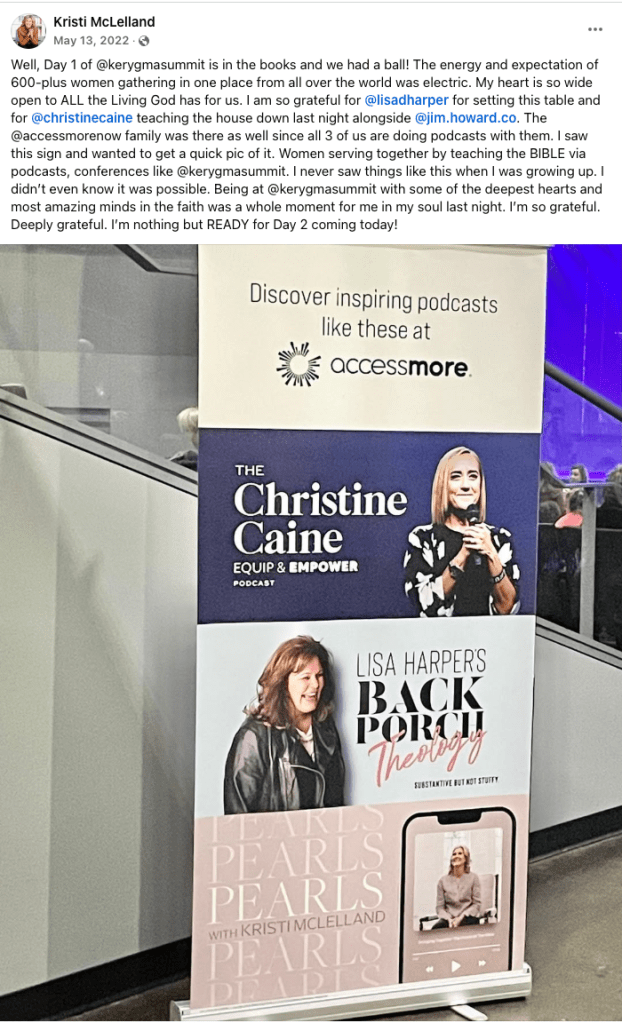
2022- Kristi speaks at the Kerygma Summit women’s conference with false teachers Christine Caine and Lisa Harper, founder of the conference. In the Greek, “kerygma” means to preach the good news. And considering the fact that Kristi is a “pastor” and Christine and Lisa both preach to men, I’m sure the emphasis of the conference is on “preach” rather than “good news”.
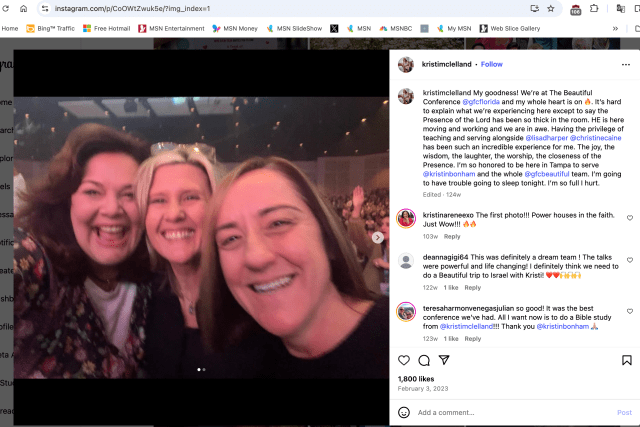
2023- Speaking again with Christine Caine and Lisa Harper at Grace Family Church in Tampa, Florida (another church with women “pastors”) at The Beautiful Conference.
Spent the weekend in Rochester, MN at a conference with Kelly Minter. I’ve lost 2 good friends over the last few weeks – Gabe Patillo and Mandisa. It’s hard to go out when you’re grieving, but Kelly and these women were a GIFT to me. We are better together. pic.twitter.com/iENDeyePCz
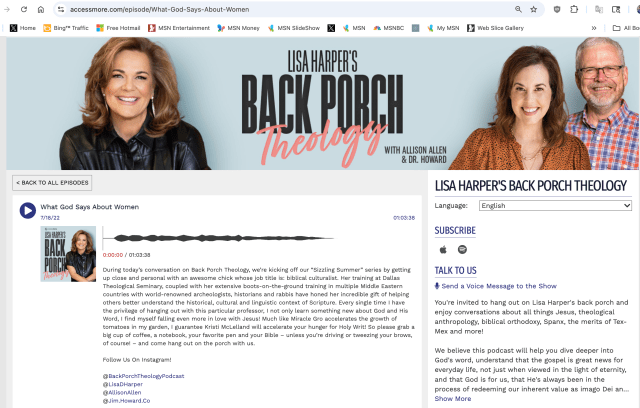
Kristi on Lisa Harper’s podcast in 2022. Part of the transcript of Lisa’s introduction of Kristi reads: “I first met Kristi…goodness gracious, I think 30 years ago…I’ve been a huge fan ever since last couple of years…By the mercy of God, we’ve gotten to do a lot of life together. Currently, she is not only one of my favorite professors, she’s teaching me how to play pickleball…”
Golf the Mac, “A world class weekend of golf, music, & purpose,” co-ed, no doubt, is coming up in September with Toby Mac*.
*Toby Mac isn’t doctrinally sound. He’s got lots of connections with Bethel, he’s obviously fine with Kristi being a “pastor,” yoking with false teachers, and teaching false doctrine, and there are other issues.
Kristi Teaches False Doctrine
I’ve cited a couple of instances of Kristi’s unbiblical teaching above. Let’s look at a few more.
Extra-Biblical Revelation
The Bible does not teach us that we’re supposed to “hear God speaking to us” outside the pages of Scripture. It teaches us that God’s Word is sufficient. Kristi, however, employs various methods of “hearing from God”.
God supposedly spoke to Kristi as she explains in this December 23, 2018 “sermon” at COTC- (101:50) “I was on a rooftop in India one night watching the sun go down and I had been in a season of prayer about what was next in my life when I heard the Lord, clear as a bell just tell me, “Kristi, it’s time for you to go to seminary.”. And I believe that I heard, in part, because I was postured to receive. I was creating space for the living God to come in and say what He wanted to say, to do what He wanted to do.”
Most Christians have heard the old joke about the guy who wanted God to speak to him. He let his Bible fall open to a random page, closed his eyes and pointed to a verse on the page. He opened his eyes and found his finger on Matthew 27:5: “Judas went out and hanged himself.”. “Well,” he thought to himself, “that couldn’t possibly be God speaking to me. I’ll try again.”. He repeated the process, only to find that this time his finger landed on Luke 10:37: “Go and do thou likewise.”.
The fact that we joke about this points to how silly it is to think God communicates with us this way.
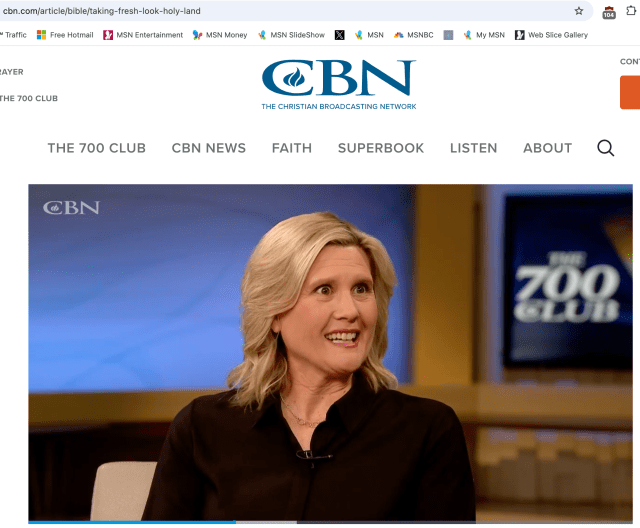
But in an interview and article on The 700 Club on CBN, Taking a Fresh Look at the Holy Land, Kristi explains how she actually used this method and believed it was God speaking to her about a life decision. This is a Bible scholar?
Desperate to hear from the Lord, Kristi opened the Bible and said, “Okay God, I need you to speak to me.” She randomly laid her finger on a scripture, (sic) and it landed on Psalms 78:19 which reads, “Can God really spread a table in the wilderness?” Kristi knew she was hearing from the Lord. Reading how God provided manna from Heaven for His children during their “wilderness” experience comforted her. God was letting her know that He would take care of her if she would only trust Him.
The Enneagram
Though its ubiquity seems to be waning and it will probably soon be relegated to the dust bin along with The Prayer of Jabez and WWJD bracelets, the Enneagram has been a popular fad for the past several years among the divangelista4 set. Unfortunately, the Enneagram is steeped in unbiblical mysticism and undermines the doctrine of the sufficiency of Scripture.
…but in this “sermon” at Journey Church, Faith to Let Go (27:00), Kristi says she’s an Enneagram 6.
I didn’t know Enneagram numbers were fluid, but…OK.
Mysticism and Spiritual Formation
Silence. Solitude. Those are words that should make your ears perk up if you hear them in the context of a Bible study or sermon, because they often indicate that you’re being taught some form of Spiritual Formation or unbiblical mysticism. And that’s just what Kristi gives us the tiniest whiff of in this January 26, 2020 “sermon” at COTC, Practicing the Way:
You’ll notice from the beginning that Kristi is not exegeting or expositing a text of Scripture. This is all about personal experience and what people do. In the first 4 1/2 minutes of this “sermon” she asks the audience three or four times to raise their hands if they think X or do Y.
7:52- Kristi actually reads two verses of Scripture, John 5:1-2. They have nothing to do with silence and solitude, and she is basically using them as a springboard to talk about what she really wants to talk about, the geography, archaeology, and architecture related to the passage.
11:43- Kristi does the same thing with John 5:3-6. She uses it as a means to transition into talking about Middle Eastern culture and history.
16:00- Halfway through a 32 minute “sermon” on silence and solitude, Kristi has taught nothing about silence and solitude, she has cited no Scripture that teaches about silence and solitude, and she has taught only architecture, history and culture – and zero exposition of spiritual principles – from John 5:1-6.
16:25- Kristi begins eisegeting her own ideas about wellness and healing into the text:
“‘You know how to live lame. Are you ready to know yourself at full speed? Are you ready to steward the wellness, the healing that I can bring you, and what that’s going to mean for you in your life?’ I think this question finds us often in times of silence and solitude…”
None of that has anything to do with the meaning of John 5:1-6, but Kristi isn’t interested in teaching what this passage actually means (if she were, she would have finished the passage, and would have handled it accurately), she wants to teach her own thoughts, ideas, and stories.
Also, “questions” do not “find you”. Questions are thoughts that you form in your mind by thinking. They are not animate, sentient objects outside yourself that hunt you down. This is part of the mysticism Kristi is foisting upon her audience.
17:30- Kristi exegetes two back to back personal anecdotes. She spends much more time on these than she did on actual Scripture; Scripture she did not, in fact, teach.
26:55- With about five minutes left in her “sermon,” Kristi talks for a few seconds about practicing the “rhythm” (another buzzword to be aware of) of silence and solitude. This is time, she says, for the audience to sit in silence so God can “meet with them”. She doesn’t instruct them to pray, which would be the biblical thing to do, but to “sit in silence”. No mention of what’s supposed to be happening or what it will look like if God “meets with them” while they’re “sitting in silence”. But that’s what they do for the next five minutes (until Kristi, once again, desecrates the Lord’s Table by presiding over it as a “pastor”).
Kristi has not taught the audience what silence and solitude mean, what Scripture says about it, or why they should practice it. She hasn’t properly taught Scripture, nor has she even done more than touch on the false doctrine her “sermon” was supposed to be about. It was just thirty two minutes of paid talk therapy for Kristi.
Secular Humanistic Therapy Philosophy and Standpoint Epistemology
In this November 14, 2021 “sermon,” The Fire of Jesus (109:40) Kristi says: “I am back in therapy, and you can only teach from where you’re at, so probably my next 500 teachings are going to somehow be connected with my therapy…And I’m reading the Bible with different eyes because my soul is being stirred in a different way. There is a work of God – a deep work of God – going on in my life right now…but story reads story, and that’s the way it’s meant to be. You’re meant to read the Bible in your story.”
Secular “trauma therapy” is another fad that’s popular among evangelical celebrities right now. Here’s an excerpt from my article on Tara-Leigh Cobble, who’s a champion of this unbiblical practice:
And since she brought it up in this post, I’d like to address another issue here. Tara-Leigh refers to her own “therapist” and also says, “I can’t think of a teacher/preacher I respect (in modern times) who hasn’t openly talked about seeing a licensed therapist…I believe in it so much that I’ve even paid for therapy for my team members. It’s VITAL.”
While everyone faces difficulties from time to time, and some of those difficulties are intense enough that a time of pastoral or biblical counseling is needed, routine or ongoing “therapy” from a “licensed therapist” (which, in the common vernacular, and at “trauma” events like this one, usually refers to a secular psychiatrist, psychologist, or other mental health professional) is no more “VITAL,” or even indicated, for normal, healthy individuals – even for non-Christians – than a weekly trip to the doctor for someone who isn’t sick.
The idea that Christians, across the board, need to be in therapy on a regular basis as though that’s normal or vital is found nowhere in Scripture, and undermines the Bible’s teaching that Scripture alone is sufficient for life and godliness.
Secular therapists (and even most “Christian counselors/therapists”) use humanistic, unbiblical methods and paradigms. (And I ought to know. I have a BA in psychology and did my Master’s work in {secular} marriage and family counseling.) When Christians have problems, the biblical thing to do is to turn to Christ and His Word, not worldly worldviews and coping mechanisms.
And this “story reads story,” read yourself into Scripture idea? Sounds great on the surface, but it’s completely unbiblical. The theological terms for this are eisegesis and standpoint epistemology – in a nutshell, reading yourself into Scripture and interpreting Scripture based on what it means to you through the lens of your personal life and experiences.
Over the past few years, several of my followers have sent me (unsolicited) their impressions of Kristi’s teaching:
Follower 1: My church women’s group did the Kristie Mclleland (sic) Luke in the Land study. In the book, on almost every page, she drove this point about “bringing God’s Kingdom to Empire” and “bringing Kingdom to earth” over and over and over. This was the central point of the book, that we must strive to bring Kingdom to earth.
Then, in the very last chapter, on the last page or two of the book was her agenda finally revealed….she introduced this Jewish concept called Tikkum Olam which means “to repair the world” and said we should adopt this. We must go out and fix the world of its problems.
No talk of sin or how it’s not our job as Christians to repair the consequences of sin in the world. No talk of how Jesus took care of this on the cross. This woman is a deceiver.
Here is the exact quote from the book Luke In The Land study (on page 148-149), very last pages of the text.
“The Jewish people have a phrase that has captured my heart and attention over the last year. It’s the tikkun olam – the “repair of the world” or the “fixing of the world.” For the Jews, the invitation is to engage the world, not retreat from it. The Jewish people are living out the mandate given to their ancestors Abraham and Sarah in Genesis 18:19– to do what is just (mishpat) and right (tzedakah). They are engaging the world to heal it, to better it, to embody the work of tikkun olam.”
Then, in the participation questions, she asks “How can you engage and embody the work of tikkun olam in your everyday life?” This is how the study ends, this is the culminating message that she has worked up to in every chapter.
I believe it’s deception to give that people the idea that they can repair the world, even if they’re working in the Holy Spirit. That’s not what Jesus told us to do. I’m not sure if this is NAR or Dominionism or what, but it’s unbiblical.
Follower 2: [In the] Jesus and Women Bible study she uses a quote from Russell Moore in the introduction on page 5. The study itself also seems to engage the reader or student in more self focus than Christ focused.
Follower 3: From the couple of hours I spent reading and listening to her content, she is very Me centered and into emotionalism. She rarely quotes the Bible, or gives any evidence for her beliefs other than ” I Felt that God was leading me”.
Follower 4: I’ve watched the first session video of Jesus and Women, 3 sermons, and 2 interviews. This woman reads little Scripture then proceeds to “pontificate” for the next hour. She’s made statements “our pain moves God to action” “we create or destroy worlds with our words” “the fire of Jesus is actually healing and not punitive” “we are meant to read the Bible according to our story.” “Prayer is meant to be this subversive presence in the earth by which the Kingdom of God is entering the restoration, renewal, and repair of all things into this broken world because we are an Easter people living in a Good Friday world.” “We are being invited (by God) to round up.” ??? She announced to the congregation last November during a sermon that she was “back in therapy.”
I wanted to share this with you so that other women can be forewarned. I too was deceived at a time in my life and I pray – NO MORE! Sola Scriptura. (I watched [COTC sermons] “Prayer is Subversive”, “Let it go, lay it down” and the first session of Jesus and Women.)
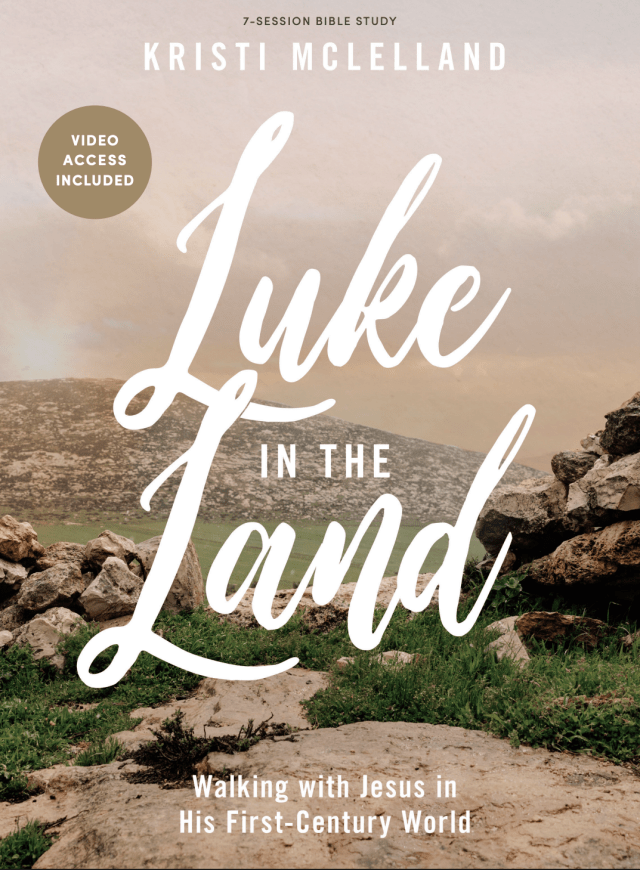
I wanted to take a closer look at Kristi’s writing and theology, so I went through Lifeway’s sample of her book Luke in the Land. My notes below include page numbers if you’d like to follow along. The text starts on p. 13.
Right off the bat, the pre-study questions lead the reader to focus narcissistically on self / self as authority:
p. 13- Me, me, me and my feelings
p. 16- I could get a really good sense of who you are, whom you love, what you care about, and the world that has shaped you and your worldview simply by looking at your photo albums and your snapshots—the snapshots you chose to keep along the way. What are some of your favorite snapshots or stories in your own life? Who’s in your photo albums? What places are in your photo albums?
p. 17- What are some of your favorite “snapshots” from Scripture? From Jesus’s life?
p. 17- Prompted by the Holy Spirit, Luke recorded the exact stories the living God wanted us to have. This makes me want to EAT my Bible and carry it around inside me. I want to see the snapshots He wants me to have, to hold, to carry within me as I live, move, and have my being in this life... What began in Luke would see fulfillment throughout Acts and on and on until this very moment you and I find ourselves in. We too are part of this story.
Me, me, me. The Bible is about me.
Kristi also muddies the waters on the theopneustos of Scripture:
p. 17- “Prompted by the Holy Spirit,” p. 19- “Led by the Holy Spirit”.
Evangelicals often describe themselves as being prompted or led by the Spirit. The inspiration of Scripture is more than that, plus she heavily emphasizes that Luke interviewed people and collected their stories, making it sound like he was merely a human biographer rather than a writer of God-breathed Scripture.
p. 20- Within these difficult stories of harsh domination by cruel pharaohs, kings, and caesars, there are stories of light in the darkness, hope in the midst of despair, and of salvation and deliverance. These biblical stories teach us to look for light in our own darkness, to reach for hope in our own despair, and to courageously cry out for salvation and deliverance in our own lives.
No, they don’t. Relief from, or solutions to personal problems is not the purpose of these passages. Their purpose is to display God’s glory in the grand narrative of Scripture and the story of redemption.
p. 21- Jesus, the King of kings, came all the way to the lowest circle of humanity, found the lost, the sick, and the marginalized, and prioritized them.
No, He didn’t. God is no respecter of persons. He does not show favoritism. Jesus preached the gospel to everyone who would listen and welcomed any who were repentant and believed.
p. 25- Throughout both the Sermon on the Mount and in His teaching and ministry as a Rabbi of Israel, He continually proclaimed one theme. What was that theme? LOOK UP MATTHEW 4:17,23-25; LUKE 4:43; LUKE 10:1-9; ACTS 1:1-3. What was Jesus proclaiming in all these verses?
How can the reader possibly know? This is the introduction to Luke. The reader hasn’t yet studied the book of Luke to glean the answer to all of this.
p. 26- Simply put, the kingdom of God is God’s reign over the universe. He is sovereign and has dominion over everything in and under heaven. It’s a term that’s used in the Old Testament, but “arises more specifically from Jesus’ proclamation of the inbreaking of God’s rule.” And what is God’s rule breaking in on? The empire. Jesus’s world in Luke, and our world today, was and is anchored in the way of the empire.
1. “God’s rule” has been there from eternity past. It’s not “breaking in” like this world is our place and He’s an unwanted intruder.
2. God has been ruling His people since Creation.
3. The kingdom of God is salvation and the gospel. It’s coming to save people -spiritually- not defeat worldly “empires”.
4. What is “the way of empire”? That’s not a phrase used in Scripture, it’s a phrase Kristi came up with and she just throws it out there without explaining it.
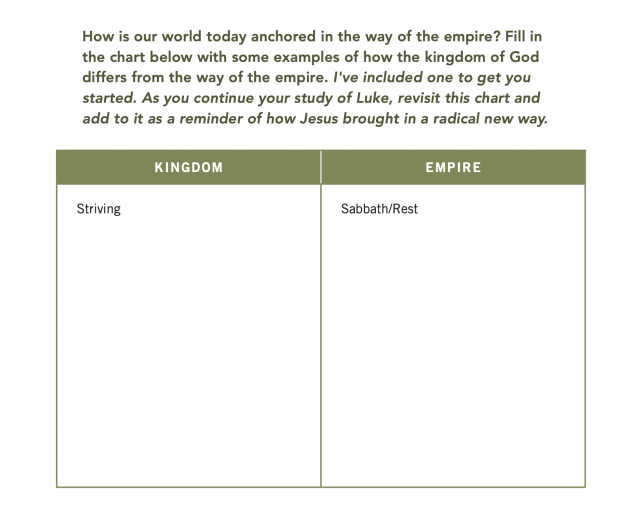
p. 27- This chart makes no sense whatsoever. The example she’s given seems to be backwards according to what little she’s said about the Kingdom of God vs. “Empire”. Shouldn’t “striving” be under “Empire,” and “Sabbath/Rest” be under “Kingdom”? (And what does any of this have to do with the text of Luke 1 or 2, which is where she should be starting a study of the book of Luke?)
This concept of the inbreaking of God’s rule was central to Jesus’s teaching,
Then why doesn’t the text of Luke (or any of the other gospels) say anything about that?
p. 29- READ ISAIAH 9:6-7. Which of these names and promises about Jesus do you think the people of the time were most excited about? What do you think they were looking for in the promised Messiah?
1. What difference does it make what they were excited about?
2. This is speculation, not study. What does the text say?
Which of the promises about the Messiah from Isaiah 9:6-7 brings you the most comfort?
And now we’re back to narcissistic navel-gazing.
Cell phones came out when I was a sophomore in college…
Personal anecdote.
Have you had a similar experience of being really lost? What did you feel when you realized you were lost?
Personal experience and feelings. What about the text of Luke?
p. 30- LOOK AT GENESIS 3:8-10 AGAIN. What was the first question God asked of man? These three words in English are one word in Hebrew—ayeka. When you read this, how do you imagine hearing the tone in His voice? In your imagination, does he sound angry? Disappointed? Sad? Frantic? Why do you imagine his voice and tone sounding that way?
Imagination? Tone of voice? Feelings? Why are we speculating and using our imaginations (about a passage in Genesis) instead of studying the text of Luke?
p. 31- Compassion is not so much an emotion that we feel. Compassion is a location- we are compassionate when we locate ourselves with someone in his or her pain. The Lord looked for Adam and Eve in the garden to meet them in their pain. Most of all, I imagine ayeka with a tone of compassion.
Their pain? They had sinned and rebelled against the holy God of the universe and they were ashamed and guilty. The remainder of Genesis 3 is God meting out the judgment and punishment of their sin. “Their pain”? This is an ungodly way of softening sin and its consequences (because now, when you sin, you’re in “pain” and God “meets you in your pain” with “compassion”), and it is not biblical regardless of how Kristi “imagines” it.
Throughout the Gospel of Luke, we will see Jesus practicing compassion—locating Himself with people right in the middle of their pain. He sought out and found the lost and offered to bring them home. He does the same today. Jesus is not afraid of our sin or our pain; He meets us there and offers to bring us home.
What would it look like for you to invite God to locate Himself with you in your pain today? Take a moment and praise God for His presence. Ask to feel His presence and compassion in your pain,
Me, me, me, and my feelings. This sounds really cozy, but where’s the repentance?
Once again, Kristi is softening sin and its consequences. Yes, Jesus was compassionate to repentant, believing sinners. But He didn’t “locate Himself with people right in the middle of their pain,” or “find the lost and offer to bring them home” (whatever that means). Jesus called sinners to repentance and to believe the gospel. He does the same today.
This “study” is quite disjointed. Kristi skips around all over the place, and at the end of the first 33 pages, the reader still hasn’t read any significant portion of Luke.
It’s like she’s using various verses from Luke (and other Scriptures) to support her historical theories. Kristi cherry picks a few verses here and there from Luke but never instructs the reader to sit down and read the opening chapters of Luke in their entirety. This is a history lesson supported by the Bible, not a Bible lesson informed by historical context.
And don’t get me wrong, historical context is fine, but this is a lot more history than Bible. It feels like what Kristi would really rather be doing is teaching Middle Eastern history and culture than the precepts of Scripture. Where a Lisa Harper or Beth Moore “study” would be largely personal anecdotes with a few out of context Bible verses sprinkled in to bolster whatever ideas they’re trying to teach, Kristi’s study is largely academic: etymology and historical/cultural anecdotes with a few out of context Bible verses sprinkled in to bolster the ideas she’s trying to teach.
And don’t be fooled by the academics. Every time Kristi cites a Greek word or relates a story from history or explains a Middle Eastern cultural concept, it boosts her stature and credibility in the eyes of the reader. “Wow! She really knows her Bible! What a great teacher! We’d better listen to her!”. But if you’ve ever taken a college level history or language class, you know that any pagan with an education can tell you what a word means or who was king two thousand years ago, and what he did.
Knowledge of Greek and Hebrew, and Middle Eastern history and culture is not the same thing as knowing Christ and His Word. Kristi demonstrates that with the fruit of her life: stealing the position of “pastor,” preaching to men, exercising authority over men, administering the Lord’s Supper and baptizing, yoking with false teachers, and teaching false doctrine. Jesus didn’t say, “by their degrees and education you will know them,” He said, “by their fruit you will know them”:
“Beware of the false prophets, who come to you in sheep’s clothing, but inwardly are ravenous wolves. 16 You will know them by their fruits. Are grapes gathered from thorn bushes or figs from thistles? 17 Even so, every good tree bears good fruit, but the bad tree bears bad fruit. 18 A good tree cannot bear bad fruit, nor can a bad tree bear good fruit. 19 Every tree that does not bear good fruit is cut down and thrown into the fire. 20 So then, you will know them by their fruits. 21 “Not everyone who says to Me, ‘Lord, Lord,’ will enter the kingdom of heaven, but he who does the will of My Father who is in heaven will enter. 22 Many will say to Me on that day, ‘Lord, Lord, in Your name did we not prophesy, and in Your name cast out demons, and in Your name do many miracles?’ 23 And then I will declare to them, ‘I never knew you; depart from Me, you who practice lawlessness.’
Matthew 7:15-23
Kristi’s book learning and eloquence demands that you regard her as a mature, knowledgeable Christian and excellent teacher. But God says:
And by this we know that we have come to know Him, if we keep His commandments.4 The one who says, “I have come to know Him,” and does not keep His commandments, is a liar, and the truth is not in him; 5 but whoever keeps His word, truly in him the love of God has been perfected. By this we know that we are in Him: 6 the one who says he abides in Him ought himself to walk in the same manner as He walked.
1 John 2:3-6
Are you going to believe Kristi or are you going to believe God?
Kristi seems like a very nice person. She’s obviously smart and well educated. She’s charming and personable. But she’s not teaching the truth of Scripture, and the fruit of her life is rebellion against Scripture. She says in numerous “sermons” and interviews that she loves the Bible and that the only thing she ever wanted to do in life was to teach the Bible. But she rejects the Bible at every turn, whether it’s disobeying what the Bible says about the role of women in the church, or spending most of her writing or teaching time talking about things besides the Bible. For all of these reasons, with sadness, it is my recommendation that you obey Scripture and stay away from Kristi McLelland and all of her materials and resources.
1A special note to my fellow Southern Baptists: We have heard the SBC platform minimize numerous times in recent years the problem of SBC churches with women in the position of “pastor”. It’s supposedly such a non-existent problem that in May 2025, Keven Ezell, head of NAMB, said during a podcast interview that he would give $10K to anyone who could show him a NAMB church plant with a woman pastor. Now, COTC may not have been a NAMB church plant, but they certainly were (and still are as of the release date of this article) listed on the church finder at the SBC website the whole time Kristi (and other women “pastors” who are still on staff) was listed on COTC’s website as a “Teaching Pastor”.
2Again, Southern Baptists, let that sink in. For the past several years we’ve been told by SBC leadership that there’s virtually no issue with women pastors in the SBC. The Law/Sanchez amendment (to require that churches in friendly cooperation with the SBC must have only male pastors) to our constitution has failed to pass for three years in a row. And Lifeway – one of your Southern Baptist entities – welcomes men to be taught by a female “pastor”.
3Women who “pastor” or “preach” to men are false teachers because they teach via their behavior, example, and often their words, the false doctrine that you’re free to ignore and disobey any command of Scripture you don’t like, such as the commands forbidding women from pastoring, preaching, instructing men in the Scriptures, and holding authority over men in the gathering of the Body.
4“Divangelista” is just a slang term I coined because the phrase “popular women’s ‘Bible’ study authors” is too long and cumbersome for writing. It’s a combination of the words “diva” and “evangelical” and rhymes with “Sandinista” (if you’re old enough to remember them) for no particular reason.
Welcome to another “potpourri” edition of The Mailbag, where I give short(er) answers to several questions rather than a long answer to one question. I also like to take the opportunity in these potpourrri editions to let new readers know about my comments/e-mail/messages policy. I’m not able to respond individually to most e-mails and messages, so here are some helpful hints for getting your questions answered more quickly. Remember, the search bar can be a helpful tool!
I was wondering what your views were on “ungodly soul ties”, in reference to past relationships? If I was in a previous relationship with someone who I was involved with physically, mentally, spiritually and emotionally, how would I loose myself from that?
The concept of “soul ties” is not biblical. It is not mentioned or even hinted at in the Bible. Proponents of this heretical doctrine, as you can see in this article, Basic Introduction to Soul Ties,¹ will try to convince you that soul ties are biblical by taking all manner of Bible verses out of context and stretching and twisting them like Silly Putty to try get them to mean what they want them to mean. All you have to do is look up the verses they cite, and read them in context to see that none of these passages say that one person’s soul can be literally bound to another person’s soul.
I find it especially laughable that many of the verses they cite in support of soul ties are the “one flesh” verses, such as Ephesians 5:31 (which is actually a quote of Genesis 2:24). Don’t you think that if God, the creator of language, meant to convey in these verses that two people’s souls were tied together, that He would have said “one soul” instead of “one flesh“? Or that He would have clearly said: “In this type of close relationship, the two people’s souls are bound together.”? This is God we’re talking about, here. He’s perfectly capable of explaining Himself clearly. He knows what words mean, and He never makes a mistake and chooses the wrong word. And yet, time and time again in Scripture, He uses the words “one flesh” to describe the intimacy of marriage and sexuality, and He never, anywherein Scripture, even suggests that the souls of two people are bound together under any circumstances.
Soul ties are just one more piece of false doctrine usually taught by those in the heretical New Apostolic Reformation camp. (When I Googled “soul ties”, articles by Kris Vallotton {Bethel}, Terri Savelle Foy, and Paula White – all among the worst of the worst of the NAR and prosperity preaching – were on the first page of results. That should tell you something.) There is no way your spirit can be tied or bound to someone else’s spirit.
I’m not sure what you mean by being involved with someone “mentally” and “spiritually”, but I’m assuming you don’t mean that you were in Mensa together or that you had long talks about theology and frequently prayed together. Those might be fond memories that make you wistful, but no mental or spiritual activity you participate in with someone else binds your soul to his or is something you need to be “loosed” from.
What you need to do is read your Bible, understand what it says about sin, and if you sinned in any way in this relationship (for example, sex outside of wedlock, putting your love for this person ahead of your love for the Lord, being influenced by this person to lie, etc.) you need to repent, not “be loosed” (because you’re not bound to this person, and because repentance from sin is the biblical way of thinking about this situation). You may also need to avoid spending time with or talking to this person for a while. And if you’re really having trouble getting over the relationship, you might want to seek counsel from a doctrinally sound pastor (one who understands that soul ties are unbiblical) or an ACBC certified Biblical Counselor.
That’s truly all there is to it. The spirit-realm mumbo jumbo of “soul ties” is a bunch of mystical malarkey. Your spirit isn’t tied to anyone else’s spirit, you’re just sad that the relationship is over, having difficulty moving on with your life, and, perhaps missing the person. And it’s OK if that sounds earthly and pedestrian. Because it is. But if Christ is your Savior, you can trust Him to carry you through it.
¹Just in case it isn’t abundantly obvious, this is a heretical New Apostolic Reformation article/website, and I certainly don’t recommend it.
We recently moved and have been attending a Southern Baptist church. They have not had communion for over two months. Isn’t it the norm to have communion at least once a month?
Also there is no women’s ministry that I can be involved with which is very disappointing to me. I would even be willing to teach/lead a women’s study but since we are new to this church we are still waiting and learning our place. We hesitate to make ourselves known as possibly unsubmissive or question why they do things the way they do.
Why no communion or women’s Bible study? Your thoughts would be enlightening.
These are such great questions because they help me, as a Southern Baptist, think about the way we do things and how those practices might be perceived by visitors or new members.
Communion/Lord’s Supper: Every Southern Baptist church is autonomous, so each church has its own policy or practice about how often the Lord’s Supper is observed. There are some SBC churches who hold the Lord’s Supper every week and probably others who hold it only once or twice a year, although I don’t personally know of any who hold it that infrequently.
In my experience, most Southern Baptist churches observe the Lord’s Supper several times a year, usually on a schedule like the first Sunday of the month, once a quarter, or every “fifth Sunday” (in months that have five Sundays). In addition to these scheduled observances, many churches also observe the Lord’s Supper at their Christmas Eve, Good Friday, or Easter service.
Women’s Ministry:I understand your disappointment in the lack of women’s ministry at the church. I would be somewhat disappointed too. There could be a variety of reasons for this. Maybe they had a women’s ministry that veered off into error or personality conflicts, so the pastor put it on hiatus for a while. Maybe no one stepped up to volunteer to lead it. Or, maybe the pastor wants everyone’s focus to be on the worship service and Sunday School with no distractions. But even if there isn’t a formal women’s ministry, you can still invite women over to your home, go out for coffee or dinner together, or study God’s word and pray together with a few others. I found this article – Ministry to Women When There’s No “Women’s Ministry” – really helpful.
Asking Questions: I would encourage you and your husband to set up an appointment with the pastor and ask away! It is certainly not unsubmissive to sit in his office and politely say, “We’re new here and we were just wondering about…” Most pastors I know would love for potential members to do this. (In fact at my church, once a month my pastor holds a sort of “orientation”/Q&A class for potential members during the Sunday School hour.) You need to know where he and the church stand on various doctrinal issues and practices so you won’t be unpleasantly surprised after you’re already members. This is especially important if you’re new to being a Southern Baptist as well as being new to the church. If the pastor in any way discourages you from asking genuine, courteous questions or sees your questions as a threat to his authority, that’s a red flag telling you that you should not join this church.
In the past I purchased books and “studies” by authors I now know are false teachers- an embarrassing amount of them really. I am wondering now what do with all of them…I don’t feel I am mature enough in my walk with Christ yet to read any of them and test them against Scripture myself, but I also don’t feel like passing them on to someone else is right either. Just wondering your thoughts on this.
You’re correct, you should not pass on books containing false doctrine to others, donate them to libraries (especially church libraries), Goodwill, or thrift stores, or sell them in a garage sale. The only scenario I can think of in which passing along a book authored by a false teacher would be OK is if it is to someone you know is a mature, doctrinally sound Christian who needs it for research purposes or to write a review of it warning people away from it.
I would also suggest that you not simply throw throw the books in the trash or recycling unless you render them unreadable (ex: scribbling on or tearing up the pages) first. People have been known to take “freebies” out of the trash.
Here are two ways I’ve handled heretical books I’ve been given:
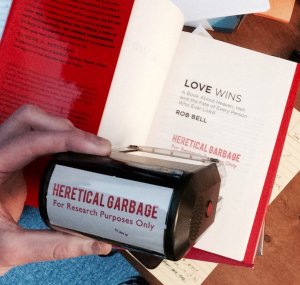
1. Keep them for research purposes. (If you think you might be tempted to read them and you don’t feel like you’re spiritually mature enough to handle that yet, maybe box them up and put them in storage for a later date.) You might want to mark them in some sort of way – in case you lose the book and someone else finds it or something like that – indicating that the book is false doctrine. My friend, Pastor Nate Pickowicz, has an awesome stamp for his “research only” books:
2. Burn them. I know it reeks of Nazism and censorship by wild-eyed preachers of yesteryear, but it’s biblical, it keeps false doctrine out of the hands of others, and these books can actually have a positive use for kindling if you have a fireplace or chiminea. (Please use all fire safety precautions. Also, it is not necessary to burn the books publicly.)
Is it Biblical for a woman to be in charge of the children’s ministry? Especially one who is not doctrinally sound?
It isn’t biblical for anyone who’s unrepentantly and unteachably doctrinally unsound to be in charge of anything in the church.
If it’s a case like Apollos, in which the person in question simply doesn’t know any better, but changes her ways and embraces sound doctrine when corrected, that’s cause for giving glory to God. (Also, she might need more training in the Scriptures before she resumes her position of service.)
But if it’s a case in which the person persists in teaching false doctrine or acting sinfully, that’s cause for church discipline. And if she steadfastly refuses to repent despite biblical rebuke, she needs to be disfellowshipped from membership in the church. Of course, it should go without saying (unfortunately, it doesn’t these days) that people who aren’t church members and/or aren’t saved should not be given any position of service or leadership in the church.
It couldbe OK for a doctrinally sound woman to be in charge of the children’s ministry, depending what you mean by “in charge”, and depending on whether or not she can do so without violating Scripture:
1. She should not be considered as, or bear the professional title of, “pastor”. It is unbiblical for a woman to be a pastor, and if she’s not a pastor, then bearing the professional title of “pastor” is lying.
2. In her leadership duties, she should not teach adult men (for example, men who teach children’s Sunday School classes, if she oversees children’s Sunday School) the Scriptures or exercise authority over them.
3. The pastor, or an appropriate elder, should vet and approve any curricula and materials, guest speakers, activities, etc., she wishes to use.
If a pastor or elder oversees her leadership so that she is acting under his authority and at his direction, and she is not violating Scripture by preaching to men, teaching men Scripture, or exercising authority over men, I don’t see why it would be a problem for a woman to lead the children’s ministry. In fact, Christian women and churches who handle this properly could be a superb example and model for other Christian women and churches.
If you have a question about: a Bible passage, an aspect of theology, a current issue in Christianity, or how to biblically handle a family, life, or church situation, comment below (I’ll hold all questions in queue {unpublished} for a future edition of The Mailbag) or send me an e-mail or private message. If your question is chosen for publication, your anonymity will be protected.
Listen in as Dave and I discuss discipleship in the church today, and those who are undermining it with progressivism, like LifeWay Women featured author and speaker Rebecca McLaughlin, Russell Moore, and others.
Be sure to check out Dave’s website, Servants of Grace, where you’ll find an abundance of great teaching, podcasts, and materials, as well as his social media links- and give Dave a follow!
Got a podcast of your own or have a podcasting friend who needs a guest? Need a speaker for a women’s conference or church event? Click the “Speaking Engagements” tab in the blue menu bar at the top of this page, drop me an e-mail, and let’s chat!
This was a reader’s recent response to one of my articles warning about a false teacher, and I thought I’d share and expand on my response to her here, because I know many of you, when you’ve said or posted things about false doctrine or false teachers, have had someone pridefully and self-righteously attempt to shame you and shut you up with a worldly twisting of these precious words of our Lord Jesus…
Some pridefully and self-righteously attempt to shame Christians and shut us up with a worldly twisting of these precious words of our Lord Jesus: “Judge not.”
You know, Matthew 7:1 is a great verse, but it’s currently probably the most twisted and abused Bible verse there is. And this is one common abuse of it – defending false teachers.
If you weren’t sitting under false teachers like the one you’re defending, you might have an accurate and biblical understanding of what that verse actually means. Instead, you’re believing and using the world’s twisted version of it.
Matthew 7:1 does not mean Christians shouldn’t warn against false teachers.
Matthew 7:1 does not mean Christians shouldn’t warn against false teachers.
If that’s what Jesus meant when He said that, He would have been contradicting Scripture, because there are many, many passages of Scripture that command us – and pastors in particular – to warn against false teachers and eradicate them from the church.
He must hold firm to the trustworthy word as taught, so that he may be able to give instruction in sound doctrine and also to rebuke those who contradict it.
Titus 1:9
Titus 1:9 is the final requirement in the list of qualifications for pastors/elders in Titus 1. If a pastor does not rebuke and warn against those who contradict sound doctrine (i.e. false teachers) he is biblically disqualified from the pastorate.
But now I am writing to you not to associate with any so-called brother if he is a sexually immoral person, or greedy, or an idolater, or a reviler, or a drunkard, or a swindler—not even to eat with such a one. 12 For what have I to do with judging outsiders? Are you not to judge those who are within the church? 13 But those who are outside, God will judge. Remove the wicked man from among yourselves.
1 Corinthians 5:11-13
False teachers – who claim to be brothers and sisters in Christ – are idolators (some of them are sexually immoral, greedy, revilers, drunkards, and swindlers as well) because they create a god according to their own liking, steal biblical names (like God or Jesus) for it, and teach people to worship their false god instead of the one true God Scripture reveals to us. Scripture clearly commands us to judge them and remove them from the church.
And the idea that Jesus would have contradicted Scripture is just silly and ridiculous. We know God doesn’t contradict Himself, or He would be a liar and would cease to be God.
The idea that Jesus would have contradicted Scripture is just silly and ridiculous.
in the hope of eternal life, which the God who cannot lie promised from all eternity,
Titus 1:2
Furthermore, the Jesus who said “Do not judge,” in Matthew 7 is the same Jesus who tells us that we are to “judge with righteous judgment” in John 7.
Do not judge according to appearance, but judge with righteous judgment.
John 7:24
In Matthew 7:1, as you can plainly see by reading verses 1-5,…
“Do not judge, so that you will not be judged. 2 For with what judgment you judge, you will be judged; and with what measure you measure, it will be measured to you. 3 And why do you look at the speck that is in your brother’s eye, but do not notice the log that is in your own eye? 4 Or how can you say to your brother, ‘Let me take the speck out of your eye,’ and behold, the log is in your own eye? 5 You hypocrite, first take the log out of your own eye, and then you will see clearly to take the speck out of your brother’s eye.”
Matthew 7:1-5
…Jesus is telling us not to judge unrighteously (in juxtaposition to his admonition in John’s account to judge righteously) or hypocritically – in other words…
We’re not to judge others when we’re equally guilty of unrepentant sin.
We’re not to judge others for doing something we’re currently guilty of ourselves.
We’re not to judge others for doing something that’s actually biblical just because it offends our worldly, fleshly sensibilities.
Kind of like what you’re doing by unrighteously, unbiblically, and hypocritically judging me for warning against false teachers, which, again, is actually commanded and demonstrated by God in Scripture. How could I be doing something wrong when I’m doing what Scripture tells me to do?
When you chide a doctrinally sound Christian for warning against false teachers, you are the one who is unrighteously, unbiblically, and hypocritically judging.
You might also notice that in the same chapter (Matthew 7) in which Jesus says “Do not judge,” in verse 1, He goes on to warn against – and judge – false teachers:
Beware of the false prophets, who come to you in sheep’s clothing, but inwardly are ravenous wolves. 16 You will know them by their fruits. Are grapes gathered from thorn bushes or figs from thistles? 17 Even so, every good tree bears good fruit, but the bad tree bears bad fruit. 18 A good tree cannot bear bad fruit, nor can a bad tree bear good fruit. 19 Every tree that does not bear good fruit is cut down and thrown into the fire. 20 So then, you will know them by their fruits. 21 “Not everyone who says to Me, ‘Lord, Lord,’ will enter the kingdom of heaven, but he who does the will of My Father who is in heaven will enter. 22 Many will say to Me on that day, ‘Lord, Lord, in Your name did we not prophesy, and in Your name cast out demons, and in Your name do many miracles?’ 23 And then I will declare to them, ‘I never knew you; depart from Me, you who practice lawlessness.’
Matthew 7:15-23
And that’s not the only time Jesus warned against, rebuked, or judged false teachers…
…beware of the leaven of the Pharisees and Sadducees.” 12 Then they understood that He did not say to beware of the leaven of bread, but of the teaching of the Pharisees and Sadducees.
Matthew 16:11b-12
And perhaps Jesus’ lengthiest, most scathing warning about and rebuke of false teachers is found in Matthew 23:1-36. Just a few choice excerpts since this is a long passage – here’s the warning to the hearers:
Then Jesus spoke to the crowds and to His disciples, 2 saying: “The scribes and the Pharisees have seated themselves in the chair of Moses; 3 therefore all that they tell you, do and keep, but do not do according to their deeds; for they say things and do not do them. 4 And they tie up heavy burdens and lay them on men’s shoulders, but they themselves are unwilling to move them with so much as a finger. 5 But they do all their deeds to be noticed by men;
Matthew 23:1-5a
“They say things and do not do them…they do all their deeds to be noticed by men…” Huh. There’s that hypocrisy Jesus was talking about back in chapter 7.
Here’s the rebuke to the false teachers themselves:
“But woe to you, scribes and Pharisees, hypocrites, because you shut off the kingdom of heaven from people; for you do not enter in yourselves, nor do you allow those who are entering to go in…you travel around on sea and land to make one proselyte; and when he becomes one, you make him twice as much a son of hell as yourselves…You blind guides…For you clean the outside of the cup and of the dish, but inside they are full of robbery and self-indulgence….you are like whitewashed tombs which on the outside appear beautiful, but inside they are full of dead men’s bones and all uncleanness. In this way, you also outwardly appear righteous to men, but inwardly you are full of hypocrisy and lawlessness…You serpents, you brood of vipers, how will you escape the sentence of hell?…I am sending you prophets and wise men and scribes; some of them you will kill and crucify, and some of them you will flog in your synagogues, and persecute from city to city, so that upon you may fall the guilt of all the righteous blood shed on earth…
Excerpted from Matthew 23:13-35
I’ve never warned against or rebuked a false teacher this sharply, but Jesus did. And we know He was right in doing so. But if you’re going to judge, criticize, and condemn someone like me who merely points out, in a matter of fact tone, how false teachers deviate from Scripture, and urges you, therefore, to obey God’s commands to have nothing to do with them, my goodness, what in the world are you going to say to Jesus about the way He warned against and rebuked false teachers?
If I’m wrong for saying, Teacher X is a false teacher because she preaches to men, teaches false doctrine, and yokes with other false teachers, and, therefore, I would not recommend you follow her, is Jesus wrong for calling false teachers “blind guides,” “whitewashed tombs,” and “brood of vipers”?
You’d best think on that lest you be hypocritical in your judgment.
The world has taken Matthew 7:1 and blasphemously twisted it into a club with which to pummel Christians who stand unwaveringly on the truth of God’s Word and, with Spirit-empowered courage, love sinners enough to call them to repent and believe the gospel, and love God, the church, and professing Christians enough to warn them against harmful false teachers and false doctrine.
The world has taken Matthew 7:1 and blasphemously twisted it into a club with which to pummel Christians, and, sadly, many professing Christians have followed the world’s example.
To the world, “Judge not,” means, “Don’t you ever dare say anything that’s not 100% affirming of me, my beliefs, or my sin of choice. Always be nice. Never say anything that could, in any way, be construed as negative. If you do, you’ll suffer the consequences.”. And, sadly, professing Christians discipled by the world and false teachers have adopted this worldly definition of “judging” and wield it like a weapon to shame and shut up Christians who are obeying Scripture.
But as genuinely regenerated Believers, accurately handling the Word of truth and having it illumined to us by the indwelling Holy Spirit, we know that Matthew 7:1 cannot possibly mean that we are not to warn against false teachers, because…
Jesus didn’t contradict Scripture, and Scripture commands us to warn against, rebuke, and judge false doctrine and false teachers.
Jesus didn’t contradict Himself during His earthly ministry, saying “Don’t judge,” in Matthew and “Do judge,” in John and other passages.
Jesus Himself warned against, rebuked, and judged false doctrine and false teachers.
We know that Matthew 7:1 doesn’t mean, “Don’t warn against false teachers,” because: Jesus didn’t contradict Scripture, Jesus didn’t contradict Himself, and Jesus Himself warned against, rebuked, and judged false teachers.
If you have a question about: a Bible passage, an aspect of theology, a current issue in Christianity, or how to biblically handle a family, life, or church situation, comment below (I’ll hold all questions in queue {unpublished} for a future edition of The Mailbag) or send me an e-mail or private message. If your question is chosen for publication, your anonymity will be protected.