Ezra Bible Study

Ezra: Lesson 2

ezra-study-e1465330077513Previous Lessons: 1

Ezra 1

In the first year of Cyrus king of Persia, that the word of the Lord by the mouth of Jeremiah might be fulfilled, the Lord stirred up the spirit of Cyrus king of Persia, so that he made a proclamation throughout all his kingdom and also put it in writing:

“Thus says Cyrus king of Persia: The Lord, the God of heaven, has given me all the kingdoms of the earth, and he has charged me to build him a house at Jerusalem, which is in Judah. Whoever is among you of all his people, may his God be with him, and let him go up to Jerusalem, which is in Judah, and rebuild the house of the Lord, the God of Israel—he is the God who is in Jerusalem. And let each survivor, in whatever place he sojourns, be assisted by the men of his place with silver and gold, with goods and with beasts, besides freewill offerings for the house of God that is in Jerusalem.”

Then rose up the heads of the fathers’ houses of Judah and Benjamin, and the priests and the Levites, everyone whose spirit God had stirred to go up to rebuild the house of the Lord that is in Jerusalem. And all who were about them aided them with vessels of silver, with gold, with goods, with beasts, and with costly wares, besides all that was freely offered. Cyrus the king also brought out the vessels of the house of the Lord that Nebuchadnezzar had carried away from Jerusalem and placed in the house of his gods.Cyrus king of Persia brought these out in the charge of Mithredath the treasurer, who counted them out to Sheshbazzar the prince of Judah. And this was the number of them: 30 basins of gold, 1,000 basins of silver, 29 censers, 10 30 bowls of gold, 410 bowls of silver, and 1,000 other vessels; 11 all the vessels of gold and of silver were 5,400. All these did Sheshbazzar bring up, when the exiles were brought up from Babylonia to Jerusalem.


The Holy Bible, English Standard Version Copyright © 2001 by Crossway Bibles, a publishing ministry of Good News Publishers.


Questions to Consider:

1. If needed, refamiliarize yourself with the characters, purpose, and historical setting of the book of Ezra by reviewing lesson 1 of this study. Read the entirety of Ezra 1, identifying each character and location mentioned.

2. Read Cyrus’ decree in verses 2-4. Summarize it in your own words. To whom was it written, and what instructions does Cyrus give? How does Cyrus describe God? How was this decree a fulfillment of “the word of the Lord by the mouth of Jeremiah“? (1) (Notice the context all of these passages give to the popular “coffee cup verse” Jeremiah 29:11.)

3. Verses 1 and 5 say God “stirred up the spirit” of Cyrus and the people. Examining these verses in the context of this chapter, what does this phrase mean? Compare these verses to Proverbs 21:1 and these other passages about God “stirring” people’s hearts or spirits. What can we learn from these Scriptures about God moving the hearts of people in order to accomplish His will? What does this teach us about God’s sovereignty?

4. Do verses 5-6 remind you of another major Old Testament event? What are some of the similarities and differences between these two events? What are some things God might have wanted to remind His people of as they remembered the Exodus on their journey back to Jerusalem? How do both the Exodus and the return from exile point us to Christ and how He delivers us from slavery to sin?

5. Verses 7-11 describe God’s preservation and restoration to His people of the temple vessels. Who had originally seized them? (7) For how many years had God protected these worship vessels? (see link in question 2 for help). Consider God’s protection of these vessels for so many years – through war, the overthrow of Babylon, the leadership of various pagan kings – and God’s promise to return them, along with His promise to bring His people out of exile after 70 years. How can God’s sovereign protection, preservation, and deliverance of His people in this story move you to trust Him to keep His promises? To provide for you? To save and keep you? That He is always in control?

Ezra Bible Study

Ezra: Lesson 1

ezra study

Welcome to our brand new Wednesday’s Word Bible study! Over the next several weeks, we’ll be studying the book of Ezra. Many of us feel like our knowledge of the Old Testament – particularly the post-exilic writings – could use some beefing up, and Ezra is a perfect book to study for that purpose.

But is Ezra relevant to us as Christians today? As we study, I think you’ll find the answer to that question is a resounding yes. Second Timothy 3:16-17 reminds us:

All Scripture is breathed out by God and profitable for teaching, for reproof, for correction, and for training in righteousness, that the man of God may be complete, equipped for every good work.

God’s people are God’s people, B.C. or A.D. We love God, love His word, and struggle with many of the same sins. And, of course, God Himself never changes.

So let’s roll up our sleeves and start digging in, shall we?

Introduction to the book of Ezra:

Before we begin studying a book of the Bible, it’s very important that we understand some things about that book. We need to know…

Who the author was and anything we might be able to find out about him or his background.

Who the audience of the book is: Jews or Gentiles? Old Testament Israelites or New Testament Christians? This will help us understand the author’s purpose and approach to what he’s writing.

What kind of biblical literature we’re looking at. We approach books of history differently than books of wisdom, books of wisdom differently than books of prophecy, etc.

What the purpose of the book is. Was it written to encourage? Rebuke? Warn?

What the historical backdrop is for the book. Is Israel at war? At peace? In exile? Under a bad king? Good king? Understanding the historical events surrounding a piece of writing help us understand what was written and why it was written.

When the book was written. Where does the book fall on the timeline of bibical history? This is especially important for Old Testament books which are not always arranged in chronological order.

So this week, before we start studying the actual text of the book of Ezra, we need to lay the foundation to understanding the book by finding the answers to these questions.

Read the following overviews of the book of Ezra, taking notes on anything that might aid your understanding of the book, and answer the questions below:

Ezra at Grace to You

Overview of the Book of Ezra at Reformed Answers

Book of Ezra at Got Questions

1. Who wrote the book of Ezra? What was his profession? His background and lineage? What do these things tell us about his position in society, his knowledge of Scripture, his approach to writing, or anything else about him?

2. Who is the intended audience of the book of Ezra?

3. Which genre of biblical literature is the book of Ezra: law, history, wisdom, poetry, narrative, epistles, or prophecy/apocalyptic? What does this this tell us about the approach we should take when studying this book versus our approach to books of other genres?

4. What is the theme or purpose of the book of Ezra?

5. Who are the leaders and significant personalities in the book of Ezra?

6. What is the historical backdrop of the book of Ezra? When did the events of the book of Ezra take place on the timeline of biblical history (ex: before the Flood, during the period of the judges, during or after the exile, etc.)? What are the historical events immediately surrounding the events of the book of Ezra? Where do the events take place? (Sometimes, a good Bible map like this one or this one can be helpful.)

7. What else did you learn about Ezra or the setting of his book that might help you understand the text of the book better?

Wednesday's Word

Wednesday’s Word ~ Ezra 3

For further study on the book of Ezra, try my study, Ezra.

ezra 3 11

Ezra 3

When the seventh month came, and the children of Israel were in the towns, the people gathered as one man to Jerusalem. Then arose Jeshua the son of Jozadak, with his fellow priests, and Zerubbabel the son of Shealtiel with his kinsmen, and they built the altar of the God of Israel, to offer burnt offerings on it, as it is written in the Law of Moses the man of God. They set the altar in its place, for fear was on them because of the peoples of the lands, and they offered burnt offerings on it to the Lord, burnt offerings morning and evening. And they kept the Feast of Booths, as it is written, and offered the daily burnt offerings by number according to the rule, as each day required, and after that the regular burnt offerings, the offerings at the new moon and at all the appointed feasts of the Lord, and the offerings of everyone who made a freewill offering to the Lord. From the first day of the seventh month they began to offer burnt offerings to the Lord. But the foundation of the temple of the Lord was not yet laid. So they gave money to the masons and the carpenters, and food, drink, and oil to the Sidonians and the Tyrians to bring cedar trees from Lebanon to the sea, to Joppa, according to the grant that they had from Cyrus king of Persia.

Now in the second year after their coming to the house of God at Jerusalem, in the second month, Zerubbabel the son of Shealtiel and Jeshua the son of Jozadak made a beginning, together with the rest of their kinsmen, the priests and the Levites and all who had come to Jerusalem from the captivity. They appointed the Levites, from twenty years old and upward, to supervise the work of the house of the Lord.And Jeshua with his sons and his brothers, and Kadmiel and his sons, the sons of Judah, together supervised the workmen in the house of God, along with the sons of Henadad and the Levites, their sons and brothers.

10 And when the builders laid the foundation of the temple of the Lord, the priests in their vestments came forward with trumpets, and the Levites, the sons of Asaph, with cymbals, to praise the Lord, according to the directions of David king of Israel. 11 And they sang responsively, praising and giving thanks to the Lord,

“For he is good,
    for his steadfast love endures forever toward Israel.”

And all the people shouted with a great shout when they praised the Lord, because the foundation of the house of the Lord was laid. 12 But many of the priests and Levites and heads of fathers’ houses, old men who had seen the first house, wept with a loud voice when they saw the foundation of this house being laid, though many shouted aloud for joy, 13 so that the people could not distinguish the sound of the joyful shout from the sound of the people’s weeping, for the people shouted with a great shout, and the sound was heard far away.


The Holy Bible, English Standard Version Copyright © 2001 by Crossway Bibles, a publishing ministry of Good News Publishers.


Questions to Consider:

1. The book of Ezra deals with the second wave (out of three) of Israelites returning from exile in Persia after the destruction of Jerusalem. Why was it important to them (3) to set up the altar? Why did they begin keeping the feasts and offering sacrifices before the temple was rebuilt?

2. What was the Feast of Booths (4), and which event in Israel’s history did it commemorate? What are some similarities between the Exodus and Israel’s recent return from exile which might have made this celebration of the Feast of Booths especially meaningful for the people? Which attributes of God are on display in both the Exodus and the return from exile?

3. Why would it have been important for the Levites (8) to supervise the work on the temple? How does this show the people’s reverence for God’s house and their desire to do things “decently and in order“?

4. Try to put yourself in the shoes of the average Israelite in verses 10-11. Think about what your experience in exile might have been like and how you might feel finally back, free, in your homeland. Now, the temple is at last being rebuilt so you can worship God – maybe for the first time in your life – in the place and the way He intended. What emotions might you be experiencing? What sorts of things might you be praising God for? Take some time to thank God for some specific things about your own church.

5. For what reasons might the old men have been weeping? (12-13) How could both tears and joy be proper expressions of worship in this passage and in worship today? What gives you joy in worship? What brings you to tears when you worship?

Faith, Old Testament, Suffering, Sunday School, Trust

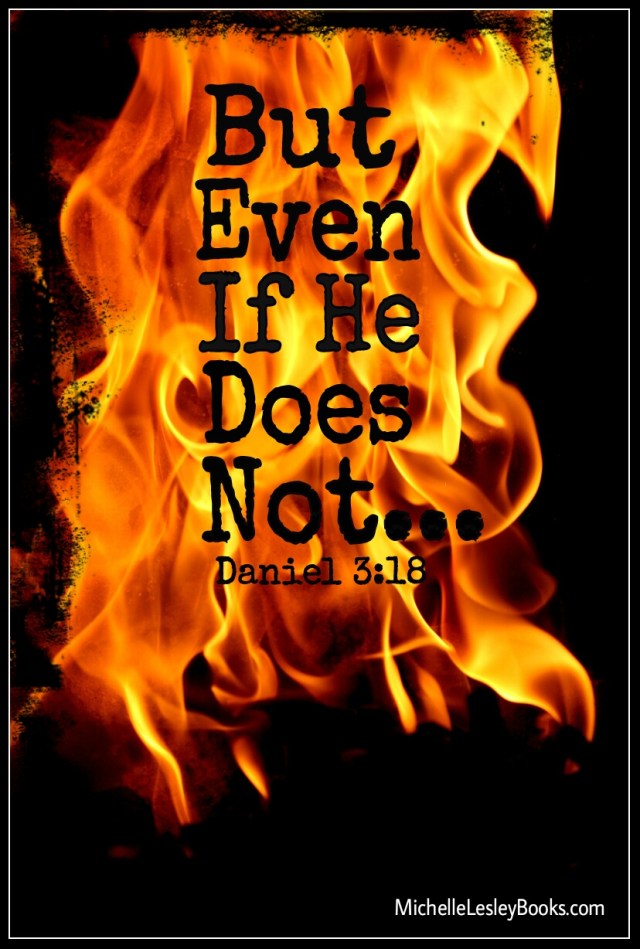
But Even If He Does Not… ~ Sunday School Lesson ~ 9-21-14

Shadrach

These are my notes from my ladies’ Sunday School class this morning. I’ll be posting the notes from my class here each week. Click here for last week’s lesson.

Through the Bible in 2014 ~ Week 38 ~ Sep. 14-20
Daniel, Ezra 1-6, Psalm 137, Haggai
But Even If He Does Not…

Exile. God has been warning Israel of the consequences of idolatry for centuries and has finally brought it to fruition. Last week we saw Ezekiel comfort the people with the good news that God’s anger and their punishment would not last forever, but today we find them smack dab in the middle of their time as Babylonian expatriates. How could they live as God’s people while being punished in a pagan nation? How could they please Him apart from temple sacrifices and offerings? Shadrach, Meshach, and Abednego are going to show us.

Daniel 3

The Problem- 1-7 (Exodus 20:1-6)
Here, the stage is set for the drama that is about to unfold. Nebuchadnezzar set up a 90 foot tall (probably much of that was a large base), 9 foot wide statue of himself, and commanded everyone under his rule to worship it. Emperor/king worship was not uncommon at any time during the Old or New Testament periods. While the emperor’s ego certainly must have played into this, it was mainly about loyalty and obedience to that leader and his rule. He was trying to preclude any hint of sedition while reinforcing to the people that he had control over every aspect of their lives. This was an especially important message to drive home to all of the governmental officials (2), because they were the ones most likely to slaughter the emperor and stage a coup.

From the emperor’s perspective, emperor worship also had less to do with actual religion and worship than submission to his absolute rule. Nebuchadnezzar and nearly everyone else in Babylon worshiped a panoply of gods, which was fine with Nebuchadnezzar as long as none of those gods superseded him and his rule in the eyes of his subjects. He was to be esteemed and obeyed above all others. That’s where our young Hebrew friends found themselves butting heads with Nebuchadnezzar’s new law. God is not OK with his people worshiping any other god before, besides, instead of, or in addition to Him. He is the only God, and He alone is to be worshiped, even if your life is on the line.

The Persecution- 8-12 (2 Timothy 3:12, John 15:18)
Shadrach, Meshach, and Abednego were three of the Judean exiles. We saw in chapter 1 that they, along with Daniel, were godly young men who risked their lives to be obedient to God’s commands. By the end of chapter two, Nebuchadnezzar had promoted them to prominent positions in his government. This is probably why the Chaldeans accused them– they were jealous. As with Daniel’s accusers in 6:4-5, they likely could not find any other grounds on which to discredit Shadrach, Meshach, and Abednego because they were upstanding, ethical, loyal citizens.

Satan hates God and anyone who loves and serves Him. John 15:18 says,

If the world hates you, know that it has hated me [Jesus] before it hated you.

Because of this hatred, Satan will do anything in his power to get God’s people to turn away from Him or sin against Him. He is the force behind all persecution, and he often uses his own servants to attack God’s servants. This was true for Shadrach, Meshach, and Abednego, and it is true for us today. Second Timothy 3:12 says,

Indeed, all who desire to live a godly life in Christ Jesus will be persecuted,

If we love God and strive towards holiness, we will find ourselves under attack at times.

The Predicament- 13-15
Being a child of God can often mean facing scary situations in which we are tempted to cut corners or sin. Shadrach, Meshach, and Abednego were tempted to bow down to the image the first time when the music played. Here, the heat is turned up because they’re standing in front of the man who holds their lives in his hands, and they face the same temptation a second time. Why not just do it? God will understand and forgive them, right?

The Profession- 16-18 (Psalm 115:3, Romans 8:28)
Although it’s tempting to think that way, we can’t, and Shadrach, Meshach, and Abednego prove this out beautifully. They would rather die than disobey their true King. And notice the strength of their testimony in the simple fact that they needed no time to consider Nebuchadnezzar’s offer (16). Immediately, they answered that their minds were made up. Under no circumstances would they bow to the image.

Why? Because they knew nothing was going to happen to them? No. We know that because we have the rest of the story. We have to remember that this was a real event happening to real people in real time, the same way things happen to us. They didn’t know what was going to happen next. For all they knew, they were toast. Yet they stood and boldly declared that God was able to do anything and they trusted Him no matter what.

But even if he does not…Those are probably the most important words in this story. To Shadrach, Meshach, and Abednego, God was still God, still worthy of worship and obedience, whether he spared their lives or not. Can we say the same?

There are a lot of false teachers out there that will tell you it is always God’s will for you to be healed, wealthy, successful. And if you’re not, it’s your fault because of your lack of faith. But the Bible clearly teaches the opposite. If God had not saved Shadrach, Meshach, and Abednego, could anyone say it was due to their lack of faith? Did God refuse to take away Paul’s thorn in the flesh because of his lack of faith? Were 11 of the 12 disciples martyred because they lacked faith?

The truth is, Our God is in the heavens; he does all that he pleases. (Ps.) God does what He does for His glory and our good. And, much like when we take our children to the doctor for a shot, what’s good for us can be scary and painful. What if God doesn’t heal you? What if your child dies? What if your marriage isn’t reconciled? What if you lose your job? For those that love God and are called out to His purposes, He works all things together for good (Rom.) He has not promised us an easy way, but a difficult way. But He has promised to be with us all the way. Can we stand in faith with Shadrach, Meshach, and Abednego and say, but even if He does not…?

The Peril and the Protection- 19-30
If we were writing this story, it would probably end right after verse 18 with Nebuchadnezzar so impressed with Shadrach, Meshach, and Abednego that he backed down and honored them for their courage and integrity. But God’s didn’t want Nebuchadnezzar to be impressed with Shadrach, Meshach, and Abednego. God wanted Nebuchadnezzar to be impressed with Him.

If you’ll notice, God did not rescue Shadrach, Meshach, and Abednego after their profession of Him. Things got worse. Nebuchadnezzar got angrier. The fire got hotter. God did not rescue them before they got tied up. Or before they got to the furnace. Or before they were thrown into the furnace. Or before they hit the bottom of the furnace. God allowed these three men who loved Him and were loyal to Him above all else to hit bottom before He rescued them. He didn’t rescue them from the furnace, He rescued them through the furnace.

God (possibly the preincarnate Christ in a theophany) was with them in the fire and, eventually, He brought them out on the other side. What do you think that did for their faith in Him? How much more intimately did they know Him, how much more thankful were they, and how much more intensely did they worship Him after God walked through the fire with them?

It’s the same for us. We grow to know and love God so much more intimately, when, instead of rescuing us from trials, He walks through them with us. I would not know and trust God as provider the way I do today had He not walked with me through some very difficult situations that only He could provide for. Others know God as healer or comforter or strength because of what He has walked through with them.

And what happened to Shadrach, Meshach, and Abednego wasn’t just about them, personally. God had a broader purpose for their suffering, and also for Daniel’s experience in the lions’ den. In those two incidents (and others), God got to pull back the curtain and reveal Himself to pagan people who desperately needed Him. He showed that He was superior to their gods, that they needed to repent and turn to Him, and that He loves His children. It had always been God’s plan to make Himself known to the Gentiles as well as the Jews, and here were God’s first missionaries. If these four men hadn’t gone through what they went through, Nebuchadnezzar and the rest of watching Babylon would not have seen God. What they went through showcased the great God they served.

Likewise, our trials can be an opportunity to point people to the Christ who has rescued us from the ultimate fire, and who can rescue them as well. Even if He does not…is a glorious opportunity to shine the spotlight on our great, mighty and merciful God.


Evangelism, Gospel, Old Testament, Sunday School

Watching and Warning with Ezekiel ~ Sunday School Lesson ~ 9-7-14

EzekielThese are my notes from my ladies’ Sunday School class this morning. I’ll be posting the notes from my class here each week. Click here for last week’s lesson.

Through the Bible in 2014 ~ Week 36 ~ Aug. 31- Sep. 6
Ezekiel 16-34
Watching and Warning with Ezekiel

Well, Ezekiel is still prophesying (and he’ll still be prophesying until Saturday :0) God is still sending out the same message through him. Again and again, God chastises His people, trying to shake some sense into them so they will repent and turn back to Him. Not because He wants to exercise judgment on them but so “they will know that I am the Lord.” (That phrase is used 74 times in the book of Ezekiel.) No one could say God was unfair because He didn’t warn them of His coming judgment or that He hadn’t given them enough time or that he hadn’t been clear.

Ezekiel 33:1-16

What’s a Watchman?
As we’ve talked about in the past, large or important cities normally fortified themselves against their enemies by constructing a tall, thick wall (sometimes an inner and an outer wall as we saw with Jericho) around the perimeter. These are great for keeping the enemy out once they get there, but not so great for being able to see whether or not the enemy is coming in the first place. We’re talking low visibility. So they would often build high watchtowers at various intervals around the city wall (sometimes outside the wall in a field or on a hill, but fairly close to the city). A watchman would be stationed in the watchtower, and it was his job to alert the higher ups that the enemy was approaching, a messenger was arriving, etc. To be good at his job, he needed good eyes. He needed to be able to discern a messenger from an enemy. He needed to stay alert and vigilant. He needed to act quickly and decisively. He needed to be able to rapidly and clearly convey an urgent message to the right person at the right time. And if he failed even once in any of these duties, he could likely kiss his life goodbye.

33:1-9- Ezekiel: Israel’s Spiritual Watchman (Matthew 23:37a)

If we’ve learned anything from studying these prophetic books, we’ve learned that being a prophet was not some cushy job. Most of the time, God did not have good news for His people, and most of the time, the people did not want to hear it. Jesus even said,

“O Jerusalem, Jerusalem, the city that kills the prophets and stones those who are sent to it!” (Matt.)

But Israel needed a watchman, and God said, “Ezekiel, you’re it.” (7)

Every time God had a message of warning for the people, Ezekiel was to faithfully proclaim it without delay. He was not to hold back from speaking harsh truths to scary people just because he was afraid. If the person Ezekiel was speaking to chose to reject God’s message, that was on that person’s head (9). But if Ezekiel kept his mouth shut, he was being just like that watchman on the wall who didn’t do his job right, and God would hold him accountable for the death of the intended hearers, who would still die in their sin (8).

33:10- What Was the Warning? (Ezekiel 18:4)
What was the warning? It was the warning to repent before God’s coming judgment. Verse 10 gives us a small glimmer of hope that maybe, just maybe God’s message was getting through to a few people:

“Surely our transgressions and our sins are upon us, and we rot away because of them.”

EXACTLY. Israel’s sin and transgressions are bringing God’s wrath upon her. That is what has caused all this calamity and the continuing sermons of doom from His prophets. As God had already told the people back in chapter 18, “The soul that sins shall die.” (18:4). But the story doesn’t end there.

33:10-16- Good News!
Look at the people’s hopelessness in verse 10:

How then can we live?

Their sin has done them in, and now they’re coming to grips with a horrifying reality: they have transgressed a holy God. They recognize that they deserve any punishment God wants to dole out and that He will be justified in pouring out His wrath upon them. What hope could they possibly have?

They have the hope of a God who is not only perfectly just, but rich in mercy and forgiveness and grace. A God who has “no pleasure in the death of the wicked, but that the wicked turn from his way and live.” (11)

“Turn back, turn back from your evil ways, for why will you die, O house of Israel?” (11) He pleads with them. This God who pleads with them now, and has been for nearly 800 years, is not the cruel, selfish, and vindictive god some portray Him as, but the tender, compassionate Father who will move heaven and earth to keep His children from destroying themselves.

Turn away from your evil ways and turn to My mercy and forgiveness, and you will live, He says. “None of the sins that he has committed shall be remembered against him.”

But remember, it’s your repentance and reliance on my mercy that saves you, God tells them. Don’t think you can get by on your past good deeds. “…if he trusts in his righteousness and does injustice, none of his righteous deeds shall be remembered, but in his injustice that he has done he shall die.”

None of the people are so bad that God won’t save them and none of them are so good that they don’t need God to save them.

Following in Ezekiel’s Footsteps
Although we’re not prophets, God has given us a similar charge to the one he gave Ezekiel. We, too, who have the good news of the gospel are to be spiritual watchmen for all those in our circle of influence. We have God’s word, we know what it says, and He has commissioned us to carry that message to people. Like the watchman, we need to stay alert and vigilant for opportunities to share the gospel. We often need to act quickly and decisively to share the gospel before the moment slips away. We need to be able to clearly convey the urgent message of salvation to the right person at the right time. And we need to take this duty deadly seriously.

What? A Warning?
Sometimes when people present the gospel, they do it by using what salesmen call a “hook,” a promise of what the product will do for the person or how it will make his life better. “Want to go to Heaven when you die?” “Jesus will make your life awesome!” But that’s not our message. Jesus isn’t a product we’re trying to convince people to buy.

Like Ezekiel, our first job is to warn people that they have broken God’s law, and that the penalty for breaking His law is God’s wrath, an eternity in hell. God doesn’t just automatically forgive everybody when they die (that’s a false teaching called Universalism). And, just like Ezekiel told the people, you can’t get by on your own good deeds. The warning always has to come first. People don’t know they need to flee to safety if they don’t know they’re in danger.

Our Good News
But as soon as the person we’re sharing with begins to feel like the Israelites– Surely our transgressions and our sins are upon us, and we rot away because of them. How then can we live? (10) –we have the unbelievable privilege of telling them the beautiful news of God’s mercy and grace for sinners like you and me:

As I live, declares the Lord God, I have no pleasure in the death of the wicked, but that the wicked turn from his way and live; turn back, turn back from your evil ways, for why will you die? (11)

None of the sins that he has committed shall be remembered against him. He has done what is just and right; he shall surely live. (16)

How could we ever keep such wonderful news to ourselves?