Basic Training, Evangelism

Basic Training: The Great Commission

For more in the Basic Training series, click here.

Have you ever heard the phrase “The Great Commission“? Do you know what it means? If not, you’re not alone…
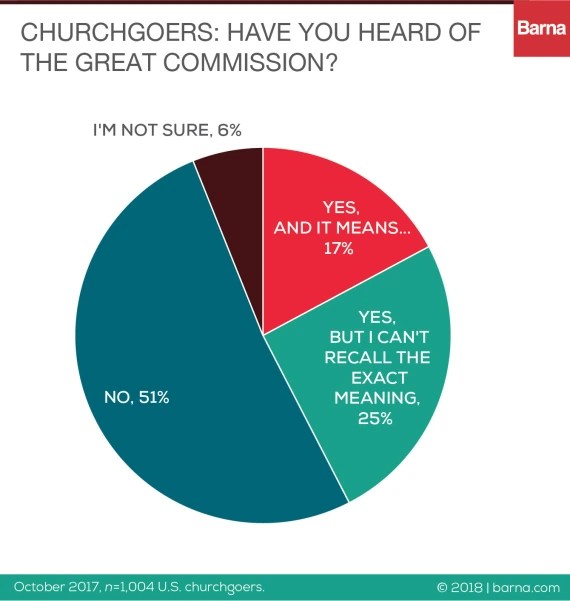
photo courtesy of barna.com

The Barna Group recently conducted a study asking churchgoers if they had previously “heard of the Great Commission.” In their report, 51% of Churchgoers Donโ€™t Know of the Great Commission the results of the study were summarized thusly:

“…half of U.S. churchgoers (51%) say they do not know this term. It would be reassuring to assume that the other half who know the term are also actually familiar with the passage known by this name, but that proportion is low (17%). Meanwhile, ‘the Great Commission’ does ring a bell for one in four (25%), though they canโ€™t remember what it is. Six percent of churchgoers are simply not sure whether they have heard this term ‘the Great Commission’ before.”

Now, if you know anything about statistics, you know how important it is to structure your questions carefully and get a representative sampling of the population you’re surveying in order to get the most accurate results. What does “churchgoer” mean? Is it possible people have never heard the term “The Great Commission” simply because churches don’t use this particular phrase any more? It’s important to take things like this into consideration because it affects the results of the survey. (You can find out more about Barna’s structuring process for this study at the end of the article linked above.) But even if the numbers of the Barna survey aren’t exact, I think it’s safe to say there are a lot of people out there in churchland who aren’t familiar with The Great Commission.

Just for fun, let’s see what the results would be if we surveyed readers of my blog:

The Great Commission refers to some of Jesus’ final words to the disciples before His ascension and is cited from Matthew 28:18-20:

And Jesus came and said to them, ‘All authority in heaven and on earth has been given to me. Go therefore and make disciples of all nations, baptizing them in the name of the Father and of the Son and of the Holy Spirit, teaching them to observe all that I have commanded you. And behold, I am with you always, to the end of the age.’

With these words Jesus commissioned the eleven remaining disciples to go out into the world and carry on His mission. Since every Christian is a disciple, or follower, of Christ, this is our commission from Him as well. Let’s examine what it says.

All authority in heaven and on earth has been given to Me.
Before commissioning his disciples, Jesus reminds them that everything He’s about to say is founded on and imbued with His authority. Jesus alone has the divine authority to establish the church and to dictate the way in which His church is to be set up and to grow.

We 21st century Christians would do well to keep forefront in our minds and hearts the authority of Christ over His church. There is no need for churches to “cast vision” or come up with mission statements. Christ is the head of the church and has already given us His vision for it. The Great Commission is His mission statement for the church.

Go therefore
“Therefore” in this little phrase refers back to what Christ has just said about His authority. In other words, because all authority in heaven and on earth has been given to Me, I am telling you to go.

“Go” is a very generic verb in English. We can “go” into the kitchen or we can “go” to the moon or we can “go” out and conquer the world. We can “go” anywhere from our own personal microcosm to the edges of the known universe. And that is the same sense the Greek word ฯ€ฮฟฯฮตแฝปฯ‰ captures: as you “go your way,” as you “go forth,” as you “walk”, as you “pursue the journey on which [you have] entered.” Wherever life takes us, whether it’s across the street or across the world, we go as ambassadors of Christ, carrying the good news of the gospel with us.

All nations
Revelation 7:9 tells us that God will save people from “every nation, from all tribes and peoples and languages.” So that’s who we share the gospel with as we go our way. Everybody. Regardless of where they’re from, what they look like, or how they talk. We are not to withhold the gospel from anyone, and we’re to make sure the church is proactively carrying the gospel to every populated geographical location on earth.

Make disciples…teaching them to observe all that I have commanded you
Notice the language Jesus uses here. He doesn’t say “make converts” or “make Christians”. He says “make disciples.”

Think about what the disciples did while Jesus was on earth. First, they answered His call to follow Him. Then, they began the journey of following Him wherever He went. He trained and equipped them day and night. They loved Him and worshiped Him. They imitated the things He did and said. They carried on His work after He ascended. Jesus is saying to the disciples, and to us, “Replicate yourselves. Make more like you.”

That means that the Great Commission starts with sharing the gospel with a lost person, but it doesn’t end there. There’s more to our mission than just evangelism. We are to train and equip Christians to follow Jesus daily, to love and worship Him, to imitate Him in obedience, and to carry on His work.

Baptizing them in the name of the Father and of the Son and of the Holy Spirit
After salvation, baptism is the first step a new Christian takes on the road of discipleship. It is not optional. Baptism publicly identifies a person – to the church and to the world – as a Christian, and is a personal pledge to follow Christ obediently all the days of one’s life.

Being baptized “in the name of the Father and of the Son and of the Holy Spirit” carries several layers of meaning.

๐Ÿ’งAgain, pay careful attention to the language in this phrase. Jesus does not say “in the nameS” – plural. He says, “in the name” – singular. This is a boldly Trinitarian statement directly from two of its members: Jesus, who spoke these words to the disciples, and the Holy Spirit, who breathed them out through the pen of Matthew. This is God Himself telling us who He is. Jesus spoke these words to good Jewish boys who were born and bred on the shema: “Hear, O Israel: The Lord our God, the Lord is one.” There was to be no confusion for new Believers back then, Believers today, or to the onlooking world, as to who these Christians are following. They are not following three different gods. They are following the one true God in three Persons: God the Father, God the Son, and God the Holy Spirit – the whole ball of wax.

๐Ÿ’งNames meant far more in biblical times than they do to us today. We see God changing people’s names – Abram to Abraham, Jacob to Israel, Simon to Peter, etc. – when He commissioned them for a new mission or phase of life. Being baptized “in the name of” the Father, Son, and Holy Spirit echoes that tradition of God changing people’s names. You are no longer your own, you are Christ’s. You are no longer “Sinner”, you are “Saint”. You no longer go forth in your own name, but in the name of the Father, Son, and Holy Spirit as their emissary, endowed with the power and authority of God to live for Him and to proclaim the gospel to a lost and dying world.

๐Ÿ’งBecause Christians are, by definition, Trinitarians, and because baptizing a Believer is commissioning her to go forth into the world as a representative of Christ, it’s appropriate for pastors to take this verse literally when performing a baptism and verbalize its words: “I baptize you in the name of the Father, and of the Son, and of the Holy Spirit.”

Basic Training: Baptism

And behold, I am with you always, to the end of the age.
What a sweet promise, both to the disciples and to us today. Obediently following Christ in our daily lives, sharing the gospel, and making disciples can be lonely, exhausting, and discouraging at times. But we don’t have to do it alone, and we don’t have to do it in the flesh. Christ is with us and He knows all too well how hard it can be. God has given the Holy Spirit to indwell and empower Believers to live for Him and to carry out The Great Commission.

Additional Resources

What is the Great Commission? at Got Questions

The Great Commission by John MacArthur

The Great Commission by Burk Parsons
Book Reviews, Guest Posts, Salvation

Guest Post: A Review of “From Death to Life: How Salvation Works”

If your theology pretty much matches up with mine (as outlined in the โ€œWelcomeโ€ and โ€œStatement of Faithโ€ tabs) and youโ€™d like to contribute a guest post, drop me an e-mail at MichelleLesley1@yahoo.com,
and letโ€™s chat about it.

photo credit: Stephen J. Melniszyn

A Review of Allen S. Nelson IVโ€™s
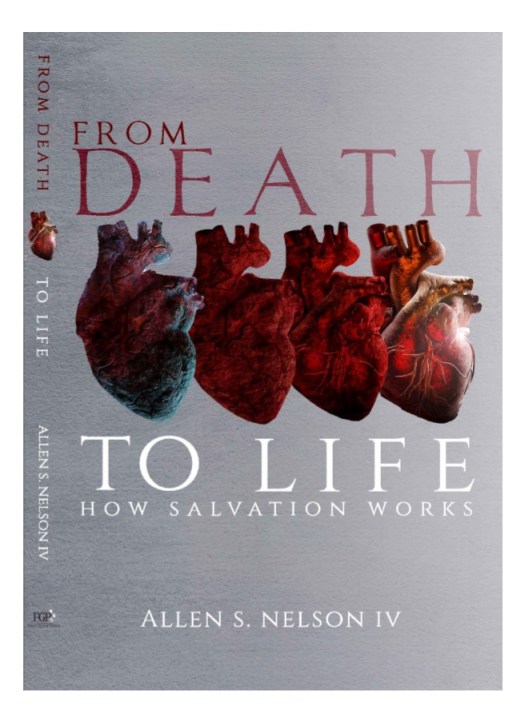
From Death to Life: How Salvation Works
by Katy B.

The most agonizing, frustrating experience in my ministry to women is the woman who claims to be โ€œsavedโ€ but gives no evidence of it. No interest in talking about Jesus, no interest in holiness, reading the Bible, going to church, serving Godโ€™s people. She has a salvation testimony (often dramatic and self-glorifying) that is superficial, shallow, and devoid of any real repentance for her sin. I suspect sheโ€™s a false convert. And I find it exceptionally difficult to talk to false converts.

In From Death to Life, Pastor Allen Nelson confronts the disaster of false conversions, linking them to a false understanding of salvation: what it is, what it does, and how it works. He writes, โ€œAsk fifteen people what it takes to be saved and itโ€™s not out of the realm of possibility that youโ€™ll get twenty different answers.โ€ (Loc 173)ยน

He makes the bold statement that โ€œthere is no spiritual life in many who claim to be Christians in America.โ€ (Loc 247) He calls them the โ€œwalking deadโ€.

How does that happen? What would cause a person to wrongly believe he or she is a Christian? He lays some of the responsibility at the feet of churches that use methods such as external manipulation, diluted gospel presentations, the altar call, and the sinnerโ€™s prayer to lead the walking dead to their false professions of faith and their false assurances of salvation. He blisters easy-believism practices that, even if well-intentioned, have done damage to churches more influenced by a fallen culture than by Godโ€™s own Word.

So how does salvation work? The author has narrowed the answer down to five main points:

1. The gospel must be proclaimed.

2. God must move.

3. The sinner must respond in faith and repentance.

4. God justifies the sinner.

5. The sinner grows in the Lord over a lifetime.

Pastor Nelson not only unpacks, but folds, hangs up, and neatly puts away each of these main points in a few short chapters. In doing so, he poses and then answersย questions such as, โ€œWhat is the true gospel?โ€, โ€œWhat is biblical repentance?โ€, โ€œWhat is saving faith?โ€, and โ€œWhat exactly is justification?โ€ His answers are delivered in a direct, engaging, accessible style with plenty of biblical illustrations and scriptural references. No theological dictionary needed.

The book includes โ€œhowto’sโ€ but doesnโ€™t read like a โ€œhowtoโ€ manual. The tone is pastoral, sometimes comfortable, sometimes convicting, but never harsh. At times, the reading felt like sitting over coffee with Pastor Nelson, asking questions about various evangelistic situations, and receiving useful advice on how to respond.

A destitute woman in a homeless shelter, eyes pallid, needle tracks running down her arms, naturally incites my heart instinct to put my arms around her, tell her Jesus loves her, and give her some money. But Pastor Nelson reminds us:

โ€œPeople need to hear more than โ€œJesus loves you,โ€ What they need to hear today is what theyโ€™ve always needed: to know that they are sinners, that they need a Savior, that Jesus is that Savior, and until and unless they come to Him in faith, they will justly spend an eternity facing the punishment of their sins.โ€ (Loc 2413)

He points out that it is vital that we all (not just the โ€œtrained professionalsโ€) know what to say when the time comes to share the gospel of Christ. And while there is no formula, it is essential that the facts of the gospel are understood. The book helpfully guides the reader in a biblical understanding of how salvation happens and presents realistic examples of responses that can be used with unbelievers/false converts in evangelistic conversations.

The chapter โ€œPlant, Water, Trust God, Repeatโ€ is a compelling warning to stick to a biblical approach to evangelizing the lost. (Throughout the book he gives examples of unbiblical approaches.) In this encouraging chapter, he discusses applying how salvation works in real life scenarios, acknowledging that it is not always easy. He doesnโ€™t present himself as a superhero evangelist.

This is a serious book, but the author can also be funny. I got a laugh out of his response to the command to โ€œask Jesus into your heartโ€. His tone, however, is utterly serious when discussing repentance:

โ€œGod doesnโ€™t beg people to repent so they can be the star player on His team. He demands repentance. He owes mankind nothing. What a fearful and insolent game we play by making repentance an optional feature to becoming a Christian, refusing to properly define it in hopes of sneaking people into the kingdom, or by flat out dismissing it altogether.โ€ (Loc 1164)

He spends a good bit of time parked on repentance, emphasizing that biblical repentance is necessary for any person to become a Christian. He asserts, โ€œRemorse does not equal repentanceโ€ and goes on to give what he calls the bare necessities of repentance.

Is it possible to know if a person has actually been converted? In the chapter on sanctification, the author acknowledges that while we canโ€™t see the heart, we can use the discernment God gives us to see evidence of true conversion. He provides a practical alliteration method to assist in discerning whether or not the gospel has actually taken root in a personโ€™s heart and the changes we would expect to see in a truly converted person.

He warns the church against haphazardly affirming people as Christians without exercising grace-filled discernment:

โ€œOften, we claim that the problem in our churches is that too many people are immature believers when the real problem is that many we call immature, actually have no life in Christ at all. They arenโ€™t growing because they arenโ€™t living.โ€ (Loc 1878)

The sanctification chapter, my favorite, thrust me to a fresh examination of my own life using his alliteration template. What evidence of salvation would others see in me? What would they discern as my motivation for life? There is plenty of self-application for the reader.

The book has three appendices. Appendix 1: The Sinnerโ€™s Prayer, Appendix 2: Acts 2 is Not an Altar Call, Appendix 3: Putting โ€œBaptistโ€ Back in Your Church. In these appendices, the author makes some โ€œsay whaaaat?!?โ€ observations that will rock your world if your church endorses these practices.

This is a short book. Although the print version is only 200 pages, there is nothing shallow about the content. The reader will step into a deep pool. Did I know how salvation works before I read the book? Yes. Have I been guilty of using unbiblical methods to try to bring about a conversion? Yes. I finished the book with an unanticipated, heart wrenching reorientation to the gospel as the power of God unto salvation. I bet Iโ€™m not the only reader who closed the book and repented.

I began by saying I find it exceptionally difficult to talk to false converts. What do you say to someone who believes she is saved when it is clear that she is not? Pastor Nelson is immeasurably supportive in reinforcing that โ€œwe must proclaim the gospel. Without it, people will go to hell. Itโ€™s as simple as that.โ€ (Loc 441)

The book left me feeling hopeful, energized, looking forward to my next evangelistic encounter. God saves sinners. God saves sinners. And he uses sinners like me to do so.

Pastor Nelson writes, โ€œEvery single one of us is charged with sharing the gospel with those God providentially places in our life.โ€ What a calling, what a staggering privilege. God could sovereignly call His own to Himself without us, but He has chosen to work through us. This book will certainly help us in our evangelism. I recommend it for everyone.

ยนKaty reviewed the Kindle edition of the book and used Kindle location numbers rather than page numbers.


Allen “Cuatro” Nelson, IV, author of From Death to Life, is the pastor of Perryville Second Baptist Church in Perryville, Arkansas, and co-host of The Rural Church Podcast. Contact Him directly via Twitter to receive a free study guide with your order of From Death to Life or a discount on bulk orders. You can also order from Amazon.

Katy canโ€™t remember when she became a Christian but is assured that, by the grace of God alone, she is a Christian. She ministers to women in her OPC church, in homeless shelters, in a prison, and sometimes at the grocery store. She is an executive with a United States health care corporation and enjoys her work, although she would rather be reading. You can find Katy on Twitter at @KatyvonBora.

ALTHOUGH I DO MY BEST TO THOROUGHLY VET THE THEOLOGY OF THOSE WHO SUBMIT GUEST POSTS, IT IS ALWAYS POSSIBLE FOR THINGS TO SLIP THROUGH THE CRACKS. PLEASE MAKE SURE ANYONE YOU FOLLOW, INCLUDING ME, RIGHTLY AND FAITHFULLY HANDLES GODโ€™S WORD AND HOLDS TO SOUND BIBLICAL DOCTRINE.
Mailbag

The Mailbag: Potpourri (Spanking, Women teaching men, Working a homosexual “wedding”…)

Welcome to another โ€œpotpourriโ€ edition of The Mailbag, where I give short(er) answers to several questions rather than a long answer to one question.

I like to take the opportunity in these potpourri editions to let new readers know about my comments/e-mail/messages policy. Iโ€™m not able to respond individually to most e-mails and messages, so here are some helpful hints for getting your questions answered more quickly. Remember, the search bar (at the very bottom of each page) can be a helpful tool!

Or maybe I answered your question already? Check out my article The Mailbag: Top 10 FAQs to see if your question has been answered and to get some helpful resources.


Can you share some Scripture with us that supports the idea that spanking is not abuse? I am genuinely curious as I have a young toddler of my own and go back and forth between the idea of spanking or not spanking.

The first way we know that a loving, properly administered spanking by godly parents is not abuse is that God would not tell us to do it if it were. The God who does not even want us abusing animals (see passages like Proverbs 12:10, Exodus 23:5, Deuteronomy 25:4) would certainly never tell us to abuse our children.

To equate proper spanking with abuse or to pejoratively call spanking “hitting” is a worldly idea, not a biblical one. The world’s (Satan’s) agenda is to get people to believe that spanking is abuse so that they will stop doing it. Since spanking began falling out of favor several decades ago, the cumulative result has been a greater number of children sinning with impunity and not being brought up in the discipline and instruction of the Lord, which is exactly what Satan wants. (Yes, I understand that is a general statement. There are always exceptions, but exceptions don’t negate the rule.) Christians parents might choose not to spank, but they may not biblically accuse others of abuse who choose to spank.

Beyond that, let me direct you to some resources that not only give you the Scriptures but give instruction in those Scriptures as well:

What the Bible Teaches About Spanking by Denny Burk (there are several additional resources linked in this article)

Capitol Hill Baptist Church Core Seminars: Parenthood Class 7- The Rod of Correction

Parenting in an Anti-Spanking Culture by John MacArthur

Shepherding a Child’s Heart by Tedd Tripp

How should Christians discipline their children? What does the Bible say? at Got Questions


We occasionally have guest speakers at our Wednesday church services that worry me. Charlotte Gambill [co-lead “pastor” of LIFE “Church”] for instance. I am a firm believer that women should not be teachers of Scripture to men, but I guess my question is this, should I leave my church because this is allowed in these Wednesday evening gatherings?

Well…I mean, I don’t mean this to sound facetious or anything, but sin is sin no matter what time of day or day of the week it takes place on. While there are certain circumstances in which it might be biblically appropriate for a woman to address a mixed gathering of Believers, preaching and teaching Scripture during a worship service is not one of them. And certainly no church or other Christian organization should be affirming a female “pastor” in her sin by inviting her to be a guest speaker for any sort of event.

I would not just quietly slip out the door, though. Set up an appointment to discuss the matter with your pastor. (You might want to use the principles and suggestions in my article How should I approach my church leaders about a false teacher theyโ€™re introducing? as a guide.) His response about the matter will probably tell you everything you need to know about whether or not you should begin looking for a new church.


Do you have a page on your website on how you verbally share the gospel with others?

I don’t recall ever having written an article on my approach in witnessing, but here’s what I would recommend.

1. Listen to Todd Friel’s Witness Wednesday every week on Wretched Radio. Todd is very good at opening up conversations with random strangers and quickly transitioning to a gospel presentation. (You might also want to order the resource Terrified.)

2. Watch the witnessing encounters in Ray Comfort’s Living Waters University YouTube videos. Ray has a standard (nearly the same, verbatim, every time) way of presenting the gospel and makes it look so easy!

These are the guys I attempt to emulate when witnessing as I trip all over my tongue and stammer around. You would do much better to follow their example than to follow mine.


If a Christian has a job as a banquet server doing weddings and one day thereโ€™s a gay wedding and the person is scheduled to work, would that be sinful to work and serve guests at the gay wedding? Would you say this is just like a Christian baking a cake for a gay wedding or is it different?

I think this is different. A business owner has the freedom to choose which jobs and clients he will accept and which he will not (at least, in America, he is supposed to have this freedom). An employee does not have any say so in which clients the business will and won’t serve. So, the employer is serving the client, but the employee is serving the employer.

If you feel uncomfortable working at homosexual “weddings,” try talking to your boss about it. Maybe you could volunteer to work a different shift, or in a different position in the business that would not require you to work at weddings. If your conscience bothers you a great deal about it, that’s totally understandable, and you might want to begin looking for a new job. Set up an appointment with your pastor for biblical counsel on this situation if it’s a decision that’s really weighing on you.

Basic Training: Homosexuality, Gender Identity, and Other Sexual Immorality

Should Christians Attend Homosexual โ€œWeddingsโ€?


I know women should not be pastors, but is it OK for women to teach men Scripture outside of church?

It depends on what you mean by “teach Scripture” and “church”. If you’re asking about sharing the gospel with someone, that’s not teaching Scripture to men in the church, it’s evangelizing those outside the church, and that’s fine. If you’re talking about teaching a Bible study to a mixed group in someone’s home, we need to remember that the church is not a building, it’s Believers, and that the churches in existence when 1 Timothy 2:12 was written were meeting in homes. So, that would be a “no.”

I think my article Rock Your Role FAQs might be helpful as you explore this more.


What do you think about _____ teacher, author, or ministry? Is he/she/it doctrinally sound?

I’m so sorry I don’t have the time to research all the teachers and ministries I’m asked about. If you’re trying to find out whether or not you should be following a certain person or organization, I encourage you to do the research and find out. Here are the steps I take when researching someone:

Is She a False Teacher? 7 Steps to Figuring it Out on Your Own


If you have a question about: a Bible passage, an aspect of theology, a current issue in Christianity, or how to biblically handle a family, life, or church situation, comment below (Iโ€™ll hold all questions in queue {unpublished} for a future edition of The Mailbag) or send me an e-mail or private message. If your question is chosen for publication, your anonymity will be protected.

Movies

Movie Tuesday: Audacity


Need something good to watch tonight?

From Living Waters, creators of the award-winning TV program โ€œThe Way of the Masterโ€ and the hit movies โ€œ180โ€ and โ€œEvolution vs. God,โ€ comes the powerful film โ€œAudacity.โ€ Executive produced by TV co-host and best-selling author Ray Comfort (Hellโ€™s Best Kept Secret, Scientific Facts in the Bible), this film delivers an unexpected, eye-opening look at the controversial topic of homosexuality.

Peter (Travis Owens) is an aspiring comedian encouraged by his friend Ben (Ben Price, Australiaโ€™s Got Talent finalist) to perform at the local comedy club. But stage fright isnโ€™t Peterโ€™s only fear. When confronted with one of todayโ€™s most divisive issues, he feels compelled to speak, but can he? Challenged by his coworker Diana (Molly Ritter) to defend his convictions about homosexuality and gay marriage, will he have the courage to stand for what he believesโ€”even at the risk of losing a friendship? And how will he respond when faced with a harrowing life-or-death experience?

โ€œAudacityโ€ uses a unique approach to address a very sensitive subject in contemporary society. Regardless of your views on homosexuality, youโ€™ll gain fresh insights and a new perspective.
(From Living Waters’ YouTube channel promo description of Audacity)

So snuggle up on the couch, grab some popcorn, and enjoy Audacity!

Evangelism

Throwback Thursday ~ Sharing Christ with the Muslim Immigrant Next Door

Originally published December 13, 2016

share-christ-muslim-immigrant

Earlier this year, I published a guest post from Stacy, a missionary in Vienna, about ministering to refugees. It’s a great article, and I’d encourage you to read it if you haven’t yet: What Can I Do About the Refugees?

A reader commented on the article, understandably upset and afraid at the prospect of potential persecution of Christians and acts of terrorism – that, quite realistically, may happen with an influx of Muslim refugees – and expressed the need to prevent their entry into the U.S. (You can read her full comment by clicking on the title of the article above if you’d like.)

I’d like to share my response to her with you. Terrorism and persecution are things this generation has never had to face on U.S. soil until recently, but we need to face the reality that it will probably become commonplace within our lifetimes. How will we face our enemies in a Christlike way?

“I understand your fear. I really do. I live near New Orleans, a major, international port city which would be one of the first gateways for Muslim immigrants to enter this country. The city I live in is home to industries that are ripe targets for terrorist attacks.

And thereโ€™s nothing โ€“ absolutely nothing โ€“ I can do about it. Yes, I can vote and I can call and email my legislators and urge them to make laws I think are appropriate, but the bottom line is that theyโ€™re going to do whatever it is they want to do, and I have no control over that. Neither do you. Neither does Stacy.

So letโ€™s set aside the idea of โ€œallowingโ€ or โ€œwelcomingโ€ Muslim immigrants into our country (which is different from welcoming individual Muslims into our homes, when appropriate, or ministering to them in other venues). As average citizens, we donโ€™t have the power to allow or prevent them from coming in.

I want to clarify again, as I did above, that is not the point of this article.
Stacy is talking about ministering to people God places in your path no matter how they got there. No matter who they are. Have you not read Jesusโ€™ parable of the Good Samaritan? (Luke 10:25-37) Muslim immigrants who are already here or who, whether we want them to or not, may come here in the future, are our neighbors. Should we be wise and be careful? Of course. Should we allow our fear to keep us from obeying Christโ€™s command to share the gospel with others and minister to them? No way.

You said, โ€œLoving our enemies means sacrifice, pain, and even death.โ€ Youโ€™re absolutely right, and that is the kind of โ€œdie to self, take up your cross and follow Meโ€ love that Christ calls us to have for others. Because that is what He did for us. While we were at enmity with Him, He laid down His life for us. (Romans 5:8)

Christ gave His life to save Caiaphas and Pontius Pilate and the mob who screamed for His death and the enemy Roman soldiers who mocked Him, whipped Him, and drove thorns into His brow and nails into His hands and feet, so that their greatest need โ€“ the forgiveness of their sin โ€“ could be met.

The apostles got this (and they got it far better than we do today). They rejoiced that they were counted worthy to suffer for the name of Christ. (Acts 5:40-42) How can we not look upon loving, serving, and evangelizing our neighbors in the name of Christ in the same way?

Safety and caution are important, but they are not the Christianโ€™s number one concern. Our number one concern is to follow Christ and obey Him wherever that may lead us and whatever it may cost us. Where would we be if Christ had not done that for us?”