Mailbag

The Mailbag: Vaxxers, Anti-Vaxxers, and the Health of the Body


I was wondering if you could help me work through this issue: some people at my church did not vaccinate their children. While I do see that people have very strong opinions about this issue, it creates a hazardous situation for some of the members. For example, a young expecting mom can not come and worship because she could contract measles from an unvaccinated child and put her unborn baby at risk. (Not a hypothetical, these are the doctor’s orders. She should not be around unvaccinated children.) The same goes for newborn babies and their families. I am wondering if I should speak to the pastor about this issue, since I believe that the anti-vaxxers act unlovingly towards those who cannot come and attend church until their children are vaccinated. However, I fear that it would cause division and divert the focus from Christ to political or medical issues.

To vaccinate, or not to vaccinate? It’s a tough issue to discuss these days. I have a strongly held position on vaccinations. I’m not going to share it because as you’ve aptly pointed out, that would do nothing but cause division and divert the focus of this article and my ministry from Christ and His Word to a far less important issue. I will say, though, that, my personal position on vaccinations aside, I miss the “good old days” – like 30 years ago – when this wasn’t an issue that had Christian women practically scratching each other’s eyes out. We really should be ashamed of that regardless of which side of the issue we’re on. As sisters in Christ, we can, and should, do better.

I’m not a medical professional, so if you clicked on this article looking for me to say, “Vaxxers/Anti-Vaxxers are right because…science,” I’m sorry, but you’re going to be disappointed. (You’ll also be disappointed if you came here to argue your position in the comments section. I won’t be posting argumentative or inflammatory comments from either side.) My priority is to address the biblical side of how individual Christians and our churches should approach this issue.

Being godly and obedient to Scripture is exponentially
more important than your stance on vaccinations.

So let’s take a look at some biblical principles involved in the vaccination issue:

Is your stance on vaccinations an idol?

How strongly do you feel about vaccinating compared to how strongly you feel about evangelizing the lost? How much time do you spend talking about vaccinating compared to how much time you spend discussing Scripture with others? How much reading have you done about vaccinating compared to how much you read your Bible? Has your stance on vaccinations ever caused you to sin in thought, word, or deed?

Making decisions about your child’s health is, of course, important. But it is not anywhere near as important as the things of God, and it is certainly not more important than the things of God. Prayerfully reflect on the portion of your heart, soul, mind, and strength you invest in the vaccination issue. If it’s more heart, soul, mind, and strength than you invest in studying your Bible, prayer, evangelism, or attending and serving your church, then the vaccination issue has become an idol for you. Repent.

You shall have no other gods before me. Exodus 20:3

And you shall love the Lord your God with all your heart and with all your soul and with all your mind and with all your strength. Mark 12:30

Do you trust God’s sovereignty?

God is sovereign over life and death, sickness and health. The reason you are alive and reading this article is that it is not God’s will for you to be dead right this minute. If it were, you would be.

Think of all the stories you’ve heard of people who were practically religious about wellness, healthy eating, and exercise who dropped dead out of the blue in their 30’s or 40’s. Now think about the people who have lived into their hundreds. When the newspaper interviews them and asks about the secret to longevity, the centenarian inevitably responds with something about eating eggs and bacon and drinking a few beers every day. You can do everything “right” and still die young, and you can do everything “wrong” and live longer than most people. Even if the pregnant woman isn’t exposed to measles at church, she could be exposed at work, the store, the park, the post office, a restaurant, even her own husband or her other children could bring it home. And even if she is exposed, it’s not a foregone conclusion that her unborn child will be harmed. God is the one who decides all of that, not our own actions.

Should we be good stewards of our health and our bodies? Of course. Christians are to be good stewards of everything God gives us. But beyond being a good steward and making decisions as wisely as possible, the life and health of your child is in God’s hands, right where it belongs. If it is within God’s plan for your child to be healthy, your child will be healthy. If it is within God’s plan for your child to have an illness or disability, your child will have an illness or disability. And there’s nothing you can do about that except praise God in whatever situation He sends your way.

And let’s consider why we’re being good stewards and making wise decisions. Sometimes, without our even realizing it, fear of what might happen causes us to think that if we can get all our ducks in a row just right, we can ward off anything bad happening. It’s kind of a superstitious or even a prosperity gospel (“If I just do all the right things to appease God, He’ll protect me from what I fear.”) way of thinking.

Superstitious worry and fear are not to be our motive for stewardship and wise decision-making. Our motive should be honoring and obeying God in every aspect of our lives and then trusting the outcome to Him. There are health concerns with vaccinating and there are health concerns with not vaccinating. Whichever choice you make, you must trust God with the outcome of your child’s health, rather than trusting in your decision, the experts, studies, statistics, etc.

Trust in the Lord with all your heart, and do not lean on your own understanding. In all your ways acknowledge him, and he will make straight your paths. Proverbs 3:5-6

And he said, “Naked I came from my mother’s womb, and naked shall I return. The Lord gave, and the Lord has taken away; blessed be the name of  Lord.” Job 1:21

What’s love got to do with it?

major problem in the church today is that everybody thinks she gets to define what Christian love is. And most of the time that individualized definition is selfish or worldly or both. If Sister A says something or does something Sister B doesn’t like, Sister B accuses Sister A of being unloving.

No way. We don’t get to mishandle God’s Word and use it as a weapon or tool of manipulation against our brothers and sisters. That is wrong. If we’re going to accuse someone of being unloving, we’d certainly better make sure we’re using the Bible’s definition of love, not the world’s and not our own. And the Bible nearly always addresses the issue of Christian love not from the  perspective of, “Is my sister in Christ being loving to me?” but “Am I being as loving to my sister as Christ is to me?” John 15:12-14 is Jesus’ example to us of this:

This is my commandment, that you love one another as I have loved you.
Jesus’ instruction to the disciples is to give love, not to concern themselves with whether or not they’re receiving enough love from the other eleven.

Greater love has no one than this, that someone lay down his life for his friends. You are my friends if you do what I command you.
Who is about to lay down His life here? Jesus. And who are His friends? The disciples. Jesus is teaching them to focus on laying their lives down for others, not to expect others to lay down their lives for them.

The fact of the matter is that we’ve got to demonstrate selfless love to others even when they’re not demonstrating that kind of love to us.

By not vaccinating, are anti-vaxxers being unloving to fellow church members who can’t be around unvaccinated children? Are vaxxers being unloving toward anti-vax church members by accusing them of being unloving for not vaccinating their children? We need to be very careful here. The Bible does not address vaccinations, which means it’s not a sin to vaccinate and it’s not a sin not to vaccinate. That puts vaccinations in the category of adiaphora, or Christian liberty, to work out our own salvation and follow our own, biblically informed, consciences. It is a sin to violate your own conscience. So, if a sister in Christ has prayerfully searched the Scriptures and made a decision about vaccinations that is in keeping with her conscience, and you are insisting she do something that violates her conscience (or you’re saying she’s unloving for refusing to violate her conscience), who is the one who’s really being unloving here?

Which is greater, our love for our position on vaccinations or our love for brothers and sisters in Christ who hold the opposite position?

…work out your own salvation with fear and trembling, for it is God who works in you, both to will and to work for his good pleasure. Do all things without grumbling or disputing, that you may be blameless and innocent, children of God without blemish in the midst of a crooked and twisted generation, among whom you shine as lights in the world, Philippians 2:12b-15

And this commandment we have from him: whoever loves God must also love his brother. 1 John 4:21

Are you dying to self?

The Christian life is a continuous act of crucifixion of the flesh and denial of self. There is no point in our journey with Christ at which we can sit down, cross our arms and say, “I’ve been serving others non-stop. Now it’s time for somebody to serve me.”. (I’m embarrassed at how many times I’ve had this attitude myself.)

How does that work itself out in the context of this reader’s question? The pregnant woman does everything she can to love and serve her anti-vaxx brothers and sisters while protecting her unborn child. She looks for a workaround in which she bears the burden of making sacrifices, not the anti-vaxxers. At the same time, the anti-vax church members do everything they can to love and serve the pregnant woman while maintaining what they believe is the wisest decision for their children’s health. They look for a workaround in which they bear the burden of making sacrifices, not the pregnant woman. (Every decision we make comes with responsibilities. Christian anti-vaxxers, part of your responsibility when you choose not to vaccinate is not only to protect your child, but also to protect, as far as you’re reasonably able, anyone your child might infect.)

Do nothing from selfish ambition or conceit, but in humility count others more significant than yourselves. Let each of you look not only to his own interests, but also to the interests of others. Philippians 2:3-4

So then, brothers, we are debtors, not to the flesh, to live according to the flesh. For if you live according to the flesh you will die, but if by the Spirit you put to death the deeds of the body, you will live. Romans 8:12-13

Are you thinking outside the box?

Outside the world of math, there is rarely only one solution to a problem. (And even inside the world of math there are some problems which have several possible solutions!) It’s probably not the case that the only choices in this situation are that either the anti-vaxxers keep their children at home (or vaccinate them) or the pregnant woman has to stay home. Your idea of going to your pastor is spot on. Just make sure you’re going to him with the attitude of, “Could we meet together as a church body and brainstorm a workable solution to this issue? I’m willing to make sacrifices,” rather than, “Please tell those anti-vaxxers how wrong they are and make them vaccinate their children or stay home.” (Not saying you would have that latter attitude, just making a comparison.)

Is your sanctuary large enough that if the pregnant woman sat on the far end of one side and the unvaccinated children sat on the far end of the other side that they would be far enough apart to keep her from exposure to the measles? (She would need to discuss this with her doctor.) Does your church have more than one worship service (two a.m. services or an a.m. and a p.m.)? An agreement could be reached in which the pregnant woman comes to one service and the unvaccinated children come to the other service. Does your church have a baby cry room/nursing room (a room fussy children can be taken to so they don’t disrupt the service and/or in which moms can nurse babies, that has the sermon “piped in” via video or speaker)? Could something be worked out where the pregnant woman and the unvaccinated children take turns “attending” the worship service in this room each week? If your church doesn’t have a room like this, could one be rigged up? If no other solution can be worked out, and it actually does boil down to someone having to stay home from church, could the pregnant woman and the unvaccinated children take turns staying home from church?

These are just some possible solutions off the top of my head. If the vaxxers and the anti-vaxxers will all come together in an attitude of self-sacrificial love (and, what an incredible opportunity for a pastor to lead his people through putting this into practice) and the desire to serve one another, surely something can be worked out. (And let’s keep in mind, this is only a temporary situation until the baby is born and is old enough to be vaccinated himself. It’s not going to last forever.)

In the body of Christ, no issue is an “us vs. them” issue. It’s always a “we’re all in this together” issue.

I therefore, a prisoner for the Lord, urge you to walk in a manner worthy of the calling to which you have been called, with all humility and gentleness, with patience, bearing with one another in love, eager to maintain the unity of the Spirit in the bond of peace. There is one body and one Spirit—just as you were called to the one hope that belongs to your call— one Lord, one faith, one baptism, one God and Father of all, who is over all and through all and in all. Ephesians 4:1-6

Has your church ever faced this issue?
How was it addressed and worked out?


If you have a question about: a Bible passage, an aspect of theology, a current issue in Christianity, or how to biblically handle a family, life, or church situation, comment below (I’ll hold all questions in queue {unpublished} for a future edition of The Mailbag) or send me an e-mail or private message. If your question is chosen for publication, your anonymity will be protected.
1&2 Timothy Bible Study

1 & 2 Timothy: Lesson 1- Introduction

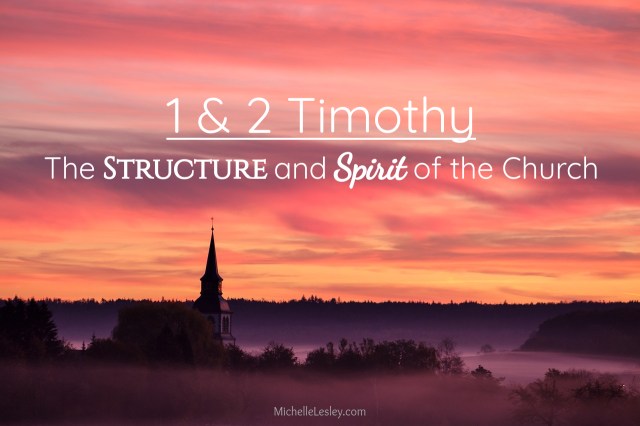
Welcome to our new study, 1 & 2 Timothy: The Structure and Spirit of the Church!

What is God’s plan for the church? How did He intend for it to be structured and run, and what is His vision for us, His people, as we worship Him and love and care for one another? For the next several weeks we’ll work our way through the books of 1 & 2 Timothy, one of God’s “policy and procedure manuals” for the church, to learn about its organizational skeleton as well as the spirit of its people.

Many thanks to those who worked so hard on their entries for our title pic contest. You ladies were very creative and did some beautiful work! 


Cheryl Toepfer                             Becky McGraw


Patti Green                                    Terri Mobley

In the end, I had such a hard time figuring out how to capture the theme I had in mind for the study – bouncing from one thought to another and discontent with every idea that popped into my mind – that I decided to design the title pic myself. (If there’s a chance I might end up dissatisfied, I’d rather be dissatisfied with my own work than the work of one of you lovely ladies!)

My thought is that the sunrise in this photo conveys the idea of the dawn of the church in history, when 1 & 2 Timothy were written. As the light of God’s instruction “rises” upon the church as they read through these epistles, it clears away the surrounding fog of uncertainty about God’s will and His ways for His people. Also, I really like the colors. :0)

If you’re new to using my Bible studies, just a few housekeeping items and helpful hints:

The studies I’ve written (you can find all of them at the Bible Studies tab at the top of this page) are like “training wheels”. They’re designed to teach you how to study the Bible for yourself and what kinds of questions to ask of the text so that, when you get the hang of it, you won’t have to depend on other people’s books and materials – even mine – any more. To that end, I do not provide answers for the study questions in the studies I’ve written.

My studies are meant to be extremely flexible and self-paced so that you can use them in the way that works best for you. You can do an entire lesson in one day or work on the questions over the course of the week (or longer). You do not need to feel obligated to answer all (or any) of the questions. If the Holy Spirit parks you on one question for several days, enjoy digging deep into that one aspect of the lesson. If He shows you something I haven’t written a question about that captures your attention, dive in and study it! Those are ways the Holy Spirit speaks to us through His Word. This is your time to commune with the Lord, not a school assignment or work project you are beholden to complete in a certain way by a certain deadline.

I will post a new lesson on the blog every Wednesday, so there is nothing to sign up for or commit to. Simply stop by the blog each week, or subscribe to the blog via e-mail to have the lessons delivered to your inbox.

With our last study (Imperishable Beauty) I “beta tested” a Facebook discussion group specific to that study. It was enthusiastically received, but after the first couple of weeks, there was virtually no participation. So with this study, I’ve decided not to put in the extra work of admin-ing a discussion group. You are welcome to form and admin your own discussion group if you like. I will also post the lessons on my own Facebook page each week, and anyone who would like to discuss the lesson can do so in the comments section of those posts.

I use hyperlinks liberallyThe Scriptures for each lesson will be linked either at the beginning of the lesson or in the lesson questions. Whenever you see a word in red, click on it, and it will take you to a Scripture, article, or other resource that will help as you study.

All of the studies I’ve written are suitable for groups or individuals. You are welcome to use them as a Sunday school or Bible study class curriculum (for free) with proper attribution.

You are also welcome to print out any of my Bible studies (or any article I’ve written) for free and make as many copies as you’d like, again, with proper attribution. I’ve explained more about that in this article (3rd section).


Introduction to 1 Timothy

Before we begin studying a book of the Bible, it’s very important that we understand some things about that book. We need to know…

Who the author was and anything we might be able to find out about him or his background.

Who the audience of the book is: Jews or Gentiles? Old Testament Israelites or New Testament Christians? This will help us understand the author’s purpose and approach to what he’s writing.

What kind of biblical literature we’re looking at. We approach books of history differently than books of wisdom, books of wisdom differently than books of prophecy, etc.

What the purpose of the book is. Was it written to encourage? Rebuke? Warn?

What the historical backdrop is for the book. Is Israel at war? At peace? In exile? Under a bad king? Good king? Understanding the historical events surrounding a piece of writing help us understand what was written and why it was written.

When the book was written. Where does the book fall on the timeline of biblical history? This is especially important for Old Testament books which are not always arranged in chronological order.

So this week, before we start studying the actual text of the book of 1 Timothy, we need to lay the foundation to understanding the book by finding the answers to these questions.

Read the following overviews of the book of 1 Timothy, taking notes on anything that might aid your understanding of the book, and answer the questions below:

Bible Introductions: 1 Timothy at Grace to You

Overview of the Book of 1 Timothy at Reformed Answers

Book of 1 Timothy at Got Questions

1. Who wrote the book of 1 Timothy? How do we know this?

2. Approximately when was 1 Timothy written? What is the geographical setting of the book of 1 Timothy? Here are some maps (scroll down to “1 Timothy”) that may be helpful as you study through the book of 1 Timothy.

3. Who is the original, intended audience of the book of 1 Timothy? Describe the historical setting (historic events, politics, sociology of the time, etc.) of 1 Timothy.

4. Which genre of biblical literature is the book of 1 Timothy: law, history, wisdom, poetry, narrative, epistles, or prophecy/apocalyptic? What does this tell us about the approach we should take when studying this book versus our approach to books of other genres?

5. What is the theme or purpose of the book of 1 Timothy?

6. What are some of the major topics of instruction in the book of 1 Timothy? How do these topics relate to the theme of 1 Timothy?

7. What are some ways 1 Timothy points to and connects to Jesus?

8. What else did you learn about 1 Timothy or the setting of this book that might help you understand the text of the book better?

Take some time in prayer this week to begin preparing your heart for this study. What are some ways your pastor and church could be encouraged by the instruction of 1 Timothy? What might you learn that could make you a healthier church member? Do you have any areas that need improvement when it comes to the way you serve God or your brothers and sisters in Christ? Ask God to grow you in those areas as we study together 1 & 2 Timothy: The Structure and Spirit of the Church.

Favorite Finds

Favorite Finds ~ April 9, 2019

Here are a few of my favorite recent online finds…

In February’s edition of Favorite FindsI mentioned that I was hoping to have the opportunity to see the movie  Patterns of Evidence: The Moses Controversy, which was in theaters in mid-March. Well, life intervened and I wasn’t able to get to the theater when it was playing, so I guess I’ll have to wait for it to come out on Netflix or something. Did you see the movie? What did you think of it? I’d love to hear a little feedback…or maybe you’d like to write a review of the movie as a guest post?


“I’m not sad that I’m not and couldn’t be a church planter or lead pastor. I don’t feel restricted or resentful. Instead, I feel full.” I always appreciate the voices of sisters in Christ who are leading unashamedly under the banner of strong, biblical complementarianism. Complementarianism is a blessing, not a burden, so I really enjoyed Whitney Woollard’s* article Delighting in Authority: How to Create a Culture of Happy Complementarians over at Eternal Perspectives Ministry.


Go Back to the Local Church“…since loving Christ entails loving the Church; it’s time for you now to heed the summons of God’s Word and go back into a local church, a local expression of the Body of Christ.” I really appreciate Jennifer Brogdon’s* gentle and compassionate approach to encouraging wounded saints to go back to church (especially compared to my usual “bull in a china shop” treatment of the same topic) in her article Go Back to the Local Church.


Image result for life in four stages

Who’s in the mood for a free book? Here’s a PDF copy of Al Mohler’s Life in Four Stages: A Biblical Celebration of Childhood, Youth, Adulthood and Age.


Want to study the Ten Commandments? Here’s a free  devotional excerpted from Kevin DeYoung’s book, The Ten Commandments: What They Mean, Why They Matter, and Why We Should Obey Them.


If you’re looking for great listening and reading material, you cannot go wrong with Steve Lawson. I highly recommend him. Here’s an excerpt from his sermon It Will Cost You Everything. (Subtitles in various languages available.)


*I’m not very familiar with these writers or all the content at these blogs. I do not endorse anything you might find at these sites that conflicts with my theology as outlined at the Welcome and Statement of Faith tabs at the top of this page.
Mailbag

The Mailbag: Potpourri (Quickievangelism, the CRCNA, JMac on the mark of the beast…)

Welcome to another “potpourri” edition of The Mailbag, where I give short(er) answers to several questions rather than a long answer to one question. I also like to take the opportunity in these potpourri editions to let new readers know about my comments/e-mail/messages policy. I’m not able to respond individually to most e-mails and messages, so here are some helpful hints for getting your questions answered more quickly. Remember, the search bar can be a helpful tool!

In these potpourri editions of The Mailbag, I’d also like to address the three questions I’m most commonly asked:

“Do you know anything about [Christian pastor/teacher/author] or his/her materials? Is he/she doctrinally sound?”

Try these links: 
Popular False Teachers /
 Recommended Bible Teachers / search bar
Is She a False Teacher? 7 Steps to Figuring It Out on Your Own
(Do keep bringing me names, though. If I get enough questions about a particular teacher, I’ll probably write an article on her.)

“Can you recommend a good women’s Bible study?”

No. Here’s why:
The Mailbag: Can you recommend a good Bible study for women/teens/kids?
The Mailbag: “We need to stop relying on canned studies,” doesn’t mean, “We need to rely on doctrinally sound canned studies.”.

“You shouldn’t be warning against [popular false teacher] for [X,Y,Z] reason!”

Answering the Opposition- Responses to the Most Frequently Raised Discernment Objections


Yesterday at the store I had a hard time with witnessing to someone. I’m pretty sure it’s because I was only there for a total of 3 minutes. My question is, how do I witness to someone in such a short time?

It brings me so much joy to hear that you are out there sharing the gospel!

I would recommend using tracts. That way if your time with the person gets cut short, you can give them the gospel “to go”.

I use Bezeugen Tract Club tracts. If you join their “tract club”, they will send you 30 free tracts a month. They are the size of a business card, so they’re really convenient to carry in your purse.

Living Waters also has a great selection of tracts. And, while they’re not exactly tracts, Wretched has some very good online evangelism resources and is currently offering a free evangelistic booklet (you pay only shipping/handling) for giveaways at outreach events.

Keep up the great work of sharing the good news of the gospel!


Is the Christian Reformed Church a church that teaches sound doctrine?

It’s always good to do our due diligence when considering a new church or denomination, so this is a super question.

The Christian Reformed Church in North America is a rather small denomination (230,000 people in membership) that I’m not very familiar with, so I went poking around their website.

There are a lot of things that look very encouraging, doctrinally about the CRCNA. They affirm the Apostles’, Nicene, and Athanasian Creeds as well as the Belgic Confession, the Heidelberg Catechism, and the Canons of Dort. The plan of salvation presented on the website is biblical. In fact, most of what I read at the CRCNA website seemed solid.

However, a few red flags jumped out at me as I explored the site:

🚩 The heavy emphasis on “justice”. There’s something about “justice” on nearly every page of the site. Certainly Christians should uphold biblical justice, but many churches and denominations today have bought into the secular social justice movement, which is decidedly unbiblical, as it promotes feminism, normalization of sexual perversion, and unbiblical methods of addressing issues like racism, immigration, poverty, etc. It appears that the CRCNA at least leans in the direction of the social justice movement.

🚩 The role of women in the church. The CRCNA’s position reads: 

All congregations in the Christian Reformed Church in North America may allow women to serve in the office of minister, elder, deacon, or commissioned pastor. The CRC recognizes that there are two different perspectives and convictions on this issue, both of which honor the Scriptures as the infallible Word of God…

This is unbiblical, not to mention self-contradictory. Either Scripture allows women to serve in these capacities or it does not. (And it clearly does not.) Both positions cannot be true at the same time. If a church adopts the unbiblical position, it is not “honoring the Scriptures as the infallible Word of God.”

🚩 Some of the CRCNA’s position statements have a “squishy”, progressive, or blatantly unbiblical tilt rather than an unflagging commitment to Scripture. For example:

Creation care (environmentalism): “We are compelled to address human-induced climate change as an ethical, social justice, and religious issue…”

Ecumenicity (unity with other churches): “[The CRCNA] also wishes to engage churches of other traditions such as…the Roman Catholic Church, and Orthodox churches.” (Catholicism and the major Orthodox traditions hold many unbiblical views including an unbiblical soteriology. Scripture forbids Christians from unifying with such organizations.)

Homosexuality: “Homosexuality [is] a condition of personal identity in which a person is sexually oriented toward persons of the same sex…for which the person may bear only a minimal responsibility…The church should do everything in its power to help persons with same-sex orientation and give them support toward healing and wholeness.” (Homosexuality is not a “condition of personal identity” any more than adultery or thievery is. It is a sin that the person is just as responsible for as the adulterer or thief is for his sin. We would not speak in terms of “support toward healing and wholeness” for an adulterer or a thief, we would speak in terms of repentance and mortification of sin, just as we should speak when someone’s sin of choice is homosexuality.)

Pentecostalism (charismaticism, sign gifts, etc.): “Acknowledge the gift of prophecy today…Think of prayer as a dialogue, not a monologue, and be attentive to what God is saying as you pray…be willing to engage in scripturally sound deliverance ministry against demonic powers…”

If you are considering attending or joining one of the CRCNA churches which does not allow women to serve in unbiblical roles, I would recommend setting up an appointment with the pastor to carefully and seriously discuss these issues at length, along with any other questions you may have. If you have the option of joining with a non-CRCNA church that has a more solidly biblical stance on these issues than your local CRCNA church, I would encourage you to go with the non-CRCNA church.


John MacArthur has said, that it’s possible to take the mark of the beast and still be saved? I notice that you endorse him, do you believe this is correct? 

I think a lot of people have stretched what Dr. MacArthur said wildly out of context and out of proportion. So the first issue here is to make sure you have a clear understanding of what he actually said and meant from Dr. MacArthur himself, not from random bloggers or people on YouTube. You can read Dr. MacArthur’s position statement on this issue (written by spokesman Phil Johnson) here.

As for my opinion on Dr. MacArthur’s position, I think it’s biblical and well-reasoned, but this particular issue – as with most detail-oriented eschatological issues – is not something I feel compelled to expend much time and energy on. When Christ returns, events will unfold as laid out in Scripture. Until then, we have a limited understanding of what will transpire and the order in which things will transpire, and much of what constitutes eschatology today is educated guessing. I think it is much more fruitful to spend our time evangelizing the lost and discipling the saved so that the church will be spiritually ready for the return of Christ. Whatever may happen in the days surrounding His return, we know that none of His sheep will be lost.


Since my last “potpourri” edition of The Mailbag, I’ve heard back from two of the readers whose questions I addressed, and I wanted to share their responses with you:

From the discouraged husband I asked you to pray for:

I am extremely encouraged by the people who are stepping forward and praying for me…Thank you for your encouragement and prayers. They reach into the darkest places and are invaluable.

From the lady needing help with her nursing home ministry:

Thank you Michelle for answering, I’ve been thinking of finding a church. I have to be truthful, it wasn’t the answer I was hoping for, but it is the answer I think I needed.


If you have a question about: a Bible passage, an aspect of theology, a current issue in Christianity, or how to biblically handle a family, life, or church situation, comment below (I’ll hold all questions in queue {unpublished} for a future edition of The Mailbag) or send me an e-mail or private message. If your question is chosen for publication, your anonymity will be protected.
Mailbag

The Mailbag: MLM-ing Essential Oils at Church

Originally published March 26, 2018

Our church has recently had a visitor come who is now promoting essential oils to the women who are flocking to a class she is having in one of their homes. This makes me very uncomfortable as it appears (to me) that she has visited to increase her MLM [multi-level marketing] customer base while touting medicinal cures via essential oils. Do you have any research on this?

Sounds like a multi-level mess! There are several different issues going on here, so let’s dig in…

Cold-calling at church
Um, no. I mean… OK, I’m just going to go there. Have you no shame? Have you no home training? I don’t care how much of a go-getter saleswoman you are, there are some lines you just don’t cross. And I can’t believe I’m actually having to explain to grown up, adult people that you don’t go church hopping to make sales and recruit people to work for you. What’s next, showing up at funerals to sell Avon? Pampered Chef demonstrations at wedding receptions?

Church is the place where a local body of Believers gathers to worship the almighty God of the universe. How dare anyone sully the Bride of Christ it by making it something as low and common as a networking site for her business! If you are visiting a church, you should be doing so to worship, not for any other reason. Jesus made that really clear.

Depending on how blatant, intrusive, and disruptive the visitor’s behavior at your church is, someone – preferably one of the women in the class that the visitor is close to, but if not, possibly an elder or the pastor – may need to pull her aside and firmly, yet lovingly, explain that she is welcome to come to church to worship, but not to hustle.

Multi-Level Members
The reader who sent in the question asked about someone who’s visiting her church, but I want to take a moment to speak to you ladies who are MLM-ing your own church.

Your fellow church members might be uncomfortable telling you this, so I’m going to do so on their behalf: Some of you are going too far and being too pushy with your businesses. And you’re putting your brothers and sisters in the no-win situation of either having to acquiesce to the pressure you’re putting on them or hurt your feelings by telling you no.

It’s certainly fine to tell people at church what your job is when they ask, but leave the ball in their court:

“What do you do?”

“I’m an independent sales consultant for Fancy Widgets.”

“Oh? That sounds great!”

“Yeah, it’s an awesome company. I love it! If you’d ever be interested in working with us or adding to your widget collection, just let me know. Want some coffee?”

And don’t bring it up again. She knows you’re her Fancy Widgets connection. If she wants something, she’ll find you.

If you leave it at that and you end up having a few people at church who want to order from you, it’s certainly OK to discreetly take orders from them or bring their products to them at church after services are over. It’s fine for people to approach you about your business, but don’t repeatedly ask people at church to host parties, invite people from church to parties others are hosting for you, attempt to recruit people, or push products. That’s a distraction from worship and fellowship, it gets on people’s nerves, and it will eventually end up alienating your church family.

Scientifically proven?
I don’t have much experience with essential oils, but it’s my understanding that some essential oils can help alleviate the symptoms of some ailments in some people. In other words, peppermint oil may work wonders on your migraine, but do nothing for mine. As long as the limits of the powers of the essential oils are made clear along with the potential benefits, there’s no problem. If the visitor is making snake oil-type promises that the essential oils don’t deliver on, that’s lying and she needs to be confronted about it. If it gets to that point, you need to let your pastor or elders know what’s going on in case she doesn’t stop and one of them ends up having to deal with her.

Essential Oils and New Age Spirituality
Some (not all) essential oils companies claim that their oils will bring about spiritual benefits in addition to (or instead of) physiological benefits. While it’s fine to say that a little lavender oil in your bath will help relax you, saying that it will balance your chakras or yin your yang or bring you inner peace and confidence or whatever is crossing the line into unbiblical (usually New Age) spirituality. No Christian should have anything to do with buying or selling such essential oils. If there’s someone in your church who’s promoting a company like that at church, that’s a church discipline issue, because she’s introducing false doctrine into the church.

Marcia Montenegro over at Christian Answers for the New Age has published numerous posts on the problems with New Age spirituality and essential oils.


If you have a question about: a Bible passage, an aspect of theology, a current issue in Christianity, or how to biblically handle a family, life, or church situation, comment below (I’ll hold all questions in queue {unpublished} for a future edition of The Mailbag) or send me an e-mail or private message. If your question is chosen for publication, your anonymity will be protected.