Favorite Finds

Favorite Finds ~ April 9, 2019

Here are a few of my favorite recent online findsโ€ฆ

In February’s edition ofย Favorite Finds,ย I mentioned that I was hoping to have the opportunity to see the movie ย Patterns of Evidence: The Moses Controversy, which was in theaters in mid-March. Well, life intervened and I wasn’t able to get to the theater when it was playing, so I guess I’ll have to wait for it to come out on Netflix or something. Did you see the movie? What did you think of it? I’d love to hear a little feedback…or maybe you’d like to write a review of the movie as a guest post?


“Iโ€™m not sad that Iโ€™m not and couldnโ€™t be a church planter or lead pastor. I donโ€™t feel restricted or resentful. Instead, I feel full.”ย I always appreciate the voices of sisters in Christ who are leading unashamedly under the banner of strong, biblical complementarianism. Complementarianism is a blessing, not a burden, so I really enjoyed Whitney Woollard’s*ย article Delighting in Authority: How to Create a Culture of Happy Complementarians over at Eternal Perspectives Ministry.


Go Back to the Local Church“…since loving Christ entails loving the Church; itโ€™s time for you now to heed the summons of Godโ€™s Word and go back into a local church, a local expression of the Body of Christ.”ย I really appreciateย Jennifer Brogdon’s*ย gentle and compassionate approach to encouraging wounded saints to go back to church (especially compared to my usual “bull in a china shop” treatment of the same topic) in her article Go Back to the Local Church.


Image result for life in four stages

Who’s in the mood for a free book? Here’s a PDF copy of Al Mohler’sย Life in Four Stages: A Biblical Celebration of Childhood, Youth, Adulthood and Age.


Want to study the Ten Commandments? Here’s aย freeย  devotional excerpted from Kevin DeYoung’s book, The Ten Commandments: What They Mean, Why They Matter, and Why We Should Obey Them.


If you’re looking for great listening and reading material, you cannot go wrong with Steve Lawson. I highly recommend him. Here’s an excerpt from his sermon It Will Cost You Everything. (Subtitles in various languages available.)


*I’m not very familiar with these writers or all the content at these blogs. I do not endorse anything you might find at these sites that conflicts with my theology as outlined at the Welcome and Statement of Faith tabs at the top of this page.
Mailbag

The Mailbag: Potpourri (Quickievangelism, the CRCNA, JMac on the mark of the beast…)

Welcome to another โ€œpotpourriโ€ edition ofย The Mailbag, where I give short(er) answers to several questions rather than a long answer to one question. I also like to take the opportunity in these potpourri editions to let new readers know about my comments/e-mail/messages policy. Iโ€™m not able to respond individually to most e-mails and messages, so here are someย helpful hintsย for getting your questions answered more quickly.ย Remember, the search bar can be a helpful tool!

In these potpourri editions of The Mailbag, I’d also like to address the three questions I’m most commonly asked:

“Do you know anything about [Christian pastor/teacher/author] or his/her materials? Is he/she doctrinally sound?”

Try these links:ย 
Popular False Teachersย /
ย Recommended Bible Teachersย /ย search bar
Is She a False Teacher? 7 Steps to Figuring It Out on Your Own
(Do keep bringing me names, though. If I get enough questions about a particular teacher, I’ll probably write an article on her.)

“Can you recommend a good women’s Bible study?”

No. Here’s why:
The Mailbag: Can you recommend a good Bible study for women/teens/kids?
The Mailbag: โ€œWe need to stop relying on canned studies,โ€ doesnโ€™t mean, โ€œWe need to rely on doctrinally sound canned studies.โ€.

“You shouldn’t be warning against [popular false teacher] for [X,Y,Z] reason!”

Answering the Opposition- Responses to the Most Frequently Raised Discernment Objections


Yesterday at the store I had a hard time with witnessing to someone. I’m pretty sure it’s because I was only there for a total of 3 minutes. My question is, how do I witness to someone in such a short time?

It brings me so much joy to hear that you are out there sharing the gospel!

I would recommend using tracts. That way if your time with the person gets cut short, you can give them the gospel “to go”.

I use Bezeugen Tract Club tracts. If you join their “tract club”, they will send you 30 free tracts a month. They are the size of a business card, so they’re really convenient to carry in your purse.

Living Waters also has a great selection of tracts. And, while they’re not exactly tracts,ย Wretched has some very good online evangelism resources and is currently offering aย free evangelistic booklet (you pay only shipping/handling) for giveaways at outreach events.

Keep up the great work of sharing the good news of the gospel!


Is the Christian Reformed Church a church that teaches sound doctrine?

It’s always good to do our due diligence when considering a new church or denomination, so this is a super question.

The Christian Reformed Church in North America is a rather small denomination (230,000 people in membership) that I’m not very familiar with, so I went poking around their website.

There are a lot of things that look very encouraging, doctrinally about the CRCNA. They affirm the Apostlesโ€™, Nicene, and Athanasian Creeds as well as the Belgic Confession, the Heidelberg Catechism, and the Canons of Dort. The plan of salvation presented on the website is biblical. In fact, most of what I read at the CRCNA website seemed solid.

However, a few red flags jumped out at me as I explored the site:

๐Ÿšฉ The heavy emphasis on “justice”. There’s something about “justice” on nearly every page of the site. Certainly Christians should uphold biblical justice, but many churches and denominations today have bought into the secularย social justice movement, which is decidedlyย unbiblical, as it promotes feminism, normalization of sexual perversion, and unbiblical methods of addressing issues like racism, immigration, poverty, etc. It appears that the CRCNA at least leans in the direction of the social justice movement.

๐Ÿšฉ The role of women in the church. The CRCNA’s position reads:ย 

All congregations in the Christian Reformed Church in North America may allow women to serve in the office of minister, elder, deacon, or commissioned pastor. The CRC recognizes that there are two different perspectives and convictions on this issue, both of which honor the Scriptures as the infallible Word of God…

This is unbiblical, not to mention self-contradictory. Either Scripture allows women to serve in these capacities or it does not. (And it clearly does not.) Both positions cannot be true at the same time. If a church adopts the unbiblical position, it is not “honoring the Scriptures as the infallible Word of God.”

๐Ÿšฉ Some of the CRCNA’s position statements have a “squishy”, progressive, or blatantly unbiblical tilt rather than an unflagging commitment to Scripture. For example:

Creation care (environmentalism): “We are compelled to address human-induced climate change as an ethical, social justice, and religious issue…โ€

Ecumenicity (unity with other churches): “[The CRCNA]ย also wishes to engage churches of other traditions such as…the Roman Catholic Church, and Orthodox churches.”ย (Catholicism and the major Orthodox traditions hold many unbiblical views including an unbiblical soteriology. Scripture forbids Christians from unifying with such organizations.)

Homosexuality: “Homosexuality [is] a condition of personal identity in which a person is sexually oriented toward persons of the same sex…for which the person may bear only a minimal responsibility…The church should do everything in its power to help persons with same-sex orientation and give them support toward healing and wholeness.”ย (Homosexuality is not a “condition of personal identity” any more than adultery or thievery is. It is a sin that the person is just as responsible for as the adulterer or thief is for his sin. We would not speak in terms of “support toward healing and wholeness” for an adulterer or a thief, we would speak in terms of repentance and mortification of sin, just as we should speak when someone’s sin of choice is homosexuality.)

Pentecostalism (charismaticism, sign gifts, etc.):ย “Acknowledge the gift of prophecy today…Think of prayer as a dialogue, not a monologue, and be attentive to what God is saying as you pray…be willing to engage in scripturally sound deliverance ministry against demonic powers…”

If you are considering attending or joining one of the CRCNA churches which does not allow women to serve in unbiblical roles, I would recommend setting up an appointment with the pastor to carefully and seriously discuss these issues at length, along with any other questions you may have. If you have the option of joining with a non-CRCNA church that has a more solidly biblical stance on these issues than your local CRCNA church, I would encourage you to go with the non-CRCNA church.


John MacArthur has said, that it’s possible to take the mark of the beast and still be saved? I notice that you endorse him, do you believe this is correct?ย 

I think a lot of people have stretched what Dr. MacArthur said wildly out of context and out of proportion. So the first issue here is to make sure you have a clear understanding of what he actually said and meant from Dr. MacArthur himself, not from random bloggers or people on YouTube. You can read Dr. MacArthur’s position statement on this issue (written by spokesman Phil Johnson) here.

As for my opinion on Dr. MacArthur’s position, I think it’s biblical and well-reasoned, but this particular issue – as with most detail-oriented eschatological issues – is not something I feel compelled to expend much time and energy on. When Christ returns, events will unfold as laid out in Scripture. Until then, we have a limited understanding of what will transpire and the order in which things will transpire, and much of what constitutes eschatology today is educated guessing. I think it is much more fruitful to spend our time evangelizing the lost and discipling the saved so that the church will be spiritually ready for the return of Christ. Whatever may happen in the days surrounding His return, we know that none of His sheep will be lost.


Since my last “potpourri” edition ofย The Mailbag,ย I’ve heard back from two of the readers whose questions I addressed, and I wanted to share their responses with you:

From the discouraged husband I asked you to pray for:

I am extremely encouraged by the people who are stepping forward and praying for me…Thank you for your encouragement and prayers. They reach into the darkest places and are invaluable.

From the lady needing help with her nursing home ministry:

Thank you Michelle for answering, Iโ€™ve been thinking of finding a church. I have to be truthful, it wasnโ€™t the answer I was hoping for, but it is the answer I think I needed.


If you have a question about: a Bible passage, an aspect of theology, a current issue in Christianity, or how to biblically handle a family, life, or church situation, comment below (Iโ€™ll hold all questions in queue {unpublished} for a future edition ofย The Mailbag) or send me anย e-mail or private message. If your question is chosen for publication, your anonymity will be protected.

Mailbag

The Mailbag: MLM-ing Essential Oils at Church

Originally published March 26, 2018

Our church has recently had a visitor come who is now promoting essential oils to the women who are flocking to a class she is having in one of their homes. This makes me very uncomfortable as it appears (to me) that she has visited to increase her MLM [multi-level marketing] customer base while touting medicinal cures via essential oils. Do you have any research on this?

Sounds like a multi-level mess! There are several different issues going on here, so let’s dig in…

Cold-calling at church
Um, no. I mean… OK, I’m just going to go there. Have you no shame? Have you no home training? I don’t care how much of a go-getter saleswoman you are, there are some lines you just don’t cross. And I can’t believe I’m actually having to explain to grown up, adult people that you don’t go church hopping to make sales and recruit people to work for you. What’s next, showing up at funerals to sell Avon? Pampered Chef demonstrations at wedding receptions?

Church is the place where a local body of Believers gathers to worship the almighty God of the universe. How dare anyone sully the Bride of Christ it by making it something as low and common as a networking site for her business! If you are visiting a church, you should be doing so toย worship, not for any other reason. Jesus made that really clear.

Depending on how blatant, intrusive, and disruptive the visitor’s behavior at your church is, someone – preferably one of the women in the class that the visitor is close to, but if not, possibly an elder or the pastor – may need to pull her aside and firmly, yet lovingly, explain that she is welcome to come to church to worship, but not to hustle.

Multi-Level Members
The reader who sent in the question asked about someone who’s visiting her church, but I want to take a moment to speak to you ladies who are MLM-ing your own church.

Your fellow church members might be uncomfortable telling you this, so I’m going to do so on their behalf: Some of you are going too far and being too pushy with your businesses. And you’re putting your brothers and sisters in the no-win situation of either having to acquiesce to the pressure you’re putting on them or hurt your feelings by telling you no.

It’s certainly fine to tell people at church what your job is when they ask, but leave the ball in their court:

“What do you do?”

“I’m an independent sales consultant for Fancy Widgets.”

“Oh? That sounds great!”

“Yeah, it’s an awesome company. I love it! If you’d ever be interested in working with us or adding to your widget collection, just let me know. Want some coffee?”

And don’t bring it up again. She knows you’re her Fancy Widgets connection. If she wants something, she’ll find you.

If you leave it at that and you end up having a few people at church who want to order from you, it’s certainly OK to discreetly take orders from them or bring their products to them at churchย afterย services are over.ย It’s fine for people to approach you about your business, but don’t repeatedly ask people at church to host parties, invite people from church to parties others are hosting for you, attempt to recruit people, or push products. That’s a distraction from worship and fellowship, it gets on people’s nerves, and it will eventually end up alienating your church family.

Scientifically proven?
I don’t have much experience with essential oils, but it’s my understanding that some essential oils can help alleviate the symptoms of some ailments in some people. In other words, peppermint oil may work wonders on your migraine, but do nothing for mine. As long as the limits of the powers of the essential oils are made clear along with the potential benefits, there’s no problem. If the visitor is making snake oil-type promises that the essential oils don’t deliver on, that’s lying and she needs to be confronted about it. If it gets to that point, you need to let your pastor or elders know what’s going on in case she doesn’t stop and one of them ends up having to deal with her.

Essential Oils and New Age Spirituality
Some (not all) essential oils companies claim that their oils will bring about spiritual benefits in addition to (or instead of) physiological benefits. While it’s fine to say that a little lavender oil in your bath will help relax you, saying that it will balance your chakras or yin your yang or bring you inner peace and confidence or whatever is crossing the line into unbiblical (usually New Age) spirituality. No Christian should have anything to do with buying or selling such essential oils. If there’s someone in your church who’s promoting a company like that at church, that’s a church discipline issue, because she’s introducing false doctrine into the church.

Marcia Montenegro over at Christian Answers for the New Age has published numerous posts on the problems with New Age spirituality and essential oils.


If you have a question about: a Bible passage, an aspect of theology, a current issue in Christianity, or how to biblically handle a family, life, or church situation, comment below (Iโ€™ll hold all questions in queue {unpublished} for a future edition ofย The Mailbag) or send me anย e-mail or private message. If your question is chosen for publication, your anonymity will be protected.

Church, Mailbag

The Mailbag: How can I tell if a church is doctrinally sound?


How do I know if a church is doctrinally sound? Do I base it off their statement of faith?

This is such a great question in a day when you can’t really trust that a building with the word “church” on the sign out front actually teaches and practices sound doctrine.

Because it would be impossible to cover every single aspect of doctrine that churches need to handle biblically, and because many of my readers are new to some of the deeper points of theology, what I want to do is give you some “signposts” to look for as you’re checking out a new church that will help indicate whether or not that particular church is likely to be one that handles those harder to understand points of theology in a doctrinally sound way.

First, check out these resources under “What to look for in a church” at my Searching for a new church?ย tab at the top of this page. These should be helpful if you’re unfamiliar with the biblical issues that a church should be handling correctly:

What to look for in a church

How Can I Find a Good Church? 

Finding a New Church: Starting from Scratch

Six Questions for a Potential Church

Nine Reasons Discerning Women Are Leaving Your Church

Six Ways Not to Forsake the Assembly

7 Reasons Church is Not Optional and Non-Negotiable for Christians

What the Bible Says About Church Membership

A Word Fitly Spoken Podcast: Is This Church for You? with Michelle Lesley and Amy Spreeman

Church Shopping? 35 Key Questions to Ask the Church at Berean Research

Looking for a Church Home? at Challies, by Don Whitney

#008: Church Shopping? Factors To Consider When Choosing Which Church To Join at Cage Free Theology


What Should I Look For In A Church? John MacArthur answers with Jonny Ardavanis

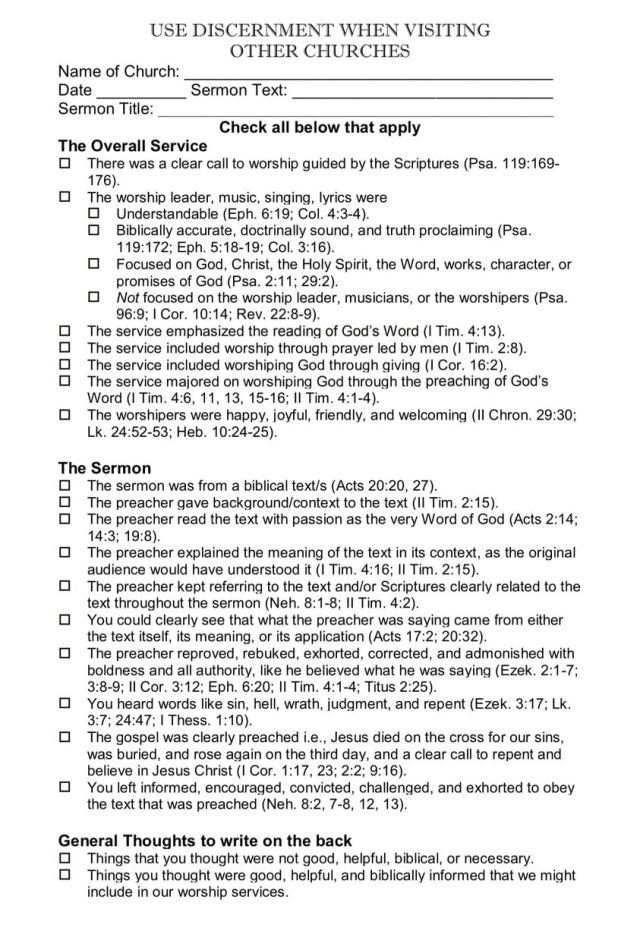
Hereโ€™s a handy evaluation sheet created by Dr. Jack Hughes. Use it when you visit a potential church to determine whether or not itโ€™s worth pursuing. (Save the photo and print it out, or type the questions into your own document.)

If you are a brand new Christian and you aren’t sure what the answers to the questions in these articles should be, ask the person who led you to Christ, a pastor you know to be biblically trustworthy, or a friend who’s a mature Christian to help. You can also use the search bar at the top of this page to see if I’ve addressed your question. And, make liberal use of Got Questions? It’s a wonderful website that gives simple, biblical answers to all kinds of questions about the Bible, church, theology and other issues.

A church’s stance on many of these theological issues can be found in their statement of faith, which most churches post on their websites (often under the heading “What We Believe,” “Doctrinal Distinctives,” or something similar). While you’re on the church website, here are some other things to look for that can give you a fuller picture of whether or not the church is likely to be doctrinally sound.

โ›ช Be wary of a church with no statement of faith on their website at all, and be cautious if they have a very simplistic statement of faith with few or no Bible verses cited to support it. Generally speaking, in my experience, the longer and more detailed a statement of faith is, and the more Scripture references it has, the more likely it is to be a doctrinally sound church.

โ›ช A few things to look for in the statement of faith:

โ€ขThe Trinity: You’re looking for language along the lines of, “We believe in one God in three persons.” If you see three “modes” or three “manifestations,” that’s the language of modalism, and it is not a doctrinally sound church.

โ€ขSome churches have a section of their statement of faith on spiritual gifts or the Holy Spirit and include wording indicating whether they are a continuationist (ex: “we believe all the spiritual gifts are in operation in the church today”) or cessationist (ex: “we believe God has ceased giving supernatural gifts such as healing and tongues to individual Christians”) church. Generally speaking, a church is more likely to be doctrinally sound if it holds the cessationist view. (No, I amย notย saying every continuationist church is heretical. I’m strictly talking probabilities here.) If there is anything in the statement of faith that indicates that a Believer will or mustย speak in tongues in order to be saved or as a result of salvation, or that the “baptism of the Holy Spirit” occurs separately from salvation, it is not a doctrinally sound church.

โ€ขSome churches intentionally indicate that they are complementarian in the “Marriage and Family” or “Church Leadership” section of their statement of faith by stating that the husband leads the family and the wife submits to her husband, or by explaining that the roles of pastor and elder are limited to men. It’s usually a good sign when a church makes a point of saying these things. A church that indicates it’s egalitarian is not doctrinally sound.

โ›ช If you find the pastor’s name listed here, it’s not a doctrinally sound church.

โ›ช If a church subscribes to a creed/confession/catechism you know to be biblical (ex: 1689 London Baptist, Westminster, Heidelberg, etc.) there’s a better chance they’re a doctrinally sound church. 

โ›ช Some churches have a page on their website where they recommend books, blogs, and other resources. If they’re recommending doctrinally sound materials by trustworthy authors and teachers (click here for a few), that can be a good sign. Conversely, if they’re recommending materials by authors and teachers listed here, that’s a bad sign.

โ›ช If they have a women’s ministry page, check out who’s speaking at the next conference they’re going to and who is the author of the Bible study materials they use.

โ›ช Check the staff page and make sure they don’t have women serving as pastors/elders. (Be aware that some churches are now using titles like “Coach,” “Director,” “Facilitator,” etc. to disguise the fact that women are serving in unbiblical positions of leadership. Regardless of the way the position title is worded, women are not to serve in pastoral or elder offices or in any position in which they will be teaching or exercising authority over men.)

โ›ช Check the sermon archives for a couple of things: 1) to see if they invite women or false teachers as guest preachers, and 2) does the pastor preach mainly expositorily or topically? Listen to several sermons to familiarize yourself with his style and presentation.

โ›ช Some churches post videos of their entire worship service on YouTube, Vimeo, or Facebook. This is also a good way to listen to sermons and to discover whether or not women are unbiblically leading parts of the worship service.

Additionally, videos of the entire worship service allow you to find out about the church’s music. Be extremely cautious of churches who use music from Bethel, Hillsong, Elevation, Phil Wickham, Brandon Lake, and other heretical sources, particularly if they also darken the sanctuary and what you’re seeing looks more like a rock concert than an orderly, reverent worship service. Churches that leave the lights on, sing hymns and worship songs from doctrinally sound sources, and are led by a minister of music rather than a band or someone who reminds you of a rock star are much more likely to be doctrinally sound.

Keep in mind, however, that there are lots of churches out there who look perfectly doctrinally sound “on paper,” or even on video, but are not practicing what their website or woship service videos preach. Take a look at these statements of faith for example: Lakewood (Joel Osteen), North Point (Andy Stanley), and Bethel (Bethel). On the surface, and especially to those newly saved or not very familiar with the Bible, these statements of faith look fairly decent (although…notice that few to no Scriptures are listed, and they are short and/or somewhat vague), but the practices of these churches may be surprising in comparison.

Because churches’ practices and teachings often differ – sometimes significantly – from what you see in their statement of faith, you’ll have to dig deeper in order to get a better feel for the church’s doctrine. Make an appointment to go in and talk to the pastor about what the church teaches and ask any questions you might have. And visit the church for a while before joining to see how things actually go. The most a church website can do is help you weed out the churches that are definitely bad. A church website cannot tell you that a church is definitely good.

If you’re looking for a new church but you aren’t sure where to start, check the church search engines and churches recommended by my readers at the Searching for a new church?ย tab at the top of this page.


If you have a question about: a Bible passage, an aspect of theology, a current issue in Christianity, or how to biblically handle a family, life, or church situation, comment below (Iโ€™ll hold all questions in queue {unpublished} for a future edition of The Mailbag) or send me an e-mail or private message. If your question is chosen for publication, your anonymity will be protected.

Sanctification

Watch Your Language! 10 Christian Terms that Need to be Cleaned Up

For the next several weeks I’ll be preparing to speak at the
Relying on God and His Wordย conference, so I’ll be re-running
some popular articles from the archives. I hope you’ll enjoy this one.

Originally published August 25, 2017

What would you think of a surgeon who forgot to take his scalpel to work one day and decided his pocketknife would be an adequate substitute? Or a chef who ran out of vanilla and figured peppermint extract would work just fine in its place? At the very least, youโ€™d probably think he was being a little sloppy and careless – not putting enough thought into his work. At worst, he could injure, sicken, or kill somebody.



When it comes to our Christian vernacular, we need to make sure weโ€™re using the right word for the right task. โ€œWell, she knows what I meant,โ€ doesnโ€™t cut it these days, as anyone on social media can attest. Sometimes, even as perfectly doctrinally sound Christians, we get a little sloppy with our phraseology, which can, at best, confuse people, and, at worst, defame God. We need to proactively think about the meanings of the words we use and be careful to say what we mean and mean what we say.

Letโ€™s watch our language on these ten terms and phrases and determine to use more precise, God-exalting vocabulary instead:

1. Let or allow God toโ€ฆ
When the doctrinally sound Christians I know say they need to โ€œletโ€ or โ€œallowโ€ God to do something in their lives, they donโ€™t mean: โ€œIโ€™m in charge here, and I call the shots. God can only do what I, as the boss, deign to permit Him to do.โ€ What they mean is, โ€œI need to stop doing things that are displeasing to God and obey His Word because He wants to grow me to greater Christlikeness.โ€ Unfortunately, one of the tenets of Word of Faith and New Apostolic Reformation false doctrine is that Christians are the ones in authority and that God can only do what we allow Him to do. Thatโ€™s blasphemy, and not something we even want to hint at with careless wording. We need to make sure our words communicate that God is in charge and we are His humble servants.

More God-exalting: โ€œI need to submit to Godโ€™s will.โ€ โ€œI need to make sure Iโ€™m not standing in opposition to Godโ€™s work in my life.โ€

2. Accept Jesus or make Jesus Savior/Lord of your life
Again, โ€œacceptโ€ and โ€œmakeโ€ put us in the driverโ€™s seat and leave Jesus a puppet who moves at our whim. Jesus is King. We do not accept Him, He graciously accepts us. We do not โ€œmakeโ€ Him Savior or Lord. He already is Savior and Lord. We throw ourselves upon His mercy to save us and bow the knee to His Lordship.

More God-exalting: โ€œAsk God to save you.โ€ โ€œBelieve the gospel.โ€

3. God said or told me; listen to God
Possibly the most prolific false teaching today is that God regularly speaks to individuals verbally, through dreams and visions, or through signs, outside of Scripture, about the mundane issues of life, despite the fact that God Himselfย tells us He doesn’t speak this way and that His written Word is sufficient for our every need.ย God speaks to us, and we hear Him, through His written Word, the Bible. When we talk about God speaking to us, we need to make sure weโ€™re driving that idea home, not subtly reinforcing the false idea that God is speaking to us outside of Scripture.

More God-exalting:ย โ€œGod tells us in Colossians 3:12โ€ฆโ€ โ€œThe Bible says in Proverbs 13:24…โ€

4. God showed up
No, He didnโ€™t. God has never – in the history of all eternity, nor in eternity yet to come – โ€œshown up.โ€ When we say somebody โ€œshowed up,โ€ the common understanding is that someone arrived on the scene who was not previously present. That has never been, and can never be, true of an eternal, omnipresent God. God has always been present everywhere. Sometimes whatโ€™s actually happening when people say โ€œGod showed upโ€ at church is that they had an emotional response to the music, or experienced a temporary worldy sorrowย over their sin. But when God really doesย seem to โ€œshow up,โ€ whatโ€™s usually the case is that we โ€œshowed upโ€ by prayerfully preparing our hearts for worship, by responding in repentance to the conviction of the Holy Spirit, by taking joy in praising and thanking God, or that God answered prayer or allowed us to see His hand at work in a situation.

More God-exalting: โ€œIt was a wonderful time of worship this morning!โ€ โ€œThank you, God, for letting us see how Youโ€™re working!โ€

5. Tithes and offerings, or offerings over and above the tithe
Tithing, like making animal sacrifices or celebrating Israelโ€™s various feasts and festivals, is an Old Testament law which Jesus fulfilled and is no longer binding on Christians. Godโ€™s instruction to Christians about giving is found in 2 Corinthians 9:7. When we try to impose Old Testament law upon New Testament Christians, we are violating Godโ€™s clear command that Christians are not to give under compulsion. On the other side of the coin (pun intended) merely plunking ten per cent of your earnings into the offering plate voluntarily and thinking youโ€™re good to go with God isnโ€™t right either. We are to follow Christโ€™s example of generosity and self-sacrifice as we minister to the church and others, giving up, if necessary, even our very lives.

More God-exalting: Offerings, gifts, generous giving, sacrificial giving

6. I have a peace about this
Often, this phrase reveals more than simple sloppy wording, it demonstrates that someone is relying more on her feelings, opinions, and experiences than on Godโ€™s Word to determine right from wrong. If thereโ€™s a Bible verse that tells us that a feeling of โ€œpeaceโ€ is what unequivocally confirms that weโ€™re obeying God, I havenโ€™t run across it. Iโ€™ve heard women say they have โ€œa peaceโ€ about leaving their husbands for sinful reasons, or that they have โ€œa peaceโ€ about opting out of church when God clearly commands the opposite.ย The fact of the matter is that our feelings are deceptive. We can have peaceful feelings about things that are ungodly, and anxious feelings even when carrying out the clear commands of Scripture. Scripture is our measuring stick for right and wrong, godly and ungodly, not our feelings.

More God-exalting: โ€œIโ€™m going to obey Godโ€™s Word and trust Him.โ€

7. What do you feel God would have you do?
Christians are not supposed to live our lives guided by our feelings. We are to live lives governed by the authority of Godโ€™s written Word. And itโ€™s important that our vocabulary reflect that by being precise when weโ€™re talking about making decisions. Our feelings are fleeting, fickle, and often false. Whatโ€™s important – and what weโ€™re to base all of our thoughts, words, and actions upon – is, โ€œWhat does Scripture say about this?โ€

More God-exalting: โ€œWhat does the Bible say you should do?โ€ โ€œLetโ€™s pray and ask God for wisdom to rightly apply Scripture to this situation.โ€

8. What is Godโ€™s will for my life?
Frequently, when Christians ask this question, itโ€™s in the context of making a life-altering decision about which college to attend or career to choose, whom to marry, and if, when, and how many children to have. But thatโ€™s not what โ€œGodโ€™s willโ€ means as outlined by Scripture. Godโ€™s will is for Christians to get up every day and walk in obedience to His Word. Thatโ€™s it. Thatโ€™s Godโ€™s will for your life. When it comes to making decisions, we rightly apply Scripture to the situation, pray that God will give us wisdom and direction, and make the most godly decision we can, trusting that the God whoโ€™s completely aware that weโ€™re frail and by no means omniscient, will direct our paths.

More God-exalting: โ€œHow can I walk in obedience to God today?โ€ โ€œGod, please give me wisdom and direct my path in this situation.โ€

9. God canโ€™t ____ unless we ____.
I beg your pardon, but God can do whatever He wants to do (thatโ€™s in keeping with His nature and character), and Heโ€™s not sitting around wringing His hands, hoping weโ€™ll do the right thing so He can act. Thatโ€™s a theology that makes man omnipotent and God impotent. Psalm 135:5-6 says it best: โ€œFor I know that the Lord is great, and that our Lord is above all gods. Whatever the Lord pleases, He does, in heaven and on earth, in the seas and all the deeps.โ€

More God-exalting: โ€œThe Bible says in 1 John 1:9, if we ____, God will ___.โ€

10. The Mormon church, the Roman Catholic church, a New Apostolic Reformation church, etc.
Itโ€™s easy to fall into the habit of calling these religious organizations โ€œchurchesโ€ because thatโ€™s what they call themselves. But any gathering that doesnโ€™t preach the biblical gospel is not a church, regardless of what the sign out front says. Human beings do not get to define what the church is. Only God gets to do that. And He has defined the churchย as Christโ€™s body, whom He died for and saved, of whom He is Head, and who submits to Him. Organizations which stand in opposition to clear Scripture or preach another gospel are not churches (Galatians 1:6-9 says they are โ€œaccursedโ€ or โ€œdamnedโ€), and verbal opposition to this misnomer would go a long way in helping to clarify that Mormons are not Christians, that Roman Catholic soteriology is not biblical, that Lakewood teaches false doctrine, and so on.

More God-exalting: Mormons, Catholicism, apostate church, organization, religion

What are some other โ€œChristianeseโ€ words and phrases that need some cleaning up, and what are some other more precise and God-exalting terms we could use instead?