I don’t often share my personal, completely subjective opinions with y’all. I figure there’s enough of that in the world and what’s sorely lacking is unambiguous biblical truth. So that’s what I try to share instead.
But today, I have an opinion. I’m sure it’ll be wildly unpopular and generate a bunch of hate mail, but that’s in my wheelhouse, so here goes:
I don’t really like most modernizations of hymns.
I didn’t say, “I don’t like modern hymns.” There are several of those I like, and contemporary hymn writers like the Gettys are doing a bang up job of writing lovely new, doctrinally sound hymns. Frankly, we need more theologically rich contemporary hymns.
What I mean is that I don’t like some well-meaning hipster to pick up How Great Thou Art and go, “Hey, those words – most of them anyway…or…at least a few of them – are cool, but that melody, harmony, tempo, and syncopation? Haul out the mothballs! We can’t be singing THAT in church! It’s gotta sound like something on CCM radio! Relevant! Fresh! Cutting edge!”. And then they proceed to put their grubby little paws all over someone else’s hard work and mangle it into something barely reminiscent of the work of art it once was.
It’s kind of the same reason I hate modern remakes of movies of yesteryear. It takes something that was great the way it was and ends up diminishing it to make it palatable and marketable to today’s consumer.
♪ Hymn modernizers are often melody driven. They take a melody they like and force the original hymn lyrics to fit it – leading to awkward phrasing or the need to change words – rather than letting the lyrics lead and crafting a melody around them.
♪ What’s wrong with the original music? I mean it. What on earth is wrong with the original music to the hymn? Nobody’s clamoring for the modernization of Gregorian chant or classical music or big band or 50’s rock, or 60’s folk music, or disco. People listen to those genres and appreciate them for what they are, and if they want to listen to a different genre, they switch genres, they don’t play musical Silly Putty with the current genre. If every generation of people had taken the hymn modernizers’ approach, we’d currently be listening to the 21st century version of Nebuchadnezzar’s horn, pipe, lyre, trigon, harp, and bagpipe.
♪ To me, it’s functionally musical plagiarism even if it doesn’t fit the technical legal definition. They take an existing piece of someone else’s work, change at least 50% of it (sometimes more if they change some of the lyrics in addition to the music) and popularize it under their own name. Whatever happened to “Keep your eyes on your own paper and do your own work.”?
♪ Most of the hymns now being modernized were written at a time when people sang like normal human beings, which nobody seems to know how to do any more. Today, when listening to modernized hymns, you have two choices of “artists”: the wispy, breathy ones who sound like a stiff breeze would knock them over, or the moany, growly ones whose vocalizations are more fit for a Barry White ditty (let the reader understand) than a hymn.
But…but…but…
Yes, I know all the exceptions to everything I’ve just said. I know various hymns have been modernized from time immemorial. I know lyrics of songs are often changed to fit existing melodies. I know some people like modernized hymns and growly or wispy singers.
But that’s kind of the point of why I posted an opinion today. This is my personal preference. I get to like what I like and dislike what I dislike as long as I’m within the confines of Scripture. So do you. So does everybody in the Body. And that’s OK.
Varied personal opinions and preferences – not biblical truth, mind you; we have to know the difference – are not things to divide over. We need to make sure we’re listening to each other, understanding each other, and valuing the unique quirks and characteristics God created in each other. God put each of us together differently for His glory. Those differences show the kind of creativity and diversity He is capable of.
So you have your subjective opinion and I’ll have mine, and we’ll love each other and have those opinions to the glory of God.
Just keep your mitts off How Great Thou Art, if you please.
1. Briefly review your notes from the introduction to 2 Peter in lesson 8 (link above). What is the main theme or purpose of 2 Peter?
2. Examine verses 1-2. How does Peter credential himself? (1) How does he characterize the audience of his letter? (2) Compare the greeting of 2 Peter to the greetings of several other epistles (ex: 2 Thessalonians, 1 Timothy, Jude, Ephesians, etc.). What similarities do you notice? Differences? What is the significance of Peter’s characterization of his audience as: “those who have obtained a faith of equal standing with ours” (2)? What does this statement demonstrate about Peter’s view of himself? What would it have said to the Christians of his day who might have viewed him as a “celebrity”?
3. Study verses 3-4. What has God given us? (3a) Through what (in what way, by what means)? (3b) How do we obtain “knowledge of Him”? Is the following a fair statement based on concepts in verse 3 (and 19-21): “God gives us everything we need for godly living as we gain knowledge of Him. And the way we gain knowledge of Him is through the study of His Word.”? Why or why not? Read 3-4 alongside 2 Timothy 3:16-17. What similar concepts do both passages express about the primacy and sufficiency of God’s Word for living the Christian life?
How do we know what God’s “precious and very great promises” (4) to us are? What does it mean that we are “partakers of the divine nature”? (4) (Hint: Use your cross-references.)
4. Study verses 5-11. Verse 5 begins with, “For this very reason…”. For what reason (3-4) is Peter about to give the instructions in 5-11?
What does it mean to “supplement” something with something else? (Maybe think about taking a vitamin supplement.) Give a brief definition for each of the qualities Peter mentions in 5-7. Then, explain why each quality needs to be supplemented with its partner. (Ex: Why does faith need to be supplemented with virtue? Why does knowledge need to be supplemented with self-control? etc.) What is the difference between “brotherly affection” and “love”?
Peter states 8b in the negative (keep you from being ineffective…unfruitful). Restate this part of the verse in the positive (ex: help you to be…), to explain the reason Peter gives for increasing in the qualities in verses 5-7. What is the effect when a Christian lacks these qualities? (9) Therefore, because of 8 and because of 9, do _____ (10), and ______ (11) will be the result.
Compare verse 10 with 2 Corinthians 13:5. What does verse 10 mean when it says to “make your calling and election sure”? Is verse 11 saying that we are saved (entrance into the Kingdom) by our good works or by trying to be people of good character? How do you know?
5. How are verses 1-11 foundational to the theme of 2 Peter: “Avoiding false doctrine and false teachers”? Why is it important to be well grounded in sound doctrine and sound Christian character qualities if we want to be able to identify, avoid, and warn others away from false doctrine and false teachers?
Homework
How would you explain to a Mormon friend that “partakers of the divine nature” (4) does not mean that we become gods when we die? Or to a New Apostolic Reformation friend that this verse does not mean that we can speak things into existence like God can? Get a Christian friend to role play the discussion with you, and don’t forget to use your cross-references.
Great balls of fire, the world has gone ya ya and we haven’t had a 4R since last July. Goodness. Well, we’ll fix that faster than a Costco shopper on a pallet of toilet paper.
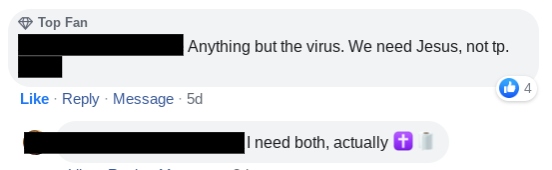
The other day I asked on Facebook if y’all wanted an article about Christians and the Coronavirus or something else. The overwhelming response was, “Something else! Anything else!” It seems many of us have reached out saturation point when it comes to hearing about the virus: But there were a few hardy souls who wanted to hear a Christian perspective on how we and our churches should be reacting to all the ramifications of quarantines, social distancing, and church closures. So here are a few brief thoughts I had:
😷Wash your hands like your life depends on it, because it might. Instead of singing a song while you’re washing your hands, recite your memory verses. Or if you’re in a public restroom, share the gospel with the poor sap lady who’s washing her hands in the sink next to you. You know she’s going to be there a while- captive audience!
😷You shouldn’t have to be told to cover your mouth when you cough or sneeze. You should already be doing it. That is basic home training and basic loving and serving your neighbor.
😷Stay home if at all possible (I thought this was just called “being normal, but it turns out I’m an introvert. Or a hermit.). The sooner this thing stops spreading, the sooner we can all get back to church, work, and normal life (which, for me, is staying home if at all possible – it’s the circle of life. Or something.).
😷Christians are not hoarders. Christians are sharers. It’s one thing to lay in a reasonable supply. It’s a whole ‘nother animal to buy into the mindset that purchasing huge amounts of supplies will somehow magically ward off harm. It won’t. That’s superstition. It is failing to trust God to provide for you. Do business with God and discern whether or not you’ve been hoarding. If you have, repent, and make like Zacchaeus and give it away to people who need it.
😷If you have a godly pastor, he has probably agonized over whether or not to cancel worship service or modify your church’s regular activities. It doesn’t matter what decision he makes, somebody is going to be unhappy about it and give him an earful. Don’t be that person. Give him some love and encouragement (from a safe social distance). He probably needs it now more than usual. And on that same note, whatever decision he makes, just roll with it for the time being, OK? We’re all playing this thing by ear right now, including your pastor. Don’t make me go all Hebrews 13:17 on y’all.
😷If you think nothing of skipping church for frivolous reasons, it’s hypocritical to complain now about your church’s services being canceled or modified for a much more important reason. (I’m not talking about First Amendment stuff here, I’m talking about your heart.)
😷”Online church” can be a blessing in an emergency situation like this, but this virus is going to pass and things are going to get back to normal. Do not fall into the fleshly mindset of, “Online church worked out just fine during the crisis, so I’ll just keep doing that instead of physically going back to church.” Uh uh. That’s spiritually lazy, and it’s sinfully forsaking the assembly. For Christians, Church is Not Optional, and that’s Non-Negotiable.
😷Have you ever stopped to think that this whole quarantine and limiting of meeting sizes thing could be God giving us a dry run of what it’s going to be like when real persecution comes, our church buildings are shuttered for good, and we have to meet in small groups in secret? That’s already real life for many of our brothers and sisters across the world. Maybe we should quit complaining and use this as a drill.
😷Where are Benny Hinn, Todd White, Bethel, and the rest of the faith healing crowd in all this? Time to put up or shut up.
😷Take reasonable precautions, but look for opportunities to help others and to share the gospel. Let your faith in God be greater than your fear of illness.
That’s pretty much my take on the whole shebang. If you haven’t had enough of all things Coronavirus, here are some more good resources:
Kudos to one of my followers, Camille, who has been hard at work curating the best Coronavirus memes on the web, part 1 and part 2. (This is meant to be lighthearted and funny. If you only do serious, please don’t click.)
Get Your Worship On
This kind of goes along with my TBT article from yesterday, God’s Not Like “Whatever, Dude,” About The Way He’s Approached in Worship. (Also meant to be lighthearted and funny, so please don’t click if that’s not your bag.). And some of you youngsters wonder why us old codgers like hymns so much!
The Real Deal, or the Fake Heal?
I was reading Acts 3, the story of Peter and John healing the lame beggar, and it struck me how starkly different this account is from the chicanery of New Apostolic Reformation “faith healers” today…
💥Peter and John didn’t have a “healing ministry”, they had a “preaching the gospel ministry.”
💥The lame beggar didn’t show up at “church” (i.e. the temple) to be healed, and didn’t seek Peter and John out for healing.
💥The lame beggar asked them for money rather than them asking him for money.
💥Peter and John had no silver, no gold, no Rolexes, no mansions, no private jets…
💥Peter said, “…what I have, I give to you.” The beggar was not asked to “sow a seed” into Peter and John’s ministry.
💥Faith isn’t mentioned once prior to the healing. Peter didn’t tell the beggar that if he just had enough faith, God would heal him.
💥No faith or money was required. The beggar played no part in “earning” his healing with his own good works. God healed him for His own glory.
💥The beggar was healed from a lifelong, obvious, eyewitnessed disability, and his healing was immediate and permanent.
💥Peter downplays both himself and the miracle and points to the Miracle Worker, Jesus.
💥Peter uses the opportunity of the gathered crowd to preach the gospel.
💥The gospel Peter preached was not, “Come to Jesus for miracles,” but “Jesus came to you, and you killed Him. Repent.”
💥Peter didn’t make crazy prophecies that didn’t come true. He pointed to the prophets of Scripture, and their prophecies fulfilled in Christ.
NAR preachers and faith healers want us to think they’re just like the apostles – even calling themselves “apostles” – but their words and actions don’t match up with what the apostles said and did.
They Aren’t Heretics Because You Disagree with Them
Of course not. So I’m not going to call Jared Wilson – who I have no reason to believe is anything other than a good, solid brother in Christ – a heretic because I disagree with the thrust of his article, They Aren’t Heretics Because You Disagree with Them. But, with genuine respect, I am going to call him “perhaps under educated” and “possibly somewhat lacking in experience” when it comes to the depth of the seemingly bottomless pit of false teaching and heresy out there.
Or perhaps our experiences are just different. Perhaps, in his world, there are throngs of people running around calling Presbyterians heretics because they believe in paedo-baptism. Or who cry “Heretic!” on anyone with a different eschatalogical view from their own.
That’s not the world I – and I would guess, most Christians – live in. In my world, the people who get called heretics and false teachers have generally earned the label by their biblically demonstrable false teaching and sinful behavior. There might be a few Baptists calling Presbyterians heretics and vice versa, but in my experience they are the rare exception, not the rule Jared’s article – putting the best possible construction on it – seems to be trying to address. And I get the feeling I swim in these particular waters much more frequently than he does.
I would certainly agree with Jared that the aforementioned types of issues are not matters of heresy, they are secondary issues on which Christians in good standing can disagree. But he lumps in some other issues (the role of women, extra-biblical revelation, yoking in ministry with “people who teach wacky things”) we cannot “agree to disagree” on because they are sin or false teaching that undermine the authority of Scripture, the sufficiency of Scripture, and the spiritual health of the church.
Jared has made the same categorization error regarding “secondary issues” that I believe Al Mohler made in his article on “theological triage” (which Jared links to in his article) – namely, that issues of sin (disobedience to clear Scripture) are not the same thing as secondary theological issues. Sin belongs all in its own category: sin. (I discussed this categorization error at length in my article Women Preaching: It’s Not a Secondary Doctrinal Issue.)
Jared uses no Scripture used to back up his opinions, making them no more valid than the “opinions” he critiques. He cites the Baptist Faith and Message (the statement of faith of the Southern Baptist Convention), but the BFM is not Scripture, and we are Christians first, Baptists second. We are Bible first, BFM second. So anywhere the BFM might contradict Scripture, go beyond Scripture, or not rise to the level of Scripture (and it does not rise to the level of Scripture regarding the role of women in the church, restricting only the office of pastor, but not the function of preaching), it is moot and useless.
Does Jared not recall that Scripture says, “A little leaven leavens the whole lump.”? And that we are to “cleanse out the old leaven…and celebrate with the unleavened bread of sincerity and truth“? Yet the thrust of his article seems to be akin to saying, “Don’t worry about that little misshapen mole on your arm. It’s just your arm having a ‘different view’ of skin. Only rampant, stage 4 cancer should be called cancer and treated.” That is not a biblical approach to false teaching.
As much as many Christians would like us all to get along and play nice with anyone and everyone who names the name of Christ, we cannot do that and still be faithful and obedient to the Word of God that tells us to contend for for the faith and silence false teachers. False teaching, even non-soteriological false teaching, is a big deal to God, and it should be to us, too.
Before we begin studying a book of the Bible, it’s very important that we understand some things about that book. We need to know…
Who the author was and anything we might be able to find out about him or his background.
Who the audience of the book is: Jews or Gentiles? Old Testament Israelites or New Testament Christians? This will help us understand the author’s purpose and approach to what he’s writing.
What kind of biblical literature we’re looking at. We approach books of history differently than books of wisdom, books of wisdom differently than books of prophecy, etc.
What the purpose of the book is. Was it written to encourage? Rebuke? Warn?
What the historical backdrop is for the book. Is Israel at war? At peace? In exile? Under a bad king? Good king? Understanding the historical events surrounding a piece of writing help us understand what was written and why it was written.
When the book was written. Where does the book fall on the timeline of biblical history? This is especially important for Old Testament books which are not always arranged in chronological order.
So this week, before we start studying the actual text of the book of 2 Peter, we need to lay the foundation to understanding the book by finding the answers to these questions. Some of the information was covered in Lesson 1 (link above) when we looked at the background of 1 Peter, but there are some differences I think you’ll find interesting and informative to the study of Peter’s second epistle.
Read the following overviews of the book of 2 Peter, taking notes on anything that might aid your understanding of the book, and answer the questions below:
1. Who wrote the book of 2 Peter? How do we know this?
2. Approximately when was 2 Peter written? What is the geographical setting of the book of 2 Peter? Here are some maps (scroll down to “2 Peter”) that may be helpful as you study through the book of 2 Peter.
3. Who is the original, intended audience of the book of 2 Peter? Describe the historical setting (historic events, politics, sociology of the time, etc.) of 2 Peter.
4. Which genre of biblical literature is the book of 2 Peter: law, history, wisdom, poetry, narrative, epistles, or prophecy/apocalyptic? What does this tell us about the approach we should take when studying this book versus our approach to books of other genres?
5. What is the theme or purpose of the book of 2 Peter?
6. What are some of the major topics of instruction in the book of 2 Peter? How do these topics relate to the theme of 2 Peter?
7. What are some ways 2 Peter points to and connects to Jesus?
8. What else did you learn about 2 Peter or the setting of this book that might help you understand the text of the book better?
Take some time in prayer this week to prepare your heart to receive what God has to say to you through 2 Peter. Ask God to grow you in holiness and in following the example of Christ as we continue studying together Living Stones: A Study of 1&2 Peter.
“This really is actually, literally true,” I found myself urging the ladies to whom I was teaching a Bible lesson.
It was a surreal moment. There wasn’t a woman in that room who would have denied the Bible’s inerrancy or trustworthiness. All of them wholeheartedly agreed with the passage we were discussing and, if asked by anyone, would have said unequivocally that they believed the truth of it.
But there was just this…this thing…nagging at the back of my heart. Why…why did I get the feeling I needed to dig down under their profession of belief in God’s Word and convince them of the gut-level truth of the passage?
I believe these ladies and I were a representative sample of average, genuinely regenerated, Bible-believing Christians. But when I look out across the landscape of denominations and churches and ministries made up of average, genuinely regenerated, Bible-believing Christians, there’s a disconnect between what we say we believe – even what we’re convinced in our hearts we believe – about God, and the way we do life and church.
We’re not living out what we say we believe.
We don’t truly trust who God is, how He works, or what He has told us to do (or not to do) enough to simply take Him at His word and do things His way. And most of the time, we don’t even realize it.
We trust profession over fruit
If someone has walked the church aisle, prayed a “sinner’s prayer”, been baptized, attends an organization that calls itself a church, or simply declares herself to be a Christian, we trust that she’s truly been born again – despite the fact that she follows a myriad of false teachers, gets angry at or argues against the plain reading of God’s Word, lives as a practicing homosexual, runs her life by her own feelings, opinions, and experiences rather than obedience to Scripture, or her behavior is otherwise completely indistinguishable from that of a non-Christian. When it’s our grown children or other deeply loved ones, we cling even more desperately to the belief that “she’s saved because _____”, and she’s safe from an eternity in Hell, regardless of everything we can see in her life to the contrary.
But that is not God’s way. God’s way is that if it walks like a lost duck and quacks like a lost duck, we are to treat it like a lost duck. Yet, we don’t do that. We hide behind “Only God knows the heart,” or “Maybe she’s just backslidden or a ‘carnal Christian’,” when the Bible teaches nothing of the sort. Yes, God is the judge of whether or not someone is ultimately saved, but God has not called us to be the final arbiter of salvation. He has called us to lovingly urge sinners to repent and believe the gospel regardless of their church pedigree or claims of being a Christian. Those who repent and pursue holiness, though imperfectly, are the ones who are genuinely saved.
You will recognize them by their fruits. Are grapes gathered from thorn bushes, or figs from thistles? So, every healthy tree bears good fruit, but the diseased tree bears bad fruit. A healthy tree cannot bear bad fruit, nor can a diseased tree bear good fruit. Every tree that does not bear good fruit is cut down and thrown into the fire. Thus you will recognize them by their fruits. “Not everyone who says to me, ‘Lord, Lord,’ will enter the kingdom of heaven, but the one who does the will of my Father who is in heaven. On that day many will say to me, ‘Lord, Lord, did we not prophesy in your name, and cast out demons in your name, and do many mighty works in your name?’ And then will I declare to them, ‘I never knew you; depart from me, you workers of lawlessness.’ Matthew 7:16-21
“If your brother sins against you, go and tell him his fault, between you and him alone. If he listens to you, you have gained your brother. But if he does not listen, take one or two others along with you, that every charge may be established by the evidence of two or three witnesses. If he refuses to listen to them, tell it to the church. And if he refuses to listen even to the church, let him be to you as a Gentile and a tax collector. Matthew 18:15-17
But now I am writing to you not to associate with anyone who bears the name of brother if he is guilty of sexual immorality or greed, or is an idolater, reviler, drunkard, or swindler—not even to eat with such a one. For what have I to do with judging outsiders? Is it not those inside the church whom you are to judge? God judges those outside. “Purge the evil person from among you.” 1 Corinthians 5:11-13
Do we trust the profession faith of someone whose life screams, “LOST!” over God’s Word that teaches us that saved people bear fruit in keeping with repentance and pursue holiness?
We trust man-made solutions over
God’s prescribed methods
Nowhere is this clearer at present than in the social justice movement. Even professing Christians are dreaming up all sorts of ways to right real and perceived wrongs against sexual perversion minorities, blacks (What about other ethnic minorities?), and women. It’s only natural that the world would come up with man-made solutions to these problems, but the church is embracing the ways of the world instead of applying the ways of God.
The world’s solution to the “problem” of sexual perversion not being embraced and celebrated is to socially and legally force dissenters to comply. Financial reparations from people who never owned slaves to people who have never been slaves is the solution to racism. Replacing men in power with women in power will end sexism. Many in evangelicalism are aping these humanistic ploys by accepting the idea of “gay Christianity,” insisting on fabricated “diversity” in congregations, ministries, and denominational leadership, and allowing women to serve as pastors and in other positions of teaching or authority over men in the church.
Again, coming up with our own solutions is not God’s way. God’s way is for us to understand what is sin and what is not, and how to biblically deal with sin.
We need to trust God’s word that there’s a difference between sinfully hurting someone and hurting someone who’s sinning. Just because someone’s feelings have been hurt doesn’t mean she has been sinned against. If I call someone names or treat her unkindly because she is a homosexual or a certain ethnicity or a woman, I am sinfully hurting her. If people are hurt when I humbly, lovingly, and kindly teach what the Bible says about homosexuality or repenting for the sins of my ancestors or the biblical role of women in the church, and call to repentance those who believe and act unbiblically in these areas, they are hurt because they are sinning.
Faithful are the wounds of a friend; profuse are the kisses of an enemy. Proverbs 27:6
We also need to stop viewing sin as systemic – as though racism, “homophobia”, and sexism were living, breathing beings we need to conquer – and start trusting God’s way of holding individuals responsible for their own sins. What is God’s way for us to deal with an individual who is, according to God’s Word, sinning?
✢ Lost sinners:We share the gospel with that person. When God raises a sinner from death in her trespasses and sins to new life in Christ, He breaks the power sin has over her and enables her, through the indwelling of the Holy Spirit, to obey His commands. He changes her from a creature who loves sin into a new creature in Christ who hates sin. If you want someone to stop being racist, sexist, or unkind to sexual perversion minorities, plucking leaves off the weed isn’t going to do it. You need the Master Gardener to pull that pernicious plant up by the roots and plant a rose bush in its place. If we really trusted God to transform the heart of a sinner like He says He will, we’d be out there sharing the gospel with everyone we know and we would stop relying on man-made solutions to sin.
And you were dead in the trespasses and sins in which you once walked, following the course of this world, following the prince of the power of the air, the spirit that is now at work in the sons of disobedience— among whom we all once lived in the passions of our flesh, carrying out the desires of the body and the mind, and were by nature children of wrath, like the rest of mankind. But God, being rich in mercy, because of the great love with which he loved us, even when we were dead in our trespasses, made us alive together with Christ—by grace you have been saved…For we are his workmanship, created in Christ Jesus for good works, which God prepared beforehand, that we should walk in them. Ephesians 2:1-5,10
Therefore, if anyone is in Christ, he is a new creation. The old has passed away; behold, the new has come. 2 Corinthians 5:17
And I will give you a new heart, and a new spirit I will put within you. And I will remove the heart of stone from your flesh and give you a heart of flesh. And I will put my Spirit within you, and cause you to walk in my statutes and be careful to obey my rules. Ezekiel 36:26-27
✢ Saved Sinners:When a Christian sins, we go to her in love, humility, and kindness, and gently point out what God’s Word says about her sin and her need to repent. If she doesn’t immediately repent, we continue praying for her and calling her to repentance until she proves that she loves her sin more than she loves Christ. Then we regard her as a lost person in need of salvation and preach the gospel to her (see “Lost Sinners” above).
“If your brother sins against you, go and tell him his fault, between you and him alone. If he listens to you, you have gained your brother. But if he does not listen, take one or two others along with you, that every charge may be established by the evidence of two or three witnesses. If he refuses to listen to them, tell it to the church. And if he refuses to listen even to the church, let him be to you as a Gentile and a tax collector. Matthew 18:15-17
Brothers, if anyone is caught in any transgression, you who are spiritual should restore him in a spirit of gentleness. Keep watch on yourself, lest you too be tempted. Galatians 6:1
God has never asked us to brainstorm solutions to these issues. He has already laid out in the Bible how we’re to handle problems and hurt and wrongdoing. We often give lip-service to His instructions, but we don’t trust that they will “work”, because, fundamentally, we don’t trust God to do what He says He’ll do in the heart of a sinner or a Believer.
We trust our own efforts over the power of God
It’s a good thing – a godly and biblical thing – to want unsaved people to know Christ and avoid an eternity in Hell. All of us who claim the name of Christ should have this burden for the lost.
But we have to sit down and really come to grips with the fact that salvation is all of God. If a person gets saved, it ultimately does not matter what lengths you went to in order to “get her saved”. Your efforts didn’t save that person. God drew her to Himself and gave her the gift of repentance and faith in Christ. He saved her. He knows whom He will save and when and under what circumstances. We have to trust that God knows what He is doing when it comes to salvation.
It is the Spirit who gives life; the flesh is no help at all. The words that I have spoken to you are spirit and life. But there are some of you who do not believe.” (For Jesus knew from the beginning who those were who did not believe, and who it was who would betray him.) And he said, “This is why I told you that no one can come to me unless it is granted him by the Father.” John 6:63-65
For by grace you have been saved through faith. And this is not your own doing; it is the gift of God, not a result of works, so that no one may boast. Ephesians 2:8-9
The vehicle God has chosen to deliver the message of salvation to the lost is the preaching of the gospel.
How then will they call on him in whom they have not believed? And how are they to believe in him of whom they have never heard? And how are they to hear without someone preaching?…So faith comes from hearing, and hearing through the word of Christ. Romans 10:14,17
We have the joy and the duty to share the gospel with the lost, but our faith should not be in our ability to share, or our method of sharing, but in the power of God working through His Word that is shared.
Every Christian I know would agree with that statement. But do we really believe it? Instead of simply presenting the gospel to people as we go about our daily lives (as the Great Commission instructs us), pastors preaching the gospel, and elders and teachers teaching the gospel, we trust in our own efforts more than we trust God’s sovereignty in salvation.
We change our church services to be “seeker sensitive,” trusting in cool music and coffee bars and skinny jeans to make Jesus appealing to haters of God. We join cultural causes – like the aforementioned social justice movement – to get the world to like us, thinking, “If we can compromise with the world just enough, we can get them to like us, and then we can introduce them to Jesus, and they’ll like Jesus too.” Wives of unsaved husbands nag-vangelize – undoubtedly out of love and concern – thinking if they just keep trying, they’ll manage to come up with the exact right combination of words at the exact right time, and their husbands will get saved. We offer a dumbed-down gospel, simplistic sinner’s prayers, mood-altering music during the altar call, urgency, scare tactics, guilt – anything, anything, anything…as long as it’s the magic formula to get them through the gates of the Kingdom.
It is wonderful and godly to have that kind of zeal for people to know Christ, but zeal becomes the sin of presumption if it leads us to trust in our own efforts to save someone – especially if those efforts conflict with Scripture or alter the gospel – rather than presenting the biblical gospel, stepping back, and trusting God do His amazing work of salvation. Do we really trust God to be able to save someone through the simple proclamation of His Word?
And Jesus came and said to them, “All authority in heaven and on earth has been given to me. Go therefore and make disciples of all nations, baptizing them in the name of the Father and of the Son and of the Holy Spirit, teaching them to observe all that I have commanded you. And behold, I am with you always, to the end of the age.” Matthew 28:18-20
I charge you in the presence of God and of Christ Jesus, who is to judge the living and the dead, and by his appearing and his kingdom: preach the word; be ready in season and out of season; reprove, rebuke, and exhort, with complete patience and teaching. 2 Timothy 4:1-2
If we truly took God at His Word, the visible church would look very different today. We say we want to see God at work in our churches, families, and the world, but, somehow, we think we’ve got to push Him along to make that happen. We over-complicate things and get lost in the weeds of programs and movements and methods and efforts instead of opening our Bibles, believing what God says to believe, doing what God says to do, and trusting Him to do everything else – in His power, in His way, and in His time.









 But there were a few hardy souls who wanted to hear a Christian perspective on how we and our churches should be reacting to all the ramifications of quarantines, social distancing, and church closures. So here are a few brief thoughts I had:
 Or perhaps our experiences are just different. Perhaps, in his world, there are throngs of people running around calling Presbyterians heretics because they believe in paedo-baptism. Or who cry “Heretic!” on anyone with a different eschatalogical view from their own.