Mailbag

The Mailbag: How to Leave a Church


What is the biblical way to leave a church?

This is a great question that I’ve received from several readers. There are a lot of different circumstances that might cause someone to leave her church, and there are right ways and wrong ways to leave. I’ve been so grateful to hear from women who want to handle things biblically.

First, a couple of words of counsel that generally apply to nearly all situations when you’re considering leaving a church:

•In most circumstances, even bad ones, I would counsel against “ghosting” your church – simply disappearing with no explanation or goodbyes to anyone. When you’re preparing to leave, as appropriate to your particular situation, tell your pastor how much he has meant to you. Say a special goodbye to dear friends. Speak words of encouragement to your leaders and teachers. Search your heart for anyone you may have sinned against, repent, and apologize. Leave graciously.

•If you’re married, you and your husband will need to talk and pray together about whether or not to leave and how to do so. Be sure to remember that your husband is responsible for making the final decision and you are responsible for submitting to him.

Let’s talk about some of the more specific reasons you might have to leave a church, and what it would look like to leave well in each situation.

Death

If you’re a faithful member in good standing and you die unexpectedly, you’re off the hook. It’s OK to “ghost” your church. :0)

If you’re a faithful member in good standing and have a terminal illness, use some of your remaining time (if you’re able) to make a gracious exit. Take some time for special goodbyes. Discuss your funeral service and details with your pastor if applicable. Consider leaving a gift to your church in your will.

Moving or Temporarily Relocating

If you’re moving too far away to continue attending your church, let your pastor and those you’re close to at church know.

Do you know your new address and/or e-mail address? Provide it to the church office if you’d like them to keep sending you the church newsletter and any other mailings, and let them know if it’s OK to give that information out to other church members who would like to stay in touch. Make sure you have correct phone numbers and e-mail addresses for church friends you want to stay in contact with. If you’re not yet connected to a church in your new hometown, ask your pastor if he can suggest a good church in the area.

For those who are temporarily relocating (for example, college students or military families) and want to keep your membership in your home church, yet be active members of a church in your new location, find out if your new church has any sort of dual membership option (sometimes called “watchcare”). This allows you to maintain your membership in your home church while giving you membership benefits (voting, teaching, communion, or whatever your new church’s policies are) in your new church.

Switching from a good church to a church that’s a better fit for your family

Maybe the church you’ve been attending is a good one, but you’ve recently become more Reformed in your soteriology and you’d like to join another church in town that you more closely align with, theologically. Perhaps there’s a nearby church that has started offering programs and accommodations your disabled child could benefit from that your current church isn’t equipped to offer. Maybe, though doctrinally sound, your current church has switched to a genre of music that, even after giving it a good faith effort, still grates on you to the point of distracting you from worship, but another local church has music you’re more in harmony with.

None of these are reasons you absolutely have to leave a church. In fact, if your church is teaching sound doctrine, and the reason you’re considering leaving is a matter of preference or convenience, I would encourage you to try to work things out and stay at your current church if at all possible. It might be that God would have you start programs and accommodations for the disabled at your current church, or that He will begin to use the new music style in your life in some way. At the very least, when it comes to non-doctrinal issues like these, give it plenty of time, prayer, and serious thought before you leave.

Talk to your pastor (or appropriate elder) when you start thinking about leaving. This should not be an “If you don’t change X,Y, and Z, we’re outta here!” type of conversation. Be kind. Express your concerns or needs lovingly and biblically. Find out if there’s any information you need to know that would affect your thoughts about leaving. For example, maybe the pastor has also started becoming more Reformed and needs you to stay and support him as he begins transitioning the church in that direction. Maybe a lot of other church members have expressed discomfort with the new direction the worship music has taken and the leadership is considering changes that would make it easier for you to stay. You never know until you discuss it with your pastor.

If you come to the decision that you really need to move to another church, talk with your pastor again and let him know your decision. Take care of all of your church responsibilities before leaving: if you’re teaching a class with a definite end date, finish it. If you’re teaching a permanent class, let whoever is in charge of securing teachers know when you’ll be leaving so a new teacher can be found. Wrap up any projects or turn them over to the appropriate person. Resign any positions you hold. Don’t leave your brothers and sisters in the lurch.

When you say your goodbyes, it’s not necessary to disclose to everyone every detail of your reasons for leaving, but, if possible, try to stop any gossip before it starts by making sure people understand you’re not leaving because of someone else’s sin, unresolved conflict, false teaching, etc.

Leaving due to sin or false doctrine

The chairman of deacons is having an affair and nothing has been done about it. Your pastor just finished Bill Johnson’s book and is starting to teach New Apostolic Reformation false doctrine. Women have been preaching from time to time on Sunday mornings.

The most crucial time not to simply disappear from your church is when there’s sin or false doctrine in the camp. Jesus and the Apostles did not handle sin and false doctrine by avoiding it or ignoring it. They loved the people committing the sin and teaching the false doctrine enough to confront them – sometimes harshly, if needed – so that they might repent and be reconciled to Christ. We don’t run. We reconcile.

Just as God placed Esther in exactly the right position at the right time to help rescue His people, it could be that God has placed you in your church and given you a biblical understanding of the situation for such a time as this.

In cases of both sin and false doctrine, you should usually* follow the steps for church discipline outlined in Matthew 18:15-20:

1. If your brother sins against you, go and tell him his fault, between you and him alone. If he listens to you, you have gained your brother. (15)

2. But if he does not listen, take one or two others along with you, that every charge may be established by the evidence of two or three witnesses. (16)

3. If he refuses to listen to them, tell it to the church. (17a)

4. And if he refuses to listen even to the church, let him be to you as a Gentile and a tax collector. (17b)

(*If you have knowledge that someone is imminently about to commit sin, especially if that sin will victimize someone else, and time is of the essence, gather the appropriate leaders and/or church members and intervene immediately. If a crime has been committed, alert law enforcement.)

In my article, The Mailbag: How should I approach my church leaders about a false teacher they’re introducing?, I’ve outlined some steps to take when approaching your pastor or lay leaders about using materials authored by false teachers. Most of this information can be adapted for dealing with issues of sin and church discipline as well.

If the sin or false teaching issue is resolved biblically, praise God, forgive, do whatever you’re able to do to be at peace with all involved, and stay at your church if at all possible.

If you have done everything you’re able to do to help bring about a biblical resolution to the situation and the sin or false doctrine is being allowed to continue, it’s probably time to leave and find a spiritually healthy church. Talk to your pastor or elders, and let them know you’ve decided to leave and why.

Attempt to leave as graciously as possible, taking care of your teaching/serving responsibilities, saying goodbye, making arrangements to stay in touch with friends, etc.

You will need to prayerfully consider the biblically appropriate way to explain to fellow church members and leadership why you’re leaving. Don’t slander people, make an unnecessary scene, or disclose inflammatory details indiscriminately on your way out, including on social media. However, it may be a situation in which those left behind need to know what’s going on so they can make an informed decision about how to address the situation or whether to stay or leave themselves. It may be appropriate to write out a calm, objective, scripturally annotated letter explaining your reasons for leaving, and mail or hand deliver copies of it to the appropriate people. You might need to talk to the denominational leadership board or organization that oversees your church. There are so many different possible scenarios it would be impossible for me to make a blanket statement as to what would or would not be biblically wise and appropriate in every single situation.


No matter your reasons for leaving your current church, your search for a new church to join with needs to begin as soon as you’ve made the decision to leave. If you need some help, ask your pastor or trusted Christian friends for suggestions of good churches, or explore the Searching for a new church? tab at the top of this page. Whatever you do, don’t succumb to the sin of staying out of church, because for the Christian, Church is Not Optional. And that’s Non-Negotiable.


If you have a question about: a Bible passage, an aspect of theology, a current issue in Christianity, or how to biblically handle a family, life, or church situation, comment below (I’ll hold all questions in queue {unpublished} for a future edition of The Mailbag) or send me an e-mail or private message. If your question is chosen for publication, your anonymity will be protected.


Mailbag

The Mailbag: What’s In a Name?

How should my child and I refer to a child who is transitioning (girl to boy)? This is not a child with whom we are close. She is the granddaughter of a neighbor and visits them once or twice a year. Because she and my daughter are near the same age (tweens), they spend time together while she is visiting. 

She recently arrived for a visit and informed my daughter that she is transitioning and wants to be called Brandon* instead of Shannon from now on. She now dresses like a boy and has a male-looking haircut.

I have already talked to my daughter about the biblical issues at play and have explained that we need to be loving and kind to her friend, but also not cooperate with her delusion of becoming a boy.

I don’t want to use the pronoun “he” to refer to this child because it is not biologically possible and it is sinful to try to change the gender God gave you. But what about her transition name (Brandon)? People change their names and I don’t think that’s sinful. But to change it for the purpose of denying your God-given gender would be.

Would you call her by her given name or her new name?
*Names changed

This is such a heartbreaking situation, and it’s happening way too often. So called “gender reassignment” is physically, psychologically, and spiritually abusive. Children in sexual identity sin need loving, kind, supportive, biblical help, not for someone, especially their parents who are supposed to protect them and do what’s best for them, to enable them in their dysfunction.

You didn’t ask about this, and you might already be doing it, but could I suggest two things before we get into the names and pronouns? Pray fervently for this child. Pray by yourself, with your daughter, with your whole family. Pray for her parents and grandparents. Pray for opportunities to share the gospel with all of them. This child is in for a very painful life, physically, emotionally, and spiritually.

In addition to loving her and sharing the gospel with her, try to do little things that will subtly continue to keep Jesus in front of her eyes whenever she’s with your family: say the blessing before meals, invite her to go with you to the church picnic or youth activities at church, do a mother-daughter Bible study every morning and ask her if she’d like to join you and your daughter. Don’t beat her over the head with these things or stop doing things with her that she would consider “normal” (going for a swim or out to get hamburgers), but try little avenues like this for introducing her to Christ.

Now as far as calling this little girl “Brandon” and using male pronouns for her, I would probably land very close to where you are on the issue. The way we use and understand language as human beings is very impactful, which is precisely why we’re starting to see people getting fired from their jobs for refusing to use male pronouns for women who think they’re men, and vice versa. Changing the language changes the tide of the movement. Once the people pushing this agenda get the language changed, changing laws, hearts, and attitudes is much easier for them. They even think it can change reality – that a woman can actually become a man and a man can actually become a woman.

As Christians, we should recognize better than anyone how integral someone’s name can be to her identity. God’s name is I AM. It’s not just an arbitrary label chosen for its mellifluous lilt. That is the essence of who He is. Matthew gives us two names for God’s Son – Jesus, “Yahweh saves,” and Immanuel, “God with us” – these names tell us His true identity and purpose. And all over the Bible, we see the importance of a person’s name to his or her identity. People’s names often had ontological meaning. And sometimes God changed a Bible character’s name at a milestone moment to indicate that that he was moving into a new phase of life. Abram to Abraham. Sarai to Sarah. Jacob to Israel.

Interestingly, there’s even an incident in the Bible that parallels the name-changing issue today. When Nebuchadnezzar took the people of Judah captive and changed the names of Daniel, Hananiah, Mishael, and Azariah to Belteshazzar, Shadrach, Meshach, and Abednego, he did so as a method of forcibly assimilating them into their new identity as Babylonian slaves in Babylonian culture. He was attempting to change their entire identity – the way they thought about themselves – from sons of God to conquered slaves of Babylon and make that new identity a reality. And that’s what’s going on with Shannon as well as the sexual identity agenda “pronoun police.” The change of name and pronouns is an attempt to change the new identity of the person into a reality. But every time someone uses the biologically correct name and pronouns for someone in sexual identity sin, that person is jolted out of her delusion of being the opposite sex and right back into the inescapable reality of the sex God created her to be. (It’s the sexual identity sin version of the positive confession aspect of Word of Faith theology: If you just believe hard enough and say all the right things and never the wrong things, you can speak your desires into existence. Scary, huh?)

So when someone in sexual identity sin asks you to call her by an opposite sex name and pronouns, it’s not some “no big deal” kind of thing. Whether that person realizes it or not, she is asking you to help perpetuate her delusion and protect her from being confronted by the reality of the way God created her, so that she can continue believing that what she wants to be true actually is true.

I have said on previous occasions that Christians shouldn’t use opposite sex names or pronouns (or made up/incorrect pronouns like “ze,” “fae,” or “them/their”- referring to an individual) for all of the aforementioned reasons and more. I do understand that for various reasons of employment, family peace, and so on, there are godly people out there who may decide in their own circumstances to use opposite sex names and pronouns for people in sexual identity sin, and I want to make clear that, while I almost certainly would not agree with those decisions, I don’t necessarily think those godly people are, across the board, sinning by doing so. This is a tough issue to navigate because the Bible doesn’t explicitly tell us what to do in this situation. We need to prayerfully examine the issue and the Scriptures and follow our biblically informed consciences in our particular situations. So please hear me clearly: this reader asked what I would do in her particular situation (which doesn’t involve the possibility of losing a job, being arrested, etc.) so that’s how I’m going to answer.

I could not, without violating my biblically informed conscience, call Shannon Brandon and start using male pronouns for her. However, I would also realize that she is going to feel hurt by not being called Brandon, which could cause her to distance herself from my family and the gospel influence we could have upon her.

The way you worded your e-mail, it sounds like Shannon came in and sort of announced or told your daughter that her name is Brandon now or that’s what she’d like to be called. Shannon announcing this is not the same thing as you and your daughter agreeing to comply with it.

Personally, what I would do, is just skip using formal names and not worry about the pronouns. The pronouns will be easier to dispense with because he/him/his and she/her/hers are third person pronouns. In other words, you use them when talking about someone (to another person), not when you’re talking to someone. When you’re talking to someone, you use second person pronouns (you/your/yours) which are already gender neutral.

Avoiding using Shannon’s formal name may also be easier than you realize, especially since you don’t see her very frequently. Think about how often you actually use your husband’s, children’s, or friends’ names when speaking directly to them in conversation. Usually, we don’t start a conversation with someone we’re sitting across from by saying, “Bob, let me tell you about my day,” we just start talking. We also use pet names (sweetie, kiddo, my friend) and nicknames (Green Eyes, Tiger, Boss). Some people are in the habit of calling others by their last names, military style. If Shannon’s “boy name” and “girl name” started with the same letter (ex: going from Shannon Johnson to Steve Johnson) you could call her by her initials.

One of the main reasons people in my house call each other by name is if we’re trying to get that person’s attention or call them from another room. Instead of your daughter calling to Shannon from another room or through a closed door, “Shannon, would you like a drink?”, teach your daughter to walk up to Shannon, tap her on the shoulder, or wait until she comes into the room, and ask her the question once the two have made eye contact. (She’s probably already good at this since most kids that age have earbuds in all the time!) Among kids, “Hey!” “Yoo hoo!” or a yoo hoo-type whistle to get her attention can also work. Keep all of these kinds of things lighthearted and casual, and Shannon might not even notice. Meanwhile, you can keep on loving her and sharing the gospel with her.

Anyway, that’s the kind of thing I would do unless Shannon point blank says something like, “I want to be called Brandon. Will you please call me that?” or “Why aren’t you calling me Brandon?”. At that point, you or your daughter will need to lovingly and briefly explain that in the same way Shannon feels uncomfortable being called a girl name, your daughter feels uncomfortable calling her a boy name. Ask Shannon if there’s some kind of compromise she and your daughter could make (initials, nickname, “secret code names” they can have fun making up, etc.) that would make both of them feel comfortable.

If she wants to know why you/your daughter feel uncomfortable, lovingly tell her the truth. “We love God. God made you a girl. If we call you by a boy’s name, we feel like we would be saying He did something wrong or made a mistake, or that we would be lying about how He made you. But we do still love you and still want to be friends.” If you feel like it would be appropriate or helpful, you might want the grandparents to be present while you have this conversation. You and your daughter might also want to role play this scenario ahead of time so that she will feel prepared when it’s time to have this conversation.

When you have this conversation with Shannon, you need to understand that it most likely won’t be well-received and that it could very well be the last conversation you have with her. Her grandparents may be angry with you. Her parents may be angry with you. As Christians who stand firmly and lovingly on Scripture, we should expect the world to hate us.

If the world hates you, know that it has hated me before it hated you. If you were of the world, the world would love you as its own; but because you are not of the world, but I chose you out of the world, therefore the world hates you. Remember the word that I said to you: ‘A servant is not greater than his master.’ If they persecuted me, they will also persecute you. If they kept my word, they will also keep yours. But all these things they will do to you on account of my name, because they do not know him who sent me. John 15:18-21

Do not be surprised, brothers, that the world hates you. 1 John 3:13

But Christ calls us to separate ourselves from the world and be loyal to Him even if it costs us everything- including those we love the most:

Whoever loves father or mother more than me is not worthy of me, and whoever loves son or daughter more than me is not worthy of me.
Matthew 10:37

The gospel divides. And Christians are always called to stand on Christ’s side of the divide.

But we should also remember Christ’s promises to us:

Blessed are you when others revile you and persecute you and utter all kinds of evil against you falsely on my account. Rejoice and be glad, for your reward is great in heaven, for so they persecuted the prophets who were before you. Matthew 5:11-12

But rejoice insofar as you share Christ’s sufferings, that you may also rejoice and be glad when his glory is revealed. If you are insulted for the name of Christ, you are blessed, because the Spirit of glory and of God rests upon you. But let none of you suffer as a murderer or a thief or an evildoer or as a meddler. Yet if anyone suffers as a Christian, let him not be ashamed, but let him glorify God in that name. 1 Peter 4:13-16


If you have a question about: a Bible passage, an aspect of theology, a current issue in Christianity, or how to biblically handle a family, life, or church situation, comment below (I’ll hold all questions in queue {unpublished} for a future edition of The Mailbag) or send me an e-mail or private message. If your question is chosen for publication, your anonymity will be protected.

Relationships, Sanctification

In Defense of Offense: Why Christians Need to Stop Worrying About Offending People

“You’re a liar,” he said dryly, the passion in his eyes gleaming through.

“What?!?! HOW DARE YOU call me a liar!” his fellow church member fumed.

“You’re a liar, Joe. You show up at church for an hour a week and claim to be a Christian, yet you’ve been living with your girlfriend for over a year, you’ve told me you use pornography, and I’ve talked to five different people with incontrovertible evidence that you’ve cheated in your business dealings with them. When you say you’re a Christian, you’re lying. Just admit it.”

Have you ever had a conversation like this with someone? Have you ever witnessed a conversation like this?

Most of us would never dream of calling someone a liar who claims to be a Christian yet walks in disobedience to Christ. Goodness, no! It might offend the person or cause her to question her salvation! She might leave the church or walk away from the faith!

You know who wouldn’t be afraid of offending such a person or causing her to doubt her salvation? Someone who would dream of calling a professed Christian walking in disobedience a liar?

The Holy Spirit – via the Apostle John – that’s who.

Whoever says “I know [Jesus]” but does not keep his commandments is a liar, and the truth is not in him, but whoever keeps his word, in him truly the love of God is perfected. By this we may know that we are in him: whoever says he abides in him ought to walk in the same way in which [Jesus] walked.

1 John 2:4-6

Take a moment and let that really sink in. People who claim to be Christians yet habitually and unrepentantly make a practice of sinning are not saved.

People who claim to be Christians yet habitually and unrepentantly make a practice of sinning are not saved.

To the Holy Spirit and John that’s as plain and simple and uncontroversial as saying, “The sky is blue, and water’s wet.” But to a false convert, them’s fightin’ words.

And we know it.

So we refrain from lovingly speaking hard, biblical truths to people who need to hear them, usually for one of a handful of reasons:

• We don’t want this person’s wrath aimed at us because it’s a hassle or because we don’t want to lose the relationship with her.

• We don’t actually believe the Bible and trust God’s sovereignty. We’d rather lean on our own understanding, desperately clinging to the irrational hope that this person is truly a Christian who’s hanging by a thread, and we don’t want to be the one responsible for saying anything that might clip that thread.

• We’re worried about how we’ll look to others and that they’ll accuse us of being unloving, unchristlike, and harming the unity of the church.

What do those reasons have in common?

Me. Me me me me me me me.

I want to keep my relationship with this person in tact. I don’t want others to blame me for this person’s reaction to biblical truth or call me unloving or divisive. I don’t want to deal with the aggravation of this person’s emotional blow up.

It’s not exactly the greater love of laying down one’s life for a friend, is it? We’re not even willing to lay down our comfort or our reputation in order to tell someone her walk doesn’t match her talk and call her to repentance. Is that love at all, or is it just plain, old fashioned selfishness? We bow and scrape at the idol of not hurting other people’s feelings while those people careen down the road paved with our good intentions straight toward the gates of Hell. How is that love? 

We bow and scrape at the idol of not hurting other people’s feelings while those people careen down the road paved with our good intentions straight toward the gates of Hell. How is that love?

Love is valuing, and acting on, what is best for another person over and above our own self interests. You know, kind of like Jesus did during His life, death, and resurrection:

By this we know love, that he laid down his life for us, and we ought to lay down our lives for the brothers.

1 John 3:16

You know, it’s interesting that the Holy Spirit speaks a lot of hard, “you’re not saved if…” truths in a book (1 John) whose purpose is to give true Christians assurance of their salvation. The Third Person of the Trinity – the embodiment of perfect love – doesn’t seem to think it’s unloving to tell false converts they aren’t saved, while at the same time reassuring young, shaky-kneed saints.

But us? We can’t seem to get our act together and do both from a heart of love the way the Holy Spirit does.

We’ve focused so much attention on reassuring anyone who claims the label “Christian” of their eternal security that we’ve lost sight of the fact that there are a great many false converts in our midst who should be questioning their salvation. The gate is wide that leads to destruction, Jesus said. It is the narrow gate that leads to life, and few are those who find it. Test yourself to see if you’re in the faith. How will they know these things if we don’t tell them?

The Bible has hard, sharp edges. It’s a sword, for crying out loud, not a feather duster. The primary purpose of a sword is to cut.

The gospel divides. Jesus – the creator of Christian unity – said, “I have not come to bring peace, but a sword. For I have come to set a man against his father, and a daughter against her mother, and a daughter-in-law against her mother-in-law.” Jesus – perfectly kind, perfectly loving Jesus – called those claiming to be God’s people yet walking in disobedience hypocrites, vipers, and sons of the Devil. Jesus – the Jesus who was more compassionately evangelistic than we could ever hope to be – didn’t beg, plead, or hand-wringingly water down Kingdom requirements so the rich young ruler would keep a toe in the door of God’s house. Jesus held high the standard of the gospel and let him walk away. Jesus wasn’t a nerdy little wimp offering people a cheap plastic heavenly trinket if they would only be His friend. This almighty King demanded perfection, the highest love, loyalty unto death. And, by the way, you’d better count the cost before deciding to follow Him. Jesus wasn’t worried about offending people with biblical truth.

We need to stop worrying that the Bible is going to offend people who need to be offended by its demands, requirements, and judgments so that they might repent and be reconciled to Christ. Whether it’s a sinner in need of a Savior or a saint in need of sanctification, the ministry of reconciliation Christ has called us to begins with confronting sin.

We need to stop worrying that the Bible is going to offend people who *need* to be offended by its demands, requirements, and judgments so that they might repent and be reconciled to Christ.

Every person we would potentially approach with biblical truth is either saved or lost.

If a person is genuinely one of Christ’s sheep, she will hear the voice of her Shepherd calling to her from the truths of His Word, turn from her sin, and follow Him. It may take time. It may take help. It may take teaching and many tears. But sheep love the Shepherd and follow Him. They grow toward Him, not away from Him.

If a person is lost, she isn’t going to get any “loster” when you biblically call her to repentance. Lost is lost, even if that lost person claims to be, or thinks she is, a Christian. There’s no such thing as a genuinely regenerated Christian who’s just barely hanging on to Jesus by her fingernails and you come along and push her out of the faith by confronting her sin with biblical truth. Uh uh. If she abandons Christ in favor of her sin, she was never saved in the first place, I don’t care what she claims to the contrary.

If a person is lost, she isn’t going to get any “loster” when you biblically call her to repentance.

All of this nonsense floating around these days about “de-converting” from Christianity, or “I used to be a real, genuine, bona fide Christian, but I’m not anymore.” Hogwash and poppycock. The Bible says if you leave the body of Christ, you were never a member of it to begin with. That God is greater than all (including you) and no one (not even yourself) is able to snatch you out of His hand if you belong to Him. That those who are saved will endure to the end. That Jesus will not lose a single one of those the Father has entrusted to Him. Dare we believe the words of sinners about themselves over what the Word of God says about them? No matter what you say or do, you don’t have the power to be responsible for someone leaving the faith. Whatever circumstance or person they might use as a scapegoat, people “leave” Christianity because they don’t know or love Christ and they’ve gotten tired of pretending like they do.

The people we love enough to lovingly, yet firmly, speak hard biblical truths to are either Christians who will come to love and embrace those truths (and love us for caring enough to speak them), or they’re lost or false converts who need to be confronted with the mirror of God’s Word so they can face up to the fact that they’re lost. Where the Bible speaks plainly and definitively, we must not be ashamed of the gospel and shrink from speaking plainly and definitively in agreement with it.

Stop being afraid of offending people by speaking hard, biblical truths. Sometimes the most loving thing you can do for someone is offend her.

Stop being afraid of offending people by speaking hard, biblical truths. Sometimes the most loving thing you can do for someone is offend her.

Basic Training, Evangelism

Basic Training: The Great Commission

For more in the Basic Training series, click here.

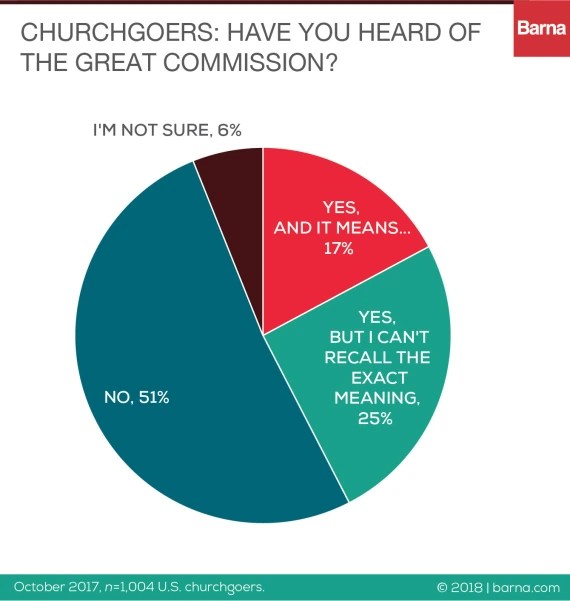
Have you ever heard the phrase “The Great Commission“? Do you know what it means? If not, you’re not alone…

photo courtesy of barna.com

The Barna Group recently conducted a study asking churchgoers if they had previously “heard of the Great Commission.” In their report, 51% of Churchgoers Don’t Know of the Great Commission the results of the study were summarized thusly:

“…half of U.S. churchgoers (51%) say they do not know this term. It would be reassuring to assume that the other half who know the term are also actually familiar with the passage known by this name, but that proportion is low (17%). Meanwhile, ‘the Great Commission’ does ring a bell for one in four (25%), though they can’t remember what it is. Six percent of churchgoers are simply not sure whether they have heard this term ‘the Great Commission’ before.”

Now, if you know anything about statistics, you know how important it is to structure your questions carefully and get a representative sampling of the population you’re surveying in order to get the most accurate results. What does “churchgoer” mean? Is it possible people have never heard the term “The Great Commission” simply because churches don’t use this particular phrase any more? It’s important to take things like this into consideration because it affects the results of the survey. (You can find out more about Barna’s structuring process for this study at the end of the article linked above.) But even if the numbers of the Barna survey aren’t exact, I think it’s safe to say there are a lot of people out there in churchland who aren’t familiar with The Great Commission.

Just for fun, let’s see what the results would be if we surveyed readers of my blog:

The Great Commission refers to some of Jesus’ final words to the disciples before His ascension and is cited from Matthew 28:18-20:

And Jesus came and said to them, ‘All authority in heaven and on earth has been given to me. Go therefore and make disciples of all nations, baptizing them in the name of the Father and of the Son and of the Holy Spirit, teaching them to observe all that I have commanded you. And behold, I am with you always, to the end of the age.’

With these words Jesus commissioned the eleven remaining disciples to go out into the world and carry on His mission. Since every Christian is a disciple, or follower, of Christ, this is our commission from Him as well. Let’s examine what it says.

All authority in heaven and on earth has been given to Me.
Before commissioning his disciples, Jesus reminds them that everything He’s about to say is founded on and imbued with His authority. Jesus alone has the divine authority to establish the church and to dictate the way in which His church is to be set up and to grow.

We 21st century Christians would do well to keep forefront in our minds and hearts the authority of Christ over His church. There is no need for churches to “cast vision” or come up with mission statements. Christ is the head of the church and has already given us His vision for it. The Great Commission is His mission statement for the church.

Go therefore
“Therefore” in this little phrase refers back to what Christ has just said about His authority. In other words, because all authority in heaven and on earth has been given to Me, I am telling you to go.

“Go” is a very generic verb in English. We can “go” into the kitchen or we can “go” to the moon or we can “go” out and conquer the world. We can “go” anywhere from our own personal microcosm to the edges of the known universe. And that is the same sense the Greek word πορεύω captures: as you “go your way,” as you “go forth,” as you “walk”, as you “pursue the journey on which [you have] entered.” Wherever life takes us, whether it’s across the street or across the world, we go as ambassadors of Christ, carrying the good news of the gospel with us.

All nations
Revelation 7:9 tells us that God will save people from “every nation, from all tribes and peoples and languages.” So that’s who we share the gospel with as we go our way. Everybody. Regardless of where they’re from, what they look like, or how they talk. We are not to withhold the gospel from anyone, and we’re to make sure the church is proactively carrying the gospel to every populated geographical location on earth.

Make disciples…teaching them to observe all that I have commanded you
Notice the language Jesus uses here. He doesn’t say “make converts” or “make Christians”. He says “make disciples.”

Think about what the disciples did while Jesus was on earth. First, they answered His call to follow Him. Then, they began the journey of following Him wherever He went. He trained and equipped them day and night. They loved Him and worshiped Him. They imitated the things He did and said. They carried on His work after He ascended. Jesus is saying to the disciples, and to us, “Replicate yourselves. Make more like you.”

That means that the Great Commission starts with sharing the gospel with a lost person, but it doesn’t end there. There’s more to our mission than just evangelism. We are to train and equip Christians to follow Jesus daily, to love and worship Him, to imitate Him in obedience, and to carry on His work.

Baptizing them in the name of the Father and of the Son and of the Holy Spirit
After salvation, baptism is the first step a new Christian takes on the road of discipleship. It is not optional. Baptism publicly identifies a person – to the church and to the world – as a Christian, and is a personal pledge to follow Christ obediently all the days of one’s life.

Being baptized “in the name of the Father and of the Son and of the Holy Spirit” carries several layers of meaning.

💧Again, pay careful attention to the language in this phrase. Jesus does not say “in the nameS” – plural. He says, “in the name” – singular. This is a boldly Trinitarian statement directly from two of its members: Jesus, who spoke these words to the disciples, and the Holy Spirit, who breathed them out through the pen of Matthew. This is God Himself telling us who He is. Jesus spoke these words to good Jewish boys who were born and bred on the shema: “Hear, O Israel: The Lord our God, the Lord is one.” There was to be no confusion for new Believers back then, Believers today, or to the onlooking world, as to who these Christians are following. They are not following three different gods. They are following the one true God in three Persons: God the Father, God the Son, and God the Holy Spirit – the whole ball of wax.

💧Names meant far more in biblical times than they do to us today. We see God changing people’s names – Abram to Abraham, Jacob to Israel, Simon to Peter, etc. – when He commissioned them for a new mission or phase of life. Being baptized “in the name of” the Father, Son, and Holy Spirit echoes that tradition of God changing people’s names. You are no longer your own, you are Christ’s. You are no longer “Sinner”, you are “Saint”. You no longer go forth in your own name, but in the name of the Father, Son, and Holy Spirit as their emissary, endowed with the power and authority of God to live for Him and to proclaim the gospel to a lost and dying world.

💧Because Christians are, by definition, Trinitarians, and because baptizing a Believer is commissioning her to go forth into the world as a representative of Christ, it’s appropriate for pastors to take this verse literally when performing a baptism and verbalize its words: “I baptize you in the name of the Father, and of the Son, and of the Holy Spirit.”

Basic Training: Baptism

And behold, I am with you always, to the end of the age.
What a sweet promise, both to the disciples and to us today. Obediently following Christ in our daily lives, sharing the gospel, and making disciples can be lonely, exhausting, and discouraging at times. But we don’t have to do it alone, and we don’t have to do it in the flesh. Christ is with us and He knows all too well how hard it can be. God has given the Holy Spirit to indwell and empower Believers to live for Him and to carry out The Great Commission.

Additional Resources

What is the Great Commission? at Got Questions

The Great Commission by John MacArthur

The Great Commission by Burk Parsons

Worship

God’s Not Like “Whatever, Dude,” About The Way He’s Approached in Worship

Social media is a strange universe to live in. There’s a lot of stupidity, but there’s also a lot that can be learned from various trending issues.

Such was the case recently when Christian social media was up in arms (and rightly so) about Cory Asbury’s worship song Reckless Love, and whether or not churches should use it in their worship services. Discussion centered around the use of the word “reckless” to describe God’s love for us and whether or not that was a semantically and theologically appropriate adjective. “Relentless” was suggested as an alternative lyric. “Reckless” was defended as an appropriate lyric. And then Cory Asbury’s explanation of the song came to light and did further injury to his doctrinal cause.

It was all a very interesting and helpful discussion, but, to some degree, it was a rearranging of deck chairs on the Titanic.

‘Cause we’ve hit the ice berg, folks. And the ship is taking on water.

Focusing on the word “reckless” missed the point – at least the big picture point. You see, Reckless Love was produced by Bethel Music. And Cory Asbury is a “worship leader, songwriter and pastor” with the Bethel Music Collective. Prior to joining Bethel, he spent eight years as a worship leader with the International House of Prayer (IHOP).

Why is this important? Because Bethel “Church” in Redding, California, and IHOP are, functionally, ground zero for the New Apostolic Reformation heresy. Heresy. Not, “They just have a more expressive, contemporary style of worship,”. Not, “It’s a secondary theological issue we can agree to disagree on.” Heresy. Denial of the deity of Christ. Blasphemy of the Holy Spirit. Demonstrably false prophecy that the head of IHOP, Mike Bickle, has publicly rejoiced in (He estimates that 80% of IHOP’s “prophecies” are false.) And that’s just the tip of our metaphorical ice berg when it comes to the NAR.

IHOP and Bethel are, by biblical definition, not Christian organizations and certainly not Christian churches. They are pagan centers of idol worship just as much as the Old Testament temples of Baal were. The only difference is that, instead of being creative and coming up with their own name for their god, they’ve stolen the name Jesus and blasphemously baptized their idol with that moniker.

The point in this whole debate is not the word “reckless”. The point is that Christian churches should not have anything whatsoever to do with idol worshiping pagans as they approach God in worship. Yet Sunday after Sunday churches use Bethel music, Jesus Culture music, Hillsong music, and the like, in their worship of God.

And it’s not just that churches are using music from the temples of Baal in their worship services. We have women who usurp the teaching and leadership roles in the church that God has reserved for men – many even going so far as to preach to men and/or hold the position of “pastor”. We have men setting themselves up as pastors who do not meet the Bible’s qualifications. We have churches that let anyone – Believer or not – participate in the Lord’s Supper. We have pastors who welcome false teachers and their materials into their churches with open arms and castigate anyone who dares point out the false doctrine being taught. We have preachers who have forsaken God’s mandate to preach the Word and use the sermon time to talk about themselves, deliver self-help tips, or perform a stand up comedy routine.

And everybody seems to think God’s up there in Heaven going, “Cool! Whatever y’all want to do in the name of worship is just fine and dandy with Me. You do you.”

Well, He’s not.

God demands – and has every right to do so – that He be approached properly. In reverence. In awe. In holy fear. With clean hands and a pure heart.

Who shall ascend the hill of the Lord?
And who shall stand in his holy place?
He who has clean hands and a pure heart,
who does not lift up his soul to what is false
and does not swear deceitfully.
He will receive blessing from the Lord
and righteousness from the God of his salvation.
Such is the generation of those who seek him,
who seek the face of the God of Jacob.
Psalm 24:3-6

Let’s take a stroll through Scripture and be taught by those who learned that lesson the hard way…

Cain

Most of the time, when we read the story of Cain and Abel, we focus on the fact that Cain killed his righteous brother. But we tend to gloss over the event that precipitated the murder. Cain and Abel both brought offerings to the Lord. God accepted Abel’s offering but rejected Cain’s.

Scripture doesn’t tell us why God found Cain’s offering unacceptable. The Levitical laws delineating offerings and sacrifices hadn’t yet been given, and even if they had, grain offerings and other offerings of vegetation were perfectly appropriate if offered at the right time and for the right reason. Was it because Cain had a wrong attitude or motive when he gave his offering? Or maybe because he offered God leftover produce instead of his firstfruits? We don’t know. What we do know is that God had a standard of how He was to be worshiped, Cain violated it, and God expressed His displeasure.

Aaron and Israel

It’s shortly after the Exodus. The Israelites have seen God perform ten – count them – ten plagues on Pharaoh for his idolatry and failure to bow the knee to God’s command to let Israel go. They saw God destroy the entire Egyptian army in the Red Sea. And now, their fearless leader, Moses, has trekked up Mount Sinai and is late getting back. The people are worried and restless.

Does Aaron lead them to pray? Trust God? Be patient? Nope. He fashions an idol for them – a golden calf. And if that wasn’t bad enough, he wasn’t even creative enough to come up with his own name for this idol. He stole God’s character and work and blasphemously baptized the idol with that moniker. He led the people to worship the false god as though it were the true God. (Does that ring any bells?)

“These are your gods, O Israel, who brought you up out of the land of Egypt!” When Aaron saw this, he built an altar before it. And Aaron made a proclamation and said, “Tomorrow shall be a feast to the Lord.” And they rose up early the next day and offered burnt offerings and brought peace offerings.

Surely God gave them a pass, right? I mean, Moses broke the tablets of the Ten Commandments when he came down from the mountain before they even had a chance to read the first and second Commandments that prohibited what they were doing.

Uh uh. God told Moses to get out of the way so He could fire bomb Israel off the face of the Earth and start over with him. It was only after Moses pleaded with God to stay His hand that God relented and allowed for the lesser punishment of having the Levites kill 3,000 of them with the sword and sent a plague on the rest of them.

Doesn’t exactly sound like an “anything goes in worship” kind of God, does He?

Nadab and Abihu

Now Nadab and Abihu, the sons of Aaron, each took his censer and put fire in it and laid incense on it and offered unauthorized fire before the Lord, which he had not commanded them. And fire came out from before the Lord and consumed them, and they died before the Lord. Then Moses said to Aaron, “This is what the Lord has said: ‘Among those who are near me I will be sanctified, and before all the people I will be glorified.’” And Aaron held his peace.

Are you seeing a pattern here? God is so not OK with people approaching Him irreverently, via idol worship, or in any other way He deems inappropriate that He’s willing to kill them.

Saul

God sends Saul and his army on a mission to defeat the Amalekites. His instructions are simple: completely destroy everything. “Do not spare them, but kill both man and woman, child and infant, ox and sheep, camel and donkey.”

But Saul’s a smart guy, see? He knows better. He goes in and destroys all the worthless stuff, but saves the good stuff for himself. It’ll be OK with God, he reasons, because he’s going to take some of the really nice sheep and make a big, showy sacrifice. Like a rich man pitching pennies to an urchin shoeshine boy.

And when Samuel confronts Saul about his rebellion, “Why then did you not obey the voice of the Lord? Why did you pounce on the spoil and do what was evil in the sight of the Lord?”, Saul has the temerity to say, “I have obeyed the voice of the Lord.” Because he was going to perform an act of worship. And the fact that he was doing it his way instead of God’s way didn’t matter. In Saul’s mind, it was the outward act that counted and God should have accepted it.

God didn’t see it that way:

And Samuel said,
“Has the Lord as great delight in burnt offerings and sacrifices,
as in obeying the voice of the Lord?
Behold, to obey is better than sacrifice,
and to listen than the fat of rams.
For rebellion is as the sin of divination,
and presumption is as iniquity and idolatry.
Because you have rejected the word of the Lord,
he has also rejected you from being king.”

God is not pleased with worship offered by hands dirtied with sin and rebellion. Saul paid the price: his throne and God’s favor.

Uzziah

Uzziah started off well as king of Judah. He listened to the counsel of Zechariah, obeyed God, and prospered. But after a while, prosperity can make you proud, and that’s just what happened to Uzziah.

He became so proud, in fact, that he took it upon himself to enter the sanctuary of the temple and offer incense to God on the altar. That was a position of leadership restricted to the priests. Uzziah had never been installed as a priest because he wasn’t biblically qualified to hold the office of priest, much like many who take on the role of pastor today.

Bravely, Azariah and eighty of his fellow priests stood up to the presumptuous king – at the risk of their lives, but in defense of proper worship as commanded in God’s Word – rebuked Uzziah, and kicked him out of the temple. “You have done wrong,” they said, “and it will bring you no honor from the Lord God.”

Well! Uzziah was hot with anger. How dare these mere priests stop him – the king whom God had blessed and prospered – from worshiping God any way he wanted to!

Guess who God sided with? The priests who were upholding His Word and His standard of worship. God struck Uzziah with leprosy for the remainder of his life, which exiled him from the palace and a royal burial, and effectively ended his reign.

The Pharisees

Hypocrites! Blind guides! Fools! Blind men! Greedy! Self-indulgent! Whitewashed tombs! Lawless! Serpents! Brood of vipers! Murderers!

How would you like to be dressed down like that by Jesus? You’re teaching the Scriptures. You’re tithing to the nth degree. You’re traveling over land and sea to proselytize. You’re behaving with outward righteousness. You’re memorializing the prophets. As far as you can tell, you’re doing pretty well with this holiness thing.

And here comes the Messiah – the One you’re (supposedly) doing all of this for – and He shames you. Publicly. He exposes your blackness of heart to the commoners you want looking up to you. All because God’s way is for you to worship Him in spirit and in truth, but you insist on doing it your way- for all your deeds to be seen by others, and because you love the place of honor at feasts and the best seats in the synagogues and greetings in the marketplaces and being called rabbi by others.

You’re approaching God in arrogance and selfishness, and He will have none of it. You won’t die to self, so He – if only temporarily – kills your pride.

The Corinthian Church

You’ve probably never seen a Lord’s Supper as messed up as the way the Corinthian church was doing it. Some people were going without while others were getting drunk. The “important” people got to go first while the poor and lower class went to the back of the line. People were using the Lord’s Table as an opportunity for selfishness rather than putting self aside and focusing on the fact that the purpose of this meal was to proclaim the Lord’s death until He comes.

That wasn’t acceptable to God. He didn’t want the church observing the Lord’s Supper just any old way. It was dishonoring to Christ and shameful to His church.

So God declared that “whoever eats the bread or drinks the cup of the Lord in an unworthy manner will be guilty concerning the body and blood of the Lord…For anyone who eats and drinks without discerning the body eats and drinks judgment on himself. That is why many of you are weak and ill, and some have died.”

“But all of that was back in Bible times!” you might protest. “God isn’t killing anybody these days for worshiping Him improperly. In fact, some of the worst violators of God’s Word are rich ‘Christian’ celebrities!”

That’s right, they are. Exactly like God said they would be: “teaching for shameful gain what they ought not to teach.” And woe betide them when they stand before Christ in judgment. Because judgment is coming for them:

“Not everyone who says to me, ‘Lord, Lord,’ will enter the kingdom of heaven, but the one who does the will of my Father who is in heaven. On that day many will say to me, ‘Lord, Lord, did we not prophesy in your name, and cast out demons in your name, and do many mighty works in your name?’ And then will I declare to them, ‘I never knew you; depart from me, you workers of lawlessness.’
Matthew 7:21-23

God is high and He is holy, and so are His standards for those who approach Him. He expects His people to obey His Word about how He is to be worshiped.

“I, the Lord, do not change,” God says in the Old Testament. The New Testament tells us, “Jesus Christ is the same yesterday and today and forever.” God hasn’t mellowed out or calmed down or gotten more tolerant. The God who poured out His wrath on those who blasphemed Him with unbiblical worship in the Old Testament is the same God we worship this side of the cross. Nothing escapes His notice. He doesn’t let sin slide. Whether in this life, or the next, or both, there will be a reckoning for unbiblical worship.

When it comes to worship, God is not a “whatever” kind of God.


Additional Resources:

Why Our Church No Longer Plays Bethel or Hillsong Music (or Elevation or Jesus Culture), and Neither Should Yours

Reckless Love, Reckless Theology at Matter of Theology