Complementarianism, Mailbag, Rock Your Role

The Mailbag: Counter Arguments to Egalitarianism

What are some of your favorite counter-arguments to egalitarian theology? 

Such a great question for a plethora of reasons. One important reason is that it’s a hot topic right now that needs to be dealt with biblically in order to silence the lies and to make onlookers aware that the Bible does address this issue with the correct answer. Another reason is that, when you think through an issue via an apologetics, “point-counterpoint” framework, it really helps solidify in your mind, and give you confidence in, what the Bible has to say about the issue.

So let’s start off with some basics…

If “egalitarian” is a new term for you, let’s nail down what egalitarianism is and what complementarianism is. Both have to do with the issue of women’s roles in the church and in the home.

Egalitarianism is the anti-biblical view that women can do anything men can do in the context of the church and home. Women can be pastors, elders, heads of denominations, preach whenever, wherever, and to whomever they want, and they don’t have to submit to their husbands.

Complementarianism is the biblical view that women and men are of equal value and worth in salvation and in the imago dei, but have different, yet equally important roles in marriage and the church. Complementarians embrace the Bible’s teaching that women are privileged to portray the relationship of the church to Christ by graciously and joyfully submitting to our husbands. Complementarians honor and respect the high calling and unique gifting women have to disciple other women and to raise up the next generation of godly men and women by discipling our own, and other, children. Because this is such a weighty and arduous responsibility, we consider it a blessing that God has not also burdened us with the responsibility to preach, teach the Scriptures to men, or exercise authority over men in the context of the gathering of the church. Rather, we encourage the men who have been given this responsibility, leaving godly women free and unfettered to carry out the ministry God has given us.

Currently, there is a movement afoot to establish a third position regarding this issue. It’s often called soft complementarianism – an attempt to straddle the fence, make everybody in both camps happy, and have your cake and eat it too. There are a variety of beliefs among those who choose this label. Many would argue, for example, that a woman may not hold the office of pastor (i.e. she can’t be on staff as the pastor of a church), but it’s perfectly OK for her to guest preach the Sunday morning sermon. At least on Mother’s Day.

Let’s dispense with soft complementarianism right now. It is a position of compromise between the biblical and the anti-biblical. Compromising with sin has never been a biblical stance for God’s people to take. Ever. The Bible tells us “a little leaven leavens the whole lump.” You don’t have to consider yourself a full-blown egalitarian to infect the church with ungodliness. Just a little compromise, a little leaven, a little dab’ll do ya. And that little dab never makes the church or individual Christians more godly, more biblical, or more Christlike. It always leads to more compromise and greater ungodliness.

Furthermore, we don’t treat other sin and rebellion this way. No one would dream of saying, “I hold to a soft view of adultery. Only actual extra-marital sex is off the table. Kissing, touching, dating other people – that’s all fine.”

For those who would argue that complementarianism vs. egalitarianism is a secondary theological issue, I would argue vehemently that it should not be categorized this way. Egalitarianism is sin because it is rebellion against God’s Word. And it is extremely detrimental when high profile complementarians unhelpfully classify it as a “secondary issue”. I know all they mean when they say that is that it is not part of the ordo salutis or a linchpin doctrine of soteriology. But when Christians hear “secondary issue” what they think is, “Oh, this is an issue where both sides have genuine biblical support like pre/post/a- millennialism or credo/paedo baptism. We can just agree to disagree and both sides are biblical.” Nobody thinks that about adultery, murder, gossip, lying or any other sin, and we need to be more careful in our terminology lest we give people an opening to think that way about egalitarianism.

Rebelling against God’s commands regarding the role of women is either a sin or it is not. There is no middle ground, so so-called soft complementarianism is not a biblically legitimate position to take. If you’re a “soft complementarian,” you’re a functional egalitarian. And if you’re a Christian who’s toying with this idea, I urge and encourage you to repent, love Christ and His Word more than you love the world and its ideals, and unashamedly embrace and promote what the Bible says about the role of women.


The next foundational issue we need to explore is whom we’re addressing when we make these apologetic arguments.

There are only two kinds of people in the world: saved people and unsaved people. Which means there are only two kinds of people who hold the egalitarian view: saved people and unsaved people.

The Bible is abundantly clear that saved people have the mind of Christ. That means we think the way Jesus thinks and we view the world and the church the way Jesus views the world and the church. We deny ourselves, putting aside whatever we might want or think, and we submit, as Jesus did, to “It is written…“. Additionally, obedience (or lack thereof) to the commands of Scripture is an indicator of whether or not someone actually belongs to Him. In fact, God says if you claim to be a Christian and you habitually and unrepentantly walk in disobedience to, and rebellion of heart against, His commands, you’re a liar, and you don’t know Christ.

What this means in practical terms when dealing with any biblical issue – egalitarianism, evolution, abortion, homosexuality, etc. – is that a sizable portion of the people on the unbiblical side of the issue are unsaved. Because a saved person has the mind of Christ, she will embrace, believe, and obey God’s Word regarding these issues and come out of these unbiblical camps, and an unsaved person will continue to fight for the unbiblical position. A new or previously poorly discipled Christian may need to be taught what Scripture says about these things, and it may take some time for her to come to grips with God’s commands, but her nature is to fight her flesh to submit to God’s Word, not to make provision for her flesh to fight against God’s Word.

Why do we need to understand this crucial foundational concept in debating this issue? Because people who are unsaved regard the things of God as foolishness and they cannot accept them no matter how much you explain Scripture to them or how much sense you make. This is a spiritual issue that requires a spiritual solution – the Holy Spirit must save the person and open her eyes to the truth of His Word. Often, what the person you’re arguing with needs most is the gospel, not an argument about a theological issue. And you will need to be careful and wise to discern when your apologetics are helpful and effective with someone who truly wants to learn and accept the biblical view, and when it’s time to gather up your pearls, step out of the pigpen, and go home until the Holy Spirit does His good work in her heart.

So I guess all of the above would be my primary apologetic argument against egalitarianism: If you’re truly saved, the fruit of your new nature in Christ will be to forsake and repent of any opinions or positions you hold that conflict with Scripture and submit to, love, and obey God’s commands. If you’re not saved, your opinion doesn’t really matter when it comes to how the church is run because the church is the body of Christ – Believers – not the house of unbelief.


Another argument I’m fond of is what I call the “let’s take a stroll through the Bible” argument, because it addresses so many arguments about 1 Timothy 2:12 that it’s almost a “one size fits all” argument:

But the Bible only says one time that women can’t preach to men!

That was just Paul, as a human, saying women can’t teach men, not God.

That passage is about wives taking authority over their husbands, not about women preaching to or exercising authority over men in the church.

That instruction only applied to the women of the Ephesian church at that particular time.

Look at the overall general pattern of male headship and leadership in Scripture. First human created? A man. The Patriarchs? As the word implies โ€“ all men. Priests, Levites, Scribes? Men. Heads of the twelve tribes of Israel? Men. Major and minor prophets? Men. All kings of Israel and Judah? Men. Noahic, Abrahamic, Mosaic, and Davidic Covenants? All established between God and men. Authors of Scripture? Men. The forerunner of Christ? John the Baptist โ€“ a man. Messiah? A man. All of the apostles? Men. All of the pastors, elders, and deacons of churches in the New Testament? Men. Founder and head of the church? Christ โ€“ a man. Leader and head of the family? Men. Now which fits better with this pattern, women preaching to, teaching, and exercising authority over men in the church, or women not preaching to, teaching, and exercising authority over men in the church?

It’s not just one verse. The entirety of Scripture backs up 1 Timothy 2:12. Which means it wasn’t just Paul’s human idea, just for the women of Ephesus, or just about wives and husbands. Male headship and leadership in God’s foundational institutions – family and church – has been God’s idea, God’s plan since the dawn of Creation (as 1 Timothy 2:13-14 clearly explains). It’s much harder for someone claiming to be a Christian to throw out the whole Bible than to sweep one verse aside.


Another argument that often needs to be made is explaining the difference between descriptive and prescriptive passages of Scripture, because one of the most common arguments egalitarians will make is, “Look at Deborah! Look at Priscilla! Look at the women at Jesus’ tomb! Look at the women Paul commends in Romans 16! They were all in some sort of leadership or teaching position, so that means women can do anything in the church that men can do!” No. No it doesn’t.

Broadly speaking, there are two main types of Scripture: descriptive and prescriptive. Descriptive passages describe something that happened: Noah built an ark. Esther became queen. Paul got shipwrecked. These passages simply tell us what happened to somebody. Prescriptive passages are commands or statements to obey. Donโ€™t lie. Share the gospel. Forgive others.

If we wanted to know how to have a godly marriage, for example, we would look at passages like Ephesians 5:22-33, 1 Corinthians 7, and Exodus 20:14,17. These are all passages that clearly tell us what to do and what not to do in order to have a godly marriage.

What we would not do is look at Davidโ€™s and Solomonโ€™s lives and conclude that polygamy is Godโ€™s design for marriage. We would not read about Hosea and assume that God wants Christian men to marry prostitutes or adulteresses. We would not read the story of the woman at the well and think that being married five times and then shacking up with number six is OK with Jesus.

And when looking for instruction about the role of women in the church, we look to clear, prescriptive passages which tell us what to do and what not to do, not descriptive passages about various women in the Bible. Descriptive passages may support, but never trump, the clear instruction of prescriptive passages.

(Excerpted from my article Oh No She Di-int! Priscilla Didnโ€™t Preach, Deborah Didnโ€™t Dominate, and Esther Wasnโ€™t an Egalitarian. I’ve also addressed each of the women often trotted out in defense of the sin of role-busting in this article.)


Some try to make the argument that it’s OK for a woman to preach or teach Scripture to men if she’s doing it “under her husband’s/pastor’s authority”. Excerpted from my article Fencing off the Forbidden Fruit Tree:

When God tells us (in context, rightly handled, correct covenant, etc., of course) not to do something and we do it anyway, that is sin, right? Only God has the authority to say what is sin and what is not. No one โ€“ not your pastor, your husband, your parents, your best friend, the Pope, nobody โ€“ has the authority to tell you that itโ€™s OK to do something God has said is sin. That authority belongs to God alone.

Try inserting any other sin into that situation. Does your husband, pastor, etc., have the authority to tell you itโ€™s OK to lie? Cuss? Covet? Of course not. And why would they even consider doing such a thing?

If you were to ask your husband and pastor to show you from Scripture where God says itโ€™s OK for them to allow you to teach men, they would quickly realize that they are not basing their decision on Scripture (because there is no Scripture that allows them to do this), but on their own opinion that itโ€™s OK.

When God says “no,” no man has the right to say, “yes.” 


And there’s the “You don’t know Greek, so you don’t know what that passage really means. I do.” fallacy.


Some have tried to make the argument that 1 Timothy 2:12 is mistranslated – that “woman” and “man” should be translated as “wife” and “husband” – and that this passage isn’t prohibiting women from teaching men at all, it’s really about marriage. The short answer to that is: hogwash. If you’d like to read the longer version, check out my article The Mailbag: Potpourri (…Mistranslating 1 Tim. 2:12…) (second question).


And finally, if a Christian struggles with the biblical argument against egalitarianism, God has graciously given us a real-time, tangible, visible argument against it. Take a look at all the once doctrinally sound Christian churches and denominations that are now apostate – the ones that embrace homosexuality, New Apostolic Reformation heresy, preach morality or liberal politics instead of the gospel, etc. They all followed the same pattern. The very first step they took on the road to apostasy was “soft complementarianism”: letting women teach co-ed Sunday school classes, preach on Mother’s Day, hold committee positions that placed them in biblically improper authority over men, and so on. The next step was full blown egalitarianism: allowing women to be elders, ordaining women as pastors, placing women in unbiblical denominational leadership positions. Next came embracing homosexuality: extending church membership to unrepentant, practicing homosexuals (and now, transgender people), ordaining them, and allowing them to serve in any and every position of church and denominational leadership, including the pastorate. And the final step is abandoning the gospel and the authority and sufficiency of God’s Word altogether. It happened to the Lutherans, the Episcopalians, the Methodists, the Presbyterians, scores of non-denominational churches, and now it’s happening to Southern Baptists. Not a single church or denomination that has embraced egalitarianism has become holier, truer to God’s Word, or more spiritually healthy. They have all ended up dead eventually, and the true Christians in those churches and denominations have left to form biblical churches and denominations.

Egalitarianism is anti-biblical, harmful to men, women, and the church, and dishonoring to God. We may not be able to convince every egalitarian to repent and embrace what God’s Word says about the role of women, but it’s important to think through this issue in a biblical way, and using an apologetic framework is a great way to do that.

Additional Resources:

Rock Your Role Series

Jill in the Pulpit

Oh No She Di-int! Priscilla Didnโ€™t Preach, Deborah Didnโ€™t Dominate, and Esther Wasnโ€™t an Egalitarian

Women Preaching: Itโ€™s Not a Secondary Doctrinal Issue

All Things Being Equal

Rock Your Role FAQs

Fencing off the Forbidden Fruit Tree

The Mother of All Rebellions: Having a Woman Preach on Mother’s Day

Ten Things You Should Know About 1 Timothy 2:11-15 and the Relationship Between Men and Women in the Local Churchย at The Council on Biblical Manhood and Womanhood (CBMW) This is a refutation of the most common egalitarian arguments against the plain meaning of 1 Timothy 2:11-15.

The Paul-Side Gambit: How A Proper Understanding of Apostolic Authority Defeats Womenโ€™s Ordination by Chris Rosebrough


If you have a question about: a Bible passage, an aspect of theology, a current issue in Christianity, or how to biblically handle a family, life, or church situation, comment below (Iโ€™ll hold all questions in queue {unpublished} for a future edition of The Mailbag) or send me an e-mail or private message. If your question is chosen for publication, your anonymity will be protected.

Favorite Finds

Favorite Finds ~ May 14, 2019

Here are a few of my favorite recent online findsโ€ฆ

“Complementarian interpretation of Scripture holds that Godโ€™s creation purpose for man and woman entails equality of individual value but also distinct roles.” Our friends over atย Crosswayย give us 5 Myths about Complementarianism.


Image result for taking god at his wordHow about a free book? Here’s the PDF of Kevin DeYoung’s book Taking God at His Word: Why the Bible is Knowable, Necessary, and Enough, and What that Means for You and Me.


Image result for 50 of all marriages end in divorce“Youโ€™ve heard it repeatedly on radio, podcasts, and TV. Youโ€™ve read it in various books and articles. Youโ€™ve even heard it in your pastorโ€™s sermon. The problem: itโ€™s a lie: 50% of all marriages end in divorce.”ย The Cripplegate helpfully explains why everything you know about American divorce statistics, including the divorce rate among Christians, is probably wrong in The 50% Lie.


โ€œImage result for ccef‘No’ to a husbandโ€™s advances is a big deal in a marriage. A godly wife can certainly say โ€œnoโ€ but she will also be alert to the way her response might be taken by her husband. Understanding and compassion can go a long way at these moments.”ย CCEF explores the sensitive subject of marital intimacy in โ€œNot tonight dearโ€โ€ฆ men rejected.


On his most recent episode ofย Ask Anything,ย Dr. Albert Mohlerย tackles a number of interesting questions, not the least of which is (from a Southern Baptist perspective) Should women preach the Sunday sermon in church? (8:58).

Mailbag

The Mailbag: Potpourri (Pianist leading worship, hosting a women’s event, re-baptism…)

Welcome to another โ€œpotpourriโ€ edition ofย The Mailbag, where I give short(er) answers to several questions rather than a long answer to one question. I also like to take the opportunity in these potpourri editions to let new readers know about my comments/e-mail/messages policy. Iโ€™m not able to respond individually to most e-mails and messages, so here are someย helpful hintsย for getting your questions answered more quickly.ย Remember, the search bar can be a helpful tool!

In these potpourri editions of The Mailbag, I’d also like to address the three questions I’m most commonly asked:

“Do you know anything about [Christian pastor/teacher/author] or his/her materials? Is he/she doctrinally sound?”

Try these links:ย 
Popular False Teachersย /
ย Recommended Bible Teachersย /ย search bar
Is She a False Teacher? 7 Steps to Figuring It Out on Your Own
(Do keep bringing me names, though. If I get enough questions about a particular teacher, I’ll probably write an article on her.)

“Can you recommend a good women’s Bible study?”

No. Here’s why:
The Mailbag: Can you recommend a good Bible study for women/teens/kids?
The Mailbag: โ€œWe need to stop relying on canned studies,โ€ doesnโ€™t mean, โ€œWe need to rely on doctrinally sound canned studies.โ€.

“You shouldn’t be warning against [popular false teacher] for [X,Y,Z] reason!”

Answering the Opposition- Responses to the Most Frequently Raised Discernment Objections


Usuallyย The Mailbag is all about mail I’ve received from readers, but today, I want to start by sending a thank you note to you!

Thank you from the depths of my heart to each and every one of you who donated so graciously and made it possible for me to speak at the Cruciform Conference in Indianapolis this October. I was floored by your generosity and it was a great way to celebrate my birthday. I’m so honored that you would partner with me in ministry to the ladies at the conference. Thank you and God bless you.

(I tried to make sure I sent an individual thank you message/e-mail to each donor, but if you donated anonymously or I somehow missed being notified of your donation, I apologize and hope you’ll accept my thanks here.)

If you’re going to be in the area, come on out toย Cruciform. It will be a blessing to you, and I’d love to meet you!


I’m the pianist at my church, and my pastor has asked me to select the hymns for our worship services because it takes a lot off him and helps him out. I select the songs from a certain hymnal and two other doctrinally sound sources. Am I in an unbiblical position of “leading” the worship service when I select these songs?

This is a great question. It’s so encouraging when Christian women want to be godly in every aspect of their ministry at church!

No, that’s not leading, that’s serving your pastor and your church. Basically what you’ve got here is a body of songs your pastor already approves of, and he has asked you to whittle it down to four or five songs each week from this pre-approved “list”.

If you choose a song he doesn’t like for some reason or that doesn’t fit with what he’s preaching that week, he always has the prerogative to say, “This song isn’t a fit this week. Could you please choose a different one?” In essence, you’re presenting him with suggestions and he makes the final decision, so he’s still the one in the position of authority. I used to do the same thing for my husband when he was a minister of music at one of our former churches.

Thank you for serving your pastor and your church!


I loved your article Women’s Events on a Shoestring Budget. The funding tips encouraged me to put on an event for our ladies, but our small church has never done anything like this before. What kind of event should we have and how should we get started?

I was so encouraged to get a couple of questions like this in response to my article. Even at a small church (and sometimesย especially at a small church) a women’s event can really help refresh and build up the ladies of your church. It can be a great outreach to the ladies of your community, too.

I would recommend starting small and then growing year by year. For example, if I were in a church with an attendance of 50-150, I would start with an in-house (only ladies from your own church) mini-conference. A Saturday morning simple breakfast (coffee, doughnuts, fruit – food that’s easy to get, serve, and handle), followed by a local speaker (maybe the pastor’s wife at a sister church, or even one of the ladies in your own church) and a couple of songs. You could end there, or possibly have a time of discussion around the tables afterward, or just allow the ladies to hang around and fellowship with each other.

The next year, you could build on that. Maybe the speaker does two sessions with a break between, and you invite/publicize to other local churches. The following year, you could do an overnight retreat or you could expand the conference to an all day thing and have more than one speaker. If you start small and grow your event each year, you’ll learn things you should and shouldn’t do differently along the way, and you won’t be biting off more than you can chew the first time out.

Another thing that might be a good idea is to have a meeting with all of your ladies and ask them what kind of event they’d like. You might be thinking “conference” and they might be thinking “movie night”. It’s good to brainstorm and take the pulse of your ladies on what they’d prefer.

You could also get the men of your church involved in putting together and serving at your conference or event. I spoke at one conference where the men of the church actually put on the conference for their ladies – to honor and thank them. That was one happy bunch of ladies!

Just remember what I said in the article: Donโ€™t try to compete with the expensive glitz, glam, and giveaways of mega-conferences. You do you, your church or host organization…And remember, itโ€™s the caring and hospitality of the hosts that will make the greatest impact on your attendees, not the swanky food, decorations and swag bags.


I wanted to let you know I saw an inappropriate advertisement on your blog.

Thank you so much for letting me know. Rest assured, I don’t choose those ads, nor do I have any control over them. I can’t even see them from my end. I’m in the process of considering some formatting changes to the blog that may (or may not) put an end to the ads.

In the meantime, my articleย Advertising Reduxย explains what you can do to avoid those inappropriate and annoying ads on my site and on other sites as well.


I have a friend who was baptized as an infant, but since she was baptized in the name of the Trinity, she feels as though she can not be re-baptized as an adult believer. How would you speak to her?

I’ll bet that’s kind of a challenging road to navigate as her friend, isn’t it? Without a great deal more information I’m hesitant to give a definitive answer, but hopefully I can point both of you in a helpful direction.

I’m assuming if your friend is considering being baptized, she’s either a member of a local church or a candidate for membership at a local church. The first thing I would want to make sure of is that she’s in a doctrinally sound local church, because the second thing I’m going to advise is that she set up an appointment with her pastor to discuss this issue of baptism. (If the church she’s in isn’t doctrinally sound, getting her into one that is is job one, not baptism. Check out the Searching for a new church? tab at the top of this page.)

Different churches and denominations have different understandings of baptism. Her pastor can explain to her how her church views baptism, why it is requiring(?) her to be re-baptized for membership, and how it understands Trinitarian paedo (infant) baptism versus credo (Believer’s) baptism.

Once she has sat down with the pastor and had all of her questions answered, she will need to search the Scriptures, pray for wisdom, and make sure her understanding of baptism lines up with that of the church she’s considering being baptized into. If it does not, she will need to further study the Scriptures to determine whether or not her personal view of baptism is indeed biblical. If it is but does not align with her current church, she will probably need to find a new church whose view on baptism she agrees with.


If you have a question about: a Bible passage, an aspect of theology, a current issue in Christianity, or how to biblically handle a family, life, or church situation, comment below (Iโ€™ll hold all questions in queue {unpublished} for a future edition ofย The Mailbag) or send me anย e-mail or private message. If your question is chosen for publication, your anonymity will be protected.

1&2 Timothy Bible Study

1 & 2 Timothy: Lesson 1- Introduction

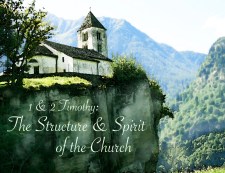
Welcome to our new study, 1 & 2 Timothy: The Structure and Spirit of the Church!

What is God’s plan for the church? How did He intend for it to be structured and run, and what is His vision for us, His people, as we worship Him and love and care for one another? For the next several weeks we’ll work our way through the books of 1 & 2 Timothy, one of God’s “policy and procedure manuals” for the church, to learn about its organizational skeleton as well as the spirit of its people.

Many thanks to those who worked so hard on their entries for our title pic contest. You ladies were very creative and did some beautiful work!ย 


Cheryl Toepferย  ย  ย  ย  ย  ย  ย  ย  ย  ย  ย  ย  ย  ย  ย Becky McGraw


Patti Greenย  ย  ย  ย  ย  ย  ย  ย  ย  ย  ย  ย  ย  ย  ย  ย  ย  ย  Terri Mobley

In the end, I had such a hard time figuring out how to capture the theme I had in mind for the study – bouncing from one thought to another and discontent with every idea that popped into my mind – that I decided to design the title pic myself. (If there’s a chance I might end up dissatisfied, I’d rather be dissatisfied with my own work than the work of one of you lovely ladies!)

My thought is that the sunrise in this photo conveys the idea of the dawn of the church in history, when 1 & 2 Timothy were written. As the light of God’s instruction “rises” upon the church as they read through these epistles, it clears away the surrounding fog of uncertainty about God’s will and His ways for His people. Also, I really like the colors. :0)

If you’re new to using my Bible studies, just a few housekeeping items and helpful hints:

The studies Iโ€™ve written (you can find all of them at the Bible Studies tab at the top of this page) are like โ€œtraining wheelsโ€. Theyโ€™re designed to teach you how to study the Bible for yourself and what kinds of questions to ask of the text so that, when you get the hang of it, you wonโ€™t have to depend on other peopleโ€™s books and materials โ€“ even mine โ€“ any more. To that end, I do not provide answersย for the study questions in the studies Iโ€™ve written.

My studies are meant to be extremely flexible and self-paced so that you can use them in the way that works best for you. You can do an entire lesson in one day or work on the questions over the course of the week (or longer). You do not need to feel obligated to answer all (or any) of the questions. If the Holy Spirit parks you on one question for several days, enjoy digging deep into that one aspect of the lesson. If He shows you something I haven’t written a question about that captures your attention, dive in and study it! Those are ways the Holy Spirit speaks to us through His Word. This is your time to commune with the Lord, not a school assignment or work project you are beholden to complete in a certain way by a certain deadline.

I will post a new lesson on the blog every Wednesday, so there is nothing to sign up for or commit to. Simply stop by the blog each week, or subscribe to the blog via e-mail to have the lessons delivered to your inbox.

With our last study (Imperishable Beauty) I “beta tested” a Facebook discussion group specific to that study. It was enthusiastically received, but after the first couple of weeks, there was virtually no participation. So with this study, I’ve decided not to put in the extra work of admin-ing a discussion group. You are welcome to form and admin your own discussion group if you like. I will also post the lessons on my own Facebook page each week, and anyone who would like to discuss the lesson can do so in the comments section of those posts.

I use hyperlinksย liberally.ย The Scriptures for each lesson will be linked either at the beginning of the lesson or in the lesson questions. Whenever you see a word in red, click on it, and it will take you to a Scripture, article, or other resource that will help as you study.

All of the studies Iโ€™ve written are suitable for groups or individuals. You are welcome to use them as a Sunday school or Bible study class curriculum (for free) with proper attribution.

You are also welcome to print out any of my Bible studies (or any article Iโ€™ve written) for free and make as many copies as youโ€™d like, again, with proper attribution. Iโ€™ve explained more about that inย this articleย (3rd section).


Introduction to 1 Timothy

Before we begin studying a book of the Bible, itโ€™s very important that we understand some things about that book. We need to knowโ€ฆ

Whoย the author was and anything we might be able to find out about him or his background.

Whoย the audience of the book is: Jews or Gentiles? Old Testament Israelites or New Testament Christians? This will help us understand the authorโ€™s purpose and approach to what heโ€™s writing.

Whatย kind of biblical literature weโ€™re looking at. We approach books of history differently than books of wisdom, books of wisdom differently than books of prophecy, etc.

Whatย the purpose of the book is. Was it written to encourage? Rebuke? Warn?

Whatย the historical backdrop is for the book. Is Israel at war? At peace? In exile? Under a bad king? Good king? Understanding the historical events surrounding a piece of writing help us understand what was written and why it was written.

Whenย the book was written. Where does the book fall on the timeline of biblical history? This is especially important for Old Testament books which are not always arranged in chronological order.

So this week, before we start studying the actual text of the book of 1 Timothy, we need to lay the foundation to understanding the book by finding the answers to these questions.

Read the following overviews of the book of 1 Timothy, taking notes on anything that might aid your understanding of the book, and answer the questions below:

Bible Introductions: 1 Timothyย at Grace to You

Overview of the Book of 1 Timothyย at Reformed Answers

Book of 1 Timothyย at Got Questions

1. Who wrote the book of 1 Timothy? How do we know this?

2. Approximately when was 1 Timothy written? What is the geographical setting of the book of 1 Timothy? Here are some maps (scroll down to โ€œ1 Timothyโ€) that may be helpful as you study through the book of 1 Timothy.

3. Who is the original, intended audience of the book of 1 Timothy? Describe the historical setting (historic events, politics, sociology of the time, etc.) of 1 Timothy.

4. Whichย genre of biblical literature is the book of 1 Timothy: law, history, wisdom, poetry, narrative, epistles, or prophecy/apocalyptic? What does this tell us about the approach we should take when studying this book versus our approach to books of other genres?

5. What is the theme or purpose of the book of 1 Timothy?

6. What are some of the major topics of instruction in the book of 1 Timothy? How do these topics relate to the theme of 1 Timothy?

7. What are some ways 1 Timothy points to and connects to Jesus?

8. What else did you learn about 1 Timothy or the setting of this book that might help you understand the text of the book better?

Take some time in prayer this week to begin preparing your heart for this study. What are some ways your pastor and church could be encouraged by the instruction of 1 Timothy? What might you learn that could make you a healthier church member? Do you have any areas that need improvement when it comes to the way you serve God or your brothers and sisters in Christ? Ask God to grow you in those areas as we study together 1 & 2 Timothy: The Structure and Spirit of the Church.
Speaking Engagements

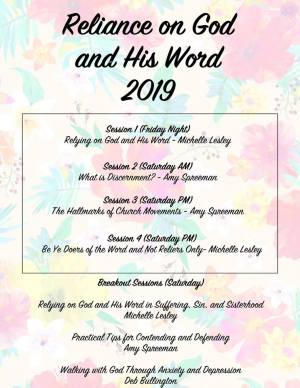
Reliance on God and His Word Conference Audio


It was my joy, recently, to speak at the Reliance on God and His Word conference at Princeton Bible Church.

PBC was so kind to record audio of the main sessions of the conference:

I hope you’ll enjoy my two sessions…

Relying on God and His Word


Be Ye Doers of the Word and Not Reliers Only


You can also listen at PBC’s website and hear Amy Spreeman’s wonderful sessions as well!

If your church is ever in need of a speaker for a womenโ€™s event, Iโ€™d love to come share with your ladies as well. Clickย hereย for more information.