Speaking Engagements

Nashville, AR, Conference: POSTPONED

UPDATE (February 15)

Ladies- I’m so sorry to inform you that this conference has been postponed due to inclement weather. We are working on setting up another date – hopefully soon. When the details are settled, I’ll let you know here on the blog. Until then, if you know someone who was planning to attend the conference this weekend, please let her know of the cancellation. Thanks.

Ladies, if you’re in the Nashville, ARKANSAS, area (please note, this is not in Tennessee), you’re invited to attend Maranatha Baptist Church’s women’s conference on Saturday, February 20.

I’ll be speaking on discernment and living under the authority of Scripture instead of being slaves to our emotions. We’ll also have a fun Q&A session to round out the day.

The conference is free and includes a continental breakfast and lunch, but you must RSVP directly to the church (not to me – contact info above) by the…

Registration Deadline – February 13

…so the hostesses can get a good headcount for food and materials.

If Arkansas is too far away for you, check out the calendar of events on my Speaking Engagements page (in the blue menu bar at the top of this page) and see if you can find one of my conferences in your neck of the woods.

If you still aren’t able to find an event to attend, host your own! I’d love to come speak to the ladies of your church or Christian organization. Now is the time to start planning for summer and fall conferences. Need a little help planning? I’ve got tips!

I hope to see you soon at an event near you!

Christian women, Church

Throwback Thursday ~ 10 Ways Godly Women Can Help Improve the Spiritual Health of Their Churches

Originally published June 10, 201610 ways healthy churches

Let’s face it, ladies- not one of us goes to a church that’s one hundred per cent spiritually healthy. Every church has its problems. Some, just a few; others, well… they’re more like “fixer uppers”. From the encroachment of false doctrine to women serving in improper places of authority to toxic personalities to sin being swept under the rug, what are we to do when we see things in our churches that conflict with Scripture? How can we bring about spiritual change without stepping outside the boundaries of biblical womanhood?

1. Make sure you’re understanding, viewing, and responding to the problem biblically
Are you basing your concern about the situation on a correct or incorrect understanding of Scripture? Is the problem actually a violation of Scripture or just something that rubs you the wrong way personally? Is it possible something you’re doing is contributing to the problem? Sometimes what needs to be changed in your church might be your incorrect understanding of Scripture, your behavior, or your heart attitude.

2. Pray
We are waaaaaaaaaaaaaaaaaaaaaaaaaaaaaaaaaaaaaaaaaaaaaaaay (yes, it really does require that many a’s) underestimating the role prayer plays in our churches in general, but especially the role it plays in changing things in the church. Don’t blow prayer off as unimportant or a last resort. Pray for your church every day. Pray about the problems you’re seeing in the church and the people involved. Pray for wisdom for your pastor and whoever is in charge of handling the problem. Pray about it faithfully, fervently, and according to Scripture. It’s not just a biblical motion to go through. I’ve seen God change things in response to prayer time and time again.

3. Approach the appropriate person
If you’ve been praying about the problem and the people involved, and you’re certain you have a biblically correct understanding of and outlook on the situation, and you think you need to address the issue with someone, go to the appropriate person in humility, kindness, gentleness, and patience and discuss it with him or her in the same way you would want to be approached. (And use wisdom- in some cases it might be best for your husband or another man to approach the person.)

Most of the time, the appropriate person to approach first is the person at the center of the problem. A lady in your Sunday School class is a gossip? Go to her first, not the Sunday school teacher. The women’s ministry director is selecting materials authored by false teachers? Go to her first, not the board of elders. Hopefully, you’ll “win your brother.” If not, Matthew 18:15-20 outlines the appropriate subsequent steps to take when dealing with sin. (And, P.S., don’t stop praying. Pray more.)

4. Set a good example
Conduct yourself like a lady – a godly lady – whether you’re dealing with a problematic issue, worshiping, serving, fellowshipping, teaching, learning, or whatever you’re doing at church. Be a velvet covered brick. Strong, firm, and unwavering from Scripture on the inside, meek, gentle, kind, and loving on the outside. Be obedient to Scripture. Repent and seek forgiveness when you sin. Maintain a reputation that’s above reproach. People are watching you, even looking up to you.

5. Be faithful
As Christians we are supposed to be faithful members of the local body of Christ. That means you become an official member. You attend services unless Providentially hindered. You show up on time. You give offerings. You join a Sunday school/Bible study/small group class. You plug in and serve. You bond with your brothers and sisters in Christ. You get invested in the life of the church. You can’t be a strong, godly influence on your church or have people take you seriously when you address a problem if you’re lackadaisical in your approach to church or you’re only there half the time.

6. Be humble and willing
Sometimes helping to resolve a problem in a godly way might require you to do something that, while biblical and appropriate, makes you feel uncomfortable. Maybe you’re introverted and scared to death to address an issue of sin with a fellow church member. Maybe you’re needed in a position of service you don’t have much experience in. Maybe that sister at church that you don’t really like needs a friend. Are you willing to humble yourself, put your own preferences aside, and serve the body of Christ in whatever way is needed?

7. Teach
If you know how to properly handle God’s word and you’re able to teach, find an open position and get in there, whether it’s a children’s Sunday School class, a women’s Bible study, discipling a younger sister one on one, or helping out with the youth girls. Biblical illiteracy is absolutely and astonishingly rampant in the church, which means there are Christians in your church who don’t know how to behave biblically, which means issues of sin will arise. Prevent those issues before they happen by correctly teaching God’s word to as many women and children as you can. (And if you don’t know how, get trained.)

8. Put on your work clothes and roll up your sleeves
We can no longer go to church with the attitude that we’re going to just row our boats gently down the stream and if a problem arises and somebody else doesn’t deal with it to our satisfaction, we’re leaving. Church isn’t the buffet line at Golden Corral, existing only to provide us with multiple options and opportunities for a pleasant worship experience. Church is often more like being employed by Roto Rooter- it’s hard, hot, sweaty, unpleasant work. Don’t turn tail and run at the first sign of trouble. God may have put you in that church to be a catalyst for biblical change. Maybe the problematic situation at church is not about your comfort. Maybe it’s about you helping the body of Christ.

9. Encourage, help, and pray for your pastor and other church leadership
Pastoring (and other ministry leadership positions) is a tough, often thankless job. Your pastor, associate pastor, minister of music, elders, deacons, teachers, etc., can use all the support they can get. Be generous with your attaboys. Volunteer to help out where you can. And, again, pray. Pray for wisdom and discernment for your pastor and leadership. Pray that God will grow them in their understanding and teaching of the Word. Pray for their marriages and parenting. Do what you can to support your leadership so they can be strong, healthy shepherds for the flock.

10. Keep your focus on Christ and trust Him
It’s easy to get so wrapped up in the details of a problem at church that we forget about God. Are you remembering that God loves and wants what’s best for your church and the people involved in the problem far more than you do? Have you stepped back, taken a deep breath, and recognized that changing people’s hearts and growing the church to maturity is on God’s shoulders, not yours? Are you acknowledging the fact that God is in control and is working in the situation even if you can’t see it? Do you believe that God is out for His glory and the good of His people even if visible circumstances suggest otherwise? Are you trusting in Christ Himself or are you trusting in a positive outcome to the situation?

No church is perfect, ladies. Your church has problems. My church has problems. Let’s work together with our brothers and sisters in the local body of Christ – humbly, lovingly, patiently, and as mature, godly women – to solve those problems and encourage our churches toward holiness and spiritual health.

Christian women

You Don’t Need Jezebel for a Role Model

In the midst of all the craziness going on out there, did you notice that, for the first time in history, the United States has a woman occupying the office of Vice President?

It’s been overshadowed a bit by the Covid vaccination, the protest at the Capitol, the “will they or won’t they” impeachment proceedings against former President Trump, the flurry of executive orders issued by President Biden in his first few days in office, and, of course, Bernie’s mittens.

Sorry to rain on your inaugural parade, there, feminists, but it seems like there aren’t very many folks – at least not as many as you’d probably like – celebrating this supposedly groundbreaking moment for women. I guess it’s kind of hard when the tribe you’re joined to has, for the moment anyway, left you in the wallflower line to dance with the “gender is just a social construct”
guys
gals
humans
huwomens

people.

But cheer up. A few gentlewomen of your ilk are out there beating the drum for Kamala Harris to be the Great American Role Model for young girls to look up to. She’s a woman in a position of power, after all, and that’s all that matters.

Or is it?

For Christian women and girls, it takes a lot more than two X chromosomes and a fancy job title to qualify as a role model, and Kamala Harris doesn’t even come close to being in the running.

For starters, she’s not a Christian. But it goes waaaaaay beyond that. You could probably recite with me the litany of the evils she stands for:

  • She promotes the torturing to death of babies in the womb, hopes to expand access to abortion, voted against protecting babies born alive after botched abortions, and votes against every piece of pro-life legislation that crosses her desk.
  • As California’s Attorney General she prosecuted David Daleiden for exposing Planned Parenthood’s illegal sales of aborted babies’ body parts.
  • She has voted in favor of banning abstinence-only sex education.
  • She was one of the original co-sponsors of the Equality Act, which enshrines sexual perversion lifestyles into a special legal class, thereby threatening the freedom of churches, Christian organizations, and others to operate according to biblical principles.
  • She is an outspoken advocate for the the sexual perversion lifestyle agenda
  • When same sex “marriage” was legalized in California, she praised the decision and celebrated it by performing the first same sex “wedding” in San Francisco.
  • She has been supportive of Black Lives Matter and many of their protest activities.

…and so much more.

Is everything she stands for evil? I doubt it. I would assume she’s not in favor of kicking puppies or armed robbery or littering, and probably lots of other things. But from a biblical perspective, in her capacity as a governmental leader, she generally advocates for wickedness. And that is certainly not the type of person Christians should look up to as a role model.

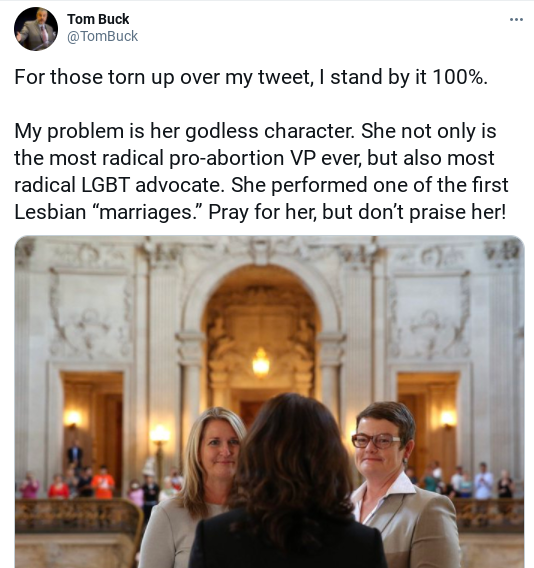
Which must have been what got my friend, Pastor Tom Buck, thinking about the evil Old Testament queen, Jezebel, and led him to make this astute observation on Twitter:

And, though he wasn’t actually calling Vice President Harris “Jezebel,”1 he’s absolutely right in drawing the comparison between Israelite women looking up to a wicked queen and Christian women looking up to a Vice President who fights for all sorts of things the Bible calls wickedness.

Do you know who Jezebel was and what she stood for? She was the wife of King Ahab, who, 1 Kings tells us, did more evil in the sight of the Lord, and did more to provoke the Lord, than all who were before him. And his “vice president,” Queen Jezebel, pushed him there.

Hold your nose and brace yourself, and let’s check out Jezebel’s bio:

1 Kings 16:31– Jezebel was the daughter of Ethbaal (whose name means “Baal is alive”). Idolatry was the way of life she had been raised in- an idolatry that required human sacrifice as a sacrament.

1 Kings 18:4,13– Jezebel “cut off” and “killed” the prophets of the Lord.

1 Kings 18:19– Jezebel welcomed, embraced, and honored the 450 false prophets of Baal and the 400 false prophets of Asherah.

1 Kings 19:1-2– After the showdown on Mt. Carmel in which God demonstrated through Elijah that He was the one true God, and Elijah put the prophets of Baal to death, Jezebel swore to kill Elijah, God’s representative to His people.

1 Kings 21:1-16– Jezebel, in the name of the king, ordered city officials to have false accusations of capital crimes levied against Naboth in order to execute him and steal his land, which Naboth, in obedience to God, had refused to give the king.

1 Kings 21:25– “There was none who sold himself to do what was evil in the sight of the Lord like Ahab, whom Jezebel his wife incited.” She encouraged the king toward greater wickedness.

2 Kings 9– God was so disgusted with Jezebel’s vile character and behavior that He destroyed Ahab’s lineage and killed Jezebel in one of the basest, most humiliating ways possible. Dogs, at the time, were wild, filthy, and despised, so much so that to call someone a “dog” was an outrageous epithet. And anyone not receiving a proper burial was looked upon as cursed by God. We’re given some hints in this chapter that Jezebel may have been sexually immoral, but Scripture places far more emphasis on her sins of idolatry (often called “whoring” in the Old Testament- indeed 2 Chronicles says “the house of Ahab led Israel into ‘whoredom'”, i.e. idolatry), rebellion against God, and general wickedness than on any acts of sexual immorality she may have committed.

That’s Jezebel. A woman in the second most powerful position in the country who facilitated the murder of innocent human beings, ran swiftly to do evil, and zealously defied the commands of the living God.

Let the reader understand.

You cannot look up at the cross of Christ and look up to Kamala at the same time. She champions the sins that nailed your precious Savior to the tree.

“So who can I point my daughters to as role models?” a reader recently asked me. “With so many false teachers out there, I can only think of one or two well known Christians I can hold up to them as examples.”

That’s OK, because you don’t need to.

Forget the evangelical celebrities, ladies. Teach your girls to look up to the godly older women in your church, and, if God has so blessed you, in your family. And you look to them, too.

Look for the women in your church who are like the godly widows of 1 Timothy 5. The ones who…

  • are deserving of honor
  • “set [their] hope on God and continue in supplications and prayers night and day”
  • have been faithful wives
  • have a reputation for good works
  • have been godly mothers
  • have shown hospitality, served God’s people, cared for the afflicted, and devoted themselves to every good work
  • are faithful to Christ
  • aren’t idlers, gossips and busybodies, saying what they should not
  • give the adversary no occasion for slander.

Look up to the women in your church who exemplify the godly character of the older women in Titus 2. Women who…

  • are reverent in behavior
  • control their tongues and speak of others in godly ways
  • don’t allow themselves to be controlled by alcohol or anything else but Christ
  • are able to teach and train young women to be godly women, wives, and mothers
  • strive to prevent the word of God from being reviled.

These are the women you and your girls should look to – not the celebrities who don’t even know you exist, but the older, spiritually mature real life women you know and have access to. The women you can pour your heart out to, call when you have a question, get wise counsel from when you need advice. That’s the biblical model – personal discipleship, not admiration from afar.

And ladies my age and older – those of us who have been married a minute and have managed to shoot our little arrows out the door and into lives of their own, who have flourished in a life of God-ordained singlehood, who have suffered the loss of a spouse or the loss of a marriage, those of us who have been there, done that, and been around the block a time or two – well, scroll back up there and read those character qualities from Titus and Timothy again, because those are the women we need to be. It’s all well and good to point these younger ladies to the godly older women in their churches, but we’d better be there for them when they show up. We need to strive to be able to say to them, as Paul said, “Imitate me as I imitate Christ.”

Younger women need, and older women need to be church “mothers” and “older sisters” who lead by example and nurture those under their care in real time.

Nobody needs Jezebel as a role model.


1Tom was accused by some of using a racial slur against Kamala Harris, because, apparently some consider the term “Jezebel” to mean “a promiscuous woman of color”. This was certainly news to me, Tom, and a host of others who had never heard such a thing before. He was (as am I in this article) strictly referencing the Jezebel of the Bible and her evil character, which had nothing to do with ethnicity, and little, if anything, to do with sexual immorality. Jezebel is an icon of female wickedness just like Hitler is an icon of wickedness in general. When you compare someone to Hitler you’re not saying they’re German or antisemitic, and when you compare someone to Jezebel, all that’s being implied is that she’s a generally evil woman, regardless of race or chastity.


Christian women, Church, Discernment

Throwback Thursday ~ Do You MIND? : Five Reasons for Pastors to Mind What Their Brides Are Reading

Originally published May 27, 2016

A while back, my husband and I were driving down the road on the way to the store discussing various aspects of ministry. At some point the conversation turned to a pastor with whom we were both vaguely familiar. Neither of us knew much about him, so we decided to look him up on Facebook to see if we could get a better handle on where he was coming from, theologically. Aside from a couple of mildly iffy posts that it wasn’t a stretch to extend the benefit of the doubt about, it didn’t seem as though there were any major doctrinal red flags. He just seemed like your average, Bible believing pastor who needed to brush up a little on his discernment. (Hey, who doesn’t, right?)

I was actually more interested in the pastor’s wife and what kind of ministries she was involved in that I might also like, so I clicked over to her page. I was pretty disappointed by what I saw. She had posted materials from several major false teachers- the female equivalents of people from Joel Osteen all the way down to Benny Hinn.

I remarked to my husband that I thought there might be some concerns about this pastor’s theology if he was OK with his wife following and sharing materials from high profile false teachers. And my husband gently reminded me that wasn’t necessarily the case:

“He probably doesn’t even know those women are false teachers.”

My husband went on to say that he wouldn’t have known that people like Beth Moore and Joyce Meyer are false teachers if I hadn’t done the research and filled him in. Not because he doesn’t care whether or not I read sound doctrine, but because pastors and Christian men in general don’t often pick up and read books written for Christian women to examine the theology we’re feeding on.

Until the last few decades, they haven’t always needed to. If your wife went shopping and came home with a book from LifeWay, it never crossed your mind to question whether or not it was biblical. It was LifeWay for heaven’s sake. LifeWay is run by pastors and theologians with years of experience and doctoral degrees from seminary. Of course it was biblical.

Well not any more, it isn’t. The majority (and that’s not an exaggeration) of the “Bible” studies and other materials marketed to Christian women by Christian retailers are authored by false teachers.

what rose reads_kindlephoto-19662398

Pastors, on behalf of Christian women everywhere, I plead with you: check out the theology of the authors and bloggers (including me) your wife is reading and the Christian personalities she follows and shares on social media. Please thoroughly vet the materials your Sunday School/small group/Bible study classes and women’s ministry are using. Find out about the speakers headlining the women’s conference or simulcast your ladies are attending. Make sure guest speakers appearing at your church’s women’s event teach sound doctrine.

Why?

It’s not my place to instruct you (and I’m sure you already know, anyway) in what the Scriptures say about being the spiritual leader of your family, responsible for its theological health or your obligations as a pastor to guard your church against false doctrine. I’ll leave that to godly men, fellow pastors, theologians, etc. What I’d like to do is to offer you some practical insights (in no particular order) from the pink side of the pew that you might find to be helpful tools as you think about and pray through how to handle vetting the teachers your wife or church ladies follow:

1. Your wife’s decision to follow false teachers could cost you a job. There are women out there like me who are familiar with the “twisted sisters” your wife is sharing on social media. If I could wrongly make assumptions about the theology of the aforementioned pastor based solely on his wife’s Facebook activity (because wives can be a reflection of their husbands’ spiritual leadership), others could do the same – maybe even those on a pulpit search committee – and that could impact your search for a pastoral position.

2. You don’t want to shoot yourself in the foot. A pastor’s wife can have a huge influence on her church. She is often the one teaching the women’s Bible study or heading up the women’s ministry, and even if she doesn’t, her input on curricula, guest speakers for women’s events, etc., is usually seen by the women of your church as carrying the weight of your approval or preferences. If you’re up in the pulpit preaching sound doctrine every week while your wife or women’s leader is importing false doctrine into the women’s ministry, it’s like bailing water out of a boat with a hole in the hull.

3. Your wife or (women’s ministry leader) may be chasing off spiritually healthy church members. (If you’ve stuck with me thus far, what follows is unlikely to describe your wife, but I’m going to go ahead and throw it out there for awareness’ sake.) I have heard the following prototypical scenario from dozens of Christian women (and experienced it myself):

“My pastor’s wife is in charge of our church’s women’s ministry, and is a big Beth Moore fan. We only do Beth Moore studies in our small groups, and last year our church hosted a Beth Moore simulcast. I participated in a couple of the studies, but they just seemed “off” biblically, so I started doing some research.

I discovered Beth Moore was teaching false doctrine, preaching to men, partnering with false teachers, and doing other unbiblical things. I went to the pastor’s wife and very kindly, humbly, and patiently showed her the scriptural evidence of Beth Moore’s false teaching. I couldn’t believe it when she flew into a rage, screamed at me, and accused me of trying to create disunity in the church! My husband and I tried to talk to the pastor about it, but he seemed completely unaware of what goes on in the women’s ministry or any problems with Beth Moore, and backed up his wife. We are now looking for a new church.”

This is not an exaggeration or isolated case. I don’t know what it is about Beth Moore’s disciples, but they (especially the ones who are pastors’ wives) seem to be some of the most vicious defenders of false teachers out there. And if your wife or women’s ministry leader acts like this it could cost you godly, spiritually mature church members.

4. Your children’s spiritual lives are at stake, both at home and at church. As with any dad who works long hours, your wife probably has more of an influence in the moment to moment aspects of your children’s lives than you do, even when it comes to training them in godliness. If her spiritual diet consists of false teaching, that’s what is being imparted to your children on a daily basis.

The same goes for the children at your church. The majority of children’s Sunday School teachers and children’s ministry workers are women. The false doctrine these women consume today will be taught to the children of your church on Sunday.

5. When women are spiritually healthy, the whole family benefits. Statistically, women make up about 60% of church attenders, and, of course, 50% of a marriage. That is an enormous influence on your own family and your church family. You want those women spiritually healthy. It’s not only biblical and good for them personally, but everyone they influence and interact with benefits.

When women are taught sound doctrine, they grow to Christlike maturity. They exhibit the fruit of the Spirit. They want to share the gospel. They walk in humility, patience, love, repentance, forgiveness, and biblical submission. They encourage their husbands toward godliness. And you know what else they do?

They teach other women to do the same. They train up children who are godly. They’re self-replicating.

Spiritually healthy, mature, godly women make your life easier, more peaceful, and more of a joy, both at home and at church, because they’re working with you, not against you.

But your wife and the women of your church are not going to get the pure milk of the Word they need to grow in Christlikeness from the pantheon of divangelistas lining the shelves of your local Christian bookstore. And most of those precious ladies you shepherd are completely unaware of that fact. So they need your help, Pastor. Your bride, and the Bride, desperately need you to mind what they’re reading.

Sermon on the Mount Bible Study

The Sermon on the Mount: Lesson 1- Introduction

Welcome to our new study, The Sermon on the Mount!

What does Godโ€™s Word teach us about thinking biblically and developing Christian character? Jesusโ€™ Sermon on the Mount in Matthew starts off with a list of character traits God blesses (the Beatitudes), then fleshes out how to submit to Scripture in real life scenarios in order for the Holy Spirit to grow us in those godly character traits. For the next several weeks, we’ll be working our way through the Sermon on the Mount in Matthew 5-7.

Our lovely title pic for the study was designed by Tammy Athey. The photo is her own, captured in the beautiful mountains of North Carolina. Many thanks to all of those who worked so hard on your entries for our title pic contest. You ladies were very creative and did some outstanding work!ย 

There were too many entries to share all of them with you, but here are a few “honorable mentions”:

If you’re new to using my Bible studies, just a few housekeeping items and helpful hints:

The studies Iโ€™ve written (you can find all of them at the Bible Studies tab in the blue menu bar at the top of this page) are like โ€œtraining wheelsโ€. Theyโ€™re designed to teach you how to study the Bible for yourself and what kinds of questions to ask of the text so that, when you get the hang of it, you wonโ€™t have to depend on other peopleโ€™s books and materials โ€“ even mine โ€“ any more. To that end, I do not provide answersย for the study questions in the studies Iโ€™ve written.

My studies are meant to be extremely flexible and self-paced so that you can use them in the way that works best for you. You can do an entire lesson in one day or work on the questions over the course of the week (or longer). You do not need to feel obligated to answer all (or any) of the questions. If the Holy Spirit parks you on one question for several days, enjoy digging deep into that one aspect of the lesson. If He shows you something I haven’t written a question about that captures your attention, dive in and study it! Those are ways the Holy Spirit speaks to us through His Word. This is your time to commune with the Lord, not a school assignment or work project you are beholden to complete in a certain way by a certain deadline.

I will post a new lesson on the blog every Wednesday, so there is nothing to sign up for or commit to. Simply stop by the blog each week, or subscribe to the blog via e-mail to have the lessons delivered to your inbox.

I use hyperlinks liberallyThe Scriptures for each lesson will be linked at the beginning of the lesson and in the lesson questions. As you’re reading the lesson, whenever you see a word in a different color text, click on it, and it will take you to a Scripture, article, or other resource that will help as you study.

All of the studies Iโ€™ve written are suitable for groups or individuals. You are welcome to use them as a Sunday school or Bible study class curriculum (for free) with proper attribution.

You are also welcome to print out any of my Bible studies (or any article Iโ€™ve written) for free and make as many copies as youโ€™d like, again, with proper attribution. Iโ€™ve explained more about that in this article (3rd section).


Introduction to The Sermon on the Mount

Before we begin studying a book of the Bible, itโ€™s very important that we understand some things about that book. But even though we’re not going to be studying the whole book this time, we still need to knowโ€ฆ

Who the author was and anything we might be able to find out about him or his background.

Who the audience of the book is: Jews or Gentiles? Old Testament Israelites or New Testament Christians? This will help us understand the authorโ€™s purpose and approach to what heโ€™s writing.

What kind of biblical literature weโ€™re looking at. We approach books of history differently than books of wisdom, books of wisdom differently than books of prophecy, etc.

What the purpose of the book is. Was it written to encourage? Rebuke? Warn?

What the historical backdrop is for the book. Is Israel at war? At peace? In exile? Under a bad king? Good king? Understanding the historical events surrounding a piece of writing help us understand what was written and why it was written.

When the book was written. Where does the book fall on the timeline of biblical history? This is especially important for Old Testament books which are not always arranged in chronological order.

So this week, before we start studying the actual text of the Sermon on the Mount, we need to lay the foundation to understanding the book by finding the answers to these questions.

Read the following overviews of the book of Matthew, taking notes on anything that might aid your understanding of the book, and, particularly the Sermon on the Mount and answer the questions below:

Bible Introductions: Matthewย at Grace to You

Overview of the Book of Matthew at Reformed Answers

Summary of the Gospel of Matthewย at Got Questions

1. Who wrote the book of Matthew? How do we know this?

2. Approximately when was Matthew written? What is the geographical setting of the book of Matthew? Here are some maps (scroll down to โ€œMatthewโ€) that may be helpful as you study through the book of Matthew.

3. Who is the original, intended audience of the book of Matthew? Describe the historical setting (historic events, politics, sociology of the time, etc.) of Matthew.

4. Whichย genre of biblical literature is the book of Matthew: law, history, wisdom, poetry, narrative, epistles, or prophecy/apocalyptic? What does this tell us about the approach we should take when studying this book versus our approach to books of other genres?

5. What is the theme or purpose of the book of Matthew?

6. What are some of the major topics of instruction in the book of Matthew? How do these topics relate to the theme of Matthew?

7. What are some ways Matthew points to and connects to Jesus?

8. What else did you learn about Matthew or the setting of this book that might help you understand the Sermon on the Mount better?

Take some time in prayer this week to begin preparing your heart for this study. Ask God to grow you in holiness and in following the exhortations of Christ as we study together The Sermon on the Mount.