Titus Bible Study

Titus: God’s Order of Service ~ Lesson 5

Previous Lessons: 1, 2, 3, 4

Read Titus 2:7-15

Questions to Consider

1. Review your notes from last weekโ€™s lesson. How does that passage carry over to, impact, and set the tone and context for this week’s passage?

2. In lesson 4 (link above, see question 2) we noted that 1:9 and 2:1 bookend the section (1:10-16) on false teachers. Today, note how 2:1 and 2:7-8 bookend the section (2:2-6) on the character and behavior qualities of church members. What aspect(s) of the pastor’s life, ministry, and/or character does verse 1 address? Verses 7-8? How does the spiritual health, doctrinal soundness, and maturity of the church both begin and end with the pastor? How can both a pastor’s teaching (2:1) and his character / behavior (7-8) impact the church toward godliness? How can the pastor’s teaching and character / behavior set a godly example for older and younger men and women (2:2-6)?

3. Compare the exhortation to older women in 3-5 to the exhortation to pastors in 7-8, especially the “so that’s” in 5b and 8b. What differences and similarities do you see? The “so that’s” explain the purpose of each of these instructions. What are those purposes? Review your answers to this question alongside your answers to question 5 from lesson 4 (link above).

4. Why do the character and behavior qualities of bondservants (9-10) seem almost to be added as an afterthought – outside the “bookends” of the pastor in 2:1 and 7-8 – to this section? Is it because they are somehow “second class citizens” in the church? Describe the character and behavior qualities of bondservants in 9-10. Why are more instructions given to bondservants than some of the other church members in 2:1-8? While there are character qualities and behaviors that are unique to, say, pastors and women, how do the character qualities and behaviors of bondservants translate to all of us who are servants of Christ? Compare the “so that” of bondservants (10), stated in the positive, to the “so that’s” of women (5) and pastors (8), stated in the negative.

5. Examine 11-14. What does the word “For” mean at the beginning of 11? Summarize the main points of 11-14. What is the reason(s), in these verses, for the instructions that have been given in 2:1-10, and even since 1:1? Why do we as individual Christians and as the church body comport ourselves as we do and carry out the tasks we carry out?

Carefully study verse 12. What does it look like for…

  • Christians in general
  • the members of your local church
  • you, personally

…to “renounce ungodliness and worldly passions, and to live self-controlled, upright, and godly lives in the present age”? What are some specific things each of those groups would do differently in their particular situations if they were renouncing ungodliness, etc.? How does God’s grace “train” (11) us to live the way verse 12 describes? Compare the description of God’s grace “training” us (11-12, 14) to pastors training and teaching the congregation (1:9, 2:1, 15), and to older women teaching and training younger women (2:3-5). Notice how each (God’s grace, pastors, older women) trains in both the positive (“do this”) and the negative (“don’t do that”). How does teaching / training from pastors and older women reflect the way that God’s grace trains each of us?

What is the purpose for which Christ gave Himself to redeem us (14)? How is Christ giving Himself for us to redeem us (14) the impetus for renouncing ungodliness, etc. (12)? Is it possible to live the way verse 12 describes if you have not been redeemed by Christ? Why?

Imagine you have a “Christian” friend whose outlook on life is, “I prayed the prayer and walked the aisle. I’ve got my ticket to Heaven punched, so it doesn’t really matter how I live between now and my death. I can do whatever I want.” How would you correct her with verses 11-14?

6. Who is the “you” in verse 15? How does this verse – and Paul continually circling back to Titus – help remind us that the book of Titus is a pastoral epistle? What is the purpose of a pastoral epistle?

Notice the emphasis on a pastor’s authority in verse 15. Consider the authority of your pastor and other pastors you may know in light of this verse. Why is it important for a pastor to exercise godly authority and oversight over his congregation? Compare verse 15 to these passages. Describe biblical pastoral authority.


Homework

Study the theme of self-control in Titus 2. How many times is self-control mentioned, and in which verses? For which individuals or groups in the church is self-control a required character trait, and why? How does self-control, exercised by each individual and group in the church, lend itself to the orderliness, unity, and spiritual maturity of the church? What specific ways can you personally, and the older and younger women in your church practice self-control?


Suggested Memory Verse

Titus Bible Study

Titus: God’s Order of Service ~ Lesson 4

Previous Lessons: 1, 2, 3

Read Titus 2:1-6

Questions to Consider

1. Review your notes from last weekโ€™s lesson. How does that passage carry over to, impact, and set the tone and context for this week’s passage?

2. Look back over the latter part of chapter 1 (9-16). How do 1:9 and 2:1 “bookend” this section on false teachers? How is the teaching of sound doctrine both the prevention and the cure for false doctrine? To what group of people (2:1-6) is Titus to teach sound doctrine?

3. In 1:5, Paul instructed Titus to “put what remained into order”. Examine the orderliness of the structure of 1:5-2:6. Notice the “first things, first” order of priority of Paul’s instructions. What is first, second, etc. on Paul’s “to do list” for Titus, and why?

  • 1:5b-
    • 1:6-9-
  • 1:10-16-
  • 2:1-
  • 2:2-
  • 2:3-5-
  • 2:6-

4. Compare the style and tone of 2:1-6 to 1:5-9. Titus 1:5-9 gives us the qualifications and character traits of an elder. Similarly, Titus 2:1-6 gives us what? Which three categories of church members are listed in verses 1-6?

  • 2-
  • 3-
  • 6-

Make a four column chart for each category: older men, older women, and younger men. In column 1, list each qualification or character trait of a godly, healthy church member. In column 2, explain this qualification / trait according to what you know of Scripture. In column 3, explain how this qualification / trait helps the church, makes it healthier, or contributes to its orderliness. In column 4, indicate whether or not this qualification / trait is the same or similar to a qualification / trait in either of the other two categories. Which are common to all three, and why?

When a church considers hiring a new pastor, we examine whether or not he meets the qualifications / traits of 1:5-9. In a similar way, should a church examine, when possible, the qualifications / traits in 2:1-6 of a potential new church member when considering whether or not to accept that person into membership? Why or why not? How might a church go about this? Does your church do this in some way?

We typically deem a pastor or elder “disqualified” for his office if he violates the qualifications / traits in 1:5-9. Consider the qualifications / traits of church members in 2:1-6 in light of the church discipline process in Matthew 18:15-20. How does a church that properly practices church discipline help to build and grow these godly qualifications / traits in church members? Should a church discipline a church member who violates the qualifications / traits in 2:1-6? Why or why not? How might a church covenant (for example) fit in to all of this?

5. Compare these requirements for elders, with the requirements for older men (2:2), older women (2:3-5) and younger men (2:6). For which groups does Paul give only character requirements? For which two groups does he give character and behavior / action requirements? Are any of these character and behavior requirements the same? Why? Which two groups does he address at greatest length? Why? For which two groups is teaching a requirement? Why?

Compare the pastor / elder leadership (over men and the entire church) and older women’s leadership and guidance (over younger women and children in the church) to the dynamic of husband as head and wife as helpmeet in a marriage. What are some ways the women of the church can serve as a “fit helper” to the pastors / elders and the church at large?

6. Often, the backlash against the extreme of antinomianism is the opposite extreme of legalism. This is what happened with the Pharisees during the intertestamental period after Israel returned from exile. There was such extreme concern about falling back into lawlessness that the Pharisees made up their own laws for God’s people that were even more restrictive than God’s laws. The same thing sometimes happens with Titus 2:3-5. There is such extreme concern about egalitarianism, that some Christians backlash against it with legalism. They twist Titus 2:3-5 to do so, basically saying that the only things women can teach other women are practical domestic skills, like cooking, cleaning, and child rearing. No Bible teaching, no discipling other women in the Scriptures, and so on. Is this what Titus 2:3-5 actually teaches? What does “teach what is good” mean? How is an older woman to teach a younger woman to “love her husband and children” without teaching her what the Bible instructs us about love? Or to be kind, self-controlled, or submissive to her husband without training her in the Scriptures about those things? I would encourage you to watch my teaching session Teach What is Good: Discipling Younger Women in the 21st Century (starting at 1:18:02 on the video) to learn more.


Homework

Consider again the paradigm of the women of the church serving as a fit helper to the pastors / elders and the church at large. How are the women of your church doing in this regard? Are they a loving and hard working Proverbs 31-type “helpmeet,” striving to nurture and do what’s best for the church? Or are they more like the quarrelsome wife of Proverbs?

Think, pray, and talk with other women and your pastor / elders about ways the women of your church could be a better “helpmeet”. Just as Paul prioritized what was most needful for the orderliness of the church in Crete, come to a wise and prayerful consensus on what is the highest priority issue that needs to be addressed for the women of your church, whether that’s learning the Bible better, hospitality, quelling gossip, servanthood, or whatever it might be. Rally a few other godly women, formulate a plan to address this issue, and, under your pastor’s / elders’ leadership, implement it.


Suggested Memory Verse

Titus Bible Study

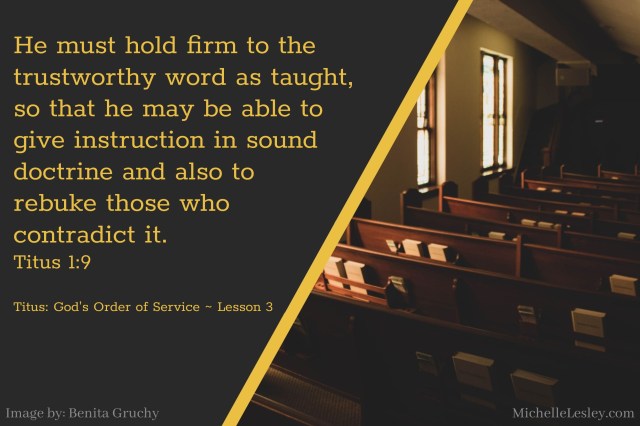
Titus: God’s Order of Service ~ Lesson 3

Previous Lessons: 1, 2

Read Titus 1:5-16

Questions to Consider

1. Review your notes from last weekโ€™s lesson. How does that passage carry over to, impact, and set the tone and context for this week’s passage?

2. Review question 6 from lesson 2: Take a look at v.5. Why did Paul leave Titus in Crete? What does Paul mean by โ€œput what remained into orderโ€? Whatโ€™s a phrase we might use in todayโ€™s vernacular to say the same thing? Why did Titus need to appoint elders โ€œin every townโ€? (You might want to review your notes from lesson 1 โ€“ link above.) How would appointing elders have given the churches in Crete structure and order?

3. Compare verses 5-9 with 1 Timothy 3:1-7. What word is used for the church leadership position in Titus 1:5? In 1 Timothy 3:1? Considering that Paul wrote both of these epistles and both of these passages are very similar in nature, is it fair to assume that these terms mean the same thing? What do we typically call an elder, overseer, or bishop in the local church today? Compare these terms in Titus 1:5 and 1 Timothy 3:1 in several reliable translations noting the footnotes and looking up the cross-references. What is a pastor / elder / overseer / bishop, according to Scripture? What does he do, according to these passages?

(If you have worked through my study on 1&2 Timothy, you may wish to review your notes on question 3, Lesson 4 for the following question.)

Make a 4-column chart. In the first column of each chart, list each qualification in Titus 1:6-9 and 1 Timothy 3:1-7 for the office of pastor / elder. In the second column, explain what that qualification means. (For example: What does it mean to be โ€œsober-mindedโ€ or โ€œhospitableโ€?) In the third column, explain why this qualification is important in the character of the man and/or in carrying out the duties of the office. In the fourth column, place a check mark if this is a requirement for pastor / elder in both passages. Which of the qualifications are common to both passages? Which are different? Why might Paul have included certain qualifications in one passage, but not the other? How is it beneficial to the church for men in the office of pastor / elder to have these qualifications?

Note the qualification “above reproach” in both the Titus and Timothy passages, paying special attention to the way Paul “bookends” Titus 1:6-7a with this term. How do all the qualifications listed between the two “above reproach bookends” (and after “above reproach” in Timothy) help us to understand what this term means? God could have tied “above reproach” to a man’s business dealings, the community’s or church’s opinion of him, or even his own personal character displayed to others, but what is “above reproach” most closely tied to in both of these passages? Why? Think about this statement: A man can hide his heart from others, but he can’t hide his family. Do agree or disagree in relation to the qualification of being above reproach?

4. How would you break down or outline the types or areas of qualifications in the Titus passage?

  • 6-7a –
  • 7b-8 –
  • 9 –

Why do you think God’s doctrinal requirements come last, after family requirements and personal character? Does it matter how sound and perfect a man’s doctrine is if he doesn’t have a godly heart that’s fleshed out in the fruit of his family and his character displayed to others? How would you answer the question of 1 Timothy 3:5: “for if someone does not know how to manage his own household, how will he care for God’s church?”

5. Note the “he must” vs. “he must not” qualifications in 6-9. How do these groups of qualifications paint the overall picture of a godly man versus a worldly man? Connect the overall picture of of the godly man above reproach in this passage to the Old Testament concept of blamelessness. We tend to break this passage down and evaluate a man in a “micro” sense on each individual trait, but could another purpose of this passage be to demonstrate the general “macro” type of man who’s qualified for the office rather than a man who is absolutely perfect in each trait mentioned?

6. What are the three doctrinal requirements in verse 9? How does “holding firm to the trustworthy word as taught” equip a pastor to both give instruction in sound doctrine and to rebuke those who contradict it? Some pastors only give instruction in sound doctrine. They refuse or are afraid to rebuke sin in the church, carry out church discipline, biblically address controversial issues (homosexuality, women preaching, etc.), or clearly teach against false teachers and false doctrine. Carefully consider verse 9 again. Are such men biblically qualified to be pastors?

7. Read verse 9 as the introduction to verses 10-16. Note that verse 10 begins with the word “for,” which, in this context means “because”. Why, according to verse 10-16 must a pastor hold to sound doctrine, instruct in sound doctrine, and rebuke those who contradict it? Connect the phrases “they must be silenced” (11) and “rebuke them sharply” (13) back to “rebuke those who contradict it” (9).

Consider the “some pastors only…” from question 6 above and verse 9’s admonition to rebuke those who contradict sound doctrine. How does Paul, in 10-16, set an example of how to “do” verse 9 for such pastors as well as for Titus?

8. Examine verses 10-16. What are the problems the false teachers – and/or the church members in Crete who believe their false doctrine – creating in the church? In what ways are these problems similar to the division and dissension created by false teachers and their followers in the church today?

Many professing Christians today consider it “unloving” or “unchristlike” to do exactly what this passage teaches – rebuke false teachers and their followers. Look carefully at the stringent language in this passage. What are some of the words and phrases these professing Christians would object to as “unloving” or “unchristlike” if someone applied them to false teachers today? How does God – Who, remember, is the One who breathed out these words – demonstrate via this passage, that it is His idea and instruction to use stark and stringent language in dealing biblically with false teachers and those who willfully and unrepentantly follow them?

How does instruction in sound doctrine and rebuking those who contradict it eradicate false doctrine, false teachers, and the division they create, and help create orderliness in the church’s fellowship and worship?


Homework

How does an orderly church structure (leadership, hierarchy, etc.) lead to orderly worship? This week, begin to consider how the order and structure in church leadership that God calls for in Titus 1:5-16 affects the order in the worship service that God calls for in 1 Corinthians 14:26-40. Also, compare and contrast the order and structure of the Old Testament system of worship – the leadership, feasts and festivals, rules for sacrifices and offerings, the architecture and design of the tabernacle and temple, etc. – compared to the order and structure of the New Testament church and worship.

Because order and structure in the church is a continuous theme throughout Titus, you may wish to make these comparisons (with 1 Corinthians 14 and with the OT system) each week of the study.


Suggested Memory Verse

Church, Discernment

Throwback Thursday ~ Nine Reasons Discerning Women Are Leaving Your Church

Originally published July 24, 2015

Earlier this week, Thom Rainer, president and CEO of LifeWay, pubished a blog article entitled Six Reasons Why Women May Be Leaving Your Church. Although I am not particularly a fan of Dr. Rainer (due to his allowing materials from false teachers to be sold at LifeWay), I thought this article was a good one, and I agreed with several of the issues he raised, especially, that these issues need to be addressed by church leadership.

As a ministry wife and someone in the field of women’s ministry myself, I, too, have noticed women leaving the church. Not just women in general, but a certain subset of church-attending ladies: discerning women. While Scripture is pretty clear that we can expect women (and men) who are false converts to eventually fall away from the gathering of believers, why are godly, genuinely regenerated women who love Christ, His word, and His church, leaving their local churches?

While Scripture is pretty clear that we can expect false converts to eventually fall away, why are godly, genuinely regenerated women who love Christ, His word, and His church, leaving their local churches?

1.
Eisegetical or otherwise unbiblical preaching

Discerning women don’t want to hear pastors twist God’s word. The Bible is not about us, our problems, and making all our hopes and dreams come true. We don’t want to hear seeker-driven or Word of Faith false doctrine. We don’t need self-improvement motivational speeches or a list of life tips to follow. We want to hear a pastor rightly handle God’s word from a trustworthy translation and simply exegete the text.

2.
The worship hour has become a variety show

Skits, guest stars, movie clips, dance routines, rock concerts, elaborate sets, light shows, and smoke machines. We didn’t sign on for Saturday Night Live on Sunday. This is supposed to be church. Get rid of all that junk, turn the lights on, give us solid preaching, prayer, and some theologically sound songs we can actually sing, and maybe we’ll stick around.

We didn’t sign on for Saturday Night Live on Sunday. This is supposed to be church.

3.
Women in improper places of church leadership

The Bible could not be more clear that women are not to be pastors, instruct men in the Scriptures, or hold authority over men in other capacities in the church. If your church has a female pastor, worship leader, or elders, or if women are teaching and leading men in Sunday school, small groups, or from the platform in the worship service, or if women are heading up certain committees, departments, or ministries which place them in improper authority over men, you’re disobeying Scripture, and we don’t want to help you do that by attending your church.

4.
Children are being entertained, not trained

There’s nothing wrong with a bit of play time or crafts for younger children, but we want our children trained in the Scriptures, not entertained for a couple of hours. We want their teachers to open God’s word and read and explain it to them at a level they can understand. We want them memorizing verses, learning to pray, and demonstrating an age-appropriate comprehension of the gospel. We want them to understand that church is joyful, yet, serious, not a Jesus-laced party at Chuck E. Cheese. We need church to bolster the Scriptural training we’re giving our kids at home.

5.
Women’s “Bible” Studies

The majority (and I don’t use that term flippantly) of churches holding women’s Bible studies are using materials written by Beth Moore, Priscilla Shirer, Joyce Meyer, Lysa TerKeurst, Sarah Young, and others who teach unbiblical ideas and false doctrine. Not minor denominational differences of opinion. Not secondary and tertiary unimportant issues that can be overlooked. False doctrine. While we long to study God’s Word with other women, discerning women will not sacrifice sound doctrine nor the integrity of Scripture to do so.

While we long to study God’s Word with other women, discerning women will not sacrifice sound doctrine nor the integrity of Scripture to do so.

6.
Ecumenism

Is your church partnering with other “churches” whose orthodoxy and/or orthopraxy are at odds with Scripture? “Churches” which approve of homosexuality or female pastors, or which hold to an unbiblical soteriology (grace plus works, baptismal regeneration, Mary as co-redemptrix with Christ, etc.)? Are you partnering with those who deny the biblical Christ altogether such as Muslims, Jews, Jehovah’s Witnesses, Hindus, Mormons, or Buddhists? Discerning women know Scripture forbids yoking ourselves to unbelievers and we want no part of it.

7.
Ageism

Look around at your pastor and staff, your lay leadership, your music team, the “face” of your church. How many of those people are over 40? Usually, discernment and spiritual maturity come through walking with the Lord over many years, yet, increasingly, by design, churches are run by twentysomething pastors, staff, and other leadership, who are often spiritually immature and/or lack the wisdom and life experience that come with age. The staff is often specifically structured this way in order to attract young people to the church. The counsel and wisdom mature, godly men and women have to offer is brushed off as old fashioned, and middle aged and older church members feel alienated and unwanted. While there are those among the twentysomething set who are godly and growing into maturity, discerning women value the wisdom and teaching of their godly elders.

8.
The “troublemaker” label

Discerning women who see unbiblical things happening in their churches and stand up for what God’s Word says about biblical ecclesiology and teaching are often vilified and labeled as troublemakers. We are called haters, threats to unity, complainers, gossips, negative, and a myriad of other scornful names. All this for wanting things done according to Scripture. Can you blame us for shaking the dust off our high heels and leaving?

Discerning women are often vilified and labeled as troublemakers. Can you blame us for shaking the dust off our high heels and leaving?

9.
Spineless or stiff-necked pastors

Discerning women have little respect for, and find themselves unable to submit to the authority of pastors who see people in their churches acting overtly sinful or propagating false teaching yet are so afraid of confrontation that they will not set things right. By the same token, we cannot continue to attend a church in which we bring scriptural evidence of false teaching or sin to the pastor and he outright denies the biblical truth we present to him. We cannot be members of churches in which pastors will not submit to Scripture or carry out biblical mandates.

Frequently, the discerning women you see tearfully leaving your church have been there for years. Sometimes they leave your church because it was never doctrinally sound to begin with, and God has opened their eyes to this as they grow and mature in Christ. Sometimes they leave because false doctrine and unbiblical practices have crept in and taken over a church that was once a refuge of trustworthy biblical teaching. Either way, these things should not be.

Maybe it’s not that discerning women are leaving the church, but that the church is leaving them.

Maybe it’s not that discerning women are leaving the church, but that the church is leaving them.


Additional Resources

Rock Your Role articles

Searching for a new church?

Podcast Appearances

Podcast Guest Appearance – Bibledingers

Don’t worry, this episode was not about complementing Arians! :0)

It was so great to sit down and chat with my new friends Ryan and Nick over at Bibledingers recently!

We talked about all things complementarian – the biblical foundation for the complementarian position, the Scriptures egalitarians twist to try to justify their position, godly women in the Bible, and the crucial roles women play in the church and the home. The guys even had some great words of wisdom for all you husbands out there!

Listen in here or check out episode 78 of Bibledingers on your favorite podcast platform!

Be sure to visit the Bibledingers website for blog articles, videos, gear, and all the Bibledingers’ social media links. Subscribe and follow!


Articles / resources mentioned or touched on in the episode:

Rock Your Role: All Things Being Equal

Rock Your Role article series

The Mailbag: Counter Arguments to Egalitarianism


Got a podcast of your own or have a podcasting friend who needs a guest? Need a speaker for a womenโ€™s conference or church event? Click the โ€œSpeaking Engagementsโ€ tab in the blue menu bar at the top of this page, drop me an e-mail, and letโ€™s chat!