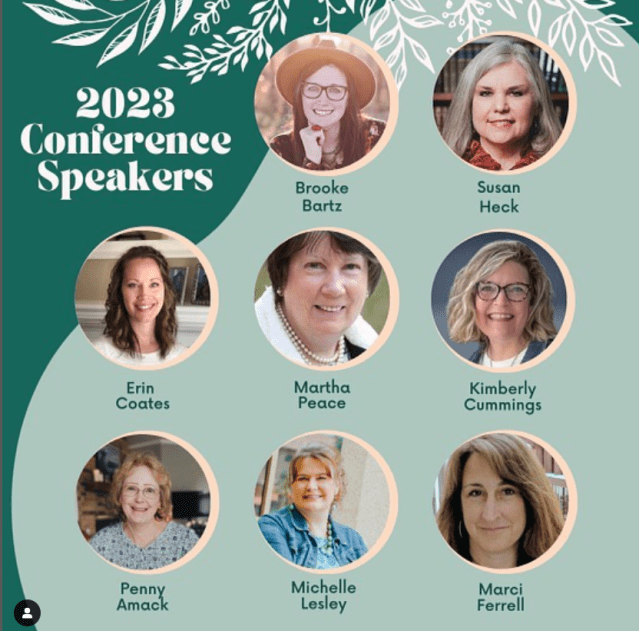
If you’re not familiar with OHCW, it’s a FREE annual online women’s conference. It has been my privilege to be one of the speakers each year since its inception.
Join us for OHCW23 – a FREE online women’s conference all this week, July 10-14. Watch and get all the details here!
All of the conference details are below. Here’s today’s teaching session (Remember, teaching session videos will not be available until 8:30 a.m. Central each day, but will remain available indefinitely.):
The theme of this year’s conference is Growing in Godliness in a Godless Generation, so each of our speakers will center their teaching around ways to grow to godly maturity in Christ. The theme verse is 2 Peter 3:18:
But grow in the grace and knowledge of our Lord and Savior Jesus Christ. To Him be the glory, both now and to the day of eternity. Amen.
The conference will run each day this week, July 10-14, Monday – Friday, 8:30 a.m. – 11:00 a.m. (Central time), and “attending” is as easy as watching your favorite TV show! There’s no cost, no registration – just tune in starting at 8:30 (Central) each morning. You can even watch the recordings later, if that’s more convenient, as the videos of each session will remain posted.
I’ll post the YouTube version of each day’s teaching session so you can watch it here on the blog if you like. Or, if you prefer, you can watch directly on…
This year’s worship music is provided by Hymns of Grace. Philip Webb and Hymnology will be leading us in worship each day.
Got a Hymns of Grace hymnal? You’re all set to sing along. If not, you can find the links for Monday – Friday’s lyric sheets here. Or, simply click the link I’ll provide each day under the teaching video.
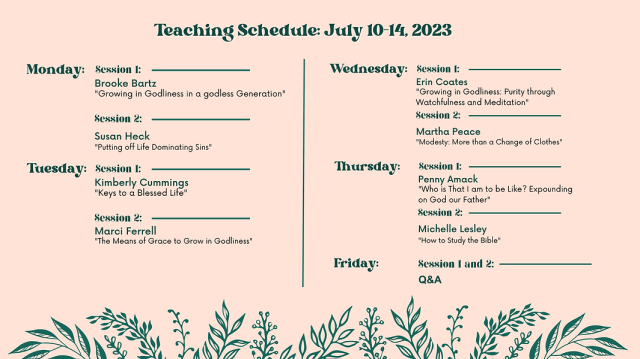
Here’s the teaching schedule for each day of the conference:
Today’s Scripture passages are embedded in the body of the study. Please click the links in each question.
Questions to Consider
Throughout this study we will be looking at various passages of Scripture rather than working our way through a book of the Bible verse by verse. Because of that, we will need to be extra vigilant to rightly handle these passages in context. I will always attempt to provide the context you need for understanding these passages correctly, but if you need more clarity please feel free to read as much of the surrounding text as you need to – even the whole book, if necessary – in order to properly understand the passage presented.
How can you tell if someone is a false teacher? Is it someone who disagrees with you on any point of doctrine? What if your pastor makes an honest mistake while preaching – is he a false teacher? How about denominations that “do church” differently from yours?
We can’t just go around willy nilly calling everyone a false teacher. A false teacher is someone who unrepentantly, despite biblical correction, consistently teaches, either implicitly, explicitly, or via his or her behavior, doctrine that is in direct conflict with clear cut Scripture. How do we identify someone like that? Let’s take a look at what Scripture says about testing teachers to see if they’re false or true to God’s Word.
1. Carefully examine 1 John 4:1-6. Zero in on 1a (stop at “…from God”). Is this written as a command or a suggestion? Explain the “do not” and the “do” in this command. What does this tell you about the Christian’s obligation and responsibility not to simply take teachers/teachings at face value, but to be a good Berean (see lesson 2, link above to refresh your memory) and, with intentionality, put that teacher/teaching to the test? Is discernment an option or a matter of obedience to God’s command?
Read this background on 1 John. Which genre of biblical literature is 1 John? What was the primary false teaching John was writing to combat in passages like 4:1-6? In light of this information, look closely at 2-3a. What is the “litmus test” John gives his readers that will rule out the majority of false teachers they are likely to encounter in that time and culture? Is this still a valid biblical test of a false teacher today? But have you ever encountered a teacher today who claims that Jesus was not fully human? Yet, are there still false teachers today? So, did God and John mean for Jesus’ incarnation to be the only test of a false teacher?
Consider 2-3a in light of 1 Corinthians 12:2-3 and2 John 7,9. What is our standard for the nature and character of Jesus – for who He is (2 John 9)? If someone is teaching a “Jesus” (or a “God/Father” or a “Holy Spirit”) that does not match Scripture’s clear teaching about Him, is that person a doctrinally sound teacher (“Spirit of God”) or a false teacher (“spirit of the antichrist / not from God”)?
Based on your answers to the questions above, in your own words, what is the general biblical principle we can extract from 1 John 4:2-3a, 1 Corinthians 12:2-3, and 2 John 7,9 about the nature and character of Christ, as test number one of a false teacher?
Test 1:
Which two spirits does God say teaching comes from? (1 John 4:1a, 2a / 3a, b) Notice the repetition of the phraseology “from the world” and “from God” in 1-6. List the characteristics of someone who is from the world versus someone who is from God. Into which of these two categories does the “Spirit of God” (2a) fit? The “spirit of the antichrist / not from God” (3)? Who are the “you / we / us” and the “they/them” in 4-6? Read the last sentence of verse 6. By what will you know the Spirit of truth and the spirit of error? (Hint: What is “this”? Backtrack in verse 6.) This is test number two of a false teacher. State it in your own words.
Test 2:
2. Read Deuteronomy 13:1-5 and 18:18-22. (Old Testament “false prophets” are analogous to New Testament “false teachers”.) In the 1 John 4 passage above, we surmised from the context of the passage and historical information that gnosticism / docetism was the prominent false teaching during that time in history. What can you surmise from these passages may have been some of the features of the false teaching Israel was encountering at this point in her history?
Read the first full sentence (v. 1-3a) of Deuteronomy 13, and explain its instructions in your own words. Try to put yourself in the place of the original audience of this instruction. As an Old Testament Israelite, what would you have understood God to be saying?
Have you heard of any “Christians” today who claim to be prophets, have the “gift of prophecy,” claim God spoke to them in a dream or vision, or perform “signs and wonders”? These are all typical of New Apostolic Reformation (NAR) heresy (click the links in the paragraph above the video for examples), and these passages in Deuteronomy are very helpful in identifying them. (Or maybe you can think of other religions, cults, or movements that seem to fit this passage’s description?)
Having seen the videos of “prophecies” and “signs and wonders” at the link above, how does the Deuteronomy 13 instruction apply to you if you walk into a NAR “church” today? What might it look like for a “sign or wonder that he tells you comes to pass”? What kinds of teachings did you see in the videos that would fall under the category of “‘Let us go after other gods,’ which you have not known, ‘and let us serve them’.”? Did you hear any of these “prophets” or teachers encouraging you to worship Baal, follow Molech, or serve Chemosh? What about the “God,” the “Jesus,” and the “Holy Spirit” they teach? Do their teachings line up with Scripture, or are they encouraging you to follow and serve a false god, created in their own imaginations, which they blasphemously call “God,” “Jesus,” or the “Holy Spirit”?
State, in your own words, the third test of a false teacher from Deuteronomy 13:1-3a. (Be sure to include the “if/and” from verse 1, the two main “and’s” in verse 2, and the implied “then” from verse 3a.)
Test 3:
Carefully examine the Deuteronomy 18 passage. Using your cross-references and the immediate context of Deuteronomy 18, who are the “prophet” and “you” in verse 18?
How does this passage say the Israelites may determine whether or not someone is a true prophet, genuinely speaking for God (like Isaiah, Jeremiah, Habakkuk, etc.), or a false prophet? (21-22) As a 21st century Christian, how would you properly apply this test to a teacher or “prophet” today?
State, in your own words, the fourth test of a false teacher from Deuteronomy 18:22. (Be sure to include the “if” as well as the implied “then” in the final sentence.)
Test 4:
How do the Deuteronomy 13 and 18 passages contrast false teachings/teachers and false prophecies/prophets with the one true God, His true teachings, and His true followers? How does this apply to Christians today? What are the characteristics of a true follower of Christ (13:3, 4, 18:18-19, 21c)? How can these characteristics help you determine whether or not someone is a false teacher and/or whether or not you, or someone you know, might be following a false teacher?
3. Read Galatians 1:6-9. What is the false teaching being addressed in this passage? What are the two, nearly identical, phrases in verses 8 and 9 that begin with “a gospel contrary…”? What do these two phrases mean? Compare them to these passages. Where did Paul’s and John’s audiences hear the gospel and teachings they received “from the beginning”? Where do we get this same gospel and teachings today?
What is the term for “some who trouble you and want to distort the gospel of Christ” (7b)? Does Paul exempt himself or anyone else from false teacher status if that person is preaching a different gospel than the one taught in Scripture?
What is test 5 of a false teacher according to this passage?
Test 5:
4. Some Christians say that overtly teaching a false gospel – an unbiblical way of getting saved (see some examples here)- is the only teaching that qualifies someone as a false teacher. Is that true according to Scripture? Can you think of a false teaching that’s not directly connected to the plan of salvation? Here are some examples from Scripture.
What are the two false teachings mentioned in 1 Timothy 4:3? Are they directly connected to salvation? How does verse 2 characterize those who teach these false doctrines? How does verse 1 characterize the teachings?
What is the false teaching mentioned in 2 Timothy 2:18? How does God characterize this false teaching in 17a, 18a, and 18c?
If God characterizes restrictions on marriage, food, and eschatology, which are not directly related to salvation, as “deceitful,” “doctrines of demons,” and “gangrene,” and those who teach them as conscience-seared, insincere liars, having swerved from the truth and upsetting the faith of some, is it true that someone is a false teacher only if he teaches a false way of salvation? What else qualifies as false teaching, and what is our standard for evaluating it? What is test six of a false teacher?
Test 6:
5. Examine these passages from 1 John. When the Bible instructs us not to do something and we do it anyway, what is that called? When the Bible instructs us to do something and we fail or refuse to do it, what is that called?
Explain the phrases “walk/walked” (2:6), “makes a practice of sinning” (3:4,8,9), and “keeps on sinning” (3:6,9). Is John talking about a Christian who’s striving for holiness, sins, repents, and keeps on striving for holiness? How can you tell?
How does God characterize a person who claims to be a Christian, yet unrepentantly walks in sin, or makes a practice of sinning? (2:4, 3:6, 8, 10) Explain the connection God makes in these passages between knowing / loving God and obedience to His commands. If a “Christian teacher” lives in willful, unrepentant sin, on an ongoing basis, is that someone you should receive teaching from? Why not (2:4b, 3:8a, 9a, 10)? State test of a false teacher number seven from these passages.
Test 7:
In questions 1 & 2, we gleaned from context and historical information the types and features of false doctrine that were prolific when 1 John 4 and Deuteronomy 13 & 18 were written. We also saw specific tests designed to combat these specific false teachings. We can do the same for the specific false teachings prolific in our culture today.
In my experience, currently, the most widespread false doctrines that are “spreading like gangrene” in the church today are the New Apostolic Reformation / Word of Faith (prosperity gospel), progressivism (liberal, woke, social justice, feminist, perversion affirming, etc.), and a general air of antinomianism (basically, the 21st century version of Judges 21:25b– “Everyone did what was right in his own eyes.”).
Aside from the fact that most of their specific beliefs demonstrably conflict with clear cut Scripture, there are two features that are common to all of these false doctrines. They are usually easy to spot and require minimal knowledge of theology, making our next two tests of false teachers practical and relatively quick. They are both “sub-tests” of test 7 because they both involve walking in specific unrepentant sins.
Read 1 Timothy 2:11-3:7. What two things does 2:12 prohibit women from doing in the gathering of the church body? Is this limited to the Sunday morning gathering of a local church? What are some examples of other Christian events where the church (Christians) physically gathers for worship and Bible teaching?
Examine the pronouns and other gender markers in 3:1-7. The office of pastor / elder / overseer is limited to which sex, male or female?
What are the three ways a woman might disobey these biblical instructions in 2:12 and 3:1-7? What are the three ways a man/pastor might disobey these biblical instructions by what he allows, encourages, or invites women to do? If he or she is biblically corrected about his or her sin, but unrepentantly persists, how does this connect to what you just learned from 1 John about walking in sin, keeping on sinning, or making a practice of sinning?
In addition to the fact that the woman (or man) violating any of these prohibitions is sinning herself, what is her behavior – pastoring, preaching / teaching Scripture to men, or exercising authority over men – teaching her audience about their obligation and responsibility to obey God’s commands? Is it false doctrine to teach, even implicitly, via one’s behavior, that Christians are free to ignore or disobey any Scripture they dislike or disagree with?
From 1 Timothy 2:11-3:7, what is test 7a of a false teacher?
Test 7a:
Read these passages. Answer the following questions for each passage:
In what way does the passage characterize false teachers?
How are Christians supposed to respond to false teachers?
What is the result of either avoiding, or failing to / refusing to avoid false teachers?
Why does God instruct Christians – including Christian teachers – to avoid, and not to partner with false teachers? Read these passages.
What is the danger of partnering with false teachers in 1 Corinthians 15:33?
Who is the false teacher’s (servant’s) master in 2 Corinthians 11? What does Luke 16:13 say about serving two masters? Can a teacher serve both Christ and Satan?
How do Matthew 10 and Luke 6 apply to a Christian teacher learning from, and being influenced by false teachers?
Since it is direct disobedience to God’s Word (sin) for any Christian – but especially a teacher, whom God holds to a higher standard – to unrepentantly and persistently fraternize or partner with false teachers (again be reminded of what the 1 John passages said about walking in unrepentant sin), and since false teachers will always influence their disciples away from Christ and the truth of His Word, what is test 7b when you’re vetting a teacher?
Test 7b:
6. What is the common theme running through all of these tests? What is our measuring stick for determining whether a teacher passes or fails each of these tests? What is one broad, general test that could encompass all of these tests?
If you’re testing a teacher to discover whether or not he or she lives, believes, and teaches in obedience to God’s Word, you need to know the Word as thoroughly as possible. You can’t know something contradicts Scripture if you don’t know what Scripture says and how to handle it correctly and in context. How can you become a good student of the Word? What are three ways God has provided you to learn and understand the Bible better? (hinthinthint)
Homework
Create a checklist listing each of the tests of false teachers you’ve learned in today’s lesson. Be sure to include Scripture references for each. Keep it in your Bible or another handy place so it’s easily accessible when you need to test a teacher.
Imagine you’re a Berean vetting Paul. Use the tests and Scriptures from today’s lesson. Start with this passage, its cross-references, and everything else you know about Paul and his teachings. Does Paul pass or fail each of the tests of a false teacher?
Although you may be more familiar with him from his hilarious “churches/denominations” videos (check out a couple of my favorites here and here), my friend, Keith Foskey, also has a regular video podcast called Conversations with a Calvinist in which he tackles serious topics and interviews (mostly not about Calvinism, my non-Calvinist friends).
Listen in as Keith and I chat about an important topic that’s been making the rounds of late, Should Women Be Teaching the Bible? We know it’s unbiblical for women to teach men the Bible, but some Christians believe women shouldn’t even be teaching the Bible to other women. Is that biblical? What role do women play in the home, in the church, and in teaching other women?
Got a podcast of your own or have a podcasting friend who needs a guest? Need a speaker for a women’s conference or church event? Click the “Speaking Engagements” tab in the blue menu bar at the top of this page, drop me an e-mail, and let’s chat!
I hate having to warn women against false teachers. I really do. I would like nothing better than to write Bible studies all day long, but, like Jude said, sometimes contending for the faith is more urgent at the moment. Today, as it was in the New Testament church, false doctrine is rampant. You can hardly throw a rock out the sanctuary window without hitting a false teacher, particularly female false teachers.
You can hardly throw a rock out the sanctuary window without hitting a false teacher, particularly female false teachers.
Invariably, when I warn against a specific popular false teacher I get a few responses from disgruntled readers jumping to that teacher’s defense. (I understand where those feelings come from. I’ve had to hear hard, biblical truths about teachers I’ve followed, too. It’s no fun.) I tend to hear the same arguments over and over (which is one reason I wrote this article). But there’s one thing all of these arguments have in common:
As Christians, we are supposed to base everything we believe and teach upon the truth of Scripture. And the women defending these false teachers aren’t doing that. They’re basing their defense of a false teacher on twisted, out of context Scripture and/or their own opinions, feelings, experiences, and preferences.
As Christians, we are supposed to base everything we believe and teach upon the truth of Scripture. And the women defending these false teachers aren’t doing that.
Sometimes these ladies will try to appeal to Scripture to defend the false teacher. I applaud them for that. Genuinely. At least they know that we’re supposed to be basing what we say and do on the Bible. That’s a step in the right direction. Unfortunately, most of these attempts only reveal how poorly they’ve been taught the Bible by the false teachers who have trained them.
“Did you meet privately with this teacher before writing this article?”
“You’re just judging! The Bible says not to judge!”
“You’re creating division in the church!”
Most of the time these women have no idea where those Scriptures are found, or even precisely what they say, much less the context of the verses they’re appealing to. (In order not to misunderstand their intent, I usually have to respond by saying, “Are you referring to Matthew 18:15-20?” or “I’m sorry, could you tell me which verse you’re talking about?”) They don’t know or understand the Scripture they’re alluding to, they’re just repeating what they’ve heard from the false teacher (or her other followers) defending herself and lashing out at those who call her to account.
Nothing More than Feelings:
Perhaps more disturbing are the near-Stepford gushings of some defenders:
“I’ve never heard anything so mean! How could you say such things about this wonderful teacher?”
“I just love her and the way she teaches!”
“You’re just jealous of her success.”
“She’s been such a help and encouragement to me!”
These ladies don’t even attempt to bring the Bible into the discussion, and their loving support for the false teacher is often coupled with vitriolic, completely un-Christlike, devoid of any fruit of the Spirit, attacks on those who dare to question the false teacher. I like this person. I’ve had a positive experience with this person. I have good feelings and opinions about this person. And that – not the Bible – is what I’m basing my decision to follow her upon. How dare you speak against her?
And is it any wonder? When women sit under the teaching of pastors and teachers who skip through the Bible ripping verses out of context and twisting their meanings, who say “the Bible says” followed by their own agenda and imaginings, who point women back to themselves as their own authority, rather than Scripture, by basing their teachings on their own ideas and life experiences instead of the Bible, what do we expect?
Jesus said in Matthew 7:15-20:
“Beware of false prophets, who come to you in sheep’s clothing but inwardly are ravenous wolves. You will recognize them by their fruits. Are grapes gathered from thorn bushes, or figs from thistles? So, every healthy tree bears good fruit, but the diseased tree bears bad fruit. A healthy tree cannot bear bad fruit, nor can a diseased tree bear good fruit. Every tree that does not bear good fruit is cut down and thrown into the fire. Thus you will recognize them by their fruits.”(emphasis, mine)
Ladies, look at the fruits of these false teachers: women who believe false doctrine because they are unable to properly read, understand, and handle God’s Word, and who base their belief system on their own feelings rather than on the authority of Scripture. That is bad fruit from a diseased tree.
Look at the fruits of these false teachers: women who believe false doctrine because they are unable to properly read, understand, and handle God’s Word.
Christian women must be properly trained in the Scriptures. How? By eradicating false teachers and all their sundry materials from our churches, homes, and Bible study classes. By properly training Sunday School and Bible study teachers. By teaching the women of our churches proper hermeneutics and sound doctrine. By exercising biblical church discipline against false teaching. And most of all, by reinstating the authority of Scripture to its rightful preeminence in our lives and in our churches.
It is imperative that wetrain Christians to understand and embrace that Scripturealone decides what we believe, which teachers we allow into our churches and our lives, and how we are to worship and practice the Christian faith. Basing these things on our feelings, opinions, and preferences is folly, a house built on the sand, because our hearts are deceitful and desperately sick, and we will always trend toward having our ears tickled with smooth words rather than having our souls pierced by the sharp two edged sword of God’s Word. “Sanctify them in the truth,” Jesus prayed in John 17:17, “Your Word is truth.” And, indeed it is. It is the only trustworthy basis for life, faith, and doctrine that will never lead us astray. When our feelings and opinions rise up against God’s Word, God’s Word wins.
When our feelings and opinions rise up against God’s Word, God’s Word wins.
May we hold high the banner of Sola Scriptura, training the precious souls of women to understand and submit to the authority of God’s Word, that one day, bad fruit and diseased trees might become a thing of the past.
Throughout this study we will be looking at various passages of Scripture rather than working our way through a book of the Bible verse by verse. Because of that, we will need to be extra vigilant to rightly handle these passages in context. I will always attempt to provide the context you need for understanding these passages correctly, but if you need more clarity please feel free to read as much of the surrounding text as you need to – even the whole book, if necessary – in order to properly understand the passage presented.
1. Carefully study the first five verses of the 2 Timothy passage. Using your cross references, any other related passages, and perhaps a side by side comparison with other reliable translations, or an interlinear, define or explain each of the characteristics listed in these verses:
lovers of self-
lovers of money-
proud-
arrogant-
abusive-
disobedient to their parents-
ungrateful-
unholy-
heartless-
unappeasable-
slanderous-
without self-control-
brutal-
not loving good-
treacherous-
reckless-
swollen with conceit-
lovers of pleasure rather than lovers of God-
having the appearance of godliness, but denying its power-
Is Timothy saying these things are characteristic of the world, the visible church (Christians and non-Christians), genuinely regenerated Christians only, or some combination of these three? Why do you think so?
From the immediate context and the context of the Bible in general, does verse five’s admonition to “avoid such people” mean only the people described in verse 5 or all of the people described in verses 2-5? Generally speaking, why would God want us to avoid all of these types of people, especially if they claim to be Christians (5) while acting this way? Go back through your list above and explain why it would be detrimental to your character and your walk with the Lord to associate with people of each of these character types.
2. Now, more specifically, why does verse 6 say to avoid these types of people? (Note: What word does verse 6 start with? What’s another word we could use there in place of “for”? When you’re looking for the reason God said something, words like “for” and “because” can help you answer the question, “Why?”.)
Compare the phrase “those who creep into households” in verse 6 with the metaphor we saw Jesus use in lesson 6 (link above), particularly in John 10:1. Who are both of these verses talking about? How do both of these verses describe the infiltration of false teachers into the church and home? Are false teachers above board, walking in the truth of Scripture?
Compare the concept of “capturing” in verse 6 with the concept of “thief and robber” in John 10:1. What does it mean to capture someone and to commit thievery and robbery? Why does God use this imagery for false teachers? Compare this idea of false teachers absconding with or luring away people to whom they have no right with John’s description of doctrinally sound “gatekeepers” (pastors and teachers, v. 3). Do doctrinally sound pastors have to deceptively lure or steal people away to the true teaching of Christ? Why not? What do they do instead (3)?
3. At this time, I’d like “ewes” :0) to focus on the second half of verse 6. Who, precisely, does God say the false teachers creep in and capture? Does He say “weak men”? “Weak Christians”? “Weak people”? Considering the fact that God never misspeaks and always says exactly what He means, why (6b) does God specify that “weak women” are in danger from false teachers?
What does God mean that these women are “burdened with sins” and “led astray by various passions“? Why would a woman in this spiritual condition be especially vulnerable to false teachers? What would a doctrinally sound pastor or teacher tell her about her sins or her fleshly cravings and feelings? Read 6b in light of 2 Timothy 4:3-4. How would a false teacher scratch her itching ears about her sins and passions?
4. Really ponder the meaning and weight of verse 7. Gaggles of weak, sinful women always reading a book or listening to a podcast by a false teacher, going to “Bible” study after “Bible” study featuring materials by false teachers, spending hundreds of dollars year after year on tickets for conferences and simulcasts headlined by false teachers. Always learning, but never able to arrive at a knowledge of the truth. Jesus said, “I am the truth,” and “[Father,] Sanctify them in the truth; Your Word is truth.” Think about it. If your friends who follow false teachers are never able to arrive at a knowledge of the truth, Who and what are they not learning about?
5. And why is that? How do we know they’re not learning the truth from these false teachers according to verse 8? In what three ways does God characterize these false teachers in 8b? What does it mean that they “oppose the truth,” are “corrupted in mind,” and are “disqualified regarding the faith”? How do each of those characteristics prevent vulnerable women from arriving at a knowledge of the truth?
6. Remember that 2 Timothy is a pastoral epistle, so the passage we just read may be instructive to us as women, but to whom is it primarily written? (see lesson 7, link above, if you forgot). How is God demonstrating His love and care for women in this passage by instructing pastors to watch out for these false teachers who prey on women, and keep them out of the church?
7. Read the Genesis 3 passage and 1 Timothy 2:14 through the lens of what we’ve just looked at in 2 Timothy 3. Why do you think Satan may have approached the woman in the Garden instead of the man? How do these passages work together to alert us as women to vigilantly watch out for a potential blind spot we may have regarding false teachers and deception?
God created women with some incredible strengths. Generally speaking, women are usually much better nurturers than men. We’re usually better communicators than men. And, frequently it’s much easier for women to trust, love, and give the benefit of the doubt to others than it is for men.
And along with those unique strengths come unique challenges. For example, being trusting is a fantastic character trait, but it’s imperative that we be vigilant not to put our trust in the wrong person – like a false teacher.
Why is it especially important that women learn and practice discernment?
Homework
Second Timothy 3:5 instructs us to “avoid” ungodly people, especially those who claim to be Christians and turn out to be false teachers. “Avoid them.” Does this command leave room for the “chew up the meat and spit out the bones” approach so many Christians think is appropriate to use with false teachers today? What about the common idea that it’s OK to use songs with “biblical” lyrics from heretical groups (like Bethel, Hillsong, and Elevation) in our worship services? Does “Avoid them” allow for that? Read #8 here.
Some professing Christians defend false teachers by saying, “Look how many people she’s helping!”. If false teachers’ audiences are “never able to arrive at a knowledge of the truth,” are they really helping anybody? Read #3 here.