Discernment, False Teachers

Shauna Niequist

If you are considering commenting or sending me an e-mail objecting to the fact that I warn against certain teachers, please click here and read this article first. Your objection is most likely answered here. I won’t be publishing comments or answering emails that are answered by this article.


This article is kept continuously updated as needed.

I get lots of questions about particular authors, pastors, and Bible teachers, and whether or not I recommend them. Some of the best known can be found above at my Popular False Teachers tab. The teacher below is someone I’ve been asked about recently, so I’ve done a quick check (this is brief research, not exhaustive) on her.

Generally speaking, in order for me to recommend a teacher, speaker, or author, he or she has to meet three criteria:

a)ย A female teacher cannot currently and unrepentantly preach to or teach men in violation of 1 Timothy 2:12. A male teacher or pastor cannot allow women to carry out this violation of Scripture in his ministry. The pastor or teacher cannot currently and unrepentantly be living in any other sin (for example, cohabiting with her boyfriend or living as a homosexual).

b) The pastor or teacher cannot currently and unrepentantly be partnering with or frequently appearing with false teachers.ย This is a violation of Scripture.

c) The pastor or teacher cannot currently and unrepentantly be teaching false doctrine.

I am not very familiar with most of the teachers I’m asked about (there are so many out there!) and have not had the opportunity to examine their writings or hear them speak, so most of the “quick checking” I do involves items a and b (although in order to partner with false teachers (b) it is reasonable to assume their doctrine is acceptable to the false teacher and that they are not teaching anything that would conflict with the false teacher’s doctrine).ย Partnering with false teachers and women preaching to men are each sufficient biblical reasons not to follow a pastor, teacher, or author, or use his/her materials.

Just to be clear, “not recommended” is a spectrum. On one end of this spectrum are people like Nancy Leigh DeMoss Wolgemuth and Kay Arthur. These are people I would not label as false teachers because their doctrine is generally sound, but because of some red flags I’m seeing with them, you won’t find me proactively endorsing them or suggesting them as a good resource, either. There are better people you could be listening to. On the other end of the spectrum are people like Joyce Meyer and Rachel Held Evans- complete heretics whose teachings, if believed, might lead you to an eternity in Hell. Most of the teachers I review fall somewhere in the middle of this spectrum (leaning toward the latter).

If you’d like to check out some pastors and teachers I heartily recommend, click theย Recommended Bible Teachers tab at the top of this page.


Shauna Niequist
Not Recommended

Shauna, an author, speaker, and podcaster, is the daughter of Bill Hybels, former pastor of Willow Creek, where Shauna has preached the Sunday sermon on many occasions.

This information from my 2016 article on Shauna is from a pastor friend of mine who knows Shaunaโ€™s family personally:

โ€œ[Shauna is] the daughter of Bill Hybels, the founder and pastor of Willow Creek in Barrington, IL. Because of very personal experience with it, I will tell you that this stuff they peddle has proven to be the worst kind of Christianity, and probably a Matthew 23:14-15 type of situation, at least in my opinion.

Next,ย this postย right here ought to really be enough.

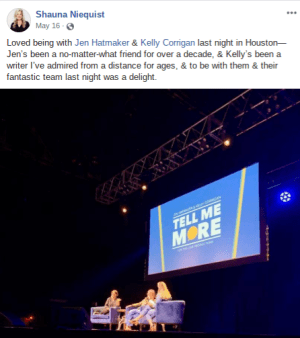
She is aย friend of Rachel Held Evans. She isย touring with Jen Hatmaker, who is a complete mess. Really, there is no other way to describe her than secularism covered with some Bible words.

Aaron [Shaunaโ€™s husband] is a worship leader at Willow Creek. He began a HUGE movement with contemplative prayer a couple of years ago. Because of his music, he comes off as very spiritual and sound, but there is nothing inherently Christian about anything he says or does, really. Take a look at Aaronโ€™s blogย here, which will give you more insight. [Aaron has apparently removed the blog portion of his website. He is no longer with Willow Creek, and neither is Shauna.]

There is ZERO discernment with this family, they either promote or flock to whoever is popular, and they are all about using words that sound really great, but have no substance to them at all. They are on this big thing lately about โ€œHoly Spacesโ€, which sounds great, but is so anti-biblical when you really think about it. You donโ€™t create a space that is holy, only God can do that. Anywayโ€ฆ

This is theย Willow Creekย legacy, in a nutshell: their lack ofย sound doctrine, lack of Bible, lack of biblical discernment, and their false teaching and false gospel. Shauna and Aaron are simply products of what her dadย has built, which is a huge gathering of people who neither know Christ, nor have reverence for His word.โ€

As I began re-researching Shauna to update this article on her, her most recent Facebook posts alluded to the fact that she hadn’t written anything in a while and that her family had gone through some “adjustments” and other issues. I was hoping this meant God had convicted her of past sin and false doctrine and was straightening out her theology. Unfortunately, a mere scroll back through the last several months of her Facebook posts demonstrates that Shauna remains a false teacher to avoid.

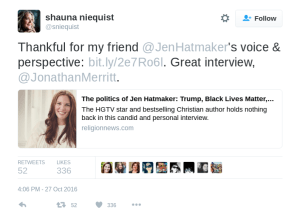
A few years ago, Shauna publicly congratulated Jen Hatmaker for affirming homosexuality.

screenshot-2016-10-29-at-5-00-58-pm

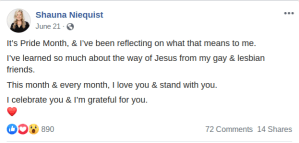
And here’s Shauna recently affirming homosexuality herself.

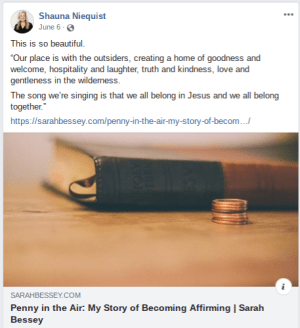
“This is so beautiful,” says Shauna about this blasphemous article from female “preacher” and feministย Sarah Bessey. The purpose of the article is for Sarah to explain to a young woman (who is on the fence about the inclusion of practicing, unrepentant homosexuals into church membership and wrote to Sarah asking for advice) how she became affirming. In addition to shamelessly twisting and abusing the Scriptures throughout the article, Sarah has the unmitigated temerity to suggest that Jesus Christ, the sinless, perfect Son of God, had to be taught by the Syro-Phonecian woman about His privilege and His prejudice against Gentiles. And Shauna says, “This is so beautiful.”

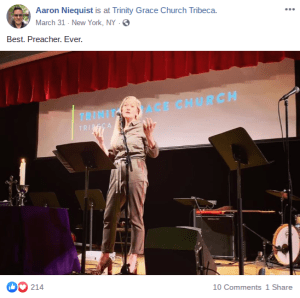
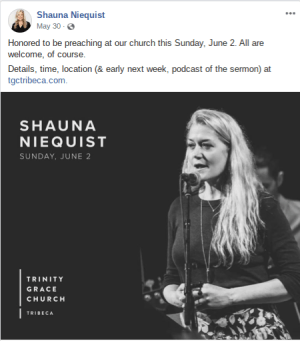
Shauna continues to violate Scripture by preaching to men. Aaron says his wife is the “best preacher ever.”

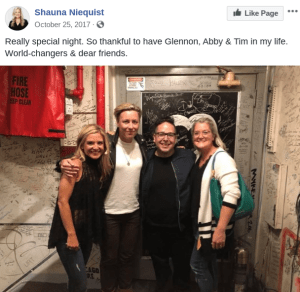
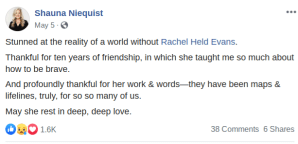
She continues to yoke with, affirm, and maintain close friendships with, some of the most egregious false teachers out there, includingย Jen Hatmaker, Glennon Doyle (The “Christian” mommy blogger who divorced her husband and “married” her lesbian partner, Abby. Shauna has recommended Glennon and spoken glowingly of her and Abby several times.),ย and the lateย Rachel Held Evans.

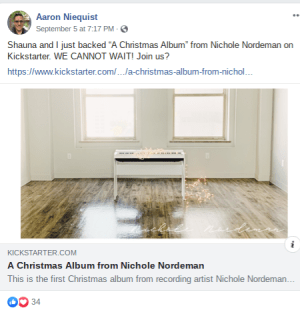
Here, Aaron says he and Shauna are helpingย Nichole Nordemanย (homosexuality affirming, frequent associate of false teachers) fund her next album.

In addition to these (and so many more) glaringly unbiblical relationships, positions, and violations of Scripture, notably absent, or nearly so, from Shauna’s Facebook timeline is any meaningful mention of God, Jesus, or the Bible. Her post on “Holy Saturday” (the day before Easter) doesn’t even mention Jesus, the crucifixion, or the resurrection. And the benediction she wrote for her church’s Easter service barely does, in passing.

For a taste of Shauna’s theology, consider the following:

Shauna recently appeared on Oprah’s Super Soul Sunday to promote her book,ย Present Over Perfect, “a path away from frantic pushing and proving, and toward your essential self.” She does not mention Christ, the gospel, or the Bible, and only mentions God in the most generic (“God loves me”) of terms. When explaining what was most helpful to her in overcoming her stress and anxiety, Shauna credits centering prayer, an unbiblical, mystical, New Age practice.

Shauna’s website markets Present Over Perfectย as a “Bible study.” You can download the first two chapters of the book, and view the teaching video for the first session of the study. I did both.

Shauna writes engagingly, there’s no doubt about that, but the first two chapters of the book read like a memoir of someone who is aching to know God but hasn’t found him yet. Christian-y words like “God,” “sin,” “grace,” and “baptism,” are sprinkled through the narrative, but there’s a palpable disconnect between Shauna’s artistic usage of these words and her grasp and internalization of what they truly, biblically mean. It’s almost like “stolen valor” – a guy desperately wants to be a soldier, so he dresses and talks the part, but he has never served and isn’t actually in the military, yet he hopes doing all these things will fulfill his yearning to actually be a soldier.

And, keeping in mind that this is supposed to be a “Bible study,” there is nothing from or about the Bible in the first two chapters of this book. No verses. No discussion of passages or books of the Bible that will be studied in subsequent chapters. It is all about Shauna and her thoughts and experiences.

The teaching video is very much the same, minus most of the sprinkling of Christian-y words. There is no Bible in this “Bible study” video. It’s all about Shauna’s opinions and anecdotes from her personal life. (Sharp listeners will also note her mention of her “friend, Glennon,” the aforementioned Glennon Doyle.)

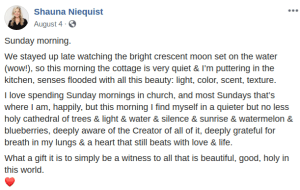
Here, Shauna reinforces the pernicious “church is optional” and “I don’t have to go to church; I can worship God anywhere,” mindset ravaging Christianity today.

In this benediction she wrote for her church in June 2019, Shauna waxes panentheistic: “May we walk through these doors and through this city intimately aware of the divinity all around us and within us and within each person we encounter.”

And in her 2017 blog article, Expanding the Way We Experience God:

Shauna commends, “a wide vision for how people connect with God,” including “poetry, silence, sitting by the ocean…centering prayer, truth-telling with my closest friends…” (rather than studying your Bible, prayer, faithfully serving and being taught Scripture at your local church, etc.). “The tools [for connecting with God] that have been meaningful along the way for me have been books, poetry, counseling, friendship, spiritual direction, the Enneagram, centering prayer.”

She again promotes the “church is optional” idea when she states, “Some seasons [of spiritual growth] require poetry, and others preaching,” and “…in late high school and early college, I needed a little distance from church life. And so instead of going to church, I went to the ocean.”

Shauna also believes inย extra-biblical revelation: “So Iโ€™d settle myself on a rock [at the beach] and Iโ€™d listen for Godโ€™s voice, or at least the sense of His spirit.”

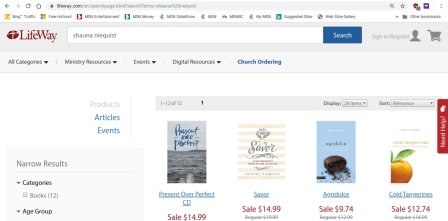
Southern Baptists should note thatย LifeWay, which purports not to carry authors who affirm homosexuality, at this time, carries four of Shauna’s five books.

Researching Shauna saddened me at every turn. Most of the false teachers I warn against proudly and brashly twist and defy God’s Word in order to build up their own kingdoms on earth of fame, fortune, and influence. That’s not the impression I get from Shauna, but rather of someone who acutely craves peace, purpose, and contentment, and is casting about for it everywhere except in the Christ of Scripture.

Is Shauna deeply steeped in sin and false doctrine? Yes. Should you and your church avoid her teaching and materials? Definitely. But there’s a subtle thread of sorrow and despair running through her writing that makes me want to hug her, sit and cry with her, and help her to embrace the truth of the gospel that will give her the peace she so desperately seeks after, the love of Christ that she’s looking for in all the wrong places, and the rest for her soul that only comes from intimately knowing as Savior the Jesus who is a stranger to her.

Discernment

Kelly Minter

If you are considering commenting or sending me an e-mail objecting to the fact that I warn against certain teachers, please click here and read this article first. Your objection is most likely answered here. I won’t be publishing comments or answering emails that are answered by this article.


This article is kept continuously updated as needed.

I get lots of questions about particular authors, pastors, and Bible teachers, and whether or not I recommend them. Some of the best known can be found above at my Popular False Teachers tab. The teacher below is someone I’ve been asked about recently, so I’ve done a quick check (this is brief research, not exhaustive) on her.

Generally speaking, in order for me to recommend a teacher, speaker, or author, he or she has to meet three criteria:

a) A female teacher cannot currently and unrepentantly preach to or teach men in violation of 1 Timothy 2:12. A male teacher or pastor cannot allow women to carry out this violation of Scripture in his ministry. The pastor or teacher cannot currently and unrepentantly be living in any other sin (for example, cohabiting with her boyfriend or living as a homosexual).

b) The pastor or teacher cannot currently and unrepentantly be partnering with or frequently appearing with false teachers. This is a violation of Scripture.

c) The pastor or teacher cannot currently and unrepentantly be teaching false doctrine.

I am not very familiar with most of the teachers I’m asked about (there are so many out there!) and have not had the opportunity to examine their writings or hear them speak, so most of the “quick checking” I do involves items a and b (although in order to partner with false teachers (b) it is reasonable to assume their doctrine is acceptable to the false teacher and that they are not teaching anything that would conflict with the false teacher’s doctrine). Partnering with false teachers and women preaching to men are each sufficient biblical reasons not to follow a pastor, teacher, or author, or use his/her materials.

Just to be clear, “not recommended” is a spectrum. On one end of this spectrum are people like Nancy Leigh DeMoss Wolgemuth and Kay Arthur. These are people I would not label as false teachers because their doctrine is generally sound, but because of some red flags I’m seeing with them, you won’t find me proactively endorsing them or suggesting them as a good resource, either. There are better people you could be listening to. On the other end of the spectrum are people like Joyce Meyer and Rachel Held Evans- complete heretics whose teachings, if believed, might lead you to an eternity in Hell. Most of the teachers I review fall somewhere in the middle of this spectrum (leaning toward the latter).

If you’d like to check out some pastors and teachers I heartily recommend, click the Recommended Bible Teachers tab at the top of this page.


Kelly Minter
Not Recommended

The โ€œaboutโ€ page of Kelly Minter’s web site used to describe false teacher, Beth Moore, as โ€œone of [Kelly’s] favorite bible [sic] study teachers.โ€ Kelly also said, โ€œBethโ€™s teachings were much of what God used in my earlier life to teach and transform meโ€ฆโ€.  (This information has been removed from Kelly’s website since the original publication of my article on her in 2016.)

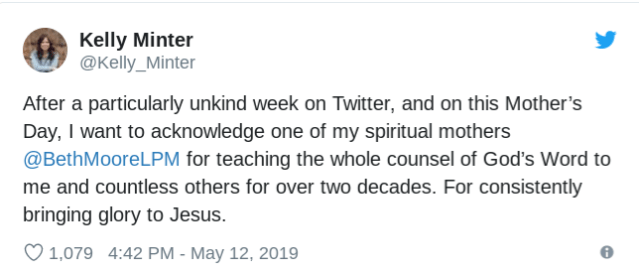
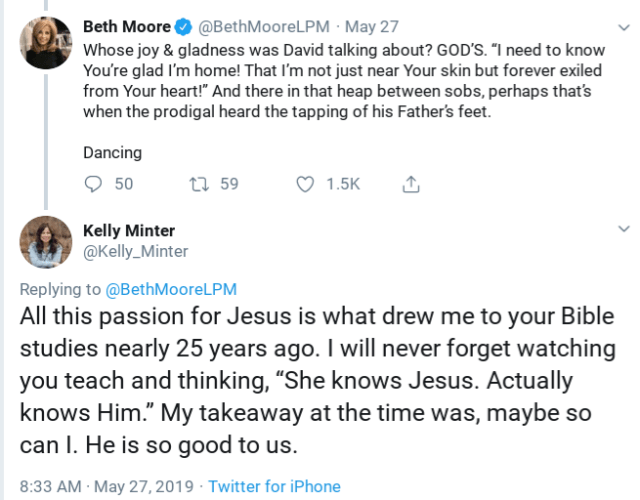
And, indeed the most glaring theological problem with Kelly is that she considers Beth Moore to be “one of my spiritual mothers.”

The “particularly unkind week on Twitter” Kelly is referring to is doctrinally sound Christians biblically rebuking Beth Moore for coyly announcing that she would be preaching the Sunday morning sermon at her home church on Mother’s Day 2019. Where Beth Moore…

  • preaches to men in violation of Scripture
  • consistently allegorizes, mishandles, and takes Scripture out of context
  • partners with demonstrably false teachers and heretics
  • is on a trajectory toward affirming homosexuality
  • not only refuses biblical correction in all these areas but publicly taunts, insults, and name-calls those who rebuke her…

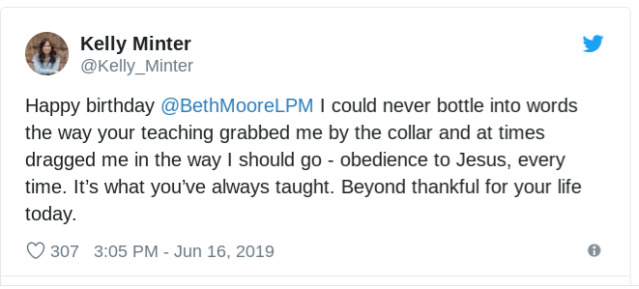
…Kelly thinks Beth has taught her “the whole counsel of God,” “brings glory to Jesus,” and is worthy of being her “spiritual mother.” If Kelly thinks these things, she is at the very least so undiscerning, or so unknowledgeable of the many Scriptures that condemn these things, or she knows that Scripture condemns these things but disregards Scripture in favor of her love for Beth, that she should not be teaching anyone, but should be sitting in a good local church under the teaching of a solid pastor so she can learn Scripture and sound doctrine.

More of Kelly honoring Beth:

If Kelly has such a fundamental misunderstanding of biblical obedience that she thinks Beth Moore – who defies Scripture in a myriad of ways – has taught her (“and countless others”) to obey Jesus, do you think she is qualified to teach the Bible to you or the women of your church, either in person or through the use of her materials?

Beth Moore is also fond of Kelly, (“I LOVE HER, I LOVE HER, I LOVE HER, I LOVE HER!!”) and has featured three of Kelly’s Bible studies during her summer Bible study series on her LPM blog: No Other Gods, Ruth and Nehemiah.

Since Beth Moore preaches to men, it is not surprising that we would find Kelly has preached to men as well. While it is commendable that Kelly doesn’t seem to preach to men often, and the FAQ page for her “Cultivate” conferences specifically says that these conferences are for women, it is troubling that she has preached in a Sunday worship service as recently as 2019 and that the woman she considers her mentor has no qualms about preaching to men.

Kelly seems to have unbiblical ideas about how people should study the Bible. In this video she recommends that people who want to understand the Bible need to get a study (in addition to her own, she recommends Beth Moore and Priscilla Shirer) and โ€œif you feel comfortableโ€ get involved in a church to study โ€œin communityโ€. The biblical model for being taught Scripture is to join a church โ€“ this is not optional โ€“ and be taught the Word by the pastor, elders, and teachers. Doctrinally sound studies can sometimes be helpful, but they are supplementary to church instruction, not the primary source of instruction.

Kelly maintains friendly relationships and/or ministry partnerships with a plethora of false and problematic teachers. Here, Kelly recommends not only Beth Moore and Priscilla Shirer, but also Jen Hatmaker, Jennie Allen, Jennifer Rothschild, Lisa Harper, and Margaret Feinberg. Kelly has guest blogged for Priscilla Shirer, and is an admirer of Christine Caine. Kelly has been featured on Angie Smith’s blog, is a fan of Catholic mystic, Henri Nouwen, and was included in The Faithful, a book of collected Bible studies by Kelly, Priscilla Shirer, Beth Moore, Jennifer Rothschild, and Lisa Harper. Kelly will be partnering with Lysa TerKeurst at a conference in October 2019, with Christine Caine at a LifeWay women’s leadership forum in November 2019, and with Beth Moore, Priscilla Shirer, Jackie Hill Perry, and Jennifer Rothschild at LifeWay Women Live in 2020 (Kelly also appeared at the 2019 LifeWay Women Live with Christine Caine, Lysa TerKeurst, Lisa Harper.) Kelly has partnered with these and other false/problematic teachers at various other events, but I don’t wish to belabor the point. Kelly has little discernment and is disobeying Scripture’s admonition not to partner with false teachers.

When a women’s Bible study teacher is willing to preach to men and shows such a dearth of discernment, she is not someone you or the women of your church should follow or receive teaching from.

False Teachers

Sharon Hodde Miller

If you are considering commenting or sending me an e-mail objecting to the fact that I warn against certain teachers, please click here and read this article first. Your objection is most likely answered here. I won’t be publishing comments or answering emails that are answered by this article.


This article is kept continuously updated as needed.

I get lots of questions about particular authors, pastors, and Bible teachers, and whether or not I recommend them. Some of the best known can be found above at my Popular False Teachers tab. The teacher below is someone I’ve been asked about recently, so I’ve done a quick check (this is brief research, not exhaustive) on her.

Generally speaking, in order for me to recommend a teacher, speaker, or author, he or she has to meet three criteria:

a)ย A female teacher cannot currently and unrepentantly preach to or teach men in violation of 1 Timothy 2:12. A male teacher or pastor cannot allow women to carry out this violation of Scripture in his ministry. The pastor or teacher cannot currently and unrepentantly be living in any other sin (for example, cohabiting with her boyfriend or living as a homosexual).

b) The pastor or teacher cannot currently and unrepentantly be partnering with or frequently appearing with false teachers.ย This is a violation of Scripture.

c) The pastor or teacher cannot currently and unrepentantly be teaching false doctrine.

I am not very familiar with most of the teachers I’m asked about (there are so many out there!) and have not had the opportunity to examine their writings or hear them speak, so most of the “quick checking” I do involves items a and b (although in order to partner with false teachers (b) it is reasonable to assume their doctrine is acceptable to the false teacher and that they are not teaching anything that would conflict with the false teacher’s doctrine).ย Partnering with false teachers and women preaching to men are each sufficient biblical reasons not to follow a pastor, teacher, or author, or use his/her materials.

Just to be clear, “not recommended” is a spectrum. On one end of this spectrum are people like Nancy Leigh DeMoss Wolgemuth and Kay Arthur. These are people I would not label as false teachers because their doctrine is generally sound, but because of some red flags I’m seeing with them, you won’t find me proactively endorsing them or suggesting them as a good resource, either. There are better people you could be listening to. On the other end of the spectrum are people like Joyce Meyer and Rachel Held Evans- complete heretics whose teachings, if believed, might lead you to an eternity in Hell. Most of the teachers I review fall somewhere in the middle of this spectrum (leaning toward the latter).

If you’d like to check out some pastors and teachers I heartily recommend, click theย Recommended Bible Teachers tab at the top of this page.


Sharon Hodde Miller
Not Recommended

Sharon Hodde Millerย is the “teaching pastor” of Bright City Church in Durham, North Carolina, where she regularly preaches during the Sunday morning worship service.

Sharon also holds a Ph.D. from Trinity Evangelical Divinity School in “women and calling”. She has authored two books and is a regular contributor toย Christine Caine’s Propel Womenย and Raechel Myers’ She Reads Truth. She has also contributed toย Ann Voskamp’s blog.

As I researched Sharon, I noticed something about her biographical information that usually appears in articles in which she is quoted, on websites, etc. While nearly all of these bios proudly present her as pursuing or holding a Ph.D. right off the bat, I don’t recall having seen an article or website in the dozens I looked at that also proudly presents her as a “pastor.” One reason for that is that some of the articles I looked at were published before Sharon and her husband planted Bright City Church in September 2018, which I believe is the first place she has served as a “pastor,” so one would not expect to see her listed as a “pastor” in these bios. However, in the year since she started “pastoring,” as of today, her bio on her own website, at She Reads Truth, her Twitter profile, the cover of her second book (released August 2019), and recent articles refer to her as “leading” (not “pastoring”) BCC “with her husband.” Sharon’s Facebook profile and Baker Books (which, again, released Sharon’s second book last week) call her a “pastor’s wife.” Is it possible that things have just been busy over the last year and Sharon just hasn’t had time to update some of these bios? Of course. We all get busy and forget or don’t have time to tend to details like that. But it does seem curious that someone who is heralded as having a Ph.D. in “women and calling”ย isn’t equally heralded as a female “pastor.” Why not be up front about it somewhere besides BCC’s website?

Sharon is friends with, under the influence of, and endorsed by Beth Moore. The two frequently interact on Twitter.

In her early years of ministry, Sharon spent a year working for Lysa TerKeurst’s Proverbs 31 Ministries, and considers that experience one way “God has equipped me on my journey.”

Sharon’s first book, Free of Me, was endorsed by false teachers Ann Voskamp, Christine Caine, Lysa TerKeurst, and Jennie Allen, (also, disturbingly, by J.D. Greear, who is currently president of the Southern Baptist Convention and a personal friend of Sharon’s). Sharon’s second book, Nice, was endorsed byย Lysa TerKeurst, Bianca Olthoff, and female “pastor” Andi Andrew.

Sharon considered Rachel Held Evans a friend and wrote a tribute to her after her death saying “the church lost a powerful voice,” “her convictions were rooted in a genuine love for people,” “She advocated for those on the margins,” “that is why so many of us loved her,” and “I learned so much from [Rachel].” Rachel also promoted Sharon three times on her own blog.

Sharon has shown sympathy for and alliance with “woke” racialist Kyle James Howard for publicly slandering doctrinally sound pastor, Josh Buice.

Sharon has had numerous friendly interactions on Twitter with advocate of homosexuality, Jonathan Merritt. He calls her a friend.

In a 2016 Washington Post article, The high cost of popular evangelical Jen Hatmakerโ€™s gay marriage comments, Sharon comments positively on Jen Hatmaker, calling her a “trailblazer” and saying,

“[Miller] believes Hatmaker represents a wave of evangelical women ‘who are not content to silo their faith,’ or to publicly support only the things that every Christian agrees on. ‘I happen to think thatโ€™s a good thing.'”

Sharon maintains a friendship with Jen on Twitter, and also recommended Jen’s blog (as well as Ann Voskamp’s and feminist/”preacher” Sarah Bessey’s) in her article Why I Am Thankful for Bloggers, a list of bloggers she is “thankful for,” “blessed by,” “God is using them,” and that these are “writers who influence me.”

Sharing her thoughts about IF: Gathering’s emphasis on social justice, Sharon was quoted in the Sojourners article Evangelical Women Look Beyond Bible Study to New Causes:

โ€œThis was about expanding our vision outside of ourselves,โ€ said Sharon Hodde Miller, a doctoral student at Trinity Evangelical Divinity School who is studying women in seminary. โ€œIt could play out in a variety of different ways but encompassed social justice, racial reconciliation, poverty, or thinking about the neighbor next door who is a widow.โ€

Sharon also wrote a blog article endorsingย IF: Gathering and encouraging her readers to attend, follow IF on social media, etc. About the leadership team of IF – which included Rebekah Lyons,ย Ann Voskamp,ย Jen Hatmaker,ย Lauren Chandler,ย Angie Smith,ย Bianca Olthoff, and Christine Caine –ย Sharon wrote:

“This leadership team gives me the tinglesโ€“itโ€™s like the Holy Spirit A-Team.”

The fact that Sharon is a female “pastor” ought to be more than enough evidence that those looking for a doctrinally sound teacher should steer clear of her and her materials, but the seemingly endless list of her ministry partnerships with false teachers belabors the point. Sharon is not someone Christians concerned about sound biblical doctrine should follow or receive teaching from.

Speaking Engagements, Special Events

Women’s Events on a Shoestring Budget and Other Practical Tips

Like listening instead of reading?
Check out How to Host a Women’s Conference at
A Word Fitly Spoken, which was based on this article.


Have you ever wanted to host a women’s conference (or any event, really) at your church, but it just wasn’t in the budget?

My husband and I have served a lot of small churches, so those tight-knit fellowships and their pastors hold a special place in my heart – especially the ones who want to give their ladies a doctrinally sound alternative to those expensive mega-conferences whose doctrine can be questionable at best.

I’ve spoken at some absolutely wonderful conferences hosted by small churches, so I know it can be done with excellence if you’re not afraid to think creatively and work efficiently.

Here are a few suggestions to prayerfully consider if you’re putting together an event on a shoestring budget. And readers, I want to hear from you too – what has your church done to support and finance special events that has worked well? Add your comment in the comments section at the end of the article.

๐Ÿ’ฐ๐Ÿ’ฐ๐Ÿ’ฐ

I’m going to start with a principle that applies to anyone doing professional work for your church, from conference speakers, to the band playing a concert at your youth event, to the plumber fixing the pipes in the bathroom, to the accountant who does your church’s bookkeeping:

You must pay workers, and you must pay them a fair wage or fee in addition to their expenses (travel, lodging, etc.).

I’ve been blessed that every host church I’ve ever spoken at has understood this and has been very generous with me, but I’ve heard that there are Christians out there who expect anyone doing anything for their church to do it for free because it’s “ministry”. Some even begrudge paying their pastor a salary! This is not biblical. In fact, the Bible says just the opposite.

It often takes many hours of hard work to properly prepare for a speaking engagement, concert, etc. (And don’t get me started on how much time pastors put into their jobs compared to the salaries most of them earn.) This pre-event work as well as the event itself may take the worker away from her family or cause her to have to cancel other activities. She may even have to take time off from her regular job to work at your event. What she’s doing for you is work and she deserves to be fairly compensated for it. This is one aspect of your event that you can’t cut corners on.

Sometimes it is hard to know what a fair wage is for the worker you’re hiring. And, indeed, it will vary from worker to worker. Ask her for a number. Figure out whether or not that amount is feasible on your end. Then, be honest with her and let her know whether or not you can guarantee (not try to raise, not “take up a love offering at the conference and hope for the best” – guarantee) that amount. If you can’t, it is then up to her to decide whether or not she can afford to work at your event. Being honest and transparent from the get go helps remove a lot of the awkwardness that comes with talking about money. I know I always appreciate it.

๐Ÿ’ฐ๐Ÿ’ฐ๐Ÿ’ฐ

Now that you know one of the expenses for the event, it will be easier to estimate a budget to cover it and the rest of the expenditures. Sit down with your planning committee and prayerfully discuss the purchases you’ll need to make for food, decorations, and any other materials, and come up with a reasonable budget for your particular venue. Use godly wisdom and exercise good stewardship.

๐Ÿ’ฐ๐Ÿ’ฐ๐Ÿ’ฐ

Don’t try to compete with the expensive glitz, glam, and giveaways of mega-conferences. You do you, your church or host organization. I’ve seen many churches go with a “simple elegance” or “homestyle” or “local charm” level of theme and decor that has turned out perfectly lovely and welcoming (Check out some of the church events I’ve spoken at for some great ideas!). And remember, it’s the caring and hospitality of the hosts that will make the greatest impact on your attendees, not the swanky food, decorations and swag bags.

๐Ÿ’ฐ๐Ÿ’ฐ๐Ÿ’ฐ

Plan your event as far in advance as possible. Not only will this give you plenty of time to raise funds, but some expenses – plane tickets for your speaker, for example – go up as time goes by.

๐Ÿ’ฐ๐Ÿ’ฐ๐Ÿ’ฐ

While some speakers need to stay in a hotel for various reasons, others are perfectly willing to be fed and housed by church members, which can cut your expenses considerably. Ask your speaker which she prefers and be ready to graciously provide either type of accommodation.

๐Ÿ’ฐ๐Ÿ’ฐ๐Ÿ’ฐ

Go local. If you can find an appropriate speaker who lives in or near your town, it will cut down on your travel and accommodation expenses for her.

๐Ÿ’ฐ๐Ÿ’ฐ๐Ÿ’ฐ

Ask your pastor or elders if there is any money set aside in your church’s budget for the women’s ministry or special events. Find out whether or not you can use it and if there are any requirements for how it must or must not be spent.

๐Ÿ’ฐ๐Ÿ’ฐ๐Ÿ’ฐ

Put the word out to your whole church and ask for help. Make a list of the things you’ll need that people can donate or lend: fresh flowers from members’ gardens for centerpieces, table cloths, paper plates, small gift bag items like pens and notepads, snack items, etc.

You could even have some fun with it and throw a women’s conference “shower,” registering for the items you need (even WalMart and other discount stores have registries these days) and inviting the whole congregation to bring their gifts and come fellowship together. And don’t forget the “money tree” (or some other receptacle) for people who would rather give cash or a check.

๐Ÿ’ฐ๐Ÿ’ฐ๐Ÿ’ฐ

Take up a love offering from your congregation for conference expenses. If your conference is far enough ahead in the future, you might be able to take up two or three over time.

๐Ÿ’ฐ๐Ÿ’ฐ๐Ÿ’ฐ

Consider a crowdfunding campaign for event expenses such as Go Fund Me or Kickstarter (there are even Christian crowdfunding sites), or set up a PayPal account specifically for donations for the event. (Some Christians feel it is biblically inappropriate to ask non-Christians to donate to a Christian cause. You will need to find out where your church stands on this issue when deciding who to share the crowdfunding information with.)

๐Ÿ’ฐ๐Ÿ’ฐ๐Ÿ’ฐ

Have a good, old fashioned fundraiser at church, such as a church-wide “garage sale,” bake sale, or car wash.

๐Ÿ’ฐ๐Ÿ’ฐ๐Ÿ’ฐ

Consider partnering with another doctrinally sound local church (or two or three!) to co-host the event and split the expenses. (Check out their doctrine first. You can’t biblically partner with churches that teach false doctrine.)

๐Ÿ’ฐ๐Ÿ’ฐ๐Ÿ’ฐ

To recoup your expenses (don’t depend on these to cover expenses) and maybe set some money aside for your next event, consider selling tickets at a nominal price, suggesting a voluntary donation amount, or “pay what you can,” for tickets, and/or taking up a love offering at the event.

Most attendees could afford, say, a $5 ticket, and if you have 100 attendees, that’s $500 to start off next year’s event budget. You could also offer the option of sponsoring tickets. People who want to support the conference (even men or other church members who won’t be attending) could give enough money to cover a certain number of tickets, which could then be given away to women who would like to attend but can’t afford to.

๐Ÿ’ฐ๐Ÿ’ฐ๐Ÿ’ฐ

It should go without saying, but be sure to get your pastor’s, elders’, or other leadership’s approval every step of the way.

๐Ÿ’ฐ๐Ÿ’ฐ๐Ÿ’ฐ

With plenty of prayer, wisdom, organized planning, and good stewardship, it is possible for small churches to host an awesome event that will glorify God and be a blessing to the women of your church and community.


Here’s a question a few readers asked
in response to the article above.

I loved your article Womenโ€™s Events on a Shoestring Budget. The funding tips encouraged me to put on an event for our ladies, but our small church has never done anything like this before. What kind of event should we have and how should we get started?

I was so encouraged to get a couple of questions like this in response to my article. Even at a small church (and sometimes especially at a small church) a womenโ€™s event can really help refresh and build up the ladies of your church. It can be a great outreach to the ladies of your community, too.

I would recommend starting small and then growing year by year. For example, if I were in a church with an attendance of 50-150, I would start with an in-house (only ladies from your own church) mini-conference. A Saturday morning simple breakfast (coffee, doughnuts, fruit โ€“ food thatโ€™s easy to get, serve, and handle), followed by a local speaker (maybe the pastorโ€™s wife at a sister church, or even one of the ladies in your own church) and a couple of songs. You could end there, or possibly have a time of discussion around the tables afterward, or just allow the ladies to hang around and fellowship with each other.

The next year, you could build on that. Maybe the speaker does two sessions with a break between, and you invite/publicize to other local churches. The following year, you could do an overnight retreat or you could expand the conference to an all day thing and have more than one speaker. If you start small and grow your event each year, youโ€™ll learn things you should and shouldnโ€™t do differently along the way, and you wonโ€™t be biting off more than you can chew the first time out.

Another thing that might be a good idea is to have a meeting with all of your ladies and ask them what kind of event theyโ€™d like. You might be thinking โ€œconferenceโ€ and they might be thinking โ€œmovie nightโ€. Itโ€™s good to brainstorm and take the pulse of your ladies on what theyโ€™d prefer.

You could also get the men of your church involved in putting together and serving at your conference or event. I spoke at one conference where the men of the church actually put on the conference for their ladies โ€“ to honor and thank them. That was one happy bunch of ladies!

Just remember what I said in the article: Donโ€™t try to compete with the expensive glitz, glam, and giveaways of mega-conferences. You do you, your church or host organizationโ€ฆAnd remember, itโ€™s the caring and hospitality of the hosts that will make the greatest impact on your attendees, not the swanky food, decorations and swag bags.


Random Tips from My Own Event Experiences…

(These are all things my event hosts have done well that I’ve really appreciated. I’ll keep adding to this list as I think of things.)

Event Planning

There’s no need to re-invent the wheel. Check out previous events I’ve spoken at, and gather some great ideas for your own event!

When you plan an event, you need somebody who’s a good detail person to do a final “look-see” before you open the doors. There are a lot of little tiny details to attend to in order to put on a polished event. For example, if attendees need to write their own names on their name tags, you need to provide pens and ample table space for them to do so. If your event program is on a folded piece(s) of paper, it’s sweet that the 4-year-old class wants to help, but folding the programs probably isn’t the best job for them. Four-year-olds don’t tend to fold things very evenly, and they often leave 4-year-old grunge on everything they touch.

Be sure to ask your speaker what she will need while speaking. A microphone is a given, as is some sort of lectern that’s large and sturdy enough to hold her notes (I say “sturdy enough,” because I use my laptop for my speaking notes, and some music stands are notorious for sliding down if anything heavier than a sheet of paper is put on them). I don’t personally use any sort of PowerPoint or slides, but other speakers do, and they’ll need the appropriate tools and connections for that. A bottle of water is always helpful.

A few conferences I’ve spoken at have built into the conference schedule small group discussion time and/or unstructured fellowship time for attendees. It seemed like the ladies really enjoyed these times of interacting with each other.

One conference I spoke at included a craft time for attendees. The planners handled it very well, keeping the craft simple, with the materials pre-cut and laid out at each seat at the table, and allowing ample time to complete the project.

Your attendees may find a book table to be helpful. Make sure the books are doctrinally sound, by doctrinally sound authors (if I’m your speaker, I can provide a few suggestions if needed), and make it clear to attendees as to whether the books are free or for sale. If they’re for sale, clearly label the price of each book, and make sure someone is there to man the table during each break.

Food

If you’re providing lunch or dinner for your conference attendees, I’ve received some good humored input from women around the country about women’s events at their own churches that you might wish to take into consideration:

  • First, consider these ladies’ lament: “When we have a women’s event, they feed us salads and finger sandwiches, and I always leave hungry. At the men’s events, they get steak! I like steak too!”. Steak may not be the direction you want to go, but just keep in mind that salad isn’t every woman’s cup of tea, and a “light” lunch at an all day event may leave some of your attendees hungry. Soups, tea sandwiches, and salads are a great option, but consider providing something a little more substantial in addition, such as sandwich rolls and lunch meat, a couple of frozen (cooked, of course) lasagnas, pizza, or fried chicken.
  • Next, consider the type of food you offer. You may personally like beets chiffonade in a caviar reduction, but many women are not fond of fancy froo froo gourmet dishes. Keep it simple and try to offer something most people are used to and generally like (such as the aforementioned lasagnas, et al).

At one conference I spoke at, many of the dishes were labeled “gluten free,” “vegan,” etc. This could be very helpful for women with dietary restrictions.

At a few conferences I’ve spoken at, the event planner has asked me if I had any food allergies. Others (planning to take me out to eat) have asked if there are any cuisines (ex: Indian, Japanese) I don’t like so they can avoid those particular restaurants. As someone who tends to forget about little details like this, I have always found this very considerate. If you’re taking your speaker out to eat and you forget to ask about her preferences, you can always take her to a “general cuisine” type of restaurant (ex: Applebees, Chili’s, etc.) or suggest a few restaurant options for her to choose from.

Speaker Amenities

Try to anticipate any needs your speaker might have. Ask at various points throughout her stay and the event if there’s anything she needs.

If your speaker’s teaching sessions aren’t back to back, try to offer her a quiet room for resting between sessions. Although I love fellowshipping with attendees between sessions, I’ve learned that if I’m teaching multiple sessions per day, I have to be disciplined to rest my voice between sessions, or it will fizzle out toward the end of the day.

If possible, try to let your speaker know the makeup of her audience. For example: “We invited the ladies from the Catholic church down the road,” or “Several unsaved ladies will be attending the event.” I can’t speak for other speakers, but for me, having this information helps me pray better for the attendees, and reminds me to, for example, spend a little longer on my gospel presentation, explain “Christianese” lingo some attendees might not be familiar with, etc.

I don’t know about other speakers – this might be just me – but when I travel, especially to somewhere I’ve never been before, I love to experience as much of the local culture and food as I can within the limited time I’m there. Is there a certain dish that’s iconic to your area? I probably want to try it (check with me first – there are certain foods and textures I just can’t handle). I loved having authentic deep dish pizza in Chicago and clam chowder in Cape Cod. Is there a particular natural wonder or historic site your area is known for? If there’s time, and it isn’t inconvenient, it would be great to at least drive past it so I could take a few pictures. This goes for hostess gifts, too. Not that I need or expect a hostess gift, but if you’re doing one anyway and are stumped for ideas, some of my favorite gifts have been those that remind me of your area – the sunflower dish towels from my Kansas hosts, caramel corn from the boardwalk from my New Jersey hosts, local honey from my Illinois hosts, etc. (Just keep in mind that if your speaker is flying, she may have limited space for packing gifts, and there may be certain items the airline won’t allow on the plane.)

Travel

Airlines now apparently feel it’s appropriate to cancel flights and change the departure/arrival times of flights on a whim. If you’re picking up or dropping off your speaker at the airport, be sure to check the arrival/departure time of her flight periodically to see if it has changed. Because if you have a speaker who’s as lame-brained as I am, she might think the airline informed you of the time change and forget to tell you about it until the day she’s arriving (oops!).

If you’re picking up your speaker from the airport, ask if she’s going to need to eat upon arrival. There’s often no time to eat a meal when changing planes, she may not have been offered a meal on the plane, and some airlines have now even discontinued in flight drinks and snacks.

I am often met at the airport by an event planner I’ve never laid eyes on before. Recently, an event planner met me at the airport wearing her church t-shirt. That was really helpful to me in recognizing her.

If you’re booking your speaker’s flights and she has to change planes at a large airport (ex: DFW, Atlanta, O’Hare), I would suggest a minimum of a one hour (not 45 or 50 minutes- one hour, if humanly possible) layover. In my experience: the first flight is often delayed, cutting down on your speaker’s time to make her connection. She may have been forced to valet check her carry-on suitcase on the first flight, which means that, on arrival, she will have to wait for it to be unloaded – more connection time lost. The gate for her connecting flight will probably be on the other side of the airport, which could take a significant amount of time to walk/shuttle to. She will probably also need time to eat a meal during her layover, which necessitates locating and getting to an appropriate eatery (possibly not very close to her gate), standing in a long line to order, waiting for her food, and eating. And let’s not forget, she also needs time to visit the restroom. My personal preference is a 1 1/2 to 2 hour layover. Other speakers may differ.

Accommodations

Whether your speaker is staying in a hotel or a host home, she will probably need access to Wi-Fi. Be sure to provide her with any password or other info she might need.

If your budget will allow this expense, ask your speaker if she’d like to bring her husband or another companion with her. It’s not a necessity (and I’m not usually able to bring anybody with me anyway) but it’s a very gracious offer.

Promoting Your Event

First make sure you’re advertising well to your own church. Put an announcement in the bulletin every week, put fliers up around the church (inside the stalls in the ladies’ room is always a good place!), announce it in the church newsletter and church-wide email, if your church puts announcements on the screen before the service, put a slide about the event in the rotation, have the pastor announce and promote it during the announcements time of the worship service. Have your adult Sunday School teachers announce it every week. Encourage members to come and to invite friends.

Create a Facebook event on your church’s FB page, share it around a lot, ask your church members to share it around a lot, and tag any nearby churches, pastors, or women’s orgs you think would be appropriate.

Contact any local networks or associations your church is affiliated with (if you’re Southern Baptist, contact your local association) and send them a flier they can email out or put in their newsletter.

Email, mail, or hand deliver fliers / info to all churches that are physically nearby your church. (Do keep in mind that some of those churches probably don’t share your church’s theology, which could cause friction. Ask your pastor for advice.)

If you have a local Christian radio station (even if it’s not particularly doctrinally sound) consider advertising, or see if they have some sort of free “community calendar” type of thing where the DJs announce local events on the air.

Contact any Christian bookstores or Christian-owned businesses you know of and ask them if they would put up a flier.

If your local newspaper has a feature where they announce events at local churches, send in a notice. (Also – again, if you’re Southern Baptist – contact your state SBC newspaper and see what their options are for running some sort of announcement.)

Speaking Engagements

Reliance on God and His Word Conference Audio


It was my joy, recently, to speak at the Reliance on God and His Word conference at Princeton Bible Church.

PBC was so kind to record audio of the main sessions of the conference:

I hope you’ll enjoy my two sessions…

Relying on God and His Word


Be Ye Doers of the Word and Not Reliers Only


You can also listen at PBC’s website and hear Amy Spreeman’s wonderful sessions as well!

If your church is ever in need of a speaker for a womenโ€™s event, Iโ€™d love to come share with your ladies as well. Clickย hereย for more information.