
Discernment, Mailbag

The Mailbag: “I Speak Jesus,” Charity Gayle, and How to Vet Christian Music

Every time I hear “I speak Jesus over you” I cringe. I can’t exactly explain why. Is it scriptural??

No it’s not, which is why it makes you cringe. It’s pretending to be biblical and your John 10:5, 27 sheep ears know it’s not. Here’s why it’s not:

• There’s nothing in Scripture that tells us to do, or shows an example of anyone doing anything of the sort. The Bible speaks in terms of encouraging, teaching, preaching, exhorting, rebuking, reproving, and comforting others with the written Word of God. If that’s what the person using this phrase means, then that’s what she should say.

Christians should use biblical terminology for biblical concepts, not made up, mystic linguistics. But what “I speak Jesus over you” sounds like, and what she probably means is some sort of supernatural transaction in which she mystically, verbally pulls Jesus down out of Heaven and invisibly spreads Him out over you, like a tarp or an umbrella, to ward off evil spirits or negative circumstances. Sounds kinda pagan, and witchcrafty or incantationy doesn’t it? That’s because it is, which brings us to the second reason you’re cringing…

• You don’t hear doctrinally sound, biblical Christians saying this. This is a buzzword/phrase typical of New Apostolic Reformation heretics. You probably heard this from an NAR false teacher or someone you know who’s into NAR (Bethel, etc.) garbage. This is John 10 at work in your spirit again: Christ’s true sheep (genuinely regenerated Believers) know His voice – what His teaching of sound doctrine from Scripture sounds like – and they will not follow the voice of strangers (false teachers).

• It’s grammatically… incorrect stupid. We speak words. We can’t speak objects or people. It’s impossible. It makes no more grammatical sense to “speak Jesus” over someone than it does to “speak a frying pan” over her.

God ontologically wired human beings for language, and the structure and grammar that goes with it, and we intuitively know when something is linguistically whackadoodle, even if we can’t put our finger on why. That’s another reason you’re cringing.

So if someone said “I speak Jesus over you” to me, I’d have some questions:

• What do you mean by that?

• Where, in context and rightly handled, does the Bible teach us to do that?

• What is that supposed to accomplish, or what will the result of that be so I can watch for it?

People who use this kind of phraseology are going to have trouble coming up with answers to those questions, because “I speak Jesus over you” is not taught in Scripture and doesn’t even make logical or grammatical sense.

◦◦◦◦◦

I was asked this question publicly on X. Since I don’t listen to pop “Christian” music – and especially not “Christian” music of this theological caliber – I was not aware that I Speak Jesus is the title of a song by an artist named Charity Gayle. I misunderstood the lady who asked the question to mean that this is a phrase she’s heard people using in conversation (I’ve heard NAR people say similar things), so that’s the way I answered. After I answered, she informed me that it’s a song.

(Just a little aside here: I do try to keep abreast of things and people in evangelicalism, I promise, but there are so many things and so many people that it’s impossible. Followers often ask me brief questions with little context, use acronyms I’m not familiar with, vaguely allude to situations I’ve never heard of, etc., assuming I’ll know what they’re talking about. I’m very flattered that my followers think I’m up on everything that’s going on out there, but I just want to be perfectly transparent that I’m not. I can’t be. Sorry about that. So when you have a question, do have mercy on me and make sure I know what you’re talking about so I can give you an answer that will actually be helpful to you. I don’t want to be unhelpful. :0)

So now that I know it’s a song, I thought this would be a good opportunity to demonstrate for you, step by step, using I Speak Jesus as an example, how to vet the purportedly “Christian” music you might be listening to.

1.

You hear a song. It’s catchy. You like it. You’re kind of half paying attention to the lyrics, but nothing jumps out and slaps you in the face as overtly heretical, like “🎶 Ooo, ooo… the Trinity doesn’t exist…🎶” or “🎶 Shall we continue in sin that grace may abound? YES, baby, YES! 🎶.”

2.

You listen again, this time paying attention to all of the lyrics. You still don’t hear anything overtly heretical. On the surface, everything seems like it aligns with Scripture, or at least doesn’t contradict it. In fact, you’re pretty sure you heard some theological words or part of a Bible verse in there, somewhere. It must be a biblical song, right? Not so fast, there, Skippy.

3.

🎶 Whoa, whoa… listen to the music…🎶 NOT. Turn the music off, get a text copy of the lyrics (It’s easy to do this by typing the title of the song, followed by the word “lyrics” into your preferred search engine.), slowly, carefully, and discerningly read the words, and compare them to rightly handled, in context Scripture.

Why read instead of listen? Because, whether you realize it or not, the music itself is impacting you. You wouldn’t have finished listening to the song the first time if you hated the music. It’s pleasing your senses, drawing you in, and dulling your objectivity*. You don’t need that distraction when you’re trying to be discerning. Additionally, listening to a song, no matter how slow the tempo, doesn’t give you the time you need to stop and ponder the words in light of Scripture, nor do you have all of the words in front of you at once.

*(Full disclosure: I gave the answer above to the lady on X about the phrase, “I speak Jesus over you” and went through the lyrics of this song two or three times before I listened to it, and even then I could feel a little tickle at the back of my brain going, “The music is great. Maybe the song isn’t so bad after all.” That’s probably exactly how Eve was feeling in the Garden when the serpent offered her that beautiful piece of fruit. And we all know how that turned out. It’s imperative that our brains, logic, and rational thought keep our feelings and senses in check when we’re trying to be discerning.)

Let’s look at the lyrics of I Speak Jesus:

I Speak Jesus

Verse 1:
I just wanna speak the name of Jesus
Over every heart and every mind
‘Cause I know there is peace within Your presence
I speak Jesus

Verse 2:
I just wanna speak the name of Jesus
‘Til every dark addiction starts to break
Declaring there is hope and there is freedom
I speak Jesus

Refrain:
‘Cause Your name is power
Your name is healing
Your name is life
Break every stronghold
Shine through the shadows
Burn like a fire

Verse 3:
I just wanna speak the name of Jesus
Over fear and all anxiety
To every soul held captive by depression
I speak Jesus

Refrain

Bridge:
Shout Jesus from the mountains
Jesus in the streets
Jesus in the darkness, over every enemy
Jesus for my family
I speak the holy name
Jesus, oh (oh)

Repeat bridge

Refrain

Repeat verse 1
Repeat bridge and refrain as artist desires

Performed by: Charity Gayle
Written by: Jesse Reeves, Dustin Smith, Abby Benton, Kristen Dutton, Carlene Prince, Raina Pratt
I Speak Jesus lyrics © Integrity’s Praise! Music, All Essential Music, For Me And My House Songs

OK, so what is the singer saying she wants to do here?
She wants to speak the name of Jesus.

Over whom?
Verse 1: Over every heart and mind (all people)
Verse 2: Over addiction itself (as a spirit or entity), or over people with addictions (it’s unclear)
Verse 3: Over fear and all anxiety (as spirits or entities), and over people with depression

Why?
Because she believes merely speaking the word “Jesus” taps into His power, healing, and life. She believes that speaking the word “Jesus” can break every stronghold; that the word “Jesus” will shine through the shadows and burn like a fire. (You’d have to ask the songwriters exactly what they mean by those last two metaphors, but I’m surmising that they mean something along the lines of, “Speaking the word ‘Jesus’ brings light to spiritual darkness.”)

Is this biblical?
No. Not in the way it’s being presented, as if the word “Jesus” is some sort of magic word you say, like “Abracadabra!” or “Hocus Pocus!” that – TA DAAAA! – magically makes things like addiction and depression disappear.
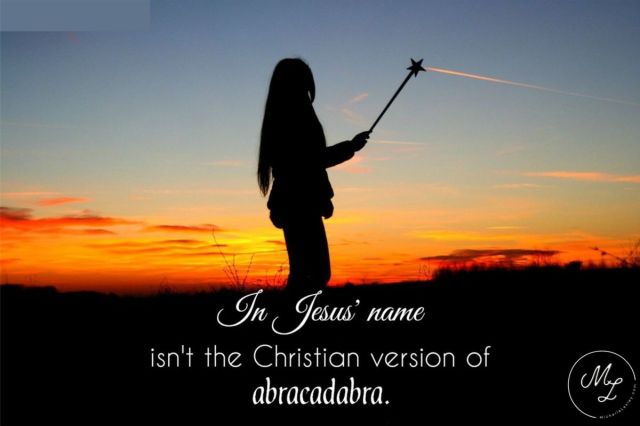
If saying the word “Jesus” did that, you’d see a lot more healing and peace and all the other things mentioned in the song happening, because a lot of people “speak Jesus” in vain a lot of the time. I mean, when was the last time you were watching a TV show and one of the characters blasphemously exclaimed, “J—s!”? Did that heal you of the flu or your gout? No, of course it didn’t.

To which Charity and the songwriters would probably reply, “Well, we didn’t mean it like that! We mean Christians speaking the name of Jesus over people with faith that doing so will heal them, bring them peace, etc.”.

Maybe so, but that’s not what they’re saying. The lyrics of the song imply that there is some sort of intrinsic power in the word “Jesus” itself. “Your name is power. Your name is healing. Your name is life.” The lyrics don’t give any other provisos other than the word passing someone’s lips.

But let’s grant them the benefit of the doubt that when they say “speak Jesus” they mean Christians speaking it with some sort of faith in what saying it will accomplish. Is that biblical?

No, it’s not. It is actually a violation of the third Commandment (taking God’s name in vain) and the laws and commands against practicing witchcraft, magic, and casting spells. Because that is exactly the way they’re using the name of Jesus – the same way witches cast spells. They’re attempting to speak words that harness supernatural power that doesn’t belong to them in order to exercise power and control over things that only God has power and control over.

And remember this little incident in Acts 19:11-19a?

And God was doing extraordinary miracles by the hands of Paul, 12 so that cloths or aprons were even carried from his body to the sick, and the diseases left them and the evil spirits went out. 13 But also some of the Jewish exorcists, who went from place to place, attempted to invoke over those who had the evil spirits the name of the Lord Jesus, saying, “I implore you by Jesus whom Paul preaches.” 14 Now seven sons of one named Sceva, a Jewish chief priest, were doing this. 15 And the evil spirit answered and said to them, “I recognize Jesus, and I know about Paul, but who are you?” 16 And the man, in whom was the evil spirit, leaped on them, subdued all of them, and utterly prevailed against them, so that they fled out of that house naked and wounded. 17 And this became known to all, both Jews and Greeks, who lived in Ephesus; and fear fell upon them all and the name of the Lord Jesus was being magnified. 18 Also, many of those who had believed kept coming, confessing and disclosing their practices. 19 And many of those who practiced magic brought their books together and were burning them in the sight of everyone;

The magicians burning their books of spells in the fear of God in verse 19 demonstrates that they recognized that the Jewish exorcists “invoking the name of the Lord Jesus” (13) were doing essentially the same thing they were doing- casting spells. The magicians saw what happened to the exorcists and they didn’t want that to happen to them, too.

And invok[ing] over those who had the evil spirits the name of the Lord Jesus (13) is exactly what I Speak Jesus is teaching. Go back up to “Over whom?” above. See how I’ve notated the lyrics “addiction,” “fear,” and “anxiety,” as “a spirit or entity”? There’s a reason for that. The NAR doesn’t teach sin like the Bible does. It doesn’t say, “You’ve committed the sin of drunkenness and you need to repent.” It says, “The spirit of addiction is on you and you need to be delivered from that spirit.” The NAR teaches that sin (and illness) happen because you’re possessed by, or at least influenced by, demonic spirits, and you need “deliverance” from those demons and spirits (Sounds an awful lot like the “exorcists” trying to drive out “evil spirits” in v. 13, doesn’t it?). This is not at all what the Bible teaches about sin (or illness either, for that matter). Here’s what God says about why we sin:

But each one is tempted when he is carried away and enticed by his own lust. Then when lust has conceived, it gives birth to sin, and when sin is fully matured, it brings forth death. James 1:14-15

No demons. No evil spirits. You and I sin because our flesh wants to. Because our flesh craves and lusts after something unholy that we’re not supposed to have. “The devil made me do it,” was a Flip Wilson comedy routine, not biblical theology. We are responsible for our sin, not some demon or spirit.

This was funny at the time because everyone – even pagans – knew it was ridiculous. But this is basically what’s now being taught at New Apostolic Reformation “churches” all over the world.

The Bible does not teach us to “speak Jesus over” anyone or anything for the purpose of bringing about results (healing, peace, freedom from sin, conquering the enemy, etc.) that are strictly within the purview of God. If you want to see people set free from sin, fear, anxiety, depression, and addiction, the biblical thing to do is to call them to repent and believe the gospel.

Is this song biblical?
No. It teaches false doctrine and is completely unbiblical.

4.

Now, maybe you’re not so much with all this “right brain” stuff – artsy words and metaphors and such. You’re more of a “left brain,” analytical, “Just the facts, ma’am,” kind of gal. Or maybe you’re just looking for a faster way to find out whether a song is worth listening to in the first place.

I have good news for you. Assuming the artist in question is somewhat prolific, there’s often a faster and easier way to find out what you should or shouldn’t be listening to. And it’s also a more biblical way than vetting individual songs.

When the Bible deals with false teachers, it doesn’t teach us to sift through every article they’ve written or every sermon they’ve preached and keep what’s good and throw out what’s bad. (In common parlance, this is often referred to as “chewing up the meat and spitting out the bones,” and it is an unbiblical way of dealing with false teachers.) The Bible teaches us to stay away from them, altogether.

Romans 16:17-18– “Turn away from” or “avoid” them.
2 John 9-11– “Do not receive him into your house and do not give him a greeting”.
Titus 3:10– “Reject” a factious man.

Scripture teaches us to avoid that teacher completely. Avoid him as a person and every piece of content he has ever created. And that’s the model we should be following with Christian musicians as well. In the same way you wouldn’t listen to a “good” sermon from heretics like Bill Johnson or Steven Furtick, you shouldn’t be listening to “good” songs from doctrinally unsound or heretical musicians. And churches should definitely not be using music from heretical sources in their worship services.

Why Your Church Should Stop Playing Bethel, Hillsong, Elevation, and Jesus Culture

How do you find out who should be avoided? You examine the musician’s life, doctrine, and practices. If you need a little help, you can use the resource I’ve created for vetting teachers: Is She a False Teacher? 7 Steps to Figuring it Out on Your Own.

The first thing I would suggest looking for is any ties to Bethel, Hillsong, or Elevation – all households of heresy (New Apostolic Reformation / Word of Faith). Bethel practically holds a monopoly on the Christian music industry (Hillsong, not as much any more since all the scandals, but Elevation is still hanging in there as a wannabe.), so any evangelical musician seeking fame and fortune is going to be looking to hitch her wagon to Bethel’s star. So look for connections to Bethel and anyone with strong ties to Bethel, for example, Phil Wickham. But also look for connections to any musician or band that you know has bad theology. I’ve got a few listed here, but this is honestly not an area I keep current with, so you may need to bounce things off a discerning friend who is more in the know than I.


Is “I speak Jesus over you” a biblical concept? Nope. Is the song I Speak Jesus biblical? Nope. Keep being discerning as you decide which music and artists to listen to.


If you have a question about: a Bible passage, an aspect of theology, a current issue in Christianity, or how to biblically handle a family, life, or church situation, comment below (I’ll hold all questions in queue {unpublished} for a future edition of The Mailbag) or send me an e-mail or private message. If your question is chosen for publication, your anonymity will be protected.


Mailbag

The Mailbag: Asked and Answered

Have I told you lately that I love you? (Some of us are old enough to remember that song! :0) I really do love all of you readers and followers. It is an honor and a joy to serve you in Christ.

Sometimes in an article I’ll say something like, “If you’ve been around the blog for a while, you probably know that…yada, yada, yada.” Well, some of y’all haven’t been around the blog for a while, and to that, I say welcome! It’s always great to have more of the fam gathered ’round.

But because some of y’all are new, you aren’t yet aware of all of the resources here to help you. Let’s remedy that!

First, if you’re new (or if you’ve never read it), check out Blog Orientation for New Readers and Old Friends. It’s like a Cliffs Notes intro to the blog.

Second, be sure to familiarize yourself with all of the tabs in the blue menu bar at the top of the page. That’s where I keep the info I’m most frequently asked about.

Third, there’s a search bar at the bottom of every page (and one in the blue menu bar at the top of every page) which might help you find what you need.

And finally, let me get you newbies some answers to the questions several of you have asked recently. Some of you long time friends may have missed these along the way, so I hope they’ll be helpful to you, too!

Are there any sound Christian musicians anymore?

Yes, they’re just few and far between, and not as well known as the unsound ones. Check out this article which contains both artists to avoid and doctrinally sound artists, plus other helpful resources:

The Mailbag: False Doctrine in Contemporary Christian Music


My sister just got ordained by her church as a minister, also she is involved in deliverance ministries. She believes that God speaks outside of Scripture and promotes many false teachers. I’ve been praying for wisdom and compassion and the right opportunity to share. Any suggestions you may have would be greatly appreciated.

It is heartbreaking when a loved one forsakes sound doctrine and does a swan dive into the cesspool of rebellion and false teaching. If you need to approach a loved one in a situation like this, here’s some help:

The Mailbag: How should I approach my church leaders about a false teacher they’re introducing? (While this article is about approaching church leaders about false teachers, the same basic principles apply when approaching a loved one.)

Clinging to the Golden Calf: 7 Godly Responses When Someone Says You’re Following a False Teacher 

Discernment: A Spiritual Battle, Not a Logical One 

Discernment: What’s Love Got to Do with It? 

Words with Friends: How to contend with loved ones at A Word Fitly Spoken


Which translation of the Bible do you recommend?

I think the two best English translations out there right now are the English Standard Version (ESV) and the New American Standard (NASB). I also highly recommend the MacArthur Study Bible. Check out more info on Bible translations, some to avoid, and more great resources here:

The Mailbag: Which Bible Do You Recommend?


Are you on any other social media that is in favor of free speech? I have deleted Twitter and am attempting to get off Facebook but I would still like to follow you.

This is an important one with all the censorship that’s taking place on the major platforms right now. I am currently on Facebook, Twitter, Instagram, Pinterest, MeWe, Parler, and Gab. (I also have a YouTube channel, but I’m not really using it at the moment.) My plan is to remain on Facebook and Twitter (and probably Instagram since it’s owned by Facebook) until I’m banned, then utilize my remaining platforms. You can always find the direct links to all of my social media accounts in the Contact and Social Media tab in the blue menu bar at the top of this page.


I have tried without success to find the answer to: As a woman is it violating 1 Timothy 2:11-12 for me to present the gospel to a man?

There’s a lot of confusion about what it means to “present the gospel” or “share the gospel” or “evangelize”. Some people use those as catchall terms for everything from a woman pastoring a church, to a mom reading a Bible story to her 2 year old, to posting a Bible verse on Facebook. If what you mean is a one on one conversation with a man in which you explain to him that he is a sinner, and how he can be saved (which is the actual defintion of the aforementioned terms), then the answer to your question is no. It is not a violation of Scripture for a woman to do that. See #11 here.

Got questions about the role of women in the church? Check out these resources:

Rock Your Role: A series of articles examining the Scriptures which pertain to the role of women in the church

Rock Your Role FAQs: Frequently asked questions about real life roles and activities in the church and whether or not women may biblically participate in them


Is X teacher, pastor, or author doctrinally sound?

Check the Popular False Teachers & Unbiblical Trends tab in the blue menu bar at the top of this page. These are the teachers I’ve actually written articles on.

If you don’t find the person you’re looking for there, find the search bar and type in the person’s name. (Make sure you spell it exactly right.) I may have mentioned the person you’re looking for in an article about someone or something else.

If you do both of these and you don’t get any hits, you can be confident that I haven’t written anything on the person you’re looking for. You’re welcome to email me asking about that teacher, but as you know (having read the “Blog Orientation” article linked above) I most likely won’t be able to answer. That brings us to our final resource here at the blog for researching and vetting teachers:

Is She a False Teacher? 7 Steps to Figuring it Out on Your Own


Who are some pastors, teachers, and authors you recommend?

You’ll find a list of several dozen at the Recommended Bible Teachers tab in the blue menu bar at the top of this page.


I live in X area. Can you help me find a doctrinally sound church?

The Searching for a new church? tab in the blue menu bar at the top of this page has multiple church search engines, churches recommended by my readers, information on church planting, what to look for in a doctrinally sound church, and how to biblically leave your current church. Just click and start searching!

Just a couple of notes:

  • You’ll have to do the legwork of searching and vetting the churches for yourself. I can’t do that for you.
  • If you’ve thoroughly searched every single search engine and can’t find an established church within achievable driving distance of your home, you may need to check around with local friends or denominational agencies, move, or start utilizing the church planting resources. You can email me, but I’m afraid I won’t be able to help. As I once joked with a friend, “I’m not Walmart. I don’t have any churches in the back stock room. Everything I have is out on the shelves.” :0)

Can you recommend a good women’s Bible study?

Yes, mine. You can find all of them – all free and all suitable for individual or group study, along with my philosophy of Bible study – at the Bible Studies tab in the blue menu bar at the top of this page.

No, I mean, can you recommend a pre-packaged book, DVD, etc., study by a well known Christian author?

No, because I recommend that women study straight from the text of Scripture itself (which is what my studies are designed to teach women how to do).

The Mailbag: Can you recommend a good Bible study for women/teens/kids?


If you have a question about: a Bible passage, an aspect of theology, a current issue in Christianity, or how to biblically handle a family, life, or church situation, comment below (I’ll hold all questions in queue {unpublished} for a future edition of The Mailbag) or send me an e-mail or private message. If your question is chosen for publication, your anonymity will be protected.
Worship

Tuneful Tuesday

Today, I thought I’d share with you some of the music I’ve been listening to lately. Enjoy!

That’s What the Bible Says by The Collingsworth Family
“I don’t need no signs and wonders to know that God is real..” Gotta love it!

Send the Light by Acapeldridge
This is a little different version than I’ve always heard, but I like it!

He Giveth More Grace by The Living Stones Quartet
Like a lullaby for a grownup. Just try to listen without a Kleenex. I dare ya!

I Know that My Redeemer Liveth by George Frideric Handel
Yes, Virginia, there are other songs in The Messiah besides the Hallelujah Chorus, and this is a lovely one.
Step of Faith by First Call
Yes, I was a First Call fan in the 80’s. Don’t judge. :0)

I do not necessarily endorse all of the songwriters or performers listed here, the churches/organizations they represent, any other songs they may have written or performed, or their theology. If you decide to follow any of these people or groups, check out their theology first to make sure it’s biblical.


What are you listening to lately?

Worship

In My Humble Opinion…The One with the Modernized Hymns

I don’t often share my personal, completely subjective opinions with y’all. I figure there’s enough of that in the world and what’s sorely lacking is unambiguous biblical truth. So that’s what I try to share instead.

But today, I have an opinion. I’m sure it’ll be wildly unpopular and generate a bunch of hate mail, but that’s in my wheelhouse, so here goes:

I don’t really like most modernizations of hymns.

I didn’t say, “I don’t like modern hymns.” There are several of those I like, and contemporary hymn writers like the Gettys are doing a bang up job of writing lovely new, doctrinally sound hymns. Frankly, we need more theologically rich contemporary hymns.

What I mean is that I don’t like some well-meaning hipster to pick up How Great Thou Art and go, “Hey, those words – most of them anyway…or…at least a few of them – are cool, but that melody, harmony, tempo, and syncopation? Haul out the mothballs! We can’t be singing THAT in church! It’s gotta sound like something on CCM radio! Relevant! Fresh! Cutting edge!”. And then they proceed to put their grubby little paws all over someone else’s hard work and mangle it into something barely reminiscent of the work of art it once was.

It’s kind of the same reason I hate modern remakes of movies of yesteryear. It takes something that was great the way it was and ends up diminishing it to make it palatable and marketable to today’s consumer.

Hymn modernizers are often melody driven. They take a melody they like and force the original hymn lyrics to fit it – leading to awkward phrasing or the need to change words – rather than letting the lyrics lead and crafting a melody around them.

What’s wrong with the original music? I mean it. What on earth is wrong with the original music to the hymn? Nobody’s clamoring for the modernization of Gregorian chant or classical music or big band or 50’s rock, or 60’s folk music, or disco. People listen to those genres and appreciate them for what they are, and if they want to listen to a different genre, they switch genres, they don’t play musical Silly Putty with the current genre. If every generation of people had taken the hymn modernizers’ approach, we’d currently be listening to the 21st century version of Nebuchadnezzar’s horn, pipe, lyre, trigon, harp, and bagpipe.

To me, it’s functionally musical plagiarism even if it doesn’t fit the technical legal definition. They take an existing piece of someone else’s work, change at least 50% of it (sometimes more if they change some of the lyrics in addition to the music) and popularize it under their own name. Whatever happened to “Keep your eyes on your own paper and do your own work.”?

Most of the hymns now being modernized were written at a time when people sang like normal human beings, which nobody seems to know how to do any more. Today, when listening to modernized hymns, you have two choices of “artists”: the wispy, breathy ones who sound like a stiff breeze would knock them over, or the moany, growly ones whose vocalizations are more fit for a Barry White ditty (let the reader understand) than a hymn.

But…but…but…

Yes, I know all the exceptions to everything I’ve just said. I know various hymns have been modernized from time immemorial. I know lyrics of songs are often changed to fit existing melodies. I know some people like modernized hymns and growly or wispy singers.

But that’s kind of the point of why I posted an opinion today. This is my personal preference. I get to like what I like and dislike what I dislike as long as I’m within the confines of Scripture. So do you. So does everybody in the Body. And that’s OK.

Varied personal opinions and preferences – not biblical truth, mind you; we have to know the difference – are not things to divide over. We need to make sure we’re listening to each other, understanding each other, and valuing the unique quirks and characteristics God created in each other. God put each of us together differently for His glory. Those differences show the kind of creativity and diversity He is capable of.

So you have your subjective opinion and I’ll have mine, and we’ll love each other and have those opinions to the glory of God.

Just keep your mitts off How Great Thou Art, if you please.

Discernment, Guest Posts

Guest Post: Lauren Daigle and the Fruit of “Losing her Religion”

If your theology pretty much matches up with mine (as outlined in the “Welcome” and “Statement of Faith” tabs) and you’d like to contribute a guest post, drop me an e-mail at MichelleLesley1@yahoo.com, and let’s chat about it.

Lauren Daigle and the Fruit of “Losing Her Religion”
by Laura M.

“It would be a sad dishonor for a child of God to be the world’s favorite. It is a very bad sign to hear a wicked world clap its hands and shout, “Well done!” to the Christian…Far be it from us to seek a crown of honor where the Lord found a crown of thorns.”  CH Spurgeon

Lauren Daigle is a 28 year old Grammy award winner. In her short career she has won many awards, secular and Christian. She has four number one songs to date and many more at the top of the billboard charts. She has over 1 million Facebook followers, and an abundance of world tour dates that she alone headlines. Her Look Up Child album just reached double platinum. She is wildly popular in the church and on Christian radio stations.

The secular world is now also paying attention. What have they learned? This is an interview with Billboard.com 

“’My home church is right here,’ [Lauren] says, gesturing toward the stage.It’s right here, every night.'”

“Daigle doesn’t preach, onstage or off. In between songs at the show, she told goofy stories — like one about her misadventures in physical therapy — but never mentioned Jesus.” 

That one interview said a lot –no church, means no pastor, no teaching, no growing…no obedience.

Sure, she is fun and cool and trendy and sincere in her desire to use her talents, but is that enough to be labeled a Christian artist? Even she does not want to be described that way, having determined to drop the word “Christian”. Yet, Christians have her at the top of their “worship” playlists.

Should we consider her as purely secular entertainment? Christian words and a great voice filled with sincerity do not make worship acceptable before God.

“When we talk about worship, we’re talking about something very specific, very objective, revelatory, unfolded for us on the pages of Scripture. It is not private, it is not personal in the sense that you define it yourself. It doesn’t rise out of your intuition. It doesn’t rise out of your experience. It doesn’t rise out of your imagination. It isn’t the invention from your own mind of what you want it to be. True worship is simply treating God in the way that God has commanded us to treat Him. That’s what it is.” The Kind of Worship God Desires, John MacArthur

We should have a great concern about the platform and influence that many so called “worship leaders” have in the church today.  Many Christians incorrectly assume that if the words are not heretical and make them “feel” good, it must be acceptable worship. Lauren Daigle is growing in her platform and influence and we should take a discerning look at whether this is a wise choice for Christians. Is the fruit of Lauren’s “Religion” good or bad?

Her Partnerships

Here are just a few, Stephen Furtick and Jesus CultureJoyce Meyer , Hillsong, Bethel Church and here Lauren is leading “worship” at Bethel.

Michelle has already written much about these false teachers and churches.

Her Testimony

Can you tell what is missing? She does not start with Christ.  Does she finish with Him? She was interviewed by the Young Salvationist here (it seems they have removed it since we copied the text). 

The interviewer asked her, “Please share with our readers how you came into a relationship with Jesus Christ?”

When I was 15 years–old I was diagnosed with a debilitating virus. It’s kind of funny how God sets things up, as I was super busy. I was in high school running all over the place and God stopped me – He stopped me in my tracks. I was placed on homebound rest for two years with this illness. It was during that season when I truly began to know God and His character. He gave me hope the entire time; I wasn’t going through this for any reason. This wasn’t just the lot I was handed in life. No, I knew, I could tell, God was setting me up for something and I needed to stay focused.

So, every morning I would get up and read my devotionals and every night before bed. Soon I started making my own devotionals. The Word was filling me up so much and during a season when I was completely alone… During that time, God would give me visions and dreams of the season that I’m walking through now! He affirmed me and who I was in Him. He showed me that my placement had to be with Him and He began to teach me that He was my comforter, He was my portion and He was my foundation. I was baptized when I was a little girl, raised in the church, and a part of a Christian family; but it changed from that to God being my source, my Savior.”

This is typical of many who have their own personal dream and attach God’s name to it. She did not say how she was changed and she did not once mention Christ or sin or the Cross. Did she mention reading the Bible? A Scripture perhaps? No, only visions.

Her website would surely have a larger testimony for us to read. However, I did not find one. The most “spiritual” she got was stating,

“It’s about remembering what it’s like to be a child again and to look up and see the clouds, the sunset, and the stars. It’s about having hope once more. You can always come back to yourself. You can come back to the things you thought were lost. You can always come back to redemption.”

She doesn’t say anything about Christ. Instead she is pointing to childhood memories, the clouds, the sunset, stars. What is the basis of renewed hope? How does one come back to yourself?

In another interview, she says, (of her teen years)

“And I kept having all of these dreams about tours, awards, charts and all of these different stages I’d be on. And I was like, ‘God what is this about? … Then He affirmed me...” 

From fear and uncertainty sprang resistance as Daigle made the personal decision to not pursue Christian music, despite messages from God telling her otherwise. “I told the Lord—yes I told Him, ‘I’m not going to do Christian music! I’ll sing whatever You want me to sing, I’ll do whatever you want me to do in the mainstream world, but I’m not doing Christian music.’”

She took her personal dream of stardom and attributed it to God.  There is much danger in this kind of mystical dream interpretation. It may have come to pass, but God does not affirm pursuit of the praise of men and I cannot say this is anything more than her pursuit of a personal desire.

The Praise of the World and Views on Sin

“The most effective servant of the Gospel of Christ crucified is crucified to the world and its applause.”  Mike Riccardi

Lauren said, “she will not compromise her faith while traveling the world ministering to those outside of the church…She vowed that her testimony would not be destroyed in any way.”

However, this is her response to being criticized for being on the Ellen DeGeneres show. Ellen is an open and proudly lesbian woman.

“I think the second we start drawing lines around which people are able to be approached and which aren’t, we’ve already completely missed the heart of God,” Daigle said during a recent interview with WAY-FM Radio.

Lauren missed the point, this is not about kindness it’s about being foolishly and sinfully drawn to the world and then affirming them because they have affirmed her. Jesus clearly drew lines in Matt 7.

And yet…after being on the Ellen DeGeneres show, she capitulated on her conviction not to compromise.

“Do you feel that homosexuality is a sin?”

After a pause, she responded: “You know I can’t honestly answer on that…I have too many people that I love that, they are homosexual, I don’t know. I actually had a conversation with someone last night about it and I was like ‘I can’t say one way or the other, I’m not God’

Pastor Gabe Hughes responds to this interview in a short video titled, Lauren Daigle doesn’t know if homosexuality is a sin?

And now, not surprisingly, Lauren Daigle Takes Issue with the Label ‘Christian Artist’

“After being in a spotlight of controversy for weeks regarding her stance on homosexuality, well-known Christian artist Lauren Daigle is now saying she doesn’t consider herself a Christian artist, but simply an “artist”….Interestingly enough, the young artist did not mention Jesus or God throughout the interview, sticking to general phrases like “faith,” while placing a large emphasis on the importance of love.”

It is not acceptable to equivocate on sins that Christ died to save us from.  He died for us to be reconciled to the Father, because we are without hope of saving ourselves, not for everyone to “feel” loved.

A 2019 article states,

“She admits the transition from a majority Christian audience to a more secular one has already been a “ride” and hints at the negative comments she’s been receiving from fans and others who are concerned the singer is leaving her Christian roots. Daigle seems unphased by the pushback, though. Risk is the best. Risk is the most beautiful thing,” she says with a smile.” source

And yet 4 years before in 2015, she said, 

God’s not a God of risks. He just says, ‘Trust me,’ because He has it all under control. To us, in our human life, it looks like a risk, but He’s like, ‘No, I’m God. I got this.’” source

This Christian Post article interviews her as well, sharing,

“Daigle went on to share a story about a megachurch pastor which was asked to step down from his ministry and lost his church, after having an affair with his secretary.

Lauren said,

I could see privately that he had some things to reconcile and I just thought about the nature of the church, to push out someone that operated in humanity,” she explained. “It’s so easy to push those people away or to build the white picket fence around our ideologies that create this counterculture that completely denies just the love of Christ, the grace of Christ, the mercy of Christ, and rejects the relationship with Christ.”

Lauren has an unbiblical view of sin, it is not in her testimony, it is not calling homosexuality the abomination that the Bible does, and it sympathizes with the poor pastor who disqualified himself by the most egregious sin against his wife. These are not the words of someone who submits to the authority of Scripture.

The Bible does not mince words (1 Cor 6:11) and neither should anyone who has been washed of the sins we have been so graciously forgiven and desire this to be true of others.

She also provocatively named a song, Losing My Religion and then comments

“This is an age where I am learning, what I believe in. We have a song on there that record called ‘Losing My Religion’ and I think one of the things that I’ve learned and one of the things that I’m embracing is the freedom of taking off the checked boxes, the rules, and all those things that kind of muddy up what faith actually is

Unfortunately, she has muddied her faith and is influencing many who flock to her and find the same muddy waters. This is exactly what we would expect from someone who claims that her church is her “stage”.

She excuses her decision to crossover by pointing to Avril Lavigne, Elvis Presley and Aretha Franklin because they sing a few gospel songs as well. “There’s all these people from back in the day that did this thing as well, where they had both. And I feel like history always repeats itself.” Billboard interview  Not great role models.

Remember, it is OK to be fruit inspectors, not just of false teachers but of everyone, fruit always gives evidence of the source of life. (Matt 7:17-20) We rejoice when we find good fruit and we warn when it is bad.

Lauren is leading worship to the masses she has before her. She seems to love the world, clings to false teachers and obfuscates clear Biblical teaching when given opportunity to proclaim it. As Christians, would it not be better to stop supporting her and so give her the wakeup call she needs rather than the praise and attention she is getting for bad fruit? If she does have a clear testimony of saving faith why is it not front and center for us to see?  

Let’s pray she would get off the stage and into a Biblical church to be taught well how to worship in “spirit and truth.” (John 4:23), and give opportunity for a pastor and church family to care for her soul. (Heb 13:17)


Laura and her husband Scott have been married 25 years and have three children. They live in a suburb of Philadelphia and NYC, where they have recently planted a church. She also writes with a few friends at Where Ordinary Life Meets Divine Truth as a ministry to the local women they are privileged to disciple.