Mailbag

The Mailbag: Potpourri (Female missionaries, quantum physics, book recommendations…)

Welcome to another “potpourri” edition of The Mailbag, where I give short(er) answers to several questions rather than a long answer to one question. I also like to take the opportunity in these potpourrri editions to let new readers know about my comments/e-mail/messages policy. I’m not able to respond individually to most e-mails and messages, so here are some helpful hints for getting your questions answered more quickly. Remember, the search bar can be a helpful tool!


In the last Potpourri edition of The Mailbaga reader asked if I could enlarge the font of my articles. I played around with several different fonts and sizes, and what you’re currently seeing is the best I can do to enlarge the font without throwing the layout of the whole page out of whack. Personally, I think it’s still too small, but I hope it has helped at least a little.


I am wanting to start a Bible study for my coworkers after work maybe once a week or every two weeks but I don’t know where to start. Many of them are young women in their early twenties and either new in the faith or no faith at all. I want to start slowly so I don’t overwhelm them but I have no idea the first step I should take. Do you have any resources for sound Bible studies for new believers or young women? 

Yes, I recommend you choose a book of the Bible, maybe a shorter one to start with, start at the beginning, and work your way through it with your ladies, teaching and discussing as you go. If you need some help in the beginning knowing what kinds of questions to ask or which issues in the text to focus on, you are more than welcome to use any of the studies I’ve written free of charge (see the “Bible Studies” tab at the top of this page), and even print them out if you like. Once you get a feel for teaching this way, I’m sure you’ll do fine on your own coming up with questions and pointing out important points in the passage.

You might want to start out with my study on Colossians since it’s fairly short and will give your group a good grounding in biblical Christology (who Jesus is, what He did, and why).

Another option might be for the group to choose a Bible reading plan (again, maybe one of the shorter ones to start off with), do the reading at home, and come together weekly to discuss the readings.

I don’t recommend “canned” book or DVD studies anymore. First of all, the overwhelming majority of them contain false doctrine. Studying the Bible itself sidesteps that problem altogether. Second, Christian women need to learn and practice the skill of picking up God’s Word and studying it for themselves. You have the unique opportunity with new Christians and non-Christians to start them off on the right foot of studying the Bible itself rather than getting them hooked on other people’s books. Below are a few more resources that might be helpful. Let me know how it goes!

Bible Study resource articles

The Mailbag: We Want Bible Study Answers

10 Simple Steps to Plain Vanilla Bible Study

You’re Not as Dumb as You Think You Are: Five Reasons to Put Down that Devotional and Pick Up the Actual Bible

10 Bookmarkable Biblical Resources for Christian Women

Rightly Dividing: 12 Do’s and Don’ts for Effective Bible Study

Bible Book Backgrounds: Why you need them and where to find them


What is your take on quantum physics and God?

Oh my! My take is that I really don’t know enough about quantum physics to speak intelligently on this. You might want to check out Answers in Genesis or the Biblical Science Institute. The founder of BSI, Dr. Jason Lisle, is a doctrinally sound Christian who has a double-major bachelor’s degree in physics and astronomy with a minor in mathematics, and a Master’s degree and Ph.D. in astrophysics. He would be the one to ask.


Book Recommendations
I need some help from you readers on these!

Readers have written in requesting doctrinally sound recommendations of books on the following topics:

Theology books for teenagers
Neither of these are written specifically for teenagers, but they’re both written simply enough that teenagers shouldn’t have any trouble with them:
None Other by John MacArthur
Everyone’s a Theologian by R.C. Sproul

A whole Bible commentary
Here
are some you can try out for free. MacArthur’s commentaries are excellent, as are Boice’s.

Explaining sex/where babies come from (8 year old level)
Clueless. My husband and I just explained it to our children verbally.

If you have a recommendation for a doctrinally sound book on any of these topics, please comment below with the title, and the author’s name and a link if possible. Thank you!


I read your blog regularly and haven’t seen you write about a particular topic: Christian wives, especially mothers, working outside the home. 

The reader went on to answer her own question quite beautifully, I thought. I couldn’t say it any better, so here’s the rest of her e-mail:

As I have read and studied Titus 2:3-5 lately, as an older woman (62 this year), I was struck by this phrase, workers at home:

Older women likewise are to be reverent in their behavior, not malicious gossips nor enslaved to much wine, teaching what is good, so that they may encourage the young women to love their husbands, to love their children, to be sensible, pure, workers at home, kind, being subject to their own husbands, so that the word of God will not be dishonored. (emphasis mine)

Interestingly, our pastor is doing a series on evangelism. He has started out in a different place, sort of laying the groundwork. He is showing us particular passages in the Scriptures regarding practical things that Scripture says Christians can do to perhaps provide openings and help to overcome some of the unsaved person’s natural enmity to the gospel. He preached on this passage because it says that women are to do/not do these things “so that the word of God will not be dishonored.” This has made this issue seem even more compelling to me. I know of Christian wives that are working outside the home, some against the counsel of godly people in their lives and even the wishes of their own husbands.

Lest you misunderstand me, I am not saying that a Christian woman should never work outside the home. Every Christian couple must decide together before the Lord how this looks in their own family. Obviously, a woman who has children in school all day, or grown children, or no children, has more leeway. If a husband is absolutely unable to work because of ill health, or whatever, I am sure there are some exceptions. But still the Scriptures teach that the Christian wife’s primary focus and attention is to be in her home, that the word of God will not be dishonored. I agree with what Grace to You wrote here.


Should women be missionaries?

Yes. Absolutely. In fact, we need more women – single and married – to serve as missionaries (more men, too). The only caveat is that women who serve as missionaries need to do so in a way that is in keeping with Scriptural principles of women’s roles in the church. (For example, female missionaries should not be pastoring churches on the mission field. A missionary’s job is to share the gospel with people and then disciple them in sound doctrine, and you don’t want to be teaching false doctrine through the act of preaching to men.) But there are oodles of mission opportunities that fit the bill.

It is my understanding that there is a great need for women missionaries to minister to women in countries whose cultures discourage or prohibit their women from interacting with men. A male missionary could not reach out to women in those countries, but a female missionary could be very effective.

My denomination, the Southern Baptist Convention, has a rich history of female missionaries and mission work, starting with our Women’s Missionary Union, celebrating its 130th anniversary this year. Our yearly offering for international missions is named after female missionary, Lottie Moon. Likewise, our annual North American missions offering is the Annie Armstrong offering, and my state convention collects the Georgia Barnette missions offering every year. You might enjoy reading about these female missionaries and others such as Amy Carmichael and Amy Medina.

There are many reputable missions organizations out there, but the two I’m most familiar with are the Southern Baptist Convention’s North American Mission Board and the International Mission Board, which, even if you’re not Southern Baptist could give you some ideas of the types of mission work out there and the countries needing missionaries.

If you’re thinking about becoming a missionary, set up an appointment with your pastor to talk it over. He can probably give you some great pointers and put you in touch with people and organizations that can help you.


If you have a question about: a Bible passage, an aspect of theology, a current issue in Christianity, or how to biblically handle a family, life, or church situation, comment below (I’ll hold all questions in queue {unpublished} for a future edition of The Mailbag) or send me an e-mail or private message. If your question is chosen for publication, your anonymity will be protected.
Book Reviews, Guest Posts

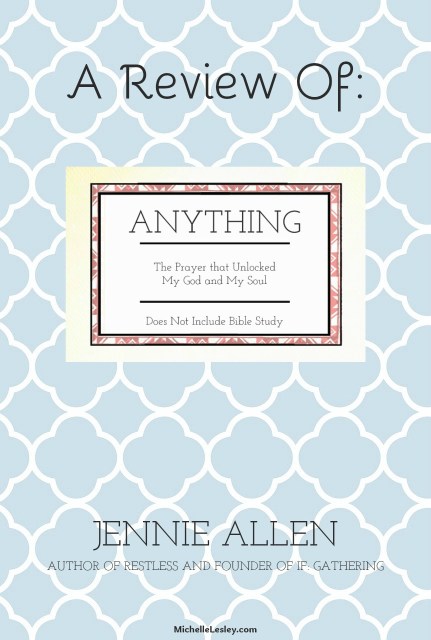
Guest Post: A Review of Jennie Allen’s “Anything: The Prayer that Unlocked My God and My Soul”

If your theology pretty much matches up with mine (as outlined in the “Welcome” and “Statement of Faith” tabs) and you’d like to contribute a guest post, drop me an e-mail at MichelleLesley1@yahoo.com,
and let’s chat about it.

A Review of Jennie Allen’s
Anything: The Prayer that Unlocked My God and My Soul

by Carol Coppens

Many years ago, when I was in the 6th grade, I was taught that when doing a book report, even if I didn’t like the book, I should try to say something good about it. That was fine teaching at the time and I think it has made me a better writer, this trying to see both sides. I’m not in school any longer though and these days, I’m bound less by trying to see the good and more to pointing out the multiple errors of books like Anything. If you’re a Jennie Allen fan, you won’t like what I have to say but I can’t stay silent.

Anything is a poorly written book. It’s an irreverent book. It’s a book that will never help any woman discover the totality of God’s plan of redemption, His sovereignty, His wrath which rests on the unregenerate, nor His holy fury at those who presume to speak for Him. This is not a book that will help you to dive deep into the character of God and to know Him better but instead, Jennie’s book is a tedious, self absorbed, experience driven, hermeneutically unsound, over-stepper of scriptural boundaries, mish-mash of emotionalism and repetitive “wrecked-ness”. Here are some of the specific faults that I see.

Even in these days of relativity, where the only rule that seems to apply is that there are to be no rules at all, there are still a few that are necessary. One of the rules of basic English grammar is, if you’re going to use an adjective (remember that word from English class?) you’d better do your homework and find out exactly what that word means, in the context in which you plan to use it.

The word reckless is used multiple times in this book. Jennie describes childlike faith as living “simply, recklessly.” On pg. 97, she writes that she and her husband, “now lay in the hands of a reckless, invisible God.” Page 143 tells of her realization that people are going to think they are foolish for adopting, saying, “that goes with almost any act of recklessness, even reckless love.” Maybe she thought the word sounded powerful and kind of daring when she penned it but the definition of reckless is “without thinking or caring about the consequences of an action.”

Describe human beings as reckless as much as you like, because we all certainly can be, but when a writer uses the word reckless to describe almighty God, that person has crossed over into blasphemy and I would shudder to think that I had written such a thing about the God I will eventually have to give an account to. Some of the other words she uses to describe God are, “unsafe”, “wildly unpredictable”, “radical”, “ridiculously radical” and she also writes that “God is still not very practical.” Exactly where are the chapters and verses for these descriptions of God, Jennie?

In many places, Jennie adds words to Scripture that are not there. Space hinders me from listing them all, so one example will have to do. On page 184, she speaks for Jesus and writes, “as if he were letting us in on the secret, Jesus whispered back to his father, this will all be worth it. Wait till they are with us and see our glory. Just wait till all of this work and suffering and pouring out is over and we are in heaven together forever. Just wait.”

This conversation is, of course, recorded nowhere in Scripture but the words “do not exceed what is written”, definitely are. Jennie would do well to read and meditate deeply on that verse in 1 Corinthians 4. When we imagine that God is speaking to us apart from Scripture, we can easily be led to enter very dangerous territory.

An example of her flawed interpretations of Scripture is on page 37. Jennie quotes Hosea 2:14-17 but then she blatantly misinterprets God’s promise to restore Israel to Himself, as a “dramatic metaphor” about those of us who chase other loves. I say, leave Biblical interpreting to those who know about these things, Jennie. If you think that you’ve been given a new interpretation of these verses that no other person has ever had before, you’re just plain wrong. God was promising restoration to Israel in these verses and nothing else.

She also does emotional and hermeneutical callisthenics with God’s call to Abraham to sacrifice Isaac (pgs. 69-70). Jennie’s theory is that God was punishing Abraham for his overwhelming love for his son that, according to her, had usurped God as Abraham’s first love. If she had thoughtfully studied these Bible passages or, if she truly understood God’s plan to ultimately save His elect, she would know that the sacrifice of Isaac and the ram God substituted for the boy, was a shadow of God’s own sacrifice of His son Jesus Christ on the cross. There is no excuse for such lazy interpretation of the sacred Scriptures. In these current times, the proliferation of false and misleading doctrine abounds. Having the correct interpretation of Scripture is of paramount importance because our eternal futures depend on understanding correctly, what God is saying to us.

On page 102, Jennie asks “so how do we actually let God change us?” Finally, I thought, a good solid question after having read page after page of drivel. Can an explanation of justification and sanctification be far behind? Sadly, they weren’t even hinted at and she goes on to tell a rather horrific (as a mother I cringed) story of telling her two oldest children to climb up a cliff and jump off! For Jennie, jumping is the key. Either “jump or crawl down” and “the more we jump and see our God come alive around us, the more we jump without fear – and the bigger the cliffs get”, she says. As the Peanuts character Charlie Brown was known to exclaim, good grief!

In the final analysis, the biggest problem I had with this book (and I slogged through it twice) was my knowing that, from the time of her “vision” in the night that Jennie feels was definitely from God, the wheels of the IF: Gatherings began to turn. For those readers who still might be unfamiliar with IF, they are para-church organization, begun by Jennie, that has no scriptural basis or authority. The gatherings happen outside of the local churches and their oversight, supposedly to accomplish something, ie. discipling women, that only churches are charged to do, in Scripture. In this case, the ends do not justify the means.

Because all the women involved in IF cannot possibly be born again, spirit filled, doctrinally sound, mature women with the spiritual gift of teaching, the possibilities for unscriptural philosophies and practices entering in to local churches, families and society at large, are enormous. I see this movement as no less than a calculated move of Satan against women, a frontal attack on the sufficiency of Scripture and a throwing off of the direct commands of God, in His Word, for both married and single women. Jennie Allen might believe that her “call” to begin IF was of God, but I do not.

So, at the end of the day, would I recommend this book to anyone? Absolutely not! What I do recommend instead is simply this – read your Bible, always praying that God will illuminate your mind with His truth. Get involved with a biblically solid church and pray for God to open doors for you to serve there. There is no substitute for a godly, biblically saturated, discerning Christian woman and one only gets that way by hard work and study. The Scriptures do not open themselves to the slothful. When a woman is mature in Christ and can properly discern truth from error then and only then it will come to pass that the writings of the Jennie Allens of this world will be seen for what they truly are, rubbish.

With a grateful nod to my 6th grade English teacher, I suppose I could say one good thing about this book and that is, that it wasn’t any longer.


Carol and her husband Mike live in a small town, on the shores of Lake Erie, in Ontario, Canada. She was 49 years old when Christ called her to be His disciple. A love for the pure truth of God’s Word fuels her passion to expose false teaching and especially that kind which has women as its primary target.


ALTHOUGH I DO MY BEST TO THOROUGHLY VET THE THEOLOGY OF THose WHO SUBMIT GUEST POSTS, IT IS ALWAYS POSSIBLE FOR THINGS TO SLIP THROUGH THE CRACKS. PLEASE MAKE SURE ANYone YOU FOLLOW, INCLUDING ME, RIGHTLY AND FAITHFULLY HANDLES GOD’S WORD AND HOLDS TO SOUND BIBLICAL DOCTRINE.
Guest Posts

Guest Post: How to Improve Your Reading Experience

If your theology pretty much matches up with mine (as outlined in the “Welcome” and “Statement of Faith” tabs) and you’d like to contribute a guest post, drop me an e-mail at MichelleLesley1@yahoo.com,
and let’s chat about it.

Today, I’m excited to share with you a guest post from my daughter Michaela, who has recently started a blog of her own. This article is adapted from her blog article How to Improve Your Reading Experience. I know many of you are connoisseurs of Christian books, so I thought this might be helpful. Some of her suggestions can even help with your Bible reading.

How to Improve Your Reading Experience
by Michaela Lesley

Anyone who knows me knows that I am an avid reader. I have my mom, grandmother, and aunt to thank for this obsession, which began at a very young age. My mom would take me and my younger brothers to the library every few weeks, and it was an outing I always looked forward to. Every summer, my mom would pick out a book series and read out loud to me and my brother, Jordan, every day. My grandmother also enjoyed reading out loud to me, but because she lived in another state, she had to get creative. She would pick out books or short stories and record herself reading them on a cassette tape (it has definitely been a while since I wrote out the word “cassette”, and I almost forgot how to spell it). I would play these tapes whenever I was in my room playing, and at night while I was trying to fall asleep. My mom’s sister, author Kaye Dacus, was always the type of person to give books or Barnes & Noble gift cards as presents, and I always knew I was in for a treat whenever I got something from her in the mail around my birthday.

While I’m a few classics short to be able to consider myself a well-seasoned reader, I do consider myself good at reading. I know how to get through many books quickly, and I know how to stay in the loop when it comes to new popular books. Here are a few tricks I’ve learned over the years to make the most out of reading:

1: Goodreads.com– This is one of the easiest ways to keep track of your books. You can log in to Goodreads through your preferred social media account, or you can start a separate account through the site. There is also a very handy app, if you aren’t often near a desktop or laptop. On this site, you can mark books as To Read, Read, or Currently Reading. If you are currently reading a book, you can track your progress by putting what page you are on, and the site will tell you what percentage of the book you have finished. Once you have completed a book or marked it as “Read”, Goodreads gives you the options to rate the book on a Five Star scale and post a review of the book. You can also create your own “Shelves” to further organize books. I personally create a new shelf for every year, so I can keep track of how many books I’ve read that year. You can also see which books are trending, and Goodreads will recommend new books to you based on what  you have read. These are just a few of the many things you can do with the site, but these are the features I find the most useful. You can create an account here: Goodreads

2: Reading Playlists– This is something that I have been doing for a while now, and it makes reading so much more enjoyable. I use Spotify to create playlists specifically for reading. These playlists have songs and scores from some of my favorite movies. I also use Pandora to listen to the Movie Scores station. I mostly read fantasy and science-fiction, which means lots of intense fight scenes and bad guys giving monologues. I can picture the the characters and what they’re doing, and having music helps set the scene in my head. I’ve also found that I read faster when I listen to music.

3: Audiobooks and Ebooks– Thanks to being an adult, I don’t have as much time as I used to to sit down and read a book. But, there are currently 67 books on my To Read list, and I add more all the time. So, I have to find ways to get through that list somehow. My favorite non-traditional way of reading is listening to audiobooks (and yes, listening to a book counts as reading a book. Don’t let anyone tell you otherwise). I listen to books while doing house work, while driving, or just while doing something relaxing. I use Audible.com to listen to my audiobooks. Audible is part of Amazon, and a membership is $15 a month (your first month is free). The $15 a month gives you 1 credit, which you can use to buy any audiobook. The great thing about this is that most of the books cost more than $15, so it’s a really great deal. You can listen to the books on your smart phone, tablet, or computer, even without an internet connection. Once you finish the book, you can remove it to save space on your device. However, you can re-download the book at anytime. Overdrive is a service that many libraries use, and it allows you to “borrow” audiobook and ebook files with your library card.  This way, you have the convenience without having to spend any money! Kindle (Amazon’s ebook service) and Nook (Barnes and Noble’s ebook service) are useful as well! You can either download the apps onto your phone or tablet, or you can buy the actual Nook/Kindle devices. Ebooks tend to be much cheaper than physical books, and you can take them with you in your pocket! You also have the option to read in the dark, which is helpful if you are traveling at night or if you have a roommate.

4: Book-to-Screen Adaptations– We live in a time where it seems like every popular book is getting a TV show or movie. If I see a preview for a movie or TV show that looks like it might interest me, and I see that it’s based on a book, I immediately add that book to my To Read list. That book becomes a top priority. I feel an urgency to read that book. If you make yourself finish the book before seeing the movie or watching the show, then you will have a reason to finish it quickly. It’s exciting to see a story you love come alive on the screen, and watching that movie or show can be your reward for finishing the book. On the flip side, if you have a favorite movie or TV show that you find out is actually based on a book, then it will be easy for you to get into that book. This is a great way for people who aren’t already readers to get into reading.

5:  Reading with Friends– back in 2012, all of my friends and I were reading a popular trilogy. We had seen the previews for the first movie, and we knew we wanted to read the books together and see the movie together. We would all carry the books with us to class. We would read them in the van on the way to basketball games. We would stay up late and text each other our reactions to certain chapters. We all finished those books in about a week and a half. Reading a book with friends is a very fun way to bond as a group. You can encourage each other to read, and you can discuss the story together. My best friend and I are currently reading a book series together. A new book comes out every year, and we read it together and have fun conversations about where we think the story is going plot-wise.

6: Developing Reading Habits– getting through books can be hard if you are like me and you are easily distracted. With Netflix, YouTube, and Social Media, it’s easy to waste your free time on other things. Setting a designated time to read is a good first step to prioritize reading. Many people like to read before bed, to help them unwind before they fall asleep. Having a specific place to read can also help you focus. I have stopped reading in my room, because I am more easily distracted in there. I prefer to read in my living room, on the couch, with my reading playlist playing on my phone. This specific setting helps me concentrate. If I find that I’m still getting distracted, I pull up my phone’s stopwatch, and try to see how quickly I can read one page. I hit the “lap” button every time I make it through a page. When my phone is being used for a purpose like that, I find that I don’t check Facebook or Instagram as often.

Happy reading, my friends! ❤


Michaela Lesley was born and raised in Baton Rouge, Louisiana. She loves to travel and wander around new places, and is always reading a new book. She is a certified Jesus Freak, and is 100% OK with that. Michaela blogs at Michaela of Baton Rouge.


ALTHOUGH I DO MY BEST TO THOROUGHLY VET THE THEOLOGY OF THE BLOGGERS WHO SUBMIT GUEST POSTS, IT IS ALWAYS POSSIBLE FOR THINGS TO SLIP THROUGH THE CRACKS. PLEASE MAKE SURE ANY BLOGGER YOU FOLLOW, INCLUDING ME, RIGHTLY AND FAITHFULLY HANDLES GOD’S WORD AND HOLDS TO SOUND BIBLICAL DOCTRINE.
Mailbag

The Mailbag: Christian Fiction Recommendations

This article is kept updated as needed.

I love to read Christian fiction but find that it can be a bit of a minefield. It can get off course theologically and may reflect the world more than biblical Christianity. Have you ever given recommendations on Christian fiction writers?

Great question! We all need a little mind candy now and then, but we don’t want it to be a vehicle for delivering bad theology to our brains.

First, let me sort of set the stage for what’s in my mind when I think of “Christian fiction.” Other people might have other definitions of this book genre, and that’s absolutely no problem, but, to me, Christian fiction has an overtly biblical message or theme and maybe even a blatant presentation of the gospel. When I think of “Christian fiction” I’m not thinking merely “family friendly” (a good clean story with nothing biblical in it), or a novel with a character in it who happens to attend church or be a Christian but there’s nothing else biblical in the book, or a fiction book on a non-biblical topic that’s written by someone who’s a Christian. So the books I’ll be recommending below will fit this definition of “Christian fiction.”

Next, I know the bulk of Christian fiction marketed to women is romance and Amish romance. And, in keeping with the “stick out like a sore thumb” weirdness that is Michelle Lesley, it’s not a genre (Christian or secular) I personally enjoy. There’s nothing wrong with it if you can find a good one and you like romances, but the books below aren’t romances simply because that’s not what I read. I tend toward biblical history novels and – I don’t know if there’s a particular name for this type – “real life scenario” contemporary Christian lit.

A few final points:

•I don’t hold Christian fiction to quite as high a theological standard as I do Christian non-fiction (theology, Bible studies, “Christian living” books, etc.). Some of the books below may have a few theological “cow pies” you’ll have to step around and ignore, but, for the most part they’re in line with biblical theology.

•My personal standard for recommending a biblical historical fiction book (a fictionalized account of a true Bible story, such as Lynn Austin’s and Chris Skates’ books below) is that the book has to stay true to what the Bible actually says took place including the dialogue, details, and chronology, and any of the fictionalized parts have to comply with biblical principles, theme, history, and culture of the time period.

•I haven’t checked any of these authors (as I would non-fiction Christian authors) to see where they stand on the role of women in the church, and I haven’t researched any of them to discover whether they associate with false teachers.

That said, here are a few recommendations:

Karen Kingsbury– Although her older works of fiction may not be too problematic, she is not someone I’d encourage you to read because of her recent theological trajectory.

Lynn Austin– Here’s a “book report” I wrote on Lynn Austin’s Chronicles of the Kings series. I read that entire series and loved it. It was VERY good and theologically strong.

Chris Skates– Chris’ biblical historical fiction rendition of the story of Noah and his family in The Rain was a fun read.

Those are the only ones I’ve actually written about. Here are some others I’ve read and enjoyed over the years. (Quoted excerpts courtesy of Amazon.com)

Hank “The Bible Answer Man” Hannegraaff:

The Last Disciple– “As the early church begins to experience the turbulence Christ prophesied as the beginning of the last days, an enemy seeks to find John’s letter, Revelation, and destroy it. Meanwhile the early Christians must decipher it and cling to the hope it provides as they face the greatest of all persecutions.”

(Update: A few months after the original publication of this article, Hank Hannegraaff decided to join the Greek Orthodox church. Though I read and enjoyed this fictional book of his, I would no longer recommend his non-fiction work or ministry as biblically trustworthy.)

Paul Maier:

A Skeleton in God’s Closet– “Dr. Jonathan Weber, Harvard professor and biblical scholar, is looking forward to his sabbatical year on an archaeological dig in Israel. But a spectacular find that seems to be an archaeologist’s dream-come-true becomes a nightmare that many fear will be the death rattle of Christianity.”

The Constantine Codex– “While touring monasteries in Greece, Jon and his wife Shannon—a seasoned archaeologist—uncover an ancient biblical manuscript containing the lost ending of Mark and an additional book of the Bible. If proven authentic, the codex could forever change the way the world views the holy Word of God.”

Kathi Macias:

People of the Book– “Farah lives in Riyadh, Saudi Arabia, with her family, and wants nothing more than to develop a deeper devotion to her Muslim faith. She sees the month of Ramadan as her chance to draw nearer to Allah, and pursues that goal. All goes well until the prophet Isa—Jesus—appears to her in a dream and calls her to Himself.”

Joy DeKok:

Rain Dance– “What happens when a Christian woman facing a childless future and a woman seeking an abortion are waiting to see the same doctor? What if after that “chance” encounter they are unable to forget each other?”

Randy Alcorn: I’ve read and enjoyed most of Randy’s fiction books. Off the top of my head, I don’t recall any I wouldn’t recommend. Two of my favorites were:

Safely Home– “Is this the day I die? Li Quan asks himself this question daily, knowing that he might be killed for practicing his faith. American businessman Ben Fielding has no idea what his brilliant former college roommate is facing…But when they are reunited in China after twenty years, both men are shocked at what they discover about each other.”

Edge of Eternity– I would call this book a modern day Pilgrim’s Progress. “Imagine Being Pulled Into the Hereafter. While You’re Still Alive. A disillusioned business executive whose life has hit a dead-end, Nick Seagrave has lost loved ones to tragedy and his family to neglect. Now, at a point of great crisis, he unbelievably and inexplicably finds himself transported to what appears to be another world.”

Frank Peretti: Years ago, I was a big Frank Peretti fan and read most of his novels. I don’t remember any overt heresy in his work, but it’s been well over a decade since I’ve read anything by him, so that could just be my faulty memory. Most of his novels deal with spiritual warfare, so there’s the potential for some errant theology there. Read discerningly. Two of my Peretti favorites are:

This Present Darkness and Piercing the Darkness (a two book series)- “The small town of Ashton is the unexpected setting for an epic clash between good and evil as a Christian preacher and a news reporter unearth a plot to take over their small community, and eventually the world.”

There are also some books that would fall under the category of Christian fiction which I would strongly recommend against:

The Shack (or any other book) by William Paul Young: While I mentioned that I don’t hold Christian fiction to as high a theological standard as Christian non-fiction, I definitely don’t recommend any Christian fiction fraught with blatant heresy or whose main goal is to teach heresy, and that’s what Young himself has stated is one of the objectives of this book (although he doesn’t consider his views heresy). The movie based on this book releases next month (March 2017). Here are some resources that will explain the theological problems in The Shack in more detail.

Redeeming Love (the book or the movie) by Francine Rivers

The Chosen (any books or materials): Yes, it’s fiction. If you want the non-fiction version, read your Bible.

Inappropriate/Unbiblical Content: In an effort, I guess, to be cutting edge, cool, or gritty, there are novels marketed under the Christian fiction genre which contain profanity, graphic sex scenes, and glorification of other sinful behavior. I would not recommend those books regardless of the reason these types of things are included in the book.

Girl “Porn”: This is really more about what’s going on in the reader’s heart than the book itself. It’s been said that romance novels can be a form of literary “pornography” for women. I mentioned graphic sex scenes above, but I would also caution women away from non-graphic Christian romances if they cause you to create an idol in your heart of the “ideal” man that no real life man can measure up to. If you’re married, read a lot of romances, and find yourself increasingly dissatisfied (in any way) with your husband because he can’t hold a candle to the leading men in the books you’re reading, you need to put those books down and walk away from them. That’s coveting.

False Teacher Fiction: There are a few false teachers who have branched out into the fiction genre. Beth Moore and Priscilla Shirer have both recently released novels, T.D. Jakes has written some fiction, and I believe there are a few others. Even though these books may be fiction and might not even contain any false doctrine, I could not, in good conscience recommend a fiction book that could serve as a “gateway drug” to their non-fiction books.


If you have a question about: a Bible passage, an aspect of theology, a current issue in Christianity, or how to biblically handle a family, life, or church situation, comment below (I’ll hold all questions in queue {unpublished} for a future edition of The Mailbag) or send me an e-mail or private message. If your question is chosen for publication, your anonymity will be protected.

Book Reviews

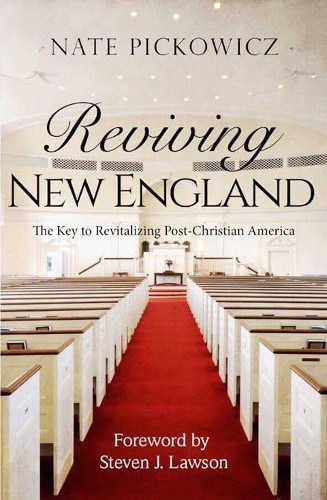
Book Review ~ Reviving New England

rnecover_330x500

I’ve said it dozens of times: I don’t write book reviews. But I’m fortunate that there are awesome, godly people out there who do, and who do a bang up job of it. So today I wanted to share a great review of the book Reviving New England. The review was written by my friend Rachel Williams over at danielthree18.com, and the book was written by my other friend, Nate Pickowicz, pastor, podcaster, and blogger extraordinaire. They are both lovely, doctrinally sound people I’m proud to know, so I’m certain you’ll enjoy both the review and the book.

Reviving New England 
(Why Women Ministry Leaders Should Read This Book)

by Rachel Williams

I ordered Nate’s book, Reviving New England: The Key to Revitalizing Post-Christian America, and I sit down to enjoy a treatise on the history of liberalism in New England, and what pastors in New England need to do today to turn the churches back to Christ.

Instead, I spent the majority of my time reading chunks of the books out loud to my husband, whispering, “YES!,” and underlining massive sections of it, realizing that every woman who leads women’s ministries across the United States (and beyond) needs this book.

Today.

Pickowicz does start the book with a brief history of the rise (and fall) of Christianity in New England. For those of you not students of church history, he does an excellent job of making this information relevant to today and fast-paced. (Trust me, I’ve heard my fair share of less-than-exciting lectures on this topic. He does a great job keeping your interest.) However, the history lesson is brief, and this is where the book becomes, in my opinion, necessary for women’s ministry leaders today.

The rest of the book is written for pastors and centers on how to preach the Word of God. He does a masterful job of navigating the problems in so many pulpits and offering real practical solutions to guiding the church back to sound biblical principles.

So why do I think women’s ministry leaders need this?…

Click here to continue reading.