What does Hitler have to do with abortion? How can a pro-life vs. pro-choice discussion turn into a witnessing opportunity? These folks did a “180” on their stance on abortion– and more. Please take the time to watch this extremely important movie, and lets all band together to win souls to Christ and end the holocaust of abortion.
Watch the full interview with Alicia here. You can find helpful resources and materials for use by individuals or churches here.
Is it biblical for women to administer communion to other women in a local church or a parachurch ladies gathering? It it biblical for a couple to administer communion at a social gathering in their home?
Communion.. the Lord’s Supper… the Lord’s Table… the breaking of bread and drinking of wine (or grape juice) as a memorial to our Lord’s suffering and death is an extremely solemn and serious ordinance of the church.
I mean, in the Corinthian church, people were getting sick and dying because they weren’t handling the Lord’s Supper in a godly way.
Whoever, therefore, eats the bread or drinks the cup of the Lord in an unworthy manner will be guilty concerning the body and blood of the Lord. Let a person examine himself, then, and so eat of the bread and drink of the cup. For anyone who eats and drinks without discerning the body eats and drinks judgment on himself. That is why many of you are weak and ill, and some have died. 1 Corinthians 11:27-30
Take a moment and meditate on what that means. How seriously does God take the Lord’s Supper?
The Lord’s Supper is an ordinance of the gathered church, just like baptism is. You wouldn’t (I hope) baptize people at your Tupperware party or even your weekly women’s Bible study, and you shouldn’t be observing the Lord’s Supper in those sorts of venues either.
Look at the language in 1 Corinthians 11:17-34 and how it differentiates between eating outside the church gathering (at home) and partaking of the Lord’s Supper inside the worship gathering of the church. The language assumes that the Lord’s Supper takes place in the church gathering: “When you come together…” (17, 20), “When you come together as a church…” (18), “Do you not have houses to eat and drink in? Or do you despise the church of God…” (22), “when you come together to eat” (33), “if anyone is hungry, let him eat at home—so that when you come together…” (34).
When you unbiblically remove the Lord’s Supper from the worship gathering of the church body, you immediately cheapen it. It becomes lesser. Just some little thing we do so we can feel like we’re being holy, or because we crave ritual. It’s reduced to the level of hors d’oeuvres or a party game. The purpose of the Lord’s Supper is for the gathered church to proclaim the Lord’s death until he comes (26).
And because it is an ordinance of the church, those who shepherd the church – pastors and elders – are responsible for administering it in a biblical way. That responsibility has not been given to any Tom, Dick, and Harry (or Dawn, Pat, and Mary, if you will) who decides he or she wants to offer it at a private shindig. It is a pastoral responsibility, which includes fencing the table.
So the answer to all of your questions is no. The Lord’s Supper should not be observed at parachurch meetings or social gatherings at all. (Or weddings. You didn’t ask about that, but I’m going to throw that in there, too, for the same reasons.) And the only reason I can think of that a church would have women administering the Lord’s Supper during a worship service instead of the pastor, elders, and/or deacons is either to appear egalitarian or because they are egalitarian, so that’s a “no” too.
What about situations like COVID, when the church can’t gather? Is “online communion” (taking the Lord’s Supper at home with whatever elements I have on hand while watching the pastor “administer” it online) OK?
No. First of all, as we learned from COVID, while there may be very temporary emergencies, the church can gather if it is being obedient to the Lord. Sometimes obedience is costly, but it can be done. Just ask our Savior, whose obedience cost Him torture and death.
Second, there’s no requirement for how often the church must observe the Lord’s Supper. Jesus said “as often as you do this,” not “every week” or “twice a month”. Once the temporary emergency is over the church can come back together and observe the Lord’s Supper as a body, in person, as indicated by Scripture.
“What about homebound, hospitalized, or dying people who are Providentially hindered from gathering with the church? Can a pastor administer the Lord’s Supper to those people outside the church gathering?”
I would leave that to a pastor’s discretion, but, if I were a pastor, I would be very reluctant to do so. Personally, I would urge those people, as well as anyone else who wants to observe the Lord’s Supper outside of the gathering of the church body to consider why they want to do that. I mean, dig deep and do some serious introspection about your reasons and what you actually believe about the Lord’s Supper.
I suspect some Christians, without even realizing it, may hold some Roman Catholic-adjacent or superstitious beliefs about the Lord’s Supper.
It’s not the thing you do right before you die (or any time) to make you right with God, forgive your sins, or secure your place in Heaven. That’s what Christ’s death, burial, and resurrection were for. And if you’re placing your faith for any of those things in partaking of the Lord’s Supper instead of, or in addition to Christ’s finished work on the cross, that’s idolatry.
It’s not something you do to assuage misplaced guilt about not being physically able to attend church (or, for that matter, to assuage appropriate guilt about forsaking the assembly when you actually could be there). If you are legitimately Providentially hindered from faithful church attendance, God knows that. He’s the One who allowed or placed you in that situation in the first place. You don’t need to “make it up to Him” or try to get “back” into His good graces by performing for Him by partaking of the Lord’s Supper. Rest. Rest in His grace, mercy, and divine Providence. You can partake when you’re able to go back to church, or when the whole church is one day gathered for the marriage supper of the Lamb.
It’s not something you do to somehow conjure up or invoke God’s presence into your midst. That’s a variant of necromancy or witchcraft. God is omnipresent. There’s not a millimeter of the universe in which He is not present. He’s at your social gathering. He’s at your parachurch meeting. What you want to do at those events is to pray, not observe the Lord’s Supper. In prayer, you recognize God’s presence, submit yourselves and your gathering to Him, and ask Him to guide your meeting. And, no, observing the Lord’s Supper isn’t “leveling up” on “just prayer”. Prayer and the Lord’s Supper are two different worship practices with two different purposes.
And, finally, the Lord’s Supper isn’t something you do to secure God’s blessing on whatever activity or venue you’re observing it in. It’s not a talisman. It’s not like rubbing a rabbit’s foot for luck or a baseball player going through his superstitious pre-game rituals so he’ll play well and win the game. Participating in the Lord’s Supper with your church family is a blessing – it’s the blessing of unity in Christ and the fellowship of proclaiming His death together until He comes, but you don’t do it to get God’s blessing on your marriage, your dinner party, or your pro-life meeting.
What would you say to a church not using unleavened bread for communion? The last time we took communion the bread was Italian bread, obviously had yeast in it. I don’t want to take the Lords supper with bread with yeast in it because yeast represents sin and Jesus has no sin in Him, and if we are to remember what He did, how can we use just regular bread. I did ask the pastor, he thought I had a good point, but I haven’t heard from him yet.
It’s great that you asked your pastor about this. That’s exactly what I would have advised you to do. I would encourage you to submit to his leadership on this issue.
Leavened bread is not a reason to abstain from the Lord’s Supper any more than grape juice instead of wine (or vice versa) is a reason to abstain. My personal opinion (not biblical mandate) is that unleavened bread and wine should be used because they are more historically accurate and truer to the details of Scripture than leavened bread and/or grape juice. That being said, I’ve never been a member of a church that didn’t use grape juice, and I have participated in observances of the Lord’s Supper that used leavened bread, and it didn’t bother me in the least.
We need to remember that the reason unleavened bread was used was not because leaven represented sin, although we do see that symbolism later, but because the Lord’s Supper began as the Last Supper, which was an observance of Passover. Unleavened bread was used for Passover because it memorialized the Israelites’ flight from Egypt. They did not have time for the dough to rise before the exodus. That’s where the unleavened bread for Passover, the Last Supper, and the Lord’s Supper came from. It had nothing to do with Jesus’ sinlessness because Jesus had not yet come at the time of the exodus.
We can also remember that Jesus used leavened bread when He fed the 5000, and in that very context of leavened bread, He Himself said, “I am the bread of life.” If leaven always represents sin, why would Jesus, who was sinless God, have referred to Himself in the context of everyday leavened bread?
If leavened bread is the only reason you’re abstaining from the Lord’s Supper, I would encourage you to stop abstaining and partake joyfully with your church family, proclaiming the Lord’s death until He comes.
We recently moved and have been attending a Southern Baptist church. They have not had communion for over two months. Isn’t it the norm to have communion at least once a month? …since we are new to this church we are still waiting and learning our place. We hesitate to make ourselves known as possibly unsubmissive or question why they do things the way they do. (From The Mailbag: Potpourri (…SBC Communion…))
These are such great questions because they help me, as a Southern Baptist, think about the way we do things and how those practices might be perceived by visitors or new members.
Every Southern Baptist church is autonomous, so each church has its own policy or practice about how often the Lord’s Supper is observed. There are some SBC churches who hold the Lord’s Supper every week and probably others who hold it only once or twice a year, although I don’t personally know of any who hold it that infrequently.
In my experience, most Southern Baptist churches observe the Lord’s Supper several times a year, usually on a schedule like the first Sunday of the month, once a quarter, or every “fifth Sunday” (in months that have five Sundays). In addition to these scheduled observances, many churches also observe the Lord’s Supper at their Christmas Eve, Good Friday, or Easter service.
I would encourage you and your husband to set up an appointment with the pastor and ask away! It is certainly not unsubmissive to sit in his office and politely say, “We’re new here and we were just wondering about…” Most pastors I know would love for potential members to do this.
We run into trouble when we start trying to “improve” on God’s Word and His ways. The Lord’s Supper is an ordinance of the church, to be observed in the gathering of the church body, and to be rightly administered by the pastor, elders, and/or deacons. Let’s leave it at that – nothing more, nothing less – right where Scripture leaves it.
If you have a question about: a Bible passage, an aspect of theology, a current issue in Christianity, or how to biblically handle a family, life, or church situation, comment below (I’ll hold all questions in queue {unpublished} for a future edition of The Mailbag) or send me an e-mail or private message. If your question is chosen for publication, your anonymity will be protected.
This year’s iteration of IF:Gathering – IF:One Night 2026 – is coming up next Friday, February 27. IF you aren’t aware that there are serious biblical problems with it, or IF you need some information and evidence to share with friends who are planning to attend, or IF, unfortunately, your church is hosting a simulcast, you need to read this…
IF: One Night 2026 is coming up Friday, February 27. IF you aren’t aware of the biblical problems with it, or IF you need some information and evidence to share with friends, or IF your church is hosting a simulcast, read this.
If you are considering commenting or sending me an e-mail objecting to the fact that I warn against certain teachers, please click here and read this article first. Your objection is most likely answered here. I won’t be publishing comments or answering emails that are answered by this article.
Originally published July 10, 2020, this article is kept continuously updated as needed.
I get lots of questions about particular authors, pastors, and Bible teachers, and whether or not I recommend them. Some of the best known can be found above at my Popular False Teachers tab. The teacher below is someone I’ve been asked about recently, so I’ve done a quick check (this is brief research, not exhaustive) on her.
Generally speaking, in order for me to recommend a teacher, speaker, or author, he or she has to meet three criteria:
a) A female teacher cannot currently and unrepentantly preach to or teach men in violation of 1 Timothy 2:12. A male teacher or pastor cannot allow women to carry out this violation of Scripture in his ministry. The pastor or teacher cannot currently and unrepentantly be living in any other sin (for example, cohabiting with her boyfriend or living as a homosexual).
b) The pastor or teacher cannot currently and unrepentantly be partnering with or frequently appearing with false teachers. This is a violation of Scripture.
c) The pastor or teacher cannot currently and unrepentantly be teaching false doctrine.
I am not very familiar with most of the teachers I’m asked about (there are so many out there!) and have not had the opportunity to examine their writings or hear them speak, so most of the “quick checking” I do involves items a and b (although in order to partner with false teachers (b) it is reasonable to assume their doctrine is acceptable to the false teacher and that they are not teaching anything that would conflict with the false teacher’s doctrine). Partnering with false teachers and women preaching to men are each sufficient biblical reasons not to follow a pastor, teacher, or author, or use his/her materials.
Just to be clear, “not recommended” is a spectrum. On one end of this spectrum are people like Nancy Leigh DeMoss Wolgemuth and Kay Arthur. These are people I would not label as false teachers because their doctrine is generally sound, but because of some red flags I’m seeing with them, you won’t find me proactively endorsing them or suggesting them as a good resource, either. There are better people you could be listening to. On the other end of the spectrum are people like Joyce Meyer and Rachel Held Evans- complete heretics whose teachings, if believed, might lead you to an eternity in Hell. Most of the teachers I review fall somewhere in the middle of this spectrum (leaning toward the latter).
If you’d like to check out some pastors and teachers I heartily recommend, click the Recommended Bible Teachers tab at the top of this page.
Jennie Allen / IF:Gathering Not Recommended
Jennie Allen is “a Bible teacher, author, and the founder and visionary of IF:Gathering,” an annual conference for women. She also blogs, hosts the Made for This podcast, and speaks at IF:Gathering and other events.
The IF:Gathering conference organization (now including Gather25, IF:One Night, IF:Pray, IF:Lead, IF:Equip, IF:Table, IF:Local, IF:TV, and Discipleship Collective), around which most of Jennie’s ministry centers, was “inspired by the question, ‘If God is real…then what?‘.” If God is real– is a troubling premise for an ostensibly Christian ministry. The Christian existence does not center around the pablum possibility that God is real, but on the rock-solid, stake your life and your eternity on it certainty that He is not only real but the Creator of, and Sovereign over, the universe, and the only hope of salvation for sinners. If God is real…then what? as the foundation of a Christian ministry is somewhat akin to If 1+1=2, then what? as the foundational concept of a Mensa-esque organization for the top mathematical minds in the world.
As to the “…then what?” part of the equation, Jennie’s and IF’s solution is woefully unbiblical. Jennie has an established history of embracing and partnering in ministry with false teachers, female “pastors,” and women who preach to men. Just a few of the many available examples:
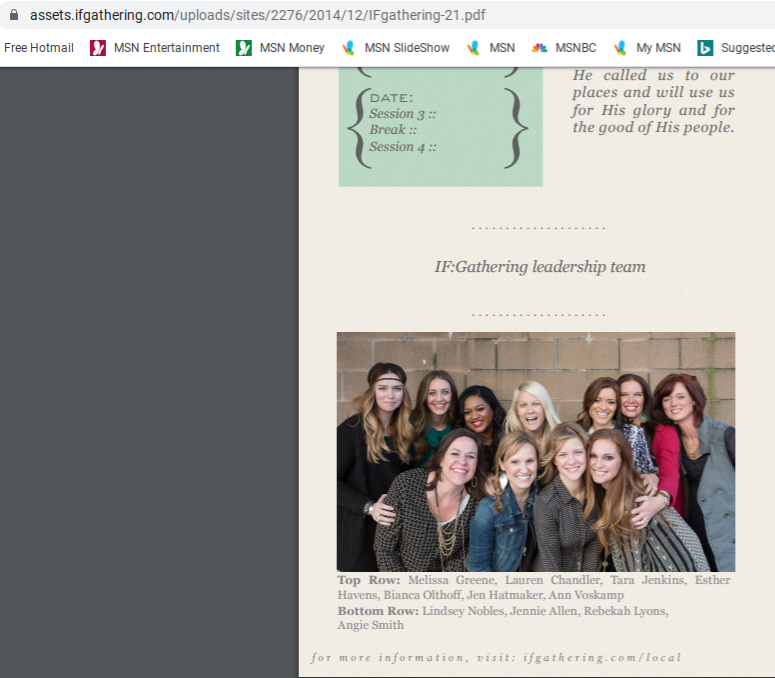
Since the launch of IF:Gathering in 2014, Jennie has habitually featured false and biblically problematic teachers and female preachers/pastors as speakers and as part of IF’s leadership team:
Top Row: Melissa Greene, Lauren Chandler, Tara Jenkins, Esther Havens, Bianca Olthoff, Jen Hatmaker, Ann Voskamp Bottom Row: Lindsey Nobles, Jennie Allen, Rebekah Lyons, Angie Smith
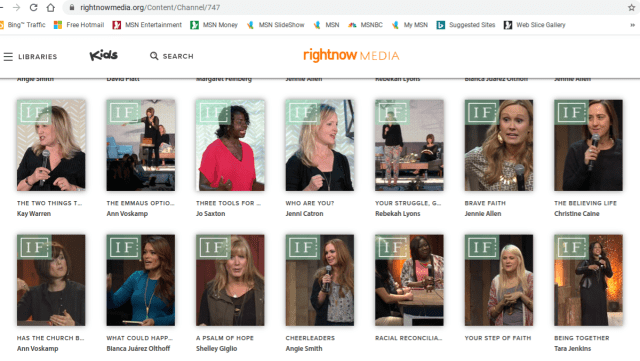
IF 2022 included a similar tableau of false teachers, female preachers/pastors, and racialists (some are returning speakers, some are new):
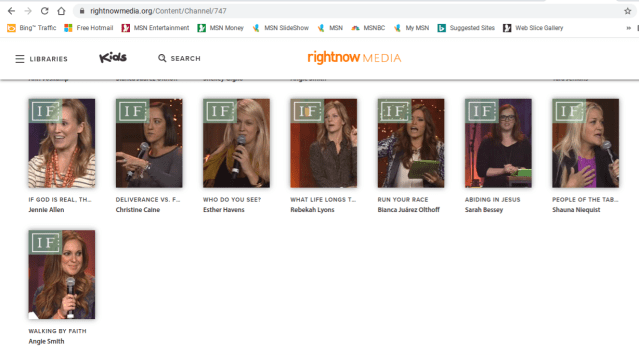
And, once again, IF 2023 features many of the same speakers, plus a few new faces who mostly (though not all) fall into the same categories of female “pastor,” women who preach to men, false teachers, and racialists.
In addition to Beth Moore speaking at IF:Gathering 2020 and IF:Lead 2020, Jennie’s partnerships and displays of affinity with her are far too numerous to list (just Google Jennie Allen Beth Moore, and you’ll see what I mean) and have been going on for years. A couple of recent examples:
Jennie preaching at Liberty University’s convocation (chapel) (LU Convocation – Mar.6, 10:30 AM, Streamed Live on March 6, 2020 – Jennie begins preaching at 40:59) Starting at 38:40 the man introducing Jennie says, “…I believe Jennie has a message for every single one of us…I’m so excited to sit under her teaching because I don’t believe…the principles that she has for us are just for women…I want you to know, especially the men in this room, that I believe that what God has brought through this messenger at this very moment is not just for the ladies in the room. It would be very closed minded for us to think that…every time a man shows up here that’s just for the men in the room and every time a woman comes, that’s just for the other [women]…”
I can’t seem to locate a statement of faith for Jennie or what church she currently attends, so you’ll have to infer what she believes by reading her books and blog, but I have learned a few specifics about her theology. Jennie is a proponent of the unbiblicalEnneagram. Jennie believes in extra-biblical revelation, and started IF:Gathering because “a voice from the sky” told her to:
Jennie often focuses on “dreaming” (in the sense of future goals or creative aspirations), a concept foreign to Scripture. I downloaded her “Dream Guide” for 2019 and found some of her statements troubling:
It really is as simple as this. Do the best you can in this world and as you’re going, love God and give Him away to people.
“Do the best you can in this world”? Where does the Bible say that? “And as you’re going, love God”? Like it’s an afterthought or an accessory to your life of “doing the best you can”? No. It really is as simple as this: Repent and believe the gospel, and walk in a manner worthy of the Lord, fully pleasing to him: bearing fruit in every good work and increasing in the knowledge of God.
When we create and thrive for the good of others, you’re participating in God’s redemptive work of making the world better.
Again, the Bible doesn’t teach this anywhere. “God’s redemptive work” is not “making the world better.” The Bible clearly says that “the Lord will empty the earth and make it desolate, and he will twist its surface and scatter its inhabitants,” and, “the world is passing away along with its desires.” Furthermore, “God’s redemptive work” is to save people. That’s the entire point of the whole Bible. His redemptive work was completed in the life, death, burial, and resurrection of Christ to save sinners. And if you want to “participate in God’s redemptive work,” you don’t “create and thrive” (whatever that means) “for the good of others,” you share the gospel with them and disciple them as we’re commanded to in the Great Commission.
..this is our goal, to create beauty out of chaos and thrive.
Also not in the Bible anywhere. Also not our goal. As Christians, our goal is to grow in the grace and knowledge of Christ, pursue holiness, and carry out the Great Commission. All of which are in the Bible.
Dreaming is an incredible privilege. It is a stewardship of the opportunities God has put in front of us.
Not to sound like a broken record, but, again, none of this is in the Bible, and the second sentence doesn’t even make logical sense. To “steward” something is to use it wisely and for a godly purpose. To do something with it to the glory of God. Sitting around “dreaming” isn’t doing anything. In fact, since “dreaming” isn’t something we’re instructed to do in Scripture, it’s actually squandering the “opportunities God has put in front of us” – opportunities like sharing the gospel, serving others, studying our Bibles, prayer, worship, etc. – which are things Scripture instructs us to do, in favor of sitting around relying on our dreams.
At the end of the “Dream Guide” are several “conversation card” questions about how you can improve yourself in the coming year. One of them is pretty good: “How could you better plug into and serve the local church?”. The rest are fairly narcissistic, and there’s nothing about studying Scripture, growing in holiness, prayer, or repenting of sin. Additionally Jennie quotes only one passage of Scripture in the entire booklet, and she quotes it from The Message, one of the worst versions (it’s a paraphrase, not a translation) of the Bible out there.
And regarding “being a strong woman in the church,” while Jennie mostly stays vague and neutral, she does touch on a few biblical concepts:
18:35- “What my husband heard from me was: My wife has strong gifts and a strong passion for God, and she wants to serve Him, and she’s not because of me.” As if she couldn’t passionately serve God with her gifts by being a godly wife and serving and submitting to her husband.
22:31- “I know that the obvious question that everybody wants to know the answer of is ‘What about roles and positions in the church?’…But I think we oftentimes get so distracted by that…that we are missing all the work that God has for us. And, you know, my view on that is every local church is going to have a different opinion about that…So wherever you go, Scripture just says, ‘Don’t be divisive,’…but the bigger issue to me is the way we view each other, the way we value each other…” Notice Jennie uses no Scripture to answer the “obvious question” everybody wants to know the answer to, she only gives her personal opinion that we are getting “distracted” by this legitimate, biblical question, and that the bigger issue – to her – is not what the Bible says about the role of women in the church, but “the way we value each other”. It’s a problem that “every local church is going to have a different opinion” about the role of women in the church because there is only one position on that issue that’s biblical. The local church doesn’t get to have an opinion on that issue, the issue is decided by Scripture and the church is to submit to and uphold Scripture’s teaching on it. Furthermore, Scripture does not just say, “Don’t be divisive.” Scripture is abundantly clear what the role of women in the church is to be, and both individual women and church leaders are to obey it.
The fact that Jennie consistently and unrepentantly platforms female “pastors” and women who preach to men at IF speaks much more clearly about her personal (and unbiblical) opinion on the role of women in the church than her finessing answer here.
27:21- The interviewer asks Jennie, “What does submission mean?” Her response is much too long to quote, so I’ll summarize. The first words out of Jennie’s mouth are, “That word? To me?” She then proceeds to give a not altogether unbiblical answer about how she loves submission, but it is mainly her opinion and personal experience with her own husband, not Scripture, and primarily centers around the fact that if she brings something to her husband for a decision and he decides unbiblically, he will have to answer to God for it, not her, and that she will have no accountability to God for any sin she might commit in the process. “It’s gonna be awesome!” she chortles, as the audience laughs along, as though there’s something funny about her husband standing before God and giving an account for his decision, and her blaming him for it. Jennie then pivots to describing how “that word [submit] has been used like a pistol to [many women’s] heads” and says “so the fact that that word has a bad rap makes sense to me…Here’s the problem, guys, we’re divided, but there’s reasons on it for both sides.” She seems to be saying that submitting or not submitting is not based on Scripture’s commands, but on personal experiences and situations, and that both submitting and refusing to submit are equally valid choices depending on our own experiences, feelings, and opinions. (And, no, I am not saying women should “submit” to being abused. That’s not the biblical definition of submission.)
Jennie seems like a lovely, genuinely caring person, and earnest when she speaks and writes, but none of those things qualify someone to teach Scripture. And in this case, Jennie is disqualified by her errant theology and unbiblical practices. I regret that I’m forced to recommend that you not receive teaching from Jennie Allen, her materials and conferences, or anyone connected to the IF organization.
Although, as a Louisiana girl, I’ve had a decades long love affair withking cake, and I totally support the increased availability of fish entrées at local restaurants and getting a few days off school or work, I’m not a big fan of Mardi Gras and Lent.
The intrinsic philosophy behind Mardi Gras – a day of revelry, indulgence, and debauchery to get it all out of your system before you have to start “being good” for Lent – is patently unbiblical.
The practice of Lent often is, as well. Lent is the forty day period, beginning with Ash Wednesday and ending with Easter Sunday, observed by Catholics and some Protestants. Originally, it was simply a time of fasting, prayer, and worship in anticipation of Easter, and for Christians who continue to observe it this way, it can be a valuable and meaningful time of respite and renewal with the Lord.
For many, however, Lent – particularly the aspect of giving something up for Lent in an act of self-denial – is nothing more than an empty religious ritual, or worse, works righteousness. Giving something up for Lent because, “I’m Catholic and that’s what good Catholics do,” or to atone for your sins, or to curry favor with God, or to flaunt your self-righteousness flies in the face of grace alone, faith alone, Christ alone biblical Christianity.
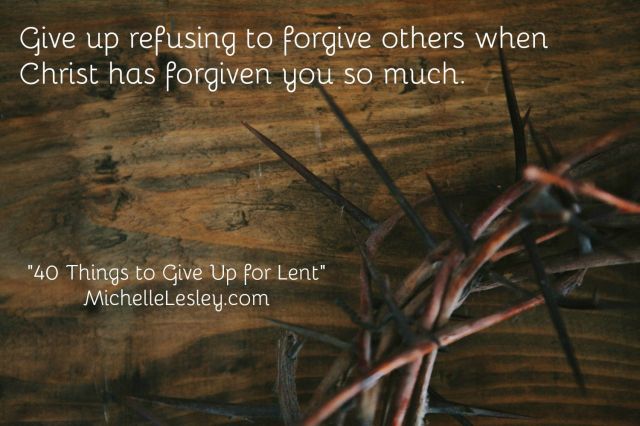
If you give something up for Lent, why do you do so? If it’s for one of the aforementioned unbiblical reasons (or others), or even if you don’t observe Lent at all, I’d like to challenge us all to give up the things below for Lent:
7. Give up the notion that penance or self-denial can pay for your sins.
8. Give up thinking that penance or self-denial curries favor with God.
9. Give up the idea that repentance and obedience belong to a certain season on the calendar. We are to walk in repentance every day.
10. Give up the concept that Christmas and Easter are Christian “high holy days.” We celebrate Christ’s incarnation and resurrection every Sunday, and should prepare ourselves all during the week. Every Sunday is a high holy day for the Christian.
11. Give up rote participation in church rituals. Search the Scriptures and see if they’re biblical first.
12. Give up thinking God concerns Himself strictly with your external behavior rather than the condition of your heart.
13. Give up “sounding a trumpet before you” with humblebrags on social media and in real life about giving things up for Lent, fasting, giving offerings, or any other good works you might do. You just lost your reward, baby.
14. Give up approaching church attendance as punching the time clock for God. The Christian’s entire life, our very beings, belong to Christ, not just a couple of hours on Sunday.
15. Give up the delusion that you’re basically a good person. You’re not.
16. Give up biblical ignorance and become a good student of God’s word.
23. Give up making excuses for failing to memorize Scripture. You can do it!
24. Give up being a non-serving member of your church.
25. Give up being a non-giving member of your church.
26. Give up thinking you’re hearing God speak to you. If you want to hear God speak to you, open your Bible and study it. God has spoken in His word and many are largely ignoring what He has already said.
28. Give up being afraid to share the gospel and just do it.
29. Give up thinking you can please God apart from faith in Christ.
30. Give up basing your doctrine and beliefs on your own (or anyone else’s) opinions, experiences, and feelings, and base them on correctly handled Scripture instead.
32. Give up thinking you have to do big things for God in order for Him to be pleased with you and “aspire to live quietly, and to mind your own affairs, and to work with your hands.”
For an expanded and more detailed treatment of this topic (based on this brief article), please listen to the Mardi Gras, Ash Wednesday, and Lent episode of A Word Fitly Spoken.
What are Mardi Gras, Ash Wednesday, and Lent? Are they biblical? Should Christians participate in them?
If you don’t live in Louisiana or a heavily Catholic area, maybe you’re not very familiar with these observances. Let’s take a look at each of them:
What is…
Lent– Lent is a forty day period (not counting Sundays) leading up to Easter. It is observed by Catholics and some Protestants. Historically, it is supposed to be a period of repentance, penance, fasting, and self-denial. The aspect of Lent that people tend to be most familiar with is the idea of giving something up (self-denial/penance) for Lent such as watching TV, chocolate, smoking, or eating meat.
Ash Wednesday– Ash Wednesday is the first day of Lent. Ashes are applied to the forehead in the shape of a cross to indicate repentance and that the recipient will begin the Lenten fast. Ash Wednesday is primarily observed by Catholics and some Protestants.
Mardi Gras (Fat Tuesday)– Mardi Gras is the day before Ash Wednesday. It has its roots in Shrove Tuesday, which was originally a day of feasting on all of the foods that were forbidden during Lent so these foods would not spoil or go to waste since they could not be eaten again until after Easter. Through the years, this day of feasting has morphed into drunken revelry – sort of a “last hoorah” for getting all the sin out of your system before you have to start “being good” for Lent. In Louisiana (and a few other places), it is much more a cultural holiday than a religious observance. People from various religions as well as non-religious people participate in Mardi Gras. It is celebrated with numerous parades, balls, and other festivities. The colors of Mardi Gras are purple (representing justice), green (representing faith), and gold (representing power).
Lent– Yes and no. Mostly no. The fundamental components of Lent – repentance, fasting, and the pursuit of holiness – are biblical. Repentance and holy living should be practiced by all Christians every day, and biblical fasting as the Holy Spirit convicts the individual Believer.
However, Lent is not mentioned or even hinted at in the Bible, and any Catholic observance (of Lent or anything else) is fundamentally unbiblical because the Catholic religion itself is unbiblical. It is also unbiblical for a church to require that its members observe a man-made religious ritual or to imply or teach that participating in this ritual earns favor with God or absolves or makes up for sin. Furthermore, to teach that there is a special time of the year set aside for repentance and holiness is unbiblical. Christians are to walk in holiness and repentance every day.
Ash Wednesday– Again, yes and no. Mostly no, and for most of the same reasons Lent is generally unbiblical. The fundamental components of Ash Wednesday – repentance of sin and the pursuit of holiness – are biblical and should be practiced by all Christians every day.
In addition to the unbiblical facets of Lent, Ash Wednesday’s forehead ashes “disfigure[s] their faces that their fasting may be seen by others” which is the exact opposite of the humble way Christ teaches us to fast.
Mardi Gras– No. The drunkenness, sin, and lasciviousness that go along with typical Mardi Gras celebrations are patently unbiblical as is the idea of getting all the sin out of our systems before we have to start being good. The Bible teaches against these things.
Should Christians participate in…
Lent– Catholic observances of Lent – no. Some doctrinally sound churches and individuals freely choose to set aside a time of biblical fasting, prayer, and worship in anticipation of Easter. For Christians who observe Lent in this way, as long as it is observed in keeping with Scriptural principles, it can be a valuable and meaningful time of respite and renewal with the Lord just as it could if observed at any other time of the year.
Ash Wednesday– No. It is unbiblical, as cited above.
Mardi Gras– Christians should not participate in any sinful activities any day of the year, including Mardi Gras, nor believe or portray to others by their actions, the unbiblical “theology” behind Mardi Gras. (And as a non-theological aside, violent crime in New Orleans during Mardi Gras has made attending Mardi Gras parades and other events very dangerous.)
However, as I mentioned, in Louisiana, Mardi Gras has become much more of a cultural holiday than an observance with religious undertones. Many smaller towns (and even some larger ones) eschew the debauchery that takes place in New Orleans and offer family-friendly parades which are basically as innocuous as our local Christmas parades or a Fourth of July fireworks show. For Christians who have worked and prayed through the appropriate biblical principles and whose consciences allow them to participate in non-sinful Mardi Gras activities such as attending these types of parades, I believe this is an issue of adiaphora(Christian liberty) similar to participating in non-sinful aspects of Halloween. (Don’t forget to take along some tracts to hand out!)
*These articles are linked for informational purposes only. Obviously, I’m not endorsing Catholic websites or anything on a secular website that’s ungodly.
If you have a question about: a Bible passage, an aspect of theology, a current issue in Christianity, or how to biblically handle a family, life, or church situation, comment below (I’ll hold all questions in queue {unpublished} for a future edition of The Mailbag) or send me an e-mail or private message. If your question is chosen for publication, your anonymity will be protected.