Obedience, Sanctification

40 Things to Give Up for Lent

Although, as a Louisiana girl, I’ve had a decades long love affair with king cake, and I totally support the increased availability of fish entrรฉes at local restaurants and getting a few days off school or work, I’m not a big fan of Mardi Gras and Lent.

The intrinsic philosophy behind Mardi Gras – a day of revelry, indulgence, and debauchery to get it all out of your system before you have to start “being good” for Lent – is patently unbiblical.

The practice of Lent often is, as well. Lent is the forty day period, beginning with Ash Wednesday and ending with Easter Sunday, observed by Catholics and some Protestants. Originally, it was simply a time of fasting, prayer, and worship in anticipation of Easter, and for Christians who continue to observe it this way, it can be a valuable and meaningful time of respite and renewal with the Lord.

For many, however, Lent – particularly the aspect of giving something up for Lent in an act of self-denial – is nothing more than an empty religious ritual, or worse, works righteousness. Giving something up for Lent because, “I’m Catholic and that’s what good Catholics do,” or to atone for your sins, or to curry favor with God, or to flaunt your self-righteousness flies in the face of grace alone, faith alone, Christ alone biblical Christianity.

If you give something up for Lent, why do you do so? If it’s for one of the aforementioned unbiblical reasons (or others), or even if you don’t observe Lent at all, I’d like to challenge us all to give up the things below for Lent:

1. Give up Lent for Lent.

2. Give up attending any church that requires the observance of Lent in a sacramental way and find a doctrinally sound one.

3. Give up thinking your good behavior earns you right standing with God.

4. Give up the idea that there’s any such thing as truly good behavior.

5. Give up thinking your good deeds could ever outweigh your sins.

6. Give up willfully indulging in sin as long as you “make up for it” later.

7. Give up the notion that penance or self-denial can pay for your sins.

8. Give up thinking that penance or self-denial curries favor with God.

9. Give up the idea that repentance and obedience belong to a certain season on the calendar. We are to walk in repentance every day.

10. Give up the concept that Christmas and Easter are Christian “high holy days.” We celebrate Christ’s incarnation and resurrection every Sunday, and should prepare ourselves all during the week. Every Sunday is a high holy day for the Christian.

11. Give up rote participation in church rituals. Search the Scriptures and see if they’re biblical first.

12. Give up thinking God concerns Himself strictly with your external behavior rather than the condition of your heart.

13. Give up “sounding a trumpet before you” with humblebrags on social media and in real life about giving things up for Lent, fasting, giving offerings, or any other good works you might do. You just lost your reward, baby.

14. Give up approaching church attendance as punching the time clock for God. The Christian’s entire life, our very beings, belong to Christ, not just a couple of hours on Sunday.

15. Give up the delusion that you’re basically a good person. You’re not.

16. Give up biblical ignorance and become a good student of God’s word.

17. Give up forsaking the assembly and become a faithful, serving member of your local church.

18. Give up thinking that everyone and everything that calls itself “Christian” actually is.

19. Give up the desire to have your itching ears scratched and long for the truth of God’s word. Even when it’s hard to hear.

20. Give up neglecting the daily study of God’s word.

21. Give up rejecting parts of the Bible you don’t agree with. We don’t sit in judgment over Scripture. Scripture sits in judgment over us.

22. Give up neglecting your prayer life.

23. Give up making excuses for failing to memorize Scripture. You can do it!

24. Give up being a non-serving member of your church.

25. Give up being a non-giving member of your church.

26. Give up thinking you’re hearing God speak to you. If you want to hear God speak to you, open your Bible and study it. God has spoken in His word and many are largely ignoring what He has already said.

27. Give up following false teachers and be a good Berean.

28. Give up being afraid to share the gospel and just do it.

29. Give up thinking you can please God apart from faith in Christ.

30. Give up basing your doctrine and beliefs on your own (or anyone else’s) opinions, experiences, and feelings, and base them on correctly handled Scripture instead.

31. Give up following your wicked and deceitful heart, take up your cross daily, and follow Christ.

32. Give up thinking you have to do big things for God in order for Him to be pleased with you and “aspire to live quietly, and to mind your own affairs, and to work with your hands.”

33. Give up worrying and trust God.

34. Give up neglecting to fear God’s wrath if you don’t know Christ.

35. Give up fearing God’s wrath if you do know Christ.

36. Give up the idea that “God is love” means God is a pushover who won’t judge you.

37. Give up thinking you’ve been so bad that God could never forgive you.

38. Give up thinking you’re so good that you don’t need God to forgive you.

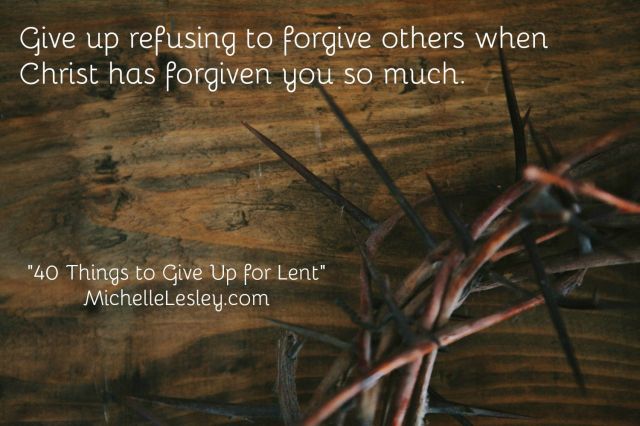
39. Give up refusing to forgive others when Christ has forgiven you so much.

40. Give up everything and be saved by grace alone, through faith alone, in Christ alone, and walk in His ways, all the days of your life, to the glory of God alone.
The Ten (10 Commandments Bible Study)

The Ten: Lesson 13

Previous Lessons: 1, 2, 3, 4, 5, 6, 7, 8, 9, 10, 11, 12

Exodus 20:18-20

Now when all the people saw the thunder and the flashes of lightning and the sound of the trumpet and the mountain smoking, the people were afraid and trembled, and they stood far off 19 and said to Moses, โ€œYou speak to us, and we will listen; but do not let God speak to us, lest we die.โ€ 20 Moses said to the people, โ€œDo not fear, for God has come to test you, that the fear of him may be before you, that you may not sin.โ€

Exodus 24:3-8

Moses came and told the people all the words of the Lord and all the rules. And all the people answered with one voice and said, โ€œAll the words that the Lord has spoken we will do.โ€ And Moses wrote down all the words of the Lord. He rose early in the morning and built an altar at the foot of the mountain, and twelve pillars, according to the twelve tribes of Israel. And he sent young men of the people of Israel, who offered burnt offerings and sacrificed peace offerings of oxen to the Lord. And Moses took half of the blood and put it in basins, and half of the blood he threw against the altar. Then he took the Book of the Covenant and read it in the hearing of the people. And they said, โ€œAll that the Lord has spoken we will do, and we will be obedient.โ€ And Moses took the blood and threw it on the people and said, โ€œBehold the blood of the covenant that the Lord has made with you in accordance with all these words.โ€


Romans 3:19-20

Now we know that whatever the law says it speaks to those who are under the law, so that every mouth may be stopped, and the whole world may be held accountable to God. 20 For by works of the law no human being will be justified in his sight, since through the law comes knowledge of sin.

Romans 7:1-12

Or do you not know, brothersโ€”for I am speaking to those who know the lawโ€”that the law is binding on a person only as long as he lives? For a married woman is bound by law to her husband while he lives, but if her husband dies she is released from the law of marriage. Accordingly, she will be called an adulteress if she lives with another man while her husband is alive. But if her husband dies, she is free from that law, and if she marries another man she is not an adulteress.

Likewise, my brothers, you also have died to the law through the body of Christ, so that you may belong to another, to him who has been raised from the dead, in order that we may bear fruit for God.For while we were living in the flesh, our sinful passions, aroused by the law, were at work in our members to bear fruit for death. But now we are released from the law, having died to that which held us captive, so that we serve in the new way of the Spirit and not in the old way of the written code.

What then shall we say? That the law is sin? By no means! Yet if it had not been for the law, I would not have known sin. For I would not have known what it is to covet if the law had not said, โ€œYou shall not covet.โ€ But sin, seizing an opportunity through the commandment, produced in me all kinds of covetousness. For apart from the law, sin lies dead. I was once alive apart from the law, but when the commandment came, sin came alive and I died. 10 The very commandment that promised life proved to be death to me. 11 For sin, seizing an opportunity through the commandment, deceived me and through it killed me. 12 So the law is holy, and the commandment is holy and righteous and good.

Galatians 3:23-26

Now before faith came, we were held captive under the law, imprisoned until the coming faith would be revealed. 24 So then, the law was our guardian until Christ came, in order that we might be justified by faith. 25 But now that faith has come, we are no longer under a guardian, 26 for in Christ Jesus you are all sons of God, through faith.


Romans 13:8-10

Owe no one anything, except to love each other, for the one who loves another has fulfilled the law.For the commandments, โ€œYou shall not commit adultery, You shall not murder, You shall not steal, You shall not covet,โ€ and any other commandment, are summed up in this word: โ€œYou shall love your neighbor as yourself.โ€ 10 Love does no wrong to a neighbor; therefore love is the fulfilling of the law.

1 John 5:2-3

By this we know that we love the children of God, when we love God and obey his commandments. For this is the love of God, that we keep his commandments. And his commandments are not burdensome.


The Holy Bible, English Standard Version. ESVยฎ Permanent Text Editionยฎ (2016). Copyright ยฉ 2001 by Crossway Bibles, a publishing ministry of Good News Publishers.


Questions to Consider:

1. In Exodus 20:18-19, how did the Israelites react to God’s appearance to Moses? What was Moses’ response to them? (20) What did Moses say would be two results of God testing the people? (20) How many times does the word “fear” appear in verse 20? What is the difference in meaning between the first “fear” and the second one?

2. Briefly skim Exodus 20:21-23:33. In addition to the Ten Commandments, what are some of the other laws, or categories of laws, God gave Moses? In the Exodus 24 passage above, what was the people’s response to hearing all of these laws? (3) Describe the sequence of events taking place in Exodus 24:3-8. Why did the people respond twice? (3,7) Was there any difference between these two responses? Compare the people’s response in this passage with their response in Exodus 19:5-8. What events transpired between the response in chapter 19 and the response in chapter 24?

3. In Exodus 24:6,8, why did Moses sprinkle the altar and the people with blood? How did this formalize Israel’s agreement to the Mosaic covenant? How does the Mosaic covenant point ahead to the new covenant in Christ? Are Christians still bound by the Mosaic covenant?

4. In what ways did the giving of the law and Israel’s agreement to the Mosaic covenant help officially establish Israel as a nation and set Israel apart from the surrounding pagan nations?

5. Examine the Romans 3 and 7 passages. What does it mean that the law makes us “accountable” to God? (3:19) Why can’t we be made righteous in God’s eyes by simply striving to keep His laws? (3:20) Read Romans 3:20 and 7:7-8 together. What do these verses tell us about the connection between knowing the law and sin?

6. Explain the analogy of dying to works of the law that Paul is trying to convey in Romans 7:1-6. Compare verse 6 to Galatians 3:23-26. What does Galatians say was the purpose of the law, and what is our obligation to it now? What does the latter part of verse 6 – “we serve in the new way of the Spirit and not in the old way of the written code” – mean? Does this mean we no longer have to obey God’s moral laws such as the ones in the 10 Commandments? (12)

7. Study the Romans 13 and 1 John 5 passages. What is the theme of these two passages? What does Paul mean when he says, “the one who loves another has fulfilled the law”? (13:8) Who are the two parties we demonstrate love for when we keep God’s commands? How does loving God and keeping His commands automatically translate into loving others? (5:2) How does loving God and our neighbors, thus keeping God’s commands, demonstrate to others that we belong to Christ?


Homework:

This week, view your sin or obedience through the lenses of love. Examine the sins you commit. How do they demonstrate your failure to love God and love your neighbor? Examine instances of your obedience to God’s commandments and think about how they demonstrate your love for Him and for your neighbor. As you pray, ask God to increase your love for Him. Increased love leads to increased obedience.

Discernment

Discernment Resources Potpourri

discernment

There are scads of fantastic discernment resources out there. Here are a few good ones that have come across my desk in the past few weeks…


deadlydoctrine-01Tim Challies is running a really good series right now called Deadly Doctrines. “In a new series of articles, we will consider false doctrine, sound doctrine, and how to train ourselves to distinguish between them. We will see how God calls us to respond to false and sound doctrine, as well as false and sound teachers.”


download-1Here’s Sinclair Ferguson over at Ligonier with What is Discernment?ย “We are on our guard against being led astray by false teachers. But there is more to discernment than this. True discernment means not only distinguishing the right from the wrong; it means distinguishing the primary from the secondary, the essential from the indifferent, and the permanent from the transient. And, yes, it means distinguishing between the good and the better, and even between the better and the best.”

And, of course, Pastor Gabriel Hughes of When We Understand the Truth is always there with his awesome WWUTT teaching videos. Here’s What is Discernment?


And here is Essential Doctrines?:


Below is a screen shot from the the Essential Doctrines video that might be helpful to print out and keep in your Bible or use when you teach a Bible study. Each letter in the word “DOCTRINES” stands for a primary area of biblical doctrine. Any teaching that conflicts with what the Bible says on any of these points is heresy:

c2eurnduoaa18km(Note: “Eschatology” here does not mean a specific flavor of end times theology such as pre-trib, post-millennial, etc. It refers to the foundational, general doctrine that Christ willย come again in final judgment and to claim His bride, the church.)


Hope y’all find these as helpful as I did!

Mailbag

The Mailbag: Is It OK for Christian Women to Wear Bikinis?

It’s that time of year again, ladies. :0)

Foreword: I re-run this article every year in late winter / early spring. And every year, there are a handful of my followers who get mad that I don’t simply say, “No. It is not OK for Christian women to wear bikinis.”

If you’re one of those people, you’re missing the point of this article.

It’s easy to throw out a hard and fast law. It’s not so easy – especially for new Christians and those who come from a background of legalism – to practice biblical decision-making, a skill all Christians need to hone and implement in every area of our lives.

This article is a teaching moment. It’s an opportunity for women to take a fairly easy question that they pretty much already know the answer to and learn how to go through the steps to arriving at a biblical answer.

Remember back in school when your math teacher would make you show your work? She did that because getting the right answer is only a part of problem solving. Understanding and correctly doing all the steps – in order – to arrive at the right answer is the bulk of what she was trying to teach you. This is a “show your work” kind of article.


Summer is just around the corner, so a lot of women will soon be shopping for swimwear. With regard to modesty- do you think it’s OK for Christian women to wear bikinis?

I’m trying to remember back to the days when I might have actually considered – without doubling over in laughter – wearing a bikini. It was a really long time ago. Young, svelte sisters, if I may bring you a bit of comfort- you won’t have to grapple with this question for the rest of your life. As your other older sisters and I can attest, one day, age-appropriateness, your figure, sun exposure, and the desire not to frighten people will make this decision for you long before you have to consider modesty as part of the equation. It’s one of the blessings of getting older.

Just to make sure we’re all on the same page here, let’s quickly define our terms. When I say “bikini,” I’m talking about the fabric equivalent of a bra and panties, not swimwear that covers a lot more yet comes in two pieces.

bikini

not bikinis

Generally speaking, I don’t think bikinis are wise in public unless you’re wearing a shirt or some kind of cover up over it. I’m reluctant to make a hard and fast law about it, though, because, as I’m sure you’re aware, the Bible doesn’t say “Thou shalt not wear a bikini.” (My husband would like to chime in here and says, “However, if you and your husband have a private place for just the two of you to swim or sunbathe, go for it!” You’re welcome, guys.)

A law is a fast and easy “yes” or “no” answer to our question- which is often what our flesh wants, because our flesh is lazy.

As with various other issues, the Bible gives us a general principle (in this case about dressing modestly) and we work out our own salvation in our own cultural context according to all pertinent biblical principles and our own consciences. A law is a fast and easy “yes” or “no” answer to our question- which is often what our flesh wants, because our flesh is lazy. But what God wants Christians to do is study His Word about the issue, pray, and ask Him for wisdom to make a godly decision. When we work through this process, it helps us to develop a greater desire to be conformed to the image of Christ and to be obedient to Him.

What God wants Christians to do is study His Word about the issue, pray, and ask Him for wisdom to make a godly decision.

Let’s take a look at just one passage of Scripture that could be helpful in this regard:

3Do nothing from selfish ambition or conceit, but in humility count others more significant than yourselves. 4Let each of you look not only to his own interests, but also to the interests of others. 5Have this mind among yourselves, which is yours in Christ Jesus, 6who, though he was in the form of God, did not count equality with God a thing to be grasped, 7but emptied himself, by taking the form of a servant, being born in the likeness of men. 8And being found in human form, he humbled himself by becoming obedient to the point of death, even death on a cross.
Philippians 2:3-8 

So, at first glance, you might wonder, “What in the world does this passage have to do with wearing a bikini?” It doesn’t have anything to do with the bikini itself, it zeros in on your heart (Why do you want to wear a bikini?) and your sanctification (Will wearing a bikini make me more Christlike?).

Verse 3a:
Examine your heart- could your motive for wearing a bikini be classified as selfish ambition or vain conceit? Is it possible you want to show your body off to men to appear desirable, or to women to make them jealous?

Verse 3b-4:
Is this a situation in which you should humble yourself and put the interests of those men who might be tempted to lust or those women who might be tempted to covet ahead of your own desire to appear attractive?

Verse 5:
Do you truly desire to have the same mindset as Christ- about this issue and all others?

Verse 6-8:
How did Jesus approach life, according to these verses? He set aside His own rights and privileges (6), He took on the role of a servant (7), He humbled Himself and was obedient to the point of death (8).

When it comes to wearing a bikini, are you willing to have the same mindset as Christ? To set aside your own rights and privileges, be a servant to others, humble yourself, and obey Christ even to the point of death?

These are not questions God wants me to answer for you. These are questions He wants you to come to Him and answer, because He wants your heart. And He wants you to examine your heart and see if it belongs to Him in this area.

Additional Resources:

Is it Okay for Christian Women to Wear Bikinis? at When We Understand the Text

Modesty, parts 1, 2, & 3 at A Word Fitly Spoken

If you’re looking for modest swimwear – even swim dresses – there are several online companies, such as Calypsa, that may have what you’re looking for. Try searching “modest swimwear”. Have you already found a great company you love? Suggest it in the comments below!


If you have a question about: a Bible passage, an aspect of theology, a current issue in Christianity, or how to biblically handle a family, life, or church situation, comment below (Iโ€™ll hold all questions in queue {unpublished} for a future edition of The Mailbag) or send me an e-mail or private message. If your question is chosen for publication, your anonymity will be protected.

Church

Church Leadership Qualifications: Biblical or Pragmatic?

leadership-1959544_1280

When it comes to leadership positions in the church we often get ourselves into unnecessarily sticky situations because we put practical considerations – who is available, who is most talented, who is willing, etc. – above biblical qualifications.
When we fill a position of leadership or responsibility at church we firstย go to Scripture to find out if the person we’re considering for the position is biblicallyย qualified to hold it. Practical considerations come second. A few examples:

1.

An elder or deacon just died and the church needs someone to replace him. The first place you go is 1 Timothy 3 and Titus 1, and you start by weeding out the men who don’t fit those qualifications. It doesn’t matter how willing they are or how great of a job they would do or what kind of connections they have or how much money they could bring into the church, they have to meet the biblical qualifications first.

2.

Your church is located near a neighborhood full of Chinese immigrants, most of whom don’t speak English. Someone comes up with the commendable, Great Commission-honoring idea to start a Bible study to reach out to the men and women of this community. The only person in your church who speaks Chinese is a woman, so she’s the natural choice to teach the class, right?

Wrong. We startย with the biblical qualifications for teachers, and one of them (1 Timothy 2:12) is that women are not to teach men. She could certainly teach (assuming she is able to teach – language alone doesn’t make someone a good teacher) a women’s class, or a male could teach the class in English and she could translate, or a man could take the time to learn Chinese before the church begins offering the class, or if there is a Chinese man in the class who is able to teach, he could teach the men and she could teach the women. But the woman doesn’t teach a co-ed class herself because Scripture forbids this.

3.

A young couple starts attending your church. After a few months, they step up and say they’d like to sing on the worship team. They’ve both got great voices and would radically improve the quality of the music on Sunday mornings. As you chat with them about joining the team, you find out they’re living together (unmarried). They’re both well aware that this is sin, but disagree with what the Bible says about adultery and fornication and have no intention of repenting, marrying, or moving out. Matthew 18:15-17 and 1 Corinthians 5:11-13 are quite clear that people who continue in rebellion after being called to repent are not even to be members of the church, let alone lead in worship.

Remember that the practical way is not always God’s way. Remember that God’s ways are higher than our ways (Isaiah 55:9). Remember that “There is a way that seems right to a man, but its end is the way to death.” (Proverbs 14:12). Remember when Saul did what was good in his own eyes instead of obeying God’s word (1 Samuel 15). Remember what happened to Nadab and Abihu when they conducted worship their own way instead of God’s way (Leviticus 10:1-6).

Obeying God’s word is not always easy, practical, or convenient, but it is always best, biblical, and blessed.