Forgiveness, Mailbag

The Mailbag: Can unforgiveness cause you to you lose your salvation?

Can unforgiveness cause me to lose my salvation?

Forgiving (or refusing to forgive) others as it relates to our salvation is such an important issue. I’m so glad you asked!

Let’s break this question down a bit.

Can you lose your salvation?

The first thing we need to tackle is whether or not someone whom Christ has genuinely saved can lose her salvation – for unforgiveness or any other reason. And the answer to that question is no.

Why? The short answer is that if God saves someone, and that person can subsequently “unsave” herself, that makes her more powerful than God, which, as we know, can’t happen. You can’t save yourself, and you can’t unsave yourself. Salvation is all of God.

You can’t save yourself, and you can’t unsave yourself. Salvation is all of God.

When God saves you, you are His new creation in Christ. You can’t “uncreate” your new spiritual life any more than you can “uncreate” your body, or a tree, or a planet. You can kill or do damage to those things, but you cannot reverse God’s creative process. To use another example, oh so relevant to today, God created you female. You can mutilate your body til kingdom come trying to appear male, but that will not change the fact that at your genetic level – the very essence of your being – you are female. And you can’t undo that because God created you that way, and you’re not more powerful than God. If you can’t even change God’s creation of your physical body, how in the world can you change God’s creation of your spiritual being?

The moment God saves you, He forgives all your sins, past, present, and future, and robes you in the righteousness of Christ.

In addition to the fact that you can’t uncreate the new creature God has created you to be, you need to remember that the moment God saves you, He forgives all your sins, past, present, and future, and robes you in the righteousness of Christ. That swear word you’re going to say next week? Already forgiven. That lie you’re going to tell five years from now? Already forgiven. And if you decide to commit the sin of refusing to forgive someone, that sin has already been forgiven too. (So since all our sins are already forgiven, we can just commit as much sin as we want and we don’t have to worry about it, right? Wrong.) We still need to confess those sins to God and be cleansed from them because they disrupt our fellowship with God, but in His accounting office, that sin debt has already been marked “paid in full”.

Furthermore, Jesus tells us plainly that if He’s got you, He’s got you:

My sheep hear my voice, and I know them, and they follow me. I give them eternal life, and they will never perish, and no one will snatch them out of my hand. My Father, who has given them to me, is greater than all, and no one is able to snatch them out of the Father’s hand. I and the Father are one.โ€

No one. That includes you and your sin. The power of your sin is not greater than God’s power to forgive that sin.

The power of your sin is not greater than God’s power to forgive that sin.

They will never perish. To say that a person about which Jesus Himself has said, “I give them eternal life,” can lose her salvation is to call Jesus a liar. He says that person “will never perish.” End of story.

Still not convinced that someone whom Christ has genuinely saved can’t lose her salvation? Try these passages on for size.

Now the reason it can look to us like someone can lose her salvation comes from two places: experience and misunderstanding the Bible.

The reason it can look to us like someone can lose her salvation comes from two places: experience and misunderstanding the Bible.

Experience:
It’s happened plenty of times in the past, but in the last few weeks, we’ve seen two high profile evangelicals “walk away from the faith,”: Joshua Harris and Marty Sampson. Maybe you know someone personally – a friend, a loved one, even a pastor – who gave every appearance of being a Christian and then suddenly left Christianity, and the church, behind.

How does this compute when the Bible teaches that genuinely born again Christians cannot lose their salvation? Well, we need to remember something else the Bible teaches that’s very important:

Not everyone who claims to be a Christian actually is one.

Some people consciously know they’re not really saved and are just trying to pull the wool over the eyes of others. But many (my guess is “most” – these days there’s not a lot of social cachet in calling yourself a Christian) are deceived into believing they’re saved. Maybe they heard some sort of unbiblical gospel presentation and have put their faith in a decision they made in response. Maybe they just assume they’re saved because they’re good church-going people and their church doesn’t teach them otherwise. Who knows? It could be a lot of things. But we know for sure that there are many people who call themselves Christians and believe they are Christians who aren’t. Why? Because the Bible says so:

โ€œNot everyone who says to me, โ€˜Lord, Lord,โ€™ will enter the kingdom of heaven, but the one who does the will of my Father who is in heaven. On that day many will say to me, โ€˜Lord, Lord, did we not prophesy in your name, and cast out demons in your name, and do many mighty works in your name?โ€™ And then will I declare to them, โ€˜I never knew you; depart from me, you workers of lawlessness.โ€™
Matthew 7:21-23

Many will say”…False converts are common, not few and far between. And it’s not just your average Joe or Jane in the pew, either. People who “prophesy…cast out demons…do mighty works” under the auspices of Christianity? They’re pastors, elders, deacons, Bible study teachers, seminary professors, “Christian” authors, evangelical celebrities. And Christ does not know them, because they don’t know Him. They talk the talk, and might even look like they walk the walk, but they’ve never truly believed the biblical gospel, repented of their sin, and trusted the Jesus of Scripture to save them. First John 2:18-19 puts it this way:

Children, it is the last hour, and as you have heard that antichrist is coming, so now many antichrists have come. Therefore we know that it is the last hour. They went out from us, but they were not of us; for if they had been of us, they would have continued with us.

People whom Jesus has genuinely saved may fall into sin for a season, but they do not fall away from the faith. Those who leave the faith were never part of it in the first place, despite appearances or their claims to the contrary. It might be difficult, but this is one of those occasions when we have to believe what Scripture says over what we can see.

Those who leave the faith were never part of it in the first place, despite appearances or their claims to the contrary.

Jesus also tells us in the parable of the sower that there will be be “rocky ground” folks who will appear to be Christians, but because they have no root, they “endure for a while, and when tribulation or persecution arises on account of the word, immediately they fall away.” Jesus follows up this parable with the parable of the wheat and tares which further drives home His point that there will be impostors in the visible church.

So even though we observe people who appear to be Christians “falling away from the faith,” through unforgiveness or any other sin, we know that what’s really happening is that a lost person got tired of pretending to be saved and went back to being a lost person. Second Peter 2:22 puts it this way:

What the true proverb says has happened to them: โ€œThe dog returns to its own vomit, and the sow, after washing herself, returns to wallow in the mire.โ€

If Christ has never fundamentally changed your spiritual nature from dog or pig into a new creature in Christ, you’re still a dog or a pig. And even if you manage to clean up on the outside you’ll eventually return to the vomit of being a dog and the mud of being a pig because that’s your nature.

Misunderstood Scripture
There are passages in the Bible that, when misunderstood, when taken out of their immediate context, or when taken out of the overall context of Scripture can seem to teach that a person can lose her salvation. But as we’ve seen, there are way too many rightly handledin context passages of Scripture that refute that idea.

Can you lose your salvation by refusing to forgive someone?

You mentioned in your original question that you believe unforgiveness can cause someone to lose her salvation because, “It is so clear in so many ways in Scripture, even parables that Jesus told.” But, you did not mention any of the Scriptures you think teach this. My guess is that one of the Scriptures you’re thinking of is Matthew 6:14-15:

For if you forgive others their trespasses, your heavenly Father will also forgive you, but if you do not forgive others their trespasses, neither will your Father forgive your trespasses.

In context, we can see that these two verses come at the end of the Lord’s Prayer. In verse 12, Jesus has just taught us to pray that God would “forgive us our debts,
as we also have forgiven our debtors,” and He’s giving us a little addendum on this in 14-15.

Remember, even though all our sins from birth to death were forgiven at the moment of our salvation, we still need to confess our sins in prayer and ask God to cleanse us from our wrongdoing to bring us back into right fellowship with Him. But if you’re willfully in the middle of committing the sin of unforgiveness against someone, you’re still actively sinning. You haven’t turned from that sin in order to be cleansed. You’re essentially rolling around in the mud and asking God to cleanse you while you have no intention of getting out of the mud. How is that supposed to work? It doesn’t make any sense. If you want to get cleaned up (“forgiven”), you have to get out of the mud (stop committing the sin of unforgiveness – “forgive”). Otherwise, you’re asking God to restore the fellowship you’re still actively damaging with your sin.

Another passage you might be thinking of is the parable of the unforgiving servant. The takeaway from this passage is not that God will rescind the salvation of Christians who commit the sin of unforgiveness. This passage doesn’t say that and we already know that idea conflicts with what Scripture teaches about the security of the Believer.

The takeaway from this passage is that God has forgiven us a sin debt that is incomprehensible. Knowing and having experienced that forgiveness, how could we not forgive some paltry little sin another human commits against us? First John 4:19 says, “We love because He first loved us,” and the way He loved us was to forgive us our sin. So we also forgive because He first forgave us. And if we can giddily and unrepentantly harbor unforgiveness in our hearts against someone else, we’d better start testing ourselves against Scripture to see if we’re really in the faith. Because that kind of unforgiveness is not the fruit of a redeemed life, it’s the fruit of someone who’s unsaved.

No, a genuinely regenerated Christian cannot lose her salvation by committing the sin of unforgiveness. But if she is genuinely regenerated, she will repent of that sin and forgive.

A genuinely regenerated Christian cannot lose her salvation by committing the sin of unforgiveness. But if she *is* genuinely regenerated, she will repent of that sin and forgive.

Additional Resources:

Walking Away from Faith? at A Word Fitly Spoken Podcast

The Mailbag: Must I reconcile with my abusiveย ex-husband?

Forgiving Like Kings and Servants

You Canโ€™t Love Jesus with a Heart Full of Hate: 7 Reasons to Love and Forgive Your Enemies

Am I Really Saved? A 1 John Check Up


If you have a question about: a Bible passage, an aspect of theology, a current issue in Christianity, or how to biblically handle a family, life, or church situation, comment below (Iโ€™ll hold all questions in queue {unpublished} for a future edition of The Mailbag) or send me an e-mail or private message. If your question is chosen for publication, your anonymity will be protected.

A Word Fitly Spoken Podcast

Introducing: A Word Fitly Spoken – A Podcast by Michelle Lesley and Amy Spreeman

It’s been a long time in the making, but it’s finally here!

You know her fromย Berean Researchย andย Naomi’s Table. You’ve loved herย Berean Examinerย articles and Pirate Gang Conversations over at Pirate Christian Radio…and today, the lovely, talented, and brilliant Amy Spreemanย and I are launching our own podcast,ย A Word Fitly Spoken.

The title of our podcast comes from Proverbs 25:11:

A word fitly spoken is like apples of gold in a setting of silver.

And that’s what we hope to serve you in each episode – an edifying word fit for the moment, in a pleasant setting, that helps you to grow in Christ. Thank you to one of my Facebook followers, Laura M., for the suggestion!

So pop on over to theย A Word Fitly Spoken website, look around, listen to our first episode, and follow us on social media! You can listen and download through our website as well as through Podbean. More podcast platforms are coming, so stay tuned!

How about them apples? :0)

Uncategorized

Good morning, early birds!

If you’re an early riser, you’re probably wondering where in the world your Throwback Thursday article is. Well, it’s coming…tomorrow. Today’s very special post is coming! Check back here in about two hours. I think it’ll be worth your wait!

Uncategorized

The Word on Wednesdays

Hi ladies! I hope you enjoyed our most recent Bible study,ย 1&2 Timothy: The Structure and Spirit of the Church, which we wrapped up recently.

Iโ€™ve been taking a break on Wednesdays, getting ready for our new study. I hope youโ€™ll enjoy it and that it will edify you as you seek to grow in Christ and His Word. (The picture above does not mean we will be studying James. :0) I really had planned to start our new study today, but I’ve had a family situation come up unexpectedly that I need to devote some time and attention to, and that has to come first. My new plan is to start our new study two weeks from today on August 28.

So, if you havenโ€™t quite finished with the 1&2 Timothy study, you can use this time to finish up, and Iโ€™ll also be posting some articles from the archives that I think youโ€™ll find helpful as we make our way toward our next study. Here is this weekโ€™s article:

Wednesday’s Word

Wednesday is Bible study day here on the blog. In myย Wednesday’s Word study, youโ€™ll find miscellaneous, one lesson Bible studies from each book of the Bible. One chapter of Scripture followed by study questions. This sampler series demonstrates that thereโ€™s nothing to be afraid of when approaching those โ€œlesser knownโ€ books and that every book of the Bible is valuable and worth studying.

Wednesday’s Word ~ Obadiah

obadiah 4


The vision of Obadiah.

Thus says the Lordย Godย concerning Edom:
We have heard a report from theย Lord,
ย ย ย ย and a messenger has been sent among the nations:
โ€œRise up! Let us rise against her for battle!โ€
2ย Behold, I will make you small among the nations;
ย ย ย ย you shall be utterly despised.

ย Keep reading…

False Teachers

Rebekah Lyons and Q-Conference/Q-Ideas

If you are considering commenting or sending me an e-mail objecting to the fact that I warn against certain teachers, please click here and read this article first. Your objection is most likely answered here. I won’t be publishing comments or answering emails that are answered by this article.


This article is kept continuously updated as needed.

I get lots of questions about particular authors, pastors, and Bible teachers, and whether or not I recommend them. Some of the best known can be found above at my Popular False Teachers tab. The teacher below is someone I’ve been asked about recently, so I’ve done a quick check (this is brief research, not exhaustive) on her.

Generally speaking, in order for me to recommend a teacher, speaker, or author, he or she has to meet three criteria:

a)ย A female teacher cannot currently and unrepentantly preach to or teach men in violation of 1 Timothy 2:12. A male teacher or pastor cannot allow women to carry out this violation of Scripture in his ministry. The pastor or teacher cannot currently and unrepentantly be living in any other sin (for example, cohabiting with her boyfriend or living as a homosexual).

b) The pastor or teacher cannot currently and unrepentantly be partnering with or frequently appearing with false teachers.ย This is a violation of Scripture.

c) The pastor or teacher cannot currently and unrepentantly be teaching false doctrine.

I am not very familiar with most of the teachers I’m asked about (there are so many out there!) and have not had the opportunity to examine their writings or hear them speak, so most of the “quick checking” I do involves items a and b (although in order to partner with false teachers (b) it is reasonable to assume their doctrine is acceptable to the false teacher and that they are not teaching anything that would conflict with the false teacher’s doctrine).ย Partnering with false teachers and women preaching to men are each sufficient biblical reasons not to follow a pastor, teacher, or author, or use his/her materials.

Just to be clear, “not recommended” is a spectrum. On one end of this spectrum are people like Nancy Leigh DeMoss Wolgemuth and Kay Arthur. These are people I would not label as false teachers because their doctrine is generally sound, but because of some red flags I’m seeing with them, you won’t find me proactively endorsing them or suggesting them as a good resource, either. There are better people you could be listening to. On the other end of the spectrum are people like Joyce Meyer and Rachel Held Evans- complete heretics whose teachings, if believed, might lead you to an eternity in Hell. Most of the teachers I review fall somewhere in the middle of this spectrum (leaning toward the latter).

If you’d like to check out some pastors and teachers I heartily recommend, click theย Recommended Bible Teachers tab at the top of this page.


Rebekah Lyons
Not Recommended

Rebekah and her husband Gabe (who previously helped co-found the Catalyst conference, which has featured false teachers such as Beth Moore and Christine Caine) are the founders of โ€œQ,โ€ an organization which attempts to join Christians with secular cultural and governmental leaders as well as other non-Christians, including Muslims, in order to make a Christian impact on culture through โ€œThe 7 Channels of Cultural Influence.โ€ These โ€œ7 Channelsโ€ are identical to the seven mountains found in the Seven Mountain Mandate of the New Apostolic Reformationโ€™s false teaching ofย Dominionism. Scripture does not tell us toย partner with non-Christians to impact culture, in fact, it explicitly tells us not to. Furthermore, Q states “Our long-term goal is to see the Christian faith become increasingly attractive, credible and influential in the church, our communities and the next generation.” Although this goal might be realized by those who claim the name of Christ but whose hearts are far from Him, this line of thinking is patently unbiblical and therefore practically unattainable withinย biblicalย Christianity.

Since the first publication of this article in 2016, Rebekah and Q-ideas have scrubbed from their websites and social media platforms much of the material I originally linked to, including:

  • A link to a talk given by a Muslim at Q entitled “How Can Christians and Muslims Work Together?” original link
  • A video of Rebekah and IF:Gathering founder Jennie Allen at Q discussing and promoting unbiblical ideas regarding the role of women in the church. original link
    In the original article, I commented on this video: “Youโ€™ll notice that Gabe commends IF for not ‘getting into doctrine’ when it comes to womenโ€™s roles in the church, and virtually no Scripture is cited in the entire talk, only opinions.”
  • A link to a talk given at Q Denver 2016 entitled “My Struggle with Gender Dysphoria,”by Melinda Selmys, a Catholic blogger and author who โ€œencourages faith communities to provide trans people with the social, emotional, and spiritual support that they need in order to heal.โ€ original link
  • A link to the transcript of one of Rebekah’s speeches at IF:Gathering entitled “Confessions for the Church” original link
    In the original article, I commented on this speech: “[The speech] is Ann Voskamp-esque sloppy theology at best, emergent at worst.”

I would like to believe that these materials have been scrubbed because Rebekah and Gabe have repented of these unbiblical teachings and have begun to teach sound doctrine, but the evidence of their continued false teaching, ties to false teachers, and unequal yoking with unbelievers belies that notion.

Featured speakers at Q have included false teachers Bianca Olthoff, Lisa Bevere,ย Lysa Terkeurst, Ann Voskamp, and New Apostolic Reformation leader, Phyllis Tickle, all of whom were allowed to preach to Q’s co-ed audience. (And, of course, Rebekah herself always speaks at Q and consequently preaches to men.) If you look through the videos at this link, you will notice that nearly all of them are under two minutes long (many under one minute), making it impossible to properly critique the substance of what the speaker taught, and leaving one to wonder if these particular snippets were chosen because they were innocuous enough not to offend the majority of Christian viewers.

One video at the Q-ideas web site features Kadi Cole saying that what we believe about women leading in the church is moot, we just need to look at what they’re gifted to do, and that we need to stay culturally relevant by elevating women to unbiblical positions of leadership in the church. Q 2019 included a talk entitled “Can AI be Intimate?” and touched on the idea of sex with robots. Also included at various Q conferences have been talks on the Pope, gender dysphoria, race and “privilege” (including “Confessing America’s Sins of Racism,” “America’s Racist Origins,” and “Are You a White Supremacist?“), “Ending the Death Penalty,” a variety of social justice issues, and included at least one practicing homosexual, Miriam Ben-Shalom, who was “the first openly gay person to be re-instated to the military after being discharged under the policy excluding gay individuals from serving,” and who considers it part of her calling to “educate” Christians on how to relate to homosexuals.ย Again, most of these video clips are under two minutes long (unless you want to pay for a subscription to the website), so it is impossible to fairly critique the content of the teaching.

(Note: If you wish to further research Q, please be aware that if you Google “Q Conference” you might get some hits for a “gay Christian” conference. This is an entirely different organization from the Q Conference that Rebekah and Gabe run. Be sure you’re looking at the right organization.)

Rebekah has appeared at, and is heavily involved with, IF: Gathering. An endorsement by Jennie Allen, founder of IF, appears on the home page of Rebekah’s website.

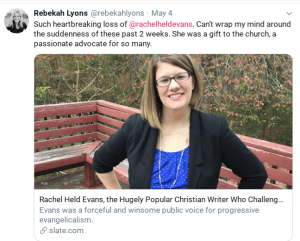
Rebekah called called Rachel Held Evans death “a heartbreaking loss,” and said of her: “She was a gift to the church, a passionate advocate for so many.” If you’re at all familiar with RHE, you know that the people she “advocated” for were female preachers, pro-abortionists, “gay Christians,” mystics, false teachers and just about anyone else who stood diametrically opposed to Scripture and biblical Christianity, while attacking doctrinally sound Christians.

Rebekah also invited Rachel Held Evans and Shauna Niequist to a “Q Focus: Women & Calling” event and participated in a panel discussion with them.

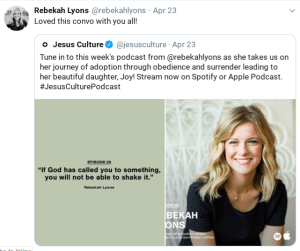
Rebekah preached the Sunday morning sermon (co-ed audience) atย Bethel’s Jesus Cultureย church“, and has appeared on the Jesus Culture podcast. An endorsement from Banning Liebscher, founder/”pastor” of Jesus Culture appears on the home page of Rebekah’s website. Rebekah has also preached the Sunday morning sermon at Bethel itself.

The few citations in this article only scratch the surface of Rebekah’s multiple relationships with false teachers and the false teaching that takes place at Q Conferences and on the Q-ideas website.

Rebekah does offer several free teaching series through her website which I would encourage you to vet if you need to critique her actual teaching. However, considering the way Q’s YouTube channel and website present only a snippet of their tamest teachings while the more in depth or controversial teachings are behind a paywall, take into account the possibility that Rebekah’s free teachings may be less theologically problematic than those you have to pay for.

But, with Rebekah so deeply saturated in ministry partnerships with some of the worst of the worst false teachers, yoking with unbelievers, promoting unbiblical teaching through Q, and preaching to men, do you really need to vet her materials to know that you and your church shouldn’t be associating with her in any way – especially using her teaching materials?